Yes. Anyone who can look at a picture and say what it brings to mind can learn to read tarot, and many people manage a genuinely useful first reading inside a month of honest daily practice. Reading tarot is a learnable skill, closer to picking up an instrument than to receiving a gift, and the entry requirements are a deck, twenty quiet minutes, and a willingness to be wrong in writing.
It is worth saying plainly, once, what the cards cannot do: tarot cannot confirm what another person is thinking, fix a date, or decide an outcome on your behalf. A card is a prompt for reflection. Your skill as a reader is the skill of noticing what the prompt stirs up and then testing it against what you already know to be true.
What follows is what you need on day one, five cards worth learning first in both orientations, the real shape of a first year, the three blocks that stop beginners, a worked example, and a spread for checking your own progress.
These are the five cards this guide uses as a first curriculum, and what each one teaches a new reader:
- The Fool: how to read a picture before you read a book.
- The Hermit: how to study alone without losing your bearings.
- Three of Swords: how to stay calm with a card that stings.
- The Star: how a card can prescribe instead of describe.
- Eight of Cups: how a question bends a textbook meaning.
What you actually need on day one
Three things, and not one of them is psychic ability: a deck whose pictures you like looking at, twenty minutes a day you can protect, and somewhere to write down what you saw.
Start with the deck. Beginners do best with one that puts a full scene on every card, including the numbered ones, because a scene can be read the way you read a photograph: who is here, what are they doing, what sits behind them, how does it make you feel? Beyond that, the only real criterion is whether you want to spend time with its color and mood. A deck you find beautiful gets shuffled. An expensive deck you find cold stays in the drawer.
Then the time. Twenty minutes is not a magic number, but it is long enough to draw a card, look at it before you look it up, and write three honest lines. Frequency beats duration here: four short sessions a week teach you more than one long evening a month, because what you are building is recognition, and recognition needs repetition.
Last, the record. Note the date, your question, the cards, what you thought at the time, and, this is the part most people skip, what actually happened afterward. Three months of that leaves you holding a reference written in your own symbolic language, which will serve you better than any published list of keywords. Our guide to keeping a tarot journal gives you a format to copy if a blank page feels intimidating.
Notice what is absent from that list. No lineage, no initiation, no permission from a teacher, no particular age, no settled belief about how any of this works. Can anyone read tarot cards? Yes, including people who are not sure they believe in it, which is a perfectly ordinary place to start.
Five cards to learn first
You do not need all seventy-eight before your first reading. These five teach the habits that make every other card easier, and each one shows something different about how meaning actually arrives at the table. Read the description, then look at the card itself for a full minute before you decide whether you agree.
The Fool: reading a picture before you read a book
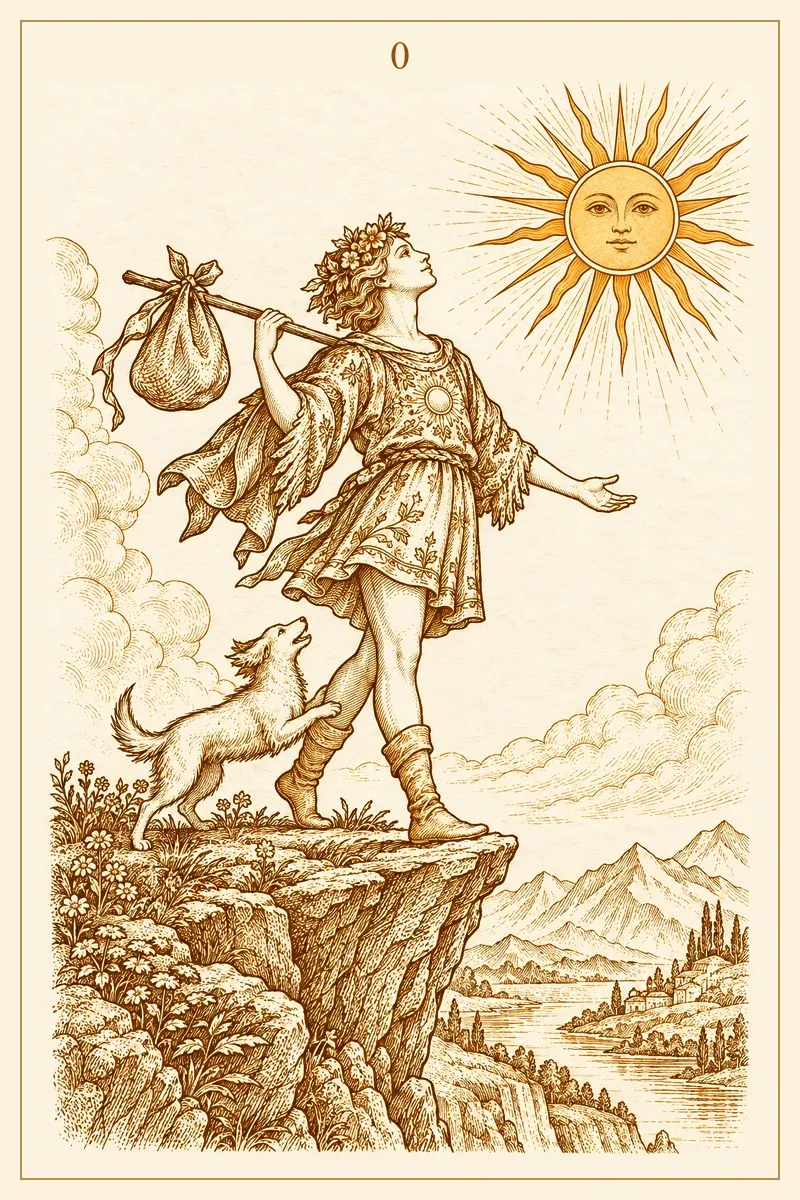
Upright, The Fool is the uninformed beginning: a figure stepping forward with a light pack and no map, trusting that the road will teach him. For a learner the whole lesson sits in that one image. You are allowed to start before you are qualified. The Fool does not know what is coming, and his not-knowing is not a flaw in the reading, it is the subject of it.
Reversed, the same figure can describe a step taken carelessly, or a step refused out of fear of looking foolish. In a question about learning, it often marks the week you decide you are not the kind of person who does this. Ask which version applies: are you rushing past the basics, or standing still because you want to be good before you are willing to be bad?
Practice on this card by describing it out loud with no tarot vocabulary at all, just the figure, the bundle, the edge, the dog, the light. What you said is a reading. The full Fool tarot meaning fills in the traditional associations once you have formed an impression of your own.
The Hermit: studying on your own
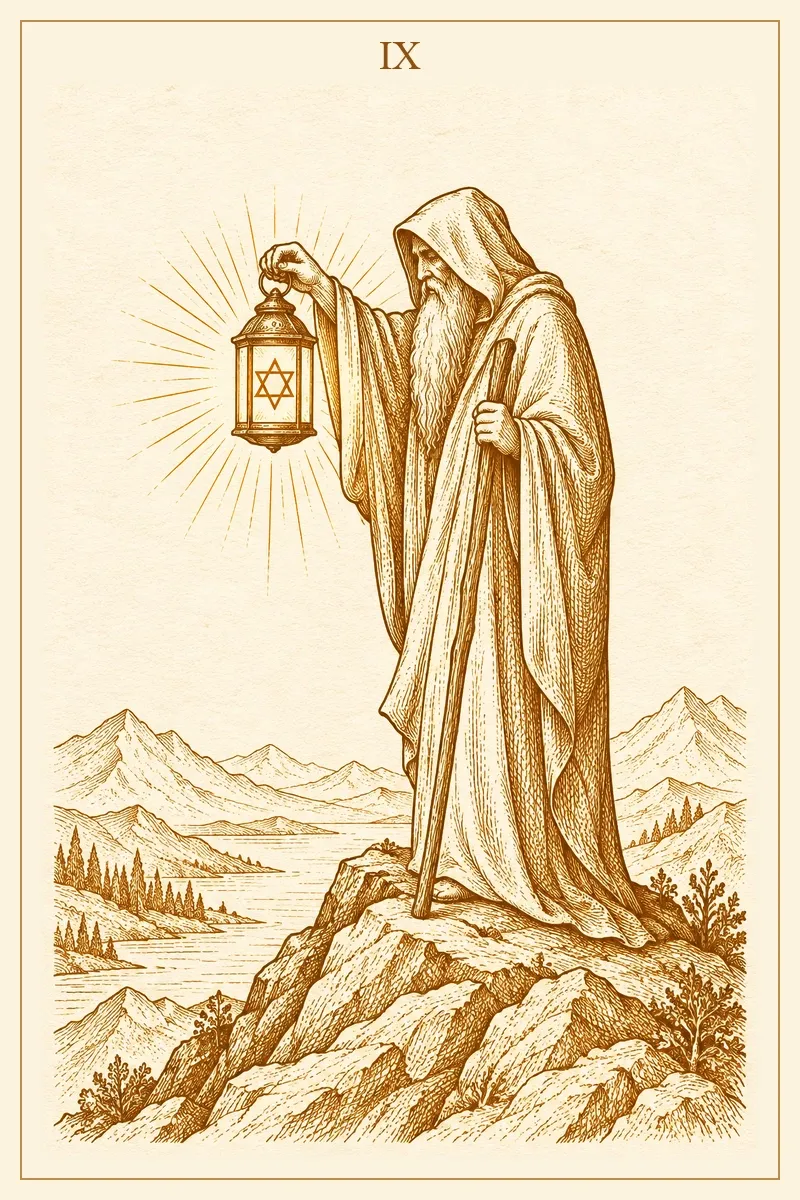
Upright, The Hermit is deliberate solitude with a light in it. He stepped away from the noise not to hide but to see one thing clearly, and his lantern reaches only the next few paces. Most tarot learning happens in exactly this posture: one person, one card, one quiet room, no audience. Slow and alone is a legitimate method, not a consolation prize.
Reversed, he can describe study that has curdled into isolation: endless reading with no practice, or hiding the fact that you are learning because you expect to be laughed at. He can also mean the opposite, so many voices and opinions that your own first response has gone quiet. Ask whether you need more silence or more contact.
Use this card as a check on your routine. If three weeks of study have produced no actual readings, the lantern is pointed at the ceiling rather than the path. There is more in the Hermit tarot meaning.
Three of Swords: staying calm with a card that stings
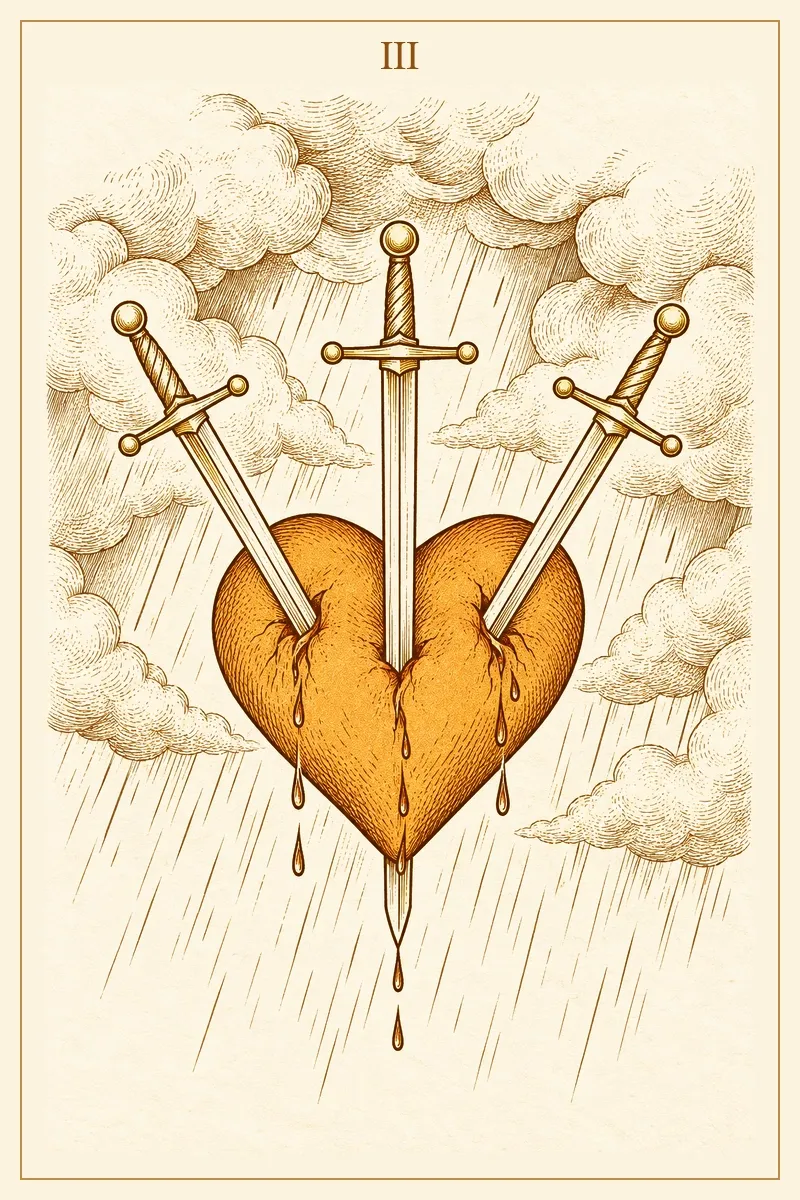
Upright, Three of Swords shows a pierced heart under rain: grief, a painful truth, the sharp clarity that arrives with unwelcome news. Beginners often meet it early and conclude either that they did something wrong or that the deck is unkind. Neither holds. A deck that can only say pleasant things cannot say anything useful, and naming a sorrow is not the same as causing one.
Reversed, it tends to describe pain being managed rather than felt: a recovery that is genuinely underway, or an avoidance that is holding for now. The difference is not in the card. It is in what you already know about the situation, which is your first lesson in evidence. The orientation suggests a direction; your life supplies the facts.
The skill to rehearse here is composure. Describe what the image shows, say one true sentence about your own circumstances, and then stop rather than spiraling. The Three of Swords meaning covers its range across love, work, and grief without turning it into a card to dread.
The Star: when a card prescribes instead of describes
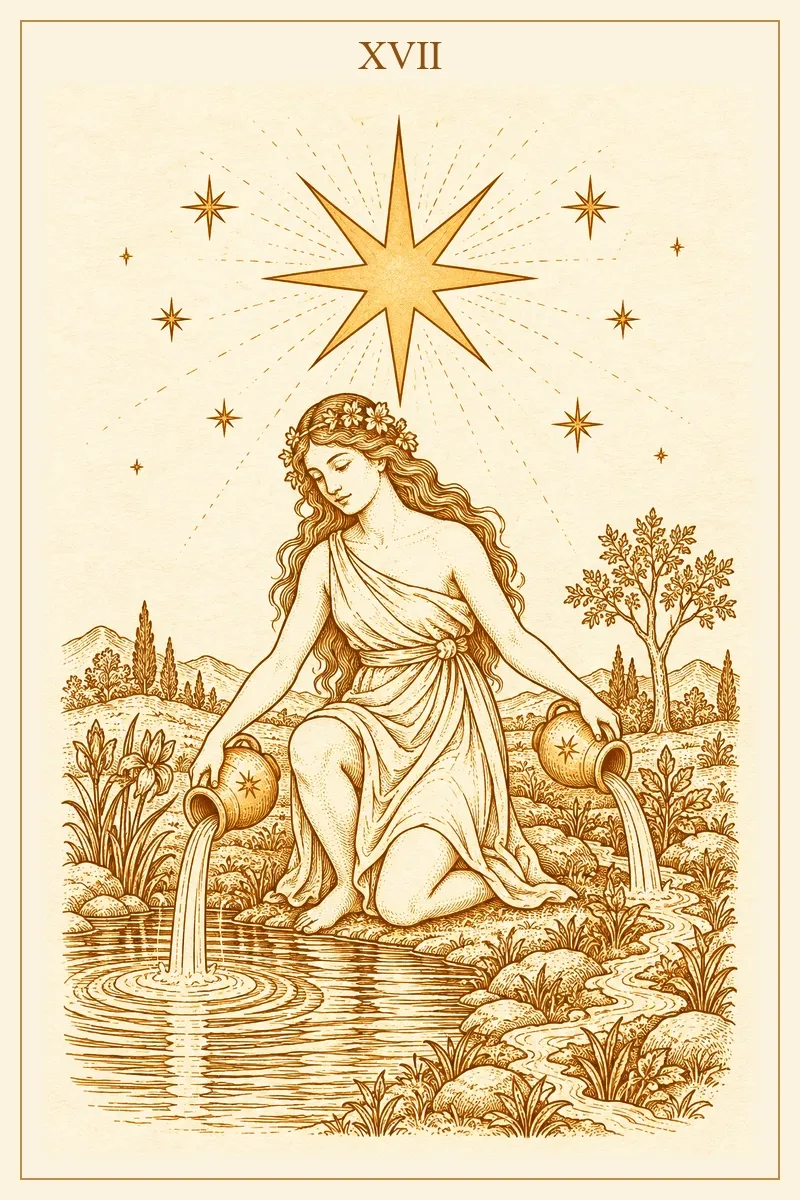
Upright, The Star is quiet hope after difficulty: water poured back into the pool, a sky that has finally cleared. New readers assume a card reports on their day, so they are baffled when this one turns up during a thoroughly miserable week. Often it is not reporting the weather at all. It is naming what the situation needs, and hope is the prescription.
Reversed, it can point to hope worn thin, or to the particular tiredness of someone who has been encouraging everybody else. It does not announce that hope is gone. It asks what would genuinely refill you, in a form small enough to manage this week rather than a grand plan for next year.
For every card you draw, ask both questions: is this describing my situation, or prescribing something for it? That single habit resolves most of the readings you would otherwise file as random. The Star tarot meaning goes further into its renewal themes and its quieter reversals.
Eight of Cups: when a question bends a textbook meaning
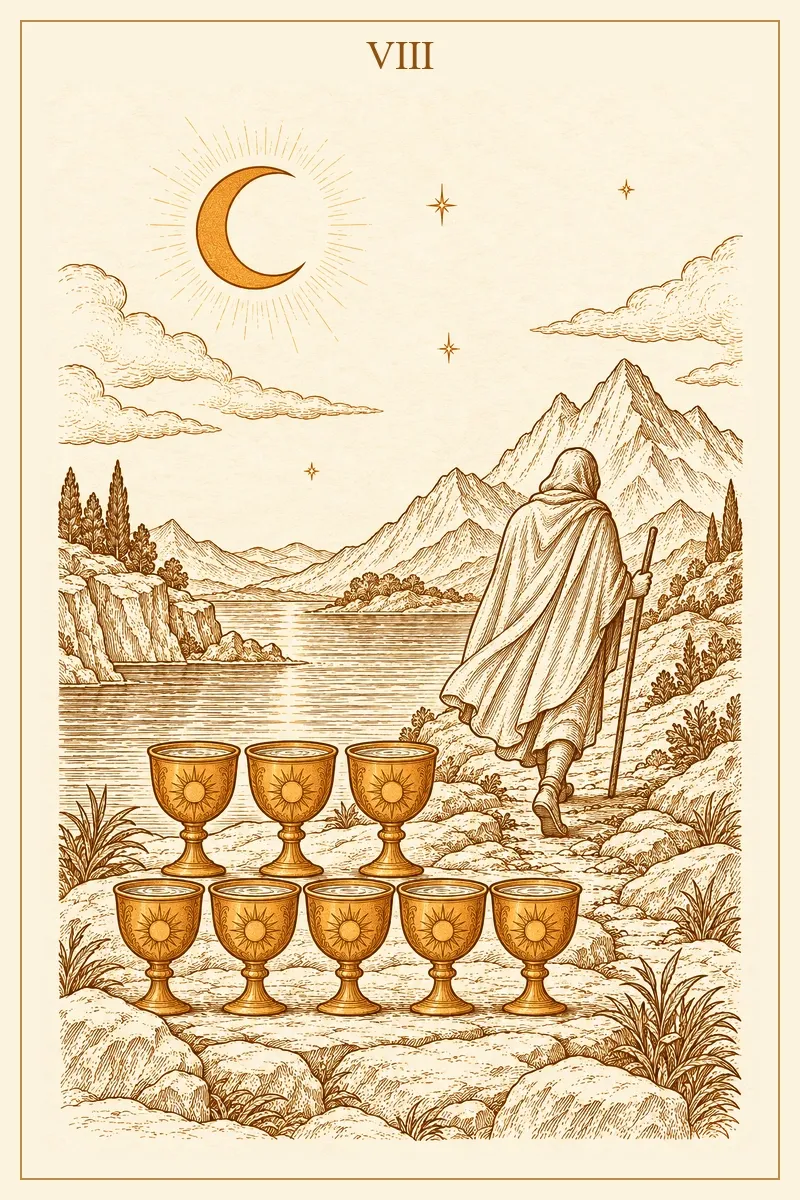
Upright, Eight of Cups shows a figure walking away from eight stacked cups that are, by any outside measure, perfectly fine. It is departure chosen rather than forced, leaving something that works in order to look for something that matters. The traditional keyword is withdrawal, and the traditional keyword is where most beginners stop.
Reversed, the card can show a departure endlessly delayed, circling the same decision, or drifting back toward what you already outgrew. It can just as easily describe someone deciding to stay and repair instead. Context settles it, and context lives in your question rather than in the picture.
That is why this card earns a place on the list. In a reading about a creative project, walking away rarely means abandonment; far more often it means the piece is finished and you are still sanding it. Learn the traditional meanings, then learn to let the question bend them. The Eight of Cups meaning shows how wide a single card's range can be.
What the first year actually looks like
Progress in tarot is not a straight line, and knowing the shape of it in advance keeps the slow stretches from reading as failure.
Month one: the deck feels enormous. Seventy-eight cards, twice that if you count reversals, several meanings each. Do not try to hold it all at once. Work with the twenty-two Major Arcana first, one card a day, and write only what is literally in the frame. If the structure of the deck itself is still unfamiliar, our complete beginner's introduction to tarot lays out the suits, the arcana, and what the numbers contribute.
Months two and three: the memorizing trap. Around now the urge arrives to sit down and commit every keyword to memory, as though fluency were a vocabulary test. Learn the traditional meanings by all means, but hold them loosely. A memorized definition recited over a spread produces a flat reading; the same definition held as one possibility among several produces a conversation. If you catch yourself reaching for the book before you have looked at the card, reverse the order.
Months four to six: the wobble. You will run readings that make no sense, pull cards that feel arbitrary, and conclude that it is not working. This is the stage where many people quit, and it is also the stage immediately before things start to click. The wobble is not evidence of missing talent. It is simply what a half-built skill feels like from the inside.
Months six to twelve: your own voice. Somewhere in here the cards stop feeling like flashcards and start behaving like vocabulary. You notice that a particular card always shows up when you are overcommitted; you stop needing the book for two thirds of the deck; you begin to disagree with published meanings for reasons you can articulate. That disagreement, grounded in your own notes, is what experienced reading actually consists of.
Intuition is built, not inherited
Readers who look naturally intuitive are usually readers who have spent a long time practicing noticing, and noticing is trainable.
What gets called intuition is largely pattern recognition running below the level of conscious attention. It is the same faculty that lets an experienced nurse sense that a patient is deteriorating before the monitors agree, or a musician hear that a note is fractionally flat. When a card gives you a feeling before you have words for it, you are recalling patterns you have absorbed, not receiving a transmission. That is good news, because recall responds to practice.
- One card, every morning. Look at it for sixty seconds before you look anything up, write what you notice, and only then check a meaning. Over a few months your immediate responses will drift closer to the established readings, because you are building the pattern naturally. The one-card daily draw sets out a version that takes five minutes.
- Image first, meaning second. Take any card you have never studied and describe it as a stranger would: the weather, the posture, the colors, what has just happened or is about to. Most of what you say will overlap with the traditional reading, which is the point.
- Keep your first response. The thought that arrives as you turn a card is usually the useful one; the second thought is your rational mind editing for respectability. Write the first one down before the editor reaches it.
- Practice on questions that matter. Attention behaves differently when something is at stake. Read about your own week, your own decisions, your own avoidance, rather than inventing hypothetical scenarios to be safe.
The three blocks that stop beginners
Three reasons come up again and again when beginners give up, and each has a practical answer.
"I will never remember all the meanings." You do not have to. Experienced readers are not reciting definitions; they are looking at a card and responding to what they see, with the traditional meanings as background rather than script. Know the mood of each suit, cups for feeling, swords for thought, wands for drive, pentacles for material life, and the arc of the numbers, aces for beginnings and tens for completions, and you already have enough structure to read with. Our guide to reading tarot intuitively shows how far that framework stretches.
"My readings do not make sense." They do; you are not fluent yet. A sentence in a language you are learning does not stop meaning something because you cannot parse it. When a spread feels arbitrary, photograph it, write the question and the date beside it, and return in a month. Patterns surface in review far more readily than in the moment, and the card that seemed irrelevant is often the one you underline later.
"I am not confident enough to read for anyone else." Good. Overconfidence in a new reader does more damage than uncertainty ever will. Read for yourself first, then for one friend who knows you are learning, and keep your language honest: what I see here is, this might be pointing at, how does that land for you? Confidence arrives as a byproduct of accumulated readings, never as a decision to sound certain.
A worked example: three cards in week three
Here is the kind of reading a learner genuinely does early on, with the thinking left visible. Imagine someone three weeks into daily practice and thoroughly discouraged, who sits down and asks: what do I need to understand about my learning right now? They lay three cards: position one for what is true now, position two for what is in the way, position three for what would help.
Position one, what is true now: Eight of Pentacles. A craftsman at a bench, repeating the same work until it is good. In this position it reframes the last three weeks: not failure, apprenticeship. Twenty-one daily draws is an unglamorous amount of practice, and unglamorous practice is what the card is about. The reader's own note was short: I have done more than I gave myself credit for.
Position two, what is in the way: Ten of Swords, reversed. Upright this card is an ending at its most dramatic. Reversed, in a position about obstacles, it reads well as a story that has been overplayed, the private conviction that this is hopeless and there is no talent here. That conviction is the obstacle, not the evidence. The reversal suggests the drama is already losing its grip, which matches the fact that the person sat down to read anyway.
Position three, what would help: The Empress. Growth that cannot be hurried, and care given generously. As advice it is specific enough to act on: treat the practice the way you would treat something you are growing rather than something you are testing. Fewer verdicts, more watering. Concretely, that meant three lines a day and no self-assessment for a month.
It is worth naming what that reading did not do. It did not promise skill by a given date, rule on whether this person has a gift, or say anything about anybody else. It reorganized a discouraged week into a sentence the reader could act on, which is a realistic account of what a good reading achieves.
A five-card spread for your own learning
Run this once a month, write the positions down before you draw, and resist renaming them halfway through to suit a card you liked. Shuffle on the question: what does my tarot practice need from me this month?
- 1. What I can already do. The skill that has quietly become reliable, even if it still feels small.
- 2. What I keep avoiding. The suit you skim, the reversals you ignore, the question you will not ask the cards.
- 3. What my notes would tell me. Read this one with your journal open; it comments on a pattern you have recorded but not noticed.
- 4. One habit to change this month. A single adjustment, small enough that you will still be doing it in four weeks.
- 5. What I am practicing for. The reason underneath the hobby, which is worth restating as it changes.
Interpret each card strictly inside its position. A difficult card in position two is not a judgment on you; it is a nomination of the thing you have been stepping around. If five positions feels like too much in your first weeks, start with the first, second, and fourth, and build up. Our guide to simple tarot spreads for beginners has smaller layouts worth borrowing.
Frequently asked questions
Is there a best age to start learning tarot?
There is no upper limit and no particular right moment. The only real requirement is enough emotional steadiness to sit with an uncomfortable idea without either dismissing it or catastrophizing, which most people have well before adulthood and keep for the rest of their lives. People who take it up after retirement can learn quickly, because decades of watching how situations unfold is exactly the raw material a reading draws on.
Do I need a teacher, or can I learn on my own?
Both routes work. Many readers are self-taught, using one good book, a daily draw, and a journal, which is enough to reach competence. A teacher or a structured course speeds things up mainly by giving you feedback, which is the one thing solo study cannot provide. If you learn alone, build your own feedback loop by reviewing old entries against what actually happened.
How long until I am actually good?
Many people produce readings that help them within a month of daily practice. Around six months to a year, many feel genuinely capable, meaning they can sit down with a question and trust the process even when the cards are awkward. After that, improvement never really stops, and readers with decades behind them still get surprised.
Can skeptics learn tarot?
Often they make excellent readers. Skeptics ask sharper questions, refuse comfortable answers, and insist that a reading earn its place by being useful rather than by being mysterious. You do not have to settle what the cards are in order to use them well.
Do I have to learn reversals?
Not at first. Many readers work upright-only for their first year and lose nothing, since a card's harder edges are already inside its upright meaning. When you do start turning cards, treat a reversal as a shift in emphasis, something internal, delayed, resisted, or in recovery, rather than as a negative sign. Decide before you shuffle whether reversals are in play, and keep that choice consistent through the reading.
What can a tarot reading not do for me?
It cannot report another person's private thoughts, name a date, or settle a medical, legal, or financial question, and no amount of skill changes that. Those belong with the person concerned or with a qualified professional. What a reading can do is organize your own thinking, surface the question you have been circling, and show you where you have been treating a guess as a fact.
Your first twenty minutes
Pull one card. Look at it before you look it up. Write three lines about what you see and one line about what is happening in your life this week. That is a complete practice session, and repeated often enough it is the whole method.
The only prerequisite is the faint sense that a picture might mean something you cannot quite articulate yet. If you have ever felt that, you have the thing that cannot be taught, and the rest is practice. When you would like a quiet place to begin, try a reading with Veil Soul and write down your first impression before you check a single meaning.