Psychic ability is not a requirement for reading tarot. Reading well is a learnable craft made of four ordinary skills: symbol literacy, pattern reading across a spread, listening to the person in front of you and to yourself, and the habit of asking honest questions. Anyone willing to practice can build all four. What people call "the gift" usually turns out to be attention trained until it moves faster than thought, and that kind of intuition grows with use. Tarot has its limits whoever is holding the deck: a card cannot confirm what another person secretly thinks, fix a date, or settle an outcome in advance. It reflects a situation back so you can see it more clearly.
If you have watched someone turn over three cards and describe a stranger's week with uncanny precision, it is natural to assume they were born with something you lack. This guide walks through what is actually happening in those moments, why the idea of a special gift is so sticky, which skills a good reader really builds, and how to grow the "something extra" that makes a reading land. It includes a worked example and a short practice spread, so you can start today with a standard deck and a notebook.
At a glance, these are the skills that do the work people attribute to psychic ability:
- Symbol literacy: knowing what the images on a card carry and how they shift between upright and reversed.
- Pattern reading: seeing how several cards relate across the positions of a spread.
- Listening: hearing what is said, what is avoided, and what your own first impression is telling you.
- Honest questions: turning a vague worry into a question a card can actually answer.
- Trained intuition: the fast, quiet synthesis that grows out of the four skills above.
What "psychic" usually means at the reading table
When a reading feels psychic, something real is happening; it is simply more human than it looks. Three things are usually going on at once.
Fast, invisible synthesis. A reader takes in a great deal before the first card is turned: the exact wording of the question, a pause before a word, a shoulder that rises when a topic comes close, the fact that someone booked a reading at all. Most of that processing happens below awareness, so the conclusion arrives as a sudden knowing. It is the same mechanism that lets an experienced nurse sense a change before the monitor shows it, or a mechanic hear a fault in an engine note. Nothing supernatural, and a great deal of practice.
Images built for recognition. Tarot pictures are archetypal; they map onto experiences nearly everyone has had. When the Tower appears for a person whose life has just been upended, that is not clairvoyance. The card depicts sudden upheaval, and people in upheaval are exactly the people who seek readings. The deck is a set of mirrors, and a mirror is very good at showing what is already standing in front of it.
Listening that goes past the words. Good readers hear the sentence and the silence around it: the partner described as "fine" in a flat voice, the subject change when a card touches something tender. None of that requires extrasensory perception. It is empathy sharpened by experience, and it is available to anyone who pays close attention.
Put those three together and you get readings that seem to know things. They do know things, but they learned them in the room, from the person, through the cards. Attention is a skill, and skills can be taught.
Why the idea of a special gift is so hard to shake
The belief that tarot requires a gift survives because it is useful to several parties, and you are not one of them.
It builds a gate. If reading requires something you either have or do not, then the people who claim to have it hold authority over everyone else. That serves anyone who wants to seem irreplaceable. It does nothing for the person who could be using tarot for honest self-reflection but feels unqualified to pick up the deck.
It explains what feels inexplicable. When a reading lands with startling accuracy, "she is psychic" is a tidier story than "her attention synthesized a dozen small cues before she knew she had noticed them." We want the magic, and tarot does hold a kind of mystery, but it is the mystery of the mind, which is deep enough without supernatural wrapping.
It gives permission not to start. "I do not have the gift" is a comfortable reason to stay on the sidelines. Beginning means being a beginner, misreading cards, and sitting with uncertainty, and tarot asks for exactly that kind of patience. Quite often the gift myth is a polite name for nerves. The whole question is answered more fully in our guide to whether anyone can learn tarot, and the short version is yes.
The four skills a good reader actually builds
Set the word "psychic" aside and look at what good readers do. Each of these can be practiced on purpose, and each one shows up in the worked example later in this guide.
Symbol literacy
A standard deck is a visual language. Every card tells its story through posture, color, objects, weather and setting. The Eight of Cups says everything about walking away from something that no longer nourishes you without a single word: a figure turned toward the hills, a tidy stack of cups left behind, a crescent moon overhead. Learning that language is the foundation. You do not have to see past the card; you have to see what is in it, and then notice how the meaning shifts when the card arrives reversed, when the same image can describe someone who cannot bring themselves to leave.
Pattern reading across positions
The same card means different things in different positions and for different questions. Death in a career reading tends to describe a role ending so another can form; in a relationship reading, an old dynamic falling away; in a question about self-image, an identity you have outgrown. A reader also watches how cards talk to each other. Three Swords cards in a row sharpen a story about thinking and words; a lone Cup among Pentacles points to a feeling nobody has budgeted for. Reading a spread as a sentence rather than a list of dictionary entries is a skill, and it comes from doing it many times.
Listening, including to yourself
Reading for someone in tears without absorbing their distress, delivering a hard card without softening it into nothing or inflating it into doom, holding uncertainty instead of rushing to a conclusion: this is emotional steadiness, and it develops through practice with people. Listening also turns inward. Your first impression when a card lands is information. It may be right, it may be a projection of your own mood, and part of the craft is learning to tell the two apart.
Asking honest questions
Most weak readings begin with a weak question. "Does he love me?" asks the deck to report on another person's inner life, and gets a vague answer. "What am I bringing to this relationship, and what do I need from it?" gives the cards something to work with. Learning to reshape a worry into a question that can be answered is quiet and unglamorous, and it changes everything. If you want to practice this before you shuffle, browsing a few well-formed tarot questions shows how much the wording does.
Four cards that teach these skills
Some cards describe the reader's work better than any lesson plan. Each one below also carries a reversed reading, which matters here because the reversal often names the exact trap a beginner falls into.
The High Priestess: knowing is attention, not magic
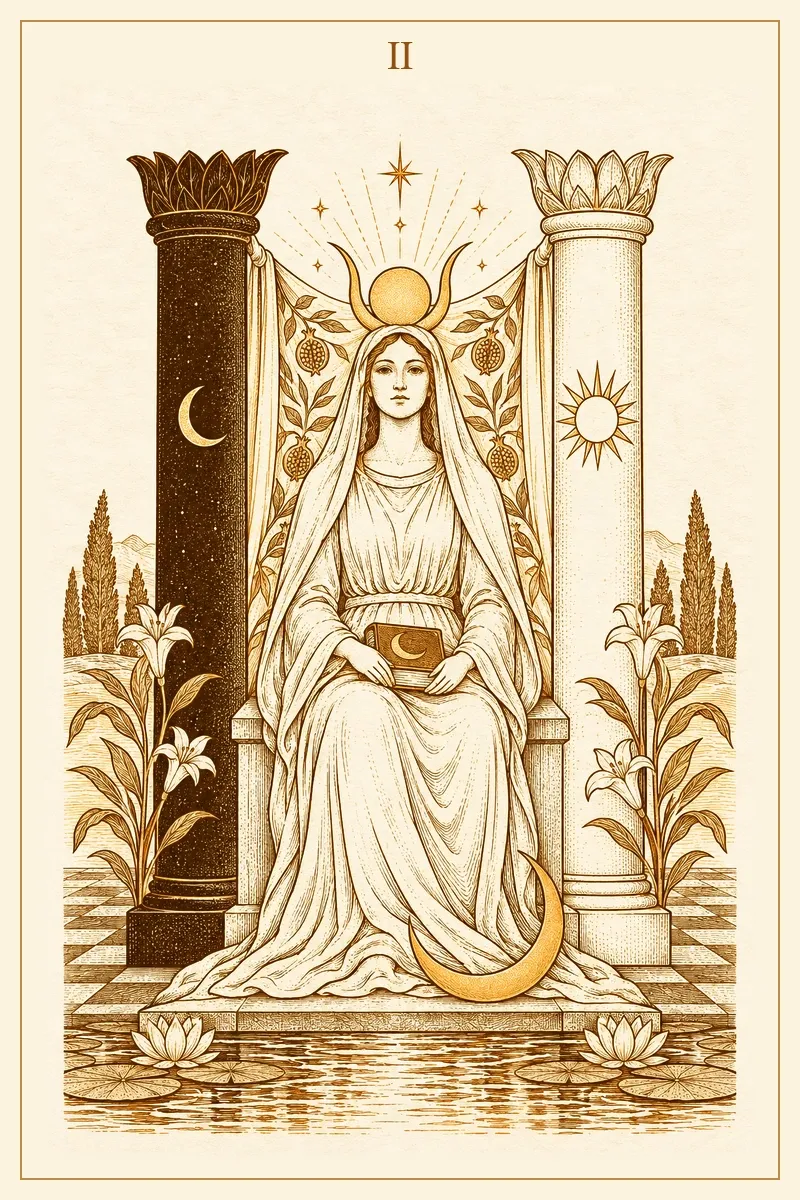
The High Priestess is the card people point to when they say tarot is psychic: a veiled figure between two pillars, a closed book resting in her lap, a crescent moon at her feet. Read closely, she is not performing a trick. She sits still, she holds what she knows without rushing to speak, and she waits for the right question. Upright, she describes the receptive side of reading, the willingness to let a card sit for a breath before interpreting it. Reversed, she points to secrets kept from yourself, or to a reader who claims mysterious insight to avoid saying plainly what the cards show. The full High Priestess tarot meaning explores her in love and career questions as well.
The Moon: working inside uncertainty
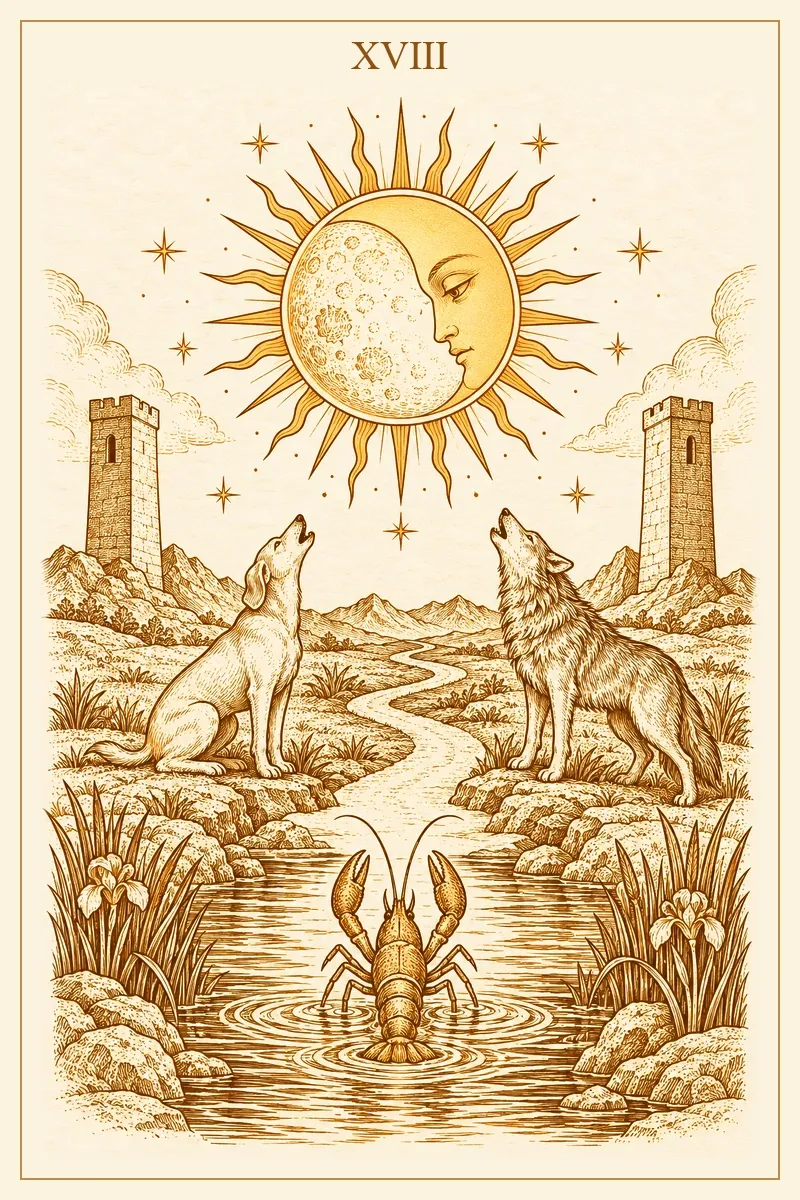
The Moon is the card of unclear ground: a path between two towers, still water, a dog and a wolf howling, a crayfish climbing out of the pool. Beginners fear it because it offers no clean answer, and that is precisely its lesson. A good reader does not need certainty to be useful; they learn to say "this card suggests something is not being seen clearly yet, and here is how we might look at it." Upright, the Moon asks you to trust the slow process of noticing. Reversed, it often marks confusion beginning to lift, or an illusion you are finally ready to name. Our guide to the Moon's meaning goes deeper into both.
The Hermit: patient, private study
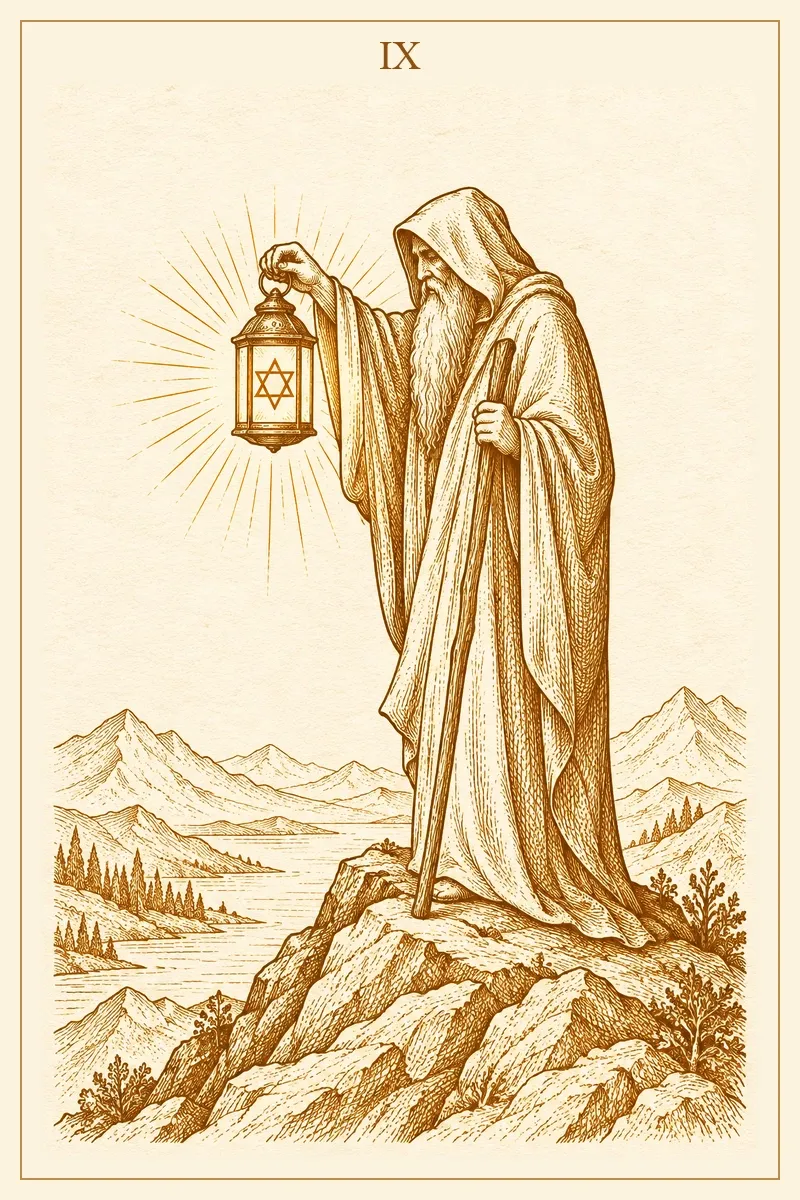
The Hermit stands on a mountain with a lantern and a staff, lighting only the next step. He is the patron of every reader who learned by sitting alone with a deck and a notebook, one card a night, for months. Upright, he describes exactly that: unhurried study, your own lamp, no audience. Reversed, he can show isolation that has gone on too long, the reader who never tests an interpretation on a real person. Both halves are part of learning. The Hermit tarot meaning covers what his lantern illuminates in other kinds of questions.
Eight of Pentacles: craft, repetition, feedback
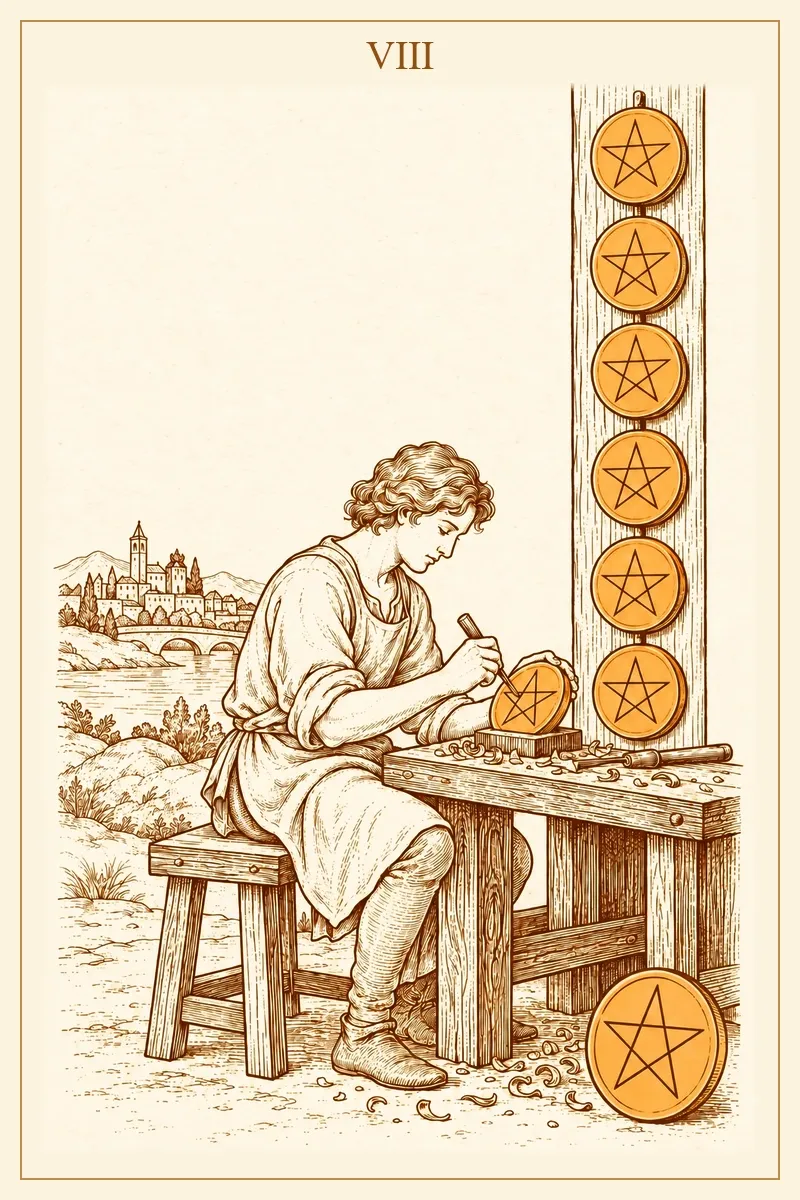
The Eight of Pentacles shows a worker at a bench, carving one coin after another, each a little better than the last. There is no inspiration in the picture, only attention and repetition, and that is the most honest portrait of how reading skill grows. Upright, it is the daily draw, the journal, the fiftieth time you have seen a card and finally notice a detail. Reversed, it warns of practice without reflection, going through the motions while learning nothing, or of perfectionism that keeps you from reading for anyone until you feel "ready." The Eight of Pentacles meaning follows this card into work and money questions too.
A worked example: a reading with no gift involved
Here is how the four skills look in use. The question comes from someone who has studied card meanings for a year and still has not read for another person.
Question: "I know the cards fairly well, but I keep refusing when friends ask me to read for them. What is really stopping me?"
Spread: three cards, read as "the belief I am holding," "what practice has actually shown me," and "the next honest step."
Cards drawn: Seven of Cups in the first position, Three of Pentacles in the second, and Ace of Swords reversed in the third.
The belief: Seven of Cups. Seven cups float in a cloud, each holding a different fantasy: a castle, jewels, a laurel wreath, a shrouded figure. In this position the card describes an imagination full of pictures of what a reader "should" be: mysterious, certain, slightly magical. Symbol literacy notices the fantasy; listening notices that the querent said "really stopping me," which admits that the stated reason is not the true one. The card suggests the obstacle is an idealized image, not a lack of ability.
What practice has shown: Three of Pentacles. An apprentice works on a cathedral while two others review the plans. The card describes skill that improves through collaboration and feedback, and in this position it reads almost as a reminder: you have been doing the work, and the next stage of the work needs other people. Pattern reading notes the shift from the airy, solitary Seven of Cups to a grounded, shared Pentacle. The story is moving from imagining to building.
The next step: Ace of Swords reversed. Upright, the Ace of Swords is one clear thought cutting through fog. Reversed, it tends to show clarity that is present but not yet spoken, a truth held back. Here it suggests the next step is a plain sentence, said aloud: "I am still learning, and I would like to read for you anyway." That reframes the first reading for a friend as practice rather than performance, which is exactly what the Three of Pentacles asked for.
Notice what the reader did. They knew the pictures, they read the three cards as one sentence, they heard the word "really," and they turned a vague fear into a question with an answer. No part of it required anything beyond attention. If you want to see how this kind of narrative reading differs from memorizing keywords, our guide to reading tarot intuitively works through more examples.
A short practice spread: the attention spread
This four-card spread is for you as a reader, not for a problem in your life. Use it once a month to see which skill is growing and which one needs work. Shuffle with the question "where is my attention as a reader right now?" and lay the cards left to right.
- What I already notice. The skill that comes naturally to you. A Cups card here often points to listening and feeling; Swords to pattern and logic; Pentacles to steady study; Wands to energy and the courage to speak.
- What I tend to miss. The blind spot. Read this card as a description of a habit, not a verdict. A Major Arcana card here deserves a slow look.
- The question I am avoiding. The thing you do not ask the cards because you fear the answer or already know it. This position trains honest questioning.
- One habit to practice this week. Keep the answer small and physical: pull a card every morning, write three lines, read for one friend.
Write all four cards in your journal with the date and one sentence each. In three months you will have a record of how your reading has changed, which is far more persuasive than any claim about gifts. If you prefer a guided path, the lessons under Learn build these same skills one step at a time.
Growing the "something extra"
With all of that said, there is a quality in good readings that goes beyond technique. Call it intuition or flow, the moment when the reading becomes more than the sum of its cards. It is real, and it is grown, not granted.
Intuition in tarot is your mind making a leap your reasoning has not caught up with yet. You look at the Empress in a friend's spread and, instead of saying "nurture and abundance," you ask: "When did someone last take care of you, rather than the other way around?" and the question lands hard. That leap did not come from nowhere. It came from tired eyes you registered without comment, a sentence about always being the strong one, the posture of someone carrying weight. Everything was synthesized below the surface and delivered as a sudden knowing.
Five habits make that happen more often:
- Draw one card a day and answer gut first. Say the first thing you see before you open any book, then write it down. Over months your first responses become sharper and more specific.
- Read for real people with real stakes. Practice on hypothetical questions builds technique; a genuine question from a friend activates deeper attention, because something matters.
- Take two quiet minutes before you shuffle. You are not summoning anything; you are lowering the noise so a small signal can be heard.
- Keep a journal and reread it. Return to a reading a few months afterward and note what you saw clearly and what you missed. Patterns seen in hindsight become next time's intuition.
- Name your own state before you read. Tired, anxious, hopeful. A reader who knows their mood can tell a true impression from a projected one.
A longer program for this is laid out in our guide to building tarot intuition, and the groundwork for complete beginners is in what tarot is and how it works.
Frequently asked questions
What about readers who seem to know specific details they could not have known?
Some readers are unusually perceptive, reading tone, pacing and small gestures so quickly that it looks supernatural. A few claim genuine psychic ability, and honesty means admitting that nobody fully understands the mind. You do not have to settle that debate to read well. The cards work for anyone who engages with them attentively, and the skills in this guide are enough to give useful readings.
Will my readings be worse if I am an analytical person?
No. Analytical readers often produce clearer, better structured readings with less dramatic overstatement. Different temperaments bring different strengths: a pattern-minded reader excels at how the positions connect, while a feeling-led reader excels at the emotional tone of a single card. Both styles improve with the same practice.
Can tarot practice develop psychic ability?
Regular practice develops intuition, your capacity to notice and synthesize quickly. Whether you call that psychic is a matter of vocabulary. What is certain is that consistent reading makes you more observant and more comfortable trusting impressions you cannot yet explain, and that is valuable under any name.
Do I need to believe in anything spiritual?
No. Tarot works as a reflective tool, a symbolic language and a structure for self-inquiry regardless of belief. Religious, agnostic and atheist readers all use it well. The deck does not ask for faith; it asks for attention.
What if I look at a card and feel nothing?
That is common, and it passes. Describe the picture out loud, literally: who is in it, what they hold, what the weather is doing. Then ask what someone in that scene might be feeling. Description leads to meaning far more reliably than waiting for a flash of insight, and a reader who can describe can always begin.
Can a skilled reader tell me what another person is thinking, or when something will happen?
No reader can, whatever their skill. A card can show how a situation looks from where you stand and what choices are open to you; it cannot read a third person's mind or supply a date. Treat any reading as a mirror for your own next step rather than a report on someone else's inner life.
Start with attention, not a gift
Do you need psychic ability to read tarot? No more than you need a runner's genes to go for a run. Some people begin with a head start in observation or empathy, and it matters less than you think. The cards respond to attention, to presence and to an honest question, and all three are already available to you. When you are ready to practice, begin a reading with Veil Soul and notice what you see before you look anything up.