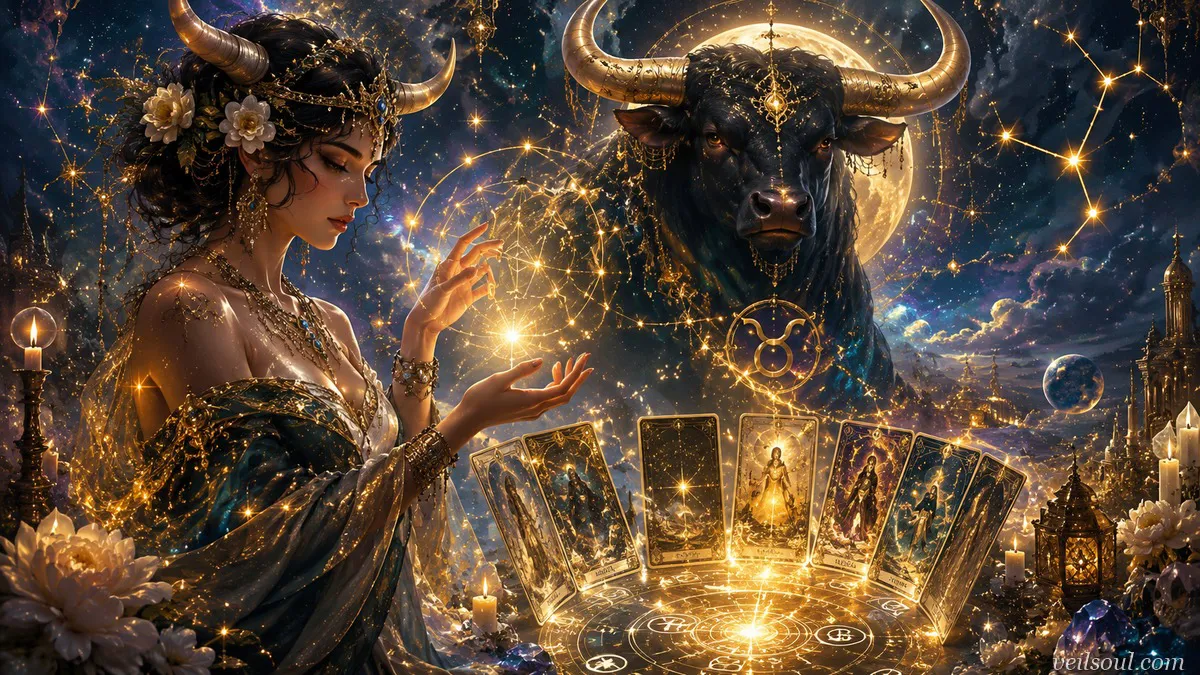
Taurus takes The Hierophant, card V, in the scheme the Golden Dawn set out and most modern decks still follow. Venus rules the sign, which brings The Empress in behind it as the ruler's card, and the three Taurus decans run across the Five, Six and Seven of Pentacles. For the court, most readers hand Taurus the King of Pentacles, and the older degree table agrees for all but the last ten degrees of the sign.
Hold these links loosely. They are questions you can carry into a spread, not a forecast. A card can describe the Taurus mood of a situation — the wish for security, the dislike of being rushed — but it cannot report another person's feelings, fix a date or settle an outcome for you.
Before the detail, here is everything that sits under the Taurus heading:
- The Hierophant (V): the Taurus card; what is worth keeping, and who you learned it from.
- The Empress (III): Venus, the sign's ruler; comfort, growth, worth that is already yours.
- Five of Pentacles: first decan, Mercury in Taurus; the fear of going short.
- Six of Pentacles: second decan, Moon in Taurus; giving, receiving, and who holds the scales.
- Seven of Pentacles: third decan, Saturn in Taurus; waiting for something slow to ripen.
- King of Pentacles: the court card most readers give the sign; provision you can lean on.
- Knight of Swords: the final ten degrees in the old table; the lean toward Gemini.
- The High Priestess (II): the Moon is exalted in Taurus; quiet knowing under the solidity.
- Death (XIII): Scorpio, the opposite sign; the release Taurus tends to resist.
The Hierophant, card V, and the Taurus habit of keeping things
Taurus is fixed earth and the second sign of the zodiac. In the Northern Hemisphere it covers the weeks when the planting is done and the real work is tending, which is the right mood for The Hierophant. The card is not about founding a faith. It is about what gets handed on: a recipe, a trade, a way of doing things that someone taught you because it worked for them.
The Golden Dawn gave this card the Hebrew letter Vav, meaning a nail or hook — the small piece of metal that fastens one thing to another. Taurus is the part of a chart that holds, keeping the lease and the friendship long after a restless sign would have traded them in. That is also where the trouble starts, because a nail pins things in place long after they stop being useful. The opposite sign, Scorpio, carries Death and its necessary release, so the axis asks one question from both ends: what is worth keeping, and what has to go?
The Hierophant: what is worth keeping, and what only looks permanent
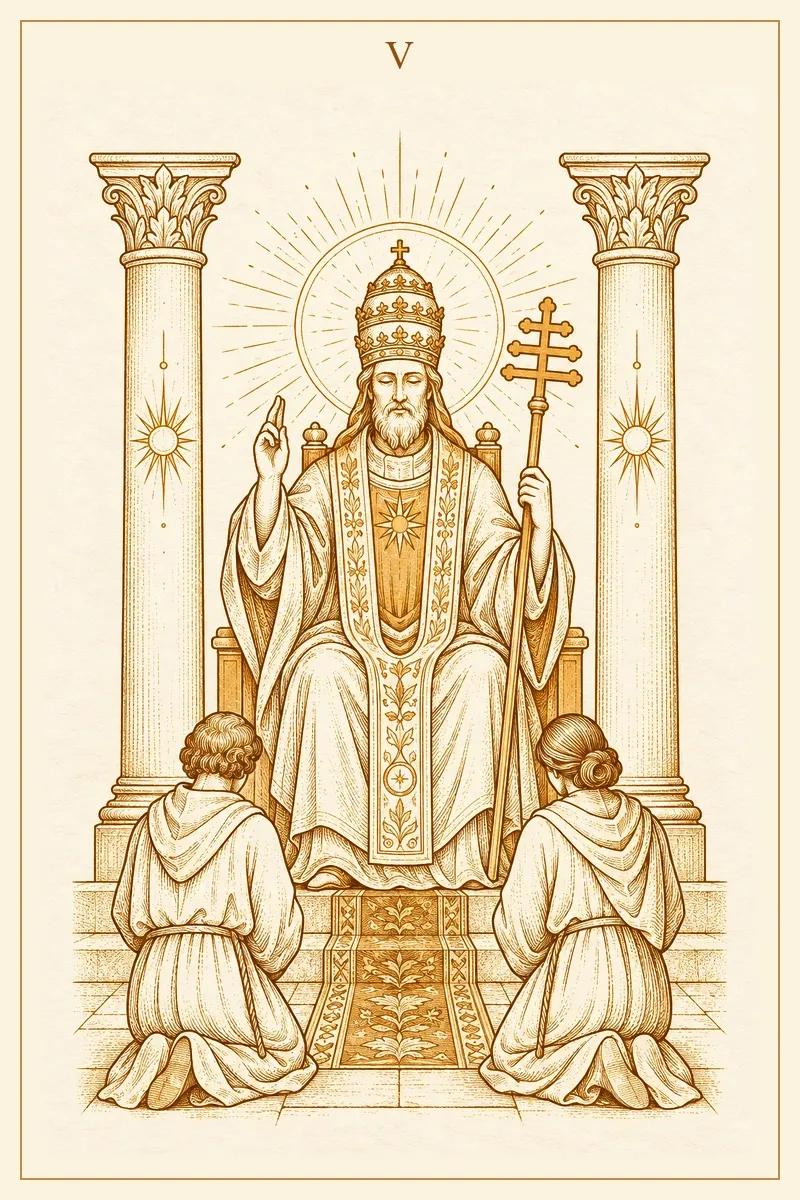
A seated figure in a tall triple crown sits between two carved pillars, one hand lifted in blessing, a long cross-topped staff in the other, and a halo of fine rays behind the crown. Two attendants kneel on the steps below him with their backs to us, on a patterned runner that leads up to the throne. Everything in the picture is transmission: the raised hand, the two who came to learn rather than to invent, the strip of worked cloth joining them to the chair.
Upright, this card points to a structure that is holding you up — a mentor, a course, a contract, a family way of doing things. It often says the sensible move is the conventional one: sign the proper agreement, ask someone who has done this before, follow the method until you know it well enough to change it. In love that means shape and agreement; at work it favors qualification and apprenticeship.
Reversed, it rarely means rebellion for its own sake. More often it is a rule you still obey without remembering who made it, or an authority you have quietly outgrown — the moment you stop asking permission from someone with nothing left to teach you. For this sign the reversal tends to land on inherited beliefs about money and worth. The full range is in our guide to The Hierophant's meaning.
Venus rules the bull, so The Empress stands just behind
Venus rules two signs, Taurus and Libra, and in the Golden Dawn attributions the planet Venus belongs to The Empress. In Libra it works through air: balance, taste, fairness between two people. In Taurus it works through earth, which means through the senses — food, texture, warmth, a body that is fed and rested, money as something you can count rather than argue about. This is the half of the sign a stern Hierophant can hide. Side by side the two cards read properly: a teacher and a garden, one asking what is worth keeping, the other asking whether you are enjoying any of it.
There is a quieter third note. The Moon is exalted in Taurus, and the Moon's card in the same system is The High Priestess. The sign carries an inward, unhurried kind of knowing underneath the solidity, and it usually surfaces as a gut feeling about a person or a price rather than as a vision.
The Empress: comfort, growth, and the worth that is already yours
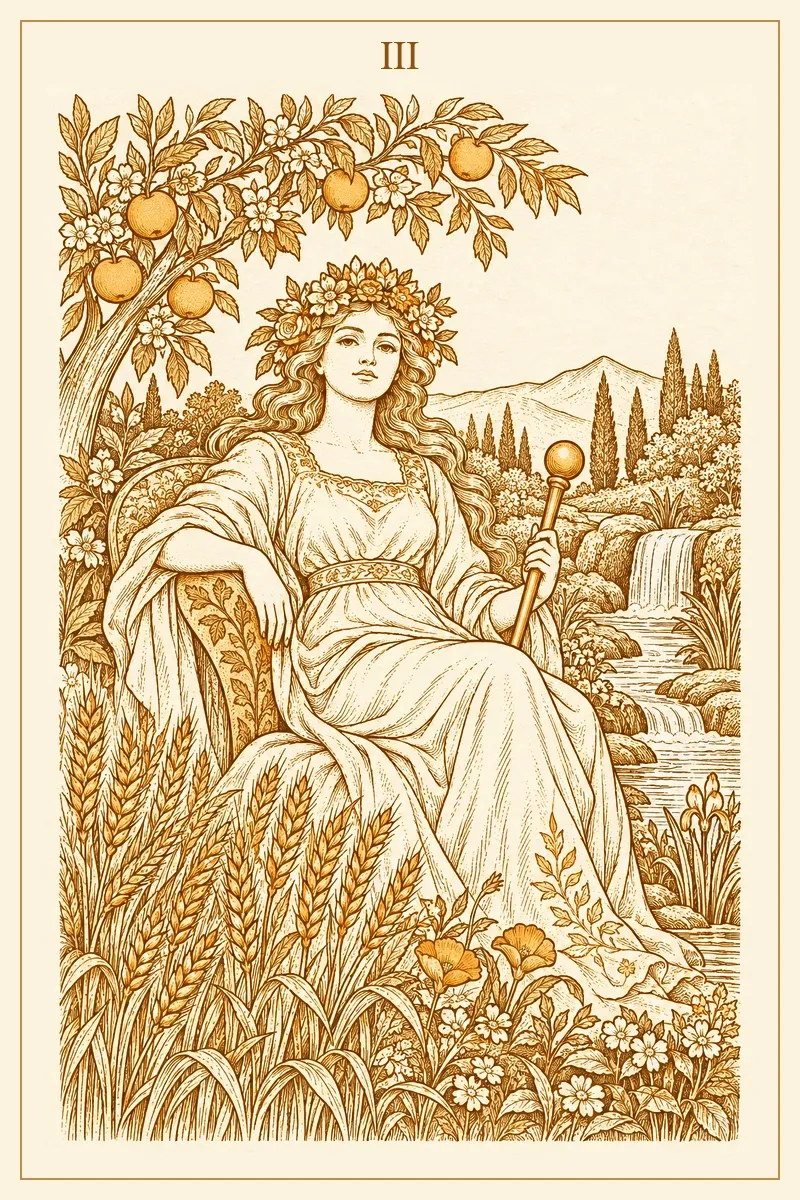
The Empress sits on a cushioned seat in the open air, a crown of flowers in her hair and a short scepter in one hand. An apple tree heavy with fruit leans over her, ripe wheat stands at her feet, and a stream falls over rocks behind her shoulder. Nothing is being forced; things grow because the conditions are right and somebody kept them that way.
Upright, she is abundance you can touch, and a project, relationship or body that is being looked after well. In a Taurus reading she often answers a worth question before a money question: you are allowed to charge for this, rest from this, enjoy this. Reversed, she shows care tipped into smothering, comfort used as an anesthetic, or a partnership where one person does all the nurturing and calls it love. Our piece on The Empress tarot meaning follows her through love, money and creative work.
Ten degrees at a time: the Pentacles from Five to Seven
A sign is thirty degrees wide. The Golden Dawn cut each one into three ten-degree decans and gave every decan a planet and one numbered card. Taurus belongs to the earth element, so its decans fall in Pentacles, the suit that carries earth through the whole deck.
The planets follow the old Chaldean order, which for Taurus produces Mercury, then the Moon, then Saturn. One detail often gets lost: the Golden Dawn's own table does not begin at Aries. It starts the cycle at the first degree of Leo, which is why the numbered cards never line up with the zodiac as neatly as beginners expect. Treat the dates below as approximate, since the Sun reaches each degree a day earlier or later depending on the year.
Five of Pentacles: Mercury in Taurus, about April 20–30
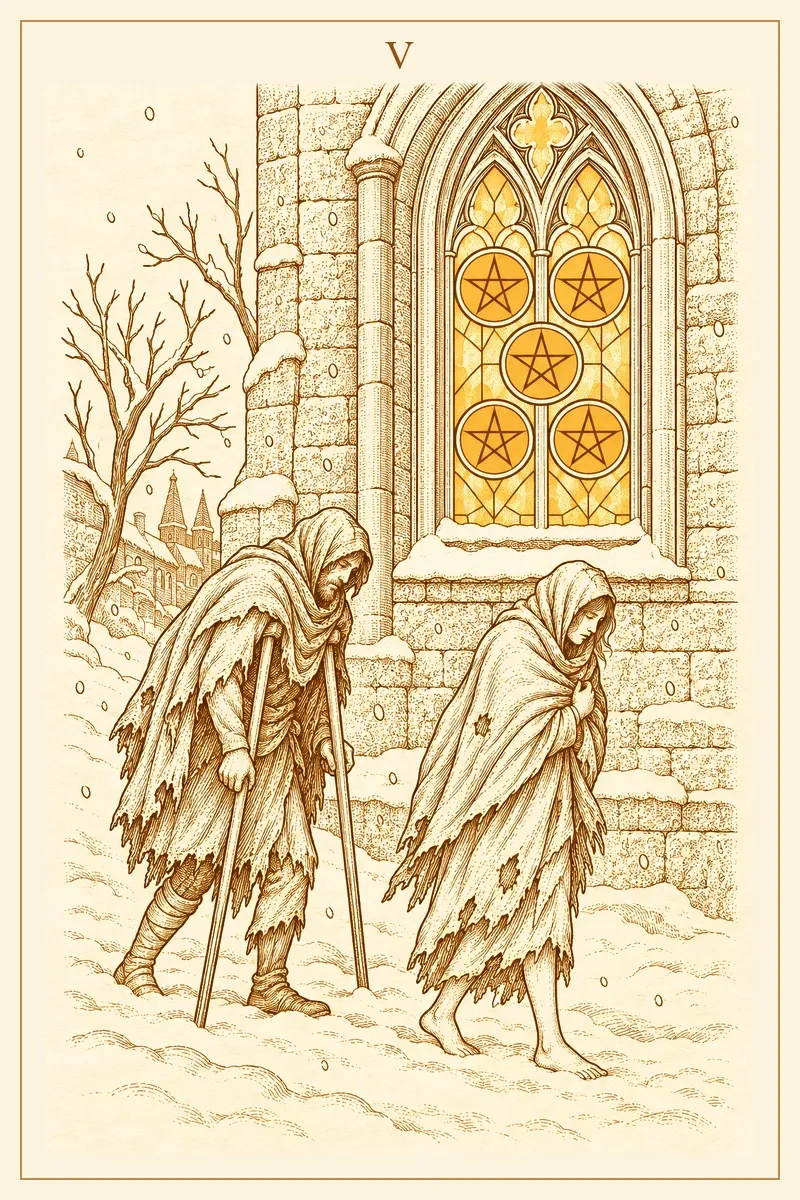
Its Golden Dawn title is the Lord of Material Trouble. Two figures move through the snow beneath a lit window, one on crutches and the other wrapped against the cold, and neither looks up at the light above. Mercury is the quickest planet set loose in the slowest sign, and the combination reads as worry: a mind running ahead, counting what might run out.
Upright, the card is hardship, or the fear of it, together with help that is closer than it looks. Early in the season it often marks the scarcity reflex rather than actual scarcity — the person with savings who still cannot buy the better shoes. In love it can be two people going through a lean stretch together, or one of them too proud to say so; at work it points to undercharging and to jobs taken out of fear.
Reversed, it usually shows the thaw: asking for help at last, the end of a hard season, or the realization that you have been standing outside a door nobody locked. The Five of Pentacles meaning goes through the card position by position.
Six of Pentacles: Moon in Taurus, about May 1–10
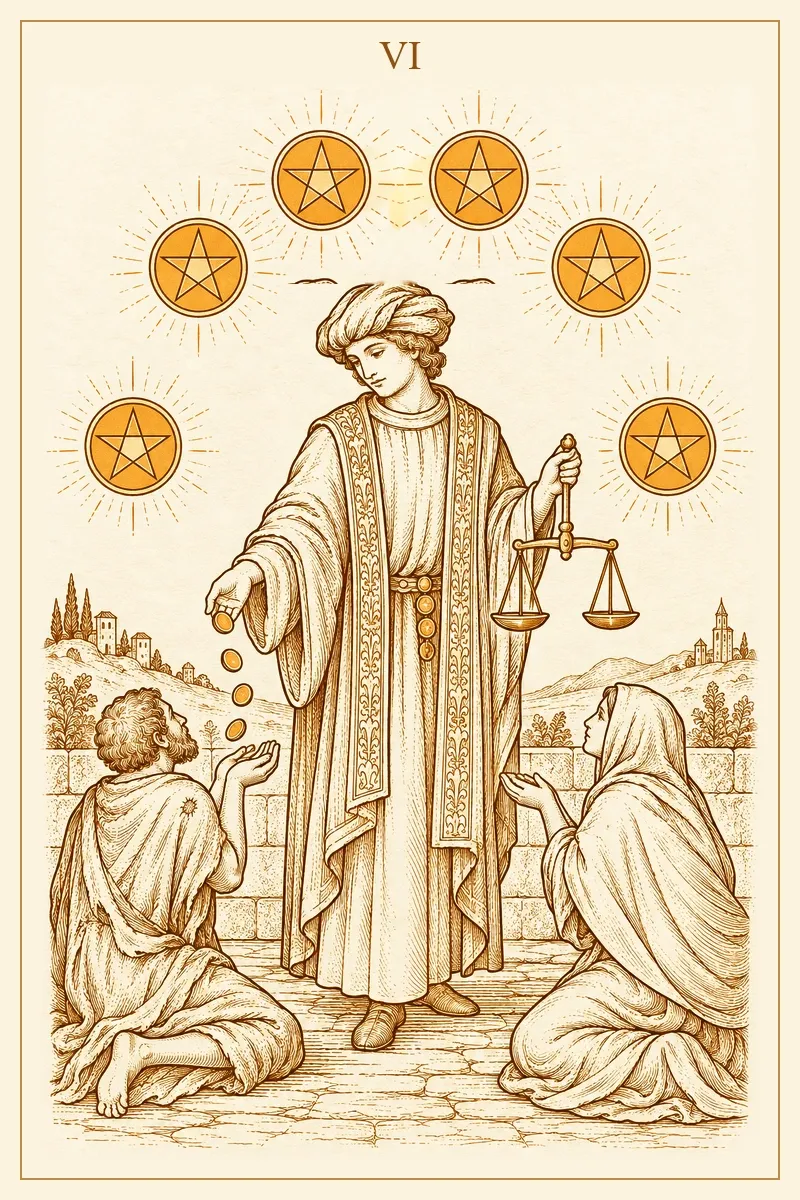
The Golden Dawn called the second decan card the Lord of Material Success. A standing figure holds a balance scale in one hand and lets coins fall into the palms of two kneeling people with the other. The Moon is exalted in this sign, which is part of why this stretch is the warmest of the three: giving and receiving feel natural here rather than transactional.
Upright, it is generosity that actually reaches someone — a loan, a fair wage, a mentor's time, a gift with no hook in it. The scale still matters, because somebody in that picture is deciding how much. Reversed, that is exactly the question it raises: giving with strings attached, help used as leverage, a lopsided arrangement neither partner has named aloud, or your own long habit of being the one who always pays. There is more in the Six of Pentacles tarot meaning.
Seven of Pentacles: Saturn in Taurus, about May 11–20
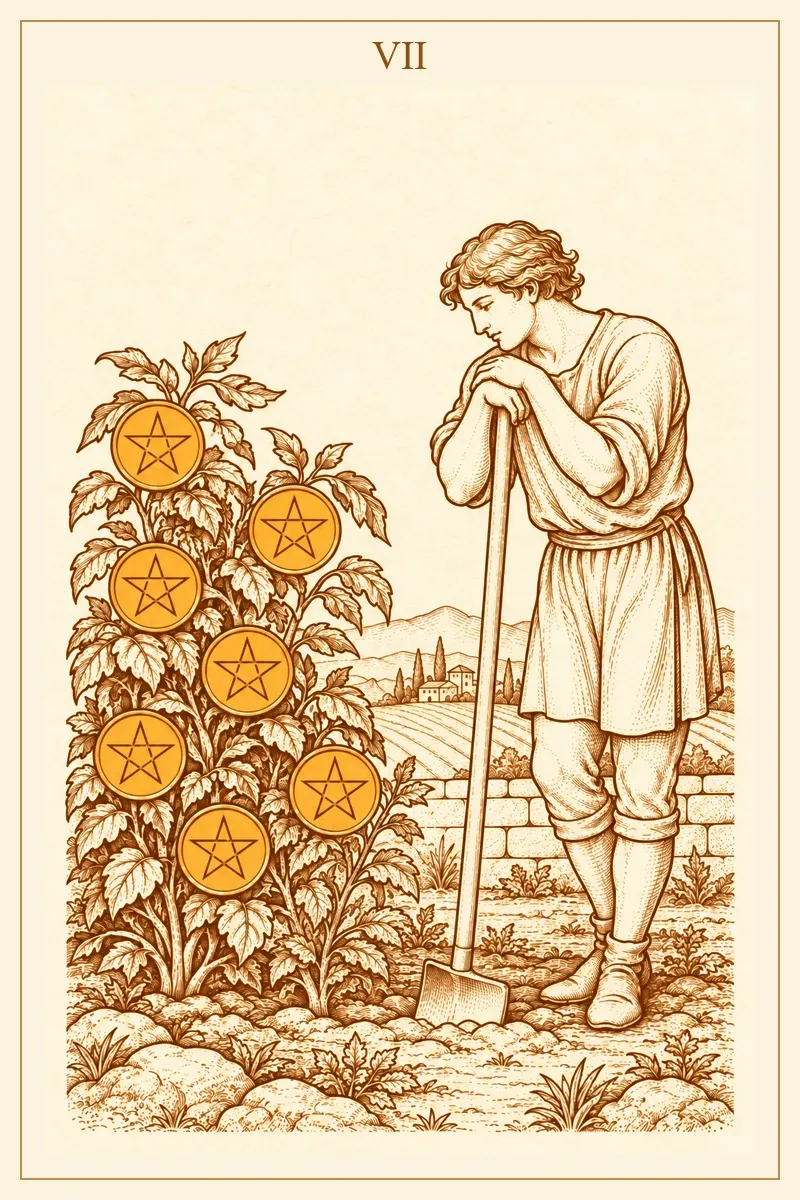
In Book T this card is the Lord of Success Unfulfilled, which sounds harsher than the image deserves. A young man leans on his tool and studies seven coins growing on a leafy bush. He has not failed at anything; he has arrived at the part where nothing visible happens for a while, and Saturn, the planet of time and limits, is a fitting ruler for that stage.
Upright, it asks for a particular patience: not endurance, but honest assessment. Is this crop still growing, or am I watering something that died in March? In love it is the relationship that needs time rather than a decision; at work it is the long project at its least rewarding point. Reversed, it can be impatience, the urge to pull up the plant and look at the roots, or the opposite failing — waiting out of habit for something that has clearly stopped moving. The Seven of Pentacles meaning looks at both sides of that wait.
Two court cards cover the Taurus degrees
The court cards are the messiest corner of tarot astrology, and the honest answer comes in two halves. The modern shorthand gives Taurus the King of Pentacles, on the straightforward grounds that he is the earthy, settled, well-provided figure of the deck. The older system is more precise and uses different names.
In the Golden Dawn scheme each of the three senior court figures covers thirty degrees, running from the twentieth degree of one sign to the twentieth degree of the next. The titles are not the ones printed on a modern deck: the Golden Dawn's King is the mounted rider most decks now call the Knight, and its Prince is the seated figure most decks now call the King.
With that translation in hand, the Prince of Disks — the card you know as the King of Pentacles — runs from twenty degrees of Aries to twenty degrees of Taurus, so he holds two thirds of the sign. The last ten degrees belong to the Golden Dawn's King of Swords, which modern decks print as the Knight of Swords, and that card carries on into the next sign. The common answer and the old table therefore agree about most of Taurus. If you were born in the final days of it, the quick, argumentative Knight may fit you better than the settled King, and the Gemini tarot correspondences will sound more familiar than you expect.
King of Pentacles: provision, and the point where it locks
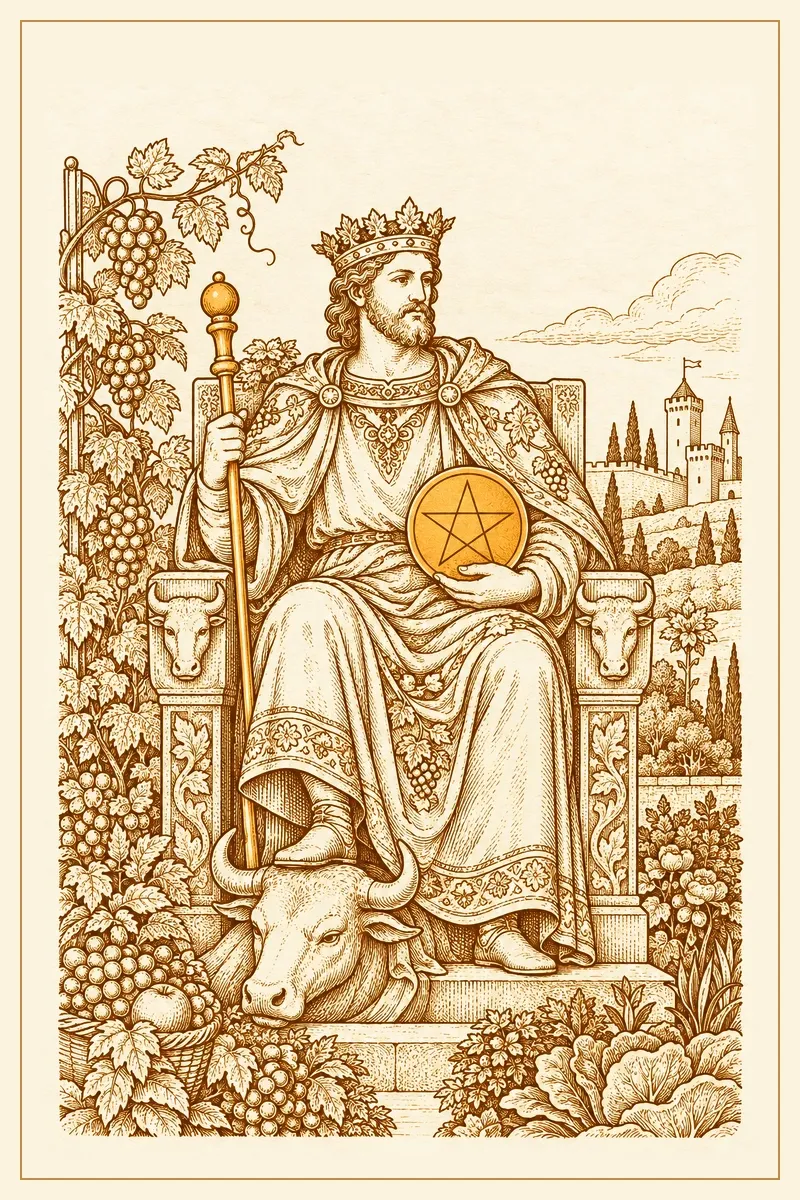
He sits in a garden rather than a hall, grapevines crowding the throne, one hand on a scepter and the other cradling a large coin against his chest. Bulls' heads are carved into the arms of his chair, and a live bull lies on the step at his feet. He is the only king in the deck who looks as though he would rather be outside.
Upright, he is reliability made into a person: someone who pays on time, finishes what they start, and quietly carries other people's security along with their own. As energy rather than a person, he asks for the boring competent move — the proper contract, the spreadsheet, the maintenance you keep postponing. In love he is steady and physically present, the partner who shows affection by doing things.
Reversed, that solidity sets hard: money hoarded instead of used, stubbornness dressed up as principle, status measured by what is owned, or a provider who gives everything material and nothing emotional. The King of Pentacles meaning covers him as a person and as a situation.
Reading the Taurus cards about money, the body and self-worth
A correspondence only earns its place when it changes how you read an actual spread. These are the four angles where the Taurus cards tend to do real work.
Worth comes before money
The Taurus sequence is a worth story told in coins: the Five is the fear of not having enough, the Six is the question of what an exchange is really worth, and the Seven is the patience to let value accumulate. When two of them turn up in a money reading, the useful question is usually not whether you will have enough but what you have decided you are worth. Pair them with the Four of Pentacles and you get the grip; pair them with the Nine of Pentacles and you get the version where the grip has relaxed and the garden is still there.
In love, and in the body
Taurus in love is slow, physical and loyal to the point of inconvenience. The Hierophant asks about form: are the two of you agreed on what this is? The Empress asks about comfort: is there pleasure in it, or only maintenance? And because this is an earth sign, the body belongs in the reading. Sleep, food and touch are not side issues here; they are frequently where the honest answer shows up first.
At work: craft rather than speed
These cards favor mastery over momentum. The Eight of Pentacles is not one of the Taurus decans, but it belongs to the same conversation: the plain repetition that turns a job into a skill. If the Seven of Pentacles answers a career question, it is rarely telling you to change direction. More often it says the direction was fine and the timeline was wrong.
Timing: what these cards suggest about when
Readers who work with astrological timing treat the decan cards as rough date ranges — the Five for about April 20 to 30, the Six for the first third of May, the Seven for the middle of the month — and fixed signs as slower than you would like but durable once they arrive. That is a convention rather than a measurement, and no card names a day. If you want to use the method carefully, tarot timing with astrology sets out how far it can honestly be pushed.
Five cards for the slow build: a Taurus season spread
This layout suits any question about money, worth, a long project, or a body you have been neglecting. Deal five cards in a row from left to right, so the shape reads like a season moving forward rather than a verdict handed down.
- Ground: what is genuinely solid right now, whatever else is shaking.
- Root: what has quietly been feeding this situation, for better or worse.
- Weight: what you are still carrying that no longer earns its keep.
- Ripening: what needs more time rather than more effort.
- Harvest: the one thing that is ready to be taken in now.
Read Ground and Harvest together first. If both are Pentacles, the question is practical and so is the answer. If Harvest is a Cup or a Wand while Ground is a Pentacle, what is ready to be collected may not be money at all. Leave Weight until last: it is the position where a reversed card is most often a relief rather than a warning, because something heavy is already loosening.
Worked example: two years at the market, the same prices
Imagine a potter asking in early May: "I have sold at the same weekend market for two years and never raised my prices. Should I raise them now?"
- Ground: Eight of Pentacles. The skill is not in question. Two years of repetition have made her work better than it was, and that is the floor she is standing on.
- Root: Five of Pentacles reversed. The habit of low prices grew out of a lean period that has already passed. The cold stretch is behind her, even if the reflex is not.
- Weight: Four of Pentacles. She holds the old price list the way the figure on that card holds his coins — not out of greed, but because letting go of a known number feels like risk.
- Ripening: Seven of Pentacles. Part of what she makes is still finding its audience. Those pieces need another season, not a discount.
- Harvest: Six of Pentacles. The scales again. For two years she has given more than she has taken, and the terms of the exchange are ready to be set differently.
Read as a whole, this is not a forecast of sales. It describes a mismatch: the skill has grown, the fear has not been updated, and the price still reflects the fear rather than the work. What the spread does is narrow the next move to something she can actually do — raise the price on the one line she is surest of, leave the rest alone for six market days, and write down what sells.
Practices that suit the bull's pace
- Name one thing you are keeping out of habit rather than value, and decide whether it stays.
- Look at one price you set for your own work or time, and ask when you last changed it.
- Draw a single card for your body rather than your plans, and read it literally: rest, food, movement.
- If the Five of Pentacles appears, ask who you have not told that things are tight.
- If the Seven of Pentacles appears, pick a date to assess instead of deciding today.
- Finish one small, physical, unglamorous thing you have postponed — the repair, the filing, the appointment.
Frequently asked questions
What tarot card represents Taurus?
The Hierophant, card V, is the Taurus card in the correspondences most modern decks still use. Venus, the sign's ruler, adds The Empress; the three decans are the Five, Six and Seven of Pentacles; and the King of Pentacles is the court card most often paired with the sign.
Is the King of Pentacles the Taurus court card?
For most readers, yes, and the older table largely supports it. In the Golden Dawn spans, the card modern decks print as the King of Pentacles covers twenty degrees of Aries through twenty degrees of Taurus. The final ten degrees belong to the card those same decks call the Knight of Swords, which continues into Gemini.
Which cards are the Taurus decans, and what dates do they cover?
The Five of Pentacles with Mercury, roughly April 20 to 30; the Six of Pentacles with the Moon, roughly May 1 to 10; and the Seven of Pentacles with Saturn, roughly May 11 to 20. Each boundary shifts by about a day from year to year.
Does The Hierophant mean religion when it appears for a Taurus?
Sometimes, but far more often it means any inherited structure: a mentor, a qualification, a contract, a family rule about money, a trade learned from someone who already knew it. Read it as what was handed to you before you read it as a church.
Why is Venus's card The Empress rather than The Lovers?
In the Golden Dawn attributions the planets and the signs get separate cards. Venus the planet is The Empress, while The Lovers belongs to the sign Gemini. Taurus therefore draws on The Empress through its ruling planet, not on The Lovers.
Can the cards tell me how Taurus season will go, or what a Taurus is feeling?
No. Tarot is a way of thinking a situation through, not a channel into somebody else's head. It cannot confirm another person's feelings, fix a date or decide an outcome for you. Use it to get clear about what you want and what is within reach, then act on what you actually know.
What the bull is actually guarding
Underneath the famous stubbornness, Taurus is protecting something simple: the right to have enough and to enjoy it without apologizing for it. The Hierophant asks what is worth keeping, The Empress asks whether any of it is being enjoyed, and the three Pentacles mark the distance between fearing scarcity and trusting a slow harvest. If a question of your own has been waiting for the right week, a calm Veil Soul reading is a steady place to begin.