Pisces closes the zodiac, and tarot hands it the card that asks you to move without clear sight: The Moon, Major Arcana XVIII. The sign's three decans sit on the last three cards of the Cups suit, the Eight, Nine and Ten, and two court cards cover its borders. Jupiter, the older of its two rulers, adds the Wheel of Fortune.
Those cards describe a mood and a set of questions. They cannot confirm what someone else is privately feeling, fix a date, or settle an outcome that still depends on choices nobody has made yet. What a Pisces card does well is name the thing you have been sensing for weeks and turn it into a question clear enough to answer.
At a glance, this is the Pisces shelf of the deck:
- The Moon (XVIII): the sign's Major Arcana card, half-light, instinct, and the work of telling insight apart from fear.
- Eight of Cups: first decan, Saturn in Pisces, leaving something that was good enough.
- Nine of Cups: second decan, Jupiter in Pisces, contentment and a wish you can finally say out loud.
- Ten of Cups: third decan, Mars in Pisces, belonging that someone has to keep building.
- Knight of Cups: the court card over the first twenty degrees of Pisces, feeling in motion.
- Queen of Wands: the court card where Pisces turns into Aries, warmth with a spine.
- Wheel of Fortune: Jupiter's card and the sign's older ruler, the part of the timing you do not control.
Mutable water, and why that shape matters
Pisces runs from about February 19 to March 20. Water in tarot is the suit of Cups: feeling, attachment, imagination, everything you register before you can explain it. Mutable is the modality of the end of a season, built to adapt rather than to start or to hold. Together they produce the quality readers notice here, because Pisces cards tend to describe a situation that is already dissolving rather than one you are being asked to defend.
The three water signs divide the element between them, and the deck keeps that division tidy. Cancer opens the element and holds the early Cups, Scorpio takes the middle of the suit and its harder lessons, and Pisces takes the last three and closes it. By the time the suit arrives here the question is not how to feel something, but what to do with everything you have already felt.
The Moon, and the two planets behind the sign
Most modern decks inherit their astrology from the Golden Dawn, and in that system Pisces is The Moon, the eighteenth trump, carried on the Hebrew letter Qoph. The sign's rulers add two more cards to the picture, one of which exists and one of which does not.
The Moon (XVIII): seeing by a different light

Most versions show the same landscape: a pool at the bottom of the image, a creature climbing out of it onto a path, a dog and a wolf raising their heads, two towers either side of the road, and above them a crescent face held inside a rayed disc. Nothing is lit well enough to be certain about, and that is the point.
Upright, The Moon says the information you are working with is partly yours and partly imagined, and you cannot yet tell which is which. It often arrives when a situation has gone quiet: a reply that has not come, a result you are waiting on, a relationship where everyone is being careful. Keep walking without pretending you can see the end of the path, and check your night vision against something solid in daylight.
Reversed, it usually describes the moment the fog lifts, or the moment you stop feeding it. A worry you have rehearsed turns out to have a plain explanation, or you decide to ask a question directly instead of reading the silence. It can also warn that you are talking yourself out of a true instinct because acting on it would be inconvenient. For anyone born under the sign the card is a mirror rather than a prediction, and the full Moon tarot meaning goes further into its symbols.
Jupiter and Neptune: an old ruler with a card, a new one without
Before Neptune was discovered, Pisces answered to Jupiter, and Jupiter's trump is the Wheel of Fortune. That inheritance is useful: the Wheel brings in the idea that circumstances turn on their own schedule, and that a Pisces question is often less about effort than about when to let a cycle finish.
Neptune, the modern ruler, has no card of its own. The attributions were built on the seven planets visible to the naked eye, so nothing in the deck was ever assigned to it. Readers who want a Neptune feeling reach for The Hanged Man, the trump given to the element water, whose suspended quality sits close to what Neptune describes. Treat that as a resonance you have chosen rather than an attribution the system hands you.
The Cups close on Pisces: the three decans
Each sign divides into three decans of ten degrees, and the thirty-six numbered cards from two to ten are laid around the circle in order. The sequence starts at the beginning of Leo with the Five of Wands, which is why the suits fall where they do. Follow it round and the Cups land on the three water signs in order: the Two, Three and Four on Cancer, the Five, Six and Seven on Scorpio, the Eight, Nine and Ten on Pisces.
A decan card is a seasonal lens, not a horoscope. Read it as the card first and the date second: the sub-ruling planet tells you what pressure the card is under.
Eight of Cups: Saturn in Pisces, about February 19 to 28
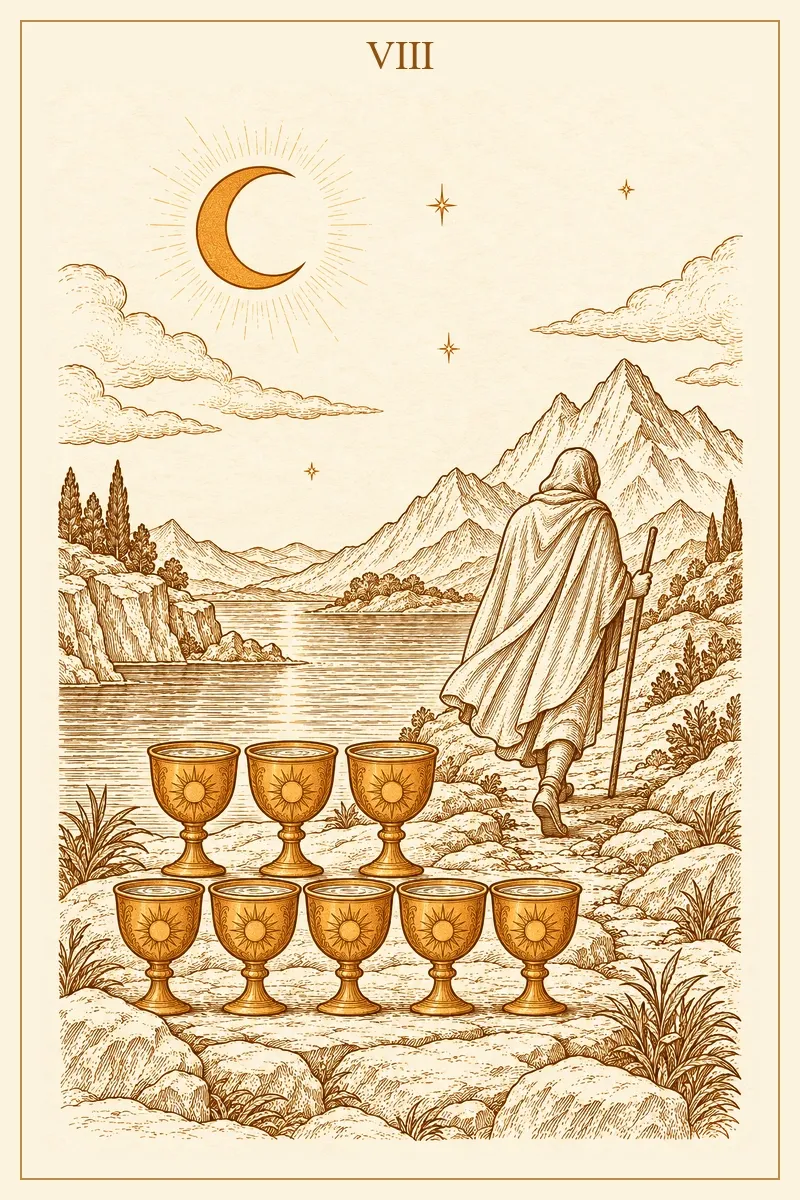
A figure walks away from a neat row of cups toward high ground, under a moon that is losing its light. The old title is the Lord of Abandoned Success, which is sharper than most modern readings, because the cups being left behind are not broken. Saturn, the sub-ruler, is the planet of limits, and it gives the softest sign its most deliberate card.
Upright, this is the decision to leave something that still works: a job that pays, a group of friends you have outgrown, a version of a relationship that is comfortable and finished. Saturn's contribution is that the departure has a cost attached and a destination you have thought about.
Reversed, it describes the long hesitation before the walk, or a return to something you left in a hurry. Ask what would have to be true for you to stay, what would have to be true for you to go, and whether you have said either answer out loud. The complete Eight of Cups meaning covers its other contexts.
Nine of Cups: Jupiter in Pisces, about March 1 to 10
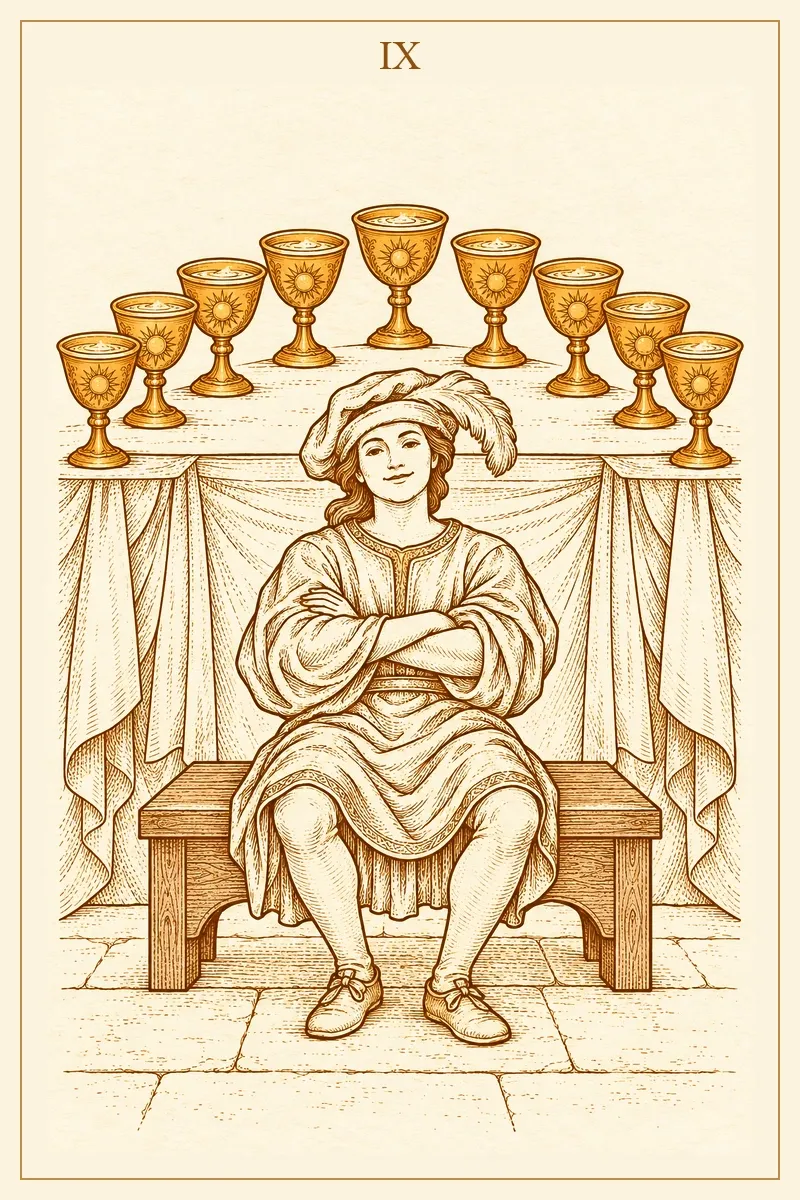
A figure sits in front of a curved rank of nine cups, arms folded, visibly satisfied. People call it the wish card, and its older title is the Lord of Material Happiness. Jupiter rules this decan and, in the traditional scheme, the sign itself, so this is Pisces at its most generous.
Upright, it is contentment you can feel in your body: enough, for now, and you know it. In a question about a hope you have carried privately, it says the hope is worth stating plainly, because a wish you can say out loud is one you can work toward. It does not promise the wish will be granted.
Reversed, Jupiter's expansiveness arrives with a bill. Satisfaction curdles into complacency, or you discover that the thing you were chasing was somebody else's idea of a good life. Read it as an invitation to check the wish against your own values, and see the full Nine of Cups meaning for its wider range.
Ten of Cups: Mars in Pisces, about March 11 to 20
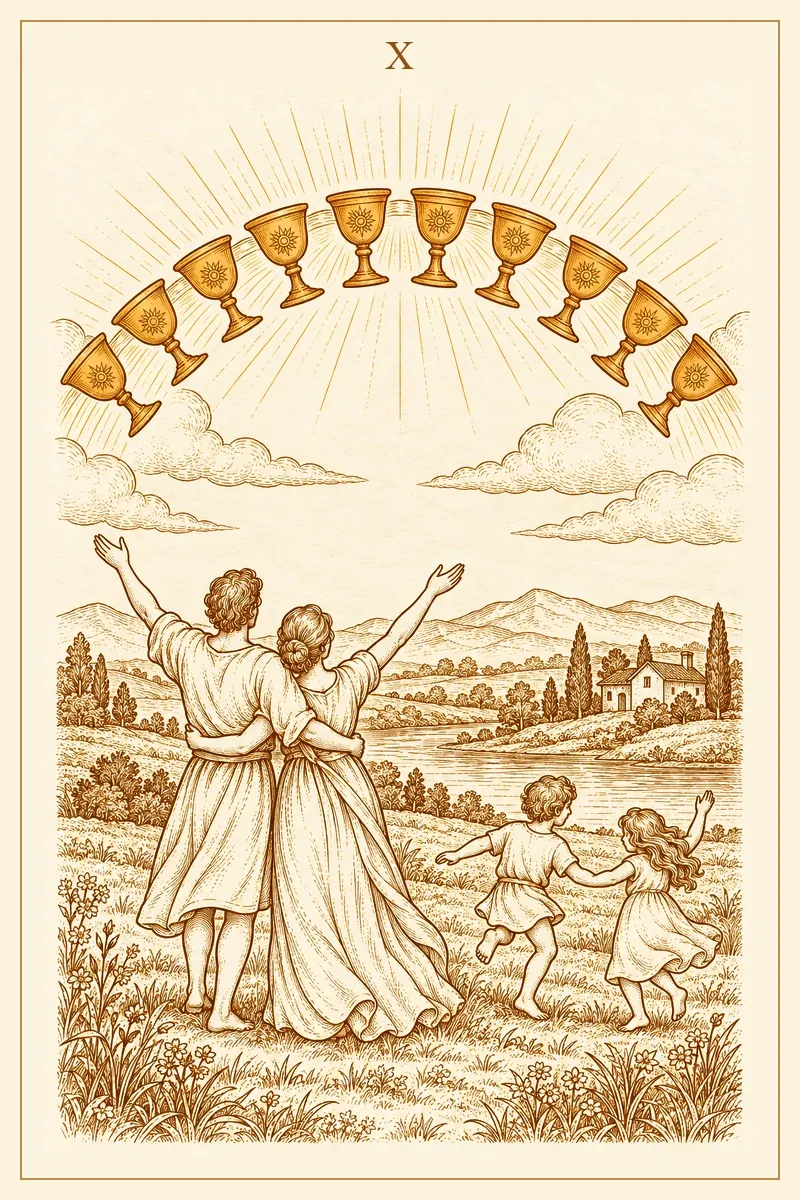
The last card of the suit shows a household under an arc of ten cups, arms raised, children playing, a house on the hill behind them. Its older title is the Lord of Perfected Success, and its sub-ruler is Mars, which surprises people. Mars is effort, and the message of the decan is that the happy ending is maintained rather than awarded.
Upright, it is belonging: a home, chosen or inherited, where people know how you take your coffee. Mars in the softest sign is the reminder that harmony survives because somebody apologizes first, books the visit, says the awkward thing kindly.
Reversed, the card points at the distance between a picture and a life, at a family image you are performing, or at the person who maintains everything quietly running out of road. That is a practical finding rather than a verdict on the relationships, and the Ten of Cups meaning has more on both readings.
Two courts on the Pisces border
Court cards are not tied to one sign each. In the traditional attributions every king, queen and knight covers thirty degrees that straddle a boundary: the last ten degrees of one sign and the first twenty of the next. Pisces is therefore shared, its first twenty degrees held by a Cups court and its last ten by a Wands court.
The naming is where sources disagree. On the older ladder the ranks are King, Queen, Prince and Princess, and the King is the mounted figure. Most modern decks print that rider as the Knight and keep King for the seated ruler, which the older system calls the Prince. So a source that gives Pisces the King of Cups and one that gives it the Knight of Cups usually mean the same card.
Knight of Cups: 20 degrees Aquarius to 20 degrees Pisces
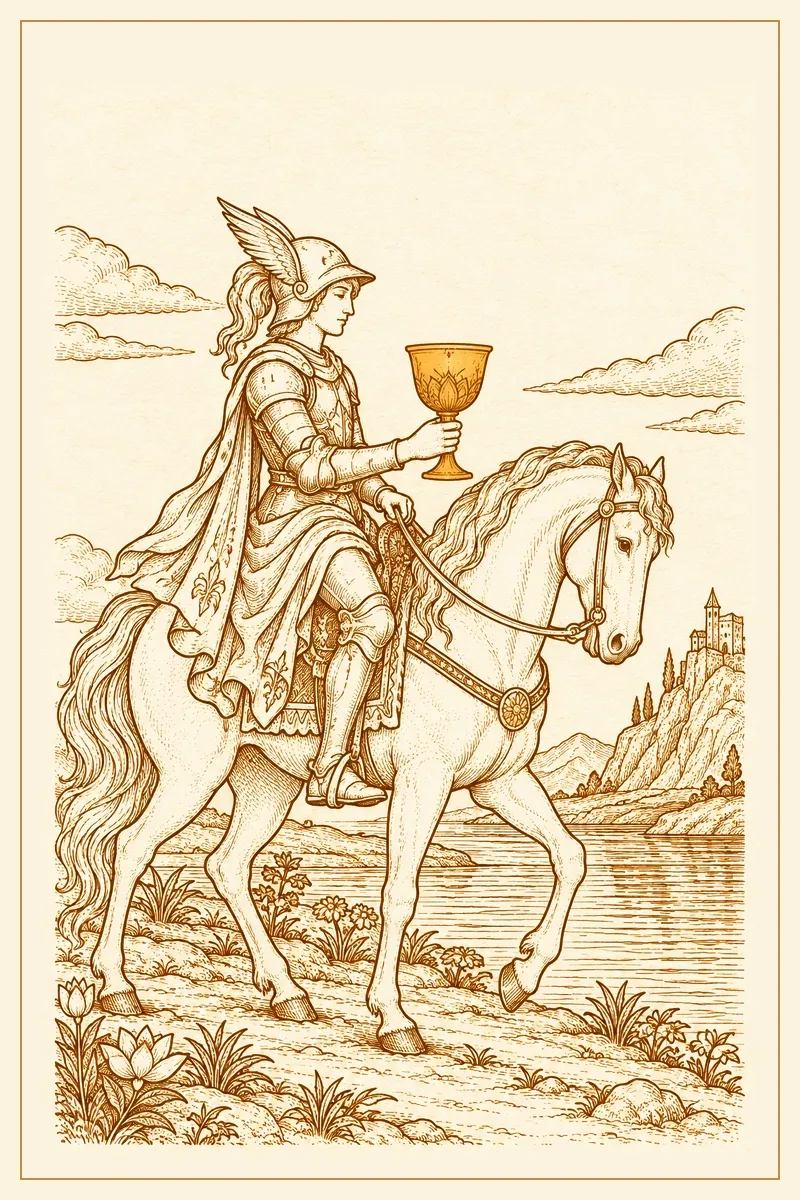
The Knight rides at a walking pace, a cup held out in front of him like something he has been asked to deliver. As a person he reads as someone led by feeling and taste: the friend who notices the mood in a room first, or writes the message everyone else was too careful to send. Artists, counselors and people whose work runs on empathy turn up here.
Upright, he is an offer arriving: an invitation, a confession, a piece of work somebody made for you, a creative idea that wants to be acted on while it is still warm. In his part of the season he often marks the week when something unspoken finally gets said.
Reversed, the offer outruns what is behind it. The feeling is genuine and the follow-through is thin, or the romance is with the idea of a person rather than the person. That is the most useful reversal in this sign, because it separates a real intuition from a beautiful story. The Knight of Cups meaning covers him as a person, a timing and an energy.
Queen of Wands: 20 degrees Pisces to 20 degrees Aries
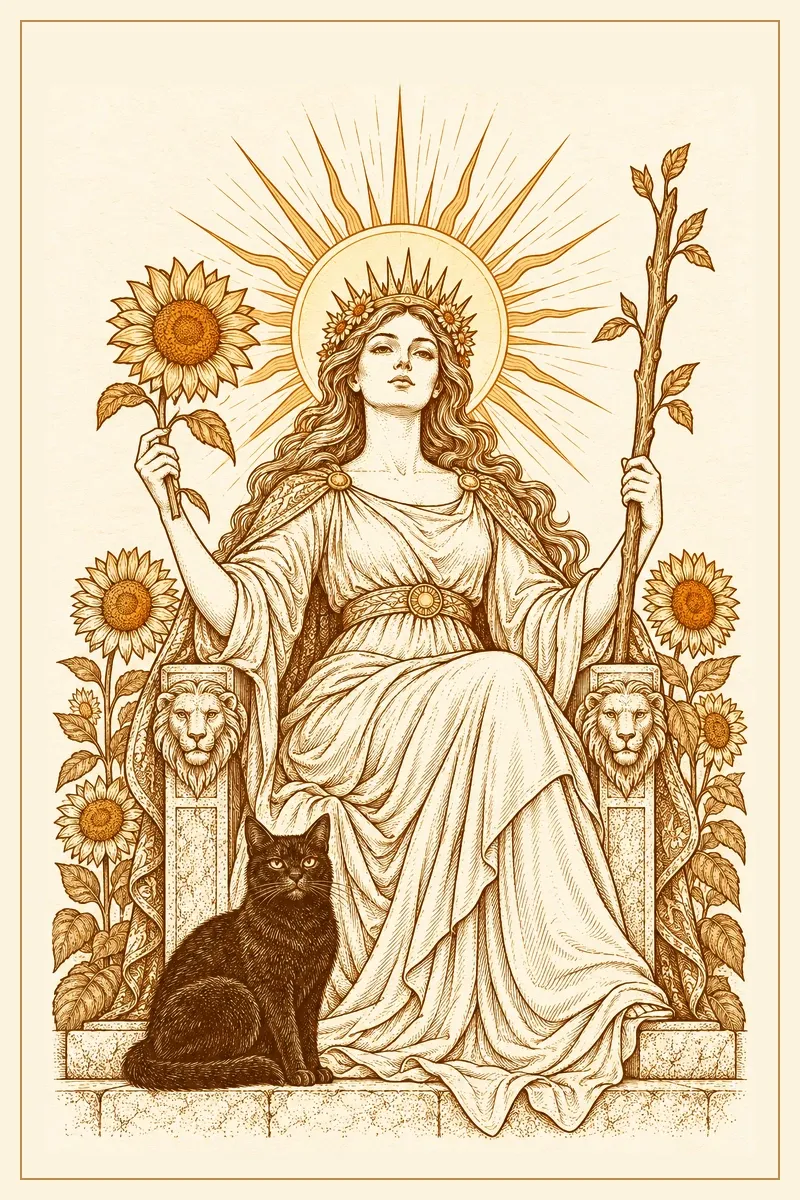
It surprises readers to find a fire queen on the end of Pisces, but the overlap is the point: the last ten days of the sign are already leaning toward spring. The Queen sits facing forward, a sunflower in one hand, a black cat at her feet, warmth that is entirely awake.
Upright, she is the antidote to the sign's hardest habit. She is warm without dissolving, she likes people and still knows what she wants, and she can say no in one sentence and stay friendly. Reversed, that warmth turns brittle or is spent on people who return nothing, and the useful question becomes where your energy is actually going. The Queen of Wands meaning has more on her range.
One footnote for anyone cross-checking sources: the seated King of Cups that modern decks print corresponds to the older Prince of Cups, whose degrees fall in Libra and Scorpio rather than Pisces.
Pisces cards in love, work, money and timing
The same card changes job depending on what you asked.
Love and closeness
The Moon in a love question is rarely about deception, however often it is read that way. More often it marks a stage where you are interpreting signals instead of receiving information, and the honest next step is a conversation rather than another spread. The Knight of Cups describes a warm approach whose weight you cannot judge yet, and the Ten of Cups asks what belonging would look like on an ordinary Tuesday.
Work and creative projects
These cards are strong on imagination and weak on logistics, which is a fair description of the advice they give. The Nine of Cups usually means the thing you are chasing is genuinely yours, so it is worth naming to somebody who can help. The Moon warns that a decision is being made on half a brief: ask for the missing number first. The Eight of Cups is the resignation card people fear, but Saturn's version expects a plan.
Money and the practical edges
Water cards describe how money feels rather than what it does, so pair them with real arithmetic. The Nine of Cups reversed often describes spending that is soothing something, and the Ten of Cups can hide a household where one person carries all the planning. A reading of this kind can be a good prompt to open the account you have been avoiding.
Timing questions
No card gives a date. What the decans offer is a calendar of flavors: the Eight of Cups window suits endings, the Nine of Cups window suits asking for something, the Ten of Cups window suits repair and gathering. Set your own checkpoint, a date you choose rather than one the deck chose, and decide now what you will do if nothing has changed by then.
A worked reading: how much to carry for someone you love
Say you are the person everyone calls first, and this month it is your sister. The question is not whether she will be all right, which the cards cannot answer, but something you can act on: what do I need to see about how much I am carrying here? Three cards, named before the draw: where I am now, what I am not seeing clearly, what is mine to do. They came out as the Nine of Cups, The Moon, and the Eight of Cups.
The Nine of Cups is awkward for where I am now, because it looks like contentment and you do not feel content. In this frame it reads closer to capacity: you are the one who has enough. A spare room, a stable week, the patience to answer the phone at eleven at night. That is why you are called first, and it is the fact the rest of the reading sits on.
The Moon in the middle is the clearest card in the spread. What you are not seeing is that you have been filling in your sister's thinking from the outside: you decided what she can handle and what she must be feeling, without asking her. That is done out of love and it is still an assumption, and assumptions are what this card exists to catch.
The Eight of Cups does not mean abandon her. Saturn's card is about leaving something specific, and what is ready to be left is the role, the arrangement where you manage the situation on her behalf. What is mine to do becomes smaller and much more possible: ask her what she actually wants from you this week, say plainly what you can give, and stop guessing the rest.
Notice what the reading did not do. It did not say whether her situation will improve, or when, or what she privately thinks of you. It produced one sentence to say out loud, which is a better result than a forecast.
The low-tide spread for Pisces season
This is a five-card layout for the murky questions this part of the year is good at, the ones where you know something is wrong before you can name it. You are not draining the water, you are waiting until more of the ground is visible.
- What I can see from the shore. The part of the situation you could describe to a stranger in two sentences.
- What the water is covering. The thing you have been avoiding naming, not a secret somebody else is keeping.
- What I have filled in. Where you have supplied another person's motive or feeling without evidence.
- What is actually mine. The part of this that belongs to you rather than to the people around you.
- One step on dry ground. A small, concrete action you can take this week.
Read the cards in order, writing one sentence per position before you move on, and expect position three to be the one worth arguing with. If spreads are new to you, the beginner spreads guide is a gentler place to start and this layout will still be here later.
Reading with Pisces energy without drifting
Whether you were born under the sign or you are reading during its season, the same strengths and risks come with the territory.
- You read images before words. The tilt of a head, the color of a sky, which direction a figure faces. This attention catches the detail that carries the meaning.
- You hear the question behind the question. People ask about a job and mean their marriage, and that perception is a real skill.
- You can stay with difficult feeling. Many readers rush to fix things; this one can sit with grief long enough to read it properly.
The same three qualities have failure modes, and naming them is what keeps them from running the reading.
- Soft readings. The temptation is to give the kind interpretation instead of the true one. The kindest reading is the accurate one delivered gently.
- Borrowed emotion. If you pick up a mood from the person in front of you and then find it in the cards, you have read the room rather than the spread.
- Beautiful vagueness. Poetry that cannot be acted on is not guidance. Finish with one sentence somebody could carry out this week.
Three habits help more than any technique. Write the question down before you shuffle and do not edit it afterward. Decide how many cards you are drawing in advance and stop there, especially when the first answer is uncomfortable. And after a heavy reading do something physical and ordinary, so that it ends when the cards go back in the box.
Frequently asked questions
What tarot card is Pisces?
The Moon, the eighteenth card of the Major Arcana, in the correspondences most modern decks are built on. Jupiter, the sign's traditional ruler, brings the Wheel of Fortune into the picture as well, and the Eight, Nine and Ten of Cups cover the sign's three decans.
Is the Pisces court card the Knight of Cups or the King of Cups?
Both names point at the same figure. The older system calls the mounted card the King of Cups and gives it from 20 degrees Aquarius to 20 degrees Pisces, while most modern decks print that rider as the Knight. The last ten degrees of Pisces belong to the Queen of Wands, so the sign has two court cards rather than one.
What are the Pisces decan cards?
Eight of Cups for the first decan, sub-ruled by Saturn, roughly February 19 to 28. Nine of Cups for the second, sub-ruled by Jupiter, roughly March 1 to 10. Ten of Cups for the third, sub-ruled by Mars, roughly March 11 to 20. The dates shift by a day or so from year to year.
Does drawing a Pisces card mean a Pisces person is involved?
Usually not. A card carries its own meaning first and the astrological attribution is a second layer. If the question is about one named person and their sign happens to match, it can be worth noting, but reading every Cups court card as a specific human being is how readings go wrong.
Can tarot tell me what Pisces season will bring?
It cannot. Tarot does not deliver dated events, other people's private decisions or fixed outcomes. What it offers is a structured way to look at what you already know and what you are assuming, so a seasonal reading works best as a set of intentions you can revisit.
Is The Hanged Man a Pisces card?
Not in the traditional attributions. The Hanged Man belongs to the element water rather than to a sign, and readers associate it with Neptune, the modern ruler of Pisces, because the system was built before Neptune was known and never assigned it a card. It is a reasonable resonance to use, as long as you say that is what you are doing.
What the tide leaves behind
These cards are at their best when they stop being atmospheric and start being specific: one assumption named, one boundary drawn, one sentence said to the right person. The Moon never clears the night. It gives you enough light to keep walking.
If you want somewhere quiet to begin, pull a card and sit with it in a reading, then write down the single question it leaves you with.