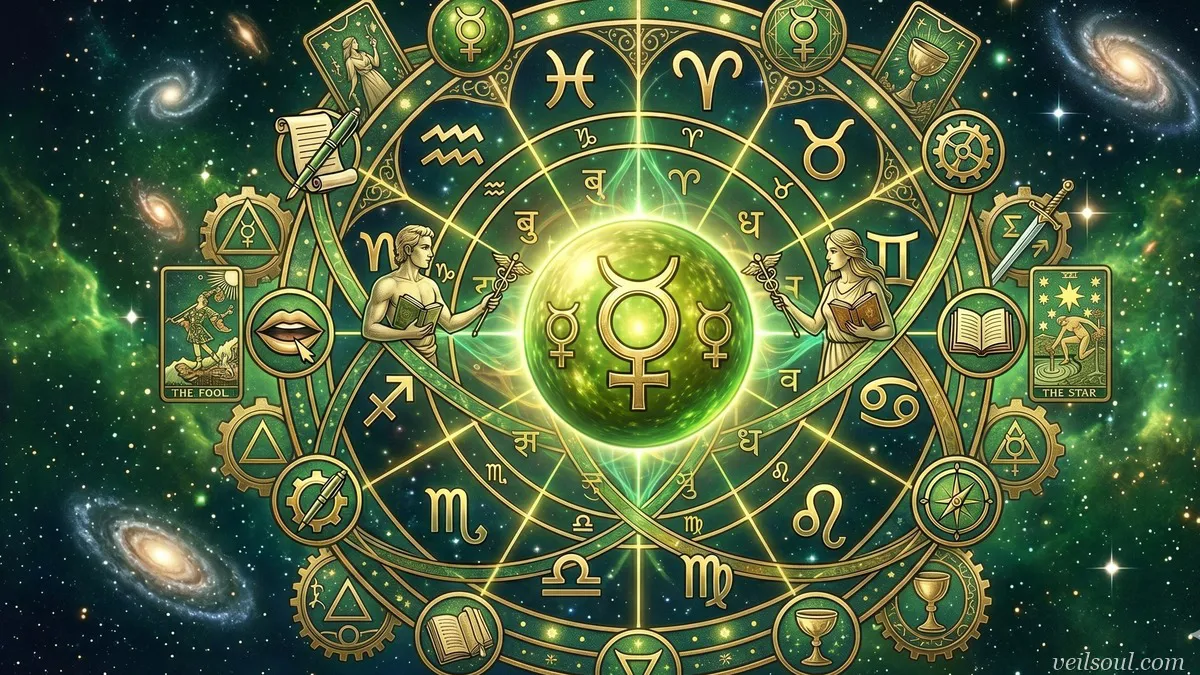
Golden Dawn readers give the Sun the card that already carries its name: The Sun (XIX). The planet does not stop there. Through Leo, the sign it rules, it reaches Strength; through Aries, where it is exalted, it reaches The Emperor; and in the Minor Arcana it rules five numbered cards, one decan each, from the Three of Wands in spring to the Four of Pentacles in midwinter.
Treat this as the Golden Dawn's map rather than a rule built into tarot itself. Other schools assign cards differently, and plenty of thoughtful readers use no astrology at all. A solar card also cannot promise success, confirm what someone else thinks of you or fix the date when things improve. What these cards do well is turn a question back toward you: where you feel alive, and where you are hiding.
At a glance, the Sun's cards in the Golden Dawn system:
- The Sun (XIX): the planet itself; plain joy, clarity and being seen.
- Strength (VIII): Leo, ruled by the Sun; courage held with a gentle hand.
- The Emperor (IV): Aries, where the Sun is exalted; the will to lead and set direction.
- Three of Wands: Sun in Aries; a plan launched and the horizon widening.
- Ten of Swords: Sun in Gemini; a story that has plainly ended.
- Eight of Pentacles: Sun in Virgo; identity built through patient craft.
- Six of Cups: Sun in Scorpio; warmth given freely, simple pleasure.
- Four of Pentacles: Sun in Capricorn; earned authority, and the grip that comes with it.
A luminary among the planets: what the Sun governs
Traditional astrology counted seven moving lights, and two of them, the Sun and the Moon, were set apart as the luminaries. The Sun is the steady one. In a birth chart it describes the core of a person: vitality, sense of purpose, the way you want to be recognized, the kind of authority you hope to grow into. Where the Moon reflects and responds, the Sun radiates and decides.
Its dignities follow from that. The Sun rules Leo, the sign of creative pride and open-hearted display. It is exalted in Aries, where its heat turns into initiative. It is in detriment in Aquarius, where the group matters more than one bright center, and in fall in Libra, where every choice is weighed against someone else's. None of this makes a sign good or bad; it describes where solar confidence comes easily and where it has to learn a different shape. In a reading, a solar card tends to ask about identity and visibility: am I acting from who I am, and do I let my effort be seen?
Resh and the nineteenth trump
Most planets had to wait for the Golden Dawn to find their cards. The Sun did not: a trump called The Sun appears in old Italian and French decks long before anyone mapped tarot to astrology. When the Order matched the twenty-two trumps to the twenty-two Hebrew letters, it gave this card Resh, one of the seven double letters it paired with the planets. Resh means head, and by extension face. On the Tree of Life the card sits on the thirtieth path, between Hod, the sphere of thought, and Yesod, the sphere of images and dreams: the mind waking into clear daylight.
The Sun (XIX): a face in the sky and a child with open arms
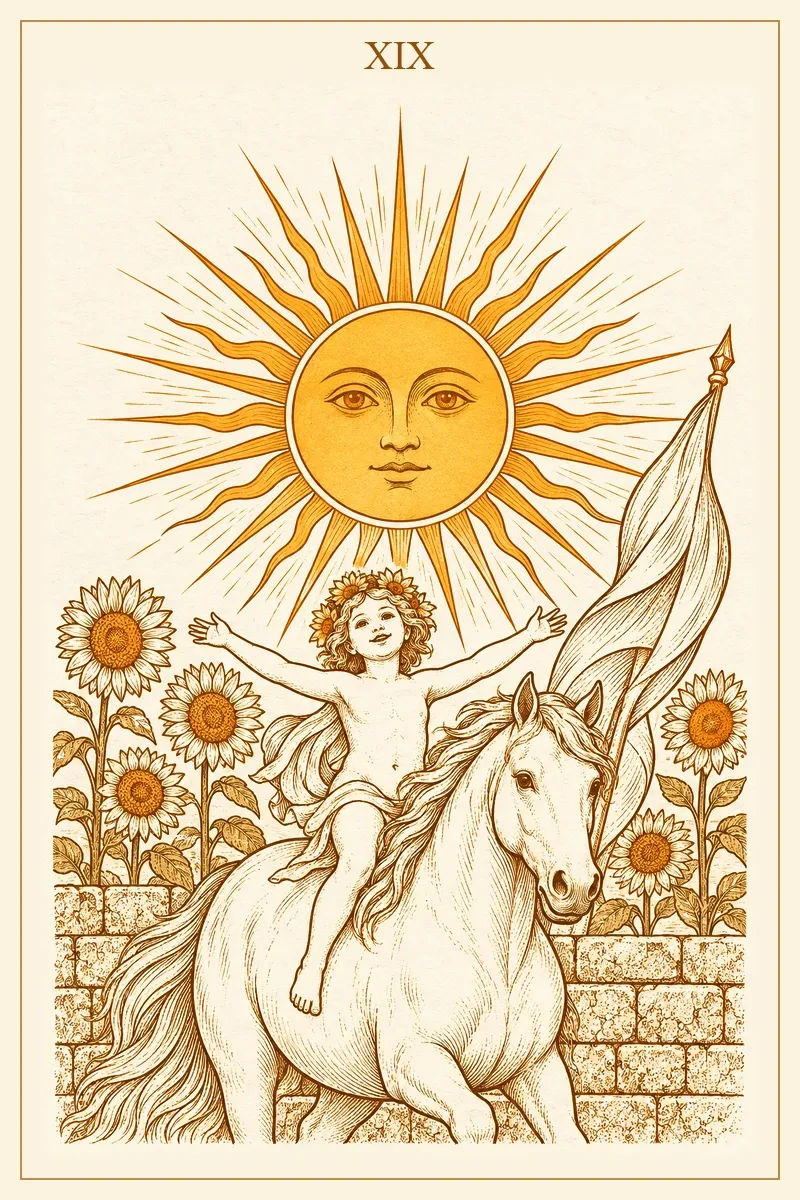
The card fills its top half with a sun drawn with a calm human face and long, alternating rays. Below it, a child crowned with a wreath of sunflowers rides a white horse bareback, arms flung wide, a light cloth slipping from the shoulders. A tall white banner rises behind them on a staff, and sunflowers stand behind a low stone wall. Nobody in the picture is guarding anything. The Sun tarot meaning covers the card in every position; here the point is how literally it shows the planet: life with nothing to hide, warmth that does not ask for permission.
Upright, The Sun points to clarity, energy and honest happiness. A confusing matter becomes easy to see, an effort starts to show results, a mood lifts. In love it suggests affection that can be said out loud; in work, recognition; with money, a period that feels simpler and more transparent. It is one of the brightest answers a single card can give, though still a description of the moment, not a guarantee of what comes next.
Reversed, the light is still there but filtered. You may be waiting for permission to enjoy something already good, or working so hard to look cheerful that you are tired underneath. Some readers also see a delay: the success is real, but it takes longer to be noticed. Either way, ask where you have turned your own brightness down, and for whose comfort.
Home sign and exaltation: Strength and The Emperor
Two more trumps carry the Sun indirectly, through the signs where it is strongest.
Strength (VIII): Leo, the Sun's home. A woman in a loose robe, flowers woven into her hair and an infinity sign shining above her head, rests one hand on a lion's mane and the other at its open jaws. The lion sits; she stays calm. This is the Sun at home in Leo, a confidence so settled that it does not need to dominate. The Golden Dawn moved it to eighth place to follow the order of the signs, which is why its number differs between decks: older ones, such as the Marseille, keep it at XI. The Strength tarot meaning follows the card through love and work, and reversed it often describes courage that has slipped into self-doubt or into force.
The Emperor (IV): Aries, the Sun exalted. A bearded ruler in a tall crown sits on a stone throne with a carved ram's head at the end of each armrest, plate armor at his knees and another ram on his breastplate, an orb-topped scepter in his right hand. Aries is ruled by Mars, but the Sun is exalted here, and that exaltation shows as authority: the clarity to take charge, set terms and stand behind a decision. The Aries tarot guide sets The Emperor beside the sign's three Wands. Reversed, it can turn rigid, or show authority you are giving away.
The Sun's weaker placements have trumps too. Justice belongs to Libra, the sign of its fall, and The Star to Aquarius, the sign of its detriment. Neither is unlucky; both describe light that has to share: weighed against fairness in Justice, poured out for others in The Star.
Five decans lit by the Sun
Book T, the Golden Dawn's tarot manuscript, splits each zodiac sign into three ten-degree slices called decans and gives each slice to one numbered card from Two to Ten, so each of those cards covers about ten days of the year. Each decan also has a planetary ruler, assigned in the Chaldean order (Saturn, Jupiter, Mars, Sun, Venus, Mercury, Moon) starting with Mars at the beginning of Aries. The Sun lands on every seventh slice, five decans in all.
The decan ruler is not the same thing as the Sun's yearly path. The Sun passes through all thirty-six decans every year; "Sun in Aries" on the Three of Wands means only that the Sun rules that slice of Aries. Lists that give the Sun the Five of Wands because it sits in Leo mix up the two ideas: in Book T, Leo's three decans belong to Saturn, Jupiter and Mars. The cards below follow the calendar, and the dates are approximate.
Three of Wands: Sun in Aries, Lord of Established Strength
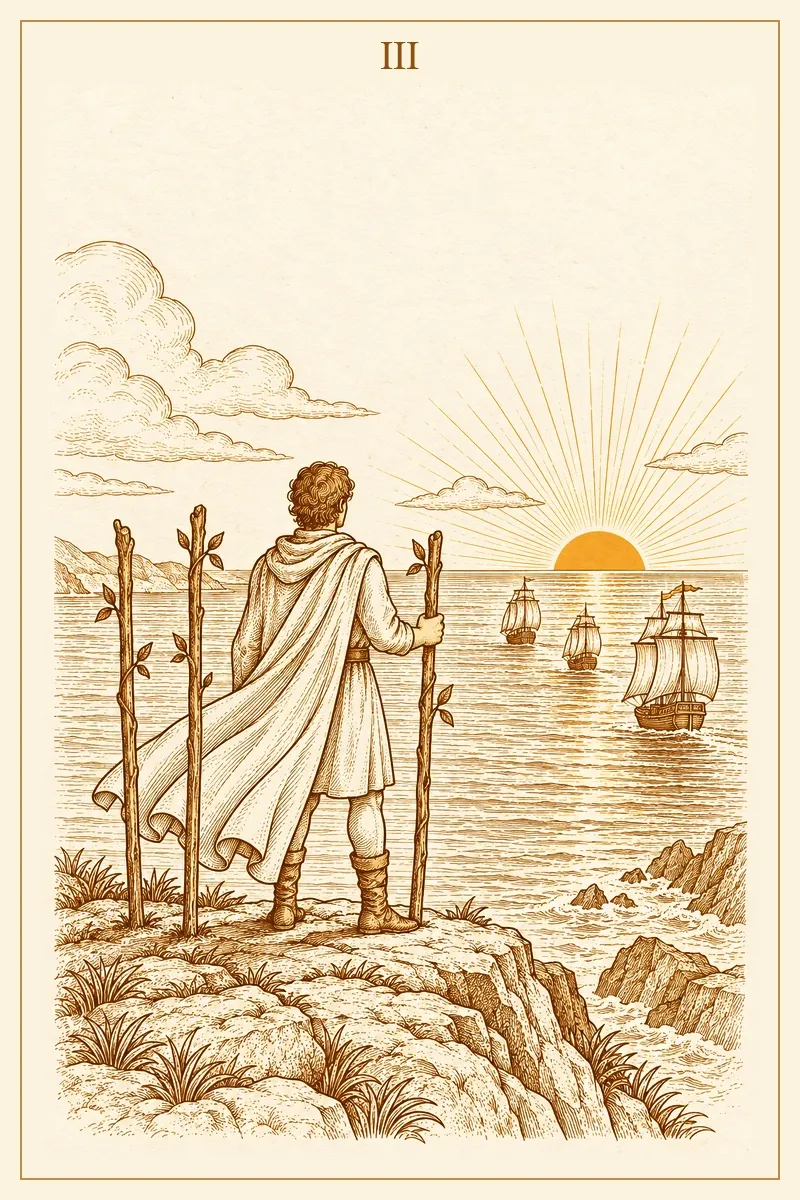
The Three of Wands covers the second decan of Aries, about March 31 to April 9. A man in a long cloak stands on a rocky cliff with his back to us, one hand on a leafing staff, two more staves planted in the ground beside him. Below, three ships sail on a calm sea under a low sun whose rays fan out over the water. The Golden Dawn called it the Lord of Established Strength. The first bold step is taken; the Sun shows how far it can reach. The Three of Wands tarot meaning covers it in love, work and money.
Upright, it describes plans in motion and the confidence that comes from early progress: a launch, an application sent, a trip booked, a partnership starting to show what it could be. It asks you to prepare for growth rather than micromanage what is already moving. Reversed, it can show delays, a plan drawn too small, or impatience that makes you call the ships back before they reach port.
Ten of Swords: Sun in Gemini, Lord of Ruin
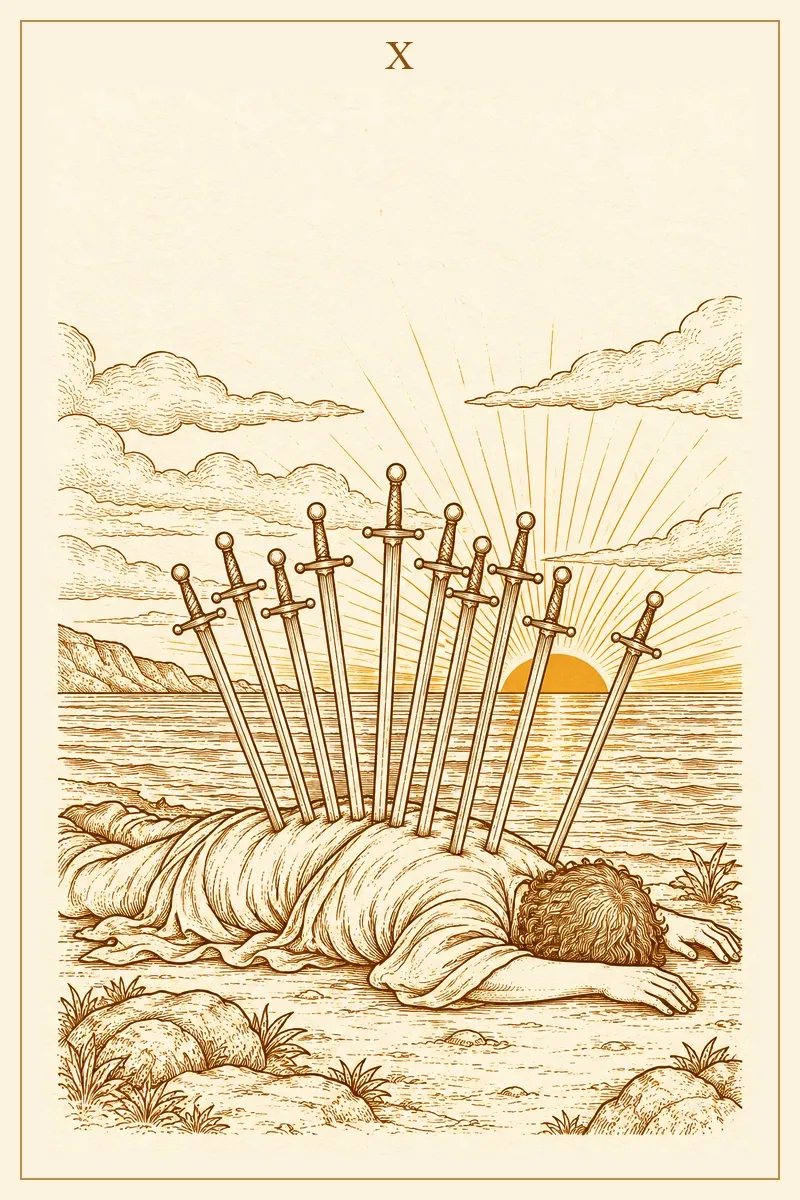
The Ten of Swords covers the last decan of Gemini, about June 11 to 20. A figure lies face down on a quiet shore, ten swords standing in their back, while the sun sits on the horizon over flat water and light rays climb into a cloudy sky. Book T's title, Lord of Ruin, does not soften it. Why the Sun? Because sunlight shows things as they are, and in restless Gemini it makes plain that a line of thinking, a plan or an argument has run to its end. The Ten of Swords tarot meaning explains why many readers find this card oddly relieving.
Upright, the card marks a clear ending: a situation that cannot get worse in the same way, a story you can stop rehearsing, exhaustion that is asking for rest. Reversed, it often shows the first movement of recovery, getting up slowly, or the opposite, staying down because the drama has become familiar. The sun on the horizon is still shining: the card ends one day, not the light.
Eight of Pentacles: Sun in Virgo, Lord of Prudence
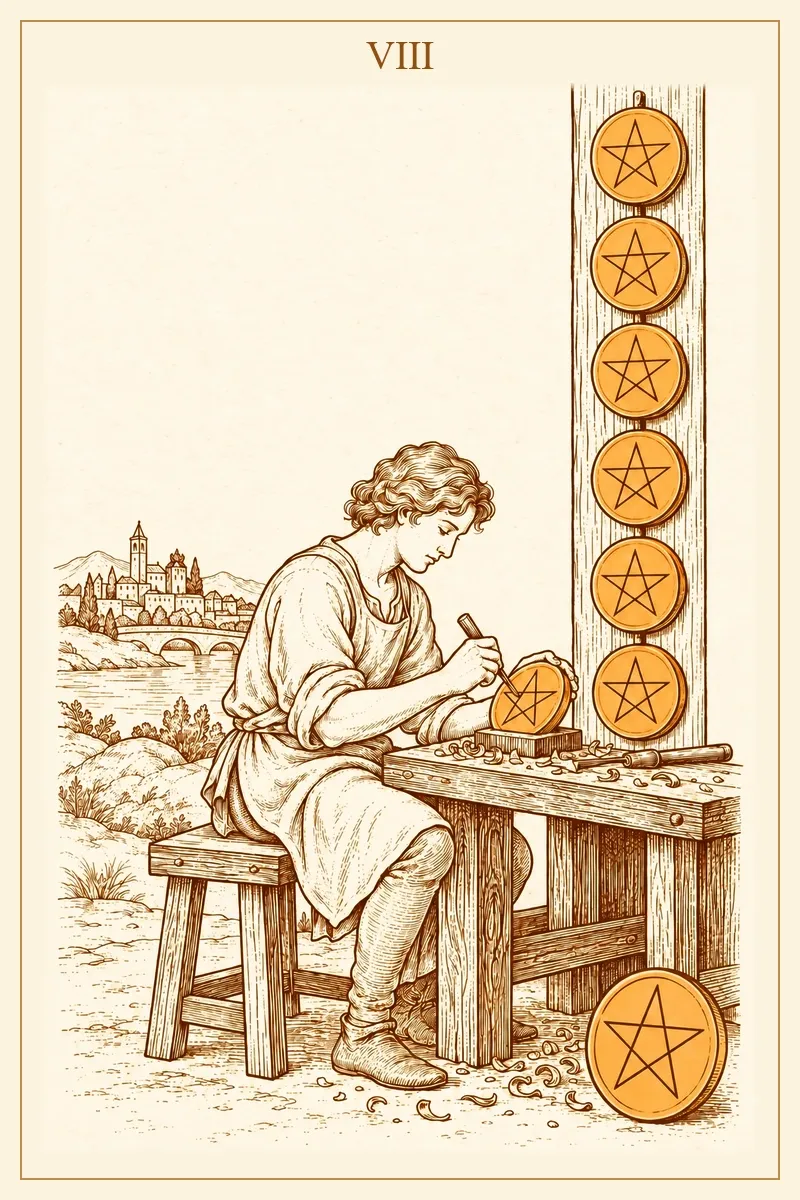
The Eight of Pentacles covers the first decan of Virgo, about August 23 to September 1. A young craftsman in a work apron sits on a stool at a heavy bench, chisel in hand, carving a pentacle on a wooden block; six finished pentacles hang on a post beside him and another leans against the bench leg. Behind him a town sits on a river with an arched bridge. Book T calls it the Lord of Prudence. Here the Sun shines through Virgo's care for detail, so identity comes from doing a thing well, again and again. The Eight of Pentacles tarot meaning follows the card into study and career questions.
Upright, it describes practice, training, a skill improving through repetition, and the quiet pride of work you can stand behind. Reversed, it can point to perfectionism that never lets anything be finished, work repeated without learning, or careless shortcuts in a task that deserves care. Ask what you are getting better at, and whether you let yourself notice.
Six of Cups: Sun in Scorpio, Lord of Pleasure
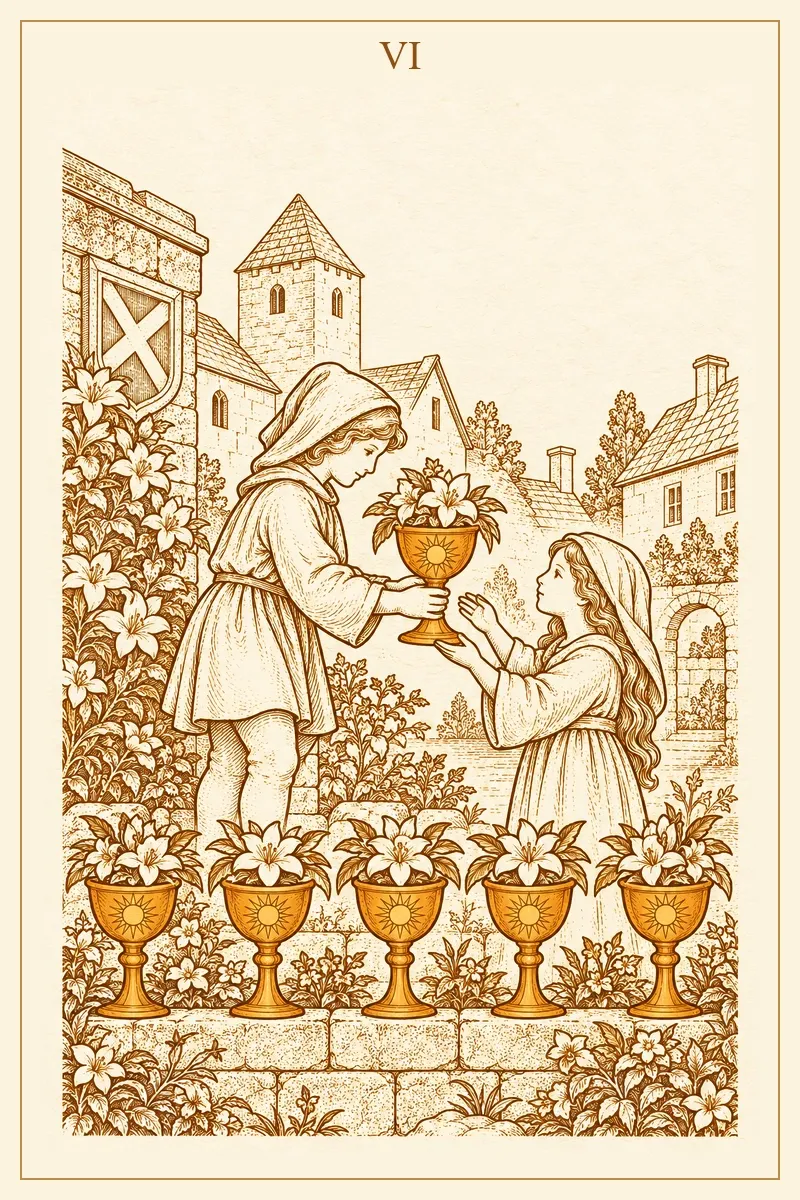
The Six of Cups covers the second decan of Scorpio, about November 2 to 11. In a walled garden a hooded boy bends to hand a cup full of white lilies to a younger girl, who reaches up with both hands. Five more cups of lilies stand in a row on a low stone ledge, and each golden cup is engraved with a small sun. A tower, cottages and a shield marked with a diagonal cross fill the background. Book T calls it the Lord of Pleasure: the Sun warming Scorpio's deep water until feeling turns into kindness. Many modern readers add memory and childhood to that, and the Six of Cups tarot meaning covers both readings.
Upright, it speaks of generosity without strings, simple shared pleasures, reconnection with old friends or places, and the comfort of being cared for. Reversed, it may show nostalgia that keeps you from the present, an old pattern being outgrown, or a gift that comes with expectations. The question it asks: what warmth from the past do you want to carry forward, and what can stay where it is?
Four of Pentacles: Sun in Capricorn, Lord of Earthly Power
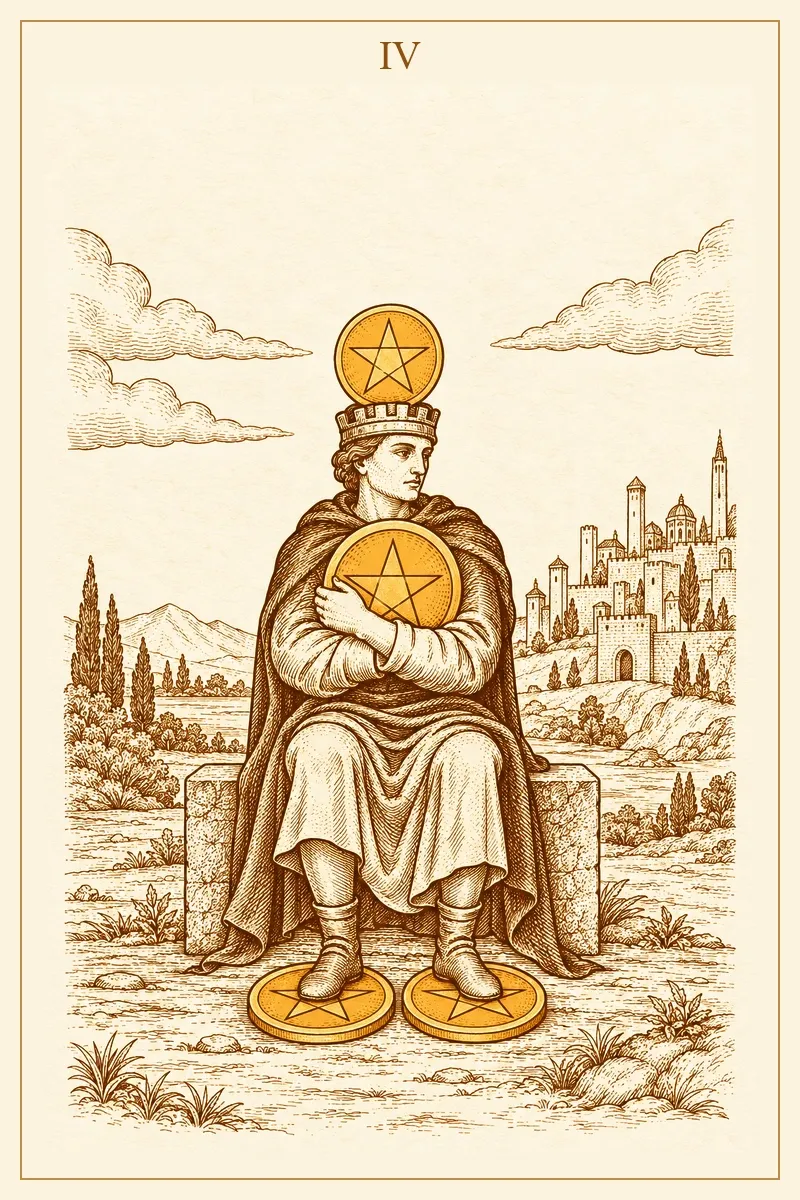
The Four of Pentacles covers the last decan of Capricorn, about January 10 to 19. A man in a battlemented crown sits on a stone block, one pentacle balanced on top of his crown, a second hugged against his chest and two more pinned under his feet, with a walled city on the hill behind him. Book T titles it the Lord of Earthly Power. The Sun in Capricorn is identity built through structure, status and things that last. The posture shows the cost. The Four of Pentacles tarot meaning looks closer at saving and control.
Upright, the card describes stability, savings, firm boundaries and earned authority, along with a tendency to hold too tightly: to money, to control, to an old role. Reversed, it can show the grip loosening, sometimes in a healthy way (sharing, delegating, trusting), sometimes as a worry that resources are slipping away. Look at what you are protecting, and whether protection has turned into hiding.
Look-alikes: suns and lions with other rulers
Several cards feel solar at first glance but answer to another planet in Book T.
- Two of Wands: Mars in Aries, the decan just before the Sun's. It shows a similar view over the sea, globe in hand, but the figure is still deciding; the Two of Wands tarot meaning covers that planning stage.
- Five of Wands: Saturn in Leo. It sits in the Sun's own sign, so it is often listed as solar, but its ruler is Saturn, and the scuffle it shows is practice under pressure. The Five of Wands tarot meaning reads it that way, and the Leo tarot guide covers all three Leo decans.
- Six of Wands: Jupiter in Leo. The victory parade looks like solar recognition, and the overlap is real, but the expansion and public reward belong to Jupiter.
- The four Sixes: the Golden Dawn set every Six on Tiphareth, the sphere of the Sun on the Tree of Life, so some readers sense a note of balance and warmth in all four. Only the Six of Cups has the Sun as its decan ruler.
Reading solar cards for love, work, money and energy
Love. Solar cards favor openness. The Sun and the Six of Cups describe affection that is easy to show; Strength asks for patience with strong feelings, your own or a partner's. The Four of Pentacles can point to someone guarding their heart, and the Ten of Swords to a story that has ended even if one person keeps reading it. Read them for what you are bringing to the relationship and what you are ready to see.
Work. This is where solar cards are most at home. The Eight of Pentacles is skill, the Three of Wands is reach, The Emperor is leadership, The Sun is visibility. Together they ask whether your contribution is recognized, and whether you have made it recognizable.
Money. The Four of Pentacles is the clearest money card in the group, about saving and holding; the Three of Wands can describe a plan that needs time to pay back. Read them as prompts to look at your habits, not as financial advice.
Energy. Readers often take The Sun as returning energy and the Ten of Swords as exhaustion. That can be a helpful mirror for your pacing, but it is not a diagnosis; health questions belong with a doctor.
The noon spread: six positions for being seen
This spread follows the Sun's day, from dawn to evening. Use it around your birthday, at the start of Leo season (about July 23), or whenever you feel unseen.
- Dawn, the light you already have: a strength or warmth that is yours right now.
- Cloud cover: where you dim that light, and why.
- Noon, what wants to be seen: the work, feeling or part of you that is ready to step forward.
- The watcher: whose recognition you are waiting for, and what that waiting costs.
- Afternoon, one warm step: an action you can take within a week.
- Evening: the rest or limit that keeps the light sustainable.
Read positions 1 and 3 together first; the gap between them is usually the real subject. Then let position 6 check position 5, so the step you choose is one you can keep up.
Worked example: putting your own name on the work
Ren is an illustrator who has spent four years drawing for a studio whose name goes on everything. A personal portfolio keeps getting postponed. The question: "What would help me step out from behind the studio's name?"
- Dawn: Eight of Pentacles. The skill is real; the reading starts from strength, not lack.
- Cloud cover: Four of Pentacles. Ren is holding the work close: worried about the steady salary, and perhaps about showing pieces that are not "finished enough".
- Noon: The Sun. What wants to be seen is not a new skill but Ren's own voice, the drawings made for joy that never went into a client file.
- The watcher: King of Pentacles, reversed. Ren has been waiting for the studio director to give permission or praise; that approval may never come in the hoped-for form.
- One warm step: Three of Wands. Send something out: a small portfolio page, three pieces, shared with a few people outside the studio.
- Evening: Four of Swords. Keep the day job for now and protect evenings for rest; this is a launch, not a leap.
Read together, the cards do not say whether the portfolio will succeed. They say Ren's hesitation is about permission, not ability. A practical next step: pick three personal pieces this week, write two plain sentences about each, publish them on a simple page, and note what feels uncomfortable about being visible. A draw this solar is unusual; one solar card is enough to start the same conversation.
Frequently asked questions
Which tarot card represents the Sun?
In the Golden Dawn system it is The Sun (XIX), linked to the Hebrew letter Resh. The Sun also reaches Strength through Leo, The Emperor through Aries, and five minor cards as decan ruler: the Three of Wands, Ten of Swords, Eight of Pentacles, Six of Cups and Four of Pentacles.
Does The Sun card stand for Leo?
Not directly. The Sun rules Leo, but Leo's own trump is Strength. The Sun card stands for the planet; for Leo itself, start with Strength and the Five, Six and Seven of Wands.
Why is the Ten of Swords a Sun card?
Because Book T gives the last decan of Gemini to the Sun. The pairing makes sense once you see the Sun as the light that shows things clearly: in this card, it shows that a painful chapter is over. Hard news, but also where recovery begins.
Is The Sun card always a yes?
Many readers treat The Sun as one of the clearest yes cards, especially upright. Still, its most useful yes is "this is worth doing openly", not "this is guaranteed". Reversed, it often reads as "yes, but slower than you hoped".
Is my sun sign the same as The Sun card?
No. Your sun sign has its own trump (Aries is The Emperor, Leo is Strength, Scorpio is Death), while The Sun card belongs to the planet. You do not need your birth chart to read solar cards; the pictures work on their own.
Can solar cards tell me when something will happen or how it will turn out?
No. Decan dates can be used as a symbolic timing frame, and the tarot timing and astrology guide explains how some readers do that, but tarot cannot fix a date, guarantee an outcome or confirm what another person intends. Use the cards to see your situation more clearly and to choose your next step.
Letting yourself be seen
The Sun's cards share one quiet message: light is meant to be used, not hoarded and not performed. A craftsman at the bench, a child on a white horse, a figure on the shore with the sun still on the horizon: each shows a different moment of being honestly visible. The other luminary keeps its own set of cards, and the Moon in tarot guide walks through them if you want to see how reflected light reads beside direct light. When you are ready to ask your own question, you can begin a reading and see which card comes forward.