The Hierophant tarot card means learning through a shared tradition: a teacher, a set of customs or an institution that passes on what it knows. Upright, The Hierophant reflects a time to study with a guide, follow a proven route or make a commitment in a recognized form. Reversed, it points to questioning those rules, outgrowing a teacher, or noticing where an authority asks for more obedience than it has earned.
The card works as a reflection, not a forecast. It cannot tell you what another person thinks, name the date of a wedding or guarantee how an exam will go. What it can do is help you ask a useful question: whose way am I following here, and do I still agree with it?
Here is the card in short:
- Upright: tradition, teaching, mentorship, belonging to a group, ceremonies and formal commitments.
- Reversed: questioning the rules, a personal path, an overbearing authority, or rebellion that has not yet found its reason.
- Love: shared values, meeting families, a relationship made official; reversed, your own terms or values that pull apart.
- Career: institutions, training, credentials and mentors; reversed, friction with a rigid workplace culture.
- Yes or no: upright, yes when the usual route fits your question; reversed, not by that route.
Hierophant upright: a teacher, a custom, a place to belong
Upright, the Hierophant is the card of knowledge that many people have tested before you. It might be a school, a faith community, a family custom or one experienced person willing to show you how something is done. You do not need to invent this from scratch: someone has already mapped the ground, and learning their map first saves detours.
The card also speaks about belonging. Traditions are how a group of people recognize each other: marking a holiday the way your family always has, or keeping the etiquette of a dojo or a restaurant kitchen. The Hierophant's quiet logic is "we do it this way so that we can do it together."
- Teaching and being taught. A mentor, a course, an apprenticeship.
- Agreed forms. Contracts, ceremonies, vows, exams and official procedures, done through the proper channel.
- Values held in common. Less "what do I want?" than "what do we stand for?", a shift that can steady a family, a team or a couple.
Upright does not mean blind obedience. A good tradition can explain itself. If you can say why a rule exists and still agree with it, the upright Hierophant is on your side.
Hierophant reversed: when the rule and the reason come apart
The reversed Hierophant reflects a time when a rule has lost touch with its reason, or when you have. It is not simply a rebellion card. Read it in one of four ways, and let the rest of the spread show which one fits:
Outgrowing a tradition. The framework you were raised or trained in no longer matches who you are. The most mature form of the reversal is the student who learned the old form thoroughly and then chose, with respect, to work in a new one.
Authority that oversteps. A teacher, boss, elder or group asks for obedience it has not earned, discourages questions, or uses its position to control people. Take this seriously: notice the pattern, talk to someone outside the group, and look for independent support if you feel pressured or unsafe.
The inner rulebook. Sometimes the rigid authority lives inside you: "people like me don't do that", "I have to finish what I started". The reversal asks which of your own rules you would still choose today.
Reaction without direction. If you always do the opposite of what you were told, the rule is still deciding for you. Ask what you are walking toward, not only what you are leaving.
A quick self-check: can you name one thing you respect about the tradition you are questioning, and what you would put in its place? If you can answer both, you are making a conscious departure. If neither, give yourself more time before a big move.
Reading the picture: blessing hand, triple cross, two kneeling listeners
The figure on the throne and the two at the steps
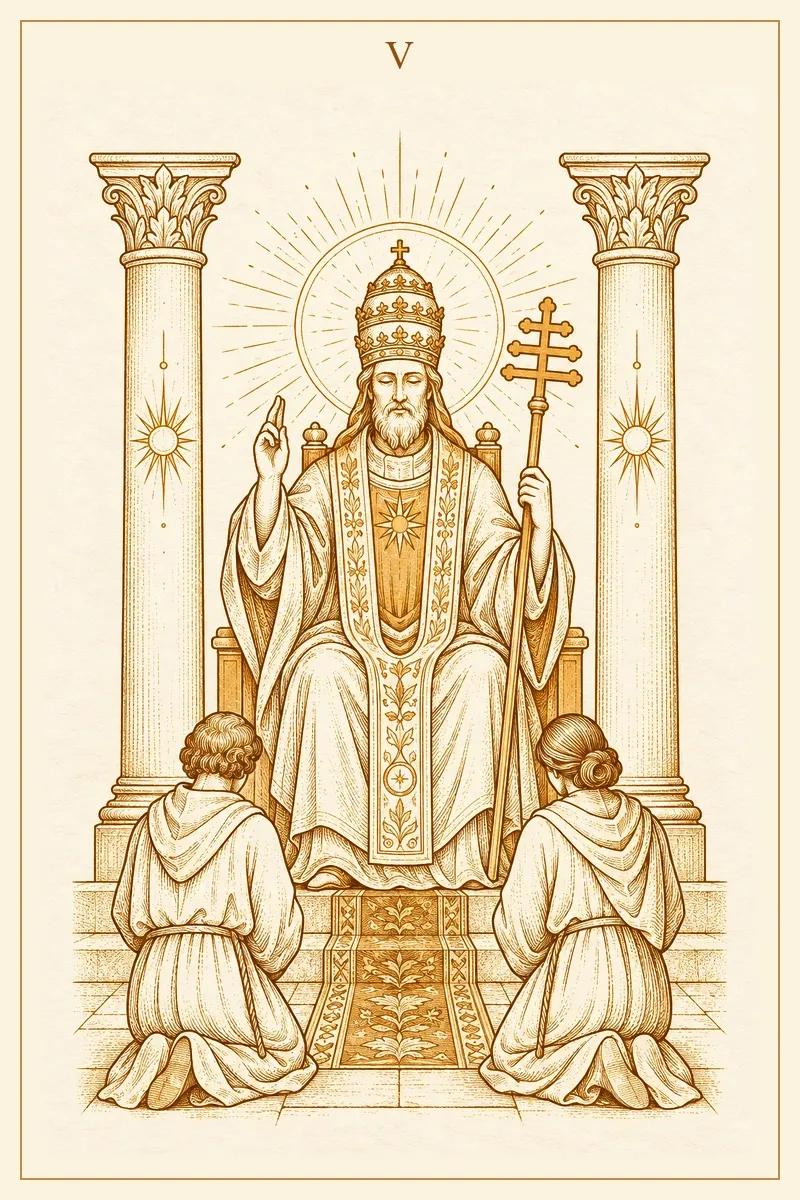
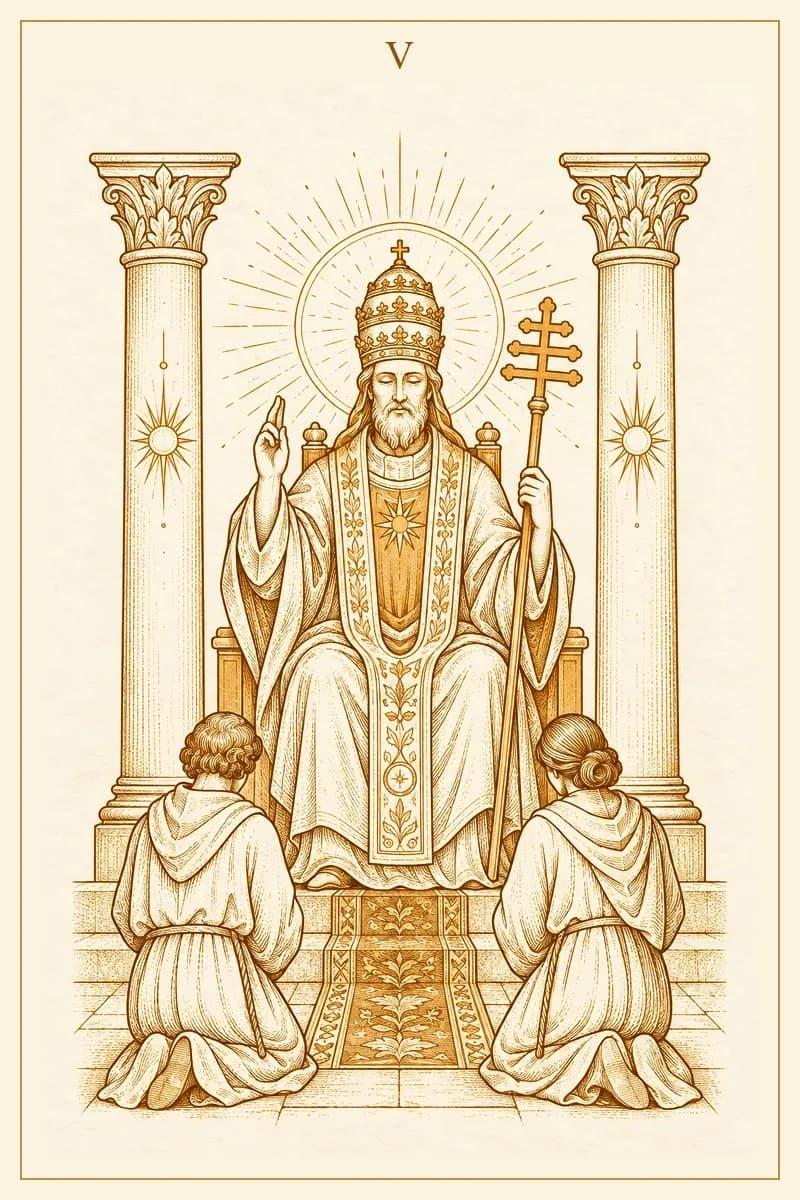
The card shows a bearded man with long hair seated on a throne, his eyes closed, as if he is listening rather than looking. He wears a tall crown built in three tiers and topped with a small cross, and a pale circle of fine rays spreads behind his head. His right hand is raised with two fingers held together in blessing; his left grips a tall staff crowned by a cross with three crossbars. A long embroidered band with leaf patterns runs down his robe, and a many-rayed star sits on his chest.
Two columns with leafy carved tops stand on either side, each marked with a radiant star. At the foot of the steps, two figures kneel with their backs to us, in hooded robes tied with cord: one has short curly hair, the other has hair gathered in a bun. Between them, a runner patterned with leaves flows down the steps to the tiled floor. The numeral V sits at the top.
- The raised hand: a blessing, and also a teacher's gesture: knowledge given outward.
- Three tiers and three crossbars: layers of learning and responsibility. He holds an office, not just an opinion.
- Two listeners: teaching needs students. The two look different yet kneel the same way, the card's picture of a shared form.
- The runner: a path from the seat of authority down to ordinary ground, so that what is taught reaches daily life.
The Waite-Smith card places two crossed keys at the Hierophant's feet. This card has none; the runner carries the idea of access instead. In the Tarot of Marseille the card was titled the Pope (Le Pape), and its imagery borrows from church ceremony. Here it is read as the role of a teacher or keeper of a tradition, not as a statement about any particular church.
Taurus, the letter Vav and the number V
In the Golden Dawn correspondences that shaped the Waite-Smith deck, the Hierophant belongs to Taurus, the fixed earth sign ruled by Venus: a fit for a card about what lasts, customs and habits repeated until they become a way of life. Its Hebrew letter is Vav, usually translated as "nail" or "hook", the small fastener that joins two things, as this figure joins teaching to practice. The card is numbered V in the Waite-Smith deck, and the Thoth deck by Aleister Crowley and Frieda Harris keeps the title "The Hierophant".
The number places it between The Emperor (IV), who sets the rules of a realm, and The Lovers (VI), who make a choice of their own. The Hierophant sits in the middle: rules explained, handed on, and offered to you to accept or to question.
The Hierophant in love: shared values, families and making it official
Together or single: the upright Hierophant in love
In a relationship, the upright Hierophant asks what the two of you believe in together. It is linked with the traditional steps a couple may take: meeting each other's families, moving in, an engagement or a wedding. It also points to the quieter agreements underneath, such as money, holidays, faith, children or caring for parents. Where those basics are shared, the card reads as steadiness; where they have never been discussed, it is a prompt to start.
If you are single, the Hierophant suggests a connection that grows through structure rather than chance: an introduction from family or friends, a class, a community group or a place of worship. The person it describes is dependable, clear about their values and happy to take things one step at a time. If marriage is on your mind, the tarot cards linked with marriage and lasting commitment show where the Hierophant sits among them.
Reversed in love: your own terms, or values pulling apart
Reversed, the Hierophant can describe a couple who would rather write their own rules: no wedding, a long-distance arrangement, a relationship family has not yet accepted. That can be healthy when both people choose it, and painful when only one wants to leave the expected route. The reversal can also point to a deeper mismatch in values, about faith, money, children or family loyalty, that good times have been covering. Name it while it can still be a conversation rather than a quarrel. For someone single, it may show pressure from relatives, or a pull toward people your circle would disapprove of; ask whether the attraction is to the person or to breaking a rule.
The Hierophant as feelings: serious, careful, sometimes torn
As a feelings card, the upright Hierophant describes someone who takes you seriously. Their affection may look careful rather than dramatic: they think about the future, picture you with their family and want to do things properly, so they may be slow to say it out loud. Reversed, the feelings may be real but tangled up with expectations: family, community or their own picture of the right partner pulling against what they feel, or a wish to avoid labels and formal steps. The card sketches their stance; their words and actions over time show where it goes.
The Hierophant and reconciliation: slow upright, new terms reversed
For getting back together, the upright Hierophant favors a slow, structured return: a proper conversation about what went wrong, agreed terms for trying again, perhaps help from a counselor or a mutual friend you both trust. It does not describe a sudden reunion sparked by a late-night message. Reversed, the old arrangement is unlikely to work as it was, because whatever expectation pulled you apart is still in place, or one of you now believes something different. A return would need new terms. To set the Hierophant beside other reunion cards, see the tarot cards read as signs of a reunion.
Hierophant career meaning: institutions, mentors and credentials
Upright at work
At work, the upright Hierophant points to established organizations: schools, hospitals, public offices, large companies, professional associations, family businesses with a long history. It favors learning the house style before changing it, following procedures, and earning the qualification your field expects; a training course or certification exam suits it well. Mentorship is the other strong thread: a senior colleague worth learning from, or a request that you become that person for someone newer.
Reversed at work
Reversed, the card reflects friction with a rigid culture: rules no one can explain, "we've always done it this way", a manager who mistakes seniority for being right. You may be ready for a different structure, freelance work or a project of your own. Before you leave, check whether the problem is the institution or one person in it. If something crosses a line, keep notes and use proper channels such as HR.
Money and formal paperwork
With money, the upright Hierophant leans toward the documented, conventional route: reading the terms, keeping records and asking a qualified adviser when a decision is large. It does not promise any return. Reversed, it can show distrust of banks or official advice and curiosity about alternatives; check those with the same care, and make sure frustration with the system is not the thing deciding.
Faith, practice and choosing your teachers
Spiritual questions are the Hierophant's home ground, but the card does not belong to one religion. It describes any lineage of practice: a faith community, a meditation group, a martial arts school, a craft passed from master to apprentice. Upright, it suggests learning inside such a tradition, with a teacher and companions who can correct you when you drift, and it covers the ceremonies that mark a life, such as a wedding or a coming-of-age rite.
Reversed, the card says that your relationship with what you hold sacred is your own. If you want a reflective practice of your own, five simple tarot spreads for beginners give it a steady structure without asking you to adopt anyone's doctrine.
Yes or no with the Hierophant: does the usual route fit?
As a yes-or-no card, the upright Hierophant leans yes when your question is about the established way: applying through official channels, taking the course, making a relationship formal. Reversed, it leans no to that route, which is not always a no to the goal: "yes, but not the way you were told to do it."
- "Should I sign up for the training program?" Upright: yes, the structure can help. Reversed: look for a format that suits you better.
- "Should I follow my family's advice?" Upright: listen closely. Reversed: take what fits and decide the rest yourself.
For shaping questions like these so the answer is something you can act on, how to do a yes or no tarot reading walks through the method.
Teacher, priestess, ruler: the Hierophant beside II and IV
The High Priestess: knowing alone, knowing together
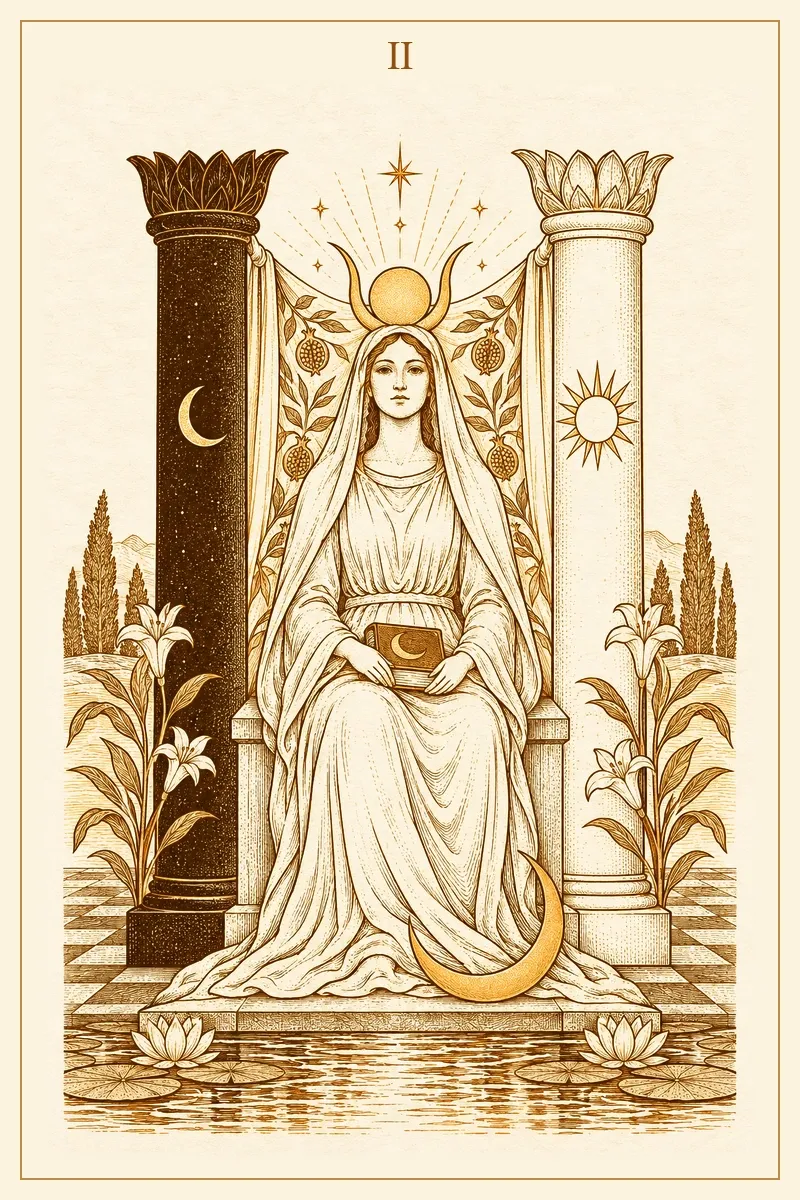
The High Priestess also sits between two columns, one dark with a crescent and one light with a sun, a book on her lap and a crescent moon at her feet. Her knowledge is private and intuitive; the Hierophant's is shared and taught. Drawn together, they ask you to balance what a teacher tells you with what your inner sense says, because either alone tips into dogma or guesswork. For her side of that balance, see what the High Priestess means for intuition and inner knowing.
The Emperor: the rule and the reason behind it
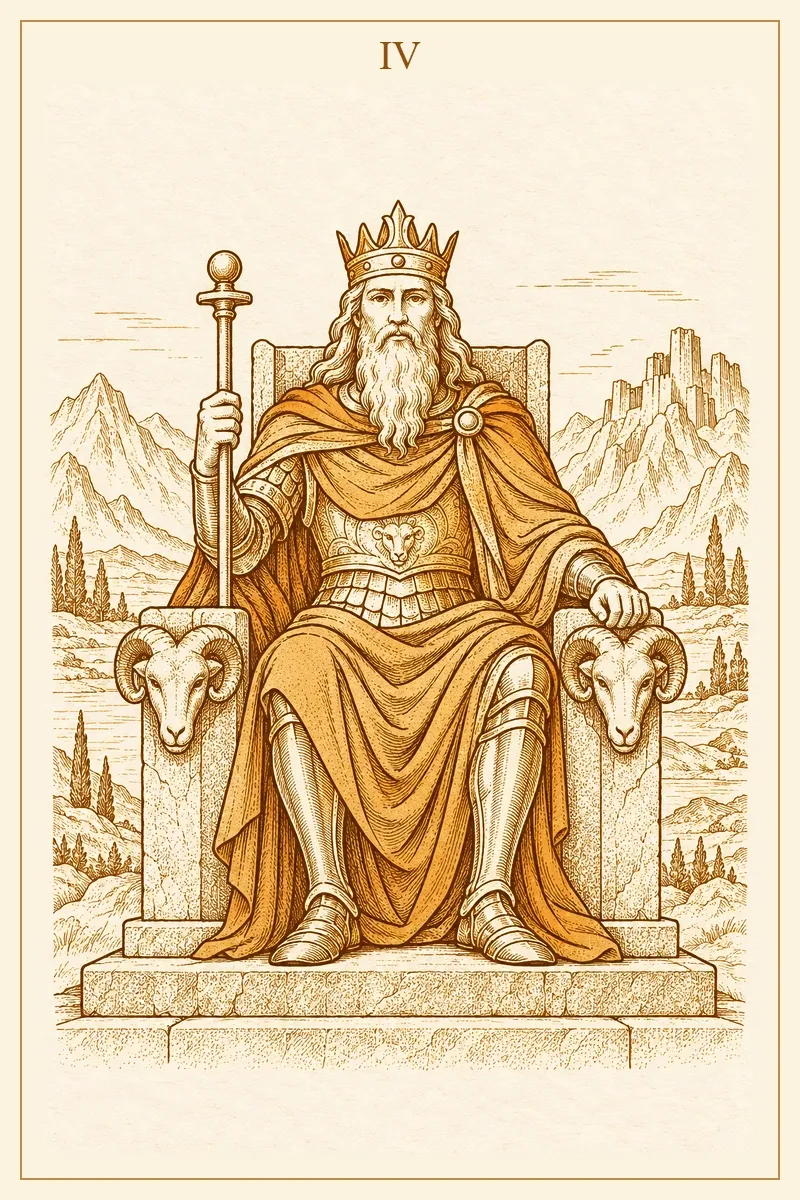
The Emperor, in armor on a stone throne with ram heads carved on its arms and a scepter in his hand, is authority over the outer world; the Hierophant is authority over meaning. Side by side, they describe an institution at full strength, such as a large employer or a family with firm elders, which can hold you up or, reversed, crowd out your own judgment. The Emperor's meaning of authority and structure covers the worldly half.
When the Lovers, the Tower or the Fool falls near the Hierophant
The Lovers: a vow made in front of others
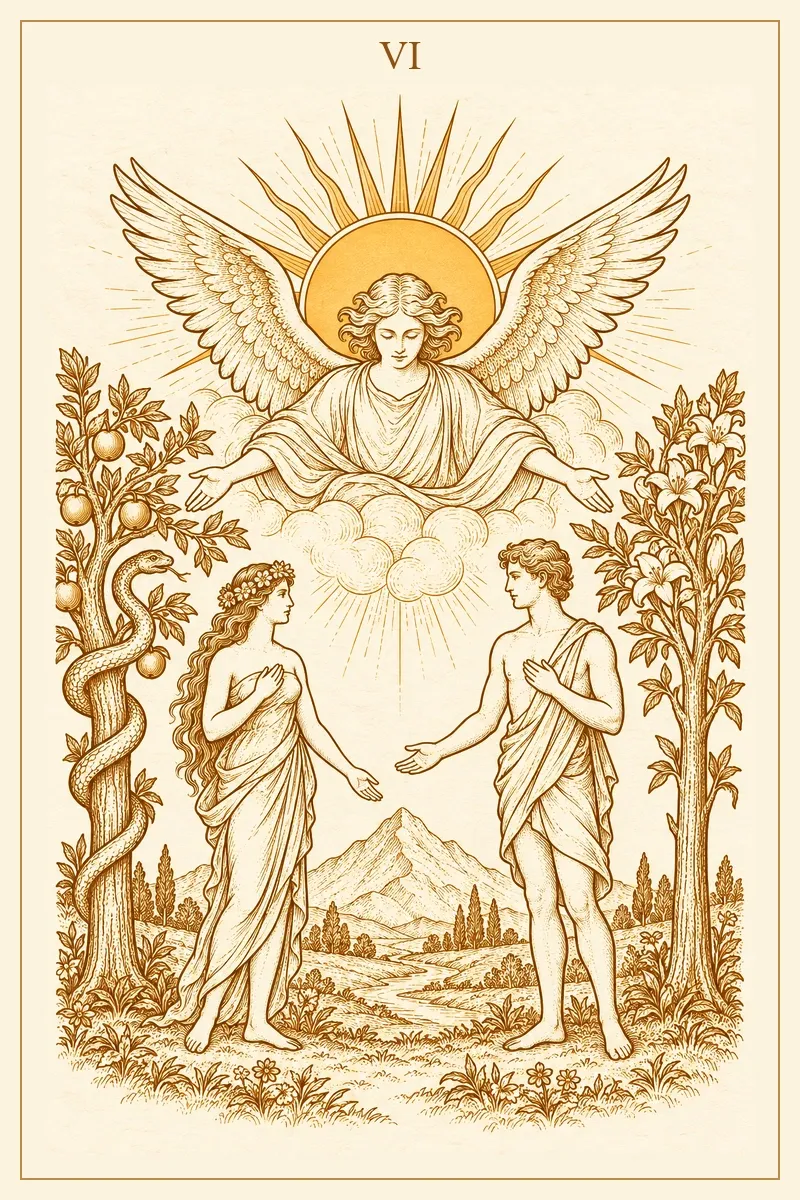
The Lovers come straight after the Hierophant. A winged figure spreads its arms before a blazing sun, and below, two people face each other, a fruit tree with a serpent behind one and a flowering tree behind the other. With the Hierophant, the pair reads as a commitment made formally, or as the pull between what tradition expects and what the heart chooses. The Lovers' meaning of choice and union takes the next step of the Major Arcana.
The Tower: a structure that cracks
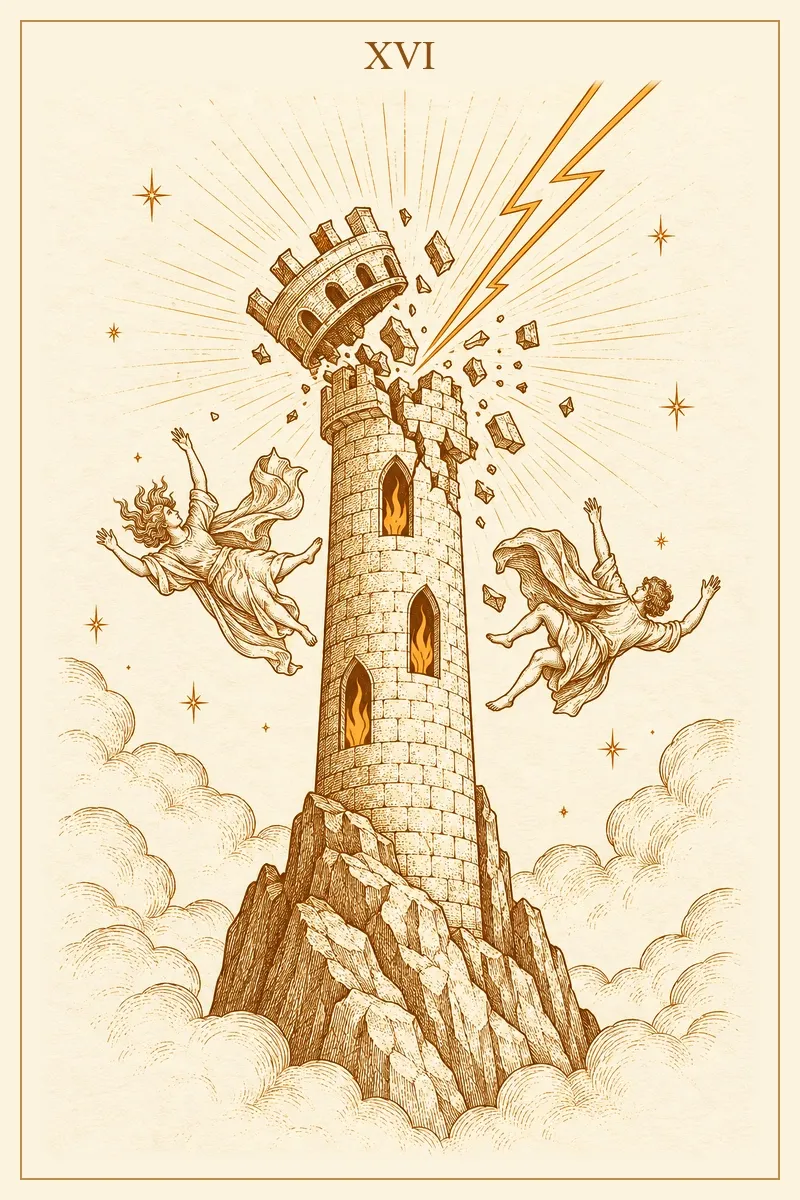
The Tower shows lightning breaking the battlemented top off a stone tower, flames in its windows and two figures falling. Next to the Hierophant, a belief system or organization breaks open: leaving a school or community, or learning something that changes how you see a teacher. The Tower's meaning of sudden change and revelation covers how to steady yourself.
The Fool: the first day of study
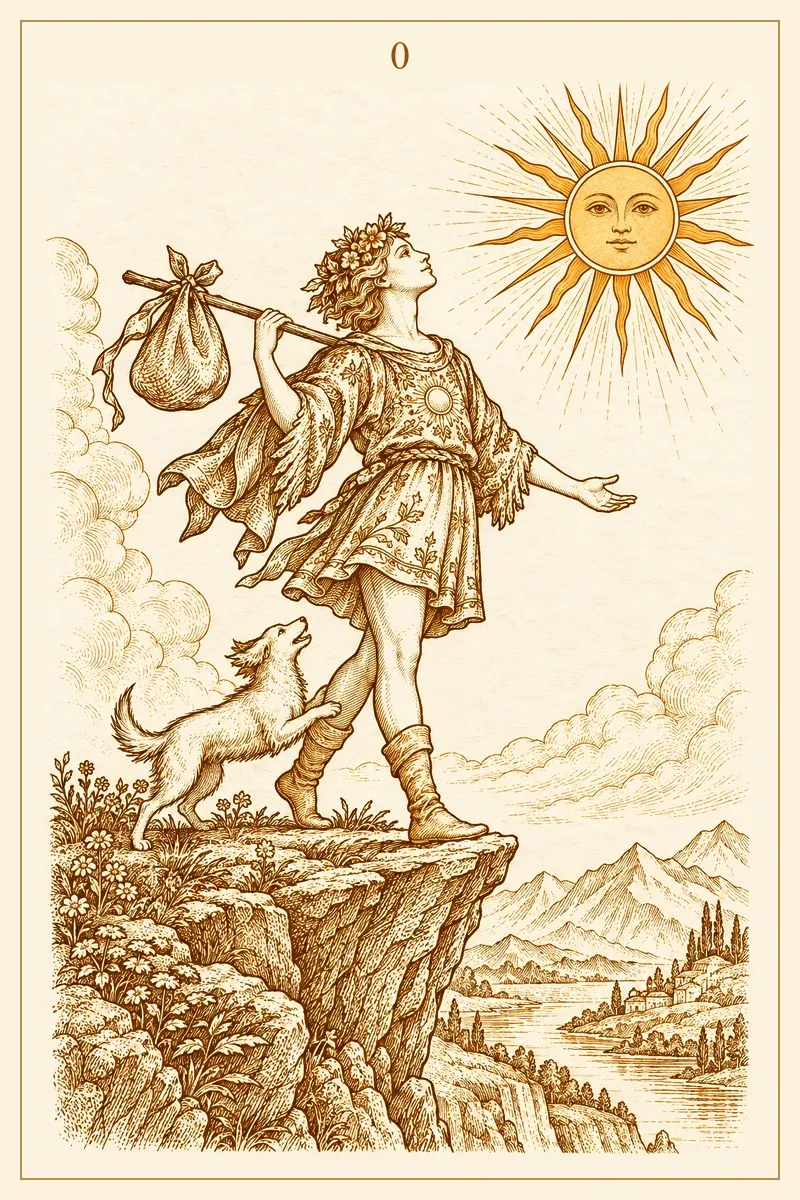
The Fool steps toward a cliff edge with a bundle on a stick, a dog leaping at his leg and a bright sun above. With the Hierophant, the pairing reads as the start of an apprenticeship or a new course; beside a reversed Hierophant, it can mean leaving a structure for an untested path, so pack what you learned. The Fool's meaning of leaping into the unknown describes that step.
What I was taught: a four-card spread, with an invented example
This spread borrows the Hierophant's own question: what to keep from a tradition and what to set down. Shuffle while thinking of a teaching you received, then lay out four cards:
- The teaching: what I was given, as it really was.
- Still mine: the part I still agree with.
- Outgrown: the part I follow out of habit or fear.
- The guide now: the person, practice or step that can help from here.
The reading below is invented to show the method; Mio is not a real person. She has studied traditional Japanese dance at the same school since childhood. Her teacher wants her to take the exam for a teaching license next spring, but Mio has spent the past year drawn to contemporary dance and feels guilty about it. She asks: "What do I keep from my training, and what do I let go?"
The teaching: Eight of Pentacles upright. Years of patient practice and a real skill that is hers whatever she decides.
Still mine: Temperance upright. Blending rather than choosing: her classical technique and her new interest can feed each other.
Outgrown: The Hierophant reversed. Not the dance itself but the habit of waiting for permission, letting the school's approval decide what counts as "real" dance.
The guide now: Page of Cups upright. Curiosity and a small first step. In the example, Mio asks her teacher whether the exam could wait a year and signs up for one contemporary dance class a week. The cards did not choose for her; they separated the skill she loves from the approval she had been chasing.
Before you follow, or before you walk away
- Name the tradition. Whose way are you following here: a family, a school, a workplace, a faith, or your own habit?
- Find its reason. For each rule that bothers or comforts you, write why it exists. A rule whose reason you still share is worth keeping.
- Ask someone experienced one specific question instead of carrying it alone.
- Check your motive. Are you conforming because you agree, or because you fear being different? Rejecting because you thought it through, or because you were told to obey?
- Take one step, formal or free. Book the class, have the family conversation or try the new practice once, then notice how it feels.
If the question is hard to put into words, a collection of questions written for tarot can give you a starting line. For a longer look at your own values, using tarot for self-discovery goes further than one card. You can also look up the meaning of every card in the deck, and if you are just starting out, an introduction to what tarot is and how a reading works shows how the Major Arcana fit together.
Frequently asked questions
Is the Hierophant a good or a bad card?
Neither. Upright, it supports you when you want guidance and confines you a little when you want freedom. Reversed, it can be a release or a warning about misused authority, depending on the cards around it.
Does the Hierophant mean marriage?
It is one of the cards linked with marriage, because it stands for vows made in front of others. In a love reading it can point toward that kind of step, or toward a talk about shared values that needs to come first. It does not set a date.
Can the Hierophant represent a person?
Yes: a teacher, a mentor, a counselor, a community or religious leader, a senior colleague, or a parent whose advice carries weight. It can also be you, in the role others come to for guidance.
Do I need to be religious to read the Hierophant?
No. A sports club, a university, a family recipe handed down or the etiquette of your profession all fit the card. Read it as whatever shared way of doing things your question involves.
Can the Hierophant tell me whether they will propose or come back?
No. Tarot cannot read another person's mind, promise a proposal or a reunion, or fix a date or an outcome. What the Hierophant can show is how much shared values and agreed terms matter in your situation, and it encourages you to ask the other person directly.
A tradition you can explain is one you can choose
The Hierophant is less about obeying than about understanding why. Learn the form, ask about its reasons, keep what still rings true and set down what no longer fits. When you want to look at your own situation this way, a reading on the question you are carrying right now can show which teacher, custom or next step comes forward.