One hand is being filled while another stays open and empty, and that asymmetry is the whole Six of Pentacles. The card describes a measured gift — money, time, teaching or care moving from someone who has enough to someone who does not — and the quiet fact that the giver decides where it lands. Reversed, the measuring takes over: a gift starts buying something, a debt starts steering a relationship, or you are the hand that keeps waiting.
Tarot cannot name the person who will help you, confirm how much they intend to give, or put a date on money arriving. It can only describe a pattern clearly enough that you recognize which hand in the picture is yours this month, which is usually enough to change what you say next.
At a glance:
- Suit and element: Pentacles, Earth: money, work, the body, the home.
- Arcana: Minor Arcana, the sixth card of the suit.
- Upright: generosity that actually reaches someone; help accepted without shame.
- Reversed: a gift with a condition on it, an uneven exchange, or the hand still waiting.
- Astrology: the second decan of Taurus, assigned to the Moon.
- Older esoteric title: Lord of Material Success.
- Yes or no: a conditional yes — help is available, and the terms are worth reading.
- The question it asks: who is holding the scale, and what is the giving buying?
The empty scale and the hand that was chosen
Most readings of this card stop at the word generosity. The picture is more specific than that, and the details are what make it usable.
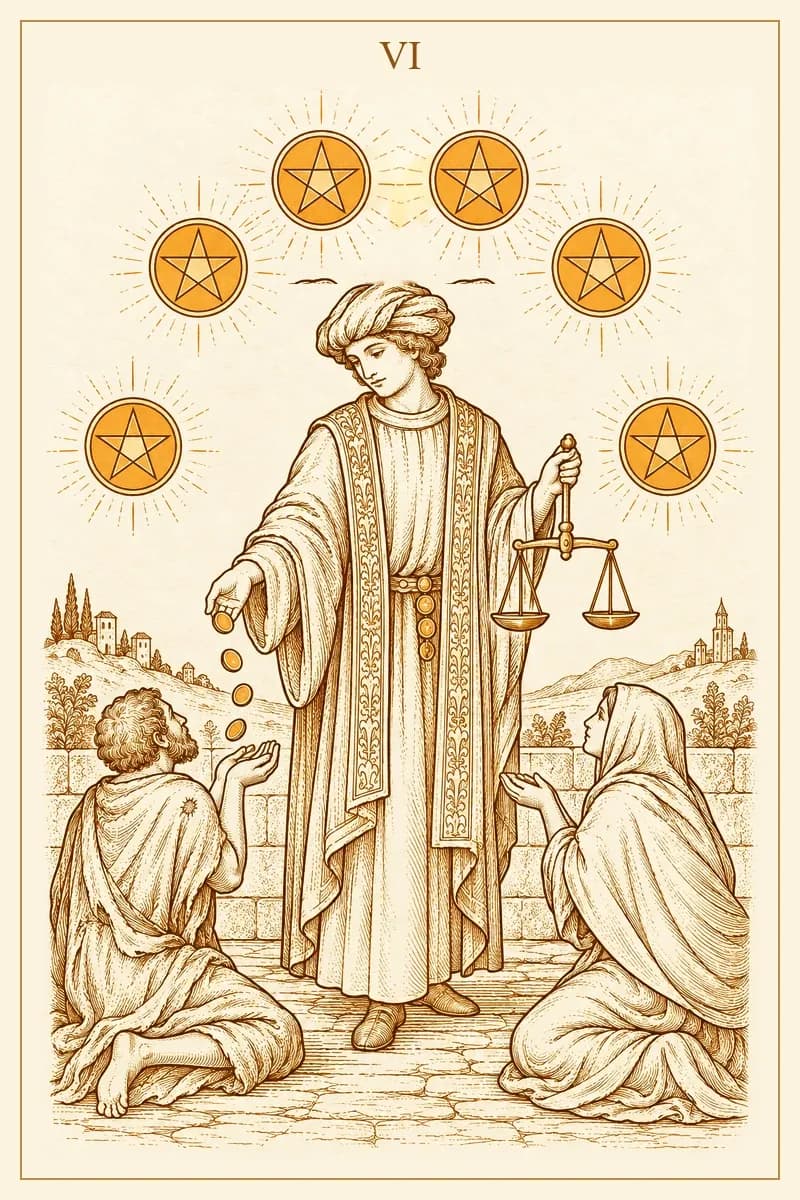
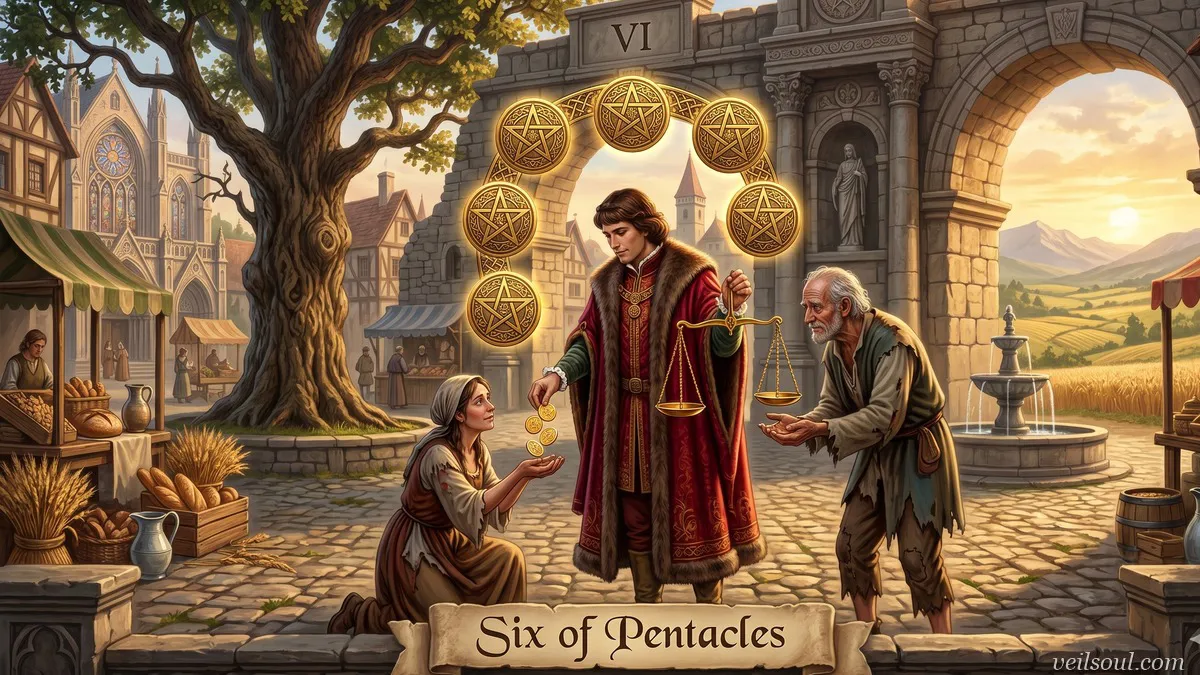
Six of Pentacles: the scene on the card
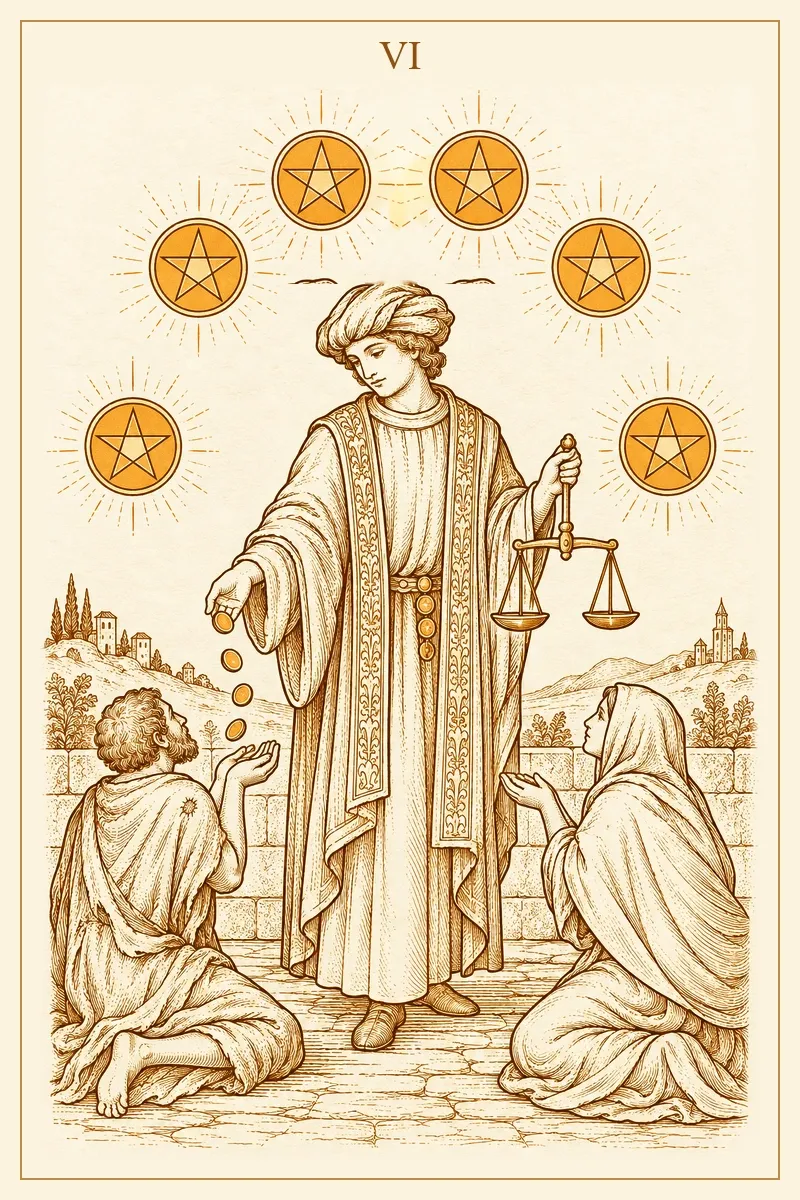
A standing figure in a turban and a long embroidered robe holds the middle of the card, belt hung with small coin-like discs, feet on cobbled pavement. Two figures kneel on the ground, one to each side, and the Roman numeral six sits at the top. Nobody here is at the same height as anybody else.
A thin stream of four coins
One hand reaches out palm-down and lets a thin stream of four small coins fall toward the kneeling figure on the left, who is bareheaded and barefoot with cupped hands raised to catch them. The coins are not passed from one hand into another. They fall through air, and the receiver has to hold a position to collect them.
Both pans level, both pans empty
The other hand holds up a brass balance scale: two shallow pans hanging perfectly level, and both of them empty. It is not weighing the coins, and it is not a record of what has already been given. It is the giver's instrument, raised while the giving happens. Nothing has been counted yet — but something could be.
The hand that is still open
The second kneeling figure, on the right, is wrapped and hooded, with both hands raised open and empty. This one receives nothing in this moment. Both are kneeling; only one is being filled. The giver chose which hand to fill, and the card does not explain the choice.
Six pentacles overhead, a wall and two small towns
Six pentacles hang in an arc above the scene, each a star inside a gold disc with fine rays. They are in the air rather than in anyone's pocket: wealth in circulation, not wealth owned. Behind the figures runs a low dry-stone wall, and beyond it hills with cypress trees and a small hilltop town with a tower on each side.
Earth, the Moon in Taurus, and what a six is for
As a Minor Arcana card in the suit of Pentacles, the Six belongs to the element of Earth, so its subject matter is material: wages, rent, food, bodies, houses, practical help. An older esoteric title for it is Lord of Material Success, which is accurate but flat. The success here is a flow that works, not a fortune arriving.
In the astrological scheme many readers use, the card covers the second decan of Taurus and is assigned to the Moon, which fits: Taurus holds and tends, while the Moon gives and withdraws on a cycle. If you work with the signs, our guide to Taurus and tarot sets out the rest of that correspondence. The number matters too. After the Five of Pentacles, with its two figures passing a lit window in the snow, a six restores a workable balance — not abundance, just a situation that functions again.
When the giving is real: the upright reading
Upright, the exchange works. Something changes hands and nobody is keeping score, because the scale stays empty: no one has decided to use it. You may be the one with coins to release, covering a bill, teaching a skill, writing the reference. You may be the one with cupped hands, and the instruction then is to hold the position and take what is offered instead of refusing it out of pride.
Received well, the help is proportionate: the right size for the problem, early enough that the problem is still solvable, and offered without a speech. Mentorship reads like this, and so does a raise that matches the work.
- Help that lands in time to make a difference
- Receiving without shame, and without an instant need to repay
- Sharing knowledge, access or a contact rather than money
- A fair split of resources inside a team or a household
- Charitable work, volunteering, funding something you believe in
- Noticing that you are, for once, the one with enough
When the scale belongs to someone else: the reversed reading
Reversed, the picture does not turn cruel. It turns conditional. The scale comes down off the giver's hand and starts getting used, and the three roles in the card go wrong in three different ways.
The gift that is buying something
Help arrives with a price that was never said out loud: visits, loyalty, agreement, silence about something. You notice it when a disagreement becomes harder because of what someone paid for. If you are the giver here, the question is uncomfortable and worth asking anyway. Would you still give this if you got nothing back, not even thanks?
The count nobody admitted to
Both pans fill up with a tally. One person remembers every transfer; the other remembers every favor returned. This is the reversal behind many money arguments between people who love each other, and it is rarely settled by paying the amount back, only by saying the number out loud and agreeing what closes it.
Being the hand that keeps waiting
The reversal also speaks for the hooded figure on the right. You applied, you asked, you were patient, and the help went elsewhere. The card does not ask you to be gracious about that. It asks something practical instead: is this the only hand you can hold out, or is there a second place to ask?
In love: the partner who provides and the partner who asks
In a relationship reading the Six of Pentacles rarely means romance. It means the logistics of care: who pays, who drives, who takes the time off, who gets to decide what the household can afford.
If you are the one giving
Supporting a partner through study, illness or a gap in work is one of the better things this card describes, and it holds while the support is freely given and time-limited in your own mind. It stops holding the moment you begin narrating it. For singles, it often points at generosity as the first thing people notice about you; it is worth checking that it is not the only thing on offer.
If you are the one asking
Being the partner with less money is not a character flaw, and the card is unusually kind here. Your contribution exists; it is simply not denominated in currency. Name it to yourself first: the cooking, the admin, the emotional work, the years you spent carrying the other half of this. Then accept the help without apologizing for the rest of the month.
When it turns up reversed between you
Reversed in a love reading, money has become a lever. One person's income decides the holidays, the city, the end of the argument; or one person gives constantly and has quietly started to resent it. Both improve when the two of you name a figure, a split and a review date — unromantic, and more effective than another round of hinting.
Work, mentors and the person who signs off on the budget
At work this card is about sponsorship. Upright, someone with resources spends them on you: a manager who puts your name forward, a colleague who hands over the template they spent years building, a client who pays early because they know you need it. If you hold the budget, the reading is that you have more to give than you think, and that access is often worth more than money.
Reversed, the structure that decides who gets funded has become the problem: a token raise after a year of carrying a team, a mentor who keeps the useful contacts to themselves, approval handed out as a reward for agreement. Where the Emperor would tell you to build the structure, the reversed Six tells you to look at who stands and who kneels in the one you already work inside, and to ask directly for the thing you hoped would be offered.
Money, loans and help you did not ask to need
For a finance question the upright Six is one of the more practical cards you can draw: money moves, and the movement is fair. It can be a grant, a refund, a debt repaid, a friend covering the ticket. It can equally be money leaving your hands on purpose. If the real question is whether a long, slow investment is ripening yet, that belongs to the Seven of Pentacles instead.
Reversed, read the terms: interest, a repayment schedule nobody wrote down, a family loan that arrives with opinions about your spending. Where family money is meant to last across generations, the Ten of Pentacles describes the structure better; the Six covers this one transfer and whether this one is clean. Before you accept or offer, write down the amount, the date and what would count as finished. None of that is financial advice, and a card is no substitute for reading the paperwork.
Energy, caregiving and the cost of being the one who gives
Health questions with this card are usually about care rather than symptoms, and nothing in a reading replaces a professional opinion. Upright, support is available and you are allowed to use it: the sibling who comes to the appointment, the neighbor who takes the dog, the practitioner who explains things properly. Reversed, it describes the slow erosion of the person who is always the carer, the one whose own checkups keep slipping. Someone has to fill your hand too, and you may have to say so first.
Generosity that does not need an audience
Read spiritually, the six pentacles overhead are the point. The wealth in this card is in the air and in motion, never owned by the figure handing it on, and the practice it suggests is to let things pass through you: attention, money, credit for an idea, a recommendation. Reversed, the giving has found an audience: giving to be seen, teaching to be deferred to, using a position of care to stay in charge of someone. It still helps the receiver, and it costs the giver something.
What the Six of Pentacles answers when you want a yes
Upright, treat it as a yes with the terms attached: yes, help is available; yes, the exchange is fair enough to accept; yes, give the thing you were considering giving. It is a strong yes for questions about asking: will they agree if I raise it, should I apply for the fund, can I bring this up at all.
Reversed, it is not a no. It is closer to yes, and read it twice. Something in the arrangement is uneven, and the reading wants you to find the uneven part before you commit.
Four of Wands with the Six of Pentacles: help that pays for the threshold
This pair has a clear joint meaning: somebody else's material help is what makes a celebration or a move possible. The deposit, the van, the relative who quietly pays for the gathering.
Four of Wands: the milestone the gift makes possible
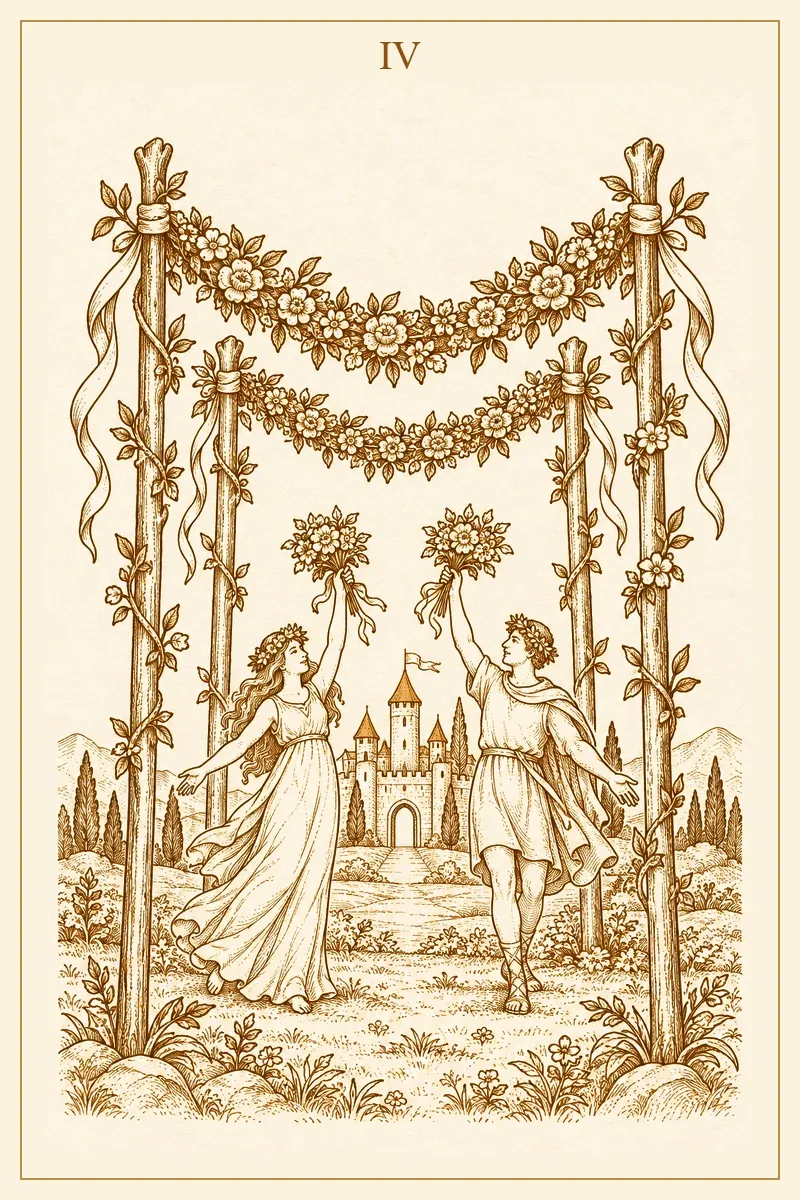
The Four of Wands is a welcome: a doorway marked, a milestone witnessed, a home you have just arrived in. On its own it says nothing about where the money came from, which is exactly the gap the Six fills — the full Four of Wands tarot meaning covers its other readings.
Reading the pair, upright and reversed
Both upright, the pair is generous and uncomplicated. Help arrived, the threshold was crossed, and the help is worth naming in front of people rather than keeping quiet. If you drew this about a move or a wedding, the practical reading is to put the giver in the room.
Six reversed with Four of Wands upright is the more interesting draw: the celebration is real and the help has a price. A guest list you did not choose, a parent with an opinion because they paid. Six upright with Four of Wands reversed inverts it — the money is there and the threshold keeps not being crossed, or the milestone is genuinely yours and you do not want it witnessed by the people who funded it. Both reversed, you are looking at a gathering that functions as a repayment. The question to carry out of the pair is short: did the gift come with a seat at the table, and whose table is it?
Three more pairs that change the giving
Five of Pentacles: the lit window you walked past
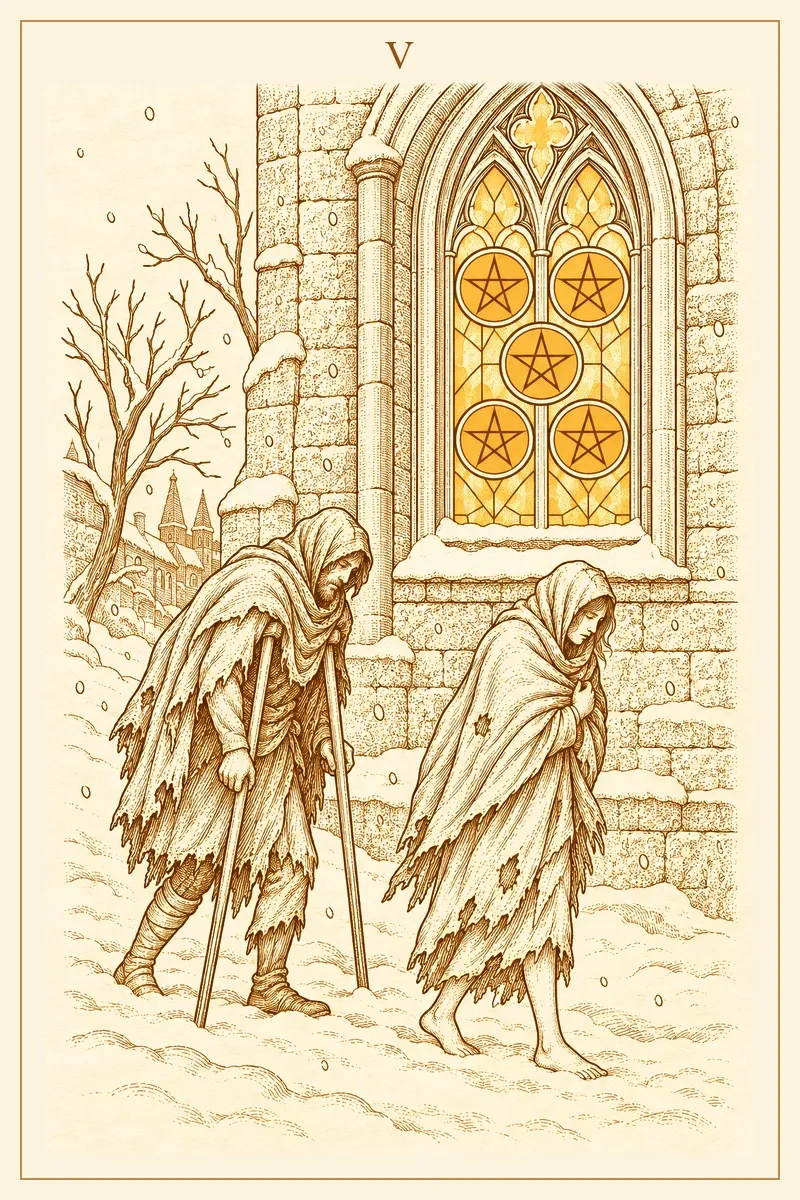
The Five and the Six are the same street seen from two sides. Together they usually mean help exists and has not been asked for: a hardship fund nobody applied to, a friend who would say yes, support you assumed was not for you. The pair is less about scarcity than about the gap between available and requested, and the Five of Pentacles meaning describes that cold side in full.
Four of Pentacles: the hand that closes
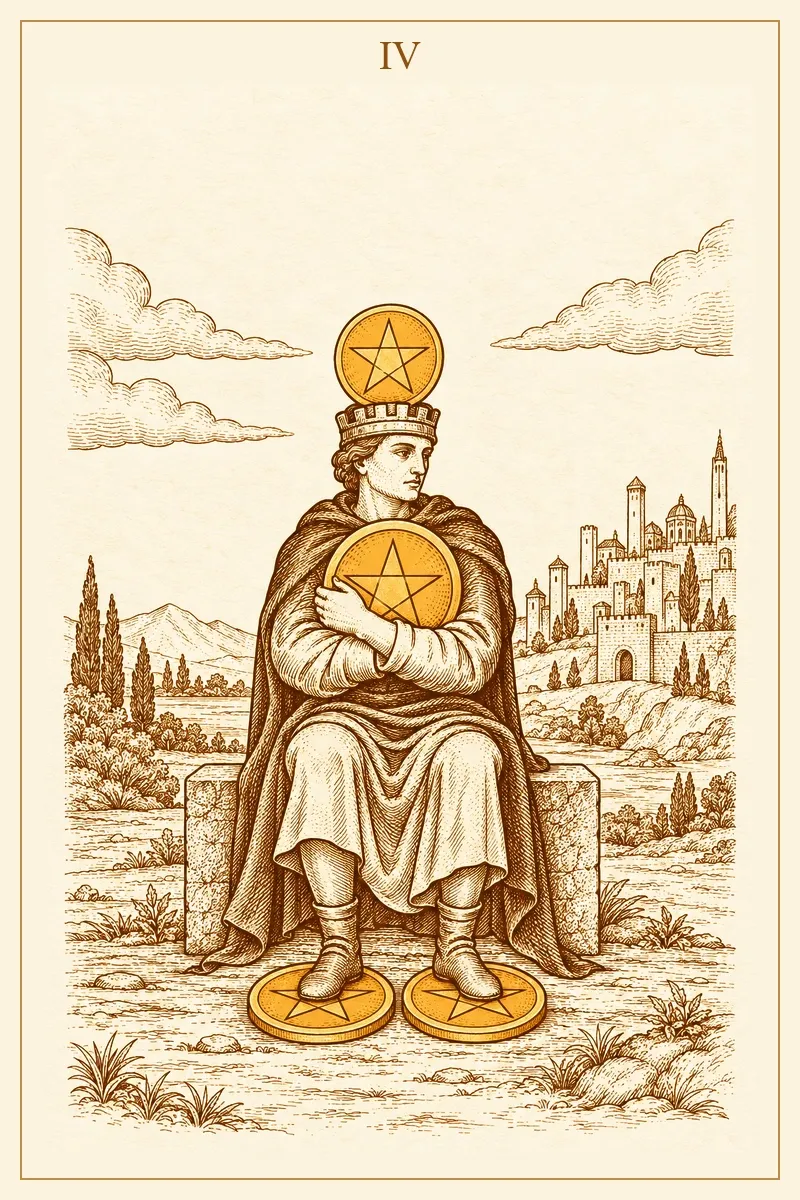
Put the Four of Pentacles next to the Six and you get the central tension of the whole suit: holding against releasing. The pair often turns up for people working out whether they can afford to be generous, and the honest answer is sometimes no. Protecting your own base is legitimate, and the Four of Pentacles meaning is not a character verdict.
Justice: who gets to hold the scale
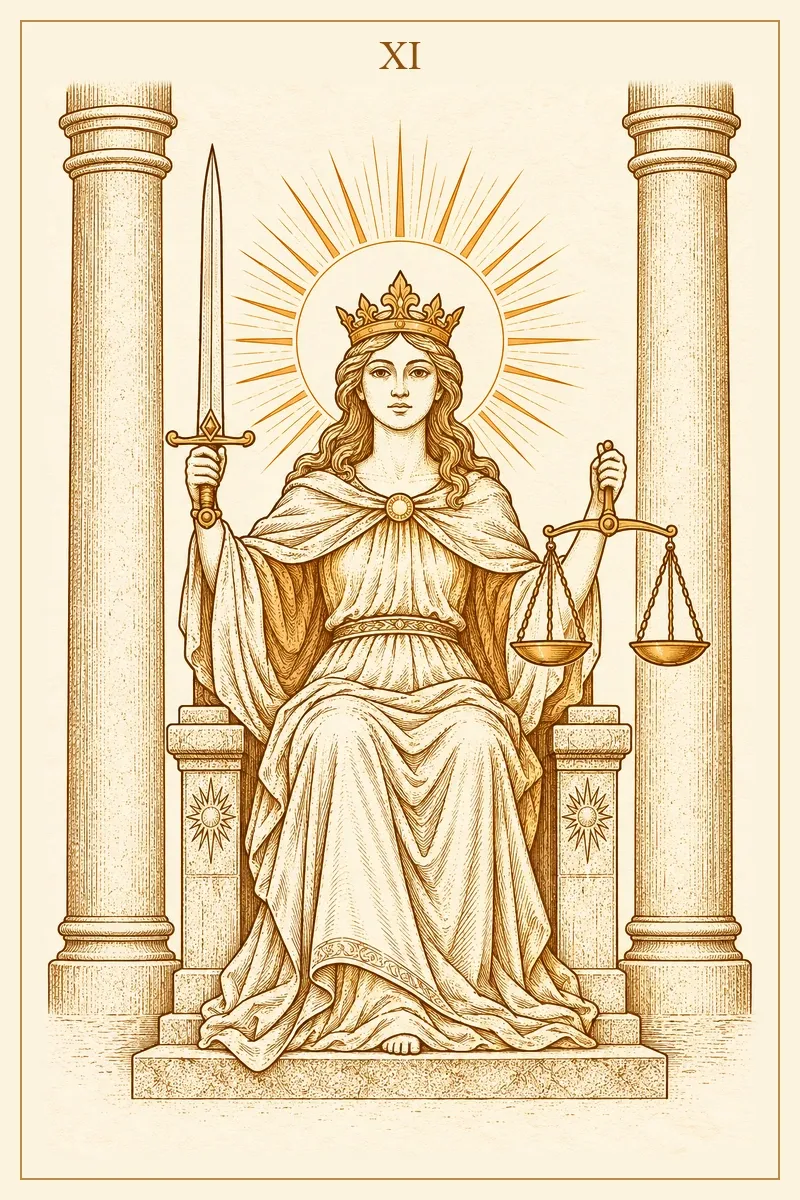
Two scales in one reading is hard to miss. Justice holds a scale that is actively weighing, while the Six holds one that is empty, so the pair asks whether this arrangement would survive being measured properly. It is the draw for unequal pay, an inheritance, a split that one side calls fair. Our Justice tarot meaning goes further into accountability; in this pair, read it as permission to ask for the numbers.
Three cards for a loan from family: a sample reading
Here is a sample reading. Consider a reader weighing a plain question: her brother has offered to cover three months of rent while she retrains, so should she take it? Three cards, laid left to right for what the offer is, what accepting would ask of her, and where it could lead.
First position, Six of Pentacles upright. The offer is what it looks like: proportionate, timed to be useful, made by someone who can currently afford it. Second position, Four of Pentacles reversed: the grip opening. Read as the cost of accepting, it was not about her brother at all but about letting go of a self-image built on never needing anyone. Third position, the Nine of Pentacles: standing on her own ground, on money she earned herself.
What she took away was not a simple yes. It was one sentence to send: I would like to take it, for three months, and I want to tell you what I am doing with it. The cards could not reveal her brother's motive or promise that the retraining works. They did show her that the part she was resisting was the asking rather than the money.
The Level Scale spread: five positions for giving and receiving
Use this when an exchange feels lopsided and you cannot say why. Five cards, named after the parts of the picture.
- The coins in my hand — what I actually have to give right now, in money, time, access or attention.
- The hand I am filling — who or what already receives most of it.
- The hand still open — who or what is waiting and getting nothing, myself included.
- The empty pans — the count I have not admitted to keeping.
- Who holds the scale — where the power in this exchange actually sits, and what would level it.
Read positions four and five together, because that pair is where the useful discomfort lives. If the fifth card describes another person, the spread is telling you to go and negotiate rather than keep adjusting on your own. If it describes you, you are allowed to put the scale down.
Five things to do before you give again
- Name the amount and the end date before the money or the hours leave, even if only in a note to yourself.
- Say what you expect back, or say plainly that you expect nothing. That second sentence is one the other person needs to hear.
- Ask the hand that has been open what it actually needs. It is often not the thing you were about to give.
- If you are receiving, write down the non-financial things you contribute and stop treating them as invisible.
- Pick one standing arrangement and review it this month instead of next year: a loan, a subscription, a lift you always give.
Five honest questions about your own scale
- Which figure in the card am I this month: the one standing, the one being filled, or the one still waiting?
- What would I stop giving if I knew nobody would ever thank me for it?
- Is there a tally running that I have never mentioned to the other person?
- Where am I waiting to be offered something I could simply ask for?
- If I let the coins pass straight through me, what would I lose that I am not ready to lose?
Frequently asked questions
What does the Six of Pentacles mean?
A measured act of giving, and the relationship that act creates. Help moves from someone who has enough to someone who does not, and the card is as interested in the power sitting inside that transfer as in the kindness of it. Upright the exchange is fair and nobody is counting; reversed, something is being counted or bought.
What changes when the Six of Pentacles is reversed?
The scale stops being a symbol and starts being used. Expect conditions, an unspoken tally, dependency that has outlasted its usefulness, or the experience of being the person who keeps asking and not receiving.
Does the Six of Pentacles answer a yes-or-no question?
Upright, lean yes, with the understanding that the yes has terms. Reversed, read it as yes with the arrangement checked rather than as a refusal. For anything that depends on another person's decision, one card is a prompt to go and ask them.
Will money actually arrive when this card appears?
Sometimes, and the card can neither promise it nor date it. It is far more reliable as a description of how money is moving around you than as a forecast of a sum landing. If income specifically is the question, the cards that suggest money coming in are a better place to start.
How do I read it when one partner earns far more?
As an invitation to make the arrangement explicit. Decide what counts as a shared expense, what each person keeps, and which non-financial contribution is being treated as equivalent. The card flags the imbalance; the two of you decide what fairness means.
What is the difference between the Six and the Five of Pentacles?
The Five is the experience of lacking and feeling shut out. The Six is the moment help is actually moving, which is better, and which introduces a question the Five never had to ask: what does it cost to be the one receiving?
Can tarot tell me whether a particular person will help me?
No. It cannot see another person's intentions, their finances or their timing, and it cannot confirm a date or an outcome. What it can do is help you work out what you want to ask for, in what words, and what you will do if the answer turns out to be no.
The scale is still in your hand
The thing worth keeping from this card is the empty scale. Nothing has been counted yet, which means the count is still a choice: yours, if you are the one standing, and worth asking about if you are not. The six pentacles in the air are nobody's property.
If you want a quiet moment to work out which hand is yours right now, try a reading and write down the first honest answer before you decide who gets the coins.