Reading tarot at the turn of the year: start with a look back
Before you ask the cards about next year, use a year-end tarot spread to look back on the year that is closing. Lay six cards in the last days of December to close this year, then draw one card for 2027 once the new year has begun. Done in that order, the new year's card reaches someone who has already settled the old year.
The spread below does not predict next year. Tarot cannot settle what 2027 will bring, how other people will act or when anything will be decided. What six cards can give you is a set of prompts for writing down, in your own words, what ended, what grew and what you want to take with you.
Here are the six positions at a glance. Note that the last one is a question, not an answer: you carry it across New Year's Eve and draw your card for 2027 with it in mind.
- The heart of the year: the theme at your center all year long.
- What ended: what reached a close or finished its work this year.
- What grew: a strength or a bond that kept growing, perhaps without your noticing.
- What you set down: a habit or belief you do not need to bring into the new year.
- What you carry: what you want to keep close in 2027.
- A question for 2027: something you want to keep asking yourself in the new year.
How to lay out the six-card review spread
The shape is simple: two columns, with one card above them and one below. Clear a space about the size of eight cards and deal in this order.
- Write your question on paper, set it in front of you, then shuffle and cut.
- Place card 1 (the heart of the year) at the top center.
- On the row below, place card 2 (what ended) to the left and card 3 (what grew) to the right.
- Put card 4 (what you set down) under card 2, and card 5 (what you carry) under card 3.
- Place card 6 (a question for 2027) at the bottom center, a little below and between cards 4 and 5.
The left column (cards 2 and 4) is the closing side; the right column (cards 3 and 5) is the carrying side. Read top to bottom, each column tells one story: what ended leads to what you set down, and what grew leads to what you carry.
Deal every card face-down and turn them in this order: card 1, the left column, the right column, then card 6. If you lay the spread on New Year's Eve, you can leave card 6 face-down overnight and turn it on New Year's Day, so a night's sleep separates closing the old year from meeting the new one.
Phrase your question with yourself as the subject, such as "How do I want to close this year?" Asking "Will next year be a good one?" pulls you toward reading the cards as a forecast, and the material for reflection gets harder to see.
Questions to ask at each position
Decide what each position asks before you turn a card, and the reading stays steady. Pick the sample question below that fits you for each position before you deal, then answer it in one sentence once the card is turned.
1. The heart of the year
"What was I facing again and again this year?" "If I had to sum up the year in a word, what would it be?" This position looks for the theme beneath the events, not a list of them. A Major Arcana card here can mark a big turning point; a Minor Arcana card points to a theme that took shape bit by bit in everyday life.
2. What ended
"What came to a close this year?" "What do I no longer have to go back to?" Some endings are visible, like a job, a home or a relationship; others are not, like a way of thinking or a role. A bright card can mean you drew that line yourself; a heavy card may point to an ending that still hurts. Either way, you read it to acknowledge the ending, not to blame anyone.
3. What grew
"What grew in me this year?" "What can I do now that I could not do a year ago?" This position looks at roots rather than results. At the end of a year it is easy to count only what fell short; the card here shines a light on growth that was slow and easy to miss.
4. What you set down
"What do I not need to bring into the new year?" "Which habit or belief has finished its job?" If card 2 shows the end of an event, card 4 shows the emotional luggage that came with it. Simply noticing that you are ready to set it down is already a real step. For gentle ways to do the letting go itself, see tarot for letting go.
5. What you carry
"What do I want to keep close in 2027?" "What is the most useful thing this year gave me?" Here you choose which part of the growth in card 3 you will put to work next year. A connection, a new skill, a small rule that protects your time: the more concrete it is, the easier it is to remember in January.
6. A question for 2027
"What do I want to keep asking myself in the new year?" Read this card as a question you hand to next year's self, not as a preview of what will happen. Turn its picture or meaning into one sentence that ends in a question mark. It does not need an answer yet; a question you can return to now and then is enough.
Write the six answers in a notebook next to the card names. Reread them this time next year and you will have one more way to look back. For ways to keep that record going, see keeping a tarot journal of your readings.
Looking back on your year in love
The same six cards work for reviewing your year in love. Keep the layout and reword each position for your love life.
- The heart of the year: what you valued most in love this year.
- What ended: a relationship that ended, or a pattern in love that did.
- What grew: what love helped you grow, such as care for another person or putting your feelings into words.
- What you set down: waiting on a reply, comparing yourself with others, and the like.
- What you carry: the part of yourself you want to bring to your next love or your current relationship.
- A question for 2027: something you want to keep asking yourself about love in the new year.
If you have a partner, read the spread as the year of your relationship. A heavy card in position 2 does not mean the relationship will end. It can instead point to a misunderstanding settled this year, or a way of being together that has done its job.
If you went through a breakup this year, give positions 2 and 4 extra time. What ended and what you set down sound alike but are not the same: the relationship may be over while the habit of measuring yourself against the other person is still with you. Position 4 is where you look for that habit.
If you spent the year with a crush or on your own, read positions 3 and 5 with care. Even a year when love did not move much can hold some growth: perhaps you got clearer about what you like, or learned to enjoy your own company.
For a new year love card, a question with yourself at its center, such as "What do I want to honor in love in 2027?", serves you better than asking about someone's feelings or when you will meet someone. Knowing what you want makes it easier to choose how you meet people and tend a relationship. To look at a relationship in more depth, pick a layout from tarot spreads for love and relationships.
A fictional example: closing a year of changing jobs
What follows is an example built around an invented person. In the spring, Nao left a company after eight years and moved to a small firm in a different industry. On a quiet night at the end of the year, Nao wrote "How do I close this year of changing jobs, and what do I bring into 2027?" on a sheet of paper and laid out six cards.
- The heart of the year: Eight of Pentacles
- What ended: Death
- What grew: Strength
- What you set down: Eight of Swords
- What you carry: Page of Pentacles
- A question for 2027: Temperance
The Eight of Pentacles in position 1 is the card of a craftsperson working one piece at a time and sharpening a skill. Read through it, Nao's year centered less on the big decision to change jobs than on the daily work of learning a new trade from scratch. The moments Nao wanted to keep came not from the first day but from an ordinary weekday, the first time a task was Nao's alone.
Death in position 2 reads plainly here. What ended was the title Nao had built over eight years, "me at the old company," along with a role that had become second nature. The card stung a little. Leaving had been Nao's own decision, yet the loneliness of losing a place to belong was real, and acknowledging the ending meant acknowledging that loneliness too.
On Strength in position 3, a woman crowned with flowers rests one hand on a lion's head and the other gently at its open jaws. What grew was a quiet steadiness: keeping panic down in unfamiliar situations and being able to say "I don't know." At the old company Nao had rarely needed to ask anyone anything, so this strength was new.
The Eight of Swords in position 4 shows a blindfolded figure, bound with rope, standing in shallow water among upright swords. Here it pointed to the ideas Nao had been tied up in: "Only the old company's way of doing things is valid," and "It's embarrassing to be taught by a younger colleague." Yet the swords stand only to either side, leaving the way ahead open. Nao decided to leave those beliefs in this year.
The Page of Pentacles in position 5 is the card of the student. What Nao carries forward is the attitude of a beginner who keeps learning. As the work becomes familiar in 2027, that attitude may slip away, which is exactly why it is worth carrying on purpose.
On Temperance in position 6, a winged angel pours water from one golden cup into another. From it, Nao made the question "In what proportions do I want to blend the new job with the rest of my life?" Work had taken up nearly everything that year, and Nao wanted to choose days off with the same care.
Read as a whole, the left column runs from the end of a title to a self-limiting belief, and the right column runs from quiet steadiness to the habit of learning. Nao wrote one line in a notebook, "In 2027, stay a learner and rebalance the mix with the rest of life," and planned to draw one card after the new year began, with that question in mind.
When The Tower, Death or the Ten of Swords appears
A heavy card in a year-end spread can make even next year feel dark. But these six cards are laid out to close a year, so a heavy card here is read as something that has already happened or is already ending, not as something on its way. Here are three of the heaviest, read by position.
The Tower
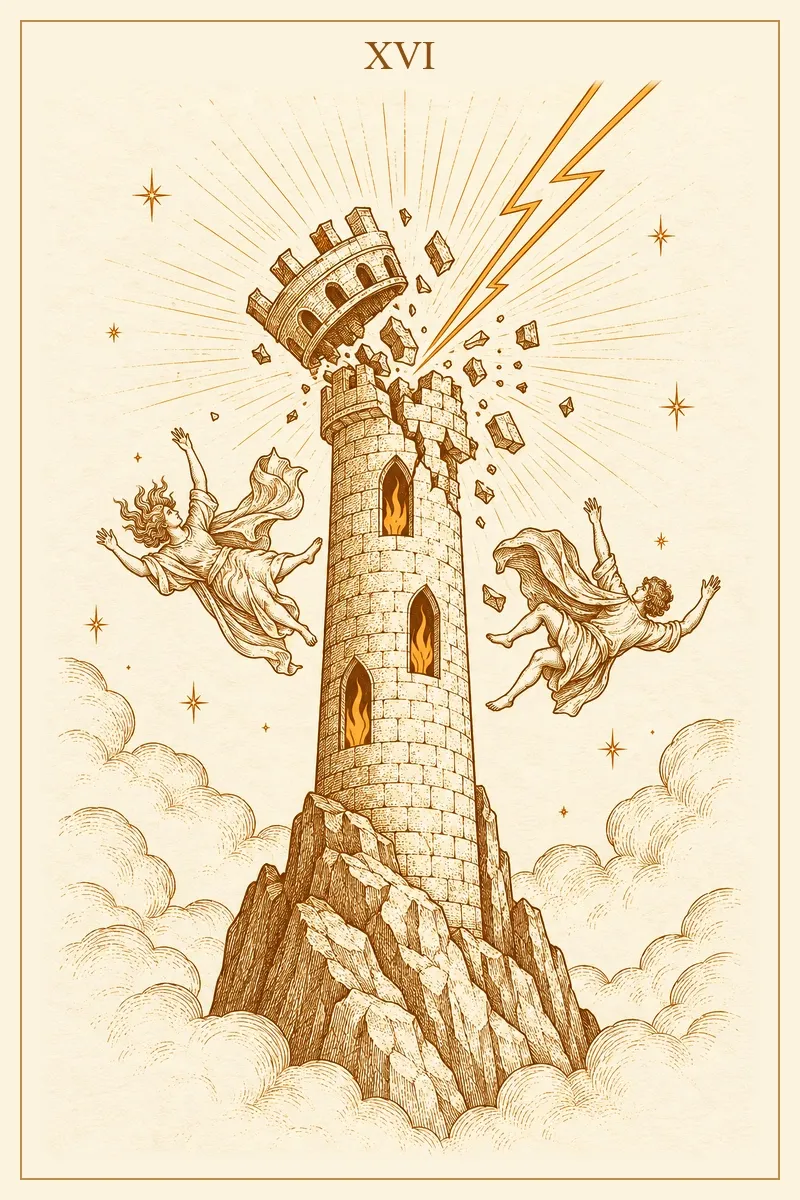
On The Tower, a golden lightning bolt strikes a tower on a rocky peak and knocks its whole top into the air. Flames show in the windows, and two figures fall away to either side. The card stands for sudden change, a belief that collapses and something hidden coming to light.
In position 2 (what ended), The Tower shows that something unexpected this year has already become a dividing line. In position 4 (what you set down), it can be a plan you were propping up by force, or a "this is how it should be" that was quietly cracking. In position 1, admit plainly that this was a shaken year. Reversed, it describes a change caught before the collapse, or one you have avoided that still smolders. The upright and reversed meanings are covered in The Tower tarot card meaning.
Death
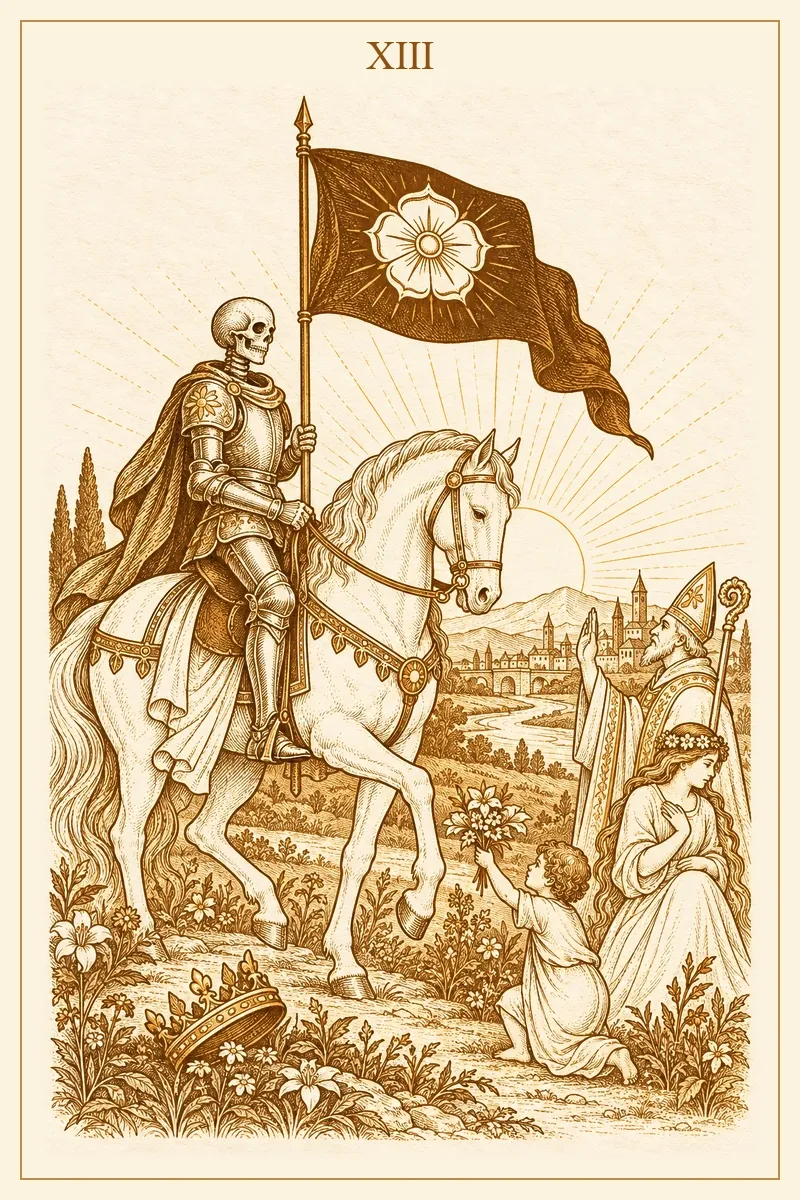
On Death, an armored skeleton rides a white horse and holds up a black banner marked with a white rose. A crown lies fallen among the flowers; in front of the horse a child holds out a bouquet, a woman wearing a wreath of flowers kneels and a bishop raises one hand. Beyond a distant town and river, the sun sits on the horizon.
Death stands not for literal death but for one stage closing and the next beginning, a natural fit for a review spread. In position 2 it says this year's ending is nearly complete; in position 4, that you are ready to let go. In position 5 (what you carry), you take the capacity to keep changing into next year. Reversed, it can show an ending you are dragging out. There is no need to rush; seeing which stage you are in is already a step. For the fuller meaning, read the Death tarot card meaning.
Ten of Swords
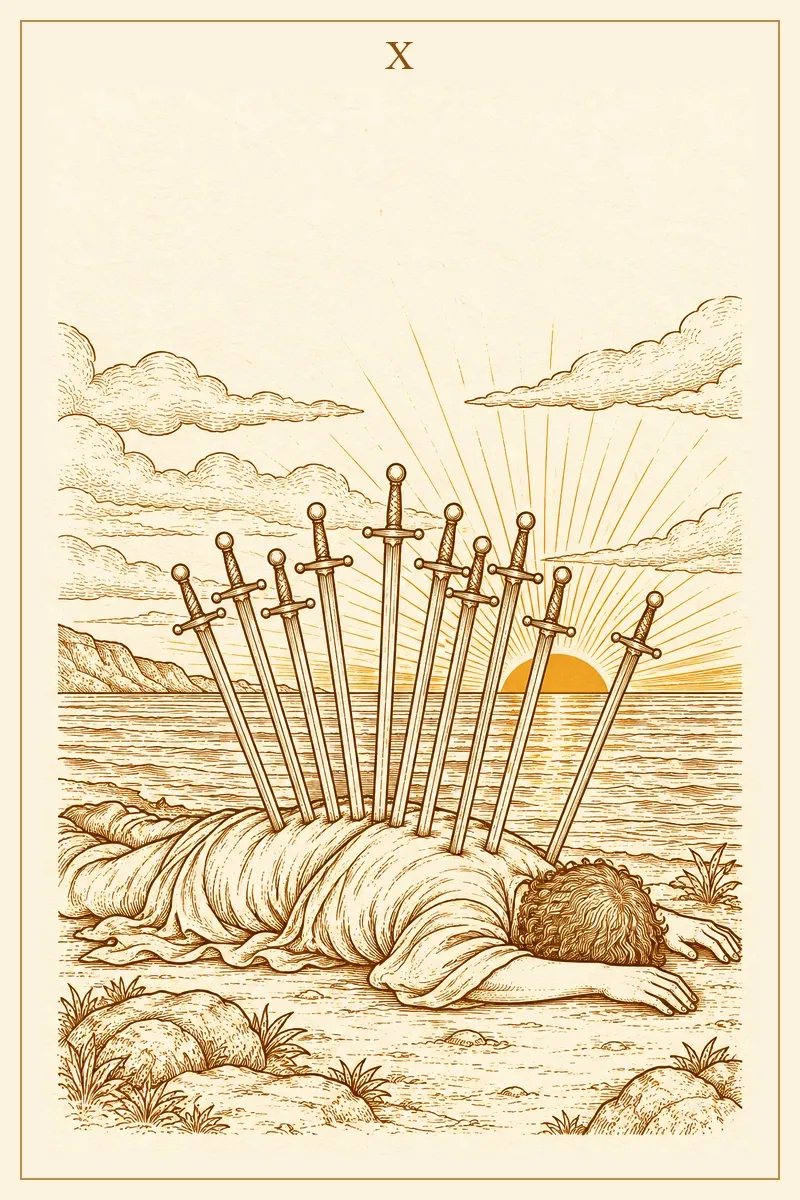
On the Ten of Swords, a figure wrapped in cloth lies face-down by the sea with ten swords in a row along its back. Lift your eyes, though, and a half-risen sun beyond the calm water sends out its rays while clouds drift overhead. The card holds the pain of an ending and a floor that cannot get any lower in the same picture.
In position 1, it asks you first to acknowledge that you came through a very hard year. In position 2, it says a long stretch of difficulty reached its close this year. In position 3 (what grew), look for the strength you gained by hitting bottom, or for having learned to lean on others. Reversed, read it as recovery in progress. For more on the card, see Ten of Swords upright and reversed meanings.
None of the three announces a bad event for next year. If a run of heavy cards weighs on you, put the spread away for the night, have something warm to drink, sleep, and read it again another day.
When to draw: New Year's Eve, New Year's Day and the first day of spring
There is no rule about which day to lay the review spread, but the turn of the year offers a few natural dividing lines.
- Winter solstice (around December 21 or 22): the longest night of the year in the Northern Hemisphere, for looking back before the end-of-year rush.
- New Year's Eve (December 31): the last day of the year, and the clearest day to close it with six cards.
- New Year's Day (January 1): turn the card 6 you left face-down and draw your card for 2027.
- Risshun (around February 4): the first day of spring in the traditional East Asian calendar, a dividing line if you had no time at the turn of the year or your year feels as if it begins with spring.
New Year's Eve tends to fill up with cleaning, travel and family. Rather than forcing the spread late at night, choose a calm evening in the last week of December so you can read without hurrying. About thirty minutes is enough.
If you want a habit of reading at the turning points of the seasons, seasonal tarot practices, beginning with the winter solstice, gives a spread for each equinox and solstice. Pairing a solstice reading with this review lets you meet the end of the year over a little more time.
Into 2027: one card, a seven-card year reading or a thirteen-card twelve-month spread
Once the year is closed, turn toward the new one. There are three main ways to draw for 2027; choose by how much time the review took and how closely you want to look at next year.
One card: the lightest option. Holding the question from card 6, you receive a single theme for 2027, and after an unhurried review that may be all you need. The page where you can draw one card for your 2027 year ahead lets you pull it for free, without an account.
A seven-card year reading: four cards look at love, work and learning, money and the people around you, and three add something to watch, how you are changing and advice. The seven-card year reading is available once you sign up for a free account. It suits you if you want to decide where in your life to use what you carry.
A thirteen-card, twelve-month spread: one card for the theme of the year plus one for each month from January to December. It fits anyone who wants to check in month by month or use the cards alongside a planner. The layout and reading method are covered in laying out the twelve months of 2027 in thirteen cards.
If you are unsure: one card if the review left you tired, seven to think area by area, thirteen for a monthly companion to your planner. Whichever you choose, read the cards beside the question from card 6 rather than as a schedule.
Frequently asked questions
If I miss the end of the year, is it too late once January starts?
No. The best time to look back is when you feel ready to close the year, and mid-January or the start of spring works just as well for the six questions. If you lay the spread after the new year, read positions 2 and 4 as "what ended last year" and "what I leave behind in last year."
Can tarot tell me what will happen in 2027?
It cannot. Tarot cannot settle future events, dates or other people's decisions. A single card for 2027 or a full year reading is not a preview; take it as a theme for thinking about how you want to spend the year. As with the six review cards, deciding what to do is up to you.
I drew nothing but heavy cards, and it feels as if the spread is rubbing in what a hard year it was.
If it truly was a hard year, the cards may simply be reflecting that honestly. Go back to position 3 (what grew) and position 5 (what you carry): even among heavy cards, the strength that carried you through should show up somewhere. When your mood is low, do not push through the reading; talk with someone you trust first.
Can I look back on the year together with a partner or family?
Of course. Each person can lay their own six cards and share only card 5 (what you carry) at the end. To look back on the relationship itself, use the love-year questions, and let the cards be a reason to listen to each other rather than a way to pin down the other person's feelings.
I do not remember much about this year.
That is fine. Before you lay the cards, scroll through your phone's photos or your planner from January onward and jot down a word or two for each month. Ten minutes of this can bring back the outline of the year, and the cards then help you pick out what mattered.
When a card makes no sense to me, can I draw again?
Try not to redraw on the same night; redrawing a card you dislike turns the review into a hunt for reassurance. Leave a one-line note about the card instead and read it again on New Year's Day or at the start of spring. With time in between, the same card can look completely different.
Lay the six cards that close your year slowly and at your own pace. When you want to sit with a question of your own a little longer, you can draw cards quietly at any time in a tarot reading on Veil Soul.