
When a career change comes to the cards, four of them carry most of the weight: Death for an ending that has already happened, the Wheel of Fortune for a turn you did not schedule, the Queen of Swords for a decision made with a clear head, and the King of Wands for a move you are ready to lead rather than merely survive. Read beside the Eight of Cups and the Two of Wands, they answer the question underneath most career change readings: is this the discomfort of growing, or the discomfort of having stayed too long?
Tarot cannot name the month to hand in your notice, confirm that a hiring manager has chosen you, or promise a salary will hold. What a reading does well is separate the parts of the decision — what you are leaving, what you are walking toward, and the thing you keep not looking at — so you can see which one is driving you. Let the cards work as a mirror, and let savings, contracts and real conversations settle the facts.
Before the longer sections, each card in one line:
- Death: something here has already ended; what is left to choose is how you leave.
- Wheel of Fortune: the situation is turning anyway, so timing matters more than nerve.
- Queen of Swords: decide on information, not mood; ask the cold questions you have avoided.
- King of Wands: you have the standing to run the new thing, not only to want it.
- Eight of Cups: nothing is broken and nothing is alive; that emptiness is reason enough.
- Two of Wands: you are choosing from strength, with a plan you can describe out loud.
- The Fool: the right step, taken before logic can justify it.
- The World: not a failure but a finish.
- The Hanged Man: change the view before you change the job.
- Seven of Pentacles: something you planted is still filling out; leaving now hands over the harvest.
- Temperance: build a bridge instead of jumping a gap.
- Four of Pentacles: security is a fair reason to stay; fear wearing security's coat is not.
Four cards a career change question keeps turning up
These four are worth knowing closely for work readings, upright and reversed, along with what each says about leaving set against staying. None of them is a verdict; each describes the ground you are standing on, which is more useful than a yes.
Death: the ending that already happened
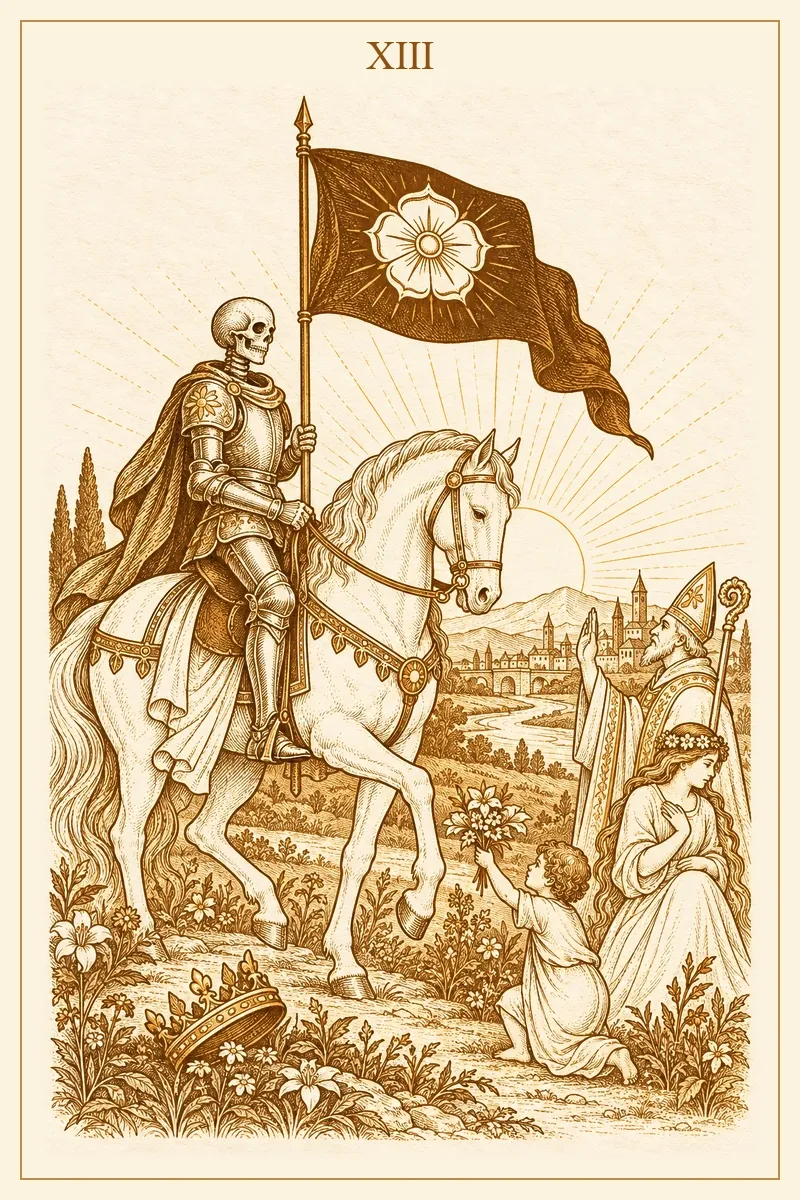
Upright, Death rarely announces a change that is coming. More often it names one that took place quietly: the role you outgrew two reorganizations ago, the craft you no longer practice, the ambition you let go of without telling anyone. If you have been waiting for a sign that it is time, this card suggests the ending is behind you and only the paperwork is ahead. Our longer piece on Death as an ending that makes room is worth reading before you take the card personally.
Leaving or staying. Death leans toward leaving but is particular about how: not a dramatic exit, a clean one, with notice given properly and the handover written down. Reversed, it describes resistance rather than reprieve — you know the chapter is over and you are holding the door shut with your shoulder. It can also mean a transition stalled halfway, where you left mentally months ago and have taken no step since.
Wheel of Fortune: a turn you did not schedule
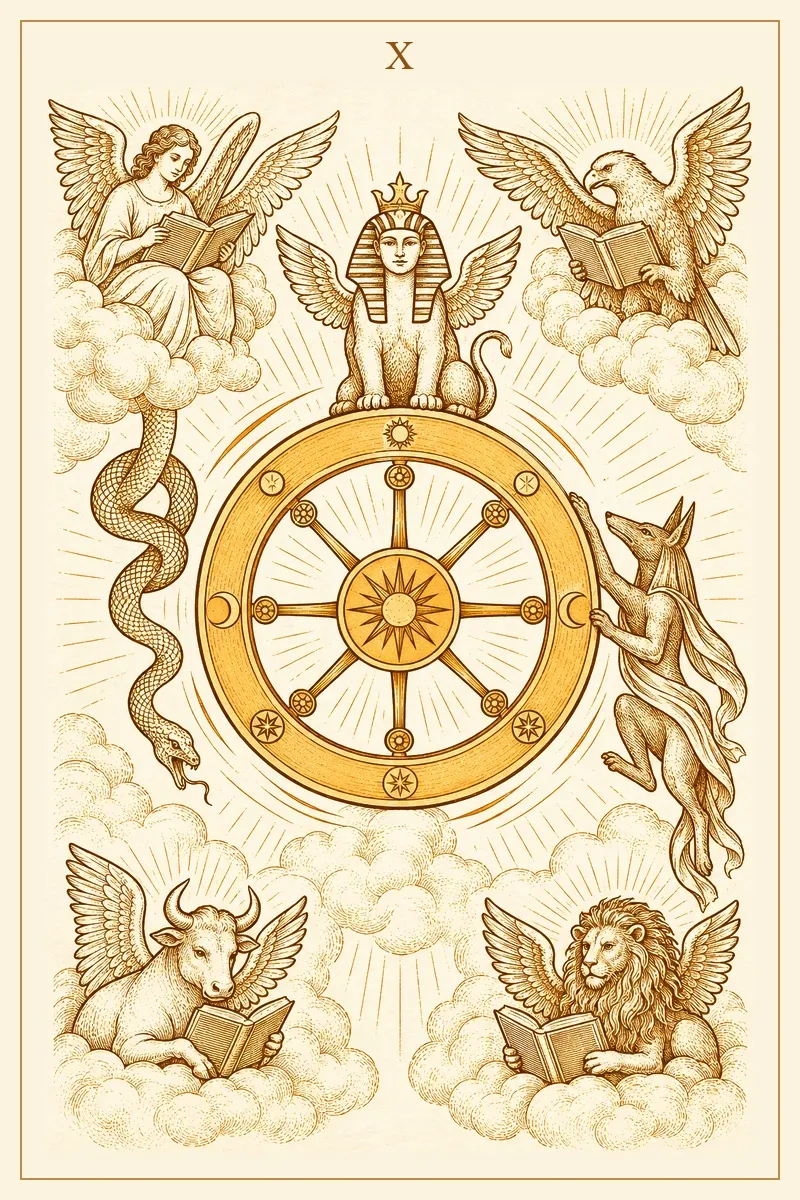
Upright, the Wheel of Fortune says the situation is moving on its own. A department is restructured, a market shifts, a manager leaves, an industry quietly changes shape. This is not a promise of luck; it is a note that the cost of waiting has gone up, because what you would be staying for may not be there in a year. The Wheel of Fortune as a card of cycles and turning points explains why it carries so much weight in the middle of a career spread.
Leaving or staying. The Wheel favors whichever choice you can make before the turn makes it for you. If you want to go, go while you still have a say in the terms. If you want to stay, make yourself useful to the version of the job that is arriving, not the one leaving. Reversed, you are fighting a cycle instead of reading it — reapplying for the same kind of role and meeting the same wall. Change one variable rather than repeat the attempt.
Queen of Swords: deciding with a clear head
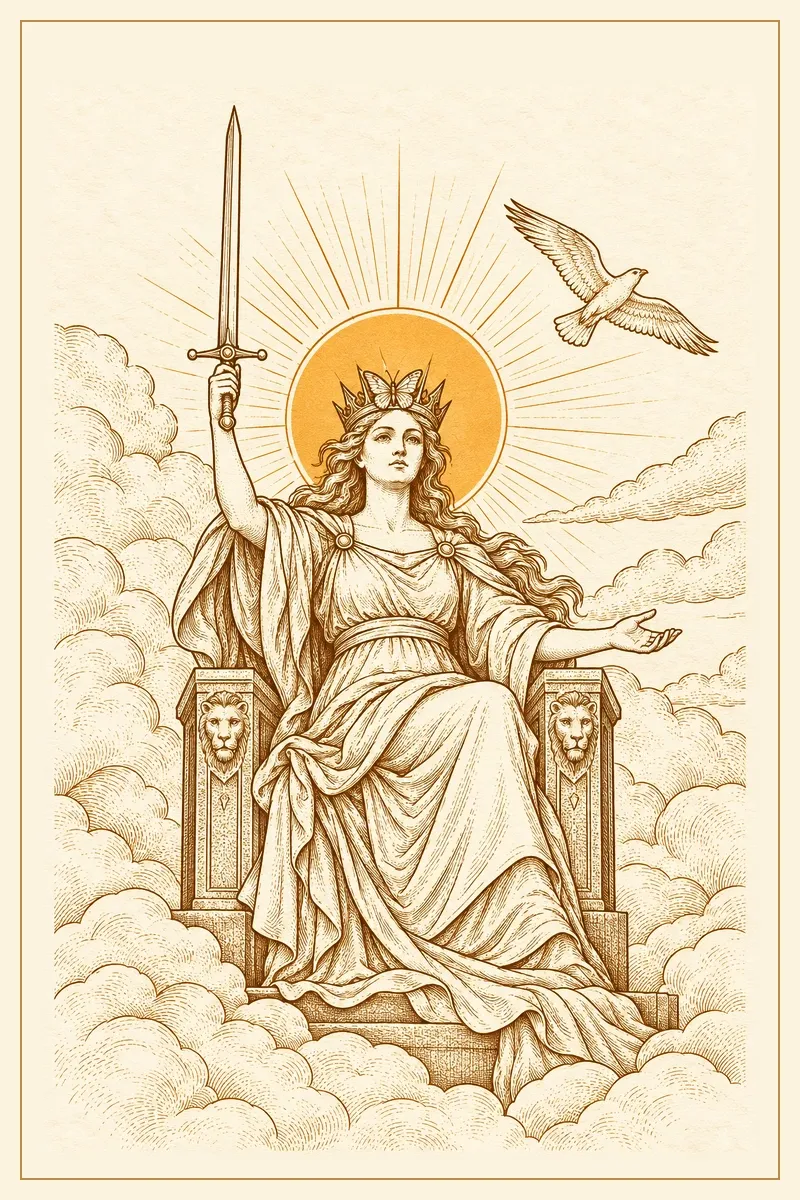
Upright, the Queen of Swords is the career change card for people who have done plenty of feeling and not much arithmetic. She asks the cold questions: how many months of expenses you actually have, what the new field pays at your level, who in it would take your call, which skills transfer and which do not. She is not cynical; she has learned that kindness toward yourself includes telling yourself the truth. The Queen of Swords and her clear, independent judgment make more sense once you meet her as an ally rather than a critic.
Leaving or staying. She backs either, on one condition: that you can write the reason in a sentence and defend it. Reversed, the clarity turns inward and sours into commentary about how far behind you are and how late it is to start. She can also describe a workplace where honesty has become a weapon, in which case the change you need may be out of one room rather than out of a profession.
King of Wands: a move you can lead
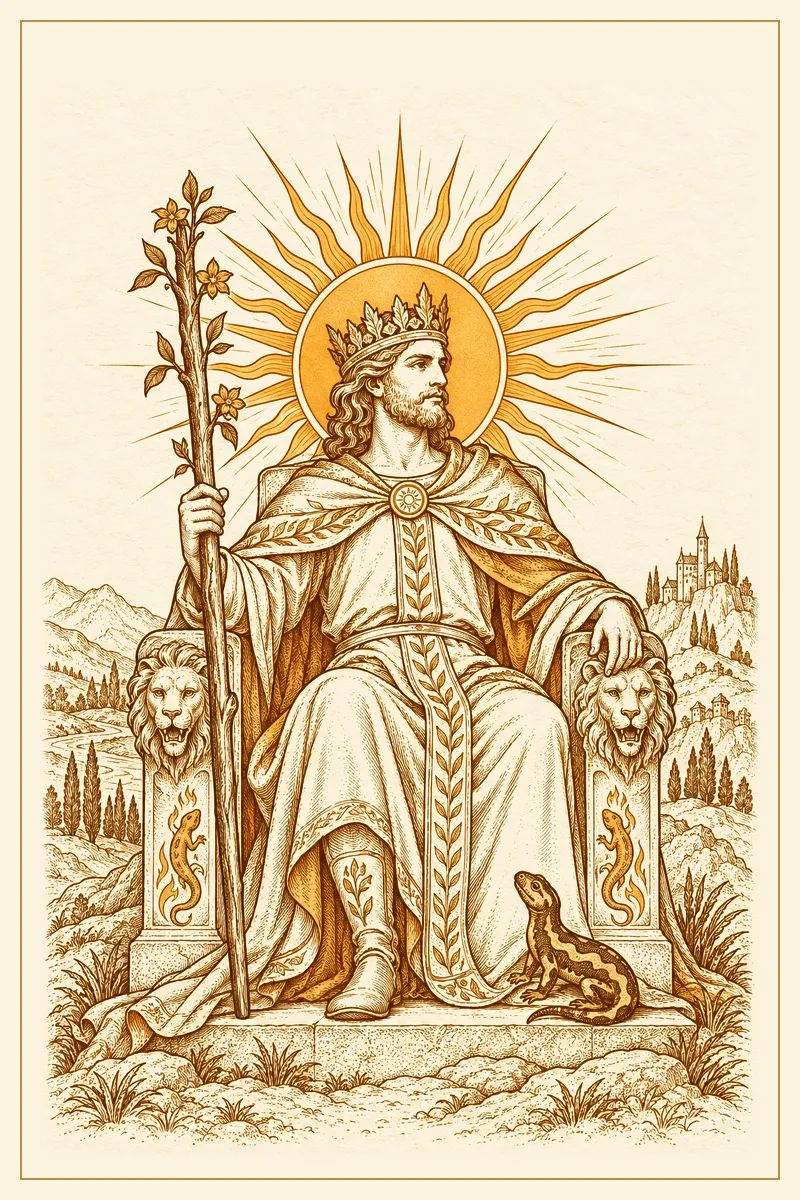
Upright, the King of Wands is the difference between wanting a new career and being ready to carry one. He is vision with a track record: someone who has already done the smaller version of the plan. In a career change reading he points toward work where you set the direction — a practice of your own, a founding role. For the full picture of his visionary, bold kind of leadership, read him as a long-term signature rather than one event.
Leaving or staying. He favors leaving when the current role has no room left for your judgment, and staying when the room exists and you have not used it. Reversed, he is appetite without groundwork: the pivot announced before anything was tested, the resignation drafted at midnight. Give the reversed King one small live test before the big one.
Signs the move is already underway
Those four set the terms. The next group tells you how far along you already are.
Eight of Cups. Nothing has gone wrong — the cups are full and set in neat rows — and still someone walks away by moonlight. In career terms: the pay is fine, the colleagues are decent, and you cannot remember the last time the work mattered to you. Our guide to walking away in search of deeper meaning follows that logic in full. You do not need a crisis to be allowed to leave. Reversed, it means one foot out and one foot in for far too long.
Two of Wands. Standing on your own wall with a small globe in hand, surveying rather than fleeing. You can see the next thing and you are weighing options from strength. If you can describe the new direction to a friend without apologizing for it, this card is already in your hand. Reversed, the view narrows to one hoped-for outcome with no second route drawn.
The Fool. The step the spreadsheet will not authorize: a different industry, a deliberate pay cut, training at an age you decided was too late. Not recklessness — movement before proof. Reversed, it asks what you are refusing to look at.
The World. The gentlest card here and one of the easiest to misread. You did not fail this career; you finished it. Reversed, something is still open, and closing it makes the next move easier to explain.
When the cards ask for one more season
A reading that says wait is not a reading that says never. These cards describe something that has to develop or strengthen before a change will hold, and overriding them usually means making the same transition twice.
Seven of Pentacles: the harvest is not in yet
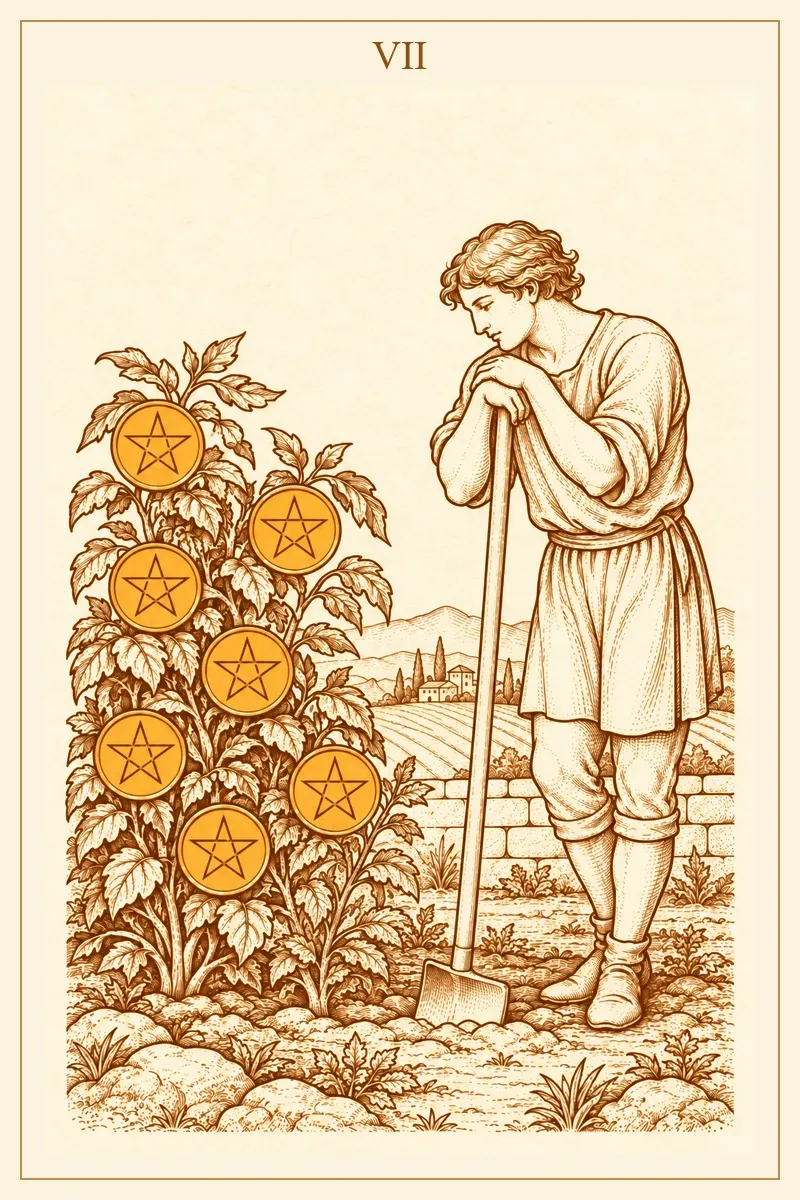
Upright, this is the grower leaning on his spade, assessing a bush that is loaded but unripe. In career terms it points to something you built that is about to pay: a qualification months from finishing, a client base thickening, a bonus cycle that vests. The card is not asking for blind patience. It is asking for a date. Our fuller look at patience and honest assessment of long-term work treats it as a review rather than a sentence.
Leaving or staying. Staying wins if you can name the thing ripening and when it lands; if you cannot, the card is describing sunk cost dressed as harvest. Reversed, the crop will not come in — effort going into work that does not compound, or a promise that keeps moving by one more quarter — which makes it one of the clearest go-ahead cards in a career spread.
The Hanged Man: change the view first
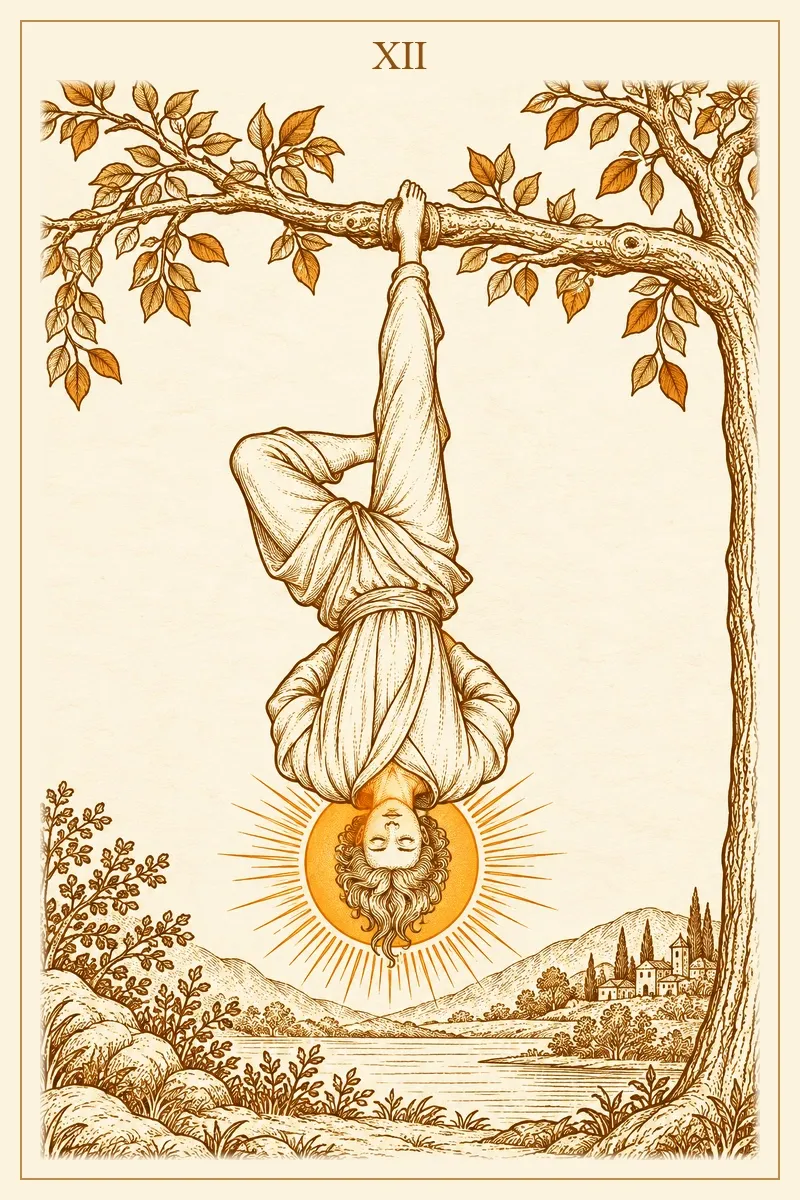
Upright, he hangs calmly, upside down, by choice. In a career reading he often says the problem is real but the diagnosis is wrong: it is this team and not this profession, this schedule and not this salary, the way you have been doing the job and not the job itself. He favors a deliberate pause — a leave of absence, a drop to four days, a month of working differently on purpose.
Leaving or staying. He is the only card here that genuinely likes suspension, and the pause works when it has an end date and a question attached. Reversed, the willing pause has become plain delay: months of research, a folder of saved listings, no application sent.
Temperance belongs in this group, and it is the most practical card in the set. It neither keeps you nor releases you; it asks you to blend. Freelance one evening a week in the field you want, move sideways into the department that touches it, teach the thing you would like to do full time. Temperance turns a cliff into a bridge, which costs more patience and much less money.
Four of Pentacles is the uncomfortable one: a figure holding his coins so tightly he cannot stand and walk toward the city behind him. The question is whether you are staying because the numbers work or because you cannot bear to loosen your grip. Staying for security is a legitimate adult choice; staying because of a fear you renamed security is what costs years.
What the deck can say about when
Tarot timing works better as conditions than as dates: the useful question is not which month but what has to be true. Our piece on reading timing in tarot goes through suits, numbers and seasons; for a career change, these two short lists do most of the work.
Conditions that read as now
- Several Aces in one spread — new material arriving in more than one area of life, which usually means more energy available than a single change needs.
- Eight of Wands — messages, interviews and introductions landing in quick succession. Answer the same week; the window is open and it is not wide.
- The Chariot — momentum you can steer, provided you pick one direction. It rarely rewards two applications in two different fields at once.
Conditions that read as prepare
- Page of Pentacles — a skill or credential is missing and the transition will not hold without it. Build the portfolio piece; do the small unpaid version first.
- Six of Swords — you are already crossing, just more slowly than impatience would like. Steady work on the move, not a fresh decision about it.
- The Star — something needs healing before it needs changing: burnout, a confidence knocked flat, grief over a role that ended badly. Rest first and decide afterward.
Money, runway and what the move costs
Career readings go wrong when the money question is left out of the spread, because it then runs the decision from the background. Give it a position and read it plainly. The Two of Pentacles is the usual card for the overlap period — two incomes, two schedules — and it reads well only if you have decided how long that juggle lasts. The Four of Pentacles in a money position asks whether your caution is sized to your actual obligations or to an old fear. The Seven of Pentacles there points to a sum worth waiting for.
None of this is financial advice. What the cards do is make you say numbers out loud: months of runway, the floor you will not go below, the date by which new work must cover a share of the old income. Our collection of cards that read as money coming in is a gentler starting point than a career spread for that side of the question.
A four-card layout for the change you keep circling
Four cards in this order, for a decision you have carried for months. Write the question down first and keep it open: not should I quit, but what am I actually deciding here.
- Position 1 — the real reason you want to leave. Not the version for dinner parties. The Five of Swords here says conflict rather than growth is driving, and a move made from it carries the fight into the next office. The Ace of Cups says something in you wants work you can feel.
- Position 2 — what is pulling you toward the new path. Read it for substance. A Pentacle means the pull is material and checkable; a Wand means appetite; a Cup means meaning; a Sword means an idea you have not tested.
- Position 3 — what is holding you back. Usually not what you assumed. Court cards often mean a person whose approval you await; Pentacles mean money; Swords mean a story about who is allowed to start over.
- Position 4 — the trajectory if you move within six months. A direction, not a guarantee: the likely weather if nothing else changes, and what you would have to do to change it.
If the fourth card lands hard, resist the urge to redraw. A difficult card in an outcome position names the cost of the move rather than forbidding it, and knowing that cost in advance is the point of asking.
A reading in full: a job that is fine and nothing more
Here is a common case written out, so you can see how the positions talk to each other. The question: "I have been in logistics for eleven years, nothing is wrong, and I think about leaving every week. What am I actually deciding?" The four cards: Eight of Cups, Two of Wands, Four of Pentacles, Wheel of Fortune.
Position 1, Eight of Cups. The reason is not grievance. It is the flatness of work that functions perfectly and asks nothing of you — which rules out the move most people here make first, the same job at a competitor.
Position 2, Two of Wands. The pull is a plan, not a fantasy: a course half looked at, a contact half approached. The card insists it be written down and costed, because a plan that lives only in your head cannot be compared with staying.
Position 3, Four of Pentacles. The obstacle is the grip, not the market: a salary band that quietly became an identity, a sense that eleven years of seniority would be thrown away. Experience in logistics does not evaporate in a new field. It changes name.
Position 4, Wheel of Fortune. The trajectory is movement either way. Something in the sector is turning, so the comparison is not between change and stability but between a change you choose and one you are handed.
Read as one spread: no card here says quit this month. Together they say stop treating the decision as a leap and start treating it as a project, with the plan in Position 2 given a budget and a deadline.
What to do with the reading this week
A career reading earns its keep when it produces something you can check later. Keep it small enough to actually happen.
- Write the four cards down with one sentence each in a note you will find in three months. Future you is a better judge of the reading than present you.
- Name the number. Months of expenses saved, the income floor you will not cross, what the new work must earn by when. Vague money turns a decision into a loop.
- Run one live test. A single freelance job, a short course, one coffee with somebody already doing the work. A test is what a reversed Hanged Man wants.
- Set a review date. Draw again in two or three months rather than two or three days, and only after one variable has changed. Re-asking weekly tells you about your anxiety, not your career.
- Decide what would make you stay. Write those conditions down; if your workplace could meet them and nobody has been asked, that conversation is cheaper than a transition, and our look at whether to quit or stay in the job you have works through that side in detail.
Frequently asked questions
What is the best tarot card for career change?
The Eight of Cups is the most specific, because it shows a person leaving something that works but no longer means anything. Death signals a deeper change, where the way you used to work is genuinely over. The World says you finished this chapter rather than failed it. For the decision itself, sit with the Queen of Swords, who makes you check your assumptions first.
Can tarot tell me the right time to change careers?
It describes conditions, not dates. Aces read as new material arriving now; the Eight of Wands as a short open window; the Seven of Pentacles as something still ripening; the Six of Swords as a crossing in progress. Set those beside the readiness that is not in the deck at all — savings, skills, contacts — and the timing question usually answers itself.
What if the cards say stay but I want to leave?
That tension is information, and cards that read as stay almost always mean not yet rather than never. Look at what the reading is cautious about: a missing credential, a thin cushion, a project with your name on it. Address that condition, then draw again in two or three months. If the pull to leave survives the delay, the spread tends to change along with you.
How do I know if I want change or just want to escape?
Change pulls you toward something you can describe. Escape pushes you away from something painful. If you can say what you want to do next — the actual work, not only the absence of this work — that is change. If all you have is not this, that is escape: an honest starting point but a poor plan, because it tends to find the same problem in a different building.
What does the Queen of Swords mean in a career reading?
She means decide with your head and your standards rather than your mood. In a career position she often describes someone generous with everybody's needs except their own, and she asks for plain facts: the market rate, the transferable skills, the real timeline. Upright she supports either choice if you can justify it in a sentence. Reversed, she turns the blade inward, or describes an environment where bluntness has tipped into unkindness.
Can a reading tell me whether the new job will pay off?
No. A reading cannot confirm an outcome, guarantee an income or tell you what another person will decide about you, and treating it that way is how people talk themselves into moves they have not costed. What it can do is show what you are weighing and what you have avoided checking. Use it to prepare the decision, and use evidence and advice to make it.
The only wrong time to move is when you stop being honest
Career readings tend to arrive in the same place. The cards do not tell you to stay or to go; they tell you whether you are being truthful about why. The damage begins the moment fear starts answering to the name loyalty, stagnation answers to stability, and numbness answers to contentment. The harm is rarely the career change itself. It is the years spent not making it while calling that caution.
The figure in the Eight of Cups does not look back, and it is not because the cups meant nothing. It is because what has not been built yet means more.
If you want to sit with this properly, take a quiet career reading at Veil Soul and write down what the fourth card asks you to pay.