
The Ace of Pentacles, the Three of Wands and the Eight of Wands are the tarot cards most often read as a new job: a concrete offer, applications reaching further than you can see, and news that suddenly starts to move. For a promotion, readers look first to the Six of Wands, the Three of Pentacles and The Emperor, which speak of visible recognition, respected skill and a step into authority.
No card can confirm that a hiring manager has chosen you, name the week an offer will arrive, or guarantee a raise. A reading can show where your effort is already landing, what may be slowing things down, and which step is yours to take next. Use the cards as a mirror for your search, and let real conversations and paperwork settle the facts.
Here is the short version, one line per card:
- Ace of Pentacles: a tangible offer or opening you can hold in your hand.
- Three of Wands: applications and contacts traveling further than you realize.
- Eight of Wands: callbacks, emails and interviews arriving in quick succession.
- The Fool: a leap into an unfamiliar role, field or company.
- Ace of Wands: work that excites you, not only work that pays.
- The Chariot: a search that rewards steady, deliberate effort.
- The World: one chapter complete and the next one ready to begin.
- Six of Wands: a win other people can see.
- Three of Pentacles: decision-makers noticing the quality of your work.
- The Emperor: more authority, structure and responsibility.
- King of Pentacles: senior leadership with financial responsibility.
- The Sun: success that feels earned and openly welcomed.
- Judgement: being called up to a larger version of your role.
New job or promotion: two different signatures
New-job and promotion cards can both promise more money and a better title, yet they look different in a spread. New-job cards carry movement and change: Aces, Wands flying through the air, The Fool stepping off a ledge, The World closing one cycle so another can open. Promotion cards carry recognition inside a structure you already know: a cheering crowd, a mentor reviewing your craft, a throne. If you ask about leaving and the cards keep pointing at recognition, your value may be more visible where you are than you assumed.
Write the question before you shuffle, and make it specific. "Will I get the job?" invites a yes or no the deck cannot really give. "What would help my application for the operations role stand out?" gives each card something to answer. Position matters too: the Ace of Pentacles in "what is possible" describes an opening, while in "what I am overlooking" it may point to an internal posting you dismissed. Reversed cards are not automatic bad news; in career readings they usually describe delay, an inner block, or a theme that needs adjusting.
Three cards that point toward a new job
These three appear again and again when a new position is forming. Each is read here upright and reversed, with a note on the money side of an offer.
Ace of Pentacles: an offer you can hold

Upright, the Ace of Pentacles is the classic new-job card because it is so concrete. Pentacles deal with income, skills and daily work, and an Ace is the seed of its suit, so the card describes a real opening: an interview invitation, a contract, a role someone is willing to put in writing. Before you celebrate, read the offer letter, compare the salary with the market, and ask about the probation period. On the money side it favors steady, secure income over a windfall, so between two offers it leans toward the sounder foundation rather than the grander title. The full Ace of Pentacles meaning covers its other contexts, from savings to health routines.
Reversed, the Ace often points to an opportunity that is delayed, smaller than hoped, or not yet on solid ground. The budget for the role may be under review, or an offer may look attractive until you read the benefits. Sometimes it describes your own hesitation to reach for something you want. Look for a practical fix: a follow-up email, a clearer question about compensation, or a plan to keep applying while one door is still half open.
Three of Wands: applications that travel further than you think

Upright, the Three of Wands shows someone who has already sent their ships out and is watching for their return. In a job reading this is the stage after the effort, when resumes and introductions are already out. Your name is circulating, and responses may come from further afield than you expect, including remote roles, another city or another industry. If relocation is part of the question, treat the card as an invitation to consider it, not an instruction to move. You can read more in the Three of Wands meaning.
Reversed, it can describe plans that have not traveled as far as you hoped. Applications may be going to places that are a poor fit, or you may be waiting on one reply instead of widening the search. The response is usually practical: revisit where you apply, ask a contact for a referral, and send the next round rather than refreshing your inbox.
Eight of Wands: news that moves quickly
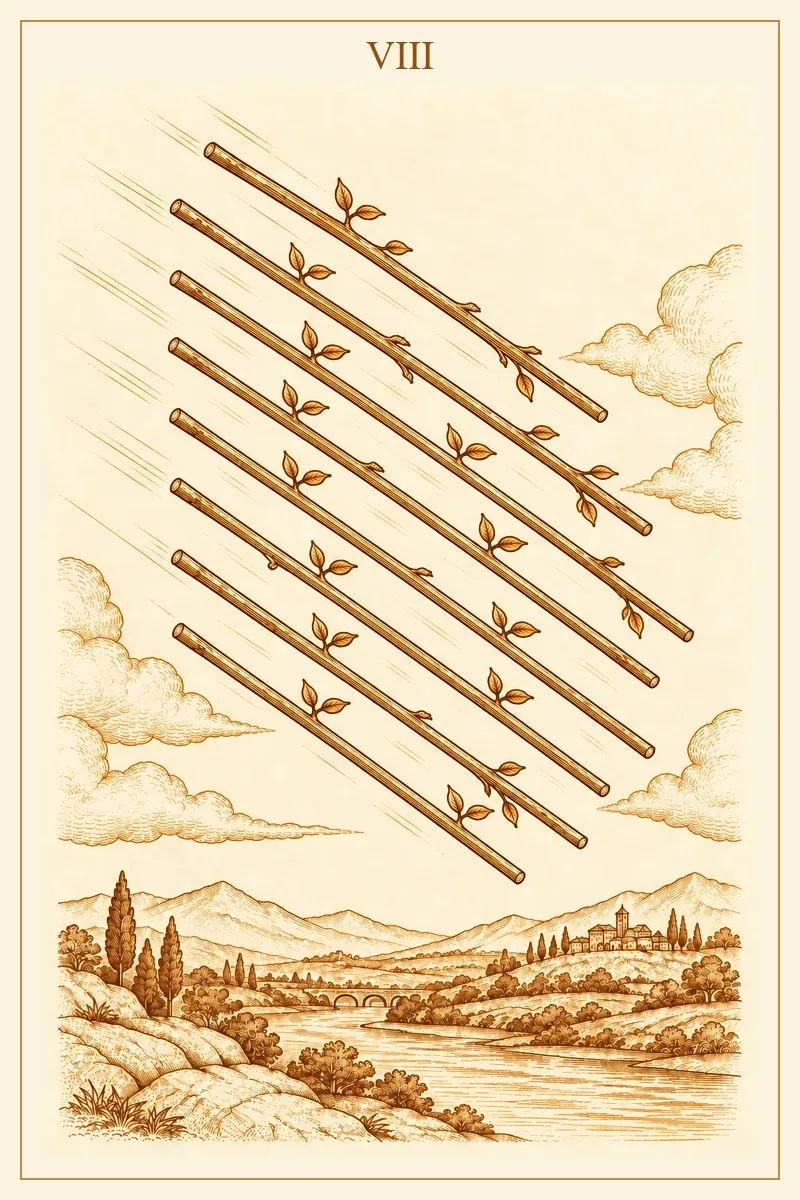
Upright, the Eight of Wands is about momentum and messages. In a job search it often appears when several things start happening at once: a recruiter calls back, two interviews land in the same week, a reference request arrives. Keep your availability open, prepare a short answer about salary expectations, and reply promptly. The Eight of Wands meaning also explores its link with travel and communication.
Reversed, the card points to crossed wires or a pace out of your hands: a stalled hiring process, an email lost in the wrong folder, or a rush to accept something before you have read it. If an offer arrives with pressure to sign the same day, remember that a reasonable employer can usually wait for a careful answer.
Four more cards for a fresh start at work
These cards add color to a new-job reading. Each describes a different kind of beginning.
- The Fool: a leap into a new industry, a startup or a role you do not feel fully qualified for yet. Upright, it supports curiosity. Reversed, it asks whether you are jumping without checking the ground, or holding back from a change you already want.
- Ace of Wands: a role that sparks real enthusiasm, often creative or entrepreneurial. Upright, the opportunity has energy and room to grow. Reversed, the spark is there while the timing, funding or follow-through is not, so test the idea first.
- The Chariot: success that comes from steering rather than waiting. Upright, it rewards a focused search with clear targets. Reversed, your energy is scattered, and narrowing the search may help more than applying everywhere.
- The World: the end of a chapter. Upright, you have outgrown your current role and the new job feels like a graduation. Reversed, something still needs closing first, such as a project, a qualification or a goodbye.
Three cards that point toward a promotion
Promotion cards are less about leaving and more about being seen. They tend to appear when your work already has a track record and the open question is whether people with influence will act on it.
Six of Wands: recognition others can see
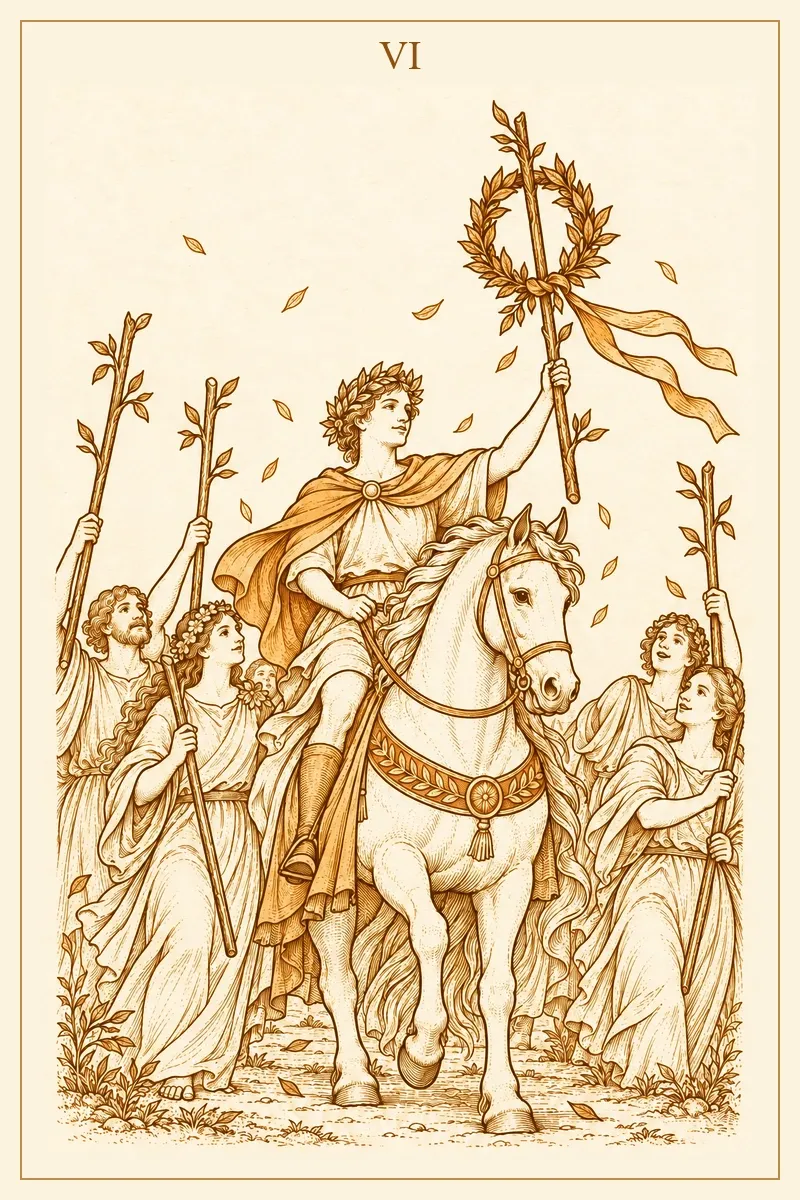
Upright, the Six of Wands is the most direct promotion card in the deck. It shows a public win: praise in a meeting, a successful launch with your name on it, a manager who backs you openly. Use that momentum. Ask for the conversation about your next role, or about a raise, while the success is fresh, and bring specific results with you. The full Six of Wands meaning also looks at its role in competition and confidence.
Reversed, the card often describes recognition that has not arrived yet, credit that went to someone else, or self-doubt that keeps you from claiming your results. A short written summary of your wins, shared with your manager, can change more than another month of quiet hard work.
Three of Pentacles: skill that decision-makers notice
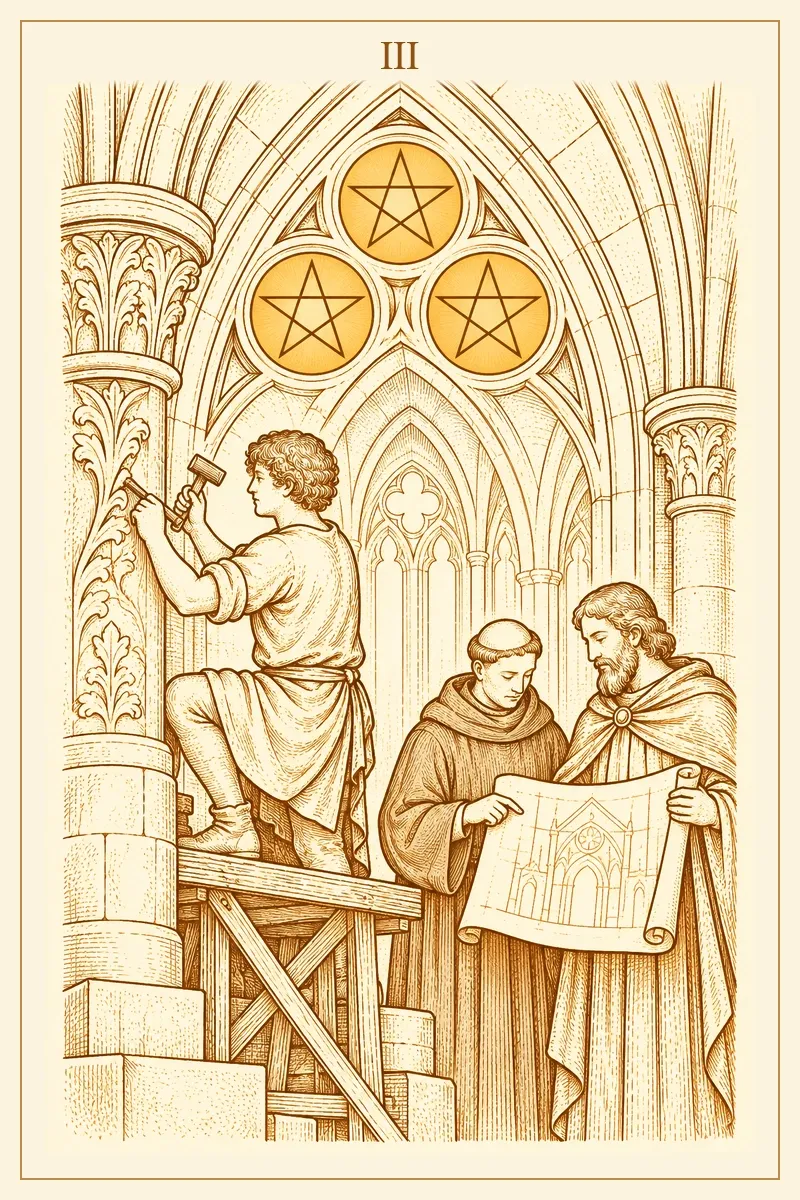
Upright, the Three of Pentacles describes respected craft and good collaboration. In a promotion reading it suggests that leaders value the quality of your work, and that the path upward may run through a shared project rather than a solo effort. Volunteer for the cross-team initiative or present the project you led. It is a gradual card, describing a reputation built over several projects rather than an overnight jump. The Three of Pentacles meaning covers its teamwork themes in more depth.
Reversed, the card can point to friction in a team, unclear roles, or good work that goes unseen because it happens behind the scenes. Make the invisible visible: document your part in a project, ask for feedback from the people who decide on promotions, and clarify what "ready for the next level" means where you work.
The Emperor: stepping into authority

Upright, The Emperor describes structure, responsibility and leadership. In a promotion reading it suggests a role with more decision-making power: managing people, owning a budget, setting standards rather than following them. It asks whether you want that responsibility, not only the title. In salary talks it supports clear negotiation: know your numbers and get any agreement in writing. The full Emperor tarot meaning explains the card beyond work questions.
Reversed, The Emperor can describe a rigid or controlling manager who is blocking movement, your own discomfort with authority, or promotion criteria that are vague or unevenly applied. Ask for the criteria in writing, and notice whether this is a structure you want to rise inside.
Other promotion signals: King of Pentacles, The Sun and Judgement
The King of Pentacles describes mature, reliable leadership with financial responsibility. Upright, he appears around senior roles, business ownership or a raise that reflects years of steady work. Reversed, he can point to a workplace that values profit over people, or to measuring your worth only by salary.
The Sun is the warmest yes a career spread can offer. Upright, it describes success that feels earned and openly welcomed. Reversed, it rarely means failure; more often the good news is delayed, smaller than hoped, or overshadowed by stress you need to address first.
Judgement describes a calling, a moment when your work asks more of you. Upright, it can show a promotion that feels like stepping into the role you were meant to grow into. Reversed, it may point to self-doubt, or to ignoring a quiet sense that you have outgrown your position.
Card pairs that sharpen a job reading
Two cards side by side often say more than either one alone.
- Ace of Pentacles with Eight of Wands: an opening that may move quickly once it starts. Have your documents and references ready.
- Three of Wands with the Two of Swords: your application is out, but a decision is stuck on the other side. Follow up politely and keep other options moving.
- Six of Wands with the Five of Swords: recognition that comes with competition. Consider how you win, not only whether you win.
- The Emperor with the Ten of Wands: more authority, and possibly more weight than one person can carry. Ask about support before you accept.
- Three of Pentacles with the Seven of Pentacles: a reputation building slowly. A review conversation may serve you better than a sudden ask.
- Ace of Wands with the Four of Pentacles: an exciting opportunity weighed against the comfort of what you have. Name the security you actually need.
Reading timing without promising a date
Timing is the question most job seekers bring, and the one tarot is least able to answer exactly. Cards do not carry calendar dates, but they can describe pace. Our guide to timing in tarot explains the systems readers use and where each one falls short.
Quick movement. Several Wands, especially the Eight of Wands, along with Aces and The Chariot, suggest things are already in motion, as often happens in the weeks after an interview.
Slow growth. The Seven of Pentacles, The Star and the Pages suggest a longer arc that may need another round of applications, a new skill or a few more months of visible work. Many readers also treat a Pentacles-heavy spread as slower than a Wands-heavy one, a helpful convention rather than a rule.
Waiting on others. The Two of Swords and The Moon often appear when a decision is stuck or information is missing: an internal candidate, a hiring freeze, a reorganization nobody has announced. Ask the recruiter for an updated timeline, and set your own check-in date from the process, such as a week after the final interview, rather than from the card.
Cards that ask you to wait or look closer
Not every reading confirms that a move is ready. These cards mean "not yet," or "check this carefully before you commit," never "give up."
- Four of Pentacles: holding tightly to security. You may be reluctant to negotiate or to leave a stable but unfulfilling job. Reversed, the grip is loosening, sometimes as a sudden urge to quit without a plan.
- Five of Swords: a role or promotion that may come with office politics or a win that costs more than it gives. Reversed, it can be a chance to step back from a fight that is not worth having.
- Seven of Swords: something may not be fully disclosed, such as the real workload or the reason the role is open. Research the company and ask direct questions. Reversed, the truth may be starting to surface.
- Ten of Wands: the new role may carry even more weight than the one you want to escape. If burnout is part of why you are searching, our perspective on whether to quit your job can help you sort out what really needs to change. Reversed, you may finally be setting part of that load down.
A five-card spread for your job search
Use this spread when you are applying or preparing to ask for a promotion. Write your question at the top of the page and keep the positions in this order.
- Your strongest asset: the skill or experience that sets you apart. The Magician here says you already have the tools and the task is presentation; the Eight of Pentacles points to deep, practiced expertise.
- How you come across: how employers or decision-makers see you, which may differ from how you see yourself.
- The hidden factor: something shaping the outcome that you cannot see clearly, such as an internal candidate or a budget question.
- Your best strategy: Cups often point to relationships and referrals, Swords to clear applications and direct questions, Pentacles to your portfolio and track record, Wands to bold initiative.
- Where current efforts lead: the direction your search is heading if nothing changes, which you are free to change.
If you are choosing between two offers rather than waiting for one, our career tarot spreads include a crossroads layout, and tarot for decision making shows how to weigh competing options without handing the choice to the cards.
Worked example: waiting after a final interview
Imagine someone who had a final interview for a project coordinator role two weeks ago and has heard nothing since. Their question: "What should I understand about this application, and what can I do while I wait?"
- Strongest asset: Eight of Pentacles, upright. Careful, detail-focused work is the real selling point.
- How you come across: Three of Pentacles, upright. The panel likely saw someone who collaborates well.
- The hidden factor: Two of Swords, upright. A decision seems stuck, perhaps between two finalists or waiting on budget approval.
- Best strategy: Page of Pentacles, upright. A modest, practical step: a short follow-up note and continued learning.
- Where current efforts lead: Ace of Pentacles, reversed.
The first two cards are encouraging: the person's skill is real and it came across in the room. The Two of Swords does not say no; it describes a stalled decision outside their control. The Page of Pentacles suggests a polite email asking the recruiter about the timeline, perhaps with a brief note on a topic from the interview.
The reversed Ace in the last position is the card people worry about most. Here it reads as an opportunity that is delayed or not yet solid, not one that is lost. A sensible response is to send the follow-up, keep two or three other applications moving, and resist redrawing the spread every day. If a no comes, the first two cards still name strengths to carry into the next interview.
Practical steps while you wait
- Write down the question, the cards and your first impressions, and reread them after the next development in your search.
- Turn each card into one action: a follow-up email for the Eight of Wands, a portfolio update for the Eight of Pentacles, a conversation about criteria for The Emperor.
- Keep applying until an offer is signed, and check every offer against facts: salary ranges, contract terms and benefits.
- If you hope for a promotion, ask your manager what the next level looks like and what evidence they would need to see.
Frequently asked questions
What is the strongest tarot card for a new job?
The Ace of Pentacles is the card most readers name, because it describes a concrete opportunity tied to work and income. The Three of Wands and Eight of Wands often appear alongside it as applications go out and responses arrive. For a promotion, the Six of Wands is the closest equivalent, though every card depends on its position and your question.
Can tarot tell me when I will get a job offer?
No. Tarot cannot see a hiring decision, confirm what a manager is thinking or give a reliable date. It can describe pace, such as fast movement with the Eight of Wands or slow growth with the Seven of Pentacles. For dates, ask the recruiter about their timeline.
What if I keep drawing difficult cards about my job search?
Difficult cards are guidance about the process, not a verdict on your worth. They may suggest refining your resume, targeting different roles or allowing more time. The Hermit, for instance, can describe a quieter season of preparation that strengthens your next application.
Should I do a tarot reading before a job interview?
A short reading the day before can help you focus. Try three cards: "my strongest quality for this role," "what to keep in mind," and "how to show up at my best." If you tend toward anxiety, skip the morning of the interview, because a challenging card can shake your confidence at the wrong moment.
Which cards point to a promotion rather than a lateral move?
Promotion cards emphasize rising authority and recognition: The Emperor, the Six of Wands, the King of Pentacles and The Sun. Lateral moves tend to show up as the Two of Pentacles for shifting responsibilities, the Six of Swords for moving toward calmer waters without rising, and the Knight of Pentacles for steady progress without dramatic change. A sideways step can still be right if it brings you closer to the work you want.
Should I accept or decline an offer because of a card?
Treat the card as one input among many. A reading can show how you feel about an offer and which questions you have not asked yet, but the decision should rest on the terms, the people, your finances and your goals.
Taking the next step at work
New-job and promotion cards give you a vocabulary for where your working life is moving: openings, momentum, recognition, authority, and the occasional sign to slow down. They work best beside the real evidence of your search, from emails to conversations with your manager.
When you are ready to look at your own situation, start a career reading with one clear question and see which cards come forward.