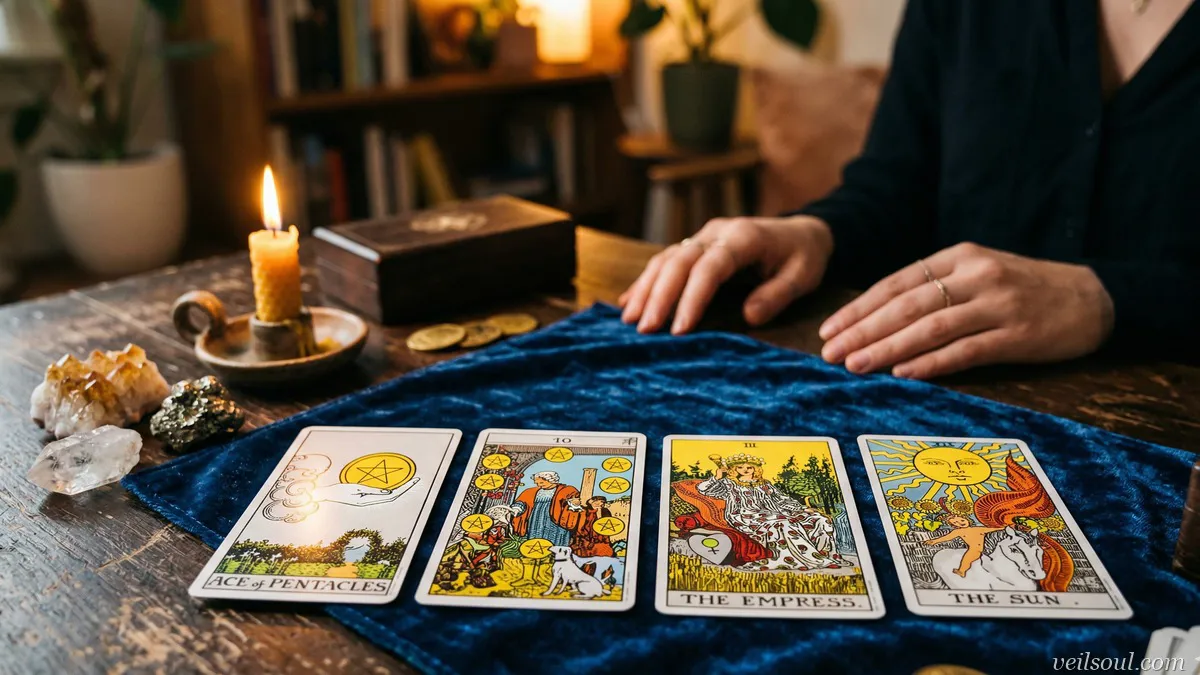
Lasting financial success has its own cards in tarot, and most of them show someone at work. The Eight of Pentacles, Three of Pentacles, Nine of Pentacles, Ten of Pentacles and King of Pentacles describe money built through skill, reputation and steady care, while The Empress, The World and The Chariot add growth, completion and discipline. The cards most people call lucky for money, the Wheel of Fortune, The Sun, the Ace of Pentacles and the Six of Wands, mark good seasons and fresh openings, and they count for most when something sturdy is already in place to catch them.
None of these cards can tell you that you will become wealthy, which investment to pick or what you will earn in five years. A reading sees no markets, contracts or bank statements, and it is not financial advice. What it does well is mirror the habits underneath your finances: what you keep practicing, what you protect, what quietly slips away. For payments on their way to you now, the guide to cards that suggest money coming in looks at sources and timing; this page follows the longer arc of building wealth and keeping it.
Here is the whole set in brief before we go card by card:
- Eight of Pentacles: skill that grows through patient, repeated practice.
- Three of Pentacles: expertise that other people recognize and pay for.
- The Chariot: discipline that holds one direction across a long stretch.
- The Empress: resources that multiply when they are tended.
- King of Pentacles: mature stewardship of what you have built.
- Ten of Pentacles: security that lasts across years and reaches other people.
- Nine of Pentacles: independence and the settled feeling of having enough.
- The World: a long project or plan reaching completion.
- The Sun and Six of Wands: success that is visible, recognized and easy to name.
- Wheel of Fortune and Ace of Pentacles: the lucky pair, a favorable season and a new chance.
- Warning cards: the Five of Pentacles, Four of Pentacles, The Moon, Seven of Swords and The Tower point to strain, fear, fog, shortcuts and structures that will not hold.
Lucky money cards and building money cards
Money cards fall into two families. The lucky cards describe moments: a cycle turning upward, an offer appearing, a season when effort is noticed. The building cards describe processes: hours at a workbench, a reputation earned one project at a time, choices about what to save and what to spend. A moment can change your month. Only a process changes your decade.
So a spread full of lucky cards and no building cards deserves a second look, because it often describes a good season with no plan to keep what the season brings. A spread of quiet Pentacles with no Sun in sight is more encouraging than it looks: finances becoming sturdier in ways that are not yet exciting to watch.
The question you ask decides which family can answer. "Will I be rich?" invites a yes or a no and leaves you nothing to do. Ask with a horizon and a role for yourself instead: "What habit would make my finances steadier over the next two years?" or "What am I building at work that will still be worth something in five years?" Measured in years rather than weeks, the question gives the building cards room to speak.
Cards of the long build: skill, reputation and discipline
These three cards describe the slow engine of financial success: becoming better at something, becoming known for it, and keeping at it when it stops being new.
Eight of Pentacles: the value of repeated practice
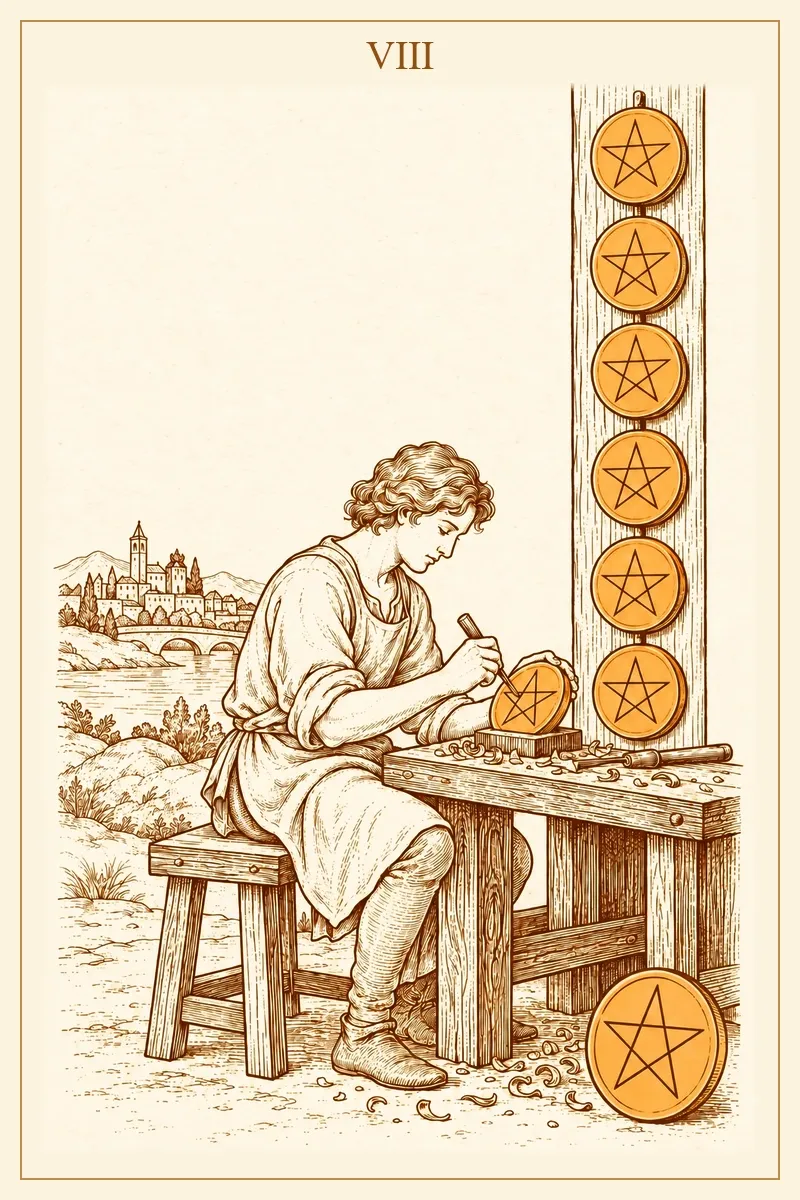
A young craftsman sits at a rough bench, carving a star into a pentacle, while six finished coins hang one above another on a post beside him and another leans against the bench leg. A town lies across the river behind him, and he is not looking at it. Upright, this is the card of income that rises as skill rises: practice, specialization and a portfolio that grows a piece at a time. The coins on the post are proof of repetition, not of luck. The full Eight of Pentacles meaning follows the card through other kinds of questions.
Reversed, the work continues but the growth does not. You may be busy without improving, polishing one piece instead of finishing it, or sharpening a skill the market has stopped paying for. A question to carry away: which of my skills will be worth more in three years than it is today, and when did I last practice it on purpose?
Three of Pentacles: being paid for expertise
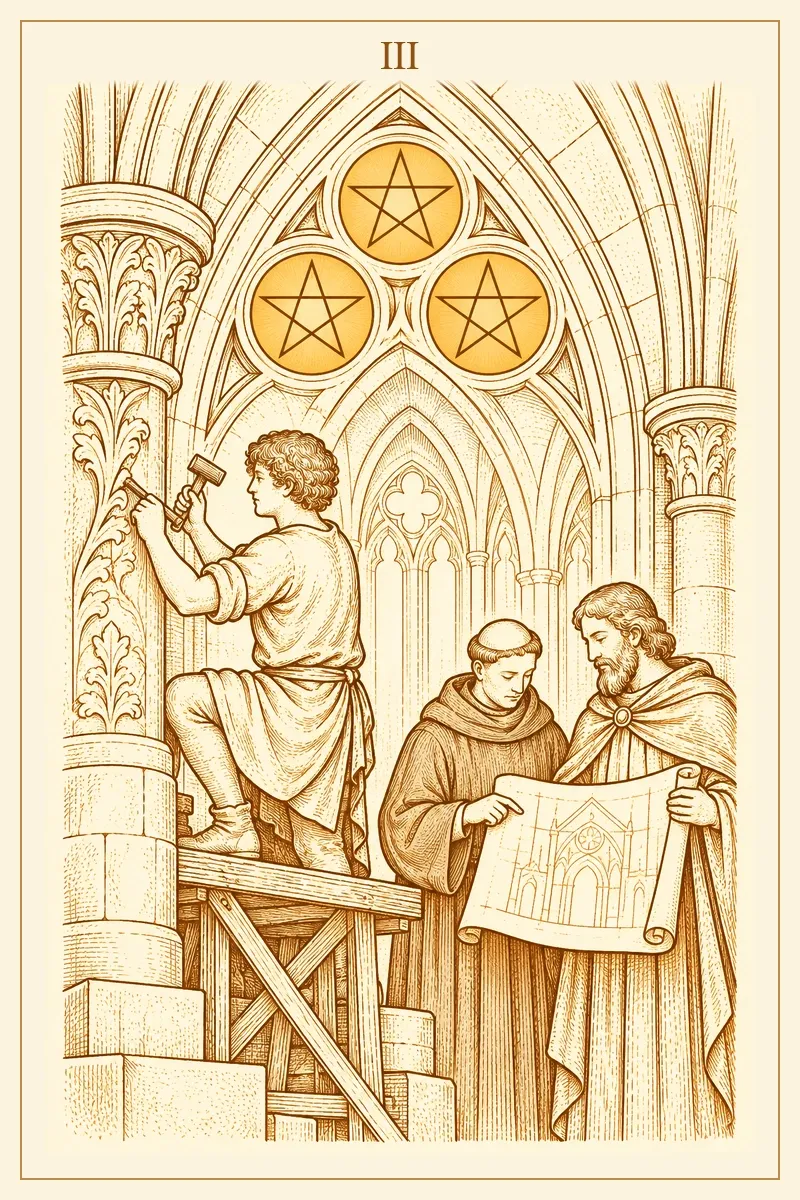
A stonemason stands on a wooden scaffold, chiseling leaves into a church column, while a monk and a cloaked patron study an unrolled plan below him and three pentacles are set into the arch above. Upright, the card describes skill that has become valuable to other people. Your work fits into someone else's plan, they can see what you contribute, and that recognition turns into referrals, better rates and steady collaboration. Over years, this is how a trade becomes a reputation. The Three of Pentacles meaning also covers teamwork and learning.
Reversed, the collaboration is out of balance. The scope is vague, credit goes elsewhere, or you do the carving while someone else holds the plan and the budget. It often appears when people undercharge for work they have done for years. Write one sentence describing what you are known for, then check whether your rates and your title say the same thing.
The Chariot: discipline that holds the course
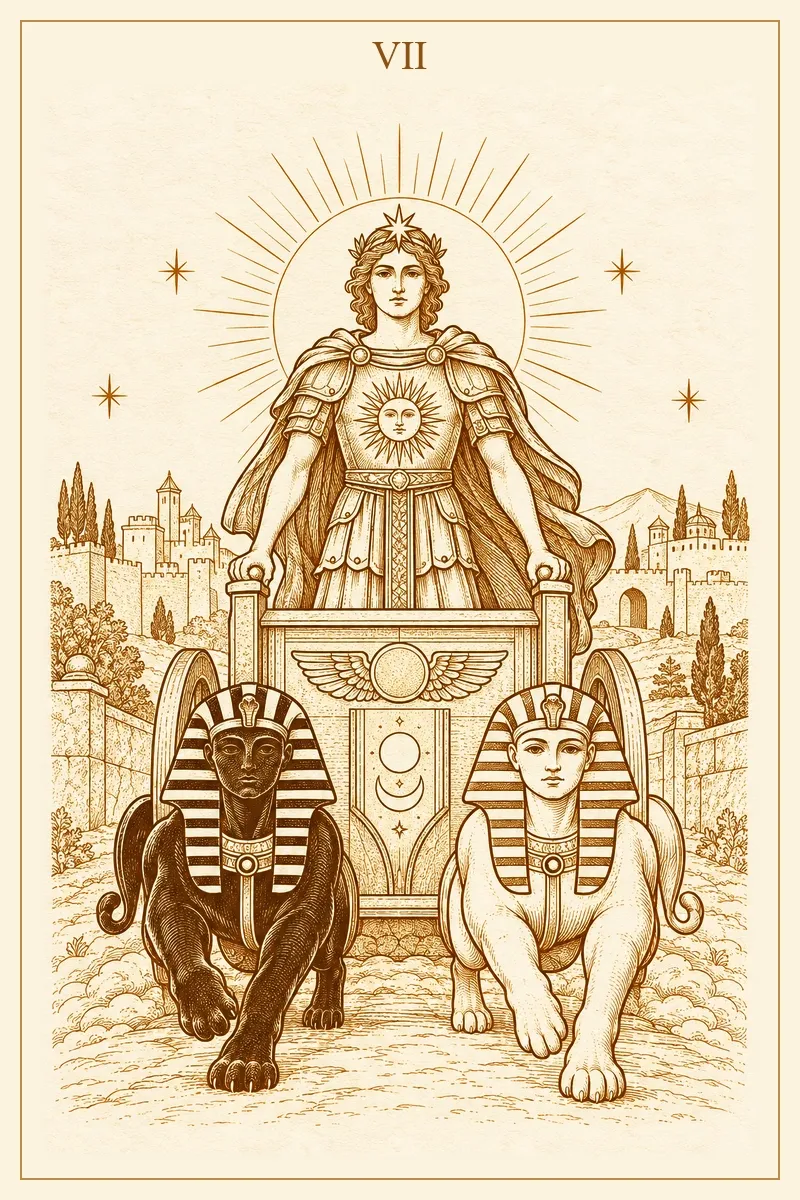
A crowned driver stands in a square stone chariot, a sun on his breastplate, while two sphinxes, one dark and one pale, rest in front. There are no reins in his hands. Upright, The Chariot is willpower sustained over distance: paying down a debt month after month, saving through the years when it feels pointless, finishing a qualification while holding a job. The sphinxes are two opposing wants, enjoy it now and build for later, and the missing reins say the steering comes from inside you. Its full range sits in The Chariot tarot meaning.
Reversed, the effort scatters. Plans change direction every few weeks, a sudden purchase undoes three months of saving, or you are forcing progress so hard that exhaustion is close. The fix is rarely more willpower. Pick one financial direction for this season and let the others wait.
Cards of growth and stewardship
Building creates money; stewardship decides how much of it is still there later.
The Empress: growth that needs tending
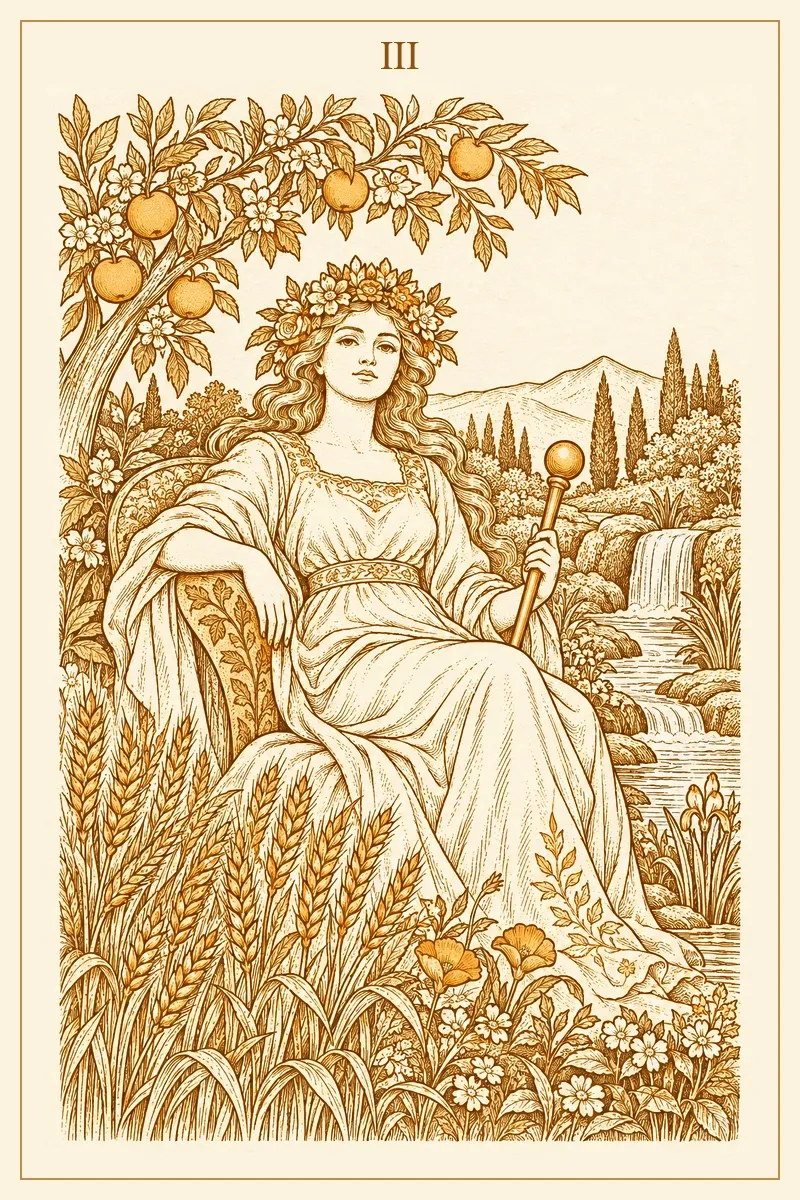
A woman crowned with flowers sits among ripe wheat, a fruit tree bending over her and a waterfall behind. Upright, The Empress describes resources that grow because someone looks after them: a business that spreads by word of mouth, savings that build on themselves, a body of work that keeps drawing people in. She also reminds you that money is for living. Comfort, good food and a home that feels cared for are part of her abundance, not a betrayal of it. The Empress tarot meaning explores her creative side as well.
Reversed, the garden is neglected or overharvested. You may have dropped the steady habit that made the growth possible, or be spending ahead of the season. Ask what you used to do regularly that brought you here, and whether you still do it.
King of Pentacles: stewardship of what you built
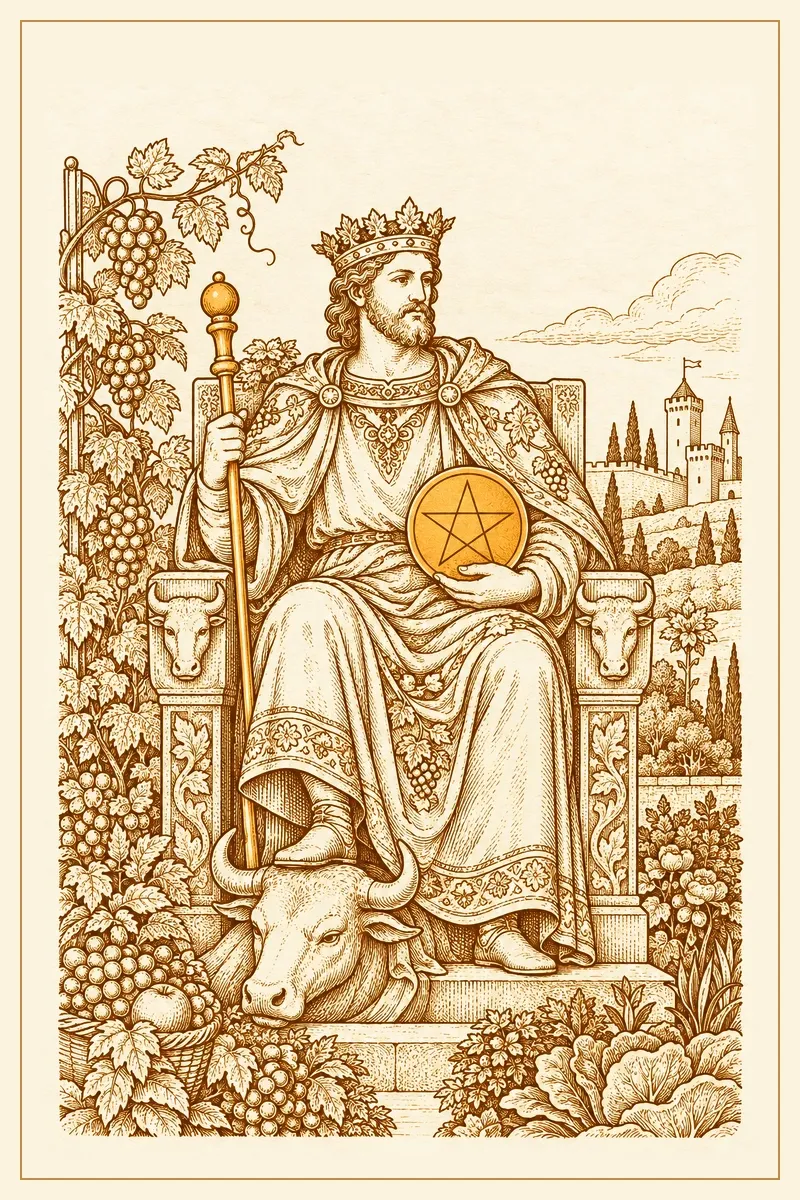
A king sits on a throne carved with bulls' heads, a pentacle resting on his knee, vines heavy with grapes around him and a castle on the hill behind. Upright, he is mastery of keeping rather than getting: budgets that work, decisions made with a long view, delegation, generosity from a stable base. He can describe you growing into that role, or a mentor, partner or advisor whose steadiness you can learn from. Read more in the King of Pentacles meaning.
Reversed, the King grips the wrong things: status spending, money treated as identity, a stubborn refusal to adapt. Sometimes he points to an advisor who sounds confident without being careful. Wealth that has to be displayed is often wealth that is quietly leaking.
Ten of Pentacles: wealth that outlasts a paycheck
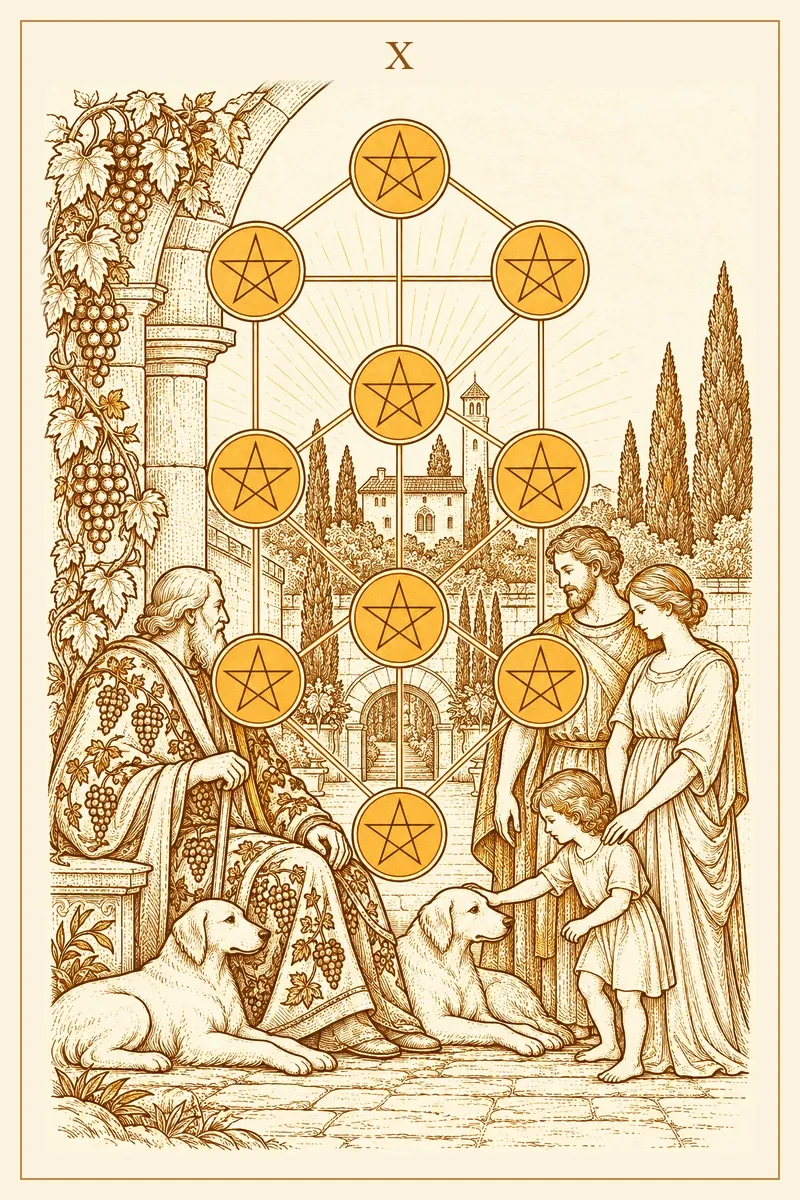
An old man in a robe patterned with grapes sits under a stone archway with two dogs at his feet, a couple and a small child stand nearby, and ten pentacles hang over the whole scene in a tree-shaped pattern. Upright, the Ten is security measured in decades: a home, a pension, a business that runs without you, arrangements that look after the people you love. It also asks what you are passing on, which includes your beliefs about money as well as your savings. The Ten of Pentacles meaning covers its family themes in more depth.
Reversed, the foundation needs attention. Family money may be a source of tension, an inheritance may come with strings, or the structure you rely on is less stable than it looks. Look at the paperwork and the conversations you have been postponing.
Milestones, recognition and the lucky cards
The remaining success cards describe arriving rather than building, and they read best when you ask what they are resting on.
Nine of Pentacles and The World: arriving at enough
The Nine of Pentacles shows a woman alone in a vineyard heavy with grapes, a falcon on her gloved hand, at ease in a life she paid for herself. Upright, it describes financial independence and the rarer feeling of having enough. The World is completion on a larger scale: a debt cleared, a business matured, a long plan finished. Together they ask a question most money readings skip: what does "enough" mean for you? Without an answer, success keeps moving one step ahead.
Reversed, the Nine often shows comfort that depends on a single client, employer or partner, or spending meant to look successful rather than feel secure. A reversed World describes the last ten percent, the project almost done or the final payment not yet made. Finish it before starting something new.
The Sun and the Six of Wands: success other people can see
Upright, The Sun is the clearest yes in the deck: vitality, openness and work that goes well in plain view. The Six of Wands is the public version of the same story, a rider in a laurel wreath carrying a wreathed staff through a crowd, which in money terms means promotions, good reviews and recognition. In a long-term reading both carry one practical message: recognition is a currency only if you spend it. Ask for the raise or pitch the bigger project while the praise is fresh. If the attention is pointing toward a different role altogether, the guide to cards that indicate a new job or promotion covers that turn.
Reversed, the warmth is delayed or the applause arrives without the pay. You may be visible and undervalued at once, or waiting for someone to notice work you have not yet shown them.
Wheel of Fortune and the Ace of Pentacles: the lucky cards for money
If you are looking for the luckiest tarot cards for money, these are the two. The Wheel of Fortune says a cycle has turned upward: demand for your work warms, timing lines up, a door that stayed shut begins to give. The Ace of Pentacles is a single coin offered, a new opportunity with real material weight: a role, a contract, a first client, a small sum you could plant. For luck beyond money, the guide to tarot cards that mean good luck covers the rest of the deck.
In a financial success reading, treat both as inputs rather than strategies. Luck knocks on most doors now and then; what you have already built decides how much of it stays. Reversed, the Wheel points to a slower cycle, a season for building reserves rather than placing big bets, and the Ace to an opportunity not yet solid enough to rely on.
Pairings that describe a long-term plan
Two cards side by side often say more about a financial path than either does alone, especially when the question is about building over time.
- Ace of Pentacles with The Magician: a real opportunity and the skills to use it. Begin, with a written plan.
- Nine of Pentacles with Ten of Pentacles: personal independence widening into security that supports other people too.
- King of Pentacles with the Ace of Wands: a stable base funding something new. Experiment from that base rather than betting all of it.
- Six of Wands with The Sun: recognition building on recognition. Turn the attention into terms before it fades.
- Seven of Pentacles with Wheel of Fortune: years of patient effort meeting a favorable turn. Review honestly what has grown and what has not.
- Eight of Pentacles with Three of Pentacles: craft leading to reputation and better pay, the steadiest route in the deck.
- Nine of Pentacles with the Three of Wands: established work ready to reach a wider market.
Look at the suits as well. Three or more Pentacles keep the reading practical and material; when Wands join them, the money tends to follow initiative and the work that excites you.
Warning cards: where wealth leaks over time
Long-term finances are rarely undone in one dramatic moment. They wear down through habits nobody examines. These cards name the common leaks; none of them is a verdict.
- Five of Pentacles: two figures walk through snow past a lit stained-glass window. Hardship, or a scarcity mindset that outlasts the hardship. The lit window is the message: help, benefits or advice exist, and the card asks you to go in. Reversed, the worst of the cold is easing.
- Four of Pentacles: a crowned figure hugs a coin to his chest, with one on his head and one under each foot. Security turned into fear, which over years looks like refusing to invest in your skills, your health or rest. Reversed, the grip loosens, sometimes into careless spending.
- The Moon: fog around the numbers. Statements left unopened, a deal that sounds better than it should, a story you tell yourself about where the money goes. Upright or reversed, it asks for daylight: read the terms, check the figures.
- Seven of Swords: shortcuts. Someone, possibly you, is not being straightforward, whether through hidden fees, a partner's vague accounting or your own corner-cutting on paperwork. Reversed, the truth is coming out.
- The Tower: a structure that cannot hold, such as a role or a business resting on one fragile support. It does not predict ruin; it says rebuild on firmer ground. Reversed, you may already sense the crack and be avoiding it.
The long-horizon spread: five positions
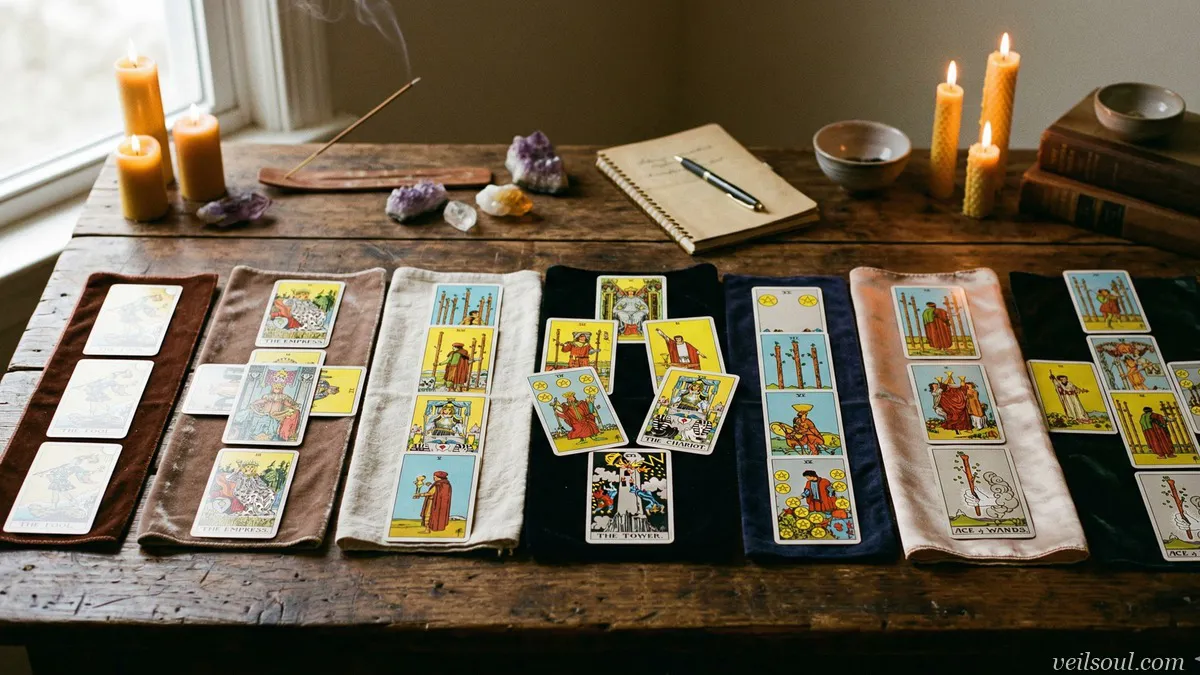
Use this spread once a season, not once a week. Write the question with a time frame in years before you shuffle, and lay the cards in a row from left to right.
- The ground: what you have already built, including skills, savings, relationships and reputation.
- The daily habit: what your ordinary choices are feeding right now.
- The leak: where effort or money slips away without being noticed.
- The skill to grow: what would be worth more to you over time if you invested in it.
- The horizon: the direction this path tends toward if the habit holds and the leak is addressed. A direction, not a forecast.
If you would like layouts for narrower work questions, the collection of tarot spreads for career guidance includes seven, from job changes to annual reviews.
Worked example: freelance work becoming security
An illustrator who has freelanced for four years asks: "What would help my illustration work become steady income over the next three years?"
- The ground: Nine of Pentacles, reversed. She has built something real, but the comfort depends heavily on one large client.
- The daily habit: Eight of Pentacles. She practices constantly and her work keeps improving, the strongest asset on the table.
- The leak: The Moon. She does not really know her numbers: which jobs pay well per hour, what she spends on tools, what she sets aside for taxes.
- The skill to grow: Three of Pentacles. Reputation and collaboration, being known for one kind of work by the people who commission it.
- The horizon: King of Pentacles. Stewardship, running her practice like a small business she looks after.
The reading does not say she will be secure in three years. It says the craft is there, the dependence on one client is the fragile point, and the fog around her numbers hides both. Her steps follow from the cards: a monthly record of income per client and per hour, one portfolio page for the niche she wants to be known for, and three conversations with art directors she has worked with well. The King on the horizon is not a promise of wealth; it is the role the reading invites her to grow into.
Turning a reading into money habits
A financial success reading earns its place when something in your week changes afterward.
- Give every reading a horizon. One year, three years, five. Long questions keep the building cards in view.
- Leave with one habit, not a list. Pick the single action the cards point to most clearly and write it down with a start date.
- Record what you drew and what happened. A simple log shows which cards keep returning around money; the guide to keeping a tarot journal suggests formats that work.
- Keep decisions grounded. Use the cards to understand your habits and fears, and real numbers and qualified professional advice for investments, debt and tax.
Frequently asked questions
What is the luckiest tarot card for money?
The Wheel of Fortune and the Ace of Pentacles are the two most often read as lucky for money: one a favorable turn, the other a new opportunity. For lasting financial success, though, the Ten and King of Pentacles carry more weight, because they describe what remains after the lucky moment passes.
Can tarot tell me whether I will become rich?
No. Tarot cannot see your future income, a market, or a decision another person has yet to make, and no card guarantees an outcome. A reading can show the patterns in your own choices and where your attention would help, which is the part of the future you can actually shape.
Which suit is most connected to money and career?
Pentacles, the suit of earth, work and material life, from the first coin of the Ace to the stewardship of the King. Wands often describe income that grows from initiative, Cups money tied to work you care about, and Swords the decisions and negotiations around money.
What if my money reading is full of difficult cards?
A difficult card points to where attention is needed, not to a fixed outcome. The Five of Pentacles asks you to seek help, The Tower to rebuild on firmer ground, the Four of Pentacles to loosen a fearful grip. For a calmer way to read these moments, see the guide to tarot cards that warn about bad news.
Should I use tarot to choose investments?
Not as the basis for a decision. Tarot can help you notice how you feel about risk, what you hope to avoid and whether you are acting from fear or from a plan. Choices about specific investments, loans or tax belong with real figures and a qualified professional.
How often should I do a financial success reading?
Once a month or once a season suits most people. Long-term finances change slowly, so drawing daily on the same money question tends to produce worry rather than insight. Ask again when something has actually changed, or when your review date arrives.
Wealth as a long practice
The cards of financial success share one quiet message: wealth that lasts is practiced before it is possessed. The workbench, the scaffold, the garden and the courtyard all show time spent, not luck received. If you would like to see which of these cards speak to your own situation, begin a reading on Veil Soul with a question measured in years.