Five cards answer a yes/no question with the plainest yes, and most readers can name the Sun before the other four. Far more readings land on a card that agrees with you and then names the one thing the agreement rests on, which sounds like a lesser answer and is usually a better one: a condition is something you can work with. Tarot cannot confirm what another person is thinking, fix a date or promise a result, so a yes reads the direction your situation is already facing rather than an outcome handed to you.
Fourteen affirmative cards, strongest first:
- The Sun: yes, and nothing important is hidden.
- The World: yes, and the cycle finishes properly.
- Ace of Cups: yes, the feeling behind it is sincere.
- Ace of Wands: yes to the start, if you act on it.
- Six of Wands: yes, and other people will see it.
- Ten of Cups: yes, shared with the people you love.
- Four of Wands: yes, and there will be something to mark.
- The Star: yes, quietly, after a hard stretch.
- Wheel of Fortune: yes, and the timing is turning your way.
- The Empress: yes to anything that still needs to grow.
- Three of Pentacles: yes, with other people in it too.
- Nine of Cups: yes to the wish exactly as worded.
- Strength: yes, if you can stay patient.
- The Chariot: yes, while you keep hold of the reins.
Open yes, conditional yes, and slow yes
Before you look up a single card, know that a yes arrives at three strengths. Sorting your card into one of them turns a flat verdict into something you can act on.
- An open yes answers the question as you asked it, with no clause attached. The Sun, The World, the two Aces and the Six of Wands behave this way: the situation already supports what you want.
- A conditional yes says yes to one route and no to the others. Strength, The Chariot and Three of Pentacles are the clearest examples, and each names its condition plainly: patience, steering, other people.
- A slow yes agrees with the outcome and disagrees with your timetable. The Star and Wheel of Fortune sit here: nothing is blocked, the conditions are still assembling.
Reading these beside the cards that lean toward no makes both groups easier to recognize, since both run on the same logic: a card answers the question you actually asked, not the one you hoped you had asked.
One habit saves a great deal of confusion. Before you shuffle, write down what a yes would mean in practice: which message you would send, which form you would sign. A card cannot tell you whether an answer is good news if you never defined the good news.
Five cards that answer yes on their own
These five give the plainest affirmative answers in a yes/no pull, and each answers in a different tone. The tone is where the practical advice lives.
The Sun: yes, with nothing hidden
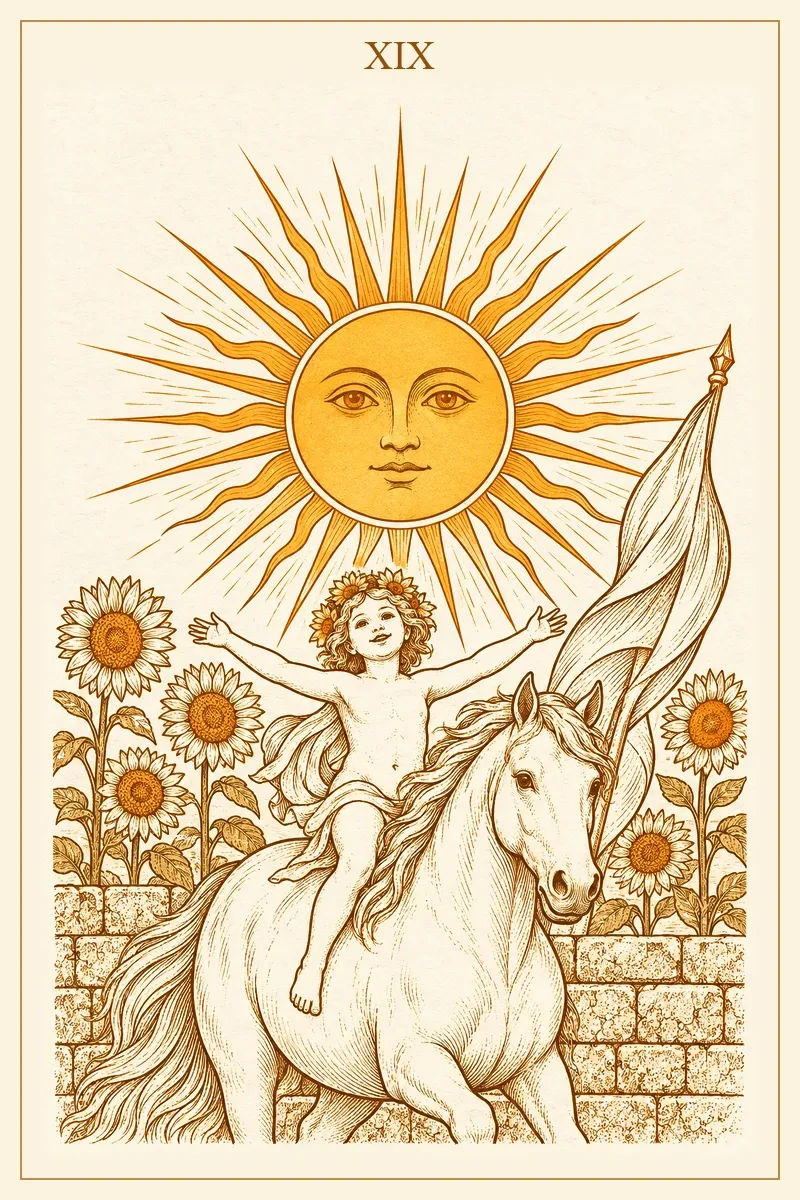
The Sun is the plainest yes in the deck. A child rides in open daylight in front of a garden wall lined with sunflowers and nothing in the picture is concealed, which is what the card contributes to a yes/no question: the answer is yes, and no hidden clause is waiting three months from now.
In love it describes warmth visible to other people rather than a private hope. In work it points to a result you will not have to defend. For money it reads as steady relief, not a windfall. If it keeps returning for you, the guide to The Sun's meaning will tell you more than a yes ever could.
Reversed, The Sun rarely flips into a no. It normally means yes with the brightness turned down: the thing happens, but you are too tired or too busy to feel it. Take it as a prompt to look at what is dimming your view, not as a refusal.
The World: yes, and the cycle finishes
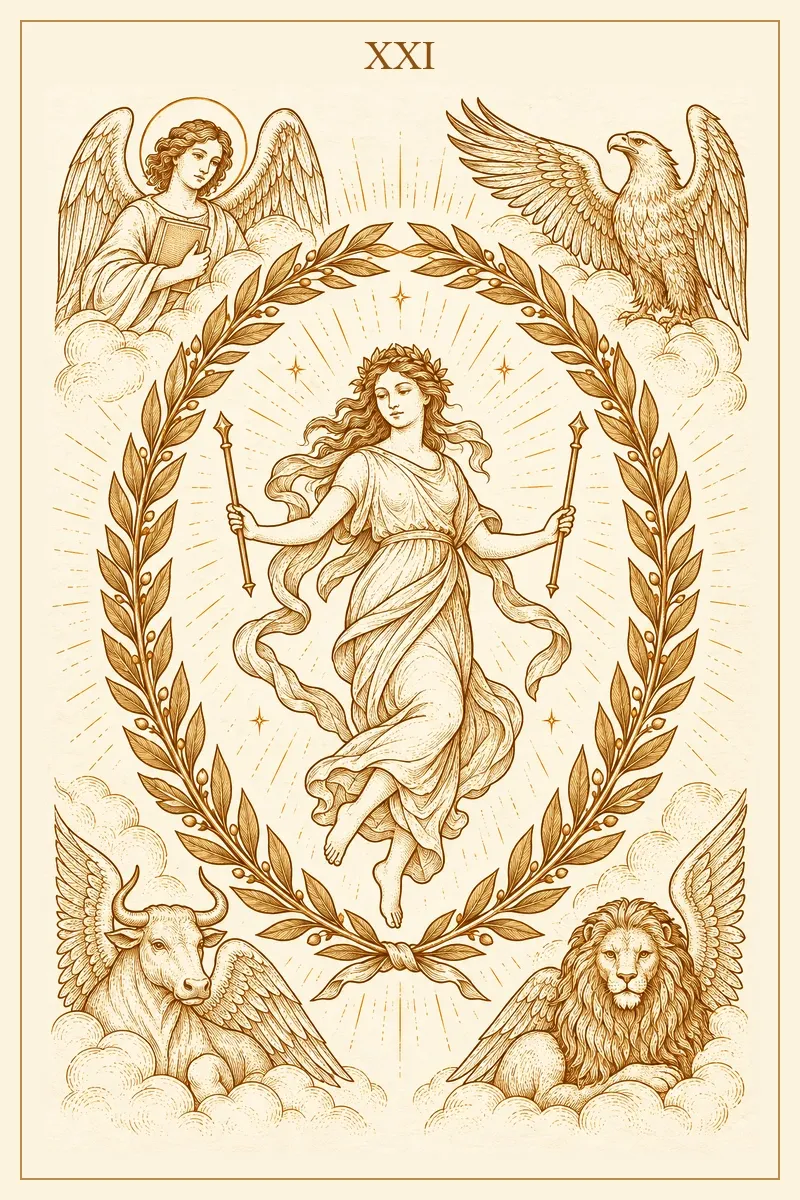
The World answers yes to anything already in motion. A dancer turns inside a laurel wreath with the four fixed creatures at the corners, and the image is about arrival rather than departure. If you asked whether something will come together, this card says it is further along than you think.
It is less helpful for brand-new ideas, because completion needs something to complete. For a move abroad, a qualification or a relationship that has circled the same decision for years, it is one of the strongest affirmatives available, and the guide to The World covers how completion differs from success.
Reversed, The World is a yes that has not been finished. One step is outstanding: a signature, a final payment, a conversation nobody wants to have. The outcome is not in doubt, but it will not close itself while you look away.
Ace of Cups: yes, and the feeling is real
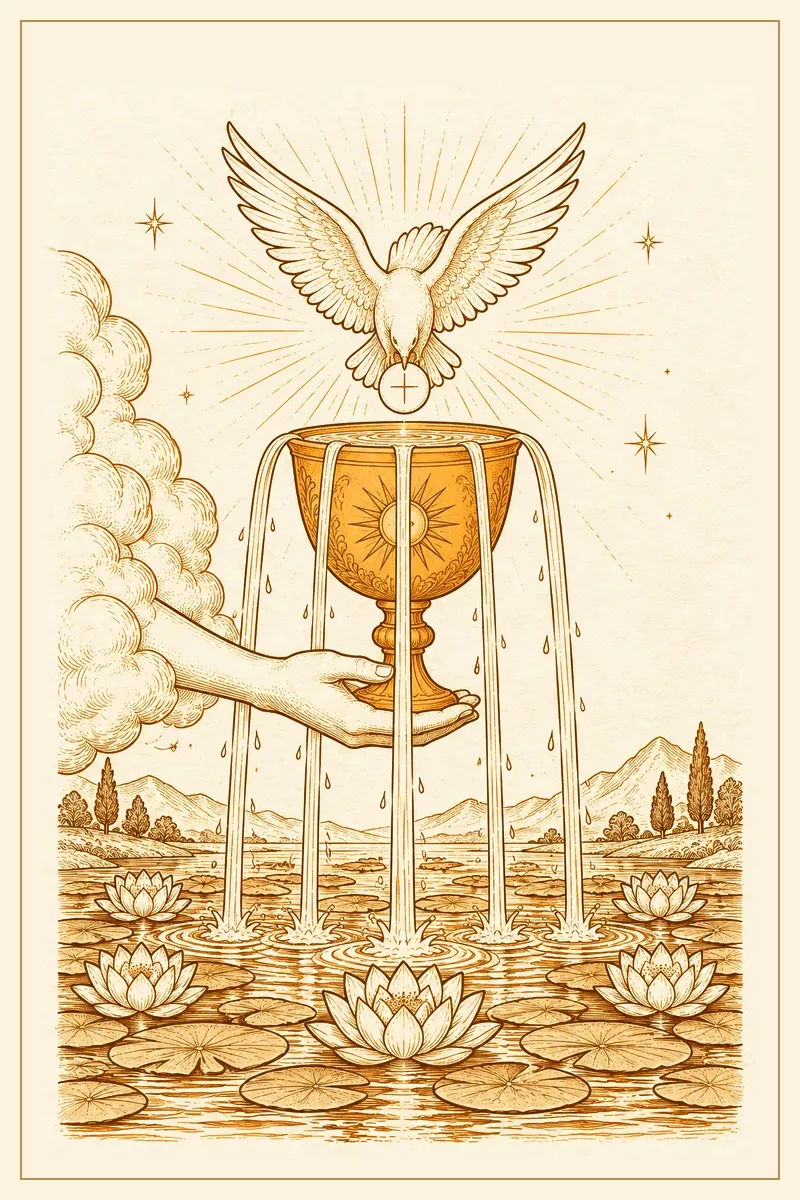
The Ace of Cups is the strongest yes for anything emotional. A cup spills over because what is being offered is larger than the container, which is a fair description of how a new connection feels before you have made room for it. For love, friendship, reconciliation or creative work that matters to you, treat it as a clear affirmative.
It answers about the feeling rather than the arrangement. Asked "does this person care about me", the Ace leans yes about the feeling itself; it does not say the person is available or able to act on it. The Ace of Cups meaning spells out how the card behaves in longer spreads. In work and money questions it is softer, and points to work you would do gladly rather than a number on a contract.
Reversed, the feeling exists but has not been spoken aloud, or it was offered and quietly withdrawn. The honest reading is "yes, and it is being held back", which usually means the next move is a conversation rather than another card.
Ace of Wands: yes to the spark, if you act on it
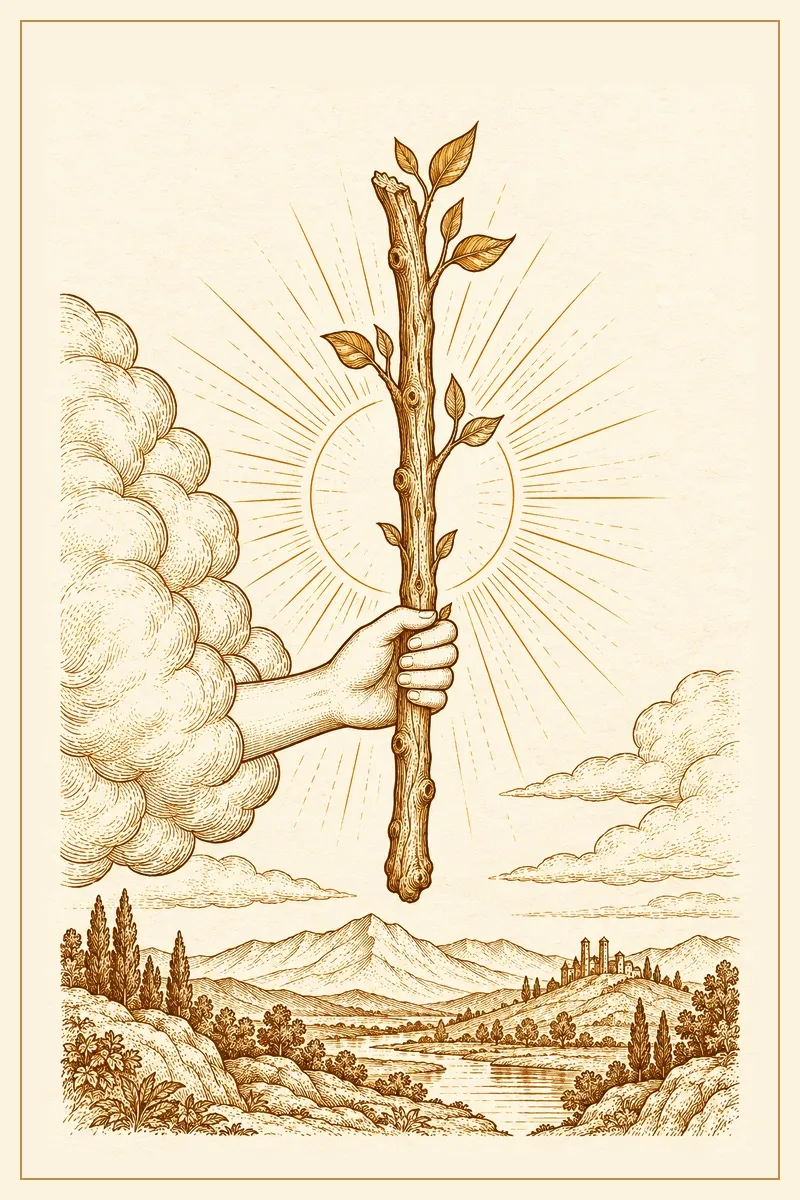
A hand reaches out of a cloud holding a branch still putting out leaves. The Ace of Wands says yes to beginning: the idea has life in it and the moment is right. What it does not say is that the thing will finish itself. This is a seed, and seeds left on a windowsill stay seeds.
For new ventures, a first class or a message you have been drafting for weeks, this is as encouraging a card as the deck offers, and the Ace of Wands meaning describes the same impulse across a full reading. In love it suggests momentum rather than a settled bond; in work it favors starting over refining; in money it points to income you create rather than income you are given.
Reversed, the spark is real and nothing has been done with it. Hesitation or a crowded schedule is holding the match. The yes stands; the delay is yours, and so is the fix.
Six of Wands: yes, and it will be seen
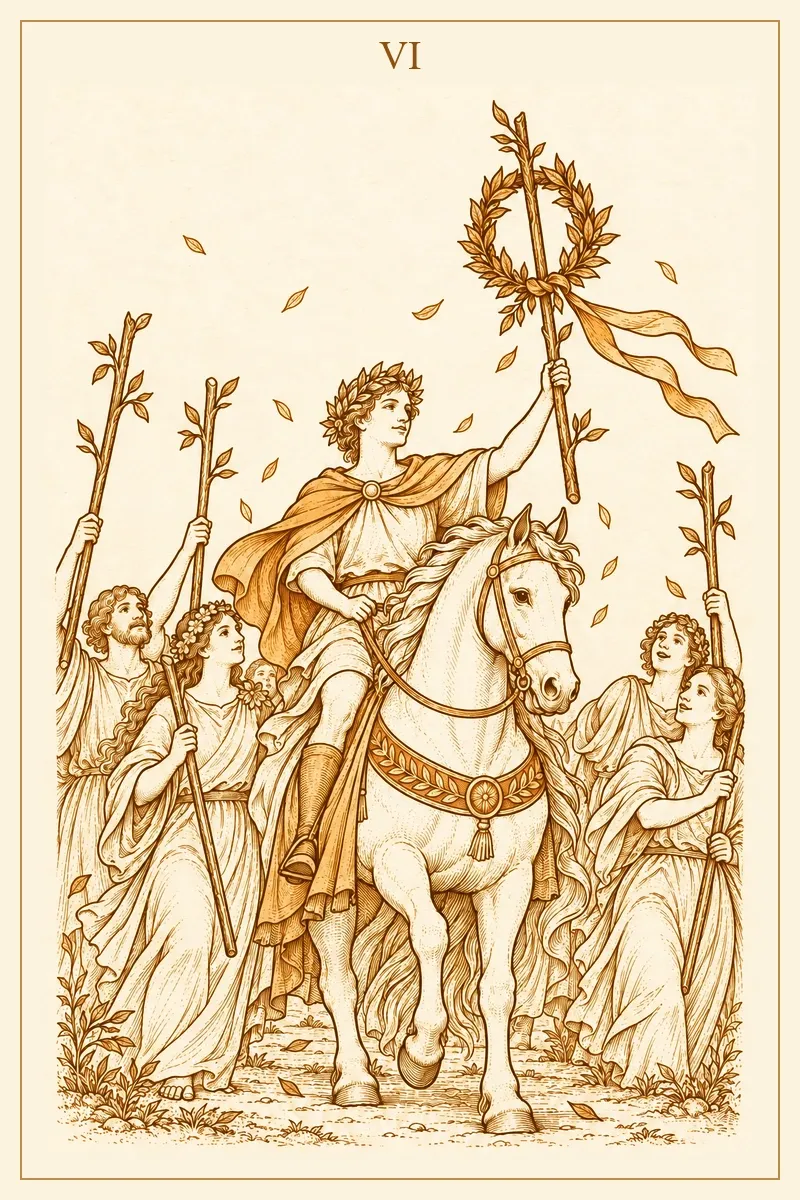
A rider wearing a laurel wreath moves through a crowd. The Six of Wands answers yes with recognition attached, which makes it the card to hope for when other people will judge the result: an application, an audition, an exam, a launch.
The recognition is not decoration. Asked whether you will get the role, this card says yes and adds that the result is likely to be noticed by the people who decide. In love it suggests a relationship that is acknowledged rather than kept quiet, and the Six of Wands meaning covers how it reads when you are in the crowd instead of on the horse.
Reversed, the yes becomes private. The result still goes your way, but the applause is missing, delayed or going to somebody else. None of that cancels the outcome; it adjusts what you should expect to feel afterward.
Cards that say yes with a condition attached
The conditional group is where most real readings land. Each card agrees with you, then names the one thing the agreement rests on, and that condition is the part worth writing down.
- The Star: yes, and gently. Hope is returning after something difficult, so the condition is that you let it rebuild at its own pace.
- Wheel of Fortune: yes, and the window moves. The cycle is turning toward you, and it will keep turning, so be ready when the opening arrives.
- The Empress: yes to anything that grows — a relationship, a body of work, a home. The condition is care and time, not force.
- Ten of Cups: yes, in a shared form. It agrees about belonging, so it answers best when the question includes the people around you.
- Four of Wands: yes, and something becomes official. A milestone, a homecoming, a small ceremony: the condition is that you let it be marked.
- Three of Pentacles: yes, with help. The plan needs other hands, and carrying it alone is the one way to turn this card into a no.
- Nine of Cups: yes to the wish as worded. It grants without evaluating, so check that what you asked for is what you need.
- Strength: yes, through patience rather than pressure. Asked whether you can get through something, it answers yes — by enduring rather than forcing.
- The Chariot: yes, through steering. Two forces pull in different directions and the yes holds only while you hold the reins.
- Eight of Wands: yes, and sooner than you expect. News, travel and messages arrive quickly here, so the condition is readiness rather than patience.
- Ace of Pentacles: yes, and it is tangible. An offer with real substance is on the table; the condition is that someone has to accept it.
Timing is the condition people most want pinned down, and the one tarot handles least precisely. Fast and slow cards describe tempo, not dates, and the guide to reading timing in tarot works by letting a card narrow a window rather than fix a day.
Queen of Swords: yes or no?
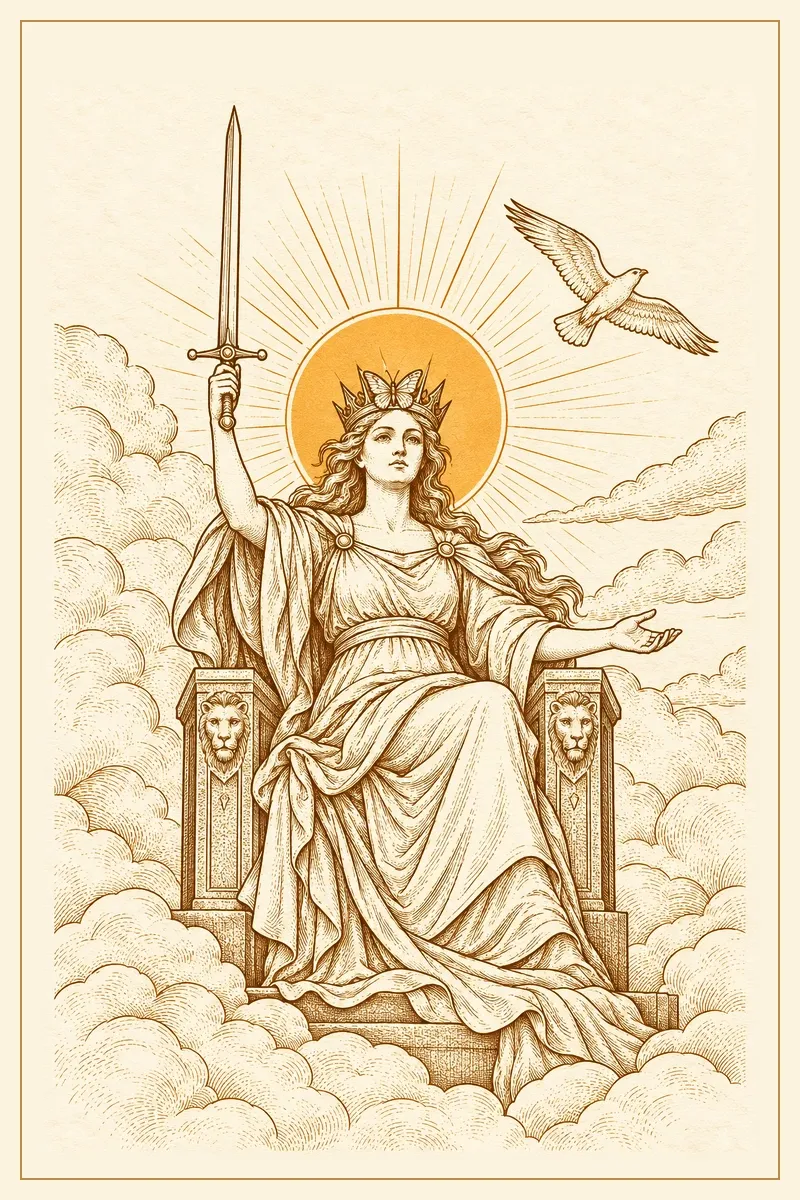
The Queen of Swords is not a yes or no card by nature, and readers place her anywhere from neutral to no-leaning; read as a yes, she is a conditional one: yes, once you look at the situation as it is rather than as you would like it to be. She is clear-eyed rather than cold, and her answer usually arrives with a fact you have been avoiding.
The question type decides which way she tips. For work, study, contracts and boundaries, she reads as a yes: you have the judgment this needs. For "will they come back" or "do they still have feelings for me", she is closer to a no, or more precisely to "not in the warm, unspoken form you are picturing". Where a decision rests on someone else being honest with you, she asks whether that honesty is present.
Court cards also describe people and attitudes, not only outcomes, so check whether she is answering your question or describing someone in it: a direct colleague, a friend who tells you the truth, or the part of you that already knows. The Queen of Swords meaning sets out the same figure across love, career and self-knowledge.
Reversed, she is harder to read as a yes. Her clarity tips into harshness, suspicion or a story you have told yourself so often it now feels like evidence. Before you accept a reversed Queen as a no, separate what you know from what you assumed.
What a reversal does to a yes
Reversals confuse yes/no readings more than any other technique, because people expect them to work like a switch. They rarely do. Three rules cover almost every reversed card you will pull.
- A reversed positive card is usually a quieter yes, not a no. The outcome holds; the energy around it is delayed, internal or less visible.
- A reversal often moves the answer inward. An upright card describes the situation; a reversed one frequently describes your relationship to it — your doubt, your tiredness, your readiness.
- Context outranks orientation. What you asked and which cards fell beside it matter more than which way up the card landed, every time.
Whether you read reversals at all is a separate decision, legitimate either way, and the arguments on both sides are laid out in the guide to tarot reversals. Whichever you choose, choose it before you shuffle: deciding once you can already see the card is how a reading quietly becomes an argument with yourself.
Wording the question so a yes means something
Most disappointing yes/no readings are caused by the question rather than the cards. A vague question collects a vague answer, and a question with two halves gets an answer to whichever half the card happens to address.
- Instead of "will I be happy", ask "what would make the next three months better than the last three".
- Instead of "does he like me", ask "what is actually being offered here".
- Instead of "should I take the job", ask "what am I saying yes to if I take it".
- Instead of "will it work out", ask "what does this plan still depend on".
Each still returns a yes or a no, and each returns the reason as well, which is the part you can use. More patterns live in the guide to asking effective tarot questions, and if you would rather borrow a well-built question than draft one, the question library is a reasonable place to start.
A three-card spread for a yes you can act on
A single card gives a verdict. Three cards give a verdict you can do something with, and the positions below are worded so that no card has to carry the whole answer.
- What is really on offer. The situation as it stands, stripped of your hopes about it. A yes card here means the opportunity is genuine.
- What the yes depends on. The condition. This position is where Strength, The Chariot and Three of Pentacles do their best work.
- What saying yes will ask of me. The cost. A difficult card here is not a no; it is a price list.
Read them in order and let the first card set the register. If position one is a clear yes and position three is heavy, you have a genuine opportunity with a real cost, which is an ordinary and workable result. The step-by-step method, including what to do when the positions disagree, is in the guide to a yes or no tarot reading.
A worked example: the offer to co-lead a project
Here is an illustrative case. A reader was asked to co-lead a six-month project with a colleague she had never worked with. She wanted to say yes and could not tell whether that was interest or flattery, so she drew three cards on the question "what am I saying yes to if I take this on".
What is really on offer: Ace of Pentacles. Something solid, with budget and standing behind it. Not a vague promise of exposure, but an actual opportunity with weight.
What the yes depends on: Three of Pentacles. The condition named itself. The project works if the two of them build it together and fails if either treats it as their own, which turned an abstract worry into one concrete task: agree who owns what, in writing, before the first week.
What saying yes will ask of me: Eight of Wands. Speed. Fast decisions, fast replies, a pace that leaves little room for her usual long consideration. A demand, not a warning.
Read together, the spread answered yes with a clear condition and a clear cost. She accepted, asked for a scoping conversation in the first week, and blocked two mornings a week for the quick decisions. Notice what the cards did not do: they said nothing about her colleague's private opinion and named no date. They gave a shape to a decision she was already making.
How a yes reads in love, work and money
Love. A yes about feelings is not a yes about behavior. Ace of Cups, Ten of Cups and Two of Cups confirm that something real is present; none of them promises that the other person will act on it. Read a yes here as encouragement to have the conversation, not as a substitute for having it.
Work. Career questions are where conditional cards earn their keep. Six of Wands and Three of Pentacles both say yes, but one describes recognition and the other collaboration, and mistaking them leads to real disappointment. When a yes lands on a career question, ask what it wants from you: visibility, patience, speed or help.
Money. Be most careful here. A yes can describe relief, an opportunity or a change in direction, and no card confirms an amount or a date. Treat a positive card as a reason to look at the actual numbers rather than permission to skip them, and take any decision with real financial consequences to someone qualified.
When a yes card does not feel like a yes
Sometimes the card is affirmative and your body disagrees. That reaction is information, and it is worth more than a second pull. Work through it in order.
- Name the feeling before you interpret the card. Relief, flatness and dread each point somewhere different, and flatness often means you asked about the wrong thing.
- Ask what the yes would cost. A yes can be accurate and still unwelcome, because saying yes to one thing means saying no to another. Name that other thing; it is often the real source of the unease.
- Check whose question it was. If you asked on someone else's behalf, or in words someone else would use, the yes may fit their wish rather than yours. Rewrite the question in your own words before deciding anything.
- Convert the yes into one small action. Send the message, check the figure, book the appointment. A yes you never act on becomes indistinguishable from a no within a month.
If the discomfort persists, change the question rather than the deck. "What am I not letting myself see about this" is an uncomfortable question and usually a productive one.
Frequently asked questions
Which tarot card is the strongest yes?
The Sun. It carries no conditions, no warning and no delay, which is unusual in a deck built mostly out of nuance. The World is a close second when the question is about something already underway.
Do reversed cards turn a yes into a no?
Usually not. A reversed positive card tends to mean a slower, quieter or more internal yes: the outcome stands but the energy around it is reduced. A flat no comes far more often from the card's own meaning than from its orientation.
Can I ask the same yes/no question again?
You can, but the second pull answers a different question. The first card responds to what you wanted to know; the second responds to "I did not like that". If the urge to re-draw is strong, sit with the first card for a day — the urge itself is usually more informative.
How many cards should a yes/no reading use?
One card for a simple question, three when the answer needs to be actionable. More than five turns it into a general reading, which is often the better choice anyway — at that point, drop the yes/no frame rather than forcing a binary out of it.
Can tarot promise that something will happen?
No. Tarot cannot confirm another person's thoughts, supply a date or guarantee a result. It reflects the situation at the moment you asked and helps you name what you already sense, which is genuinely useful and is not the same as a forecast. For medical, legal or financial decisions, ask someone qualified.
Putting a yes to work
Take the question you have been circling all week, draw on it in a free tarot reading, and write down what your yes would ask of you before you answer it.