Used well, tarot for business is not a forecasting tool; it is a structured way to interrogate a decision you have already analyzed. You give each part of the choice its own position in a spread — the offer, the money, the thing you keep not looking at — and read what each card asks you to check before you commit. It cannot confirm revenue, reveal what an investor is privately planning or supply a launch date, and no card should ever stand in for due diligence.
Owners tend to arrive at a reading at the same moments: a partnership on the table, a price that feels wrong, a hire you cannot quite afford, a product that has been nearly ready for months. The analysis is finished and the decision still will not close, because what is left is not arithmetic. It is risk tolerance, timing, and whether you still want the business this choice would create.
At a glance, these are the cards that read most clearly as a green light in a business question:
- Ace of Wands: a live idea with its own momentum.
- The Magician: the skills, contacts and capital are already within reach.
- Three of Pentacles: work that can be built with other people.
- Nine of Pentacles: a venture that pays the person who owns it.
- King of Wands: leadership that sets direction instead of waiting for it.
- Three of Wands: expansion beyond the first market.
- The World: a cycle completed — a launch, a milestone, an exit.
- The Empress: growth to tend rather than force.
- The Emperor: structure that holds — agreements, process, clear authority.
Framing a business question before you draw
A business reading is only as good as the sentence you write before you shuffle. "Will my business succeed?" produces a card you can read any way you like, because it names no decision, no timeframe and no action you control. "Should I accept the distribution offer this month, knowing it costs a third of the equity?" names all three, and every card that lands has something specific to answer.
Add three things to that sentence: the decision that is yours to make, the date you will make it by, and what you would do if the reading turned out to be unhelpful. The last one matters most. If no card could change anything, you are not reading — you are looking for permission, and a deck will give you permission all day.
Keep one list of what you know from documents, numbers and conversations, and another of what you are assuming; a reading belongs to the second list. If you are weighing two options and genuinely cannot tell them apart, a layout like the one in our guide to tarot for decision making gives each option its own column instead of handing you one verdict.
Six cards to read before a business decision
These six carry most of the weight in business spreads. Four describe conditions worth building on; two describe pressure that becomes expensive when it is ignored. Read each in the position it actually landed in, and resist scoring the spread: four supportive cards are not a forecast, they are four separate observations.
Ace of Wands: is the idea still alive?

Upright, the Ace of Wands describes an idea that still generates its own energy: you think about it unprompted, you can explain it in one sentence, and an afternoon of work on it leaves you with more appetite than you started with. That is a real signal, because an early venture runs on the founder's attention long before it runs on revenue. The useful question is not whether the idea is clever; it is whether you expect this spark eighteen months in, when the work is invoicing and support.
Reversed, the card often shows an idea that has gone quiet. Sometimes the concept was a reaction to a bad month rather than to a market; sometimes it is sound and you are simply depleted. Ask whether you would still want this business if someone handed you the first ten customers. If so, the problem is capacity, not the idea. The full Ace of Wands tarot meaning covers how the card reads outside a business question.
The Magician: the resources are already within reach
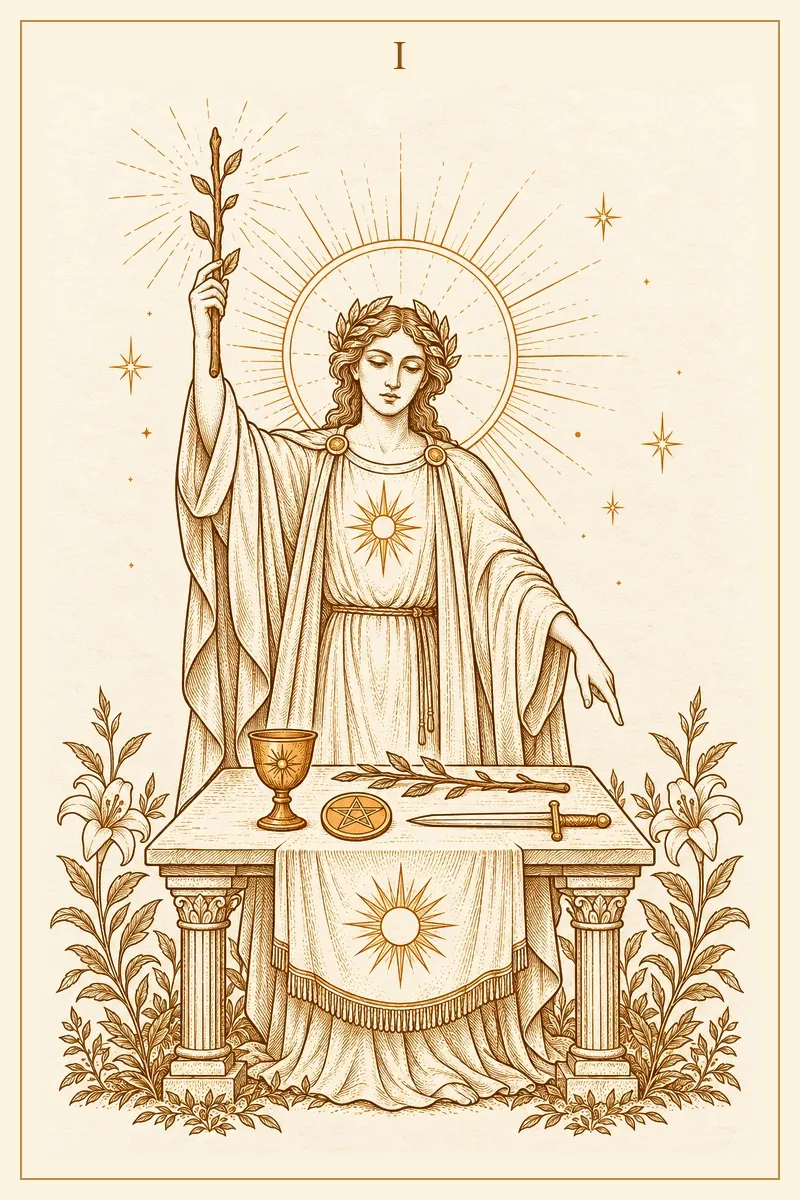
Upright, The Magician says the pieces exist: a skill you already have, a contact who would take the call, equipment or capital you can reach without raising a round. In practice this card speaks most directly to an owner who is waiting for one more credential, one more feature or one more quiet quarter before starting. Say out loud what you are waiting for; if it is not on the critical path, the card is asking why the start date keeps moving.
Reversed, it can describe effort spent on the wrong lever — a website rebuild instead of a sales conversation — or resources you are counting on but have not confirmed, such as a verbal promise of referrals. Turn each of those into something written before you treat it as an asset. More on the card's range is in the Magician tarot meaning.
Three of Pentacles: work that needs other people
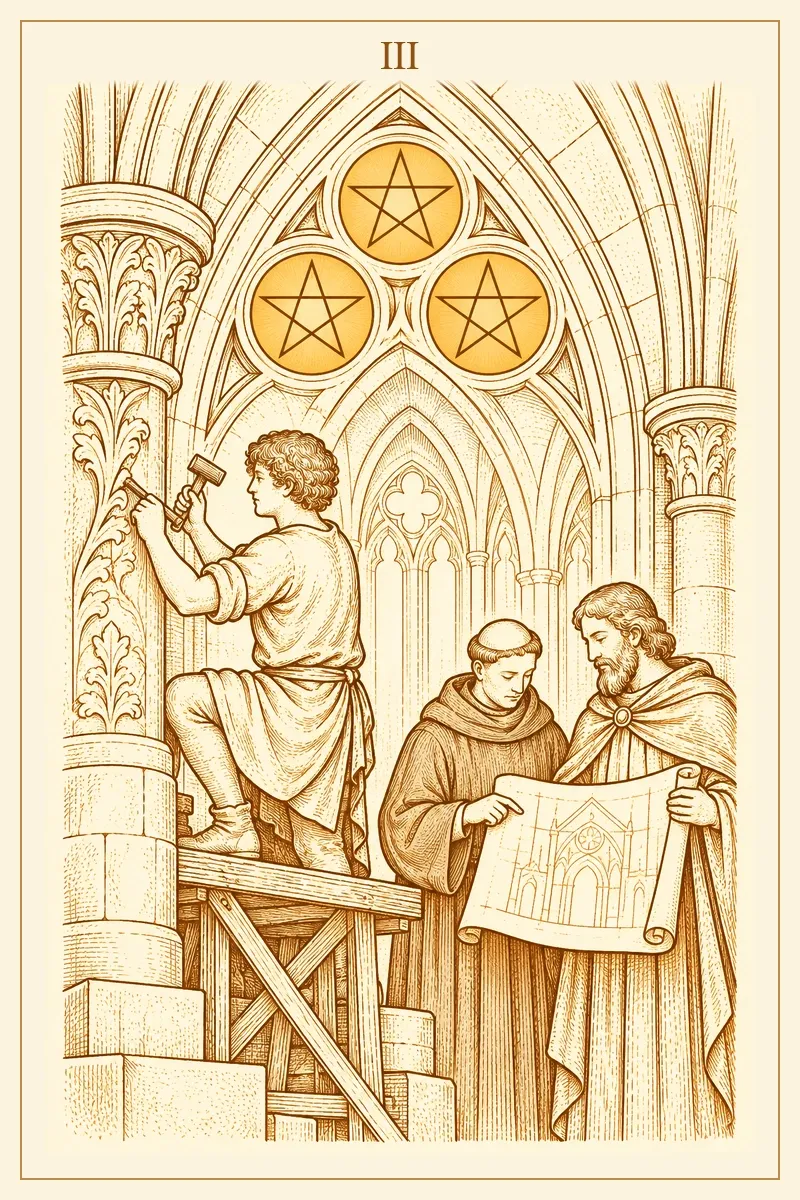
Upright, the Three of Pentacles is the card of coordinated work: a cofounder whose strengths are not yours, a contractor who delivers what they quoted, a client who gives usable feedback instead of silence. For a small business it often marks the moment a solo operation becomes a team — the first hire, the first retainer, the first project where someone else's standard raises your own.
Reversed, look at roles rather than personalities: two people guarding the same decision, a contractor working from a brief that changed by email, a partner whose contribution is assumed rather than agreed. Write down who decides what, and what "finished" means for the current project. The Three of Pentacles tarot meaning goes further into its craft and apprenticeship themes.
Nine of Pentacles: a venture that pays its owner
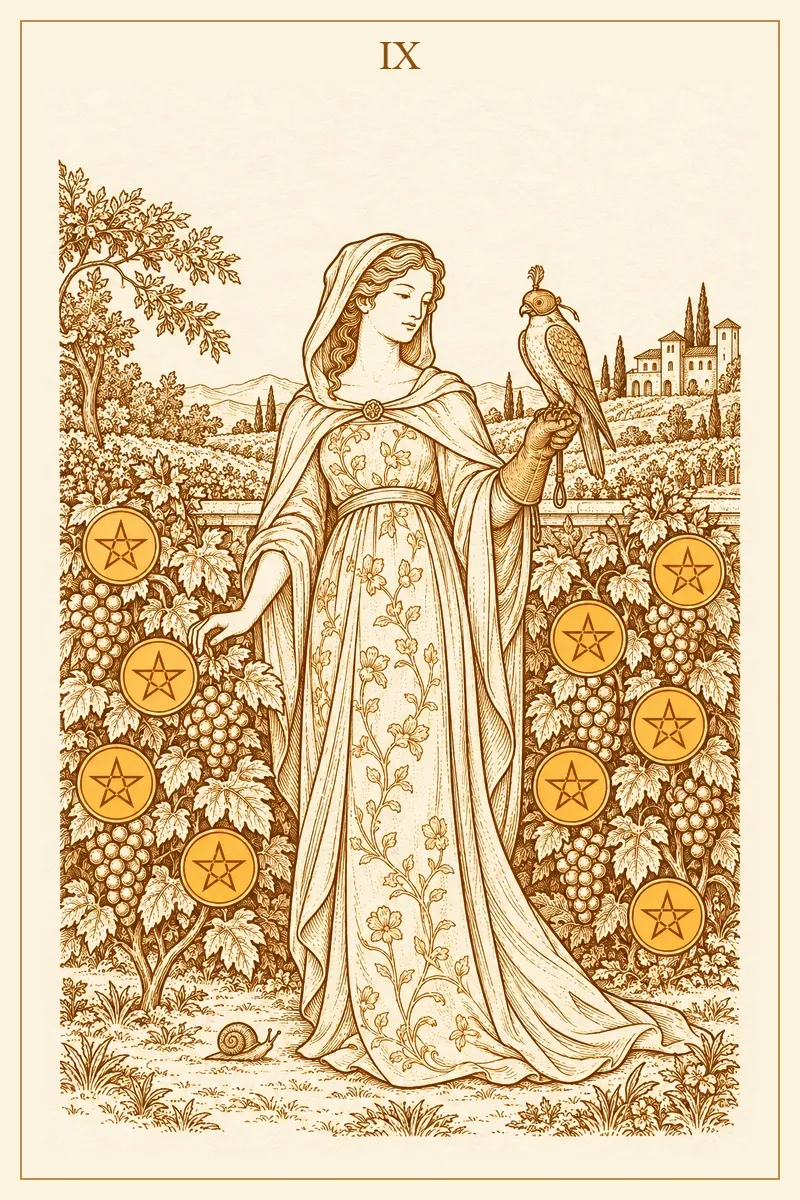
Upright, the Nine of Pentacles describes a business that has begun to support the person who built it: income that arrives without a launch, a week you can shape, work you are able to decline. That is a different signal from growth. Plenty of owners reach a revenue number and still have no margin, no time off and no way to be ill for three days. This card asks what the business pays you in money, in hours and in quiet.
Reversed, it often marks a venture that looks established from outside and costs its owner a great deal inside: revenue leaning on one client, a calendar with no slack, personal savings quietly subsidizing the company. That is a prompt to open the owner's own numbers, not only the company's. For how the card reads on wealth questions generally, see the Nine of Pentacles tarot meaning.
Seven of Swords: what is not being said in the deal
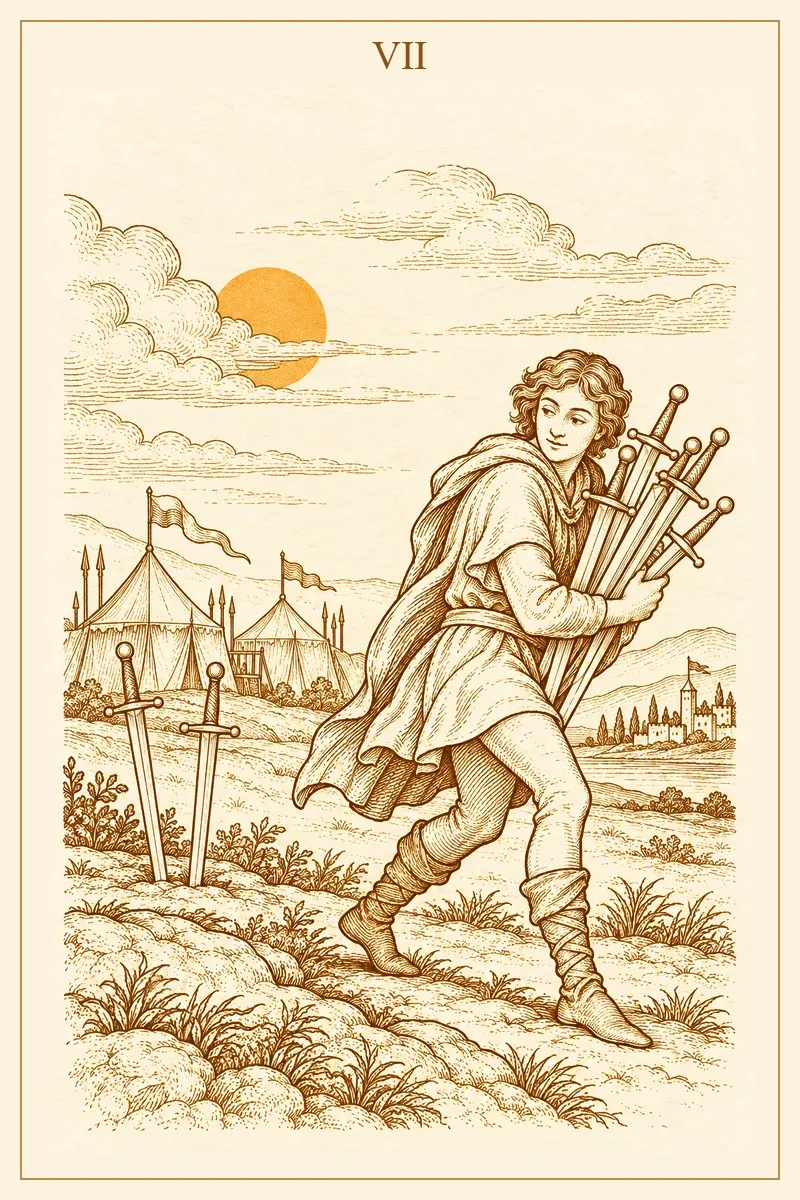
Upright, the Seven of Swords points to information moving out of view. In a business spread that is usually mundane rather than sinister: a term sheet with a clause nobody walked you through, a supplier who has not mentioned a second buyer, a founder's own optimism about a pipeline. Treat it as a prompt to read the documents again and to ask the question you have been phrasing too politely.
Reversed, it can suggest something coming to light, or your own suspicion running well ahead of the evidence. Either way the response is the same, and it is not tarot: have the agreement reviewed by a qualified professional, call the references you skipped, and write down what would have to be true for your worry to be unfounded. The Seven of Swords tarot meaning explains the card well beyond deal-making.
Ten of Wands: the owner who carries everything
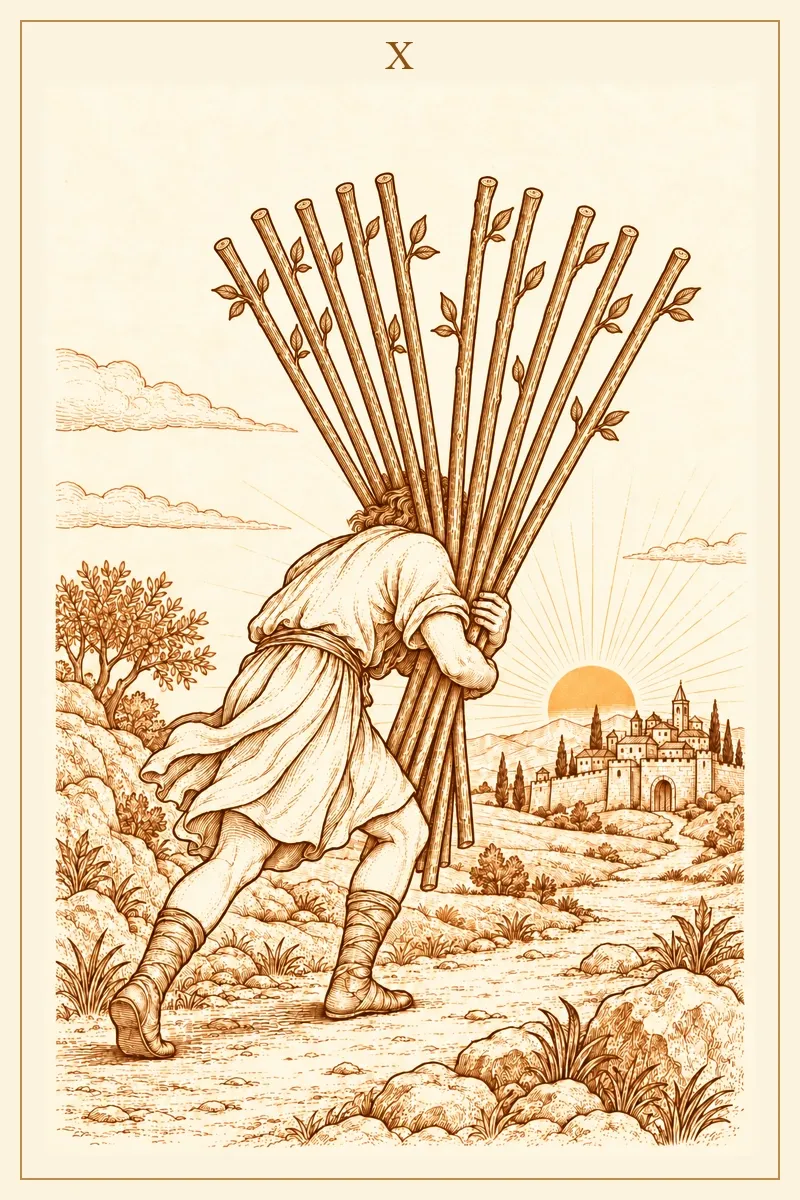
Upright, the Ten of Wands is the card a tired owner recognizes fastest. The load is rarely one crisis. It is bookkeeping, support, sales, delivery and the task you keep meaning to automate, all held by the one person who is also the only one who can do the actual work. The card does not say the destination is wrong. It says the current pace will not reach it.
Reversed, something is being put down: deliberately, if you choose it, and otherwise by collapse. Read it alongside two lists — what only you can do, and what you have never handed over. If delegating is not affordable yet, the honest move is usually to narrow the offer rather than to work faster. The Ten of Wands tarot meaning looks at its wider themes of burden and release.
Other cards that back a venture
Five more cards from the list above fill in what the core six leave out:
- King of Wands: leadership that sets direction and hires slightly ahead of comfort. Reversed, a company that cannot function unless its founder is in the room.
- Three of Wands: a second channel, another country, a product someone else could sell for you. It assumes the groundwork is done, so it also tests whether your base could support expansion or only your ambition has moved.
- The World: a cycle closed rather than a windfall — a round completed, a product shipped, a long client relationship ending well. Completion also means the next version of the business has not been designed yet.
- The Empress: growth that wants tending rather than forcing, such as existing customers who buy again or a referral pattern you did not engineer. It argues for improving what works over launching something new this quarter.
- The Emperor: structure rather than charisma — the agreement in writing, the process that runs while you are away, the boundary a client cannot talk you out of. Reversed, it can mark control held too tightly, or a company whose rules nobody could state out loud.
Alongside them, the Ace of Pentacles is the practical opening — a first contract, a deposit, an offer you can name a price for — while the Eight of Pentacles is the unglamorous middle, where the craft gets good enough to charge properly for. For the longer view of money cards in business, the guide to tarot cards that signal financial success maps how they combine over years rather than quarters.
Cards that ask for a slower decision
Warning cards are not instructions to stop. In a business spread they mark where the plan is thin, and the expensive mistakes are almost always the ones where the thin part was visible in advance.
Five of Pentacles is financial exposure: a shorter runway than you have admitted, a venture that works but is undercapitalized. Its practical note is that the support usually does exist and has to be asked for out loud. Talk to an accountant or your bank about options such as a credit line before it is urgent.
The Tower is a structure built on an assumption that no longer holds: a channel that was really one platform's traffic, a margin that depended on one supplier's price, a partnership that was never written down. Rebuilding on purpose costs less than rebuilding after.
The Moon is missing information and the stories that rush in to fill it. You may not actually know why customers leave or what a quiet cofounder thinks. Before committing more money, turn one of those unknowns into data: ask five departing customers, or have the conversation you keep deferring.
Five of Swords is a win that costs more than it returns — a dispute pursued past the point of value, a price war with a larger competitor, a client you could keep by conceding everything. It asks what you would be left holding on the day you won.
Two of Swords is the decision deferred until the delay has become the decision. Set the date, name the information that would change your mind, and if nothing would, accept that you have already chosen.
How the suits balance in a business spread
Most business readings are shaped by suit balance before any single card matters. Wands carry vision and drive; Pentacles carry money, resources and the slow build. A spread heavy in Wands and light in Pentacles usually describes real enthusiasm without a model that pays for it, and the question becomes who buys this, at what price, how often. Weighted the other way, a careful plan may be missing the reason a customer would choose you over the cheaper option.
Swords are the paperwork and the conversations: contracts, positioning, the difficult email, the thing you have not said to your cofounder. Cups are whether anyone still cares. A spread of Pentacles and Swords with no Cups at all often belongs to an owner doing everything correctly and dreading Monday.
Three spreads for the decisions owners actually face
Each layout below has named positions; write them down before you draw so that a card cannot drift into whichever slot flatters the plan. For longer layouts aimed at work questions in general, there are seven in our guide to tarot spreads for career guidance.
Partnership check: four positions
Use it before a cofounder agreement, an investment, or a supplier you would come to depend on.
- What they bring: the contribution you could describe accurately to a third person.
- What is not on the table: an expectation, a control question or a dependency nobody has named yet.
- Effect on the business you want: whether this amplifies the company you are building or gradually turns it into a different one.
- Six months in: what the working relationship looks like once the novelty has worn off.
Read the second position against the documents rather than your feelings about the person: if a card there points at control, find the clause about decision rights.
Launch readiness: five positions
For a product, a new service line or a reopening.
- The offer: is the thing itself ready to be paid for?
- The market's appetite: who is waiting for this, and what are they doing instead today?
- Your blind spot: the part of the launch you keep not looking at.
- Capacity: whether your money, time and support can carry the first month of demand.
- Early trajectory: how the opening weeks are likely to feel, and what would make you adjust.
The fourth position is the one owners skip. A successful launch you cannot deliver makes for a worse quarter than a quiet one.
Quarterly review: four positions
A standing check-in. Pull it once a quarter and keep the records in one place.
- Current business energy: the honest state of the venture right now.
- Biggest opportunity: where your attention would compound this quarter.
- Biggest risk: what needs protecting before it needs rescuing.
- Quarter-end outlook: the direction of travel if nothing changes.
Over a year these records become the most useful part of the practice: you can see which risk you named three quarters running and never addressed.
Worked example: a price that has not moved in three years
Take a hypothetical case: a designer runs a small studio alone. Her rates have been the same for three years, she is busy every week, and she cannot tell whether raising them would cost her the work she depends on. The decision: new rates for new projects from next quarter. She uses the quarterly review above.
Current business energy — Nine of Pentacles reversed. The studio looks established from outside and pays her less than it appears to. Sitting with the card, she notices that two long-standing clients have never had a price change, and that she has no record of which projects made money.
Biggest opportunity — Three of Pentacles. Not a new market: her last three good projects all came through one developer she subcontracts with. The opportunity is to formalize that relationship with a retainer and a shared scope template.
Biggest risk — Five of Pentacles. She is one client away from a thin quarter, and a rate rise announced badly could make that real. The card reads as a sequencing problem rather than a prohibition: raise rates for new work first, keep existing clients on current terms for one more cycle, and ask her bank about a credit line before she needs one.
Quarter-end outlook — Ten of Wands. Charging more does not change her load; doing less does. She picks one service to retire and writes down the date she will stop offering it.
Nothing in that reading set a number. What it produced was a short list she could act on, and it stopped her from treating the price as the only lever she had.
When the decision affects other people
Reading for your own choices is straightforward. It gets harder when a decision lands on someone else's income, and the line worth holding is simple: a reading can change which questions you ask, never who decides or on what evidence. A few habits keep that line visible.
- Keep readings for decisions that are yours to make, and bring evidence rather than cards to the meeting where they are agreed.
- Do not read to settle a hire, a dismissal or a performance question about a named person; those need a documented, fair process.
- Do not read about someone without their knowledge, including a competitor's plans or a candidate's intentions.
- Never let a supportive card override a concerning number. When the reading and the accounts disagree, the accounts are the evidence.
- For anything with legal, tax or regulatory weight, get advice from a qualified professional.
Watch what you do with a reading you dislike. A spread that unsettles you is usually the one doing its job, and the common failure is not superstition — it is shuffling again until a friendlier card arrives.
Turning a reading into a plan you can review
Close every business reading with four lines in the same notebook: the question as you asked it, the cards and their positions, the single action you will take, and the date you will look at this again. That fourth line separates a practice from a habit of worrying in a more decorative format.
A workable cadence is one review reading per quarter plus one focused reading per significant decision; daily pulls about the company tend to produce noise, because a business changes more slowly than a card does. If you are shaping next quarter's targets instead of resolving a single choice, the approach in tarot for goal setting fits that work better. Reread the notebook two quarters later, not to score the cards but to see your own patterns.
Frequently asked questions
Is tarot for business a legitimate practice?
It is as legitimate as any structured reflection an owner uses: a pre-mortem, a written decision log, a walk with a mentor's questions in your head. What tarot adds is a set of positions and images that make you consider parts of a decision you would otherwise skip. What matters is how you treat the output — as a prompt for better questions, or as a replacement for evidence.
Which tarot cards are best for starting a business?
The Ace of Wands for the idea's energy and the Ace of Pentacles for the first tangible offer are the usual pair, with The Magician when the resources are already within reach. Read them as three separate readiness questions rather than one combined green light, because desire, viability and capability can sit at very different stages in the same venture.
Can tarot tell me whether my business will succeed?
No. A reading can describe conditions — whether your resources are adequate, whether the timing is argued or merely assumed, whether a partnership is genuinely agreed — but it cannot confirm an outcome, a revenue figure or a date, because those depend on execution and on a market that has not happened yet. Use a reading to find the question you are avoiding, then use evidence to answer it.
How often should an entrepreneur read for the business?
Once a quarter for a review, plus one focused reading per major decision, is enough for most owners. More than that usually generates anxiety rather than clarity, and it tempts you to reshuffle a question you have already answered.
Should I tell my cofounder or my team that I read tarot?
That depends on your relationship and your workplace, and there is no obligation either way. Many owners keep it private, in the same way they keep a journal private. If you do mention it, be clear about its role — a thinking tool you use before you bring a proposal — so that nobody has to wonder whether a decision about their work was made by a card.
Can I read about a client's business or a competitor?
Read about your own choices in relation to them: whether to take the contract, how to position against a cheaper rival, what you would need to see before depending on a supplier. Trying to divine another company's private plans gives you nothing you can act on and quietly displaces the research that would.
A steadier way to decide
Running a business means deciding with incomplete information, repeatedly, often alone. A reading does not remove the uncertainty. It keeps you from pretending the uncertainty is arithmetic, slows the decision enough to name the part you have been avoiding, and hands the choice back to you with the question sharpened.
Keep the practice small and honest: one clear question, one layout you trust, one action with a date on it. When your next decision is ready for that kind of second look, you can start a reading on Veil Soul and see what it asks you to check.