Clear sight and honest words, offered without cruelty: that is what the Queen of Swords means. Upright, she stands for discernment, independent judgment and boundaries stated calmly, the kind of clarity that can grow out of a loss or a hard lesson. Reversed, the same sharpness turns into coldness, cutting criticism, suspicion or a guarded isolation that calls itself independence.
As a court card she can point to a person in your life, a role you are being asked to take on, or the attitude a situation needs from you. What she shows is how honestly you are looking at something. She cannot see into another person's mind, set a date, or promise how a frank conversation will land, so treat her as a prompt to check your facts and your tone rather than as a verdict.
Her keywords and correspondences at a glance:
- Upright: discernment, honest communication, independence, fair boundaries, wisdom drawn from experience.
- Reversed: coldness, cutting words, bitterness, distrust, isolation, overthinking.
- Element: Water of Air, the receptive side of the suit of thought.
- Astrology: 20° Virgo to 20° Libra in the Golden Dawn system, roughly mid-September to mid-October.
- Love: high standards and plain speaking; reversed, walls built from old hurt.
- Yes or no: yes, once you have the facts; reversed, not while resentment is doing the thinking.
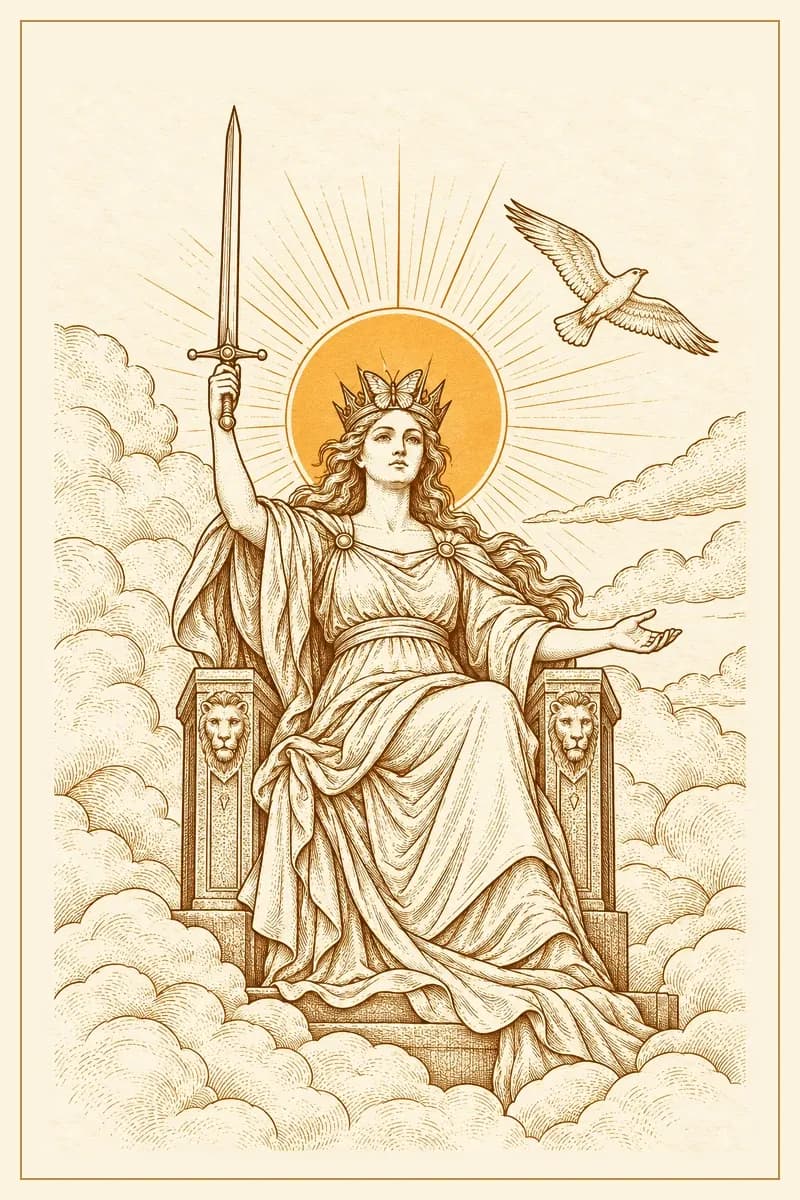
Sword raised, palm open: the picture on the Queen of Swords
Every detail of this card makes the same point twice: she can cut, and she chooses when to. Her meaning sits in the contrast between her two hands.
The upright blade and the outstretched hand
She lifts her sword straight up in her right hand, the point aimed at the sky rather than at anyone. An upright blade is a blade at rest: it marks truth and decision, not attack. Her left arm reaches out to the side with the palm turned up and open, the gesture of someone who invites a reply or offers help. Read together, the hands say that clarity and openness are not opposites. She will name what is true, and she will still hold out a hand afterward.
Butterfly crown, golden disc and a single bird
A butterfly sits at the center of her crown, a creature that flies only after a complete change of form, and a large golden disc sends long rays out behind her head: wisdom that came through change, held in the light rather than in secrets. Her stone throne has a lion's head carved into each side pillar and rests on steps above banks of cloud, which gives her firmness, self-command and a view above the weather of the moment. High in the corner one white bird flies alone with its wings spread, a fitting image for a mind that goes where the view is clearest instead of following a flock.
Queen of the Thrones of Air: water inside the element of thought
Swords belong to air: thought, language, analysis and decisions. The Hermetic Order of the Golden Dawn, whose teachings fed into the Waite-Smith deck, gave every court card two elements, one for its rank and one for its suit. Queens carry water, so this card is Water of Air: a mind that listens before it speaks, and feeling that has been thought through. Her full title is the Queen of the Thrones of Air.
The Golden Dawn's ranks were King, Queen, Prince and Princess, and they do not match modern names one to one. Its King was a mounted warrior, the figure modern decks call the Knight of Swords, whose charging energy is covered in the Knight of Swords tarot card meaning. Its Prince corresponds to the modern, enthroned King of Swords, and the King of Swords meaning explains that judging side of the suit. The Thoth deck keeps this order and calls the rider a Knight; the Princess stands where the modern Page does. Only the Queen keeps her name in every system.
Her zodiac span runs from 20° Virgo to 20° Libra: Virgo's precision joined to Libra's wish to weigh both sides. It covers the decans of the Ten of Pentacles, the Two of Swords and the Three of Swords, and that last link suits her: grief, once understood, can become her clear-eyed calm. Not every reader uses these correspondences, so take them as one lens rather than a rule.
Upright Queen of Swords: discernment that keeps its kindness
Upright, the Queen asks you to see a situation as it is, not as you hoped or feared it would be. She is the friend who reads the contract twice, notices the sentence that does not match, and asks the question everyone else was too polite to ask. Her honesty is not a show of toughness; it comes from having been wrong or misled before and deciding not to look away again.
- Forming a view from evidence instead of borrowing one from the loudest voice in the room.
- Saying what you mean in plain language, with enough care that it can be heard.
- Setting a boundary once, clearly, and holding it without a long apology.
- Separating what you know from what you suspect.
- Using a past difficulty as information rather than as a wound you keep reopening.
Remember the open palm: her clarity leaves room for the other person's side of the story. If you are tempted to soften a truth until it means nothing, she suggests saying it once, and kindly. If you are hearing something unwelcome, she asks whether the message is fair, even if it stings.
Queen of Swords reversed: when the open hand closes
Turn the card upside down and imagine the open palm curling shut. The blade is still sharp, but no longer held at rest. Reversed, her gifts work against connection: accuracy turns into nitpicking, honesty into sarcasm, independence into a refusal to need anyone. The pain that taught her has hardened into a rule that nobody gets close enough to hurt her again.
- The cutting remark: criticism delivered to win rather than to help, or "just being honest" at someone else's expense.
- The closed door: coldness used as protection, so that warmth offered by others bounces off.
- The private verdict: building a case against someone in your head and never letting them answer.
- The inner critic: her sharpness turned on yourself, with impossible standards and harsh self-talk.
The reversal can also point the other way, toward confusion, gossip or opinions you have not checked. Either way, it is not a judgment on your character. It marks a place where self-protection has started to cost more than it saves. The way back is the gesture on the card: lower the blade a little, open the hand, and ask one real question before deciding what someone meant.
When the Queen of Swords is a person in your spread
As a person, of any gender or age, she is perceptive, articulate, independent, quick to spot inconsistency and slow to be flattered: a mentor who gives frank feedback, a friend who tells you the uncomfortable truth, an editor, a lawyer, or a manager whose standards are high and fairly applied. She may also be someone who came through a divorce, a bereavement or another hard ending and rebuilt life on their own terms. Ask whether her honesty is what you need right now, whether her sharpness has started to wound, or whether the card is describing your own voice.
Love with the Queen of Swords: honesty before romance
In a love reading the Queen puts truth ahead of chemistry. She cares whether words and actions match over time, and whether a deep conversation can stay a conversation instead of a contest. For someone single, she describes dating with clear standards: knowing what you will not accept, saying so early, and not mistaking intensity for compatibility. For a couple, she asks for direct talk about what is bothering you, one specific thing at a time, and for boundaries both people understand.
Reversed, love can feel like a negotiation conducted behind armor. A new person may be judged for an old partner's mistakes, or arguments may become precise, wounding debates that one person wins and both lose. It can also show a relationship gone quiet because neither person will say the first honest sentence. The remedy is small: say one thing you feel, not only one thing you think.
Queen of Swords as feelings: respect first, warmth earned slowly
When you ask how someone feels about you and the Queen of Swords answers, the first feeling she describes is respect, or the wish for it. Upright, this person sees you clearly and likes what they see, but shows it through attention and honesty rather than grand gestures. They may ask probing questions, remember exactly what you said last week, or tell you a truth others would not risk. Their interest is real, measured, and grows as trust is shown rather than promised.
Reversed, the feelings are guarded. This person may care more than they let on and hide it behind dry humor or distance, or may be weighing you critically, waiting for a misstep that confirms an old fear. Sometimes it is disappointment that has cooled into reserve. What to do with that: offer one direct, low-pressure question, and let their answer, not the card, tell you the rest.
Career and money: the editor's eye
Work, feedback and hard calls
At work she favors careful analysis, plain communication and integrity under pressure. Your ability to read the fine print, write a clear proposal or give fair feedback can become your main asset, and roles that reward precision suit her: editing, research, law, auditing, teaching, consulting. In a job search she suggests honest self-assessment and specific answers over polished ones. Reversed, the climate turns sharp: constant criticism, withheld credit, cleverness used to undermine, or your own perfectionism holding a team to standards nobody can meet.
Budgets, contracts and clear numbers
With money she is the person who opens the spreadsheet instead of hoping. Upright, review what comes in, what goes out and what a loan or subscription really costs over a year; decide from facts rather than guilt or a sales pitch, read terms before signing, and for a large decision get advice from a qualified professional, since a card is not a financial plan. Reversed, distrust or pride may shape choices: refusing useful advice, hiding finances from a partner, or using money to keep score. Ask yourself whether you are being clear or merely guarded.
Wellbeing for a mind that keeps weighing everything
The Queen lives in the head, which is both her gift and her strain. She can encourage you to take an active part in your own care: write down questions before an appointment and ask for straight answers, while leaving diagnosis and treatment to a doctor or other qualified professional. Reversed, she can point to a mind that will not switch off, replaying conversations or explaining grief instead of feeling it. A walk, regular sleep and time with people who do not need you to be sharp can help, and if heavy thoughts are affecting daily life, reaching out to a health professional is a decision in her own clear style.
Yes or no: a yes once the facts are on the table
Upright, the Queen of Swords leans toward yes, on one condition: your reasoning has to hold up under honest inspection. If you could explain the choice in a sentence to a fair-minded friend, go ahead. Reversed, she leans toward no or not yet, because resentment, suspicion or the wish to prove someone wrong is making the decision; let that cool first. To phrase such questions so the cards can answer them usefully, see the guide to doing a yes or no tarot reading.
Cards that sharpen or soften her blade
The Queen's meaning shifts with her neighbors. Each pairing below shows what her clarity is for, or what it needs to stay humane.
Justice: the same sword, a public verdict
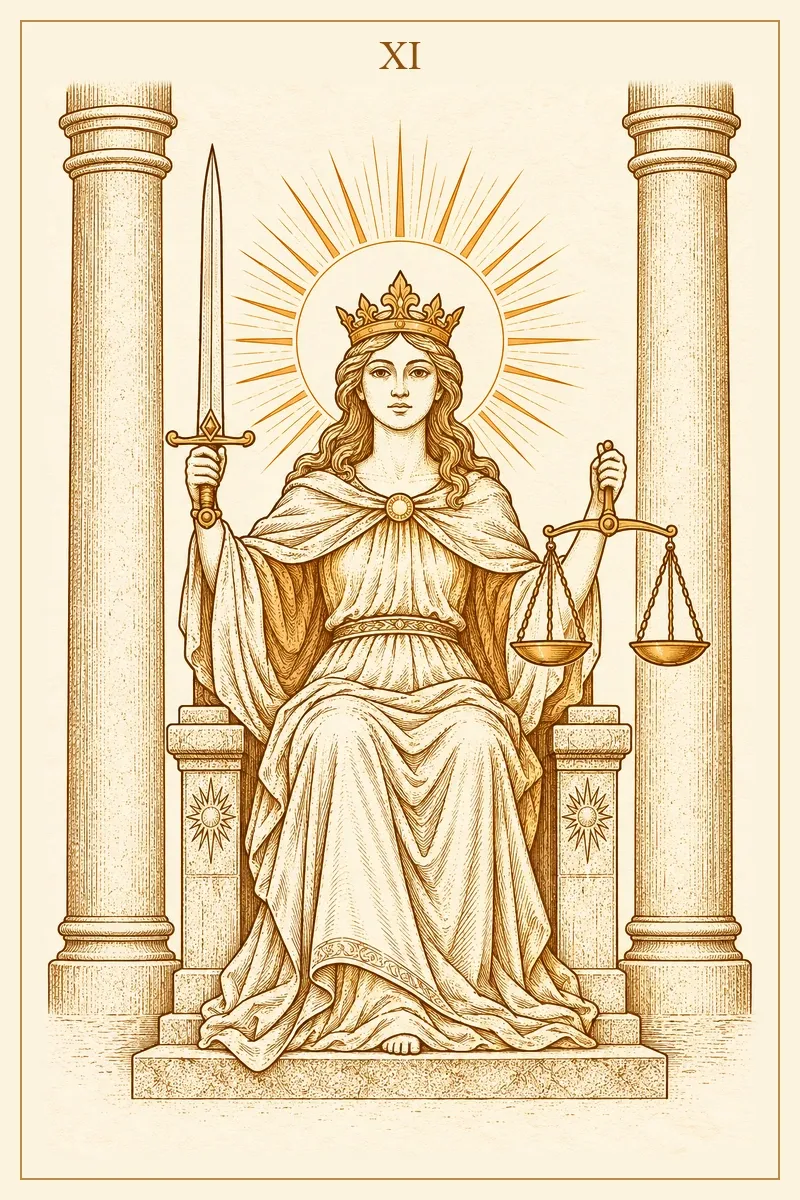
On the Justice card a crowned figure sits between two stone pillars, sword upright in one hand and scales in the other, a halo of rays behind her head, an echo of the Queen's own blade and disc. Together they describe a fair decision based on evidence: a contract, a formal complaint, an agreement to put in writing. The Queen supplies personal discernment; Justice adds weighing that applies to everyone. The Justice tarot card meaning explores that accountability in depth.
The Empress: a clear head in a garden
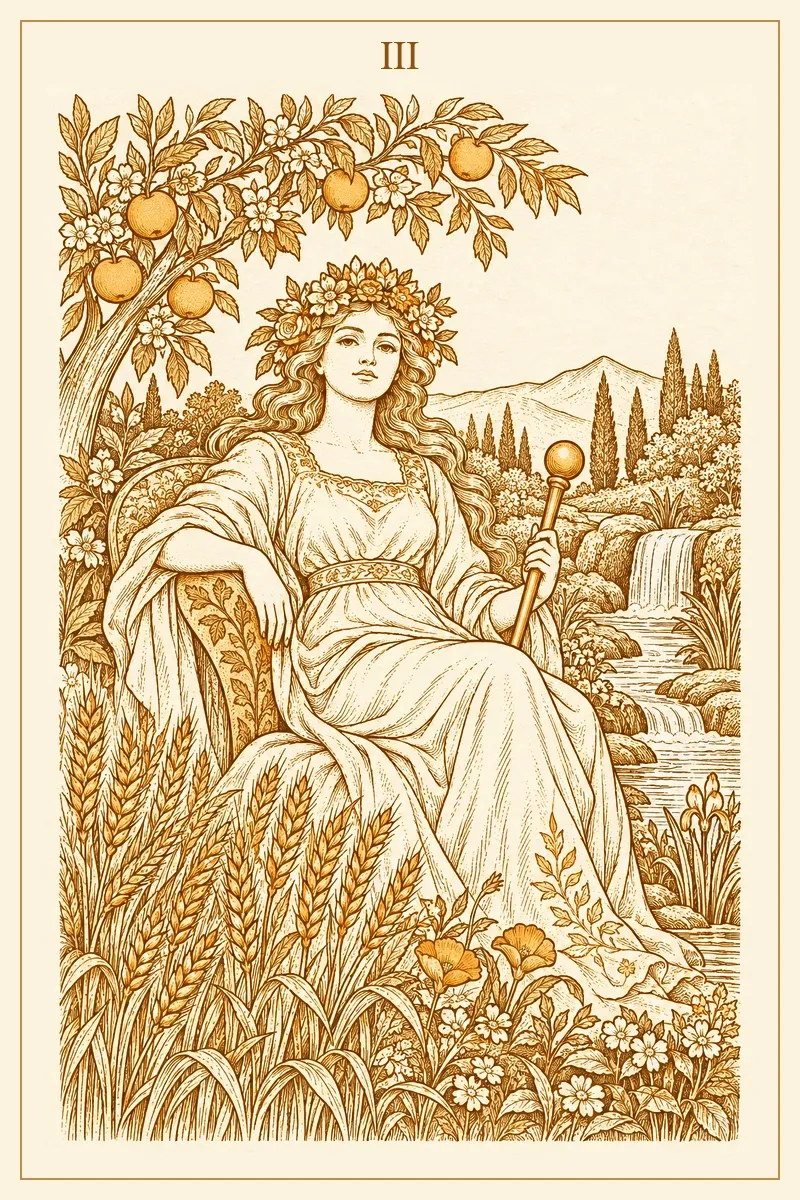
The Empress reclines among ripening wheat beneath a fruit tree, flowers in her hair and a gold scepter in her hand, a stream falling over rocks behind her. Where the Queen sits above the clouds, the Empress sits on fertile ground. Paired, they balance head and heart: honest standards with patience and warmth. Read the Empress tarot meaning for her full picture of abundance.
The Hermit: solitude that sharpens judgment
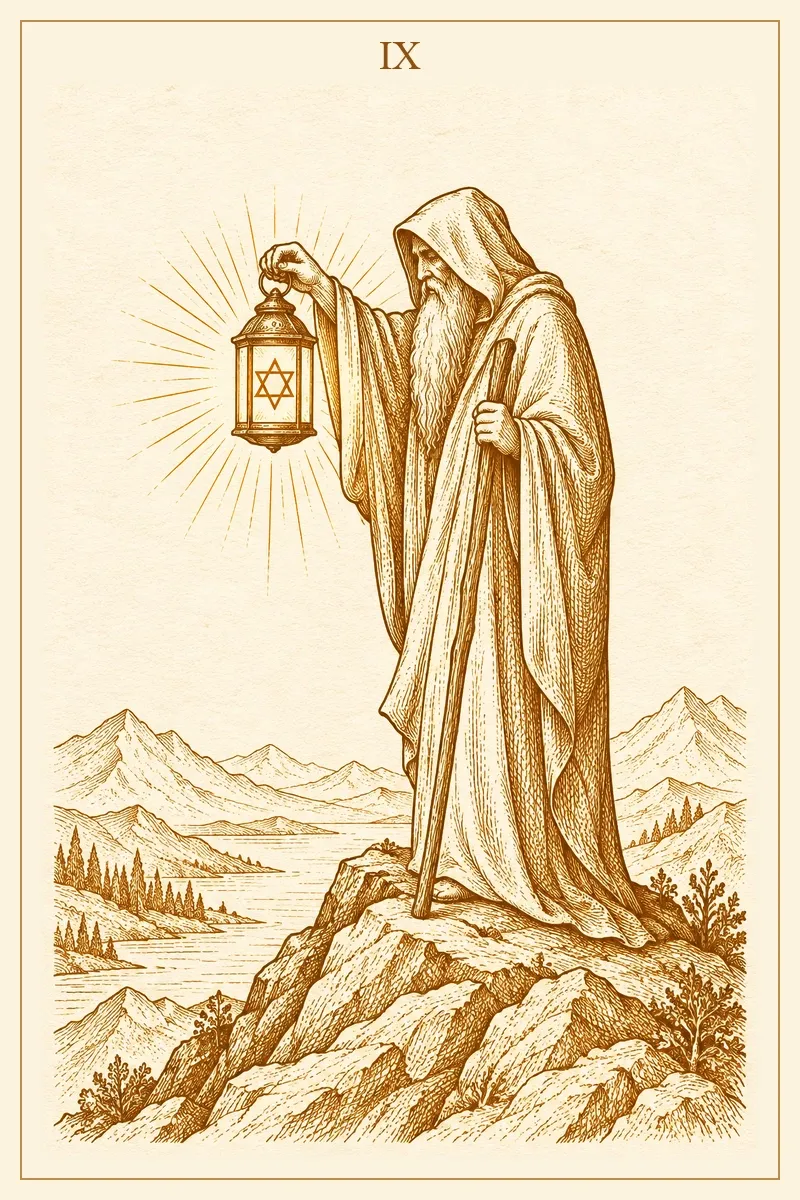
The Hermit stands on a rocky peak in a hooded cloak, leaning on a staff and holding up a lantern with a six-pointed star inside, a lake and mountains below. Both cards face a wide view alone. Together they suggest a deliberate retreat from other opinions so that you can hear your own; if either is reversed, the risk is withdrawal that hardens into isolation. The Hermit tarot card meaning shows how chosen solitude differs from hiding.
The Star: clarity that heals instead of cuts
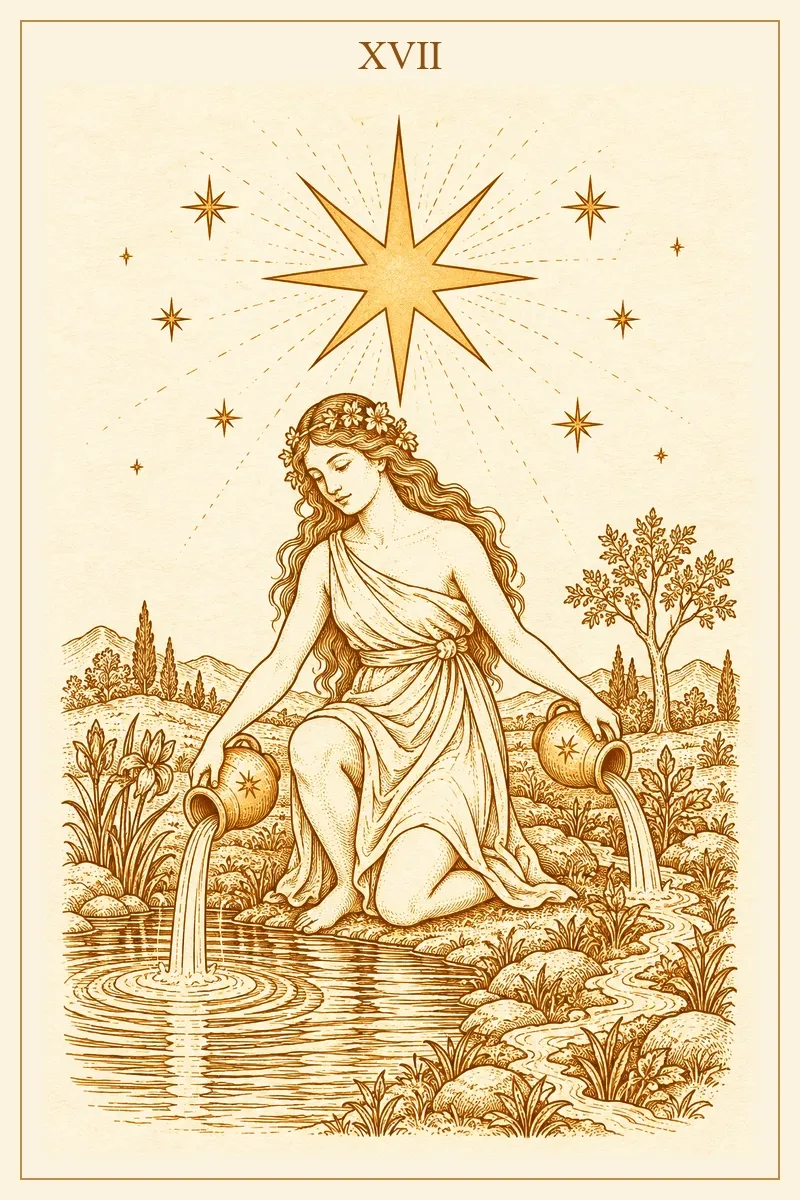
On The Star a woman kneels at a pool, pouring water from two jugs, one into the pool and one onto the land, beneath a large eight-pointed star ringed by smaller stars. After the Queen's hard-won wisdom comes renewal: a painful truth has been faced, and now there is room to rest and trust again. The Star tarot card meaning covers that quiet kind of healing.
Ace of Cups: a guarded heart opens
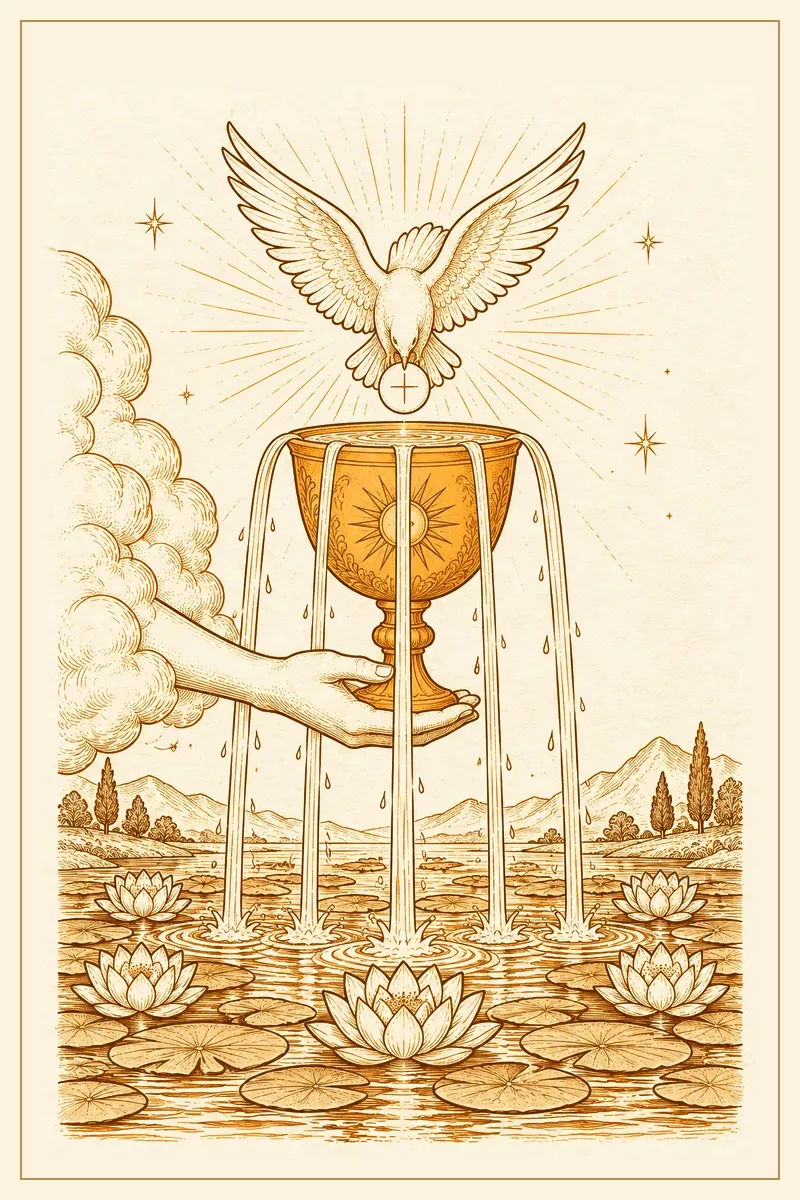
The Ace of Cups shows a hand from a cloud holding a golden chalice that overflows in five streams into a lotus pond, while a dove carrying a small round wafer descends toward it. The Queen's sky has one bird too; here it comes down to bless the cup. The pairing marks someone who kept their heart behind careful reasoning and is ready to feel again. The Ace of Cups tarot card meaning explores that fresh emotional start.
The Sword and Palm spread: four positions for a hard conversation
This layout borrows the Queen's two hands. Use it before a conversation you have been putting off, when you need to say something true and keep the relationship intact. Lay four cards in a row:
- The sword: what I see clearly. The fact you are sure of, stated without exaggeration.
- The clouds: what I have not said. What you have been rehearsing silently, and what it has turned into.
- The open palm: what I can offer. A question, a concession, help or a shared plan.
- The throne: the boundary that keeps me steady. The line you will hold, whatever is said.
Write one sentence per position before turning the next card. At the end you hold the outline of the conversation: one observation, one admission, one offer and one limit.
A worked example: a launch date that will not hold
Take an illustrative question. Someone runs a small online shop with a business partner, who has announced a launch date to customers. The person asking thinks the date is unrealistic but has said nothing for weeks: "How do I tell my partner the date will not work without starting a fight?"
The sword: Ten of Wands. The clear fact is overload: too much carried by too few hands, now with a public deadline on top. This can be said plainly, with the list of unfinished tasks and the hours they need.
The clouds: Queen of Swords reversed. Weeks of silent rehearsal have turned "the date is risky" into "you never think things through." Said that way, it would land as a verdict on the partner. The card says: drop the case-building, keep the observation.
The open palm: Three of Pentacles. The offer is collaboration: bring the task list and suggest planning the next stage together, asking what the partner would cut or move.
The throne: Four of Swords. The boundary is rest. The timeline will not be rescued by giving up every evening and weekend, and saying so early keeps the new plan honest.
The spread does not say whether the partner will agree; it shows how to have the conversation well. If the partner still prefers the original date, at least the disagreement is about the plan, not a buried accusation.
Practicing her clarity this week
- Write the hardest true sentence about your situation in under twenty words, then rewrite it so it would be fair to read aloud to the person involved.
- For one decision, list what you know and what you are assuming, and act only on the first list.
- When you catch yourself judging someone silently, ask them a question instead.
And one question to keep nearby: where am I protecting myself so hard that nobody can reach me?
Frequently asked questions
Is the Queen of Swords a positive card?
Upright, yes, in a grounded way: she brings clarity, fairness and the courage to speak honestly, which can feel uncomfortable before it feels good. Reversed, she is a caution about coldness or harsh judgment, not a bad omen.
Does the Queen of Swords mean someone is cold toward me?
Not necessarily. Upright, she describes someone reserved whose care shows through honesty and attention. Reversed, she can describe guardedness, but the reason may be past hurt rather than anything about you. A calm, direct conversation will tell you more than the card can.
Can tarot tell me what a Queen of Swords person really thinks of me?
No. Tarot cannot read another person's private thoughts, fix when something will happen, or guarantee how a situation turns out. It can help you reflect on what you have observed and what you want to ask; what they think is theirs to tell.
How is the Queen of Swords different from the King of Swords?
Both are clear thinkers. The King applies judgment outward, setting rules and making decisions that affect others. The Queen is more personal: she reads people, draws on her own experience and speaks one to one. In Golden Dawn terms she is Water of Air, while the modern King corresponds to the Prince, Air of Air.
Does the Queen of Swords always represent a woman?
No. Court cards describe qualities, roles and attitudes, so she can stand for a person of any gender, or for a way you yourself are being asked to think and speak.
Can the Queen of Swords point to a breakup or divorce?
She can appear around endings because she describes clear decisions and independence, and older card lists linked her with separation and widowhood. That does not make her a prediction of a breakup. Read her as a call for honesty about what is working, and a reminder that life after an ending can be rebuilt on your own terms.
One true sentence, one open hand
The Queen of Swords asks for a demanding combination: the courage to see clearly and the generosity to stay open after you have spoken. Her sword names what is true; her palm keeps the door unlocked.
If there is a conversation or decision you have been circling, start a reading with Veil Soul and write down the one clear sentence you want to carry into it.