Fire in tarot is the suit of Wands: fourteen cards about wanting something and doing something about it. Four Major Arcana cards belong to fire as well — The Emperor for Aries, Strength for Leo, Temperance for Sagittarius, and Judgement, which the old correspondence tables give to the element itself. Eighteen of the seventy-eight cards are fire cards, and when several land together the reading has turned toward drive, nerve and what you will spend yourself on.
That is also where fire stops. A Wands card can show how much appetite you really have for a plan and what it costs to keep alive. It cannot promise the plan will work, name the month the money arrives, or decide whether you hand in your notice. Read it as an honest picture of your own heat, then test it against the real schedule.
The fire element at a glance:
- Suit: Wands, called Rods, Staves or Batons in older decks; fourteen cards about will, risk and work you chose.
- Fire signs: Aries (cardinal), Leo (fixed), Sagittarius (mutable) — fire that starts, fire that keeps going, fire that spreads.
- The Emperor: Aries; will given a shape solid enough to stand on.
- Strength: Leo; heat you can put your hand on without being burned.
- Temperance: Sagittarius; the flame deliberately set to the right height.
- Judgement: fire as an element in its own right; the call you cannot un-hear.
- Ace of Wands: the root of fire, the whole element before it has a shape.
- Upright and reversed: upright fire is heat with somewhere to go; reversed fire is heat with no outlet, or no heat left at all.
What fire is asking about
Each Minor Arcana suit carries one classical element: Wands fire, Cups water, Swords air, Pentacles earth. A wand is a cut branch — dry wood, the one object on the table that will actually catch. The pairing is that simple, and it holds in readings, because every card in the suit describes something that has already caught: an idea, an ambition, a rivalry, a career, a crush.
Classical writers called fire hot and dry, which turns into three habits you can watch for at the table. It moves outward, wanting to leave the planning stage and become visible to other people. It is quick next to the other three elements, so its cards usually describe weeks rather than years. And it is the only element that cannot exist by itself: it has to consume something — wood, oxygen, savings, evenings, sleep, somebody's goodwill. Where water asks how a situation feels, air what you have concluded and earth what it costs, fire asks what you want badly enough to spend yourself on. So when Wands fill a spread, the useful question is rarely whether the plan will work and almost always what it is burning.
Reversals here rarely mean the opposite of the upright card. A reversed Wands card usually points at one of two states: heat with no outlet, where you want something strongly and do nothing with it, which surfaces as restlessness or a fight picked with the wrong person; or heat that has gone out, where the honest reading is that you no longer want what you used to. From outside the two look identical. From inside they are nothing alike.
The four Major Arcana cards made of fire
The Golden Dawn tables behind most modern teaching give each zodiac sign one trump and hand three further trumps to the elements themselves. The fire signs differ by modality — Aries opens a season, Leo holds one steady, Sagittarius breaks one open toward whatever comes next — and their cards follow exactly those movements, with Judgement standing beside them as fire in the raw.
The Emperor: Aries and will that holds a shape
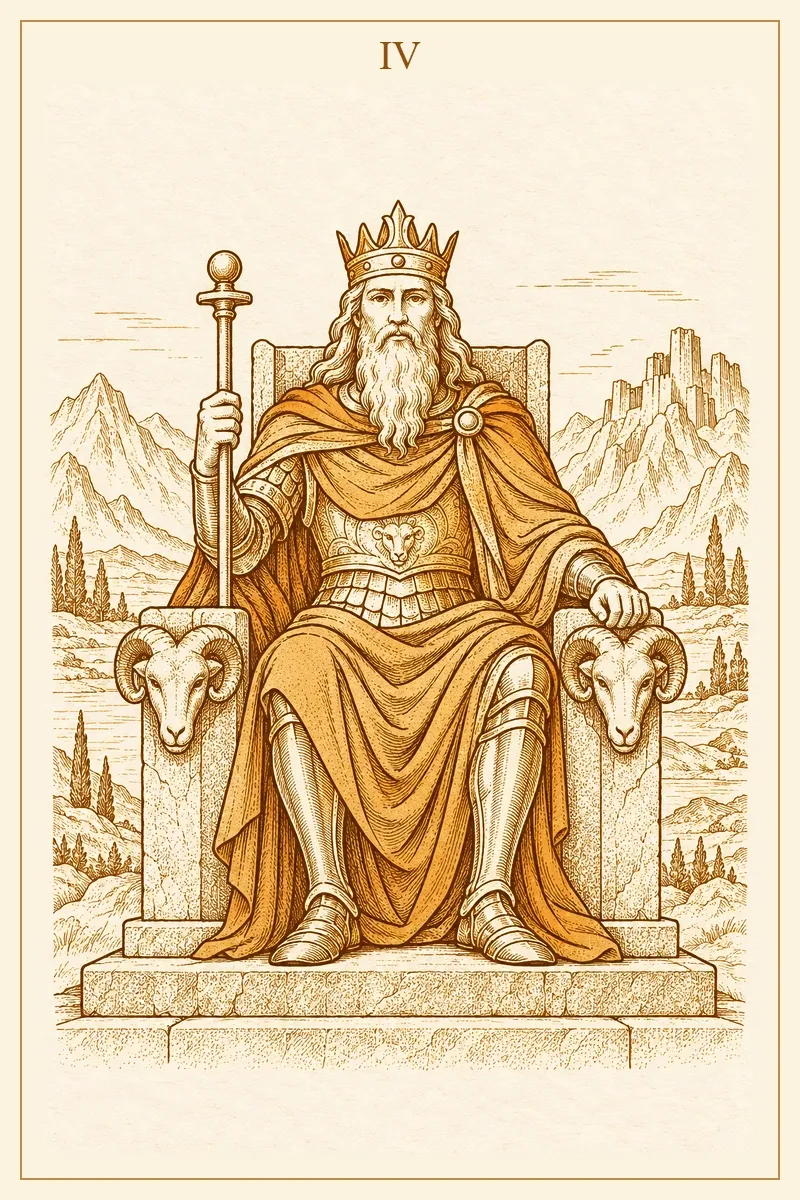
The Emperor is the card of Aries, the first fire sign and the first push of the year. He is not fire at its hottest; he is fire after someone has built a grate for it. Upright, he describes the day you stop polling your friends and set the terms yourself: a budget, a deadline, a boundary. In love he can show a partner who is dependable and a little unbending, or your own wish for a relationship with terms you can name.
Reversed, the structure has become the problem — a rule defended long after it stopped serving anyone — or there is none at all, so every week begins again from nothing. The Emperor card meaning goes further into both sides, and the Aries tarot guide follows the sign card by card.
Strength: Leo and heat you can put your hand on
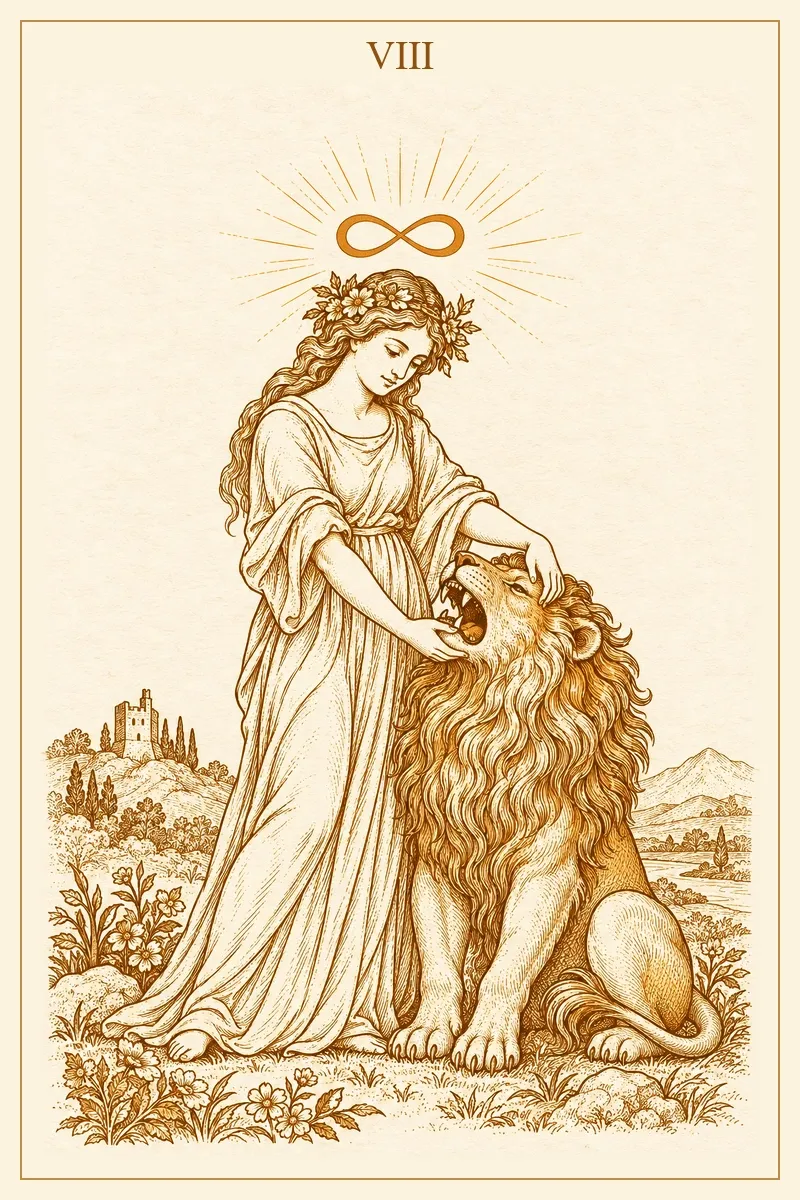
Strength belongs to Leo, fixed fire, the sign that keeps a season burning rather than lighting it. The card shows a figure closing a lion's jaws with no visible effort, which is the whole teaching: fire lived with long enough to be handled. Upright it is stamina, warmth under pressure, and courage that does not announce itself — finishing the hard conversation calmly, or returning to a craft on the days it goes badly.
Reversed, the lid is held down by force: temper barely contained, or every reserve spent on looking composed. The Strength card meaning covers the patience side in more depth, and the Leo tarot guide traces the sign through the rest of the deck.
Temperance: Sagittarius and the flame set to the right height
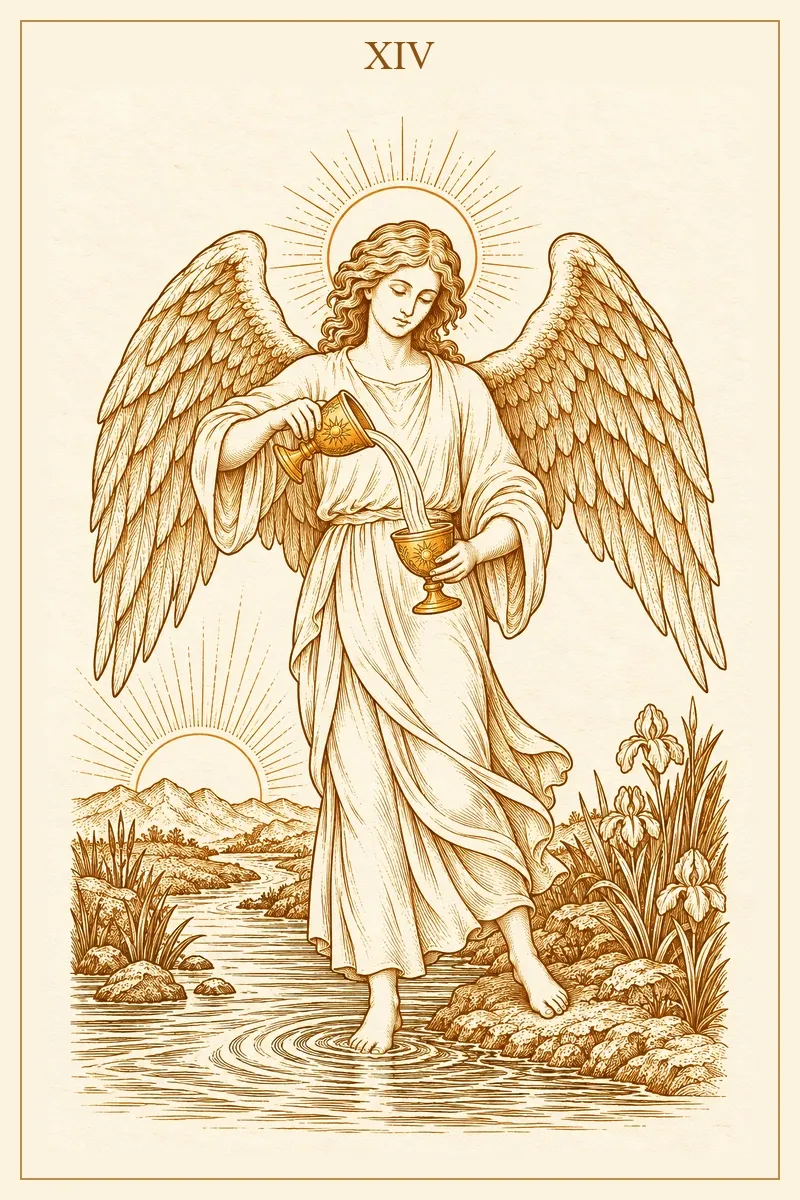
Temperance carries Sagittarius, mutable fire, the sign that aims. Readers sometimes file it under water because of the jug and cup, but the pouring is the point: a steady flow at the rate that will not spill. Upright it is a fire turned down on purpose — pacing a project over months, mixing two things that should not work together and finding they do.
Reversed, the measure is off. Too much flame and the work scorches; too little and the project cools into something you merely intend to do. The Temperance card meaning opens up its healing sense, and the Sagittarius tarot guide shows where the sign's restlessness lands elsewhere.
Judgement: fire as an element in its own right
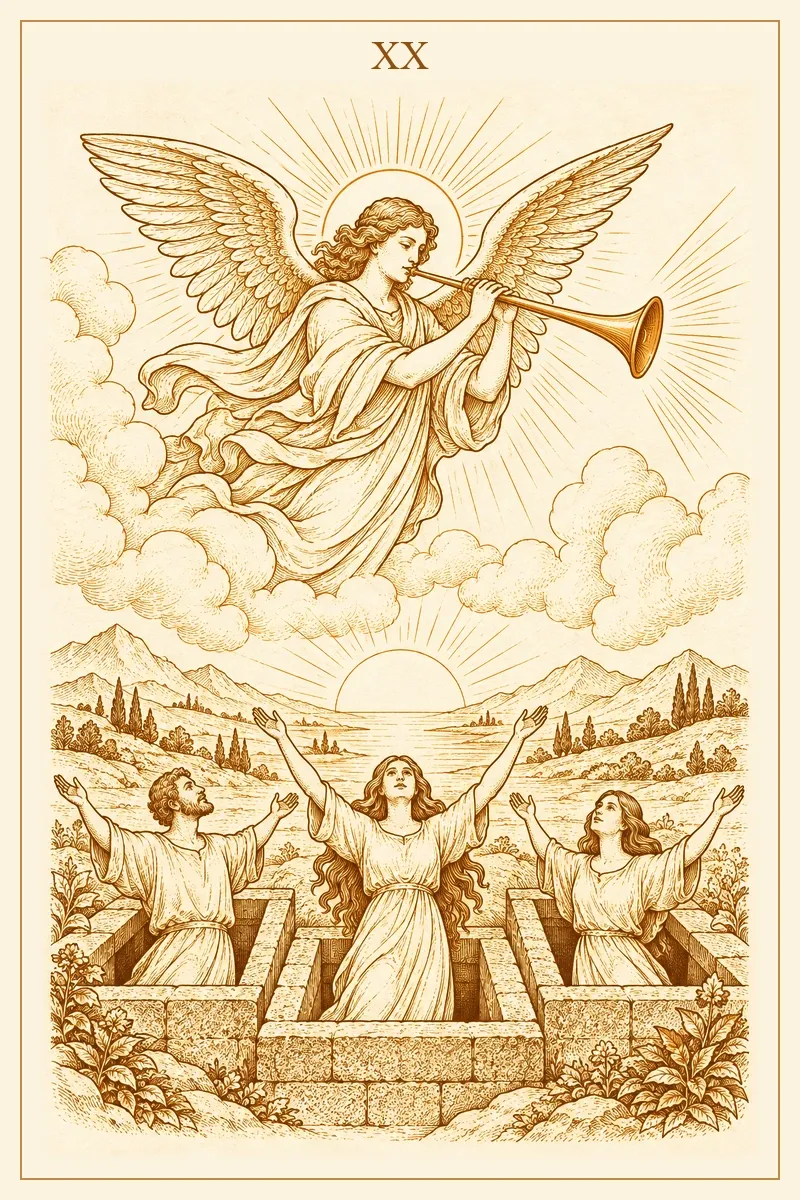
Three trumps were assigned to elements rather than signs, and Judgement took fire through the Hebrew letter Shin, whose shape is read as a flame. It is the only card in the deck that is fire without a sign's manners on it. Upright it is the summons you have already heard and been pretending not to: a verdict you reach about your own life, a reckoning that is more relief than punishment.
Reversed, the call has been received and shelved — a decision you keep re-opening, or a season of harsh self-criticism that produces no change. The Judgement card meaning treats awakening and self-reproach separately, which helps when this card lands beside heavy Wands.
The ten numbered Wands, from match to load
The Ace holds the element whole. The nine cards after it run in three groups of three, one per fire sign, following the old decan tables — and read in order they tell one story: something catches, other people notice, and then you have to carry it.
Ace of Wands, before the thing has a shape
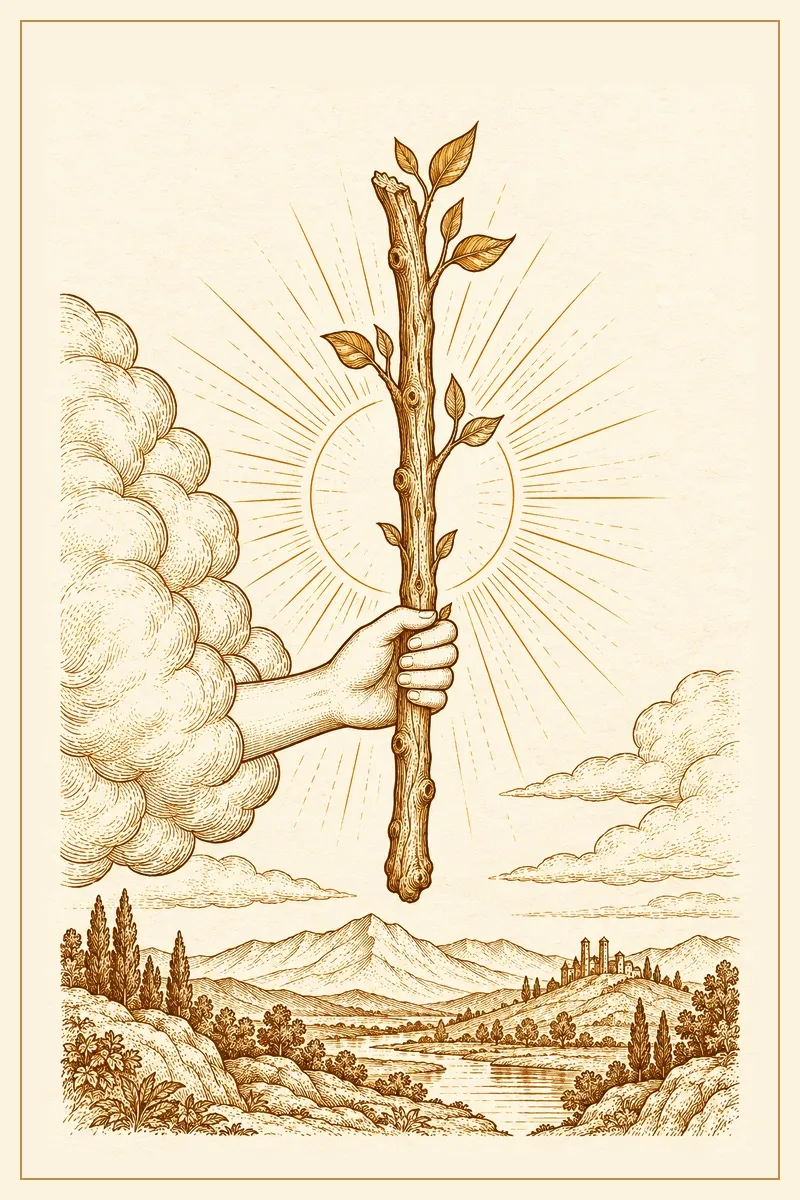
The Ace is the root of fire: an offer, an invitation, a surge of appetite that arrives before any of the practical questions do. It is not yet a project and does not promise to become one. Upright it marks a genuine opening: the message that makes you sit up, the first week of wanting something again. Reversed, the spark has nowhere to land, or has been struck so often with no follow-through that you stopped trusting it. The Ace of Wands meaning repays a full read when this card opens a spread, because what you do in the two weeks after it decides most of what the rest of the suit will say.
Two, Three and Four of Wands: Aries, and the price of starting
The Two of Wands is the spark turned into a choice: a globe in one hand, a staff in the other, the safe version weighed against the larger one. Reversed, planning becomes a hiding place, or a real fear of the bigger option deserves naming rather than overriding.
The Three of Wands is the point where something you sent out is no longer in sight — the application is in, the first returns are still at sea. Upright it asks for patience with a decision already made. Reversed, you wait for news that will not come because the thing was never sent.
The Four of Wands marks the first milestone solid enough to stand under: a move, a launch, a reason to call people together. Upright the result is real and may be enjoyed. Reversed, the celebration is postponed or quietly withheld, or the home it should be held in is tense.
Five, Six and Seven of Wands: Leo, and being seen
The Five of Wands is friction without malice: five people swinging staves, all talking at once, nobody wounded. It reads as a crowded field, a team where every voice wants the same airtime, or your own competing priorities. Reversed, the clash has gone underground into sniping, or it has been defused.
The Six of Wands is recognition arriving in public: a win other people can see and will say out loud. Reversed it splits two ways — the credit goes elsewhere, or your sense of the work is so tied to applause that the quiet weeks feel like failure.
The Seven of Wands is the hill you decided to hold: a rate you will not drop, a principle you will restate as often as needed, and the higher ground to do it from. Reversed, you are tired of defending it, or defending against people who stopped attacking long ago.
Eight, Nine and Ten of Wands: Sagittarius, and the long burn
The Eight of Wands is fire finally let out: messages, bookings, three things resolving in a week after two months of nothing. Upright, move while it moves. Reversed, everything is in the air at once with no order, or the arrow has not left the bow and the delay is the message.
The Nine of Wands is the card of one more round. The figure is bandaged and watchful, which is realistic rather than tragic: this is what late-stage effort feels like. Upright, you have more left than you think. Reversed, the guard has become the problem: you are braced against an old injury in a situation that no longer resembles it.
The Ten of Wands is the load: ten staves carried at once, obscuring the road, every one picked up voluntarily because each mattered at the time. Upright it is not failure but the arithmetic of saying yes too often. Reversed, either something is finally set down, or the bundle is carried in a way that lets nobody help.
Four court cards, four ways of carrying fire
The court mixes fire with each element in turn, which is why four people made of the same material behave so differently. Page of Wands is earth of fire: enthusiasm with its feet on the ground, the beginner who learns by doing it badly and doing it again. Upright, a new interest worth following. Reversed, excitement that does not survive the first dull week.
Knight of Wands is fire of fire, the element undiluted. Upright, departure — travel, a bold move, charm that gets doors open. Reversed, speed with no steering: three things begun and none finished, or someone thrilling to start with and absent by week six.
Queen of Wands is water of fire: warmth that includes other people, confidence that makes a room easier rather than smaller. Reversed, the warmth is performed over private doubt, or has curdled into comparison.
King of Wands is air of fire: vision with a direction, someone who sees what a thing is for and gets others to build it. Reversed, the vision stays in the telling, or leadership hardens into control. These are the Golden Dawn pairings; others differ, so if your deck's own book disagrees, follow that and stay consistent.
What fire does to the cards around it
Readers who use elemental dignities check each card against its neighbors before fixing a meaning, and fire has strong opinions about company. Beside air the two strengthen each other, because air feeds flame: Wands next to Swords is an idea with an engine, and sometimes a disagreement that gets hotter each time it is discussed. The thinking half of that pairing is laid out in the guide to the air element in tarot.
Beside water the two weaken each other. Wands with Cups is wanting and feeling pulling apart — the person you are drawn to and the life you are building do not fit. That is not doom; it means the reading needs both halves, which the guide to the water element in tarot covers from the other side.
Beside earth the result depends on proportion. Earth gives fire something to burn and a container to burn in, which is how an ambition becomes a business; too much and the flame is smothered under logistics, as the companion guide to the earth element in tarot works through from the material end. Fire beside fire doubles everything, risk included: a spread of nothing but Wands moves fast and burns through its fuel early.
Where fire shows up in an ordinary question
Love and attraction
Wands in a love reading describe desire and momentum rather than depth of feeling: chemistry, initiative, and whether anyone is actually doing anything. A Wands-heavy love spread often means attraction is not the problem — the Knight charms, the Ace sparks, and six weeks later nobody has suggested a second plan. Read them for what is being done rather than what is being felt.
Work, money and the risk you chose
This suit is at home in work you opted into: a side business, a portfolio, a role you fought for. Watch for the Five and Seven together, which usually means energy going into defending your position rather than doing the work, and for the Ten, which is most likely describing something you volunteered for. On money, fire does not count — it describes your appetite for the risk attached. Read the Pentacles alongside for what is in the account, and treat the Wands as a statement about nerve.
Timing
Of the four elements, fire moves fastest. Many readers treat Wands as days to weeks and Pentacles as seasons, which is a convention rather than a measurement. Use it as a sense of pace: a spread full of Wands says this is a now question, and leaving it for a quieter month will probably cost you the opening.
The hearth spread: five cards for a fire you want to keep
Shuffle with one specific ambition in mind and lay five cards left to right. It suits the stage where something has started and keeps going out.
- The Match: what is genuinely trying to start — which is not always what you think should be starting.
- The Fuel: what will keep it alive once the novelty is gone.
- The Draft: what it needs and is not getting; the opening that lets it breathe.
- The Smoke: what this costs, or what you will have to let burn to keep it.
- The Light: what it is for, and what it gives you while it stays lit.
Read positions two and four as a pair: thin fuel with heavy smoke means the ambition is real but the timing is not, and the kindest answer is a smaller version of it.
A worked example: the plan that always starts next month
Imagine a reader who has said for a year that she will run an evening course in the craft she is good at. Nothing is stopping her and nothing has happened. Her question: why can I not get this off the ground? Her five cards, hypothetical but typical.
The Match — Ace of Wands. The want is real, not borrowed from someone else's idea of a good career, which rules out the most common cause of a plan that never starts.
The Fuel — Strength. Not a dramatic push; the fuel is ordinary patience applied weekly. Fixed fire keeps a thing alive by returning to it on the uninteresting days, so the course needs a fixed hour in the calendar more than a burst of inspiration.
The Draft — Eight of Wands reversed. The missing element is announcement. Nothing has left her outbox: no date posted, no message to the two people who asked last spring. The fire is starved of air because it is still private.
The Smoke — Ten of Wands. The cost is load. She already carries a full bundle, so a course on top makes eleven staves rather than ten, and something existing has to go down — chosen deliberately, instead of letting the newest thing be the one that drops.
The Light — Six of Wands. What she gets, if it stays lit, is being seen doing work she is good at. Beside the Ten that reads as a fair trade, and it names what she loses by never starting.
The spread does not say the course will succeed. It says the desire is sound, the method is weekly rather than heroic, the blocked step is a public date, and the price is one existing commitment — all of which she can act on this week, which is what a fire reading is for.
What to do in the week after a fire-heavy reading
Fire readings go stale quickly, because they describe momentum and momentum does not wait. Give yourself seven days and four small tasks.
- Put the fuel in units. Not more focus, but two hours on Tuesday evening. Fire that is not scheduled is just weather.
- Make one thing public. A date, a price, a message to one person. Air is what a reversed Eight of Wands is missing, and most stalled plans stop at exactly this point.
- Audit the load. If the Ten appeared, list what you are carrying and name the item you are setting down. Adding without subtracting is the usual route to exhaustion.
- Separate no outlet from no heat. Sit with the question for a day. If you genuinely do not want it anymore, that is not a failure of will, and a reversed Ace is allowed to mean exactly that.
Then leave it. Drawing on the same question every morning will not give fire more air, and four to six weeks is enough time for a real answer to show up.
Frequently asked questions
Are Wands fire, or are Swords fire?
Wands are fire and Swords are air in the system almost all modern books and decks use. The confusion has a history: some magical traditions swapped the two, reasoning that a blade is forged in fire while a staff is a living branch full of sap. Pick the attribution your deck's own material uses and keep it — mixing the two mid-reading is the only genuinely wrong answer.
Which cards count as fire cards?
Eighteen in total: all fourteen Wands from Ace to King, plus The Emperor, Strength, Temperance and Judgement. The Sun and The Tower lean hot by planetary rulership — the Sun rules Leo, Mars rules Aries — but they are planetary cards rather than elemental ones, and most readers keep that distinction.
What does it mean when a reading is almost all Wands?
That the question is about energy and action rather than feeling or circumstance: something is live right now, and the decisive factor is what you do in the next few weeks. It is an encouraging pattern with one caution — a spread of nothing but fire has no card describing resources, so check the practical side before committing money or time you have not counted.
Does a reversed Wands card mean the fire has gone out?
Sometimes, and sometimes the opposite. A reversal in this suit most often means heat with nowhere to go: the want is intact, the outlet is blocked. The way to tell them apart is bodily — blocked fire is restless and irritable, extinguished fire is flat and faintly relieved. The Draft position above is designed to ask that question directly.
Can fire cards tell me how long something will take?
No card can give you a date. The elemental pace convention is a reading habit rather than a calendar: it describes the tempo of a situation, not its arrival time. Tarot is a way of looking clearly at what you already half-know; it cannot confirm another person's intentions or guarantee an outcome, and a reading that names a specific week is overreaching.
What if a reading has no Wands in it at all?
Often the most useful thing a spread can say. No fire means no engine: a situation can be well understood, well felt and well resourced, and still nobody wants it enough to move. If the cards keep coming back without a single Wand, the missing piece is usually the wanting, not the planning.
One lit thing is enough to start
Fire asks the least sophisticated question in the deck and the hardest one to dodge: what do you actually want, and what are you prepared to burn for it? You do not have to answer for your whole life at once. One lit thing, fed on an ordinary Tuesday, is how every Ace of Wands became a Four. When you want to look at yours with a clear head, you can draw a reading and start with whatever is trying to catch.