Ask what the water element means in tarot and the short answer is the suit of Cups: fourteen cards about feeling, attachment and what a person actually wants. Three Major Arcana cards join them through the water signs — The Chariot for Cancer, Death for Scorpio and The Moon for Pisces — while The Hanged Man takes the element itself in the old correspondence tables.
Water is the part of a situation you feel rather than decide. When several Cups land in a spread, the reading has turned toward your attachments: who you are close to, what you are mourning, what you keep hoping for and have not said out loud. That is also where tarot is easiest to over-trust. Cups can show you that a friendship still matters to you; they cannot confirm what another person privately feels, fix a date, or promise how a relationship ends. Take them as an honest picture of your own side of it, then check the rest by asking.
Water in tarot, at a glance:
- Suit: Cups, also called Chalices or Vessels; love, grief, imagination, what you value.
- The Chariot: Cancer, cardinal water; feeling turned into forward motion, with a shell around it.
- Death: Scorpio, fixed water; the ending that clears a blocked channel.
- The Moon: Pisces, mutable water; dreams, half-light, what you sense before you can name it.
- The Hanged Man: the Hebrew letter Mem, water itself; suspension and a changed angle.
- Ace of Cups: the root of water; a feeling offered before you decide what to do with it.
- Queen of Cups: water of water, the element at its most concentrated.
- Direction and season: west, and autumn in the order most modern readers inherited.
What a cup has to do with feeling
Each Minor Arcana suit is paired with one classical element: Wands with fire, Swords with air, Pentacles with earth and Cups with water. The pairing comes from the object: a cup is defined by what it holds, and what it holds takes the shape of whatever is around it. Older decks call the suit Chalices, Goblets or Vessels, and readers who also use playing cards match it with Hearts, which is the clearest hint of all about what the suit is for.
In classical physics water was cold and moist, the element that receives. Readers turn that into three working habits. First, Cups describe relationship rather than achievement: the question behind a Cups card is usually who, not how much. Second, water changes temperature slowly, which is why feeling lags behind events — a Cups card often describes something that happened months ago and has not finished moving through you. Third, water does not stay where you put it. It arrives where you never planned to put it: in your sleep, in your work, in your temper with someone uninvolved.
Reading the ten numbered Cups
From the Two to the Ten, each card is tied to a ten-degree slice of the zodiac called a decan, and all nine slices fall inside the three water signs. The Ace sits outside that scheme as the root of the element. Grouping by sign turns ten definitions into one movement: an offer, a bond, a loss, and whatever you build after.
Ace of Cups: the root of water
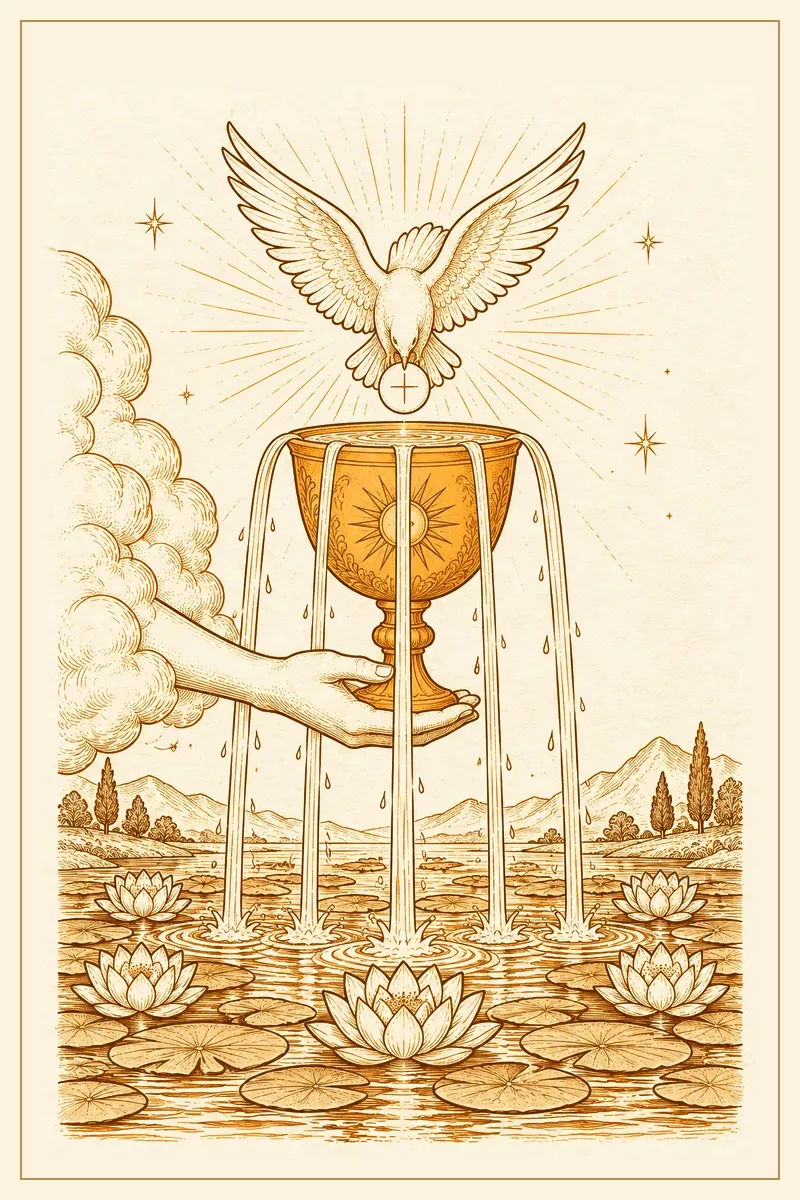
A hand comes out of a cloud holding a chalice that cannot stop overflowing, a dove descending toward it and water lilies on the pool below. The Ace is not yet a relationship or a creative project; it is the raw capacity for one. Upright it is an opening: a feeling you did not manufacture, an invitation, the first unforced warmth toward a person or a piece of work. Reversed, the cup is tipped — the feeling has nowhere to go, or you are pouring it out faster than anything comes back in, which is what emotional exhaustion looks like from the inside. The longer Ace of Cups meaning follows it into love and work questions.
Two, Three and Four of Cups under Cancer
Cancer's decans give the suit its domestic arc. The Two of Cups shows two people exchanging cups as equals: a reconciliation, a partnership, a mutual yes. Reversed it marks a mismatch in that exchange rather than a disaster — one person carrying the relationship, or a promise heard on different terms by each side. The Three of Cups widens the circle to friendship and celebration; reversed, the group has become performance, or you are too drained to want the party. The Four of Cups closes it again: a figure sits under a tree with folded arms, three cups in front and a fourth held out from a cloud they are not looking at. Upright it is honest discontent, the stale feeling when nothing is wrong and nothing is enough; reversed, the head lifts and the offer becomes visible.
Five, Six and Seven of Cups under Scorpio
Scorpio's three cards are the deep water of the suit. In the Five of Cups a cloaked figure stands over three spilled cups, blind to the two still upright behind and to the bridge across the river: the loss is real, the attention is narrow, and the way back is behind you. Reversed, the figure turns — not cheerfulness, just the first look over the shoulder. The Six of Cups hands a cup of white flowers from one child to another and carries memory, kindness without an agenda, sometimes a person from your past; reversed, nostalgia has become a hiding place. The Seven of Cups stacks seven vessels in a cloud with something different in each: every option still imaginary and therefore still perfect. Reversed, a choice has been made, or the fog thinned enough to show which cup was empty.
Eight, Nine and Ten of Cups under Pisces
Pisces closes the suit with departure and arrival. The Eight of Cups shows a figure walking away under a crescent moon, leaving eight cups neatly stacked on the rocks — nothing is broken, which is exactly why leaving is hard. Upright it is a considered departure from something that was good enough; reversed, the pull to go without having decided to, or a drift back toward what was left. The Nine of Cups is satisfaction you can feel in the body, often read as a wish granted, though it is quieter: a thing you wanted and now have. Reversed it asks whether the wish was ever yours. The Ten of Cups arches ten cups into a rainbow over a household, the suit's picture of shared, ordinary happiness; reversed, the gap between a life that looks right and one that feels right.
The four court Cups and what they are made of
Court cards mix a second element into the suit, which is why four people in one family differ so much. In the arrangement most readers use, the Page brings earth, the Knight fire, the Queen water and the King air; one long-standing disagreement swaps the Knight and the King, so check which convention your notes follow.
Page and Knight of Cups: water on the move
The Page of Cups stands at the shore holding a cup with a fish looking out of it, the deck's best picture of an unexpected feeling. Earth of water makes this the most grounded Cup in the court: a small message, an invitation, creative work at the sketch stage. Upright it is slight and worth taking seriously; reversed, a feeling you cannot find words for, or an offer you keep leaving unanswered. The Knight of Cups rides at a walking pace with a cup held out — fire of water, sincerity with momentum. Upright he says it first, makes the gesture, writes the letter; reversed, the gesture outruns the follow-through, charm doing the work honesty should do.
Queen and King of Cups: water that keeps its level
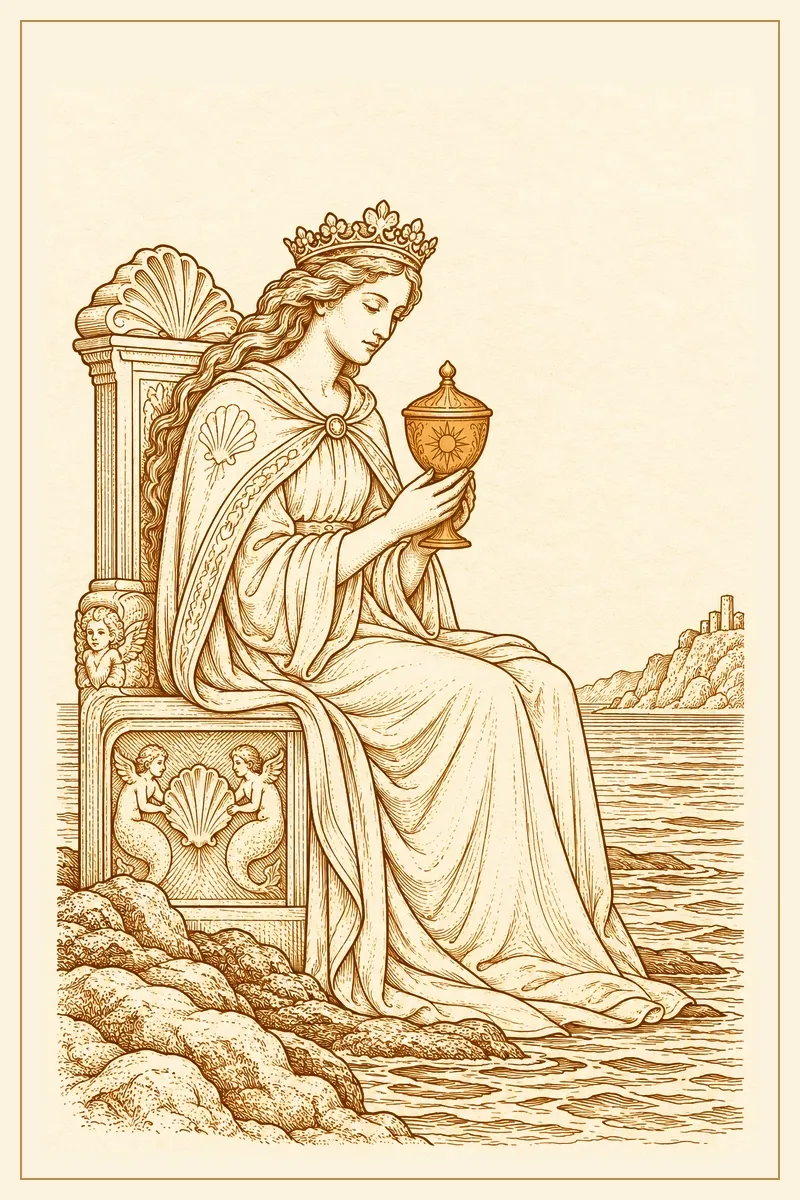
The Queen sits on a throne at the water's edge with an elaborate lidded chalice, the only cup in the deck that must be opened to look into. As water of water she is the element at full strength: she feels everything in the room and is not knocked over by any of it. Upright she is the counselor's card, the capacity to stay with someone's distress without absorbing it; reversed, the boundary fails in one of two directions, flooded by other people's moods or shut so tightly that nothing reaches her. The Queen of Cups meaning goes through both in detail. The King of Cups has his throne on a rough sea that never touches him, and air of water gives him the sentence that explains a feeling rather than just having it. Upright he is steady under pressure and genuinely kind; reversed, the calm is a lid.
The trumps that belong to water
Each zodiac sign was matched to a Major Arcana card through the Hebrew letters on the Tree of Life, which gives water three trumps through its signs and a fourth through the element itself: protection, ending, imagination and surrender.
The Chariot: Cancer in armor
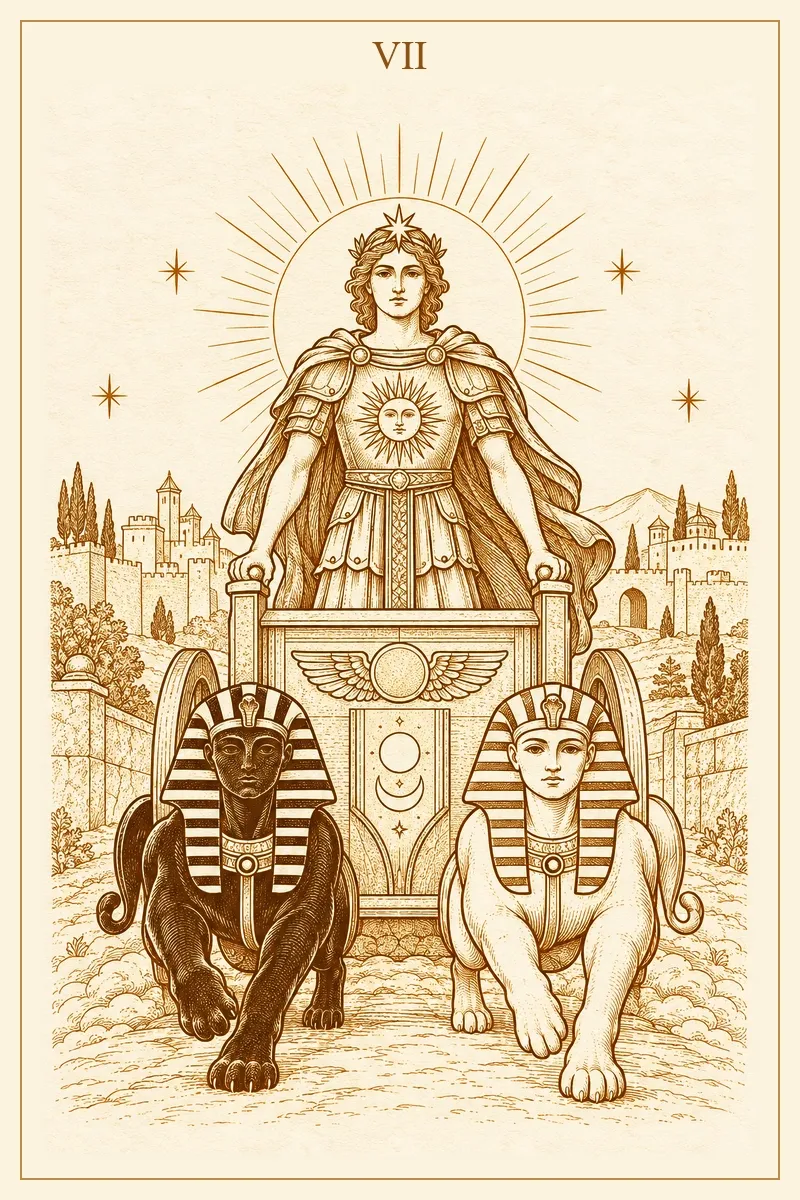
The driver stands in his chariot between a black sphinx and a white one, a sun on his breastplate, a crescent moon on the chariot's front and a walled city behind him. Cancer is cardinal water, the sign that starts things, and The Chariot is water deciding to move: not a cold strategy but a feeling strong enough to organize a life around. The two sphinxes pull opposite ways, so the card is about holding a course while two parts of you want different things. Upright it reads as protective determination, often on someone else's behalf; reversed, the shell closes over everything, or the drive becomes a way of outrunning something unfelt. The full Chariot tarot meaning follows that into work and love questions.
Death: Scorpio and the cleared channel
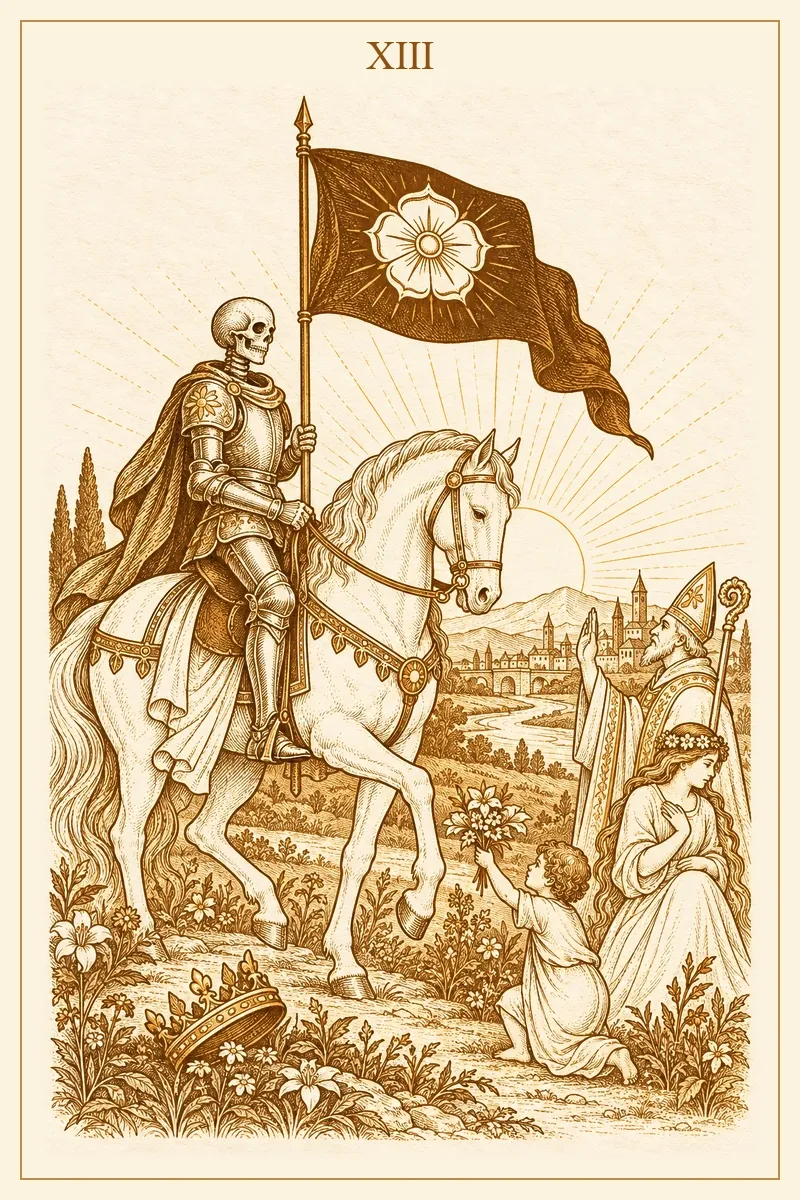
An armored skeleton rides a white horse past a bishop, a child and a kneeling woman under a black banner with a white rose, a river winding toward a distant town and a rising sun. Scorpio is fixed water, the still deep kind, and Death in tarot almost never describes a literal death. It describes the one ending that cannot be negotiated. In a water reading it is the card for a feeling you have outgrown: the version of yourself that belonged to a job, a city or a relationship. Upright, the ending is already underway; reversed, the card describes resistance, a connection held in place long after it stopped giving anything back.
The Moon: Pisces and the light you read by
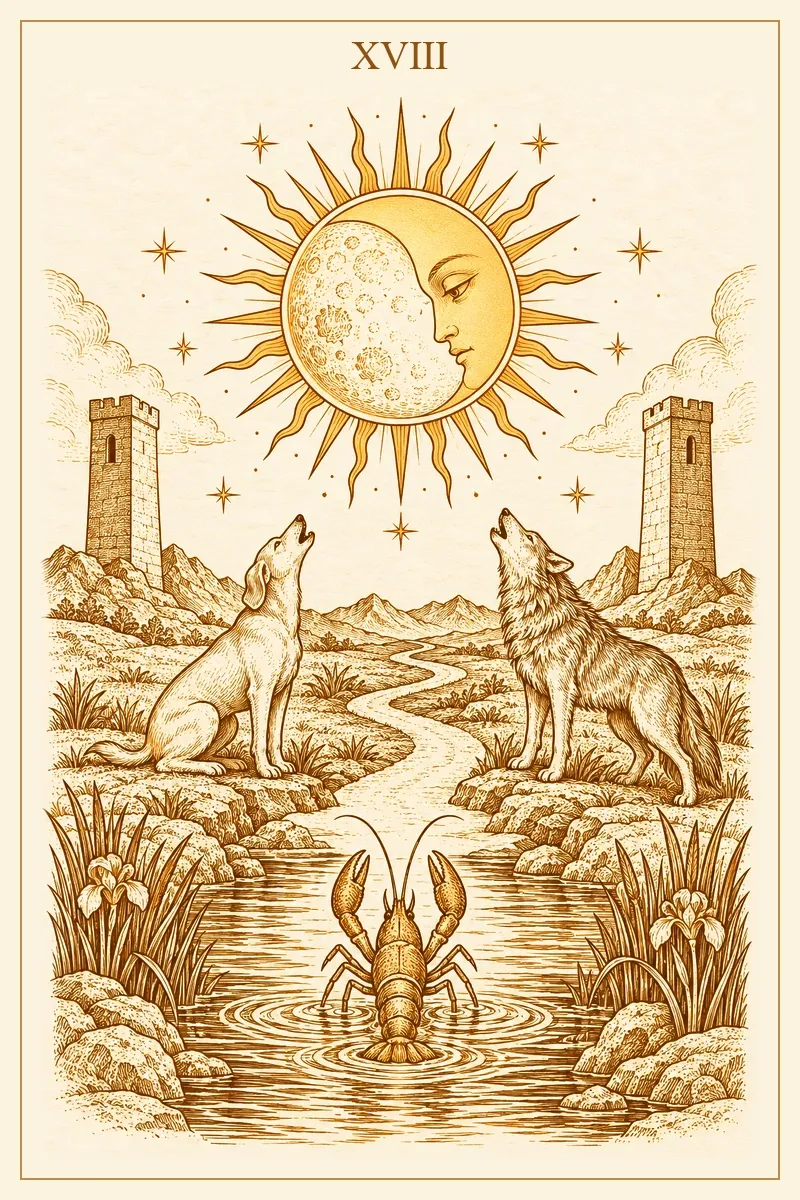
A dog and a wolf howl at a moon with a face in it, a crayfish climbs from the pool, and a path runs between two towers into the hills. Pisces is mutable water, the sign with the fewest edges, and this trump pictures what the mind does with incomplete information at night. Everything in the image is real; none of it is clear. Upright it asks you to slow down rather than be afraid: your instinct is picking up something true, and your explanation of it is probably wrong. Reversed, the fog lifts, or the fear is named and turns out smaller than the dread. The Moon tarot meaning takes both readings further.
The Hanged Man: the card of water itself
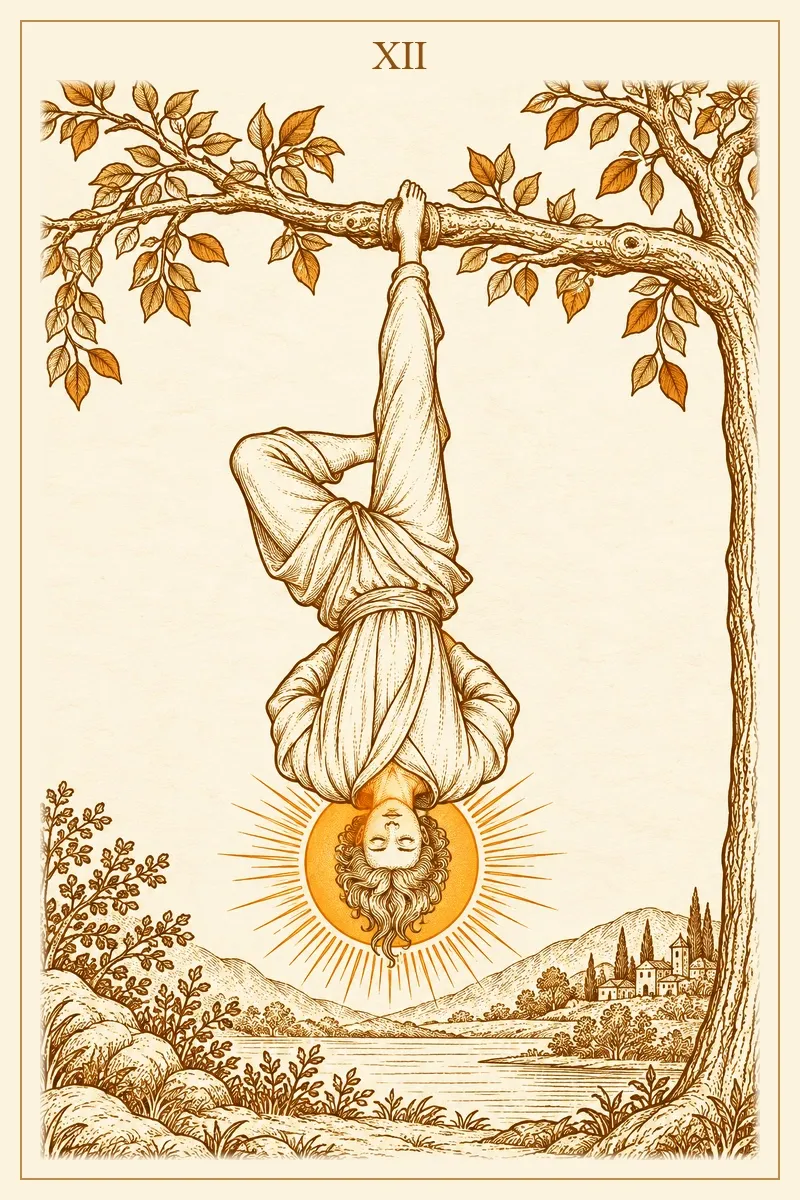
A figure hangs by one ankle from the branch of a living, leafy tree, one leg crossed behind the other, light around the head, no sign of struggle. This card is assigned to Mem, the Hebrew letter for water, so it carries the element directly rather than through a sign. What it adds to the other three is the one thing moving water cannot do: stop. Upright it is a deliberate pause — a decision left unmade so more of it becomes visible. Reversed, the pause has gone stale: waiting has become avoidance, or the sacrifice is one nobody asked for. Readers in a stuck patch often find the Hanged Man tarot meaning more useful than any Cups card.
One element at three temperatures
The three water signs differ by modality, and it shows in their cards. Cancer in tarot is cardinal water: it begins things for emotional reasons and builds a container around them — home, family, a chosen circle. Scorpio in tarot is fixed water: it holds, concentrates and refuses to be diluted, which is why its three Cups cards are the ones about loss, memory and illusion. Pisces in tarot is mutable water: it dissolves boundaries, takes on the mood of the room and reaches past the ordinary. For a quick sense of which water is in a reading, look at the containers: Cancer builds them, Scorpio seals them, Pisces lets them leak.
Water next to fire, air and earth
Older readers weigh a card's neighbors as well as the card itself, and the elements are the simplest version of that. Water and earth get along: a Cups card next to a Pentacles card means the feeling has somewhere practical to go — a home, a job that suits you, a plan you can afford. Water and fire work against each other. A Cups card beside a Wands card marks where wanting and feeling disagree — the project you are excited about and quietly dread, the person whose energy you love and cannot live with. Water and air are neutral and often useful together: the feeling gets a sentence. If another element runs through your spread, the guide to the fire element in tarot covers the one water argues with most, and the air element in tarot and the earth element in tarot take the other two.
When Cups keep coming up
A spread with four or five Cups in it is telling you where the real question is, and it is almost never where the asker put it. People bring a logistics question — should I take the job, should I move — and get back a suit that is only interested in attachment. That is information, not a refusal to answer; the practical decision usually turns out to be waiting on an emotional one. A reading that lands almost entirely in one suit deserves a second look at the question, and the guide to an all-Cups tarot reading goes further into that. Four themes cover most of what water adds:
- Attachment: who matters here, and what you are afraid of losing.
- Unfinished feeling: something from earlier that is still draining energy in the present.
- Imagination: the version of events you have been living in, kinder or crueler than the real one.
- Capacity: how much you have left to give, which Cups measure more honestly than you do.
Love and closeness
In relationship questions, water describes the bond and not the logistics. It shows whether you feel met, whether you are performing contentment, whether you want more closeness than you have asked for. It will not tell you whether someone else is going to call. The most useful love readings with Cups let the cards describe your own position precisely — the Two for a mutual bond, the Four for a relationship gone quiet, the Five for the part of you still with someone who is gone — and then you say some of it out loud to the person it concerns.
Grief and healing
Water is the suit that takes loss seriously. The Five of Cups does not advise you to look on the bright side; it notes that two cups are still standing, whenever you are ready. In readings about grief, Cups answer "where am I in this" rather than "how long will it take". Healing here is slow and uneven; a reading that keeps returning to the same card is marking something in progress, not a verdict. Tarot sits alongside rest, people who care about you and, when the weight is heavy, professional support; it is a reflective practice, not a treatment.
Timing in a water reading
Water is the slowest element after earth, and it reads in seasons rather than dates. A Cups-dominant spread about timing says the situation will move when the feeling does, which is not something you can schedule. For a rough frame, readers traditionally give water weeks to months, Cancer cards quicker and Pisces cards vaguest. Treat that as texture, not forecast.
A four-card spread for feelings that will not settle
This spread is for the situation you keep turning over without getting anywhere. Shuffle with the situation in mind rather than a question — the point is to find the question — and lay the cards left to right.
- Surface: what this looks like from the outside, including to me when I am busy.
- Undertow: the feeling that is actually running underneath it.
- Source: where that feeling was learned or first attached, often an older situation.
- Shore: the one thing that would let it move, small enough to do this week.
Read Surface and Undertow as a pair first. If they match, the situation is simpler than it feels. If they contradict each other, that gap is the reading, and Source usually explains it.
In practice: the friend who stopped replying
Here is a hypothetical draw, written out the way a reading goes. A close friend's replies have become short and slow over about four months, with no argument and no explanation, and the asker cannot tell whether to raise it or let it go.
Surface — Four of Cups. From the outside nothing is wrong — nobody has been rude, nothing has been said — and the card names exactly that stale discontent: a friendship technically intact and no longer nourishing anyone.
Undertow — Five of Cups. Underneath is plain grief. Something has already been lost, and the asker has looked at the spilled cups for months without naming it, because nothing happened that would justify mourning. Naming it is most of the work.
Source — Six of Cups. The attachment is partly to an earlier version of the friendship, the years when it was easy and both people had more time. The feeling is real, and the picture it measures against is fifteen years old.
Shore — Page of Cups. What would move it is small: one honest, unarmored message saying the friendship matters and the distance has been noticeable. Not a summit, not an accusation. The Page's cup is modest on purpose.
What the spread does not say is why the friend went quiet. Four Cups describe one person's inner side of a two-person situation; the other half lives in a conversation nobody has had yet.
Living with what a water reading showed you
Water readings are easy to feel and easy to leave in the air. Three steps keep them useful. Write the undertow in one plain sentence before you interpret anything further — "I am lonelier than I have admitted" does more than a paragraph of symbolism. Wait a night; cards read at eleven at night and at eight in the morning are not the same cards. Then pick one action small enough to finish, which in water questions is nearly always a sentence said to a person rather than a plan. If the cards kept answering a different question than the one you asked, change the question; the question library helps you work out what you are really asking before you shuffle.
Frequently asked questions
Which suit is the water element in tarot?
Cups are water. All fourteen, Ace through King, belong to the element and cover feeling, relationship, memory and imagination. The other suits take the rest: Wands fire, Swords air, Pentacles earth.
How many water cards are in a tarot deck?
The fourteen Cups, plus four Major Arcana: The Chariot through Cancer, Death through Scorpio, The Moon through Pisces, and The Hanged Man, assigned to water as an element rather than through a sign. Eighteen in all, and that is the standard list.
Is a Cups-heavy reading always about romance?
No. Cups cover every attachment: friendship, family, creative work you care about, a place you miss, your relationship with yourself. Romance is the most common reason people bring a question here, which is not the same thing.
Is The Hanged Man really a water card?
The old correspondences assign three trumps to the elements through Hebrew letters, and The Hanged Man takes Mem, the letter for water. It is why the card is about suspension rather than effort: water yields, finds its own level and arrives without pushing.
Does a Cups card show another person's feelings?
Not reliably, and this is worth being clear about. A Cups card drawn in a "how do they feel" position shows your read on the situation: what you are picking up, hoping for or bracing against. That is useful material for deciding what to say. It is not access to another person's mind, and no spread replaces asking them.
How do I read a reversed Cups card?
Most reversed Cups fall into three shapes: the feeling is blocked, turned inward, or leaking out somewhere unhelpful. A reversed Ace is warmth with no outlet; a reversed Five is the first turn away from grief; a reversed King is calm used as a lid. Decide before you shuffle whether you are reading reversals at all, and stay consistent within one reading.
Read when the water is calm
Water rewards patience more than any other element in the deck. Let a feeling settle long enough to see through it, and ask the cards what is under it rather than what will happen. When you are ready to sit with a spread, you can draw a reading and take the first card slowly.