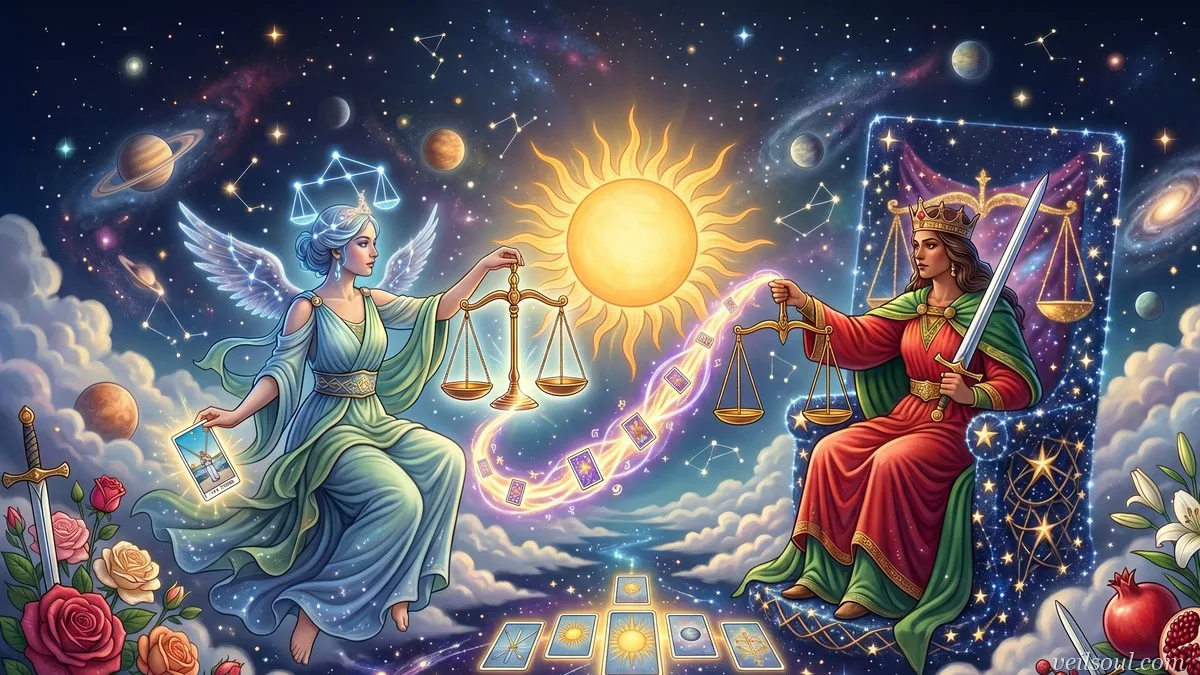
Justice is the Libra tarot card. The attribution comes from the Golden Dawn, whose table of correspondences sits under most decks printed in the last hundred years: the eleventh trump, a seated figure with a sword held upright and a pair of scales held level, is given to cardinal air. Libra's three decans run across the Two, Three and Four of Swords, Venus as the sign's ruler has a trump of its own in The Empress, and two court cards cover Libra's thirty degrees.
What those cards cannot do is report a decision someone else has already made, pin down when something will happen, or win an argument for you. A reading sorts out what you are weighing; it does not report on anyone else's private verdict. For a sign whose questions tend to arrive as "is this fair, and am I allowed to say so out loud," that limit is less of a loss than it sounds.
At a glance, these are the cards that carry Libra:
- Justice (XI): the sign's trump — consequence, honest weighing, the adjustment you have been putting off.
- The Empress: Venus, Libra's ruler, as pleasure, beauty and care that costs something to give.
- Two of Swords: first decan, Moon in Libra — a truce kept by refusing to look.
- Three of Swords: second decan, Saturn in Libra — the clean cut, and the grief that follows it.
- Four of Swords: third decan, Jupiter in Libra — the pause that gives you your judgment back.
- Queen of Swords: the court over 20 degrees Virgo to 20 degrees Libra — unflattering, fair, kind in a way that lasts.
- King of Cups: the court over 20 degrees Libra to 20 degrees Scorpio — feeling held steady enough for other people to use.
- The World: Saturn's trump, worth a glance because Saturn is exalted in Libra.
The scales, and the letter behind them
Each sign is fastened to its trump through the Hebrew alphabet rather than through the picture on the card, and Libra takes Lamed, whose name means ox-goad: the pointed stick that puts a working animal back on the line of the furrow. Fairness in this tradition is not a mood of calm; it is a correction, applied deliberately, usually later than it should have been. Which is why Libra's card is the one with a blade in it. Scales on their own only measure. The sword acts on the measurement, and in a reading that is almost always the harder half of the message.
Justice (XI): the account you are being asked to settle
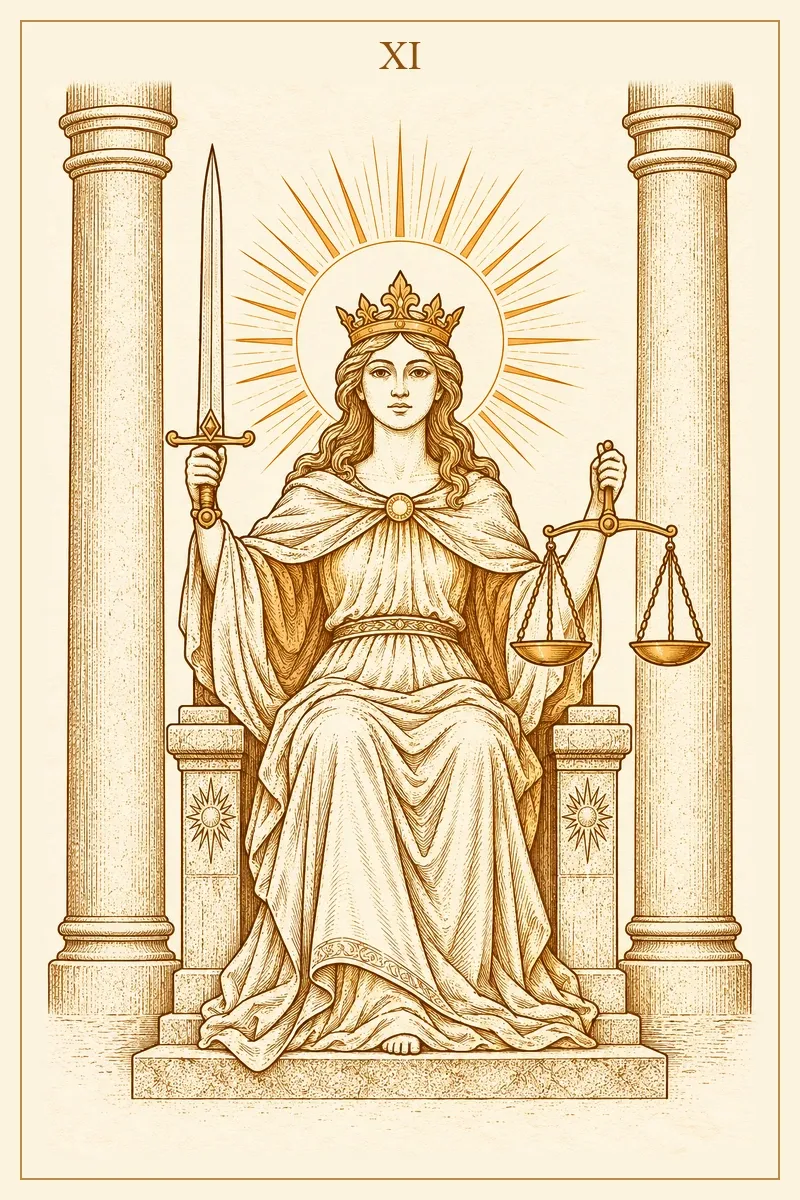
Upright, Justice describes a situation in which cause and effect have caught up with each other. Something is being weighed — a contract, the share of work at home, a claim about who did what and when — and the weighing will be accurate whether or not the result suits you. It asks one flat question: if everything you have done here were laid out in front of a stranger, would you defend it? The card also has a procedural side: terms actually read, an agreement put in writing, a decision recorded rather than assumed. Anything carrying real legal or financial weight belongs with a qualified professional.
Reversed, the usual reading is an account left unsettled. Weight has shifted quietly onto one side — the person who always drives, who always pays first, who always apologizes to end the silence — or a decision has been deferred so long that the deferral has become the decision. Ask who benefits from the arrangement staying undiscussed. On numbering, since it confuses people: Justice is XI in decks that follow the Golden Dawn and Waite in swapping it with Strength, and VIII in the Marseille order, and the Libra link travels with the image rather than the number. The full Justice tarot meaning covers the card in more depth, upright and reversed.
Venus owns the sign; Saturn is honored in it
Two planets matter for Libra and both have a trump. Venus rules the sign outright, which is the correspondence most readers already use. Saturn is exalted in Libra, an older and quieter claim, and it explains a good deal about why the sign's decans look the way they do.
The Empress: Venus with her feet on the ground
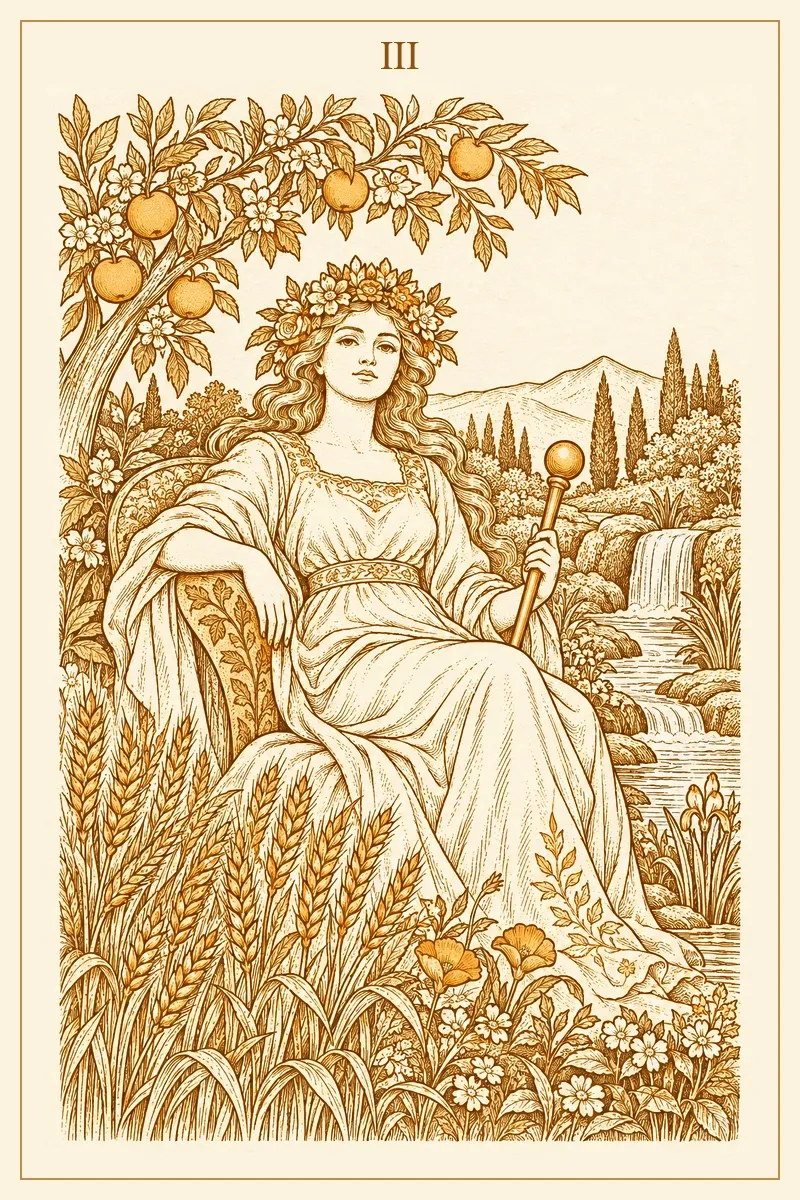
The Empress is Venus's card in this system, and she restores the part of Libra the usual description leaves out. Libra gets written up as the sign of balance, as though its natural state were a kind of poise. Venus suggests something warmer and considerably less tidy: an appetite for beauty, for comfort, for a room that feels right and company that is easy to be in. Upright, she says that wanting those things is not frivolous, and that a life arranged for other people's comfort first will eventually stop producing any. Reversed, she can show taste used as a shield — an existence arranged to look lovely from outside while the person inside it is not being fed.
The broader Empress tarot meaning covers her creative and nurturing readings beyond this one sign. Saturn's exaltation is the other half of the picture: The World is Saturn's trump in the same table, and it holds what the scales only gesture at — something completed properly, every obligation discharged, nothing left owing. Saturn at its best in a sign of partnership is why Libra's cards care so much about terms, limits and who agreed to what.
Why Libra's ten-day stages belong to Swords
The decan cards look wrong to most readers at first: Libra is the sign of partnership and the suit it draws is the one about thought, conflict and loss. The arrangement is not arbitrary. In Book T, the Golden Dawn's source for the minor arcana, the wheel of decans opens at zero degrees of Leo with the Five of Wands, because the Sun's own sign is treated as the starting line, and the numbered cards are dealt around the zodiac in order from there. By the time the count reaches Libra it has arrived at the Two, Three and Four of Swords, each covering ten degrees with a planetary sub-ruler and an old title blunter than the modern keyword. In sequence they describe one movement: a stalemate, the cut that ends it, and the recovery afterward.
Two of Swords: Moon in Libra, about September 23 to October 2
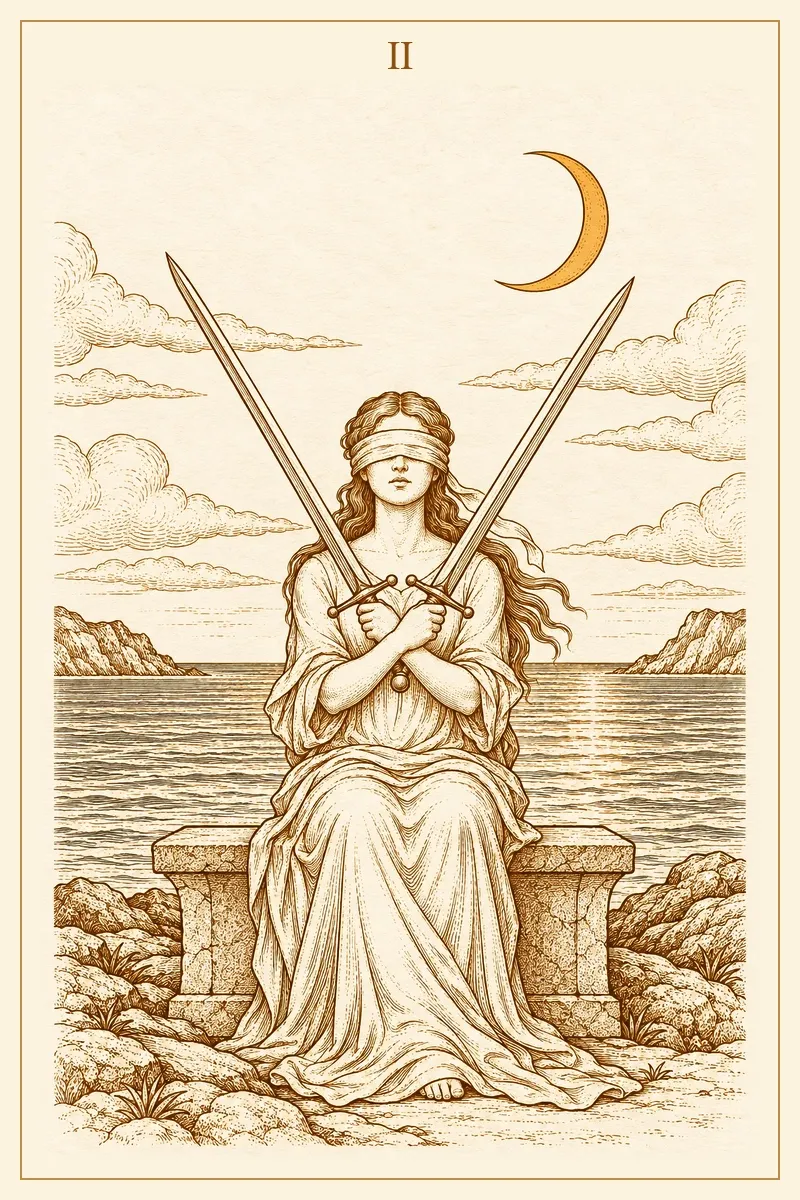
Book T calls this the Lord of Peace Restored, and the restoration is conditional. A blindfolded figure sits with two blades crossed over the chest and still water behind — a balance that holds precisely because nothing is being looked at. The Moon's sub-rulership puts feeling underneath what presents itself as a rational stalemate: the reason a decision is stuck is seldom that the options are equal, but that one of them costs something you are not ready to pay yet. Upright, the card is often accurate and unhelpful at once; treat it as a description of the present rather than as advice. Reversed, the blindfold comes off, which can read as relief or as a mess and frequently as both inside one week. The Two of Swords meaning is worth reading in full if this is the card you keep drawing.
Three of Swords: Saturn in Libra, about October 3 to 12
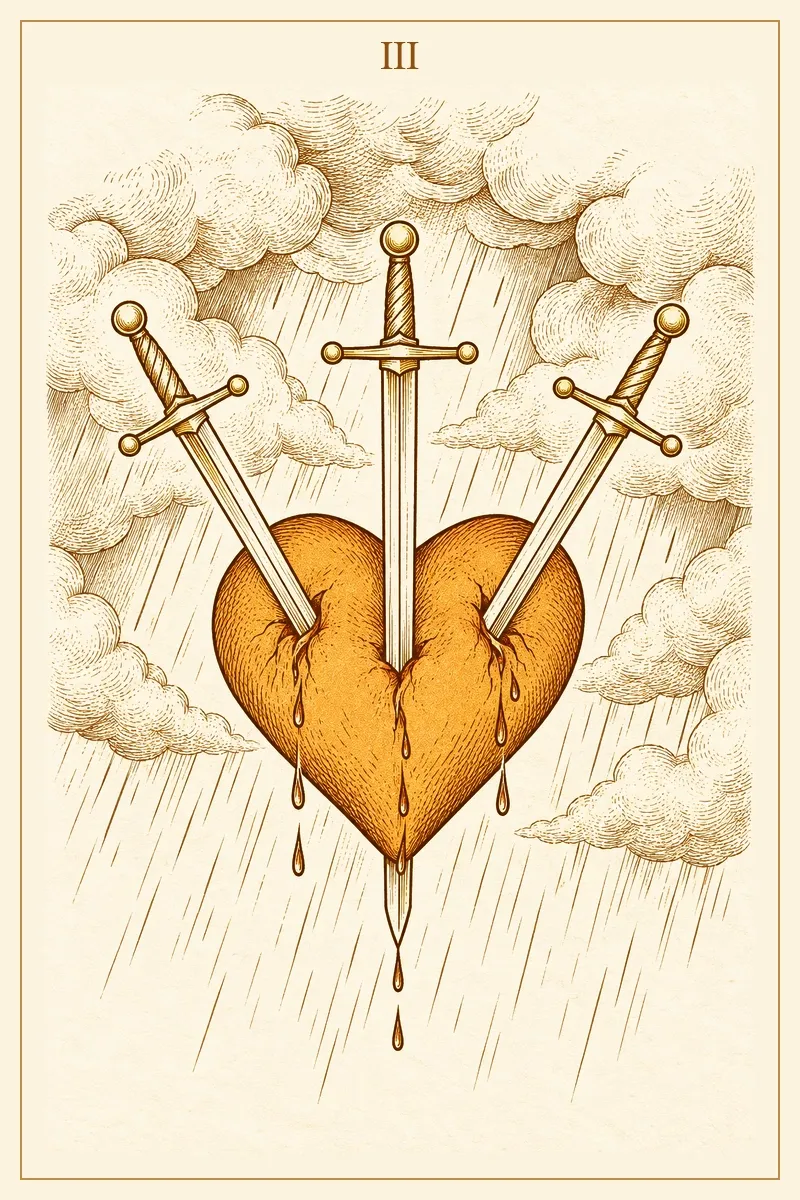
Its Golden Dawn title is the Lord of Sorrow, and Saturn, exalted here, is the planet doing the work. Three blades through a heart under rain is the deck's most literal image, which is why it frightens people on sight, but the Saturn reading is narrower and kinder than general sadness. A true thing gets said out loud, and the arrangement built on not saying it comes apart; the pain is the cost of accuracy, not a punishment. Upright, this decan governs the part of Libra season where diplomacy stops working. Reversed goes either way — recovery already under way, or a hurt rehearsed so often it has hardened into an identity. The Three of Swords meaning separates the grief reading from the betrayal reading, which matters in relationship questions.
Four of Swords: Jupiter in Libra, about October 13 to 22
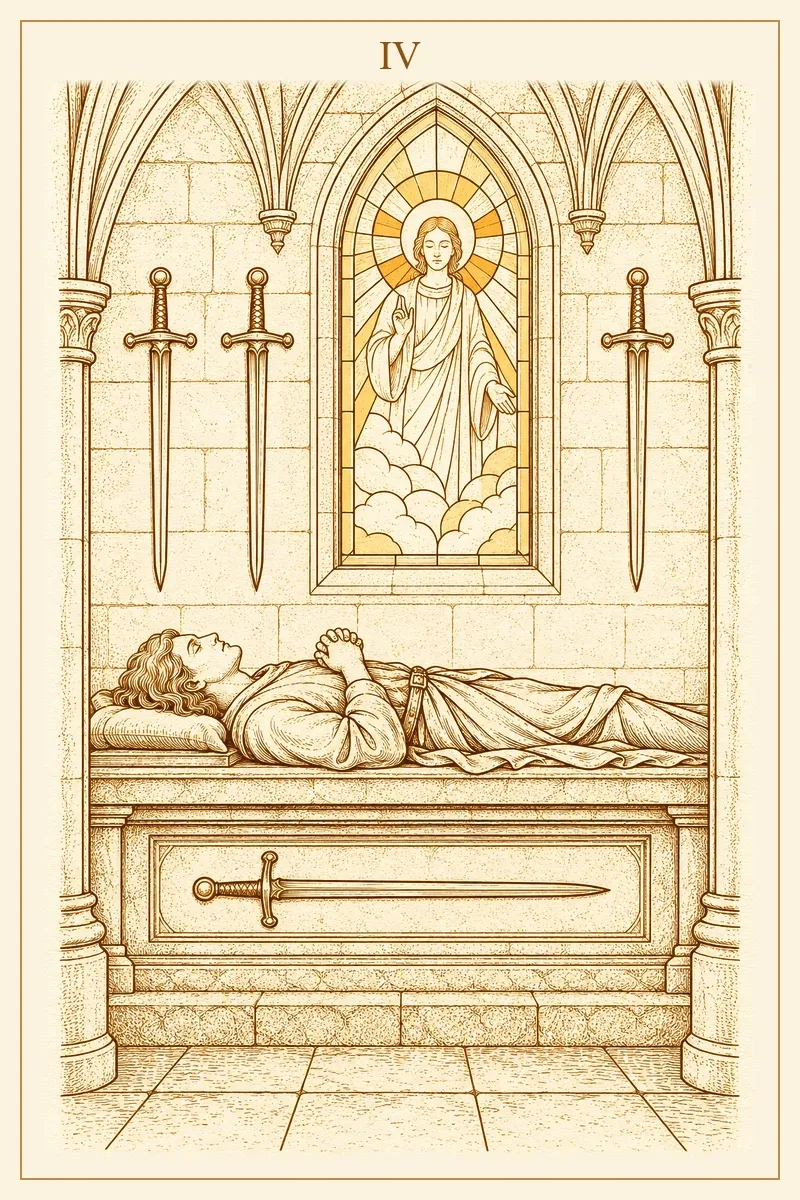
Lord of Rest from Strife, with Jupiter widening the frame after Saturn has narrowed it. A figure lies on a stone tomb with hands joined, three swords hanging on the wall above and one set into the side of the tomb beneath him: the conflict is not gone, it is set down. This is neither defeat nor avoidance but the deliberate pause that lets judgment come back, and Libra's last decan understands that a decision made while exhausted is not a fair decision, however carefully it was reasoned. Upright, the instruction is plain — step back, sleep, let the matter sit until the week turns. Reversed, either rest is being refused or it has quietly become hiding. The Four of Swords meaning covers the recovery readings that come up around illness and burnout.
Two courts on Libra's degrees, under two different names
Court cards are where this correspondence gets genuinely confusing, because the Golden Dawn and the deck in your hands may use the same word for different cards. The Golden Dawn ranks its court as King, Queen, Prince and Princess, where the King is the figure on horseback and the Prince rides in a chariot. Waite-style decks call the horseman the Knight and seat their King on a throne instead. So a Golden Dawn King is a modern Knight, and a Golden Dawn Prince is a modern King.
Libra's two courts are the Queen of Swords, who holds the last ten degrees of Virgo and the first twenty of Libra, and the Prince of Cups, who holds the last ten degrees of Libra and the first twenty of Scorpio. In almost any deck on sale today that Prince is the King of Cups. If one book gives Libra's last degrees to the King of Cups and another gives them to the Knight, the two authors have simply translated the Golden Dawn's Prince differently; the degrees themselves have not moved.
Queen of Swords: 20 degrees Virgo to 20 degrees Libra
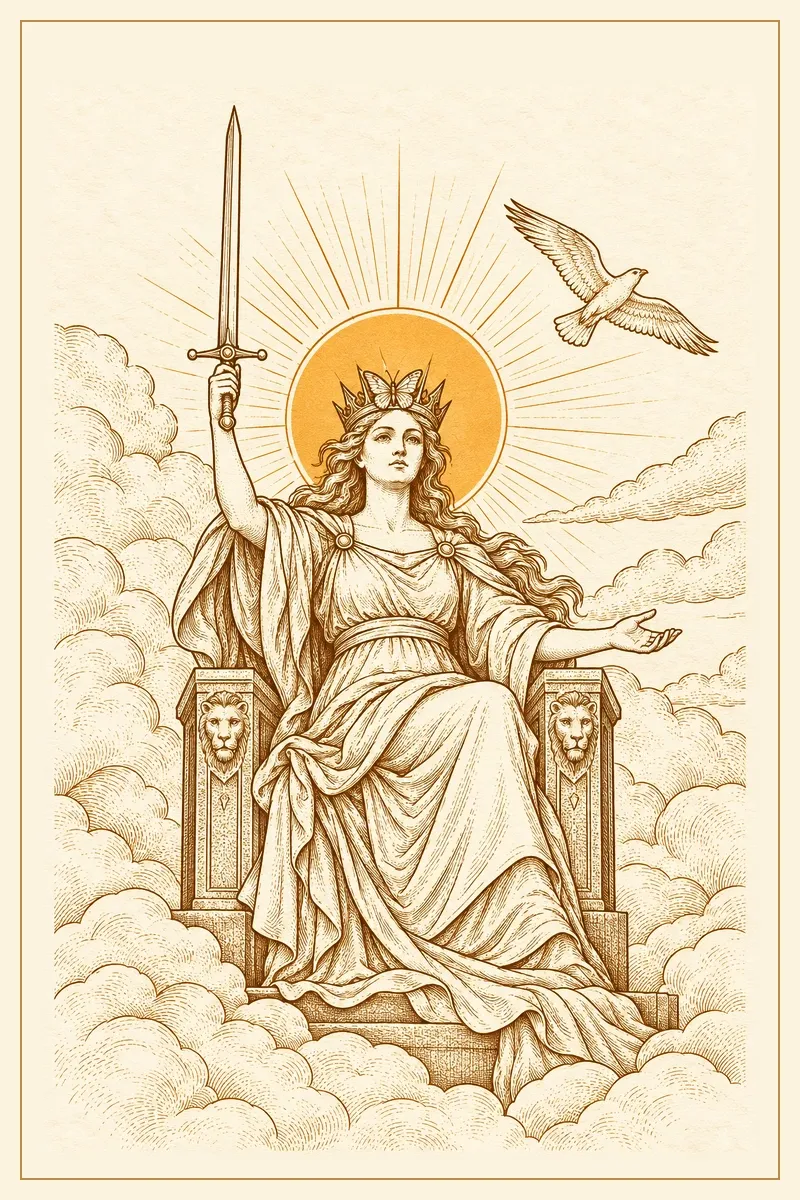
Twenty of Libra's thirty degrees sit under this Queen, so she is the court card a reading usually means when it means Libra. She is air in its settled form: someone who has been through the experience and kept the clarity out of it rather than the bitterness. She tells you what she actually thinks, and the kindness is in the telling rather than in the softening. In a spread she can be a person whose read on the situation is accurate, or a stance you are asked to take. Reversed, the same edge turns cold, or becomes a critique that is easier to deliver than the feeling underneath it. The Queen of Swords meaning goes into how she reads as a person versus as advice.
King of Cups: 20 degrees Libra to 20 degrees Scorpio
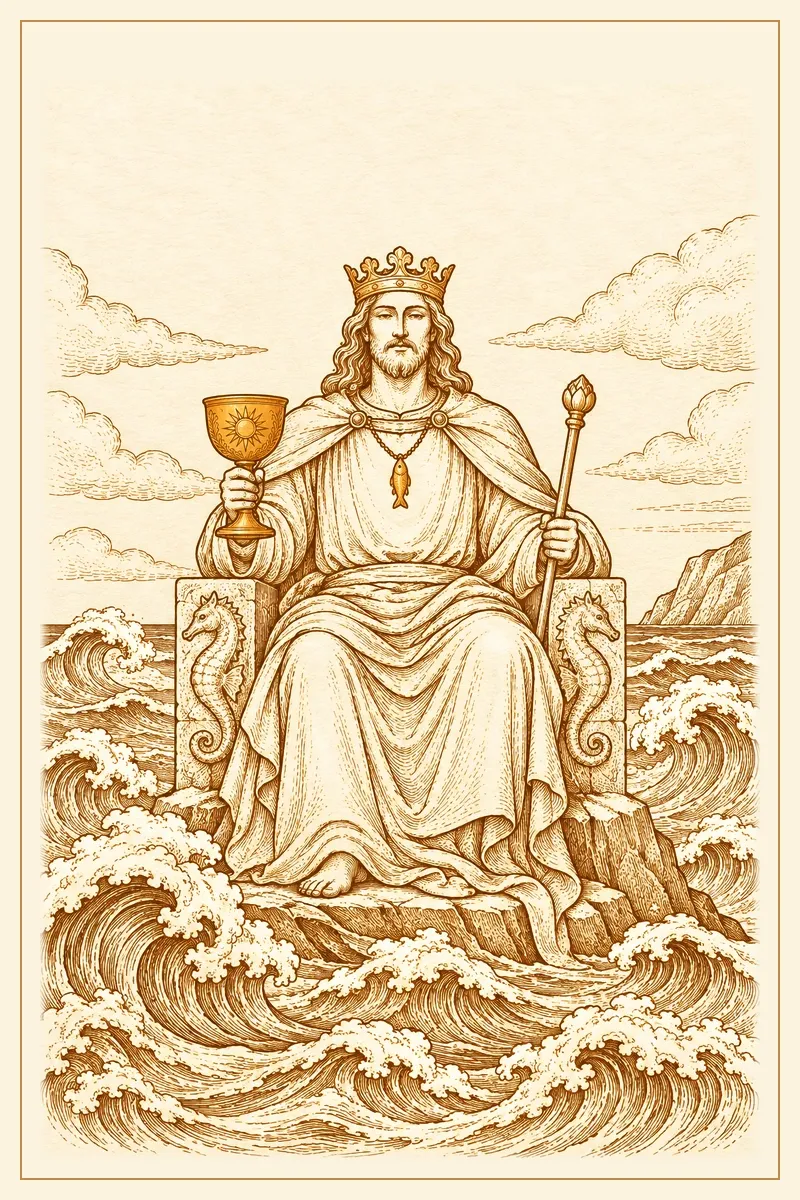
Here is the handover. A figure on a throne set on moving water holds a cup without looking into it: feeling that is real, acknowledged, and not being poured over everyone in the room. That is the diplomatic end of Libra done honestly — not charm that keeps the peace, but steadiness that lets other people say a difficult thing without the room catching fire. Reversed, feeling is managed instead of felt: the gracious host who has not mentioned in two years that they are unhappy. The King of Cups meaning is thorough on his leadership side, and since his degrees run on into the next sign, the Scorpio tarot correspondences pick the story up where Libra's composure stops being enough.
Four cards people file under Libra by mistake
Each of these has a real link to something Libra cares about, and none of them is the sign's card.
- The Lovers: partnership and a choice between two, but it belongs to Gemini. In a Libra question it points at a choice that costs you one of the options.
- Two of Cups: Book T calls it the Lord of Love, yet its decan is Venus in Cancer. It describes something mutual and private, where Libra's cards describe something negotiated.
- Temperance: most people's mental picture of balance, and the card is Sagittarius's. Its subject is proportion over time, not fairness between two parties.
- Six of Pentacles: actual scales in the picture, but its decan is Moon in Taurus, and its real subject is the gap between the person holding the scales and the person holding out a hand.
What the Libra cards do in an ordinary question
Correspondences earn their keep when they change how you read a spread, not when they decorate it. Here is where these cards tend to land in the questions people actually bring.
Relationships, and the person who never states a preference
Libra's cards are unusually good at one problem: a person has stopped saying what they want, and both people have mistaken the quiet for agreement. The Two of Swords names the quiet, The Empress reversed names its cost, and Justice asks what each party has actually contributed, counted honestly rather than generously. If a spread leaves you more certain about someone else's inner life than about your own next move, read it again.
Work: the decision nobody wants to put their name to
In career questions the Libra run describes committee weather: a choice everyone has an opinion on and nobody will own, a project where the credit and the workload have come apart, a role in which you smooth things rather than decide them. Justice upright often means the decision is more defensible than it feels and you should make it. The Four of Swords means you are about to make a poor one because you are tired.
Money: what keeping the peace quietly costs
Money questions under these cards are rarely about forecasting and almost always about terms: who pays for what, what was agreed, what has been absorbed without anybody noticing. Justice reversed is often a standing arrangement that was fair two years ago and has not been looked at since. Take this as a prompt for a real budget conversation, not as financial advice.
Timing, and why the equinox keeps turning up
The Sun moves through Libra from about September 23 to October 22, and the decans divide that stretch into three ten-day windows, which is the most specific timing this system offers. The equinox opens it, and the reason it matters is literal rather than poetic: day and night are the same length, so the sign begins at the one moment in the year that is genuinely level. Treat a timing read as a working assumption to test, never as a date to plan around.
The even hand: six cards for finding where the weight went
This spread is built for a question where something has gone lopsided and you cannot see where. Shuffle while you hold the situation in view, then deal two rows of three. If wording the question is the part you are stuck on, the prompts in the Veil Soul question library are a reasonable place to start.
- The heavier pan. Where is the weight actually sitting right now?
- The lighter pan. What has been going unweighted, uncounted or unpaid?
- The withheld objection. The point you keep drafting and never send.
- The overlooked evidence. What the situation has been telling you that you filed under "later."
- The adjustment. One correction you can make inside the next seven days.
- Level. What a fair outcome would look like if nobody had to lose face to reach it.
Read positions one and two as a pair before anything else — the imbalance is the whole question. Position five is the one to write down, because Libra readings fail when they end in a balanced insight and no action.
An illustrative reading: the invoice a client keeps shaving down
In this illustrative case, a freelance designer had worked with the same client for three years, and each invoice came back slightly reduced, always with a friendly note and a plausible reason. She had never once contested it. The question she brought was not "will they pay me properly," which the cards cannot answer, but "what am I doing here, and what do I change?"
The heavier pan gave her the Three of Swords; the lighter pan, The Empress reversed. The withheld objection was Justice reversed; the overlooked evidence was the Two of Swords. The adjustment was the Queen of Swords, and Level was the Four of Swords. Read as a sequence it was unusually direct. The weight sat on an old hurt she had never treated as one: three years of small reductions had registered as a long grievance rather than as a business problem, and the pleasure had drained out of work she used to like. Justice reversed was the arrangement she had never renegotiated, and the Two of Swords opposite it was the thing she had refused to look at, since the client's behavior had been legible the whole time.
The Queen of Swords as the adjustment was not a call to burn the relationship down. It was one plain email, sent once, without apology or decoration, stating the rate and the terms. The Four of Swords reframed a fair outcome as no longer carrying the argument rather than winning it. What the client does with that email is the client's move, and the reply will tell her more than another reading could. The cards predict none of it; what they showed her was the objection she had been withholding, the only part of the situation she controlled.
Four small practices for a season of weighing
- Name the two pans before you shuffle. Write the question as "between what and what?" If you cannot fill in both blanks, the spread will produce fog, however elegant the cards look.
- Count one arrangement honestly. Pick a single standing agreement — chores, money, who travels — and work out the real split for one week. Not a judgment, just an accurate number to talk from.
- Deliver one undecorated sentence. Say the thing once, plainly, without the softening clause on the end. It is the practice most people skip.
- Take the Four of Swords literally. Put a genuine pause in front of any decision made in the last hour of a long day.
If the structure behind these correspondences interests you more than the cards one at a time, the Veil Soul lessons work through the zodiac and the decans in order.
Frequently asked questions
What tarot card is Libra?
Justice, the eleventh trump in most modern decks. Libra also holds the Two, Three and Four of Swords as its decan cards, and The Empress stands behind the sign as the card of its ruling planet, Venus.
Which court card represents Libra?
Mainly the Queen of Swords, who covers the last ten degrees of Virgo and the first twenty of Libra. Libra's final ten degrees go to the King of Cups, the card the Golden Dawn called the Prince of Cups.
What are the Libra decan cards and their dates?
Two of Swords for the first decan, Moon in Libra, about September 23 to October 2. Three of Swords for the second, Saturn in Libra, about October 3 to 12. Four of Swords for the third, Jupiter in Libra, about October 13 to 22. Exact boundaries move by a day either way depending on the year.
Why are the Libra decans all Swords if Libra is the sign of love?
Because the decan wheel is dealt in a fixed order starting at Leo, not matched to each sign's reputation. Swords is the air suit and Libra is an air sign, so the pairing is consistent even where it is unflattering. The warmer side of Libra sits with Venus and The Empress instead.
Is Justice card VIII or card XI?
It depends on the deck in front of you. The Golden Dawn swapped Justice and Strength and Waite's deck made the change standard, so Justice is XI in decks that follow him and VIII in the older Marseille order. The correspondence follows the image, not the number.
Does drawing Justice mean a Libra person is involved?
Not usually. Court cards describe people far more often than trumps do, and even then they more commonly describe a stance than a person. Read Justice as a Libra individual only where the question was about someone specific and the rest of the spread supports it.
Can tarot tell me what Libra season will bring, or whether a decision will go my way?
Not as a forecast. The cards will not confirm an outcome, supply a date or report what somebody has decided in private. They are better at showing you the imbalance you have been tolerating and the one correction available to you.
A level scale still has to be held by someone
Libra's cards are less serene than the sign's reputation suggests. A blindfold, a pierced heart, a figure lying down to recover, and a woman with a sword who will tell you the truth whether or not you asked that clearly — that is the actual run, and it describes the work of fairness rather than the feeling of it. Balance here is never a state you arrive at; it is something held, adjusted, and held again.
If a decision has been sitting unmade for a while, a tarot reading gives you room to lay out both sides and see which one you have been avoiding.