Aquarius is The Star in tarot: Major Arcana card XVII, the image of water poured out freely beneath a bright star. The Golden Dawn, whose correspondences most modern decks still use, gave The Star to Aquarius together with the Hebrew letter Tzaddi, and placed the sign's three decans on the Five of Swords, the Six of Swords and the Seven of Swords. Saturn, the sign's traditional ruler, brings in The World, and the King of Swords is the court card many readers pair with it.
These links are a vocabulary, not a horoscope. A card can describe the Aquarian mood of a situation, such as a wish to change a system, step back from the crowd or work for something larger than yourself, but it cannot tell you what another person thinks, name a date or decide an outcome for you. Treat the correspondences as questions you bring to the cards and to your own life.
Here is the whole Aquarius set before the detail:
- The Star (XVII): the Aquarius card; hope you can act on, generosity, a long view.
- The World (XXI): Saturn, the traditional ruler; structure, completion, the long haul.
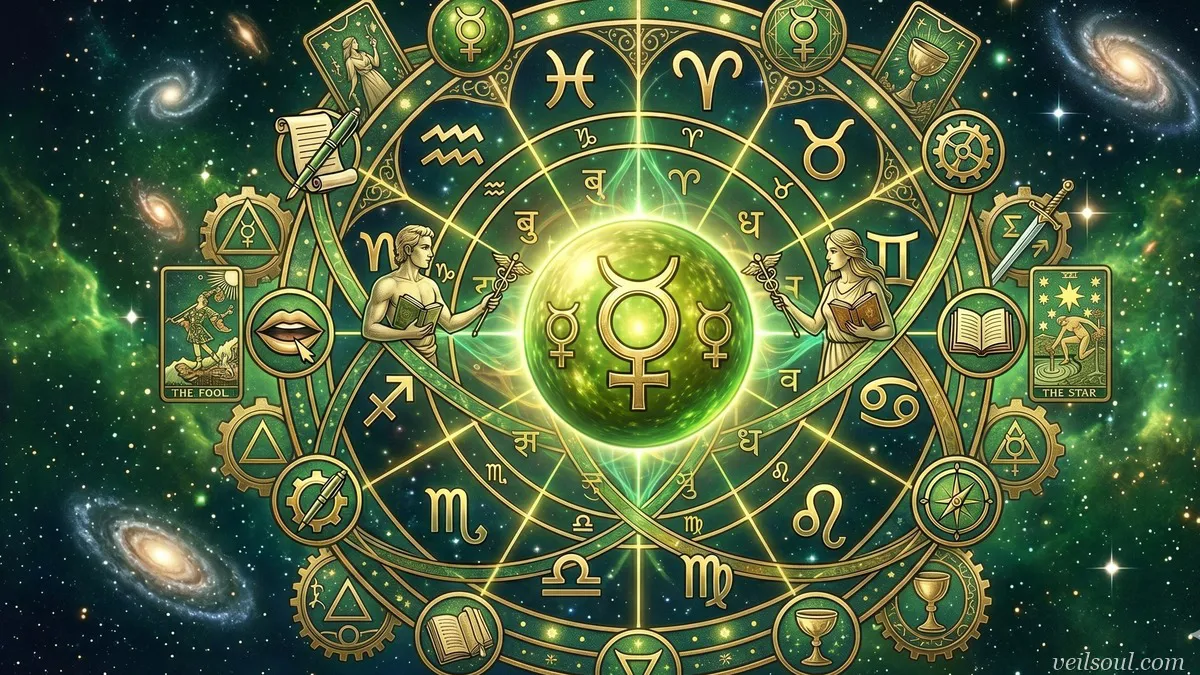
- The Fool (0): linked to Uranus, the modern ruler, by some modern decks and books.
- Five of Swords: first decan, Venus in Aquarius; the cost of winning an argument.
- Six of Swords: second decan, Mercury in Aquarius; moving toward calmer water.
- Seven of Swords: third decan, Moon in Aquarius; working alone, around the rules.
- King of Swords: the court card most often given to Aquarius; clear, fair judgment.
- Strength (VIII): Leo, the opposite sign; warmth and courage to balance Aquarian distance.
Why the water bearer belongs to The Star
Aquarius is an air sign, yet its symbol is a figure pouring water. That puzzle is the best way into the card. In astrology the water bearer's jug holds something meant to be shared: ideas, knowledge and care offered to anyone who comes to the stream. Air is the element of thought and communication, so the water here is less about feeling than about what a clear mind gives away. Aquarius is also a fixed sign and falls in the middle of winter in the Northern Hemisphere, the stretch of weeks when keeping faith with a plan takes real stubbornness.
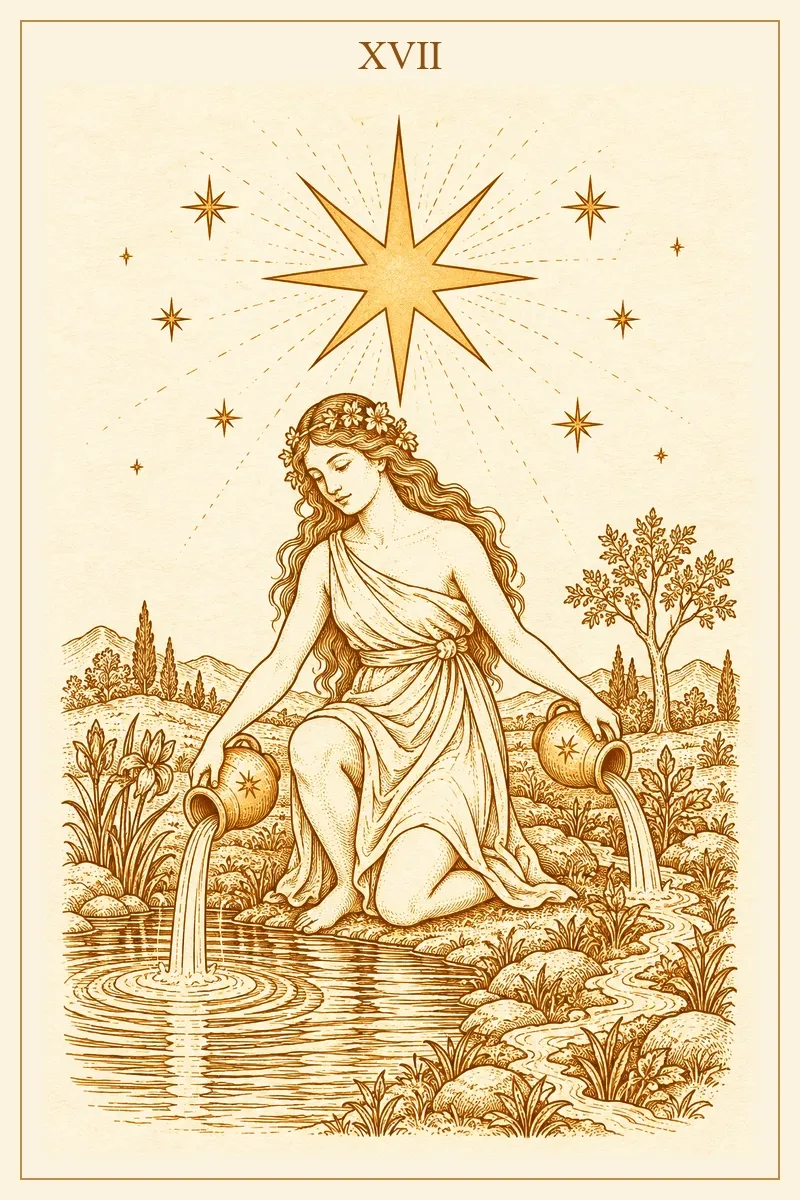
The Star carries the same picture. On the card a young woman in a loose draped gown, a crown of small flowers in her hair, kneels at the edge of a pool and pours from two jugs: one stream falls into the still water, the other spills over the bank and becomes a little brook through the grass. Above her a large eight-pointed star shines, with smaller stars scattered around it, and a leafy tree stands on the far bank. Nothing in the scene is hoarded. The water returns to the pool and runs out into the land at the same time, which is a fair description of the Aquarian ideal: renewal for yourself and for the people around you.
Tzaddi, the Hebrew letter the Golden Dawn gave this card, ties it to Aquarius inside that system. Aleister Crowley later moved Tzaddi to The Emperor in his Thoth deck, but he kept The Star with Aquarius, so in both traditions the sign and the card stay together.
The Star (XVII): hope with a direction
Upright, The Star in an Aquarius reading speaks of renewal after a hard stretch and of hope that knows where it is going. It often appears once the worst of a disruption has passed (in the Major Arcana it comes right after The Tower) and you can see what you want to build in its place. For an Aquarius reader it can confirm that an ideal you have been holding quietly is worth pursuing in the open. The card's full range is covered in our guide to The Star's meaning; here the focus is the Aquarian angle of generosity, a wide circle of people and patience with a long plan.
Reversed, The Star usually points to hope that has worn thin rather than to anything dramatic. You may be pouring yourself into a cause, a volunteer group or a friend's crisis until your own jug is empty, or you may have stopped saying your ideals aloud because someone once laughed at them. The reversal asks for a smaller, steadier pour: one honest goal, a little rest, and help you accept rather than only give.
In love, the upright Star describes a relationship with room to breathe, where both people are allowed to be a little odd and a little free, and trust builds slowly. Reversed, it can show that you are waiting for a partner to change before you let yourself hope again, or that you keep your feelings under a layer of cool friendliness. At work, the upright card favors projects with a public purpose: teaching, research, community work, open tools anyone can use. Reversed, it can mark burnout from caring about the mission more than anyone pays you to.
Saturn and Uranus: the two rulers in tarot
Aquarius has two rulers, and each one brings another Major Arcana card into the picture. Saturn is the traditional ruler, the one astrologers used long before Uranus was discovered in 1781. In the Golden Dawn system Saturn's card is The World (XXI). It shows the Aquarian talent for structure: meetings that actually happen, rules that serve the group, the long work of building something that outlives the excitement that started it. Our piece on Saturn in tarot follows this planet through all of its cards.
Uranus is the modern ruler, the planet of sudden change, invention and the urge to break free. The Golden Dawn never gave Uranus a card, because its scheme was built on the seven classical planets. Some modern decks and books link Uranus to The Fool, card 0, since both suggest a leap into the unknown; treat that as a modern convention rather than part of the older system. The Uranus tarot guide explains how readers use that link.
Seen side by side, the two rulers describe the Aquarian tension well. Saturn wants the plan to hold; Uranus wants the plan to change. The Star sits between them: a fixed sign that keeps faith with one idea for years, and an air sign that keeps redrawing the route toward it. When The World and The Fool both turn up in the same Aquarius reading, ask which part of your plan needs finishing and which part needs a fresh start.
The three decans: Five, Six and Seven of Swords
Each sign covers thirty degrees of the zodiac. The Golden Dawn split every sign into three decans of ten degrees and gave each decan a planet and one of the numbered cards from Two to Ten. Aquarius takes the middle of the Swords suit. The planets follow the old Chaldean order, so Venus, Mercury and the Moon take their turns, and each card carries a Golden Dawn title that reads like a one-line summary. The dates below are approximate, because the day the Sun enters each degree shifts slightly from year to year.
Five of Swords: Venus in Aquarius, about January 20–29
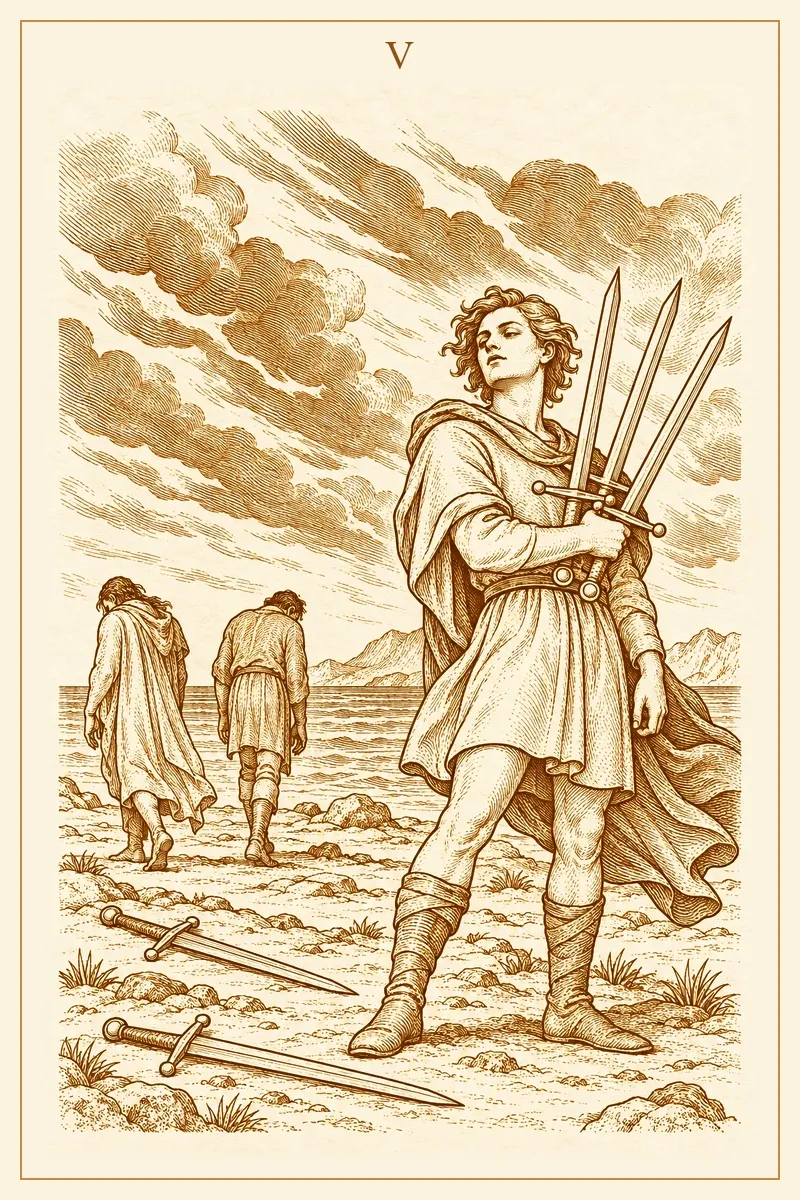
The Golden Dawn called this card the Lord of Defeat. A young man in a short tunic and cloak stands on a stony shore with three swords gathered against his shoulder, while two swords lie on the ground and two figures walk away toward the sea with their heads down. The sky is full of torn clouds. Venus wants harmony, but in this decan it meets the Aquarian habit of standing firm on principle, and the result is the argument you win and regret.
Upright, the card asks what being right is costing you. In an Aquarius reading it often describes a clash of values, at work, online or at the family table, where each side is sure it speaks for the greater good. Reversed, it can show the moment after the fight: the wish to make peace, an apology that is overdue, or the decision to leave a quarrel that cannot be won. In love, it warns against treating a partner as an opponent in a debate; at work, it asks whether a point of principle is worth the team's trust. Our Five of Swords meaning covers the card in every position.
Six of Swords: Mercury in Aquarius, about January 30 – February 8
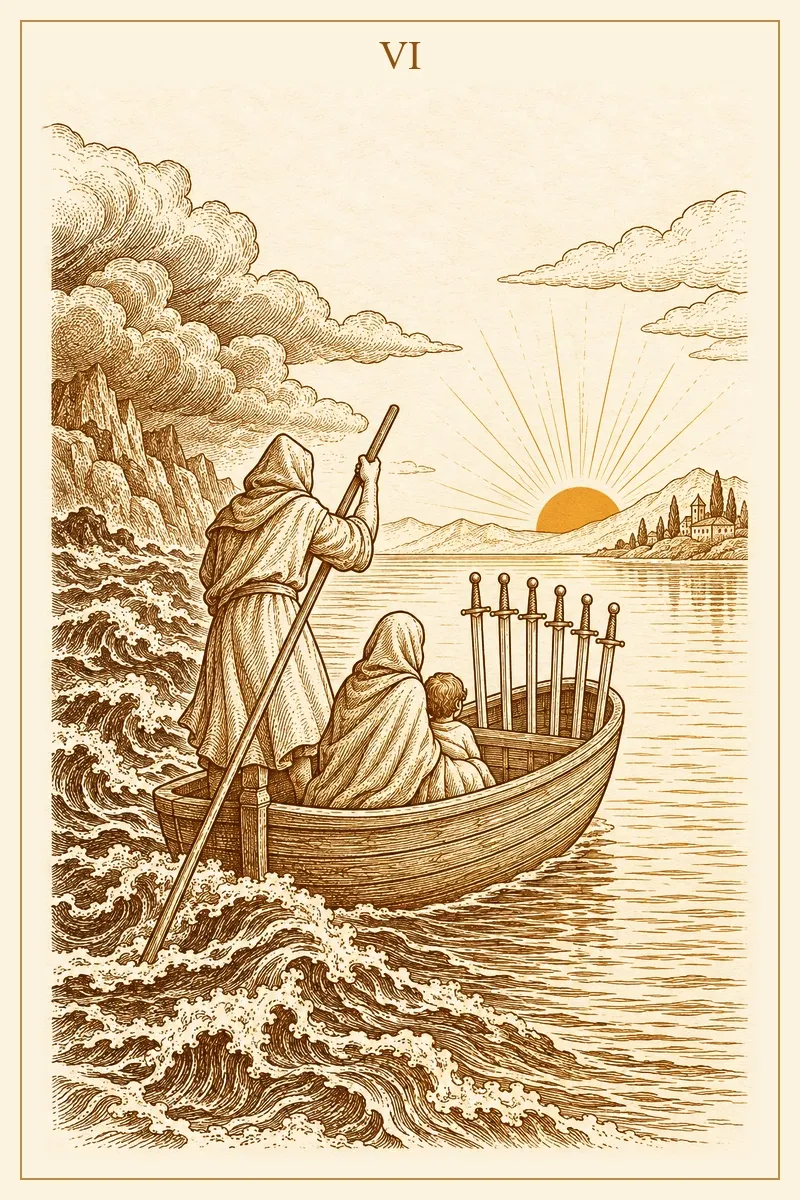
The Golden Dawn title is the Lord of Earned Success, which surprises people who know the card only as a sad crossing. A hooded ferryman stands at the back of a small boat and pushes it with a long pole away from rough, breaking waves; a hooded passenger and a child sit in front of him, with six swords standing upright in the bow. Ahead the water is calm, and a low sun shines over a far shore with a small town. Mercury, the planet of thought and travel, gives this decan the Aquarian gift of finding a way out by thinking clearly.
Upright, it shows a transition you have worked for: a move, a change of team, leaving a draining situation for a quieter one. The success is real but modest, more relief than triumph. Reversed, it suggests a journey that keeps being postponed, or the same worries carried into the new place because nothing was set down before leaving. In love, the upright Six of Swords can describe a couple steering through a hard season together; at work, a planned exit rather than a dramatic resignation. More on the card is in the Six of Swords tarot meaning.
Seven of Swords: Moon in Aquarius, about February 9–18
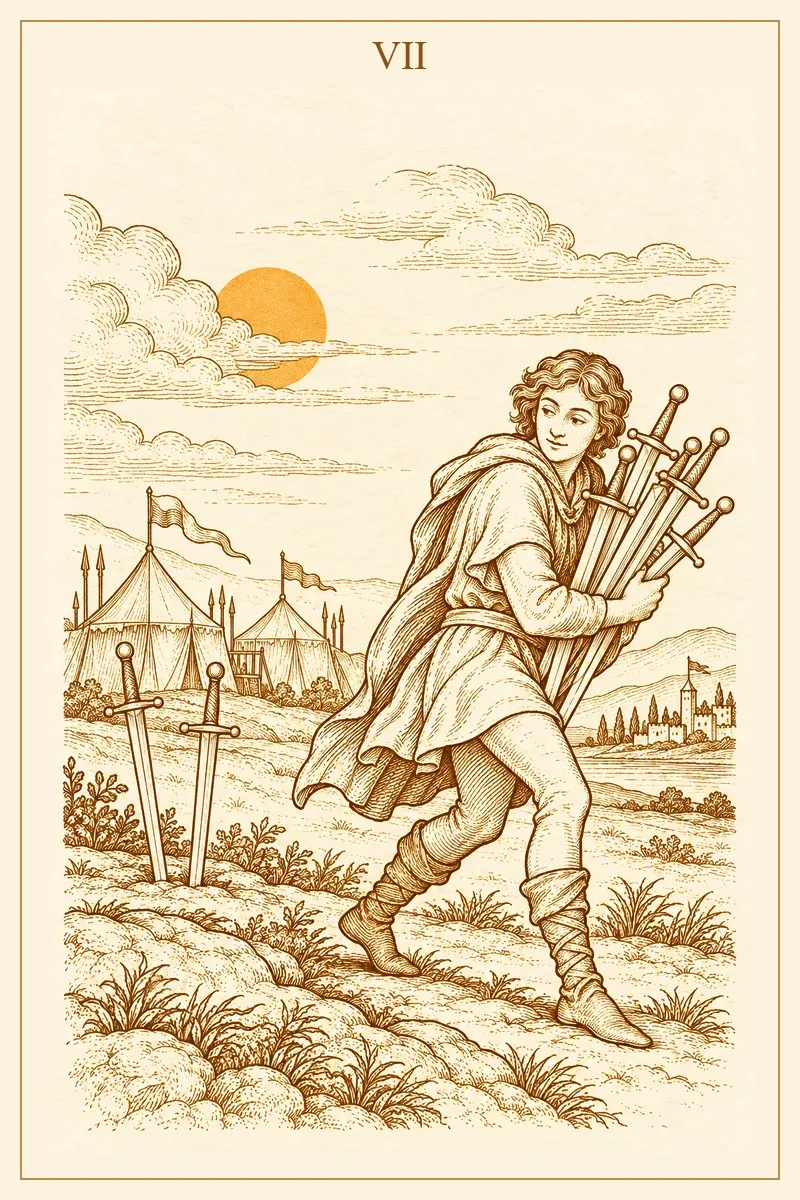
The Golden Dawn named it the Lord of Unstable Effort. A curly-haired young man hurries away from a camp of tents with five swords bundled in his arms, glancing back over his shoulder with a half smile; two swords stay planted in the ground behind him. The Moon brings feeling and instinct into an airy, independent sign, and the effort turns uneven: clever, solitary and hard to sustain.
Upright, the card describes a plan carried out alone, sometimes quietly and sometimes by cutting corners. In an Aquarius reading it can be the inventor tinkering on the side or the person who bends a rule they consider unfair. It can also point to evasion, your own or someone else's, so ask honestly which one you are looking at. Reversed, it often means a secret coming out, a decision to stop going it alone, or a return for the swords you left behind. In love it asks whether something is being held back; at work it asks whether your workaround would survive being explained to your team. The Seven of Swords meaning post looks at both the darker and the lighter readings.
The court card: why readers pair Aquarius with the King of Swords
Court cards are where tarot astrology gets untidy, and it is fair to say so. Many modern books give the King of Swords to Aquarius because both belong to air and both value steady, impartial judgment. The Golden Dawn worked differently: each of its court cards covers thirty degrees, running from the 21st degree of one sign to the 20th degree of the next. In that scheme the card most modern decks print as the King of Swords (the Golden Dawn's Prince of Swords) spans the 21st degree of Capricorn to the 20th degree of Aquarius, so it holds most of the sign. The last ten degrees of Aquarius belong to the Golden Dawn's King of Cups, the card most decks print as the Knight of Cups, which then runs on into Pisces.
So the King of Swords is a reasonable Aquarius card, as long as you hold it as one convention among several. If you were born in the last days of the sign, the Knight of Cups may speak to you as well.
King of Swords: clear judgment, held lightly
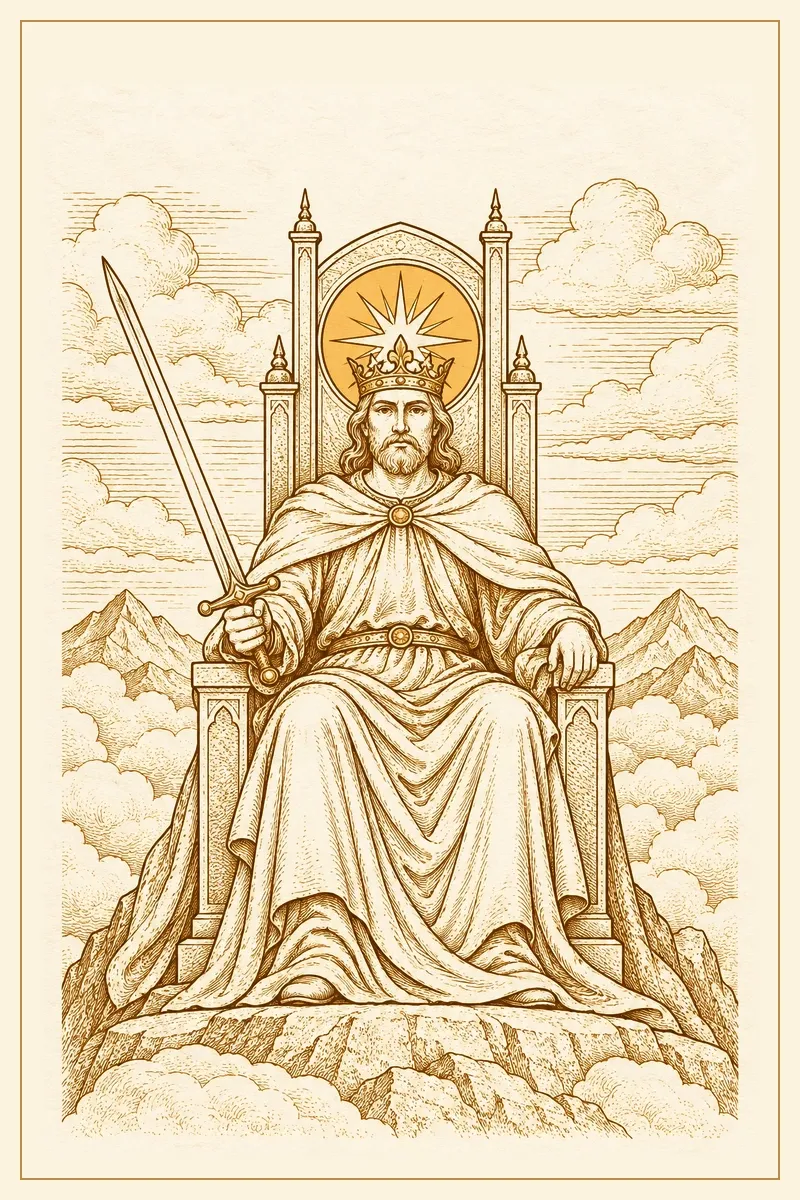
The King sits on a tall stone throne on a rocky summit above the clouds, crowned, with a pointed sunburst behind his head and a long sword held at an angle in his right hand. Mountain peaks rise behind him. It is a picture of a mind above the weather, which matches the Aquarian ideal of thinking clearly while others are swept along.
Upright, the King of Swords stands for fair, well-reasoned decisions and honest speech. As a person he is someone who judges by evidence and principle: an editor, an engineer, a mediator, or a friend who tells you the truth kindly. As energy, he asks you to lay out the facts before you act. Reversed, his clarity turns cold or controlling: logic used to win rather than to understand, rules applied without mercy, or a refusal to admit that feelings are part of the facts. In love, upright, he favors honest conversations and agreements you both keep; reversed, he can describe emotional distance passed off as being reasonable. At work, he is the fair manager or the expert whose advice holds up under questions. The King of Swords meaning post covers him in more depth.
Aquarius between Capricorn, Pisces and Leo
A sign makes more sense beside its neighbors. Aquarius follows Capricorn, whose card is The Devil: ambition, attachment, the structures people build and then feel chained by. The Star can read as the relief that comes after The Devil and The Tower, a breath of air once a heavy structure has fallen away. You can follow the step before it in our Capricorn tarot guide.
After Aquarius comes Pisces and The Moon, where clear starlight gives way to dreams, intuition and uncertainty. Where Aquarius thinks about the whole group, Pisces feels along with it. If The Star and The Moon appear together, the reading may be asking you to carry a clear idea through a foggy, emotional stretch. The Pisces tarot article picks up the story there.
The opposite sign is Leo, whose card is Strength. Leo shines as an individual; Aquarius serves the collective. Leo leads from the heart; Aquarius leads from principle. When Strength turns up in an Aquarius reading, it often asks for more warmth: patience with people rather than with ideas, and the courage to be seen caring. The other half of that axis is laid out in Leo's tarot connections.
Reading with an Aquarius lens
Whether your Sun is in Aquarius or you are simply reading during Aquarius season, the sign's style shows in how you read as much as in which cards appear.
What Aquarius brings to a reading
- Pattern recognition: noticing links across a spread, such as three cards that all describe the same group or system.
- Objectivity: looking at a difficult card without panic and asking what it actually describes.
- Fresh interpretation: willingness to design a new spread or read a familiar card from an unusual angle.
Where it can go wrong
- Detachment: analyzing a reading so coolly that the feeling in it, yours or the querent's, gets ignored.
- Contrarianism: rejecting a traditional meaning only because it is traditional.
- Idealism without a plan: taking every Star as proof that things will work out, instead of as a cue to begin.
Questions that suit Aquarius season
From about January 20 to February 18, questions about friendship, community, groups and the future tend to feel natural. Try asking where you fit in a group you belong to, what you would change about a system you work inside, which ideal you have quietly let go of, where you go along with others when you would rather stand apart, and what you could offer people beyond your own circle.
The Aquarius season vision spread
This five-card spread keeps the sign's focus on change and the collective. Lay cards 1 and 2 side by side as a base, card 3 above them at the top, and cards 4 and 5 to the left and right between them, so the layout looks loosely like a star.
- The status quo: the system, habit or situation as it stands now.
- The disruption: what needs to be questioned or changed.
- The vision: what could exist if you follow your best ideals.
- The bridge: a practical step that links where you are to where you want to be.
- The collective gift: how your own change could help other people.
Read card 3 first and card 4 second, because an Aquarian vision is only as useful as its first practical step. If the bridge is a Sword or a Pentacle, the step is probably a conversation or a concrete task; a Cup suggests a step that involves people's feelings, and a Wand suggests momentum and a start date you choose yourself.
Worked example: an idea kept in a drawer
Here is how the spread might run for a sample question. Imagine someone asking in early February: "I have an idea for a tool-lending shelf in my apartment building. What would help it take shape?"
- The status quo: Four of Pentacles. The idea is being held close. Perhaps the person worries about lost tools or about seeming pushy, so nothing has been shared yet.
- The disruption: Five of Swords reversed. An old disagreement with a neighbor, or a debate already lost at a residents' meeting, may be what keeps the idea quiet. The reversal suggests that quarrel is ready to be put down.
- The vision: The Star. The Aquarius card in its own season, describing just what the person wants: something shared freely and refilled by many hands.
- The bridge: Three of Pentacles. A plan made with others, such as a short proposal, two or three neighbors who would help and a simple sign-out sheet.
- The collective gift: Ten of Pentacles. Something that lasts and belongs to the building rather than to one person.
Read as a whole, the spread moves from holding on (Four of Pentacles) to sharing (The Star), and what links them is cooperation, not a solo push. The next step is modest: write one page, ask two neighbors, and pick a date to raise it. The cards do not promise the shelf will be approved; they help the person see that the obstacle is an old argument and a habit of holding back, and both of those are things they can work with.
Turning Aquarius season into small actions
- Pick one ideal you care about and write down the smallest action that would serve it this month.
- Draw a single card for a group you belong to, and ask what you could offer it rather than what it owes you.
- If the Five of Swords appears, choose one argument to set down, even if you were right.
- If the Seven of Swords appears, tell one trusted person about a plan you have been carrying alone.
- Keep a short note of each reading during the season, and around February 18 look back for cards that repeated.
Frequently asked questions
What tarot card represents Aquarius?
The Star (XVII) is the Aquarius card in the Golden Dawn system that most modern decks follow. Its decans are the Five, Six and Seven of Swords, and the King of Swords is the court card most often paired with the sign.
Is the King of Swords the Aquarius card?
It is the court card many modern sources give to Aquarius, but it is a convention rather than a fixed rule. In the Golden Dawn spans, the King of Swords (their Prince of Swords) covers most of Aquarius, while the final ten degrees fall to the card most decks call the Knight of Cups. The Major Arcana card for Aquarius is The Star in either case.
Why is Aquarius a water bearer if it is an air sign?
The water in the jug stands for what the sign gives away: knowledge, ideas and care. Air is the element of the mind, so Aquarius pours out thought more than emotion. The Star shows that pouring directly, which is one reason the card and the sign fit so well.
Which tarot cards go with Saturn and Uranus?
Saturn, the traditional ruler of Aquarius, is The World (XXI) in the Golden Dawn system. Uranus, the modern ruler, was not part of that system; some modern decks and books link it to The Fool (0).
Can tarot tell me what Aquarius season will bring, or what an Aquarius is thinking?
No. Tarot can help you reflect on your own choices and patterns during the season, but it cannot confirm another person's thoughts, give a date or decide an outcome. Use it to get clear on what you want and what you can do, then act on what you actually know.
Does a reversed Star mean bad news for an Aquarius?
Usually not. A reversed Star tends to describe tired hope or a cause that has drained you, not a disaster. It asks you to rest, accept help and choose one ideal to keep, all of which are within your reach.
Pouring from a full jug
Aquarius reminds you that a vision is meant to be shared, and that the one who pours needs refilling too. When you are ready to put your own question to the cards, a calm Veil Soul reading can help you find the next step.