What does the Justice card mean? In tarot, Justice stands for weighing the facts honestly and accepting what follows from them: fair terms, clear decisions and responsibility for your own part. Upright, it reflects a situation where the truth is on the table and a balanced choice is possible. Reversed, something has tipped the scales, whether that is a missing fact, an unequal arrangement or a reluctance to own a mistake.
Think of the card as a mirror rather than a ruling. It cannot tell you how a court, an employer or another person will decide, and it cannot know facts that nobody has shared. What it does well is ask what you actually know, what you are leaving out, and what a fair outcome would look like if you were the one deciding.
Justice in brief:
- Upright: truth, fairness, cause and effect, a decision made on the evidence.
- Reversed: an imbalance, a convenient half-truth, blame pushed elsewhere, or being far harsher on yourself than the facts deserve.
- Love: equal give and take, honest terms, a relationship decision made with a clear head.
- Work and money: contracts, reviews and agreements; read the terms and keep your records.
- Yes or no: upright, yes if the facts support you; reversed, not until the imbalance is put right.
Sword raised, scales level: what the Justice card shows
A crowned figure seated between two columns
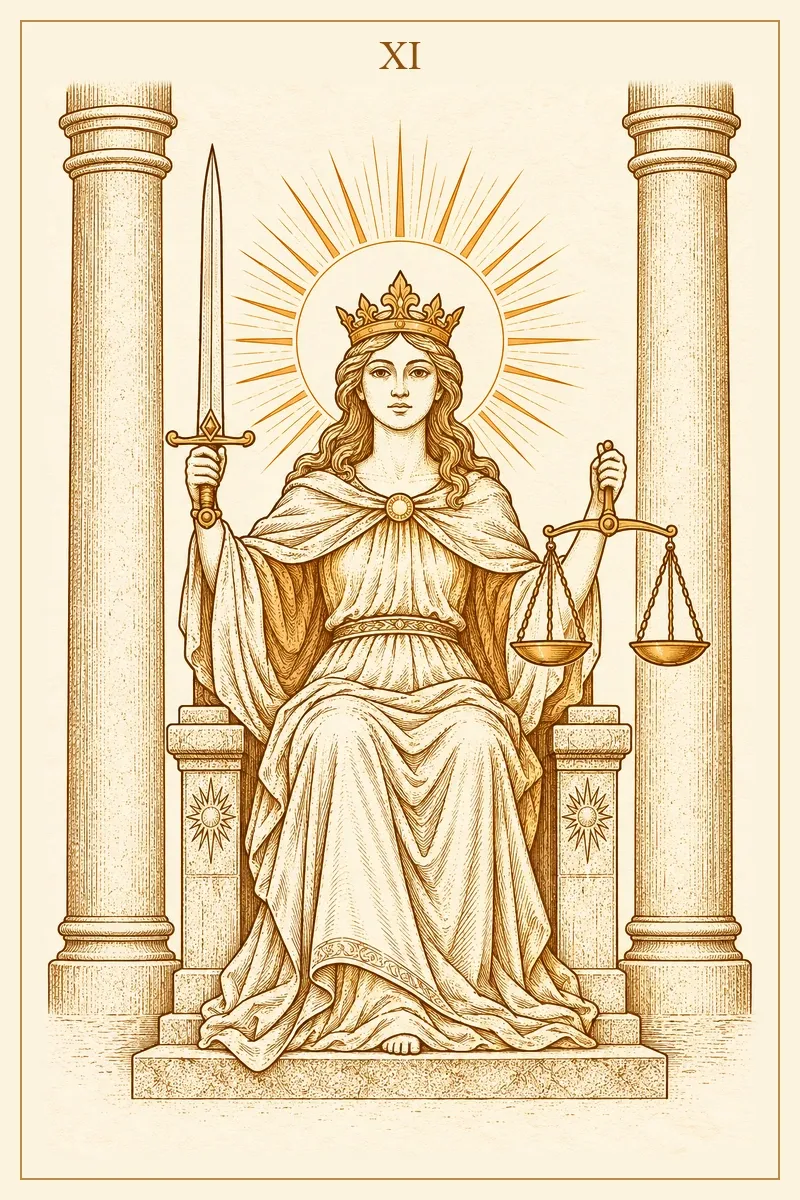
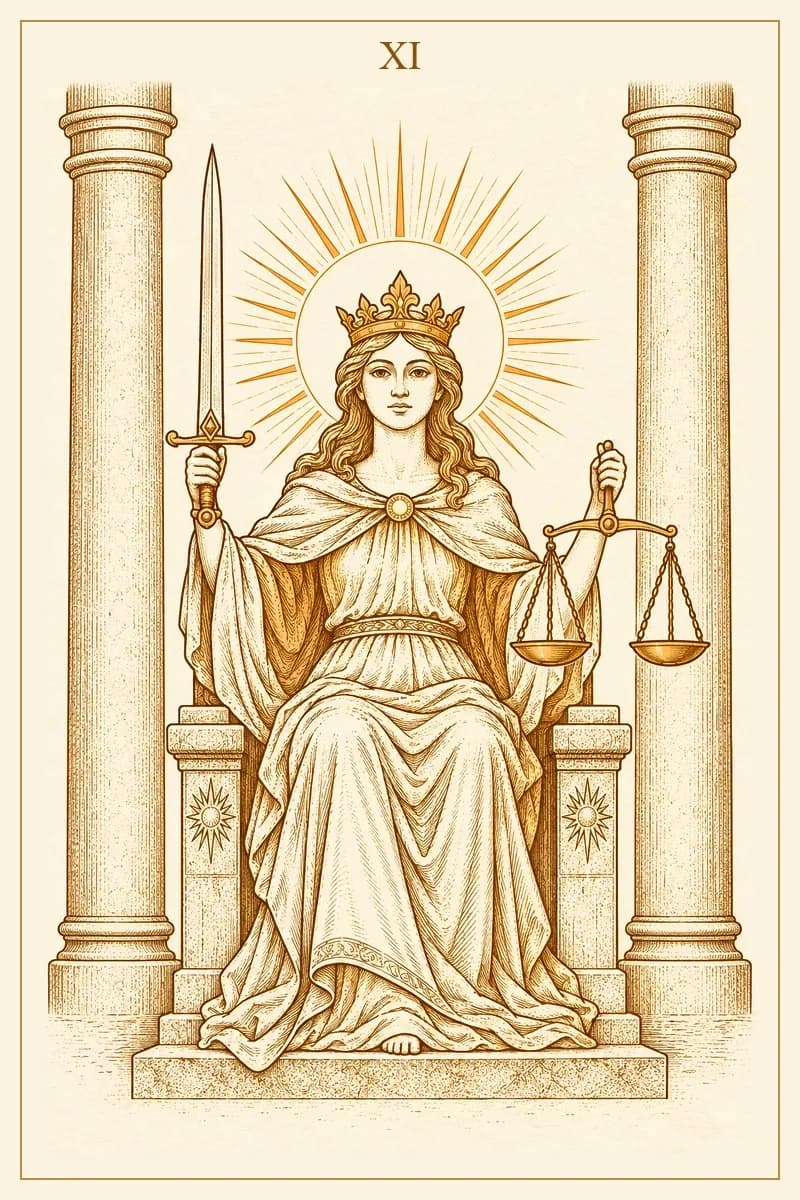
A young woman sits on a stone throne, facing straight out of the card and looking directly at you. Her eyes are open; there is no blindfold. A crown with fleur-de-lis points rests on her long wavy hair, and behind her head a wide circle of fine rays spreads like a sunburst. In her right hand she raises a straight sword, point to the sky. In her left she holds a balance at shoulder height, its two pans hanging on chains at exactly the same level.
A cloak fastened by a single round clasp falls over a belted gown, and the toes of one bare foot show beneath the hem. Each arm of the throne is a stone block carved with a sun-like star, long and short rays around a round center, and two tall stone columns stand on either side of a low stepped platform. Nothing hangs between the columns: the space behind her is open and pale, so whatever she weighs happens in plain view. The number XI sits at the top.
- Open eyes: she sees context and intention instead of judging blind, and asks you to look at the whole situation, your own role included.
- The upright sword: a decision, cleanly made. A sword separates one thing from another: a contract signed or cancelled, a story finally told straight.
- Level pans: both sides have been heard. If the pans feel uneven in your situation, the card asks what weight is missing.
- Columns and steps: a formal setting, which is why the card is read in terms of rules, procedures and written agreements.
Two columns also frame The High Priestess, one dark with a crescent and one light with a sun, and The Hierophant, whose pale columns carry star emblems much like those on Justice's throne. The High Priestess guards what has not yet been said (see the High Priestess meaning of hidden knowledge), and the Hierophant keeps shared customs (see the Hierophant's meaning of tradition and teaching). Justice brings the facts out and applies a rule to one case.
Libra, the letter Lamed, and why the card is XI or VIII
In the Golden Dawn system of correspondences, which shaped the Waite-Smith deck, Justice belongs to Libra, the cardinal air sign of the scales, ruled by Venus. Air is the element of thought and speech, fitting for a card about weighing evidence and putting a decision into words; Venus adds the wish for harmony rather than victory. The card's Hebrew letter is Lamed, and on the Kabbalistic Tree of Life as the Golden Dawn used it, its path joins Geburah, the sphere of severity, to Tiphareth, the sphere of beauty and balance: strictness in the service of harmony.
The number depends on the deck. In the older Marseille-style order, Justice is VIII and Strength is XI. The Waite-Smith deck swapped them, numbering Strength VIII and Justice XI, so that the cards follow the Golden Dawn's correspondences, in which Strength's Leo comes before Justice's Libra in the zodiac. The Thoth deck by Aleister Crowley and Frieda Harris keeps the card at VIII and renames it Adjustment, still linked to Libra. The card on this page carries the Waite-Smith number, XI.
Upright Justice: the facts on the table
Upright, Justice describes a moment when what really happened can be seen and weighed. The card cares less about who deserves to feel better than about what is true, what each person did, and what a fair next step would be. It speaks to moments when a decision is due and the honest answer is already within reach, even if it is not the comfortable one.
Cause and effect sits at the center. Choices made earlier are showing their results now, welcome or awkward. If you kept your side of an agreement or told the truth when it cost you something, upright Justice reflects that those choices count. If you cut a corner, the card does not threaten you; it points out that the corner is part of the picture and is best dealt with in the open.
Justice also asks for a slower, cooler way of thinking. Feelings matter, but the card asks you to separate what you know from what you fear or hope.
Reversed Justice: a tilted pan, and who is tilting it
Reversed, the balance on the card hangs crooked. The useful question is where the extra weight comes from, and it usually comes from one of four places.
An arrangement that is not fair. One person carries more of the work, the cost or the blame than the agreement says they should. The reversed card names the imbalance so that it can be raised rather than quietly absorbed for another year.
A missing or bent fact. Someone is telling a partial story, and it may be you. Half-truths and convenient silences all tip the pan. The card does not say who; it says the full account has not been given yet.
Responsibility handed elsewhere. A mistake was made and the energy is going into explaining it away. Owning it early, in plain words, will cost less than defending it later.
A verdict against yourself. This shape is easy to miss: someone who judges themselves far more harshly than they would judge a friend, replaying one error until it outweighs everything else. Here fairness means giving yourself the balanced hearing you would give anyone else. Tarot for self-discovery suggests gentler ways to look at that inner courtroom.
To tell the four apart, imagine a calm, neutral friend hearing every side, including yours. If they would point to the arrangement, raise it. If they would point to a gap in the story, fill it. If they would point to you, ask whether the charge is accountability, which leads to repair, or self-punishment, which only adds weight.
Justice in love: fair terms between two people
In love readings Justice is not the most romantic card, and that is its value. It asks whether a relationship runs on terms both people would agree to if asked out loud.
In a relationship, and when you are single
Upright in a relationship, Justice reflects a balance worth protecting, or a decision that needs both head and heart: moving in, sharing money, dividing chores and time, deciding whether to commit further. It favors a conversation where each person names what they give and what they need, and nobody keeps score in secret. For someone single, it suggests looking for, and offering, the same honesty: saying what you want early and noticing whether people's actions match their words.
Reversed in love
Reversed, the give and take has drifted. One person may be doing most of the emotional work, an old hurt may never have been talked through, or something is being held back. That does not prove anyone is lying, and it is not a cue to start checking a partner's phone. It suggests the terms need looking at again; an honest talk, and where it fits a couples counselor, can bring the pans back level.
Justice as feelings: how they may see you
In a position about someone's feelings, upright Justice tends to describe respect and careful thought rather than a rush of emotion. The person may be weighing things up: whether they feel equally treated, whether the timing is right for you both. Their feelings can be real and still measured. Reversed, it can reflect someone who feels the relationship has been unfair to them, or someone avoiding an honest look at their own part. Either way the card describes an attitude, not a promise; a direct question, and listening to the answer, will tell you more.
Getting back together: Justice upright and reversed
On a reconciliation question, upright Justice looks at whether the reasons for the breakup have been named and dealt with. A return is more likely to feel fair and steady when both people can say what went wrong on each side and what would change. Reversed, blame is still one-sided, or an apology, a debt or a broken promise is unresolved, and going back before that is settled may restart the same imbalance. To read Justice alongside the rest of the deck, signs of reconciliation in tarot sorts the cards that support a healthy reunion from those that counsel a pause.
Contracts, workplaces and money under Justice
At work: reviews, decisions and credit
Upright, Justice suits anything that rests on a fair assessment: a performance review, an application, a negotiation, a disagreement over who did what. Keep notes of what you delivered, put agreements in writing, and bring facts to meetings rather than impressions. If you manage others, the card asks whether your decisions would look fair from their side of the desk.
Reversed, it can reflect unfair treatment, unclear criteria, a broken promise or credit going to the wrong person. Write down dates and specifics, check your workplace's own procedures, and if the problem is serious, get advice from HR, a union representative or an employment adviser. The reversal can also ask whether you have been entirely fair to a colleague yourself.
Money, agreements and the fine print
Upright, money matters favor clear and balanced arrangements: a contract whose terms you understand, a debt repaid as agreed, a shared expense split in a way both people accept. Read every clause before signing and ask about the parts you do not understand. Reversed, look for hidden costs, terms that lean toward one side, or an informal arrangement between friends or family that has quietly become unfair. For large decisions, a qualified financial adviser is the right person to check the numbers.
When the question is legal or official
Because the card shows a sword and scales, it can feel weighty when it turns up while you are waiting on a court date, an insurance claim, a visa application or a dispute with a landlord. There it works as a way to prepare, not as a forecast. Upright, gather documents, check dates, write a clear timeline and be accurate about your own part. Reversed, look for what is missing from your file, or for an awkward fact you have held back from the people helping you.
The legal side itself belongs with a qualified lawyer, a legal aid service or the official body handling the matter; the card knows nothing about local law or the other side's evidence.
Justice yes or no: an answer that follows the facts
As a yes-or-no card, upright Justice says yes when the facts and fairness are on your side, and asks you to check that honestly before relying on it. Reversed, it leans toward "not yet": something is unbalanced or incomplete and needs sorting out first.
- "Should I sign this agreement?" Upright: yes, once you understand the terms. Reversed: not before the unclear or one-sided parts are fixed.
- "Was I in the wrong?" Upright: look at your part honestly; there may be something to own. Reversed: you may be carrying more of the blame than belongs to you.
The guide to asking yes or no questions with tarot explains how to phrase a question so that a conditional answer like this one stays practical.
Justice, Judgement or the Wheel? Three cards about consequences
Several Major Arcana cards talk about results catching up with us, and these three are easy to blur together. Justice is a measured decision in the present: the facts are weighed and a fair conclusion follows from your own choices and reasoning.
Wheel of Fortune is a turn of circumstance: timing, chance and cycles nobody fully controls. Next to Justice, it suggests an old pattern has come back around, and the fair response is to adjust rather than resist. The Wheel of Fortune meaning of cycles and turning points shows how different that is from a reasoned decision.
Judgement is an inner call to review a whole chapter of life, forgive, and answer a sense of purpose. Justice weighs one case; Judgement looks back over the whole story and asks who you want to be now. When both appear, a single decision belongs to a larger reckoning with yourself.
Justice and Death, The Lovers and Justice, and other pairings
Justice and Death
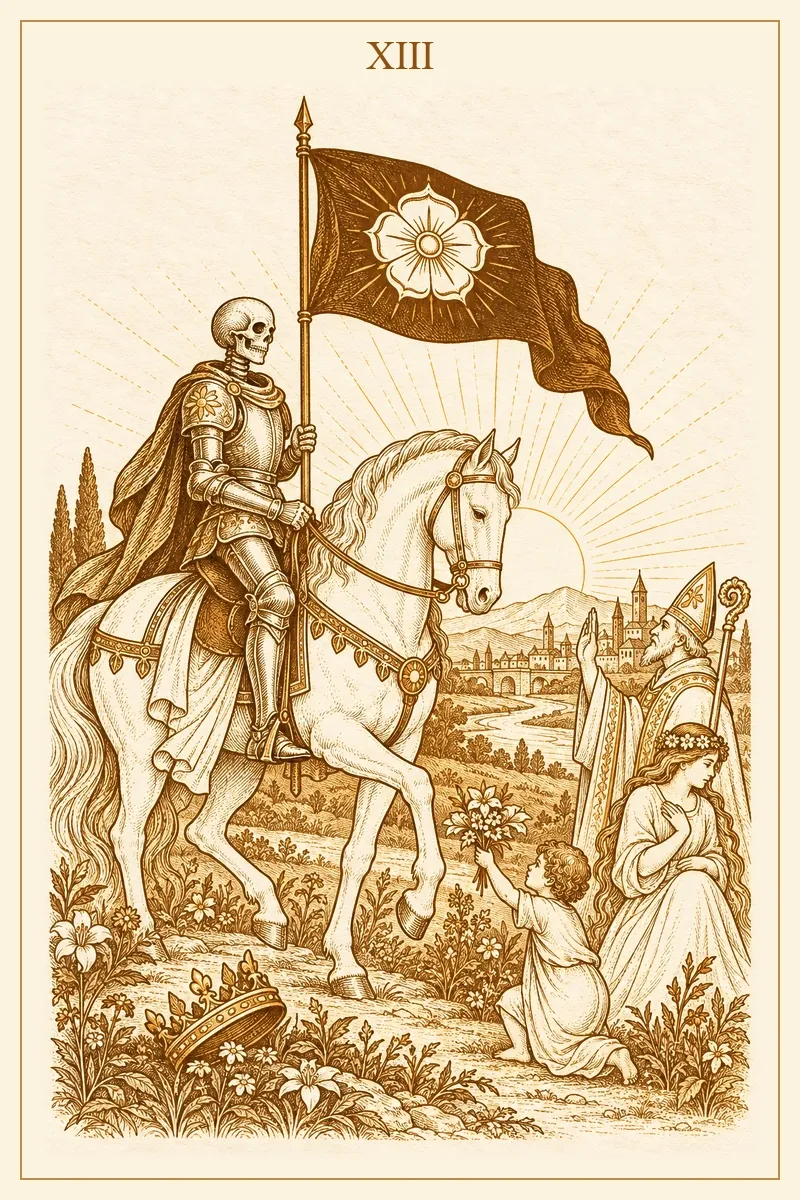
Death shows a skeleton in armor riding a white horse and carrying a dark banner marked with a five-petaled white rose. A crown lies in the grass near the horse's hooves, a child holds up a small bouquet, a young woman kneels with a garland in her hair, and a bishop in a tall miter raises one hand. Far behind them a low sun shines over hills and a town of towers, and a river winds toward an arched bridge.
Beside Justice, that fallen crown is telling: Justice wears hers, and Death lets one go. Together the cards describe an ending reached through a clear decision: a contract closed properly, a separation on fair terms, a job left once the accounts are settled. Keep your side of the bargain to the last day, then let the chapter close. If Justice is reversed, the ending may be happening unfairly, or someone may be trying to leave without facing what they owe. The Death card's meaning of endings and transformation explains why such an ending need not be a loss.
The Lovers and Justice
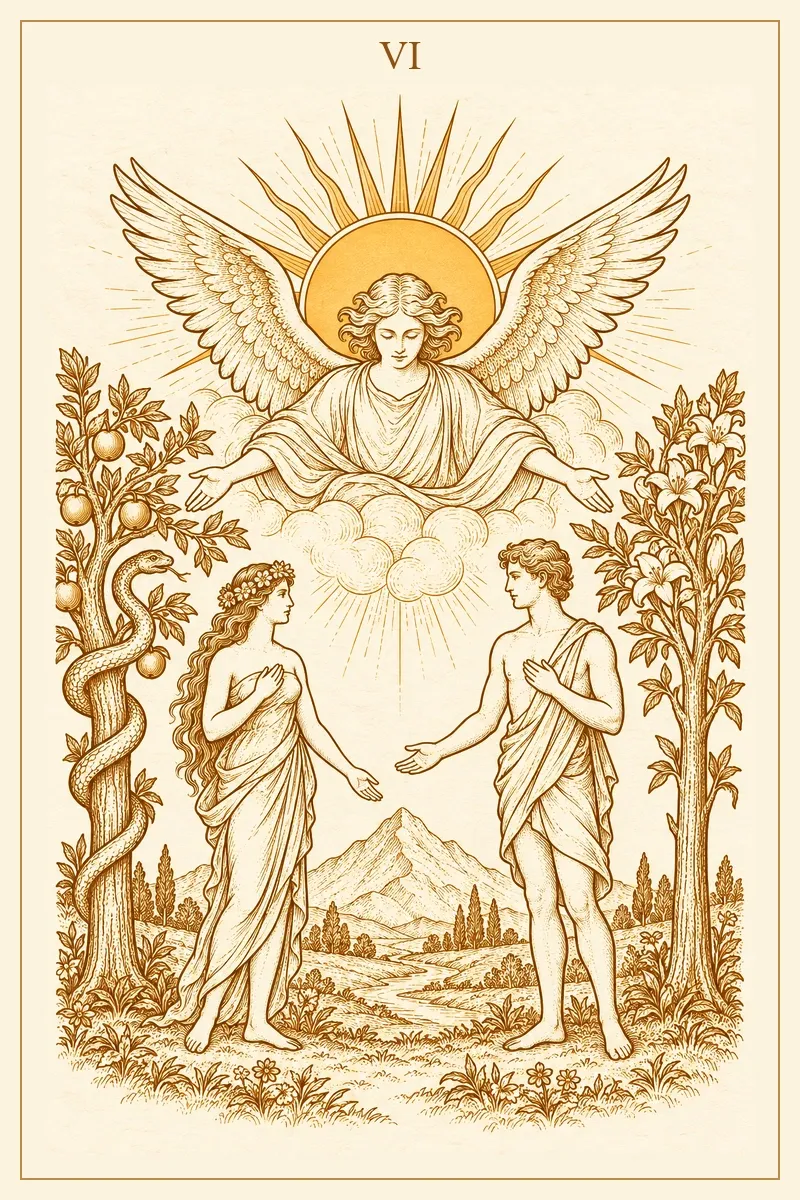
The Lovers shows a man and a woman facing each other beneath a winged figure who spreads both arms over a bank of clouds, a sun blazing behind. Each holds one hand to their own chest and reaches the other toward the partner. Behind the woman a fruit tree carries a coiled snake; behind the man stands a tree with lily-like blossoms, and a single mountain rises between them.
The Lovers is a choice made from the heart and from one's values; Justice is a choice made by weighing, and the two people facing each other echo its two pans. Together they describe a relationship decision taken with open eyes: a commitment on honest terms, or a choice between two paths where feeling and fairness both get a say. If Justice is reversed, one side may be giving far more than it receives, or a choice is being made to dodge responsibility. The Lovers' meaning of choice, union and alignment fills in the other half of this pair.
Three more pairings
- With The Emperor: institutions and written rules; a formal decision by someone in charge, or your own duty to set fair rules where you hold power. The Emperor's meaning of authority and structure covers that side.
- With The High Priestess: something unspoken comes into view, and intuition and facts start to agree. Wait until you know more before you decide.
- With The Tower: a sudden revelation brings down a false arrangement. Painful, but the truth is out, and fairer ground can be built on it.
The two pans spread, with an invented example
This four-card layout borrows Justice's own picture. Shuffle with a situation that feels unbalanced in mind, then lay out:
- My pan: what I bring, and my real part in this.
- The other pan: what the other person or side brings, as fairly as I can see it.
- Off the scale: the fact, feeling or detail nobody has put down yet.
- The sword: the clear step or sentence that would make things fairer.
The reading below is invented to show the method; Rina is not a real person. She and a colleague built a client report together over two months. At the review meeting the colleague presented it alone and was thanked for it. Rina is annoyed, and unsure whether she is overreacting. She asks: "What would make the credit for this project fair?"
My pan: Knight of Pentacles upright. Steady, careful, quiet work. Rina did most of the data checking and rarely mentioned it, so her contribution was real but nearly invisible.
The other pan: Page of Swords upright. Quick, articulate and eager to speak. The colleague did the writing and the presenting and is simply at ease in the spotlight. That is a different style, not necessarily stolen credit.
Off the scale: Justice reversed. No one ever wrote down who did what, so the meeting had nothing fair to go on. The reversal also asks about Rina's own part: she never told their manager about her share.
The sword: Ace of Swords upright. One clear, factual statement. In the example, Rina first talks with her colleague, who agrees that both names belong on the report, and then sends their manager a short note on how the work was split. The cards did not say how the manager would respond; they pointed at the missing record and her own silence, both things she could change.
What to do after drawing Justice
- Write the facts and the assumptions as two lists, and decide from the first list only.
- Name your own part in one sentence, without excuses and without self-punishment.
- Read the terms of whatever is involved: the contract, the policy, the agreement you made in conversation.
- Raise one imbalance with the person concerned, using specifics rather than "always" and "never".
- Ask a professional where the stakes are legal, financial or medical.
For help putting the question itself into words, try a library of ready-made questions to ask the cards. The card after Justice in the Waite-Smith order, The Hanged Man, turns from deciding to waiting; the Hanged Man's meaning of surrender and new perspective picks up from there. You can also browse all 78 card meanings, and if you are new to the deck, a beginner's introduction to tarot shows how the cards fit together.
Frequently asked questions
Is Justice a good card to get?
It is a balanced card more than a lucky one. When the facts favor you, it is reassuring; when they do not, it is a clear prompt to put something right. Either way it rewards honesty.
Does Justice mean I will win my court case?
No. Tarot cannot see the evidence, predict how a judge or official will decide, confirm another person's thoughts, or fix a date or an outcome. Upright Justice can encourage you to prepare carefully and tell the whole truth to the people advising you; reversed, it asks what is missing from your account. For the case itself, rely on a qualified legal professional.
Is Justice the karma card?
It is sometimes called that, in the sense of cause and effect. It reads best in down-to-earth terms: consequences you can understand and respond to now, not punishment sent from somewhere else.
What does Justice mean in a past, present or future position?
In the past, it points to a decision or agreement whose consequences still shape the situation. In the present, a fair choice or an honest conversation is due now. In a future position, a decision point is coming, and how you prepare for it will matter.
What does it mean when Justice keeps appearing?
It points to an unfinished question: a decision you keep postponing, an imbalance you have not raised, or something you have not admitted to yourself. Name it and take one step on it.
Leveling the scales, one fact at a time
Justice does not ask you to be perfect or to win. It asks you to see clearly, say what is true and accept the fair consequence, including the good ones. When you are ready to weigh your own situation, you can lay out a reading on your own question and see what sits in each pan.