Tarot and mindfulness work together through one simple move: you look at a single card and notice what is actually on it before you decide what it means. The card gives your attention something concrete to rest on, so a draw becomes a short, steady pause rather than a hunt for answers. Practiced this way, tarot is less about the future and more about noticing where your mind is right now and bringing it back to this moment.
That is also the honest limit of the practice. A card cannot tell you what will happen, what another person is thinking, or when a hard season will end, and a few quiet minutes with the deck are a reflection habit, not a treatment. If stress, sleep or mood are weighing on you, a doctor or counselor is the right person to talk to; the cards can sit alongside that support, never in place of it.
Here is the whole practice at a glance:
- The one-minute look: one card, one minute, describe only what you see.
- Five senses, one card: sight and touch first, then let imagination supply sound, scent and taste.
- The breath-paced shuffle: let the rhythm of your hands follow your breathing.
- Reading with the body first: notice a physical response before you name a meaning.
- The three-breath pause: breathe before you interpret any spread.
- The Where Is My Mind? spread: three positions for checking in when you feel scattered.
- Four cards to know: the Six of Cups for a mind in the past, the Seven of Cups for one racing ahead, the Two of Pentacles for split attention and The High Priestess for being here.
What mindfulness asks of you, and what a card adds
Mindfulness is commonly described as paying attention, on purpose, to what is happening in the present moment, and meeting it without rushing to judge it. The instruction sounds simple. The difficulty is that attention does not stay put. You sit down to notice your breathing and find yourself rehearsing an email, replaying a conversation, or planning dinner. Wandering is not failure; it is what minds do. The practice is the noticing and the return, repeated as many times as it takes.
A tarot card helps with that return because it is a physical object with a lot to look at. Color, posture, a horizon line, the angle of a cup: there is always another detail waiting when your attention comes back. Breath is always available, but it can feel abstract when you are new to sitting still. A card is concrete. You can hold it, set it down, and look again.
Four habits from mindfulness carry straight into reading:
- A single point of focus. One card, looked at closely, gives a busy mind one place to land instead of ten.
- Seeing before labeling. Mindfulness invites you to notice before you judge. With a card, that means describing the picture before you reach for the keyword you memorized.
- An anchor in the hands. Shuffling and turning a card over are small physical actions, and physical actions only ever happen now.
- Holding meaning lightly. A reading describes how things look to you today. Tomorrow's draw may show something else, and both can be true for their moment.
None of this requires a special deck, an altar or a free afternoon. It asks for a few minutes in which the card, not the phone or the to-do list, is the thing you are looking at.
Five ways to practice with the cards
These practices run from the shortest to the most involved. Try one at a time. When a practice starts to feel like a chore, pick a shorter one; mindfulness you resent has stopped doing its job.
The one-minute look
This is the simplest version, and it slots easily into any small tarot rituals you already keep. Draw one card. Set a timer for sixty seconds. For that minute, do not interpret. Only observe: the colors, the shapes, which way any figure is facing, what sits in the background, what is cut off at the edge of the frame.
When your mind starts explaining the card ("this means change"), notice the explanation, set it aside, and go back to looking. When the timer ends, check how you feel compared with a minute earlier. You might feel calmer, or you might simply notice that you were more restless than you realized. Either is useful information, and neither is a grade.
Five senses, one card
This exercise slows the look down further by moving through the senses one at a time.
- Sight: describe the card as if to someone who cannot see it. Keep going after the obvious details run out.
- Touch: feel the card stock, the edges, the weight, whether it is cool or warmed by your hand.
- Sound: imagine the scene had sound. Wind, water, silence, a crowd?
- Scent: what would the air in the picture smell like? Rain on stone, cut grass, a closed room?
- Taste: if the card were a flavor, would it be sweet, bitter, salty or sour?
The first two senses are real sensations in the room; the last three use imagination. That mix is the point. Sight and touch ground you in the present, and the imagined senses keep a curious mind busy with the card instead of with tomorrow. If one sense draws a blank, skip it without fuss.
Shuffling at the pace of your breath
Any method in the guide to shuffling tarot cards can become a breathing practice. Slow the shuffle so that one movement matches an inhale and the next matches the exhale. Feel the cards slide past your fingertips. Listen to the soft sound they make. When a thought arrives, give it a quiet label, such as "planning" or "remembering", and bring your attention back to your hands.
There is no correct number of shuffles. Stop when your breathing has settled, or when you catch yourself shuffling on autopilot. Catching the autopilot counts as practice too.
Reading with the body first
After you turn a card over, pause before naming a meaning and check in with your body. Does your jaw tighten? Do your shoulders drop? Is there a small lift in your chest, or a wish to look away? Name the response in plain words: "tight", "warm", "flat", "curious".
This is not a claim that the body knows the future. It is a way of noticing your own reaction before habit or a guidebook overrides it. A tense response to a gentle card, or a relaxed response to a stormy one, can tell you something about what you are carrying today.
The three-breath pause
This one belongs in any reading, not only a mindful one. Lay out the cards, then take three unhurried breaths before you say or write anything. Let the images land as a whole: which colors dominate, where the figures look, whether the layout feels crowded or open. Then begin interpreting.
The pause protects you from reading in a rush, which is when fear and wishful thinking slip in. For longer sits, such as card gazing, visualization or stepping into a card's scene in your imagination, the guide to tarot meditation techniques picks up where this pause ends.
Four cards that show where attention has gone
Any card can be the focus of a mindful look. These four are worth knowing because their pictures map neatly onto the places a wandering mind goes: back into memory, forward into possibility, sideways into juggling, and, finally, here. Use them as a vocabulary for checking in, not as diagnoses.
Six of Cups: the mind in the past
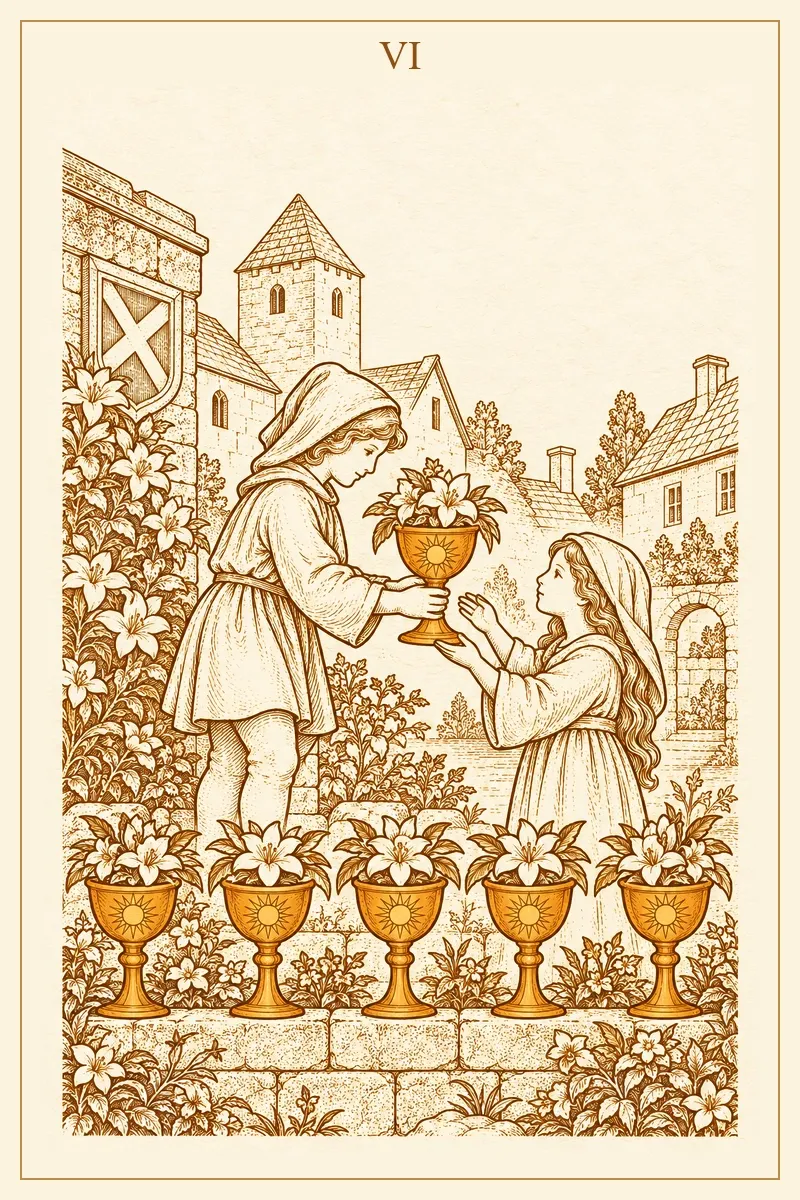
Upright, the Six of Cups brings memory, childhood, kindness and the sweetness of something familiar. In a mindfulness check-in it can name a mind that has drifted backward: replaying an old friendship, a former home, or a version of yourself that felt simpler. That drift is not wrong, and fond memories can be a real comfort. The question the card asks is whether you are visiting the past or living there.
Reversed, the card can point to holding on too tightly to how things used to be, or to idealizing a time that was more complicated than memory admits. It can also show a healthy step forward, a sense of outgrowing an old pattern. For the full upright and reversed range in love and work, the Six of Cups meaning goes into more depth.
A mindful response: name one thing from the memory that you miss, then name one thing in the room right now that you can see, hear or touch. You do not have to choose between them. You are simply making room for the present alongside the past.
Seven of Cups: the mind racing ahead
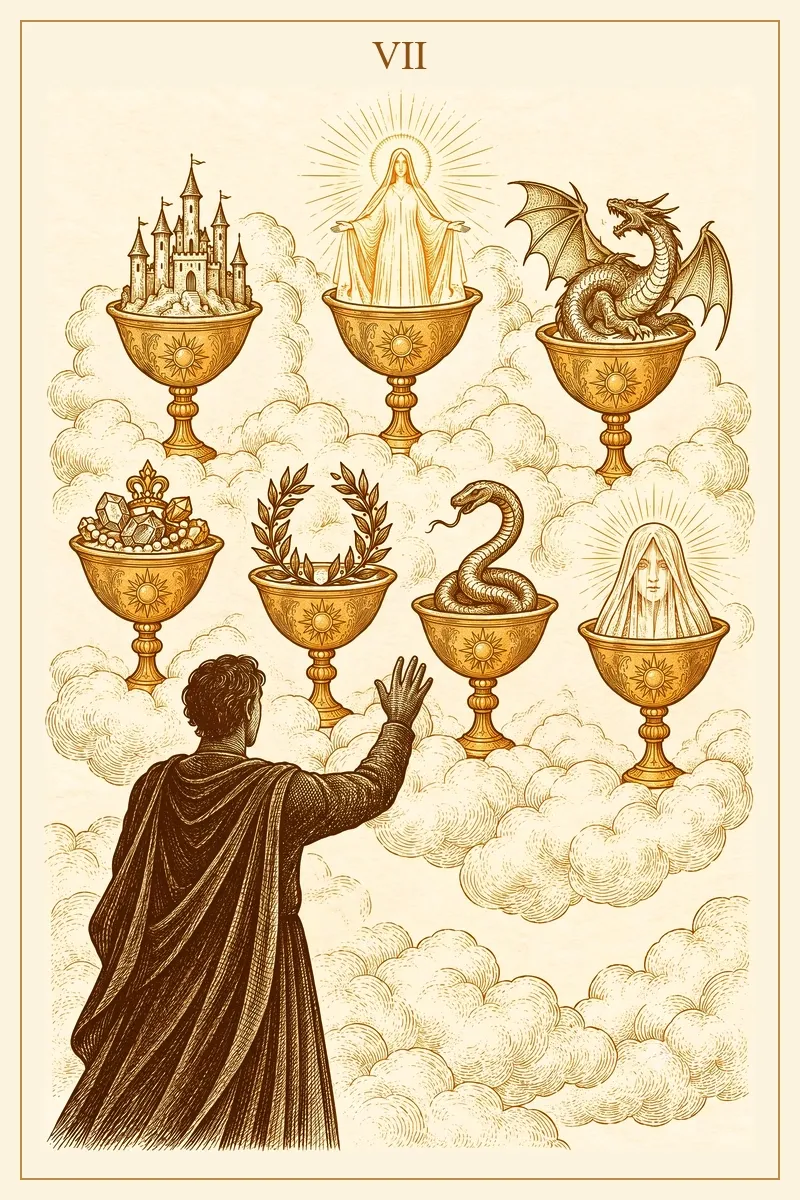
On the card, seven gold cups float in two rows among the clouds, each holding a different vision: a castle, a heap of jewels, a laurel wreath, a dragon, a snake, a veiled head and a figure wrapped in light, while a man seen from behind lifts a hand toward them. Upright, its themes are imagination, many options, daydreaming and wishful thinking. In a check-in it describes attention that has run into the future, trying on outcomes, rehearsing what-ifs, comparing paths that do not yet exist.
Reversed, it can suggest the fog starting to clear, a moment of seeing which option is real and which is fantasy. It can also show overwhelm, when the sheer number of possibilities is itself the problem. The Seven of Cups card meaning walks through how the card plays out in decisions about love and work.
A mindful response: pick one cup on the card and let the rest go for now. Then ask what single, small action belongs to today rather than to the imagined future. The planning mind is useful; it just does not need to run the whole day.
Two of Pentacles: attention split in two
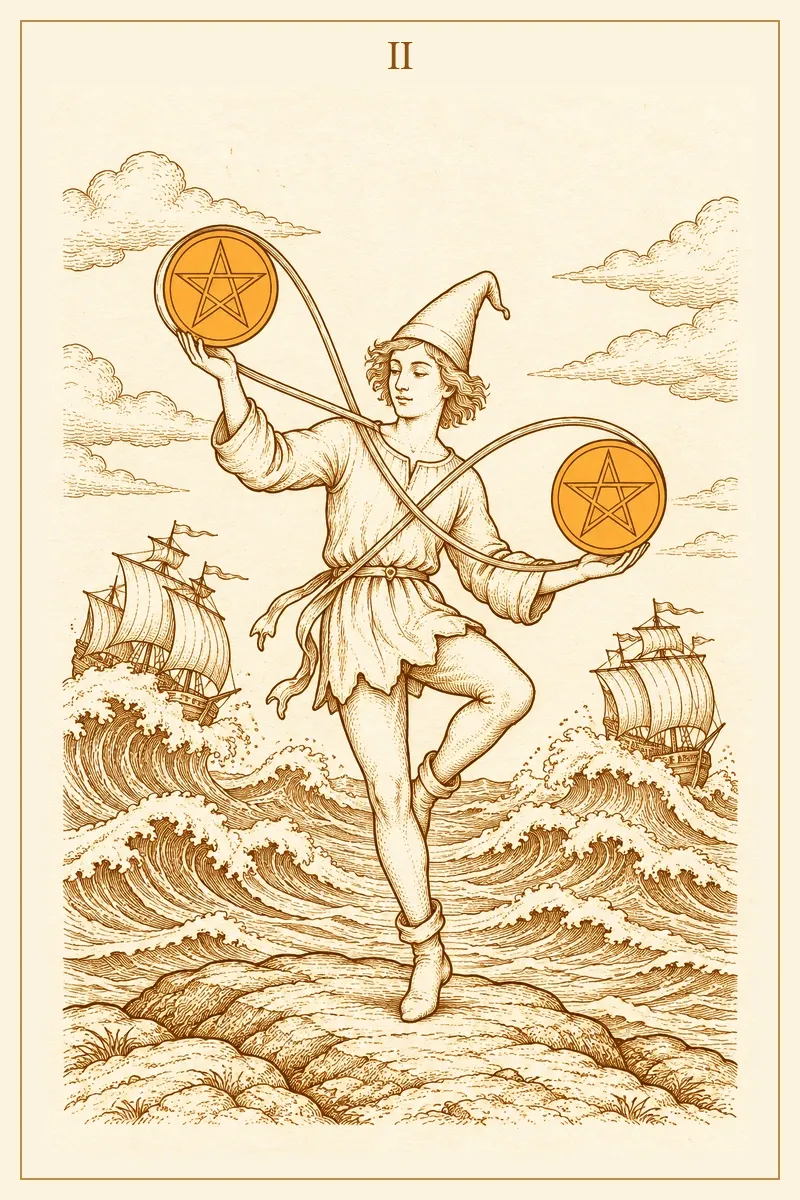
Upright, the Two of Pentacles shows a young figure in a tall pointed cap balancing on one foot on a rock, keeping two coins in motion inside a ribbon that loops into a figure eight, while two ships ride high waves behind. It speaks of balance, adaptability and juggling priorities. In a mindfulness check-in it can name attention that is divided: answering messages while cooking, half-listening during a conversation, holding two worries at once. The figure is drawn with a certain grace, which is a reminder that juggling is a skill, not a flaw.
Reversed, the balance slips. It can describe overcommitment, dropped tasks, or a feeling that one more thing will tip everything over. Treat it as a cue to put one coin down. The Two of Pentacles meaning goes further into its money and career angles, where it speaks to budgets and crowded calendars.
A mindful response: choose one task and give it your whole attention for five minutes. Close the other tabs, on the screen or in your head. When those minutes are up, decide whether to keep going or switch, so that switching is a choice rather than a reflex.
The High Priestess: quiet attention, here
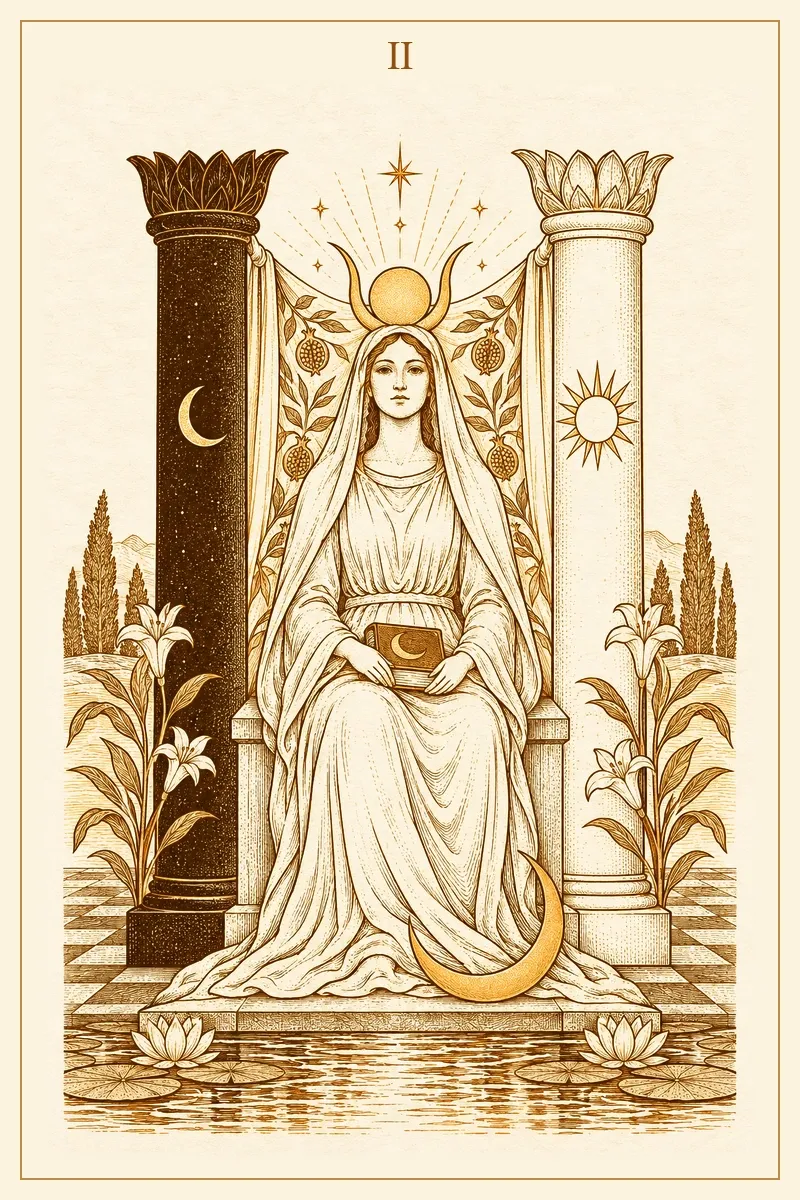
Upright, The High Priestess sits still between a dark pillar marked with a crescent and a pale one marked with the sun, with a veil of pomegranates behind her, a closed book in her lap and a crescent moon at her feet. She represents intuition, stillness, inner knowing and the patience to let something reveal itself in its own time. Among these four cards she is the one who is not somewhere else. She is the picture of presence: listening, unhurried, not reaching for an answer before it arrives.
Reversed, the card can point to ignoring your own quiet signals, or to so much outside noise that you cannot hear yourself think. It may suggest time away from screens and opinions. For her symbols and her place in love and decision readings, see The High Priestess tarot meaning.
A mindful response: sit with the card for a full minute without asking it anything. If a question comes, let it wait. She is a good card to keep on the table during the one-minute look, because she models the kind of attention that exercise asks for.
The Where Is My Mind? spread
This three-card layout is for moments when you feel scattered, rushed or far from where you actually are. It takes about ten minutes. Shuffle at the pace of your breath, then lay the cards from left to right.
- Where my attention is right now. Is the mind in the past, in the future, split between things, or here? The card describes the pull, not a verdict on you.
- What this moment actually asks of me. Not what the week asks, or the year. Just this hour or this evening.
- One way back to the present. A small, concrete step: a walk, a single task, a glass of water, a phone call, a rest.
Read position one with the four cards above in mind, but let any card speak. A Wands card in that spot might describe restless energy, a Swords card a loop of thinking, a Pentacles card a body that wants some care. Keep the reading short. If you notice yourself drawing extra cards to settle every doubt, take that as your signal to stop and do the step in position three.
A worked example: a scattered Tuesday evening
Here is how the spread might read in practice. The situation is invented, to show the steps from question to action.
The situation. A reader comes home after a long workday. Dinner is half made, three messages are waiting, and her mind keeps jumping between a deadline on Thursday and a conversation she wishes had gone differently. She sits down for ten minutes with the question, "Where is my mind right now, and how do I come back?"
Position 1, where my attention is: Two of Pentacles. The juggler is a fair description of the evening. She notices that she has been cooking, texting and worrying at once, and that none of the three is getting her full attention. She writes, "Split three ways."
Position 2, what this moment asks: Four of Swords. This is the card of rest and recovery. Her first reaction is resistance; there is too much to do. After three breaths she reads it more gently: the evening does not need her to solve Thursday. It needs her to stop for a while. She writes, "Rest before the next thing."
Position 3, a way back: Page of Pentacles. Here is a student absorbed in a single coin. She takes it literally: finish one thing with full attention. She decides to finish cooking with her phone in another room, and to answer the messages after dinner, one at a time.
What the reading did. It gave her a calmer description of the evening and one step she could take within the hour. When her mind drifts to the deadline again later, she has a phrase to return to: one coin at a time.
Journal prompts after a mindful draw
Writing a few lines afterward helps the practice stay with you once the deck is put away. Keep the entries short; a sentence or two per prompt is plenty.
- What did I notice on this card that I had never noticed before?
- During the minute of looking, where did my mind wander? (Note it without scolding yourself.)
- What feeling came up the moment I saw the card, before I started interpreting?
- Which detail did my eyes keep returning to, and why might that be?
- If I could step into the card, what would the present moment feel like there?
- What is one thing in my surroundings right now that I can see, hear or feel?
Reading back over a few weeks of notes can show patterns: the times of day your attention scatters, the cards you tend to rush past, the details that keep catching your eye. Those patterns belong to you, and they are more useful than any keyword list.
Keeping the practice gentle
Mindful tarot works best when it stays light. A few principles help keep it that way.
- Short is fine. Thirty seconds of looking counts. If a minute feels like too much on a hard day, do less and call it done.
- Do not redraw to feel better. If a card unsettles you, stay with the feeling for a few breaths, describe it, and then decide whether to continue. Drawing again until a gentler card appears turns the practice into a search for reassurance.
- Let readings expire. A card describes how this moment looks. You do not need to carry its message all week or check whether it "came true".
- End on purpose. Close with a breath, a word of thanks to yourself for taking the time, or a single line in your journal, then put the deck away. Ending deliberately keeps the practice from blurring into the next task.
If anxiety makes stillness feel out of reach, be patient with yourself. A racing mind is not a sign that you are doing it wrong. Start with the one-minute look, or simply hold a card and feel its edges. For evenings when worry is loud, the guide to tarot for anxiety offers steadying cards and a spread built for that moment.
Frequently asked questions
Can tarot be a mindfulness practice?
It can, when you use the cards as a focus for attention rather than as a source of predictions. Looking closely at one card, shuffling slowly with your breath, and pausing before you interpret are all ways of practicing present-moment awareness. The deck is a tool for noticing; the mindfulness is in how you use it.
Do I need to know the card meanings to read mindfully?
No. The one-minute look and the five-senses exercise work better when you set meanings aside. Being new can even help, since there is less memorized material getting in the way of simply seeing. When you do want meanings, look them up after the looking, not instead of it.
What if my mind keeps wandering while I look at the card?
That is the practice working, not failing. Each time you notice you have drifted and bring your eyes back to the card, you are doing exactly what mindfulness asks. Some sessions will have dozens of returns. Count none of them against yourself.
Is mindful tarot the same as tarot meditation?
They overlap. Mindful tarot, as described here, means short moments of attention woven into ordinary readings. Tarot meditation refers to longer, seated practice, such as gazing at a card for several minutes or imagining yourself inside its scene. You can start with either, and the short practices make a gentle doorway into the longer ones.
What if a card brings up a difficult feeling?
Notice it, name it in a word or two, and breathe with it for a moment before you decide what to do next. You might continue the reading, write a line about the feeling, or put the deck away and do something steadying. A hard card is not a warning about your future. It may simply be reflecting something you already feel.
Can a mindful tarot practice replace therapy, or tell me what will happen?
No to both. Tarot cannot predict events, reveal another person's mind, or guarantee an outcome, and a mindfulness habit with cards is not a treatment for anxiety, depression or any other condition. If you are struggling, a doctor, counselor or therapist can offer support the cards cannot. Tarot can be a calm companion to that care.
Back to the card in front of you
Mindful tarot comes down to a simple sequence: draw, look, breathe, notice where your mind has gone, and come back. The card is only paper and ink, but for a minute it can hold your attention in one place, and that minute is a small, real rest from the past and the future.
When you are ready, draw a card for this moment and give it one quiet minute before you ask it anything.