Pick a fixed moment, ask one plain question, draw a card, write a single line about it, and choose one small action for the day: that is a complete morning tarot routine. The daily tarot draw sits at the center, yet the steps around it are what make the card useful by evening. The whole sequence fits into five to ten minutes, and on a rushed morning it can shrink to one.
A morning card is a lens, not a forecast. It cannot tell you what will happen at work, how another person will respond to you, or whether a plan will succeed. What it can do is give the day a theme to notice and a question to come back to, which is exactly what a quiet start needs.
At a glance, the routine has five parts:
- Anchor: tie the draw to something you already do every morning.
- Settle: three slow breaths while you shuffle.
- Ask: one open question about how to meet today.
- Draw: one card, or three on a morning with more room.
- Record: one line in a journal and one action you can take before noon.
Why the start of the day suits a card
Before messages, news, and the first task of the day arrive, your attention is still yours to direct. A card drawn in that window gives the next hours a shape: instead of a general wish to have a good day, you carry one image and one word. When the afternoon gets busy, recalling that image takes a second and can bring you back to what you meant to focus on.
The morning draw also creates its own follow-up. If you draw a card about patience at seven, the natural evening question is where patience was tested and how you responded. Pairing a morning prompt with a night check-in is what turns pulling cards into learning them, because each card meets a real day instead of a list of keywords.
The five steps, one at a time
1. Anchor the draw to a habit you already have
Choose a cue that happens every morning without effort: the kettle boiling, the coffee maker finishing, sitting down after a shower, or the first quiet minute after the house empties. Say the link out loud once, such as "after the coffee is poured, I draw," and keep the deck within arm's reach of that spot, next to your favorite mug if that helps. A deck tucked into a drawer in another room turns a two-minute habit into an errand.
Pick a cue you can protect on weekdays and weekends alike. If your mornings vary, anchor to an action instead of a clock time. The cue matters more than the hour.
2. Settle before you shuffle
Sit down, put both feet on the floor, and take three slow breaths while you shuffle. You are not trying to empty your mind; you are noticing what is already there. If you want to stretch this step, a short body scan or two minutes of breath counting works well, and the guide to tarot and mindfulness offers more ways to arrive in the present before you draw.
Check in with one word for how you feel right now: tired, restless, hopeful, flat. Write it down before you see a card. Over a few weeks, that single word becomes a record of your mornings that has nothing to do with the cards themselves.
3. Ask one open question
A morning question works best when it is about you and about today. Questions that ask the deck to predict events or read someone else's mind give the card a job it cannot do. Try one of these, and keep the same question for a week so your draws are easier to compare:
- What quality would help me most today?
- Where should my attention go this morning?
- What do I need to remember when the day gets busy?
- What is one thing I can do today to take care of myself?
- How can I meet today's main task with a clear head?
On a day with a specific event, you can narrow the question. "How do I want to show up in this afternoon's meeting?" stays focused on your own approach without asking for an outcome.
4. Draw one card, or three
Cut the deck or fan it out, pick a card, and turn it over. Look at the image for a full minute before you think about meanings. Notice the first detail your eye lands on, the color that stands out, and the mood the scene gives you. If you want a deeper method for a single card, the one-card daily draw guide walks through reading one card in layers, while this page stays with the routine around it.
Three cards suit mornings with more room, such as the start of a week, a day off, or the day before a big event. The layouts in the next section show how to name each position so the three cards answer different parts of the question.
5. Record one line and one action
Write the date, the card, your one-word mood, and a single sentence about what the card suggests for the day. Then add one action small enough to finish before noon: send the email you have been putting off, take a walk at lunch, ask a coworker for help. The action is where the card leaves the table and enters the day.
Keep the entry short on purpose. A routine that asks for a full page every morning is easy to abandon the first time you oversleep. A tarot journal can hold longer entries on weekends, while weekday notes stay at three lines.
Three morning layouts for different amounts of time
The two-minute check-in (one card)
Ask your question, draw one card, write one line. This is the everyday version, and it is enough. On days when you have only a minute, you can skip the journal and simply take one word from the card to carry until lunch, such as "steady," "begin," or "listen."
Today, focus, reminder (three cards)
Lay three cards from left to right and read them as named positions:
- Today: the general tone or theme the day may ask you to work with.
- Focus: where to put your effort and attention.
- Reminder: something to keep in mind when things speed up, whether a caution, an encouragement, or a change of perspective.
Read the Focus card first, since it holds the most practical advice, then see how the Today and Reminder cards frame it. If two cards seem to pull against each other, write the tension down as a question instead of forcing a single answer.
The decision-day card
When a choice is waiting for you later in the day, draw one card with the question "What approach will help me decide well today?" The card does not pick the option for you. It shows the attitude you want to bring to the choice: patience, honesty, caution, or courage. For bigger choices with several options, save the question for an evening spread that gives each path its own cards; the morning card only sets the tone.
Five cards turned into morning sentences
One of the most useful things to do with a morning card is to turn it into a short sentence in your own words and put it where you will see it: a sticky note on a laptop, the lock screen of your phone, a line at the top of a to-do list. Below are five cards, each with an upright and reversed morning reading, a sample sentence, and one action. The sentences are starting points; rewrite them until they sound like you.
Strength: gentle steadiness
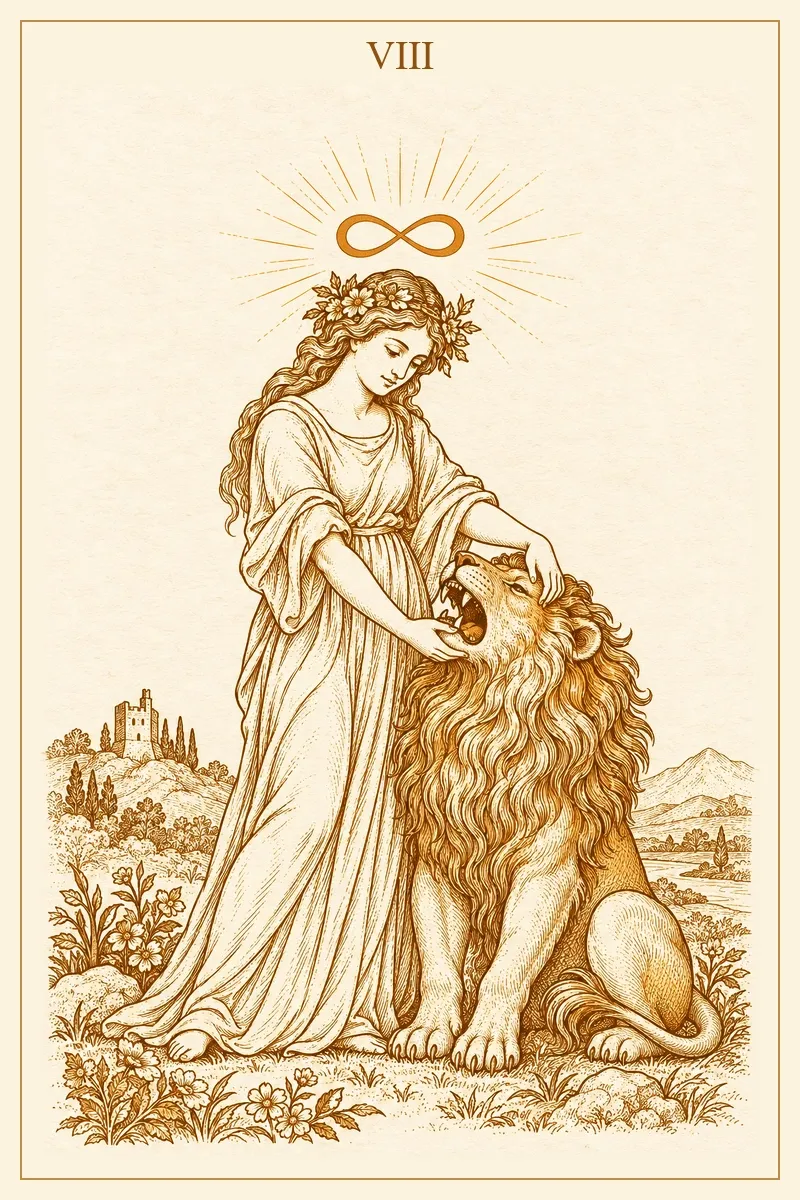
On the Strength card, a woman wearing a crown of flowers rests one hand on the head of a seated lion and the other at its open jaws, with a glowing infinity sign above her head and a small castle on a distant hill. Nothing in the scene is forced; the lion stays calm because she is calm. As a morning card, Strength upright suggests meeting the day with patience instead of pressure, especially with people or tasks that test your temper.
Reversed, the card can point to self-doubt or to trying to control a situation by force. In a morning draw, read it as a reminder to slow down before a reaction and to be as gentle with yourself as you would be with a nervous friend. The full Strength tarot meaning covers its love and career angles in more depth.
Sample sentence: "I can be steady without being hard." Action: pick the conversation you are most likely to rush and give it one extra minute.
The Star: hope that refills
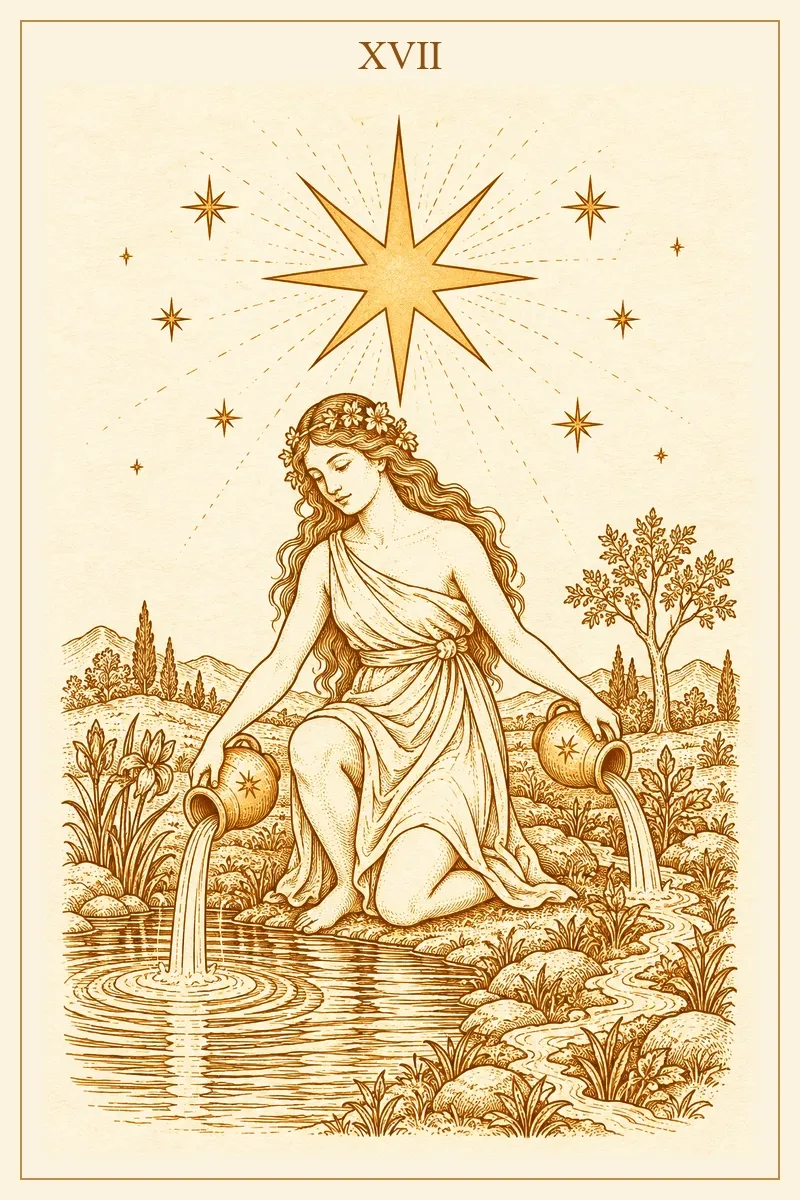
The Star shows a woman kneeling at the edge of a pool under a large eight-pointed star, pouring water from one jug into the pool and from the other onto the land, where it runs off as a small stream. The image is one of replenishment after effort. In the morning, The Star upright invites you to trust that things can improve and to do one thing that restores you.
Reversed, it can describe discouragement or feeling cut off from what usually lifts you. That does not mean the day will go badly; it means your reserves may be low and are worth tending first. More on its themes is in the article on The Star tarot meaning.
Sample sentence: "I can rest and still be hopeful." Action: set aside fifteen minutes today for something that refills you, and keep that appointment as you would any other.
Ace of Pentacles: a practical start
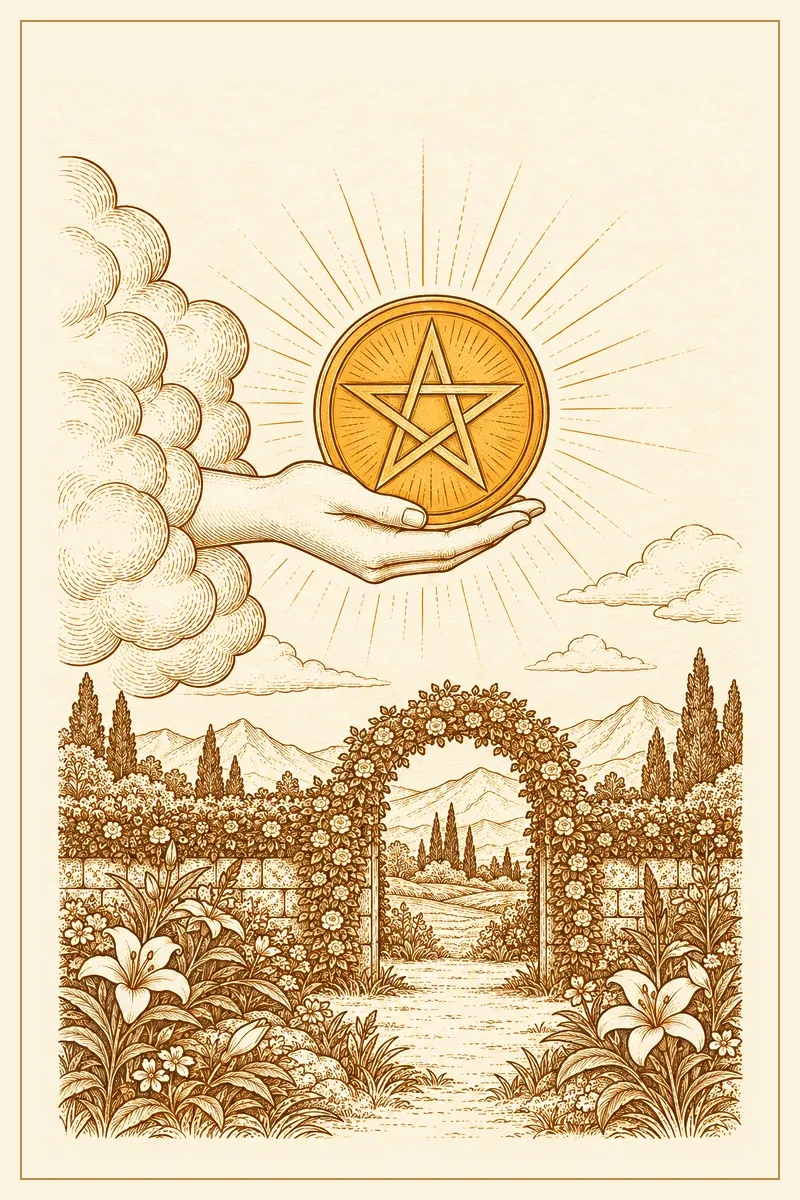
On the Ace of Pentacles, a hand reaches out of a cloud holding a single golden coin marked with a pentacle. Below it, a garden wall opens through a flower-covered arch onto a path that leads toward the mountains. The card offers something tangible and an open gate to walk through. Upright in a morning draw, it points toward a concrete first step on a work, money, or health goal.
Reversed, the Ace can suggest an idea that is not grounded yet, or a chance you may let pass because the plan feels too big. Shrink the step until you can take it today. The Ace of Pentacles card meaning explains how the card reads for career and money.
Sample sentence: "I will take one real step toward what I am building." Action: do the smallest physical task that moves a project forward, such as booking the appointment or writing the first line of the plan.
Two of Cups: reaching toward someone

The Two of Cups shows two people facing each other, each raising a cup toward the other, beneath a winged lion's head set above a staff wrapped by two serpents. A lake and a small village sit in the background. The exchange is mutual: each gives and each receives. Upright as a morning card, it highlights the relationships in your day, from a partner to a coworker, and the value of meeting someone halfway.
Reversed, the card can point to a small imbalance or a misunderstanding that needs a kind word. It is not a sign that a relationship is failing. Treat it as a prompt to listen first. The Two of Cups tarot card meaning goes further into its love readings.
Sample sentence: "I will listen as well as I speak today." Action: send one message of thanks or reconnection before lunch.
Nine of Swords: the morning after a worried night
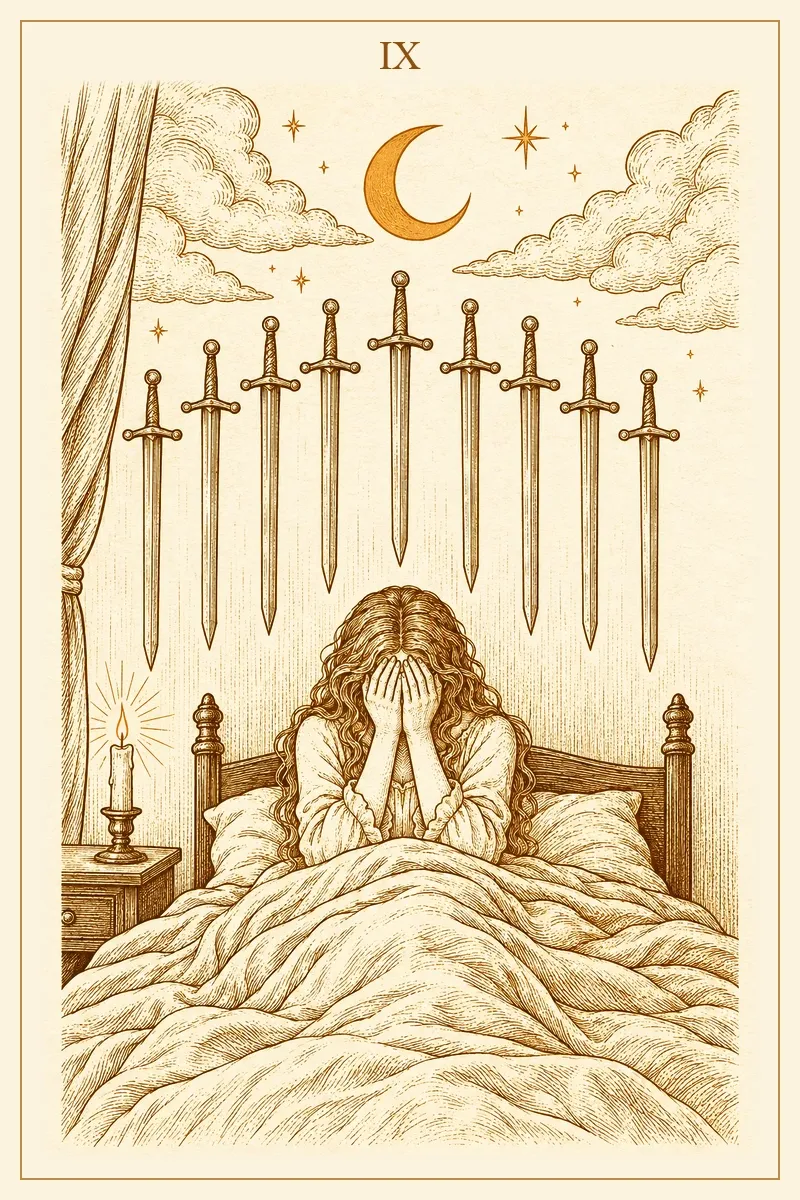
The Nine of Swords is a night scene: a person sits up in bed with their face in their hands, nine swords hang in a row in the night sky above the bed, a crescent moon shines among the clouds, and a single candle burns on the nightstand. Drawn in the morning, it can feel like a bad start. A gentler reading is that the card names the worry you woke up with, so that you can look at it in daylight.
Upright, it asks you to separate fears from facts: write the worry down, then write what you actually know. Reversed, it can show anxiety beginning to ease, or a worry kept so private that it grows. Either way the next step is the same, which is to share the load with someone you trust. The Nine of Swords meaning has more on how this card reads in other positions.
Sample sentence: "I can look at this worry one piece at a time." Action: tell one person what is on your mind, or set a time later today to deal with it, so it does not follow you all morning and you can let it rest afterward.
A hypothetical week of morning draws
The following example is invented to show how the routine works; it is not a real reading or a real person. Imagine a reader with a full week ahead: a project due on Thursday and a family dinner on Saturday. On Monday, with a little more time than usual, they lay out the three-card layout and ask, "How can I meet this week with a clear head?"
- Today: Eight of Wands, which brings speed, messages, and many things moving at once.
- Focus: Four of Swords, which stands for rest and a planned pause.
- Reminder: Page of Pentacles, which asks for steady study, one practical detail at a time.
Read together, the cards describe a week that may move fast, with the real advice sitting in the middle: protect short pauses so that speed does not turn into scattered effort. The Page in the reminder position points to handling the project one concrete piece at a time. The reader writes one line, "Fast week, planned pauses, one piece at a time," and chooses an action: block two fifteen-minute breaks in the calendar for Tuesday and Wednesday.
From Tuesday to Friday they return to a single card each morning. On Tuesday Strength appears, and the sentence becomes "Steady, not hard," which they recall during a tense call. Wednesday brings the Nine of Swords on the morning they wake up anxious about the deadline; they write down the two tasks that actually remain and see that the list is shorter than the worry. Thursday is a hurried ten-second draw with no journal entry, and that is fine. On Friday the Two of Cups reminds them to thank the coworker who helped.
On Sunday evening they read back through the week. The pattern is clearer on paper than it was in the moment: the hardest morning followed the one night they skipped their evening check-in, and the planned pauses turned out to be the action that helped most. The value came from the notes and the small actions, not from any card being right.
When the morning card does not make sense
Some mornings the card will seem unrelated to anything in your life. Leave it alone for the day instead of reshuffling. Write one guess, even a weak one, and check it at night; the connection may only appear once the day has happened. If a card stays confusing for several mornings in a row, look at your question before you blame the deck. A vague question makes any card harder to apply.
Heavy cards deserve a calm reading too. Turning over The Tower at seven in the morning, or Death, or the Ten of Swords, does not announce a disaster. In a morning routine, read a challenging card as the part of the day that needs the most care, and choose an action that gives you more support there. If a heavy card arrives on a morning when you already feel fragile, you can set the deck aside and come back to it tomorrow.
Reversals are optional. If you read them, a reversed card in a morning draw can point to an inner version of the card's theme, a delay, or too much of a good thing. If you would rather keep mornings simple, keep every card upright and read each one for its central idea. Either choice works as long as you stay with it for a few weeks. And if the same card keeps returning, treat it as a theme asking for attention: what in that card keeps matching your mornings?
Closing the loop at night
A morning card is half a practice. The other half takes about a minute before bed: look at the card again and ask three questions.
- Where did this card's theme show up today?
- Did my one action happen, and what changed because of it?
- What would I tell myself tomorrow morning, knowing what I know now?
Write the answers under your morning line. Over time you will see the gap between what you expected a card to mean and how it actually played out, which is where your reading skill grows. If thoughts about the day keep you awake, close the journal, leave the card face up, and take a few slow breaths with it in view so the check-in becomes a gentler wind-down.
After a month, read back through your entries. Look for suits that keep turning up, moods that repeat on certain weekdays, and actions that changed the most. Those patterns are about your life, not about the deck, and they are what gives the routine its long-term value.
Keeping the habit on busy or low mornings
- Shrink it instead of skipping it. On a rushed day, draw one card, look at it for ten seconds, and leave it face up on the counter. That still counts.
- Change the question with the seasons. In spring, ask what wants to grow; in summer, where you can be seen; in fall, what you are gathering in; in winter, where you need rest.
- Let the card shape one step. If you are working toward a larger goal, let the morning card decide how you take today's step toward it, not whether you take it.
If mornings are hard because of depression, anxiety, grief, or exhaustion that does not lift, a tarot routine is not a replacement for care. Talking with a doctor or a licensed counselor is a strong step, and a gentle morning ritual can sit alongside that support instead of in place of it.
Frequently asked questions
Is it okay to do a daily tarot card draw every morning?
Yes. A single card each morning, used as a reflection prompt, is one of the gentlest ways to practice. Drawing again and again on the same question in one sitting is what makes readings muddled; one card for one day does not.
Can my morning card predict what will happen today?
No. Tarot cannot confirm events, outcomes, dates, or what another person thinks or plans. A morning card offers a theme to reflect on and an attitude to try. How the day unfolds depends on many things, including your own choices.
Should I draw again if I do not like my card?
Keep the first card. Redrawing until you get a comfortable answer teaches you to avoid the card that might be the most useful. If the card feels heavy, read it as the area that needs care today and pick a supportive action.
How is a morning tarot routine different from a daily tarot draw?
The daily draw is the card itself. The morning routine is the frame around it: the anchor habit, the breath, the question, the written line, the action, and the evening check-in. You can draw a daily card at any hour; the routine makes it part of how you begin the day.
What if I miss a morning?
Nothing is lost. Draw the next morning as usual, or pull a card at lunch if you want one for the afternoon. A routine is measured over weeks, not single days.
Your first morning tomorrow
Tonight, set your deck and a pen beside the kettle or coffee maker. Tomorrow, breathe three times, ask one question, draw, write one line, and pick one action. When you want a longer reading with more context, you can start a reading on Veil Soul and take your time with it.