Tarot for better sleep works best as a short, gentle wind-down rather than a late-night search for answers. Ten quiet minutes with one to four cards and a few written lines can help you set the day down before you turn off the lamp. A bedtime tarot spread gives your thoughts a place to land outside your head, so you are not carrying them into the pillow.
This is a reflective practice, not a treatment. A card cannot fix insomnia, explain why you wake at night, or predict how you will sleep. If sleep problems persist, keep coming back, or affect how you function during the day, they deserve a doctor's advice; a bedtime reading can sit alongside that care, never in place of it.
Below are an evening ritual, three bedtime spreads, a worked example, and what to do when a card unsettles you. At a glance, these are the cards this practice leans on:
- Four of Swords: rest, recovery and permission to stop.
- The Star: quiet hope and renewal after a hard day.
- Ace of Cups: emotional refilling and kindness toward yourself.
- Temperance: balance, a slower pace, enough rather than more.
- The Hermit: turning inward and letting the outside world go quiet.
- Six of Swords: moving toward calmer water, one stroke at a time.
- Nine of Swords: night worry that feels larger than it is.
- The Moon: uncertainty, dreams and fears that grow in the dark.
Why a bedtime reading helps you wind down
Most familiar sleep-hygiene advice comes down to a few habits: go to bed at roughly the same time, dim the lights in the last hour of the evening, and put screens away well before you try to sleep. A short tarot practice fits inside those habits. It does not replace them, and it works best when it is the quietest thing you do all evening.
It marks a transition. Doing the same small sequence each night (lamp low, shuffle, draw, write, put the deck away) signals that the active part of the day is over. Over time the sequence itself becomes the cue.
It moves thoughts onto paper. Naming what is on your mind, with a card as the prompt, turns a loop of half-thoughts into one sentence you can see. A thought that has been written down is easier to leave on the nightstand than one you are trying to remember.
It replaces scrolling. Ten minutes with paper cards is ten minutes away from a bright screen and a feed that keeps asking for one more look.
It ends on a chosen note. Instead of falling asleep on the last message you read, you close the day on a word or image you picked on purpose: rest, enough, tomorrow.
A ten-minute evening ritual, step by step
The routine below is a starting shape; adjust it until you would actually do it on a tired weeknight. Begin at about the same time each evening and finish before you turn out the light.
- Lower the light. Switch off overhead lights and use one small lamp. Soft, warm light helps the evening feel like evening.
- Put the phone somewhere else. Charge it across the room so the reading does not compete with notifications.
- Clear a small surface. A nightstand, a tray on the bed or a corner of a desk is enough. If you want a dedicated corner, our guide to creating a tarot reading space has simple ideas that work in a bedroom.
- Take three slow breaths. Let each out-breath be longer than the in-breath. You are not trying to reach a special state, only to arrive.
- Shuffle without hurry and ask one gentle question. "What can I set down tonight?" works on most evenings.
- Draw, look and write one line. Note the card and the first plain thought it brings. One line is enough; the notebook is not a test.
- Close the deck. Return the cards to the box or turn the last one face-down. Say, silently or aloud, "That's enough for today," and turn off the lamp.
On short nights, keep only steps one, five and seven; a single card drawn in low light is still a ritual.
Three bedtime tarot spreads with named positions
Choose one spread per night and write the positions down before you shuffle, so their meaning does not drift once you see the cards.
The Nighttime Release: three cards
This is the core bedtime tarot spread and a good default for ordinary evenings. Draw it in bed or at your usual reading spot in the half hour before you plan to sleep.
- What I can release from today: a thought, feeling or task that does not need to come to bed with you.
- What I can keep from today: something good, small or large, that deserves to stay.
- A word for tonight: a gentle theme to hold as you settle, not an instruction for tomorrow.
Read the first card as something to name, not something to solve. If the second card is difficult, look for the smallest thing in it worth keeping, such as effort, honesty or a boundary you held. Let the third card be soft; if it feels sharp, read it as "what I need to be gentle with" and stop there.
The One-Card Lullaby
The simplest version: draw one card and ask, "What do I need to hear before sleep?" Look at it for a minute, note one word, and lay it face-down on the nightstand. On tired nights this is enough, and it keeps the habit alive during weeks when a longer spread would feel like homework.
The Worry Release: four cards
Use this one on nights when a specific concern is keeping you up. If worry is a frequent visitor rather than an occasional one, our guide to tarot for anxiety covers daytime spreads that give it more room.
- The worry: what is keeping me awake? Let the card name it so you do not have to keep rehearsing it.
- The proportion: is this as large as it feels at this hour? What am I not seeing while I am tired?
- What can be done, and when: often the honest answer is "nothing tonight," and that is a complete answer.
- Permission to rest: what would letting go until morning look like?
After the fourth card, write the worry and the action from position three on a slip with tomorrow's date. It is a promise to return in daylight, which makes it easier to stop going over it now.
A worked example: Sunday night before a full week
Imagine someone sitting on the edge of the bed on a Sunday evening. A project is due on Wednesday, and their mind keeps running through everything that could go wrong. They lower the lamp, shuffle and lay out the Nighttime Release.
What I can release: Nine of Swords. The card names exactly what is happening: worry that grows larger at night. The reading here is not "something bad is coming" but "this is the hour when the deadline looks biggest." What they can release is the mental rehearsal, not the project. They write one line: "Wednesday is real; the midnight version of Wednesday is not."
What I can keep: Ace of Cups. In this position the card points to something that filled them up during the day. They remember an easy lunch with a friend and write it down. It is a small thing, and that is the point: the day held more than the deadline.
A word for tonight: Four of Swords. Rest, plainly. The card does not promise that the project will go well; it suggests that being rested is part of doing it well. They put the three cards back, set an alarm, leave a note with Monday's first task by the bed, and turn off the light.
The reading did not predict Wednesday. It sorted one evening's thoughts into three piles (let go, keep, rest) and gave the person a reason to stop thinking for the night.
Cards that invite rest
These four cards turn up often in evening practice. A reversal here points to the same theme in a blocked or tired form, not to a bad night ahead.
Four of Swords: permission to stop
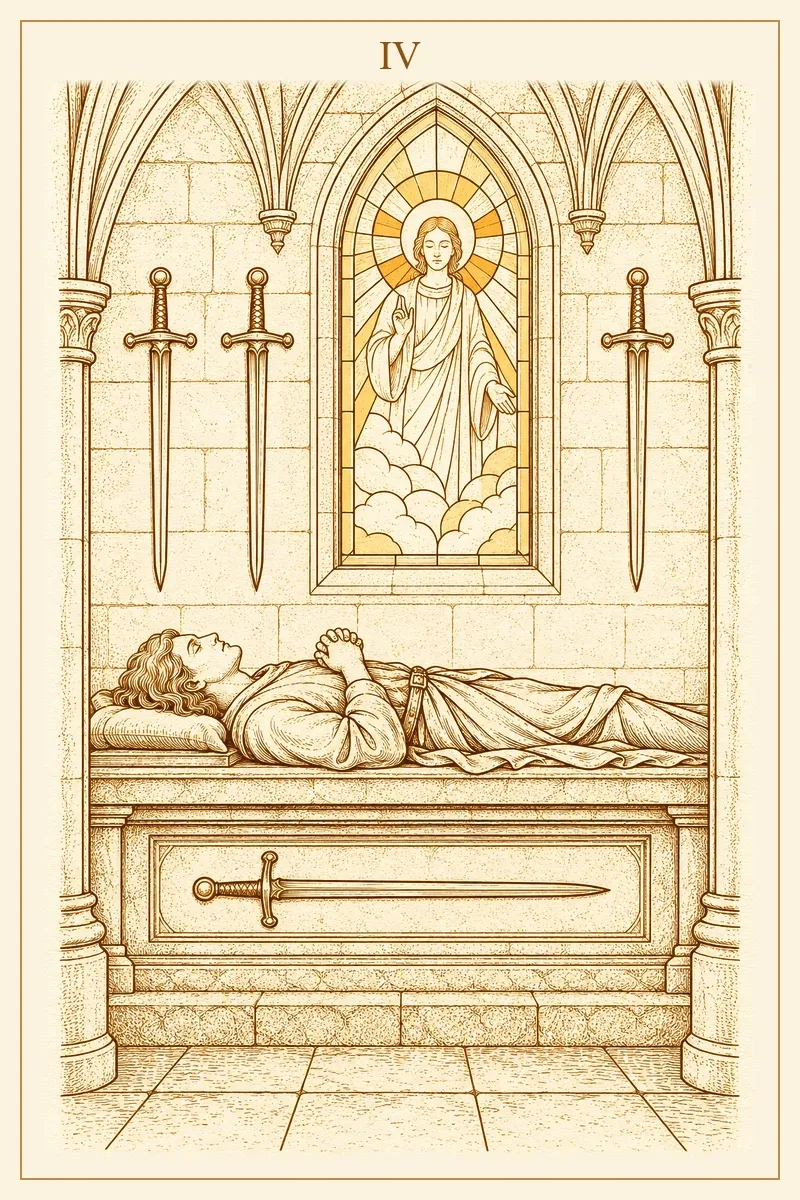
The card shows a figure lying on a stone tomb with hands pressed together, three swords hanging on the wall above and a fourth carved along the side of the tomb, beneath a stained-glass window. The swords are still there; they are simply not in use. That is the bedtime message: problems do not need to be gone before you are allowed to rest. The full Four of Swords meaning covers its role in recovery and retreat outside the evening.
Upright, it is the clearest "you have done enough today" card in the deck. Read it as permission to close the notebook early. Reversed, it often describes restlessness: the body is tired, but the mind keeps getting up to check one more thing, or rest keeps being postponed until a better moment. Ask what you are waiting to finish before you let yourself stop, and whether it can wait until morning.
The Star: hope after a hard day
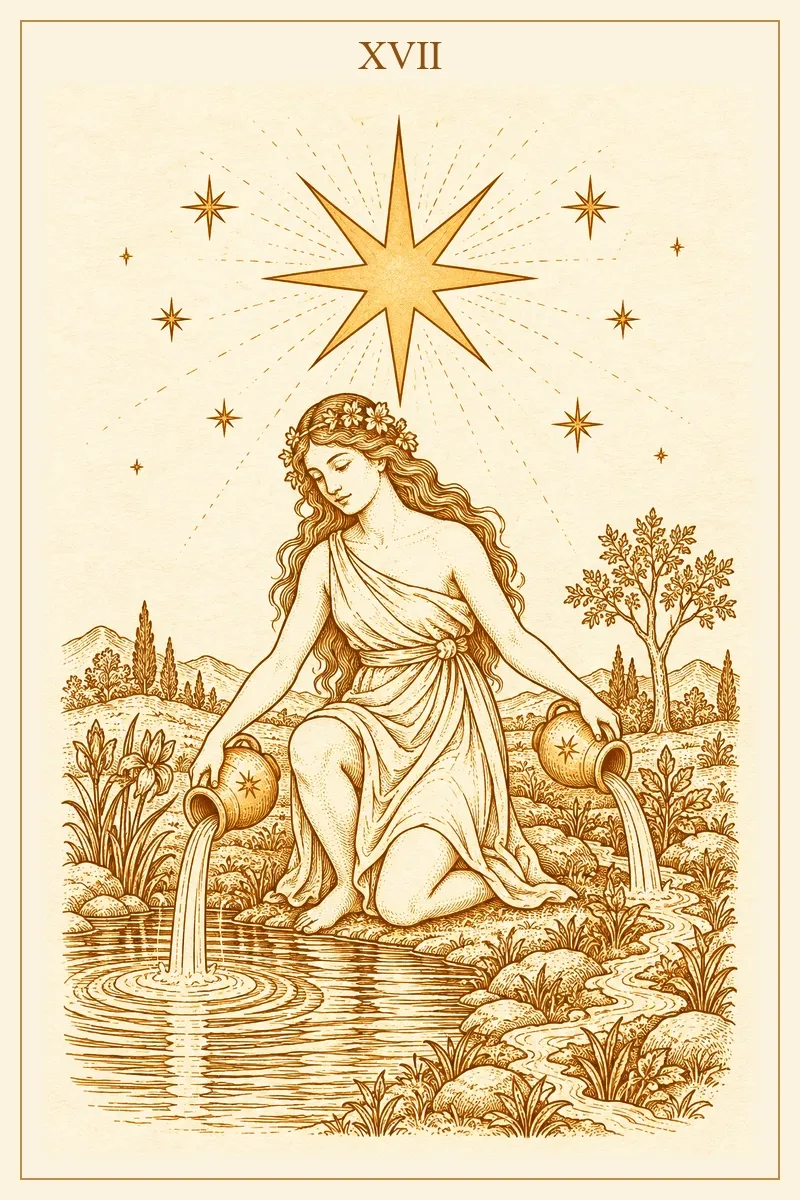
A kneeling figure pours water from two jugs, one into a still pool and one onto the land, beneath a large eight-pointed star and several smaller ones. The Star follows a card of upheaval in the major arcana, so it carries the feeling of calm after a storm. At night it suggests that you do not need to solve today in order to feel some hope for tomorrow. The full Star tarot meaning explores its themes of healing and renewal.
Upright, it invites you to name one thing you are quietly looking forward to. Reversed, it may reflect discouragement or a sense that the day took more than it gave. Do not argue yourself into optimism at bedtime; note one small source of renewal, sleep itself included, and let the card rest there.
Ace of Cups: refilling what the day used up
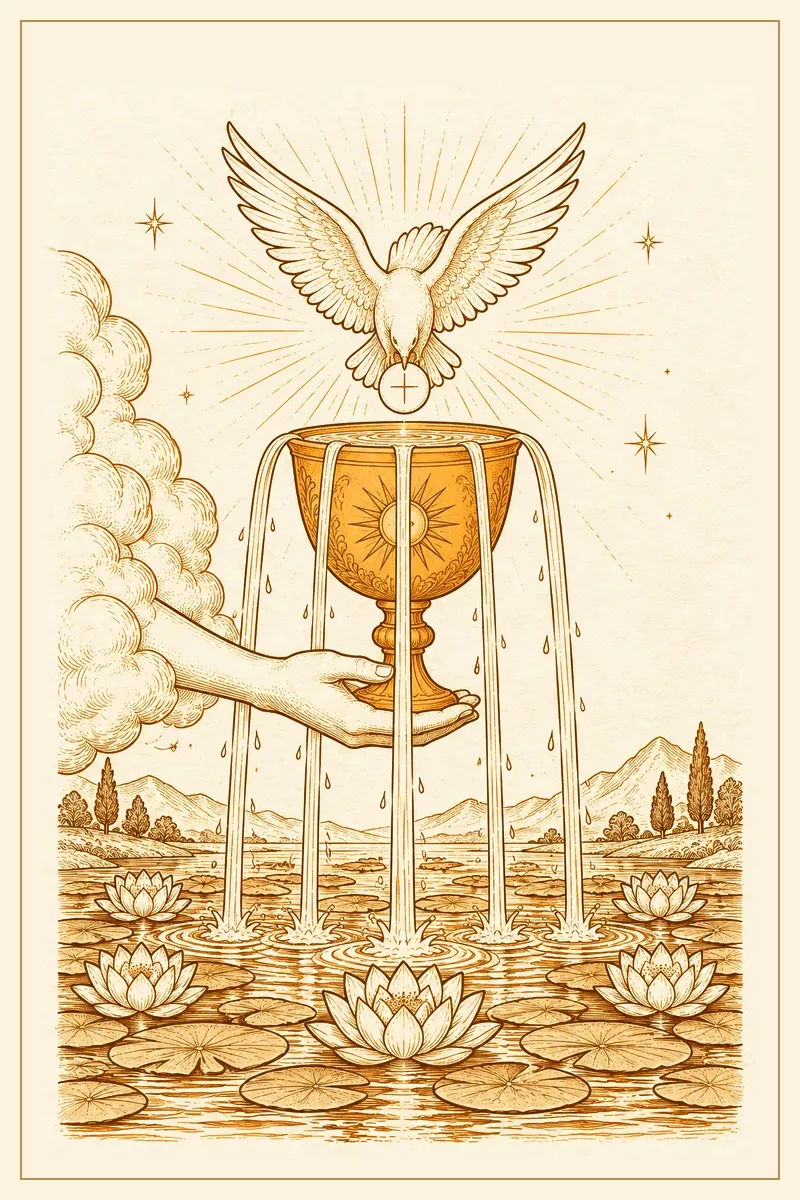
A hand reaches from a cloud holding a cup that overflows in several streams into a pond of water lilies, while a dove descends above it. The card speaks of emotional fullness and care offered freely. In an evening reading, that care can be turned toward yourself. The full Ace of Cups meaning covers its love and relationship readings.
Upright, ask, "What would feel kind to me in the next hour?" The answer might be a warm shower, a glass of water, or simply going to bed now. Reversed, the cup suggests feelings held in or a well that has run low. It can be a reminder that you have been pouring out for other people all day. Write down one feeling you did not have room for, and leave it on the page.
Temperance: enough, not more

A winged figure pours water from a jug into a cup, one foot in a stream and the other on the bank, while the sun rises over distant hills. Temperance is the card of balance and pace. At night it asks whether the day had room for both effort and rest, and it suggests blending the two more gently tomorrow. The full Temperance tarot meaning looks at its patience and healing themes in more depth.
Upright, it is a cue to slow the last part of the evening: one more chapter instead of three, one task finished instead of five started. Reversed, it may reflect overdoing something (work, caffeine, screens, worry) or a schedule with no space between commitments. Ask which one thing you could reduce tomorrow, not which ten.
Two more cards belong in this group. The Hermit says that letting messages wait until morning is healthy, not antisocial; reversed, it can point to loneliness that feels louder at night. The Six of Swords describes moving toward calmer water: "you are on your way, even if you have not arrived." Reversed, it shows a stuck transition, which is a daytime question.
Cards that name a worry
Some cards feel alarming when they appear just before sleep. In an evening reading their usual job is to name what is already on your mind, so you can see it clearly and set it down. None of them is a prediction about tonight or tomorrow.
Nine of Swords: the 3 a.m. card
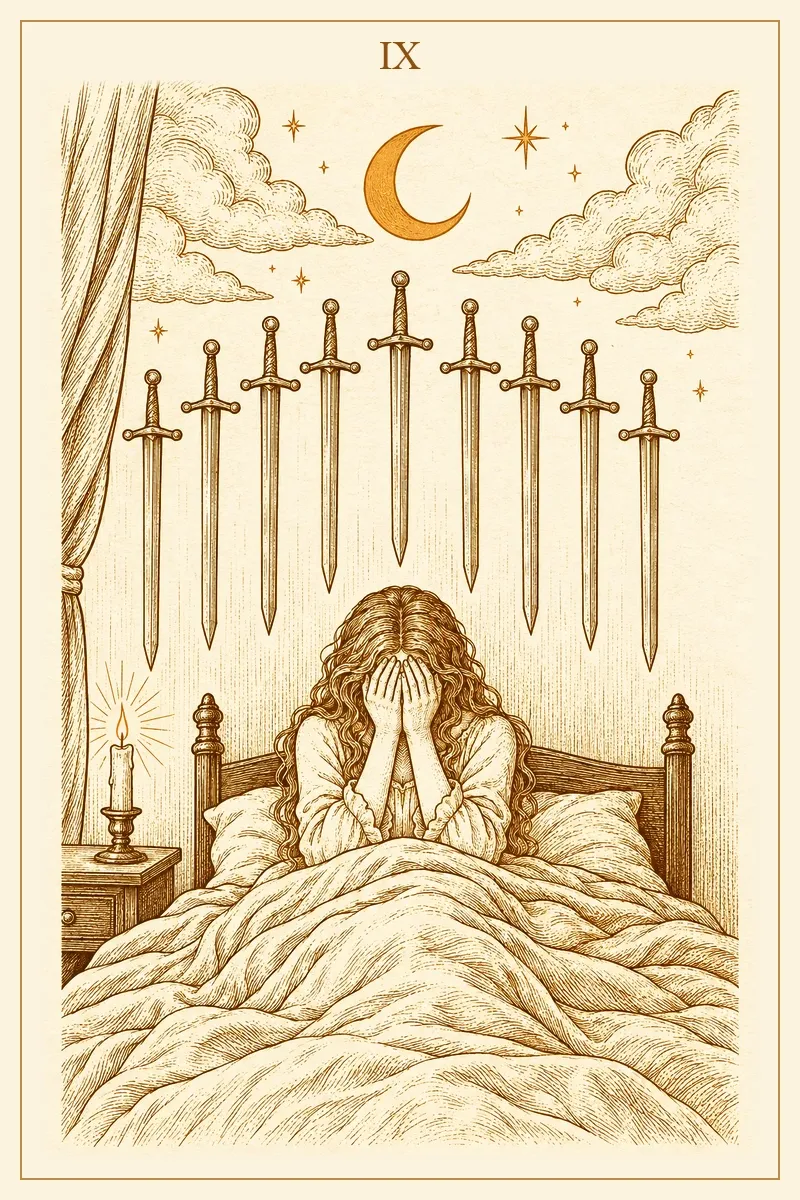
Nine swords hang in a row above a figure who sits up in bed with their face in their hands; a candle burns on the bedside table and a crescent moon shows overhead. The swords do not touch the person in bed. That detail is the key to reading the card at bedtime: the distress is real, but much of it lives in the mind's rehearsal of what might happen. The full Nine of Swords meaning covers it in love and work readings.
Upright, it names night worry plainly. Use it as a cue to write the worry down, as in the Worry Release, and to label it "tomorrow's question." Reversed, it can describe a worry starting to loosen, or anxiety held so tightly that you have told no one. If worry keeps you awake night after night, take that as a reason to talk with someone you trust.
The Moon: when the dark makes things look bigger

A dog and a wolf howl toward a moon whose crescent face sits inside a radiant disk, while a crayfish climbs out of a pool and a path winds between two towers into the hills. The Moon is the card of uncertainty, imagination and dreams. At night it describes the way an unclear situation fills with invented detail when you are tired. The full Moon tarot meaning explains its links to intuition and illusion.
Upright, ask, "What do I actually know about this, and what am I imagining?" Write the two lists side by side; at bedtime the second list is usually longer. Reversed, the card may suggest that confusion is starting to clear, or that a fear you have avoided looking at is close to the surface. Either way, the path on the card keeps going, and you do not have to see the whole road tonight.
A few other cards can feel heavy in an evening draw. The Ten of Swords often points to a thought spiraling toward the worst case, or to a painful chapter that is ending; at night, read it as "this is the bottom of the spiral, not the whole picture." The Eight of Swords describes feeling trapped by your own thoughts, and those restrictions often look looser in the morning. The Tower can reflect fear of sudden change or the aftershock of a jarring day; let it name the jolt, then move the questions to daylight.
When a card stirs worry before bed
Sometimes a card lands badly. Your heart speeds up, and a quiet ritual suddenly feels like the opposite of one. This is the moment to make the reading smaller, not bigger.
- Do not draw again. Pulling more cards to cancel the first one usually feeds the worry. One card was enough.
- Name the feeling, not the future. Write "I feel uneasy about..." and finish the sentence. If the card showed you what you were carrying, it has done its job.
- Turn the card face-down. Put it back in the deck, or place it in a box or drawer. The physical act of closing is part of the message.
- Use a worry jar. Write the concern on a small slip, fold it, and put it in a jar or envelope by the bed. If you wake in the night, remind yourself that it is written down and can wait for morning.
- Return to your body. A few slow breaths with a long exhale, a sip of water, or letting your shoulders drop can bring the evening back to calm.
- Reread it in daylight. Look at the card again the next afternoon. Most cards read very differently after rest.
Bedtime is not the time for deep shadow work or for questions you already know are emotionally loaded. If a reading ever leaves you feeling unsafe or overwhelmed, close the deck and reach out to a person you trust rather than another card.
Small rituals to rotate through the week
The same spread every night can start to feel like a chore. These variations keep the practice fresh without making it longer.
The gratitude card
Draw one card and find a single moment from today that connects to it, however loosely. A Pentacles card might bring back a good meal; a Cups card, a kind word from someone. You are not grading the day, only making sure one good moment gets noticed before it fades.
A card to rest your eyes on
Choose a calming card on purpose, such as the Four of Swords, The Star or the Ace of Cups, and look at it softly for a few minutes while breathing slowly. Let your attention wander across the picture rather than analyzing it. Our guide to tarot meditation techniques has longer versions if you enjoy this one.
A dream note
Draw a card and set a light intention: "If I dream tonight, I would like to notice something about this card's theme." Keep a notebook by the bed and jot down any image you remember on waking. Nothing has to happen; noticing is the practice. If you already keep a tarot journal, one line in it each morning is plenty.
A body-and-mind check-in
Draw two cards for two questions: "What does my body need tonight?" and "What does my mind need tonight?" The answers are often simple, such as water, a stretch or a shorter to-do list. For fuller versions, our self-care tarot spreads include longer check-ins for weekends.
Journaling prompts for the last page of the day
Use one prompt alongside your card, or none on nights when one line is all you have.
- What am I still carrying from today that I can put down now?
- What went well today, however small?
- What does "enough" look like for today, and did I reach it?
- If I could leave one message for myself to read in the morning, what would it say?
- What would a well-rested version of me want me to do in the next ten minutes?
- Which worry belongs to tomorrow, and when tomorrow will I give it attention?
- What did my card show me that I already knew?
Frequently asked questions
Can tarot help me sleep better?
It can help you wind down, which is part of what makes falling asleep easier, but it is not a sleep treatment. Tarot cannot diagnose why you sleep badly, predict how tonight will go, or tell you what someone else is thinking. Use it as a calm closing ritual and keep the practical habits (a regular bedtime, dim light, screens away) in place.
What is the best bedtime tarot spread?
For most nights, the three-card Nighttime Release: what to release, what to keep, and a word for tonight. On tired evenings a single card is enough. Save the four-card Worry Release for nights when one specific concern is keeping you awake.
Is it okay to read tarot in bed?
Yes, as long as it stays short and calm. Some people prefer a chair or the edge of the bed so the bed itself stays linked with sleep.
What if I draw the Nine of Swords or The Tower right before sleep?
Read it as a mirror of what is already on your mind, not as a warning about the night ahead. Write the worry down, turn the card face-down, and do not draw again. Look at it in daylight, when it usually feels more workable.
Should I sleep with a card under my pillow?
Some readers like to place a card under the pillow or on the nightstand as a reminder of their intention. It is a personal ritual, not a rule, and nothing bad happens if you skip it. If having a card nearby keeps you thinking, put it away.
How often should I do a bedtime reading?
As often as it feels restful. Some people draw every night; others prefer three evenings a week. If the practice starts to feel like another task, cut it back to one card or take a break.
Setting the deck down for the night
A bedtime tarot practice is less about the cards you draw than about the pause you make: a lower light, a few honest lines, and a clear moment when the day ends. Keep it short, keep it kind, and let the hardest questions wait for morning.
When you would like a fuller reading at a calmer hour, you can start a reading and take your time with it. Tonight, one card and a dark room are enough.