Order, steady authority and plans built to last: that is what The Emperor reflects when he turns up in a tarot reading. Upright, the Emperor tarot meaning centers on structure you can lean on, clear rules, and the confidence to take charge of your own affairs. Reversed, the same energy tips one of two ways, into control that has grown rigid, or into a situation where nobody is holding the frame at all.
So what is the Emperor in tarot? He is card IV of the Major Arcana, the ruler who follows the abundance of The Empress and gives it walls, borders and a calendar. In love he speaks of reliability and clear terms, at work of leadership and systems, and in any reading he asks where your life needs more shape and where you are gripping too hard. Tarot can show you that pattern. It cannot read another person's mind, fix a date or decide an outcome for you, so treat what follows as a mirror for your own choices.
- Upright keywords: structure, stability, leadership, discipline, protection, long-term planning.
- Reversed keywords: rigidity, control, domineering behavior; or the opposite, no plan, no boundaries, avoided responsibility.
- In love: upright, a dependable partner and commitments that show up in actions; reversed, a power imbalance or a relationship with no frame.
- Yes or no: upright, yes, when a plan stands behind it; reversed, no, or not until the terms change.
- Number and element: IV, Fire.
- Astrology and letter: Aries, ruled by Mars; in the Golden Dawn system, the Hebrew letter Heh.
Ram heads and a stone dais: what card IV shows
Before any keyword, look at the picture. Almost everything the Emperor means is drawn into how he sits and what he has built around himself.
A crowned ruler in plate armor
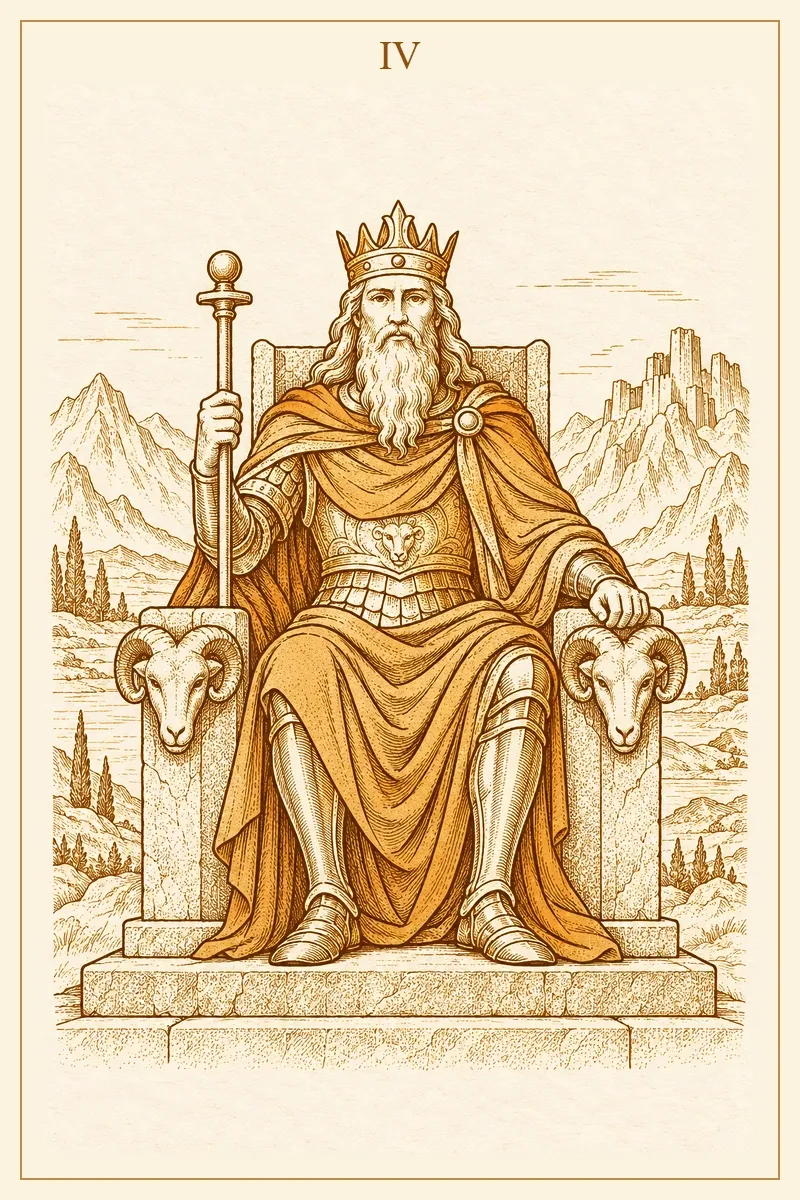
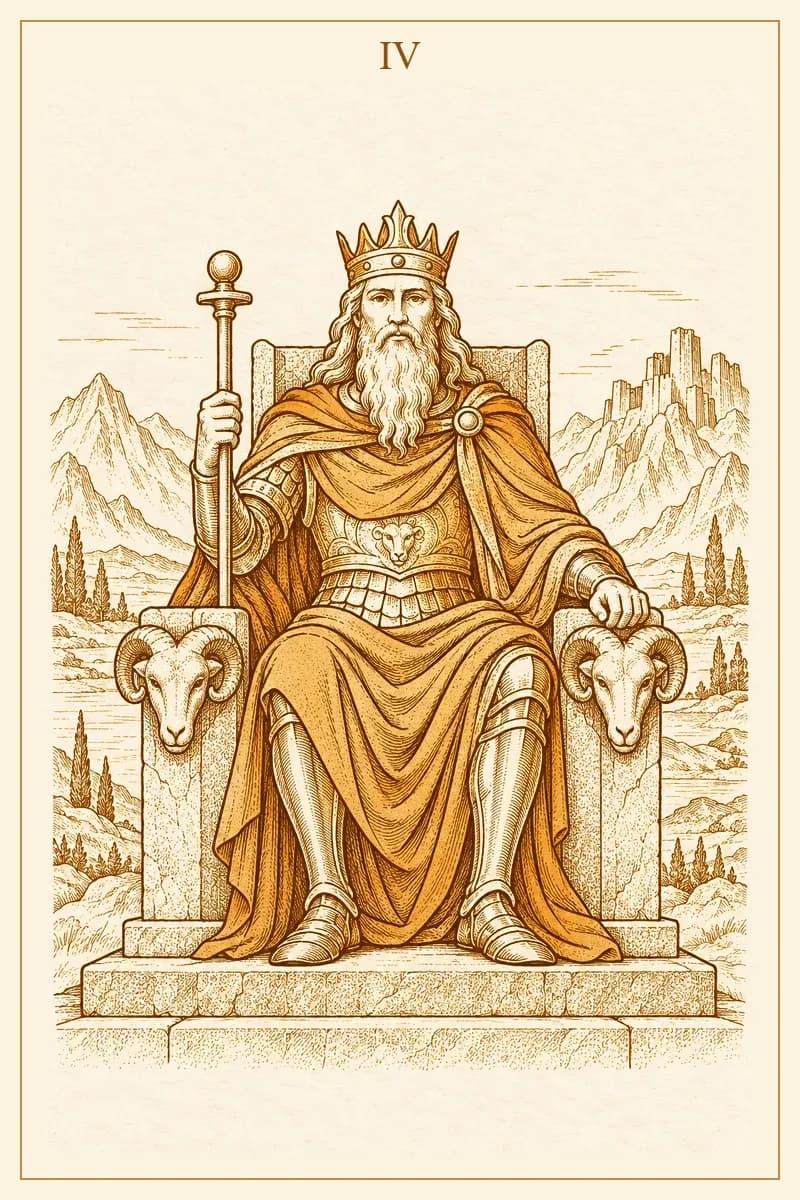
A man with a long white beard and hair past his shoulders sits square on a high-backed stone throne, facing straight out at you. He wears a pointed gold crown with a single stone at the brow. Under a heavy amber cloak, pinned at one shoulder with a round clasp, he is armored from breastplate to shins, his armored shoes resting on the step. This is not a king at a banquet: the armor says the order he keeps was won and is still guarded, and the age in his face says he has kept it a long time.
His right hand grips a tall scepter, a straight rod with a short crossguard and a round orb at the top, planted upright beside the throne. His left hand rests easily on the carved armrest. One hand holds the sign of command; the other simply settles on what is already his. He is not reaching for anything, because what he needs is within reach.
Rams on the armrests and the breastplate
Each armrest ends in a carved ram's head with heavy curled horns, and a smaller ram's head is worked into the center of his breastplate. The ram is the symbol of Aries, the sign this card belongs to, and the rams sit under his hands and over his heart. The headlong, charging energy of Aries is still there, but it has been carved into stone and put to work holding up a seat. That is a fair one-line summary of the card: drive, given a structure.
Mountains, cypresses and a walled town
Behind the throne the land is dry and rocky. Jagged peaks rise on the left; on a hill to the right stands a walled town with square towers, the kind of place that exists because someone laid out its streets and defended its gates. A river winds through the valley between rows of tall cypresses, and the throne rests on a two-step dais of fitted stone blocks. Most lines in the picture run straight up or straight across; the scene is built, not grown. Water still moves through the valley, though. Feeling has not vanished from the Emperor's world. It has simply been given banks.
Four, Aries and the letter Heh
Four is the number of the square: four corners, four walls, four legs under a table. Where the three of The Empress is growth, four is growth given a shape that holds still. In the run of twenty-two Major Arcana cards, he stands between The Empress, who creates, and The Hierophant, who carries rules out of one person's hands into a shared tradition. The Hierophant's meaning of teaching and tradition picks up where the Emperor's personal rule stops.
In the Golden Dawn attributions, the Emperor belongs to Aries and to the Hebrew letter Heh, on the Tree of Life path joining Chokmah, wisdom, to Tiphareth, beauty and balance. Aleister Crowley's Thoth deck swaps two letters, giving the Emperor Tzaddi and The Star Heh, so other books may list either; the Aries link is the same in both. Aries is cardinal Fire, ruled by Mars and the sign where the Sun is traditionally exalted: Mars gives him the armor, the Sun the right to sit at the center, and cardinal Fire the urge to begin and lead. How Aries connects to the Emperor and its other cards covers the sign's side of the story.
The Emperor upright: order you can build on
Upright, the Emperor stands for structure that serves you. He appears when a situation needs a plan rather than a mood, a decision rather than another round of discussion, or a boundary rather than one more exception.
Structure, plans and the long view
The Emperor thinks in years. He favors the budget over the impulse buy, the schedule over the burst of effort, the foundation over the decoration. In a position about what to do next, his advice is usually concrete: write the plan down, put numbers and dates on it, decide who is responsible for what, and keep to it after the novelty wears off. His discipline is not a punishment. It is what lets you stop deciding the same question every morning.
Authority you are allowed to hold
The Emperor can turn up just as you are being asked to lead: to run a team, to speak for a family, to be the one who says "this is how we will do it." The upright Emperor says you can carry that. Leadership here means taking responsibility and making decisions that stick, not raising your voice. If you have been waiting for permission to take charge of your own finances, health routine or creative project, this card can be read as that permission.
A father figure, mentor or institution
Traditionally the Emperor is the father card of the deck, but he can stand for anyone who provides structure and protection: a parent, a manager, a mentor, a landlord, a government office or a rulebook. He is not tied to any gender; a woman who runs the household budget or a department can be the Emperor in your spread. When he describes a person, ask whether their structure helps you grow or keeps you small. The upright card leans toward the first.
The Emperor reversed: a throne held too tightly, or left empty
Reversed, the Emperor's meaning splits in two directions, and the cards around him usually show which one you are looking at.
Control that hardens into rigidity
The first reversed reading is too much Emperor. Structure turns into a cage, authority turns authoritarian, and protection becomes control: a manager who micromanages, a partner who decides everything, a parent whose rules never changed as you grew, an institution that follows procedure past the point of sense. It can also be you, holding a plan so tightly that nothing new gets in. Rigidity often grows out of fear, so it helps to ask what the person holding the scepter is afraid of losing.
The empty throne: no plan, no edges
The second reading is too little Emperor. The seat is vacant. Bills go unopened, deadlines drift, nobody in the group will decide, or someone you depend on keeps sidestepping responsibility. In your own life this can feel like freedom at first and then like exhaustion, because without structure every day has to be invented from scratch. The reversed card is not asking you to become a tyrant. It asks for one wall, one routine, one decision you will actually keep.
Your own relationship with authority
Under both runs a quieter thread: how you relate to power. The reversed Emperor can point to rebelling against every rule on principle, or to handing every decision to someone who seems more certain than you. Both give your authority away. A useful question to sit with: whose rules am I following right now, and did I ever agree to them?
The Emperor in love: reliability, clear terms and the risk of control
In a love reading the Emperor is less about fireworks and more about whether a relationship has something to stand on: commitment that shows in behavior, agreements both people understand, and the sense that someone will still be there next month.
Upright in love
In a relationship, the upright Emperor describes a bond with a solid frame. Plans get made and kept, money and chores are discussed plainly, and both partners feel looked after. If you are wondering whether things are serious, he leans toward yes, though seriousness may look practical rather than romantic: a shared lease, a savings goal, meeting the family. For someone single, he can describe a settled, dependable person entering the picture, or your own decision to look for steadiness instead of drama. He is a slow card in love; what he builds is meant to last, so it rarely arrives overnight.
Reversed in love
Reversed, look at power. One partner may be making every decision, controlling money or contact with friends, or treating care as a reason to supervise. If that describes your relationship and you feel unsafe, a tarot card is not the place to settle it; talk to someone you trust or a local support service. The other reversed reading is a relationship with no frame at all: no clear status, no plans past the weekend, promises that never turn into dates.
How the other person feels when the Emperor appears
When you ask about someone's feelings and draw the Emperor upright, the card usually describes a person who feels responsible for you, or would like to. Their affection comes out as action: fixing things, making plans, turning up on time, thinking about a future with you in practical terms. They may say little about emotions and take a while to commit, because once they do, they mean it. Reversed, the feelings may be real but tangled with caution or a need to steer: wanting to set the pace, holding back until they feel sure of their footing, or keeping their guard up because being needed feels safer than being vulnerable. Either way the card describes a pattern, not a verdict on their heart. The useful step is to watch what they do over the next few weeks and to ask plainly for the clarity you need.
Hoping to reconcile with an ex
If your question is about getting back together, the Emperor shifts it from "will they return?" to "what would have to be different?" Upright, he suggests a second attempt only holds with new terms: clearer agreements, a realistic plan for the old sticking points, and two people willing to keep to them. Reversed, he often points to the power struggle that ended things, still unresolved. The cards read as signs of reconciliation can help you read the rest of the spread, but whether to try again remains your decision.
Work, money, health and practice under the Emperor
Career and leadership
At work the Emperor is a strong card for leadership, promotion and building something on your own terms. Upright, he favors taking on responsibility, putting systems around work that has been running on goodwill, and negotiating with clear numbers. Reversed, he can describe a rigid boss, a workplace where rules matter more than people, or your own reluctance to step up when a role is clearly yours.
Money and long-term security
With money he is a card of budgets, savings and steady growth, not quick wins. Upright, he supports planning a large purchase or paying down debt on a schedule. Reversed, he points to spending without a plan, or to holding money so tightly that it runs you. Tarot is not financial advice; the card describes your attitude, while the numbers deserve a real look and, where needed, professional help.
Health, routine and practice
In a health question, read him as a prompt to look at routine: how regular your sleep and meals have been, and whether a plan agreed with a doctor or other professional is actually being kept. Reversed, the routine has become too strict to bear or has quietly fallen apart. No card can diagnose anything; if something feels wrong in your body, see a professional. Spiritual practice benefits from the same kind of frame: a daily one-card draw or a journal you return to lets insight build up instead of evaporating.
Yes or no, and the Emperor's sense of time
As a yes-or-no card, the upright Emperor is a yes, on the condition that a plan, a commitment or a clear agreement stands behind it. Reversed, the answer is no, or not yet: the structure is missing, or someone's need for control is blocking the way. On timing he is slow and steady rather than sudden, suggesting weeks and months of consistent effort and results that arrive once the groundwork is done. Some readers also tie the card to Aries season, roughly March 21 to April 19; treat that as one convention, not a forecast.
Cards that sit beside the Emperor
The cards next to the Emperor show what his structure is for, and whether it is about to be tested.
With The Empress: vision meets execution
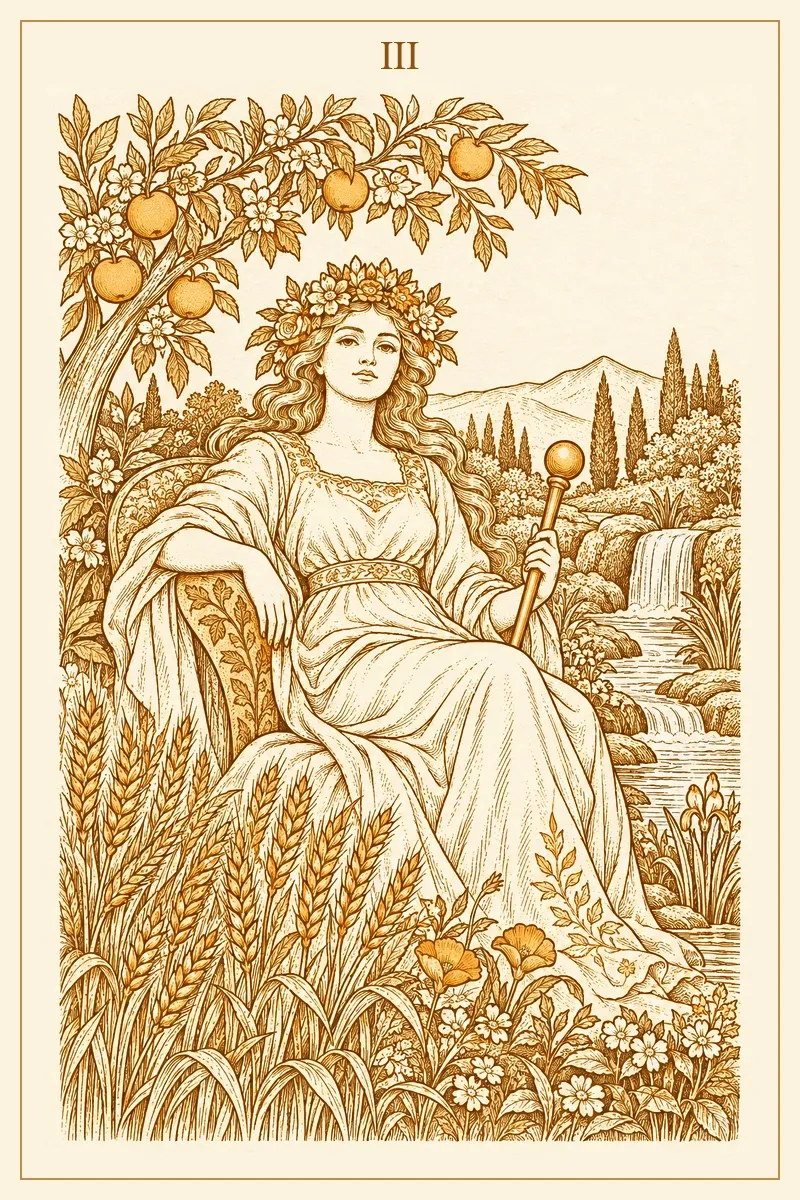
The Empress lounges in a cushioned chair among ripe wheat, under a tree heavy with fruit, a waterfall behind her; the Emperor sits upright on cut stone. Together they balance care with structure and creativity with follow-through: in love, a partnership where tenderness and planning both have a place; at work, a project with a heart and a budget. The Empress's meaning of abundance and creation fills in the other half.
With The Fool: a new start with a plan
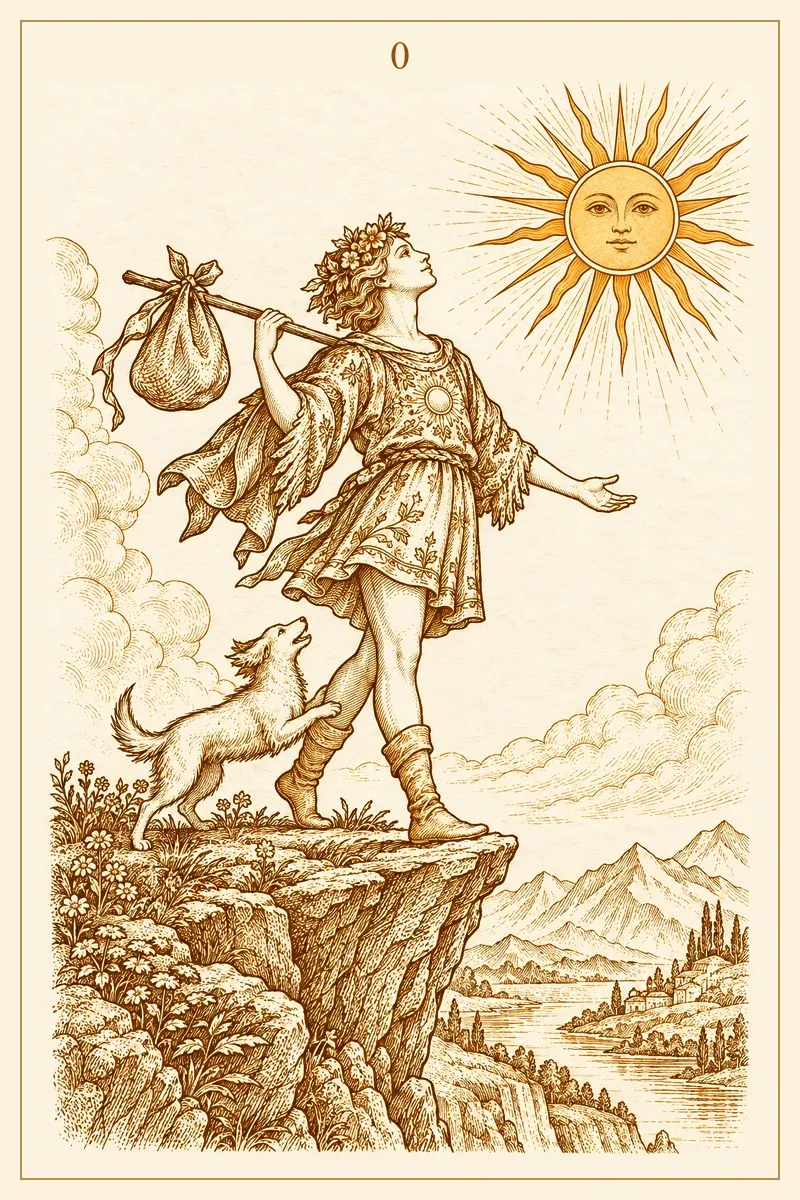
The Fool walks toward a cliff edge with a bundle on a stick and a small dog leaping at his leg. Beside the Emperor, that leap gets a map: a fresh start taken with some preparation, or a beginner learning from an experienced guide. The Fool's meaning of leaping into the unknown shows the open-handed side of the pair.
With The Tower: when a power structure gives way
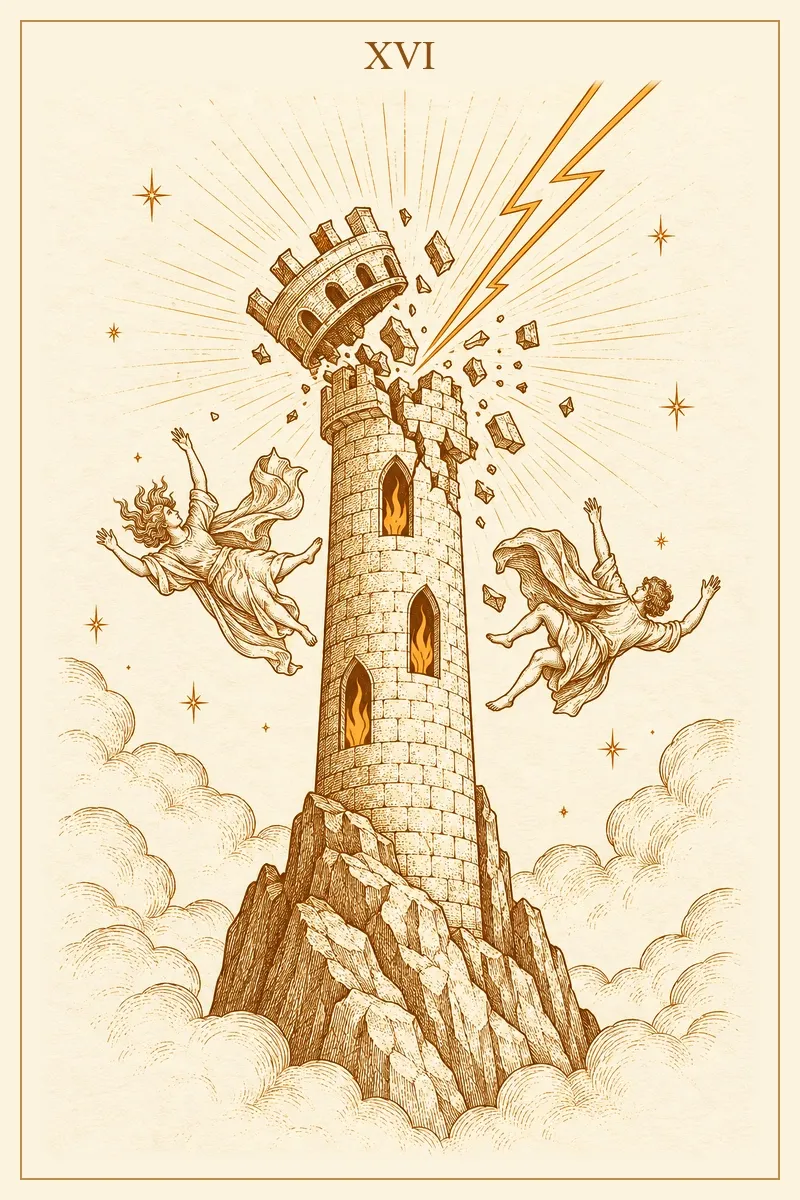
In The Tower, lightning splits a stone tower on a rocky peak, blowing its battlemented top loose as two figures fall. Next to the Emperor, it shows a structure too rigid to bend: a leader replaced, a company reorganized, a controlling arrangement that has run its course. The Tower's meaning of sudden change and revelation explains how to read that shake-up calmly.
With Justice: authority that answers to fairness
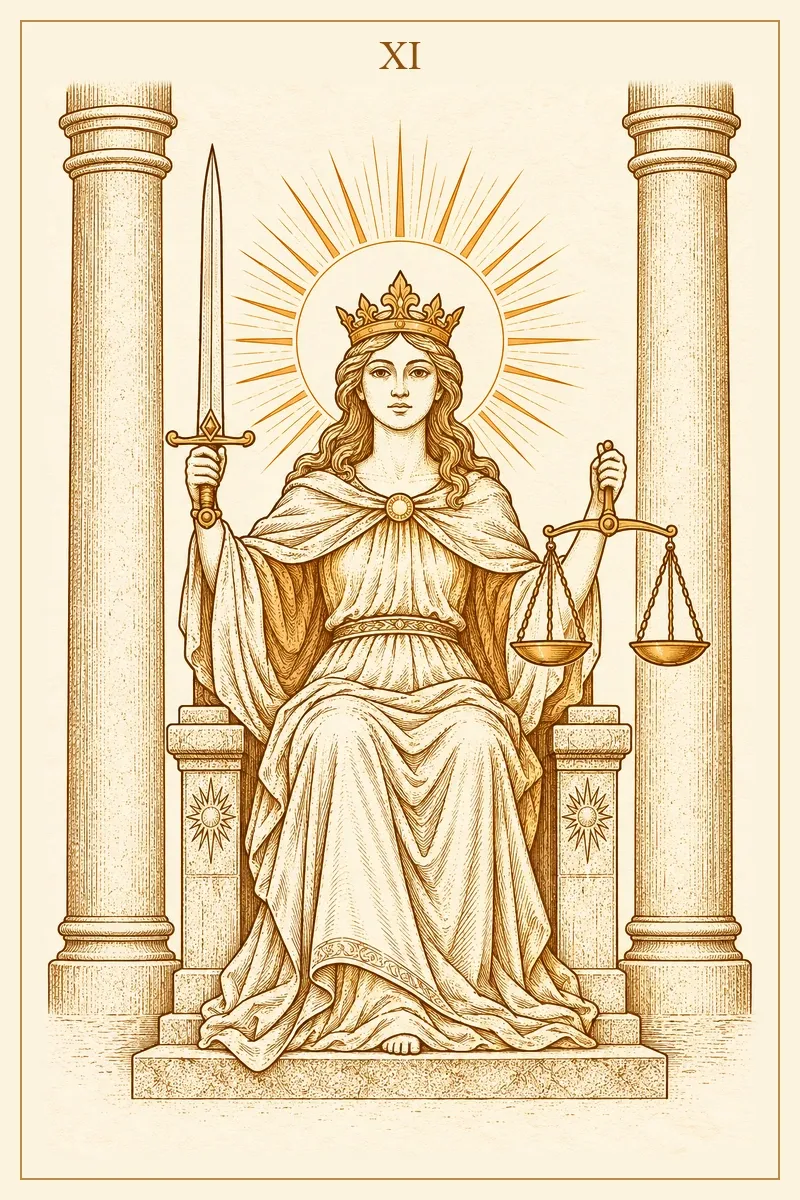
Justice also sits on a stone throne: a crowned woman between two stone columns, a raised sword in one hand and a set of scales in the other. With the Emperor, authority is held to a standard of fairness: contracts, official decisions and choices that weigh logic against ethics. Justice's meaning of truth and accountability covers that side in detail.
With the Ten of Pentacles: a household built to last
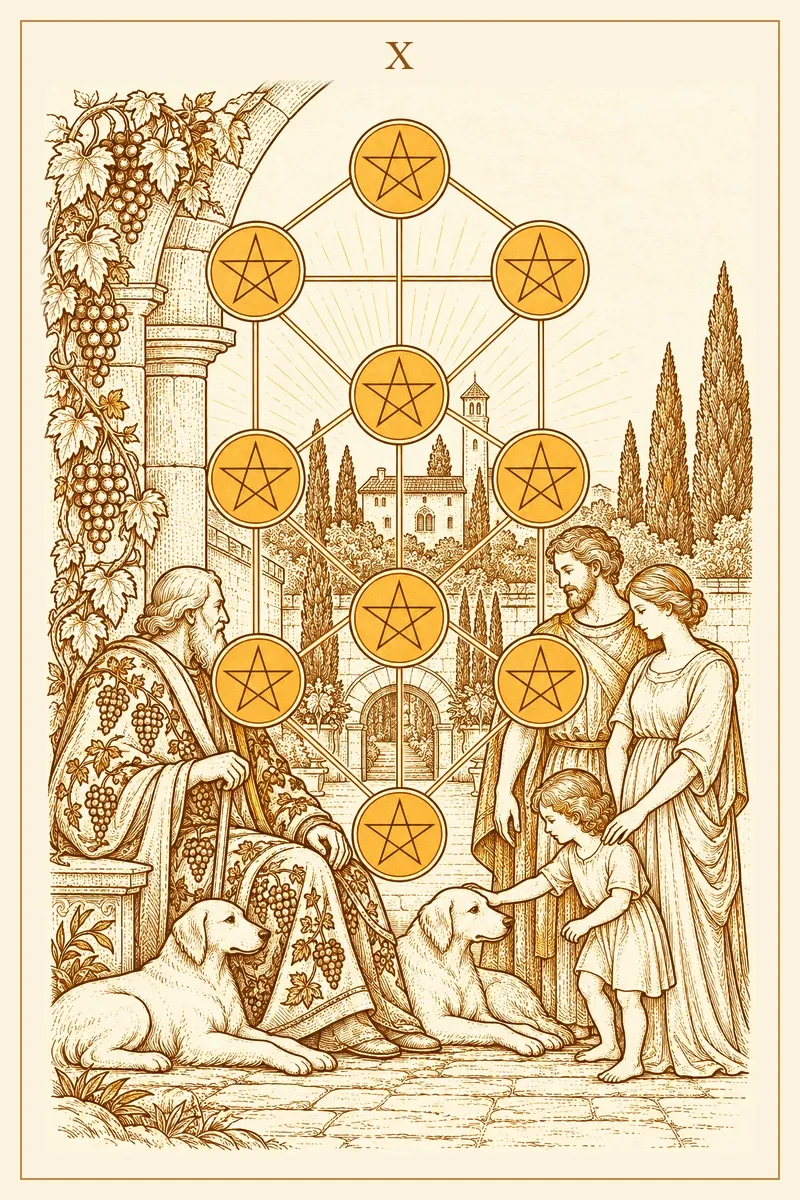
The Ten of Pentacles shows an old man in a grape-patterned robe sitting with two dogs beside a young family, ten coins arranged above them in the shape of the Tree of Life. Paired with the Emperor, it speaks of structures that outlast one generation: a family business, property, inheritance, or simply home routines that survive this year's stress.
The Four Corners spread: a layout for bringing order
The Emperor's number is four, so this spread lays four cards out as the corners of a square. Use it when part of your life feels shapeless, or when someone's control is pressing on it.
- Foundation (top left): what already stands and can be trusted.
- The missing wall (top right): where a rule, boundary or routine is needed.
- The tight grip (bottom left): where control is too strong, yours or someone else's.
- The first stone (bottom right): one structural step to take this week.
A worked example: two desks, one kitchen and no edges to the day
The querent and her partner both work from home. Days blur together, interruptions never stop, and she has become the one who reminds everyone of everything. Her question: "How do we build a routine that holds without me policing it?"
In the Foundation corner she drew the Three of Pentacles upright, a card of skilled people working to a shared plan: when the two of them sit down and agree on something, they cooperate well. The missing wall was the Eight of Wands upright, messages flying and everything in motion at once; the boundary they lack is around interruptions. The tight grip was the Emperor reversed, and she recognized it at once: she has taken the throne by default, holding the whole schedule in her head and enforcing it alone, which is why it collapses whenever she is tired. The first stone was the Four of Wands upright, a card of a stable home: one short weekly meeting at the kitchen table to agree on quiet hours, chores and one shared evening both protect.
Reading the four together
Read as a square, the spread moves from cooperation that exists, through a missing boundary and a throne held by one person, to a structure both partners keep. The Emperor's lesson here is not "take more control" but "share the frame," so that order no longer depends on her vigilance.
Bringing the Emperor's order into one week
If the Emperor keeps appearing in your readings, small structural steps tend to help more than big resolutions:
- Pick one area that feels shapeless and write a single rule for it, with a day of the week attached.
- List the decisions you keep postponing and make the smallest one today.
- Find one place where you hold control alone, and hand part of it to someone else on clear terms.
- Check one boundary: is it protecting you, or isolating you?
If you want a sharper question to bring to the cards, Veil Soul's library of reading questions groups prompts by situation, including work, boundaries and commitment.
Frequently asked questions
What is the Emperor in tarot, in plain words?
He is the fourth card of the Major Arcana and the deck's image of structure and authority: the person, rule or system that keeps things standing. If you are new to the cards, a beginner's introduction to tarot explains how a card like this works in a reading, and the full card library lets you compare him with the other seventy-seven.
Is the Emperor a good card to draw?
Usually, yes. Upright, he strongly supports stability, commitment and work that is built properly. He can feel stern because he asks for discipline, but that sternness is in your favor, and even reversed he points straight at where control is out of balance.
What does the Emperor mean reversed?
Either too much control, such as rigidity, domineering behavior or rules that serve no one, or too little, such as chaos, missing plans and avoided responsibility. The surrounding cards and your question usually show which.
Does the Emperor always represent a man or a father?
No. He can stand for anyone in a structuring, protective or authoritative role, of any gender, including you. He can also represent an institution, a set of rules, or a quality you are being asked to develop.
Can the Emperor tell me what someone will decide?
No card can. Tarot reflects patterns and choices; it cannot confirm another person's intentions, guarantee an outcome or give you a date. The Emperor is most useful when you turn it toward what you can decide and build yourself.
A frame you can live inside
The Emperor is not about domination. He is about making order out of chaos, protecting what matters, and having the patience to build something that will still stand next year. Whether he arrives as support or as a warning, his question is the same: where would a little more structure set you free? When you are ready to look at your own situation, a three-card reading on your own question is a calm place to start.