Self-care tarot spreads are short layouts whose positions ask what you need rather than what will happen: rest or movement, company or quiet, a firmer boundary or a softer pace. The five below range from a three-card check-in to a seven-card seasonal layout, and each position is worded so the answer points to one small, doable act of care. Pick the one that matches the time and energy you have today.
Tarot works here as a mirror, not a prescription. A card can help you notice that you have been running on empty or that you miss someone, but it cannot diagnose anything, measure your health, predict how you will feel next month, or stand in for a doctor or counselor. What it can do is slow you down long enough to ask an honest question and hear your own answer.
The five layouts at a glance:
- The Quick Check-In (3 cards): body, mind and heart, in a few quiet minutes.
- The Sunday Reset (5 cards): what drained you, what fed you, and one focus for the week ahead.
- The Emotional Landscape (4 cards): for a heavy mood you cannot yet name.
- The Boundaries Check (3 cards): where you are overgiving and how to rebalance.
- The Seasonal Soul (7 cards): a longer look when a season, literal or personal, turns.
After the layouts come five cards that speak directly to care, a full worked example, a gentle way to set up the reading, journaling prompts and answers to the questions people ask before they start.
What turns a spread into a self-care spread
Any layout can touch on wellbeing, but a self-care spread is built around needs. Its positions ask "what would help" and "what am I carrying," not "will this work out." That shift matters. An outcome question invites you to wait for an answer from outside, while a needs question hands the next move back to you.
Good self-care positions share three traits. They are specific enough to act on ("my body today" rather than "my life"), they are kind in tone ("what drained me" rather than "what I did wrong"), and they end on something you can do, however small. If a position leaves you with nothing to try, rephrase it before you shuffle.
It also helps to separate self-care from self-improvement. A spread that turns into a list of things to fix about yourself has drifted off course. The point is to notice where you are depleted and offer that part of you something, the way you would bring a glass of water to a friend who has been talking for hours, without asking them to earn it first.
Finally, decide in advance what a hard card will mean in this context. In a self-care reading, a card of grief, worry or exhaustion is not a verdict on you; it names something that deserves attention. Reading it that way keeps the practice gentle on the days you need it most.
Five self-care spreads with named positions
Each layout below lists its positions in the order you lay the cards down. Read the position aloud before you turn the card over. It keeps your interpretation tied to the question rather than to the card's general reputation.
1. The Quick Check-In (3 cards)
This is the lightest layout, short enough to fit into a morning tarot routine or a pause before bed. Lay three cards in a row:
- Body: What does my physical self need today?
- Mind: What does my thinking self need today?
- Heart: What does my emotional or spiritual self need today?
Read each card as a single request. A Cups card in the body position might ask for warmth and a comforting meal; a Swords card in the mind position might ask for one decision to be made so the rest can quiet down; a Pentacles card in the heart position might point to something grounding, like tending a plant or tidying one drawer. Choose one of the three requests and act on it before the day ends. If all three cards feel unclear, keep only the one that made you react.
2. The Sunday Reset (5 cards)
Despite the name, this layout works on whichever day closes your week. It looks back before it looks forward, so you plan care from what actually happened rather than from what you think you ought to need.
- How am I really feeling? The honest answer, not "fine."
- What drained me this week?
- What nourished me this week?
- What do I need more of?
- My self-care focus for the coming week.
Positions two and three belong together. If the card for what drained you is busy and crowded while the card for what nourished you is still and solitary, you have learned something about your balance that no planner would show you. The fifth card is your focus: write it as one sentence that starts with "This week I will" and keep it modest enough to keep.
3. The Emotional Landscape (4 cards)
Use this one when you feel heavy or on edge and cannot say why. It moves from what is visible to what lies underneath, then to something soothing.
- The surface: What I am showing the world.
- Underneath: What I am actually feeling.
- The root: Where this feeling comes from.
- The soothing: What would ease this right now.
The gap between the first two cards carries much of the message. A composed, capable card on the surface with a tender or tearful card underneath suggests you have been holding yourself together for other people. The root card is not there to assign blame; read it as context. Translate the last card into something physical you can do within the hour, such as stepping outside, calling someone, eating a proper meal or crying without apologizing.
4. The Boundaries Check (3 cards)
When other people's needs have worn you thin, this short spread pairs well with the deeper work in tarot for setting boundaries.
- Where am I overgiving?
- What am I neglecting in myself?
- How can I rebalance?
The first card names the leak, the second names what has gone untended because of it, and the third suggests a repair. Keep the third card practical. A Wands card might mean declining one request this week; a Cups card might mean telling someone how you feel instead of quietly absorbing it; a Swords card might mean writing down the limit you want before the next conversation, so you are not inventing it under pressure.
5. The Seasonal Soul (7 cards)
This is the longest layout here, meant for a turning point: an equinox or solstice, a birthday, a move, the end of a demanding project. It sits naturally alongside other seasonal tarot practices.
- What is this season asking of me?
- What should I release from the last season?
- What wants to grow?
- My physical self-care focus.
- My emotional self-care focus.
- My spiritual self-care focus.
- The gift this season offers.
Lay the first three cards in a row, the three focus cards beneath them, and the gift card on its own at the bottom. Give yourself time with this one; it reads better over an unhurried hour than in a rushed ten minutes. The three focus cards form a small plan for the months ahead, and the final card is something to look forward to rather than another task.
Five cards that speak to care
Any card can land in a self-care reading, but a few speak to rest, overload, balance and comfort so directly that it pays to know them well. Here is how to read each one, upright and reversed, when the question is about looking after yourself.
Four of Swords: permission to stop
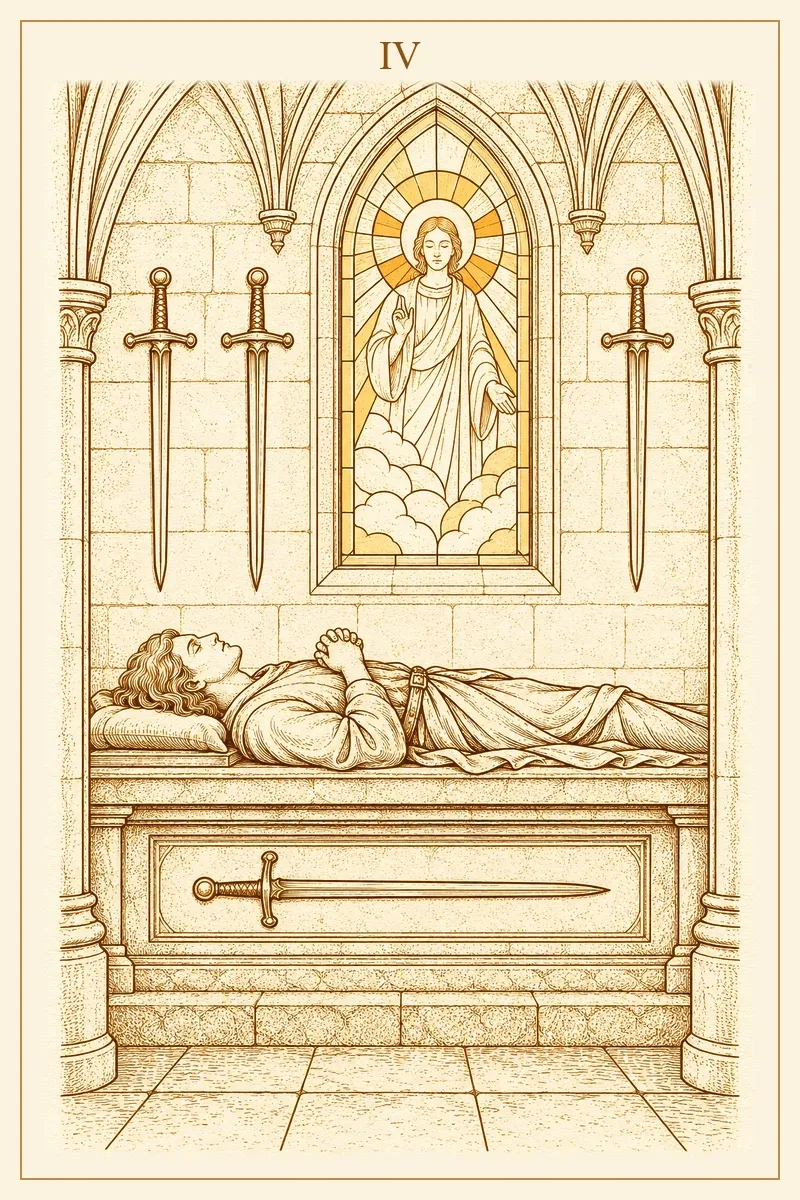
The Four of Swords shows a figure lying on a carved stone tomb with hands folded, three swords hung on the wall above and a fourth carved along the side of the stone, while a stained-glass window lets soft light into the chapel. Upright in a self-care spread, it is about as clear as a card gets: rest is required, not earned. It can mean sleep, a quiet weekend, a break from news and messages, or simply lying down for a few minutes without a podcast. For how it reads in love, work and decisions, see the full Four of Swords meaning.
Reversed, the card can describe rest that is not working: you lie down but your mind keeps racing, or you take time off and spend it catching up on chores. It can also suggest that you are ready to get moving again after a pause. Ask which applies. If rest feels impossible, the kindest step might be making it easier, with a darker room, the phone left in another room, or a shorter to-do list tomorrow.
Ten of Wands: carrying too much
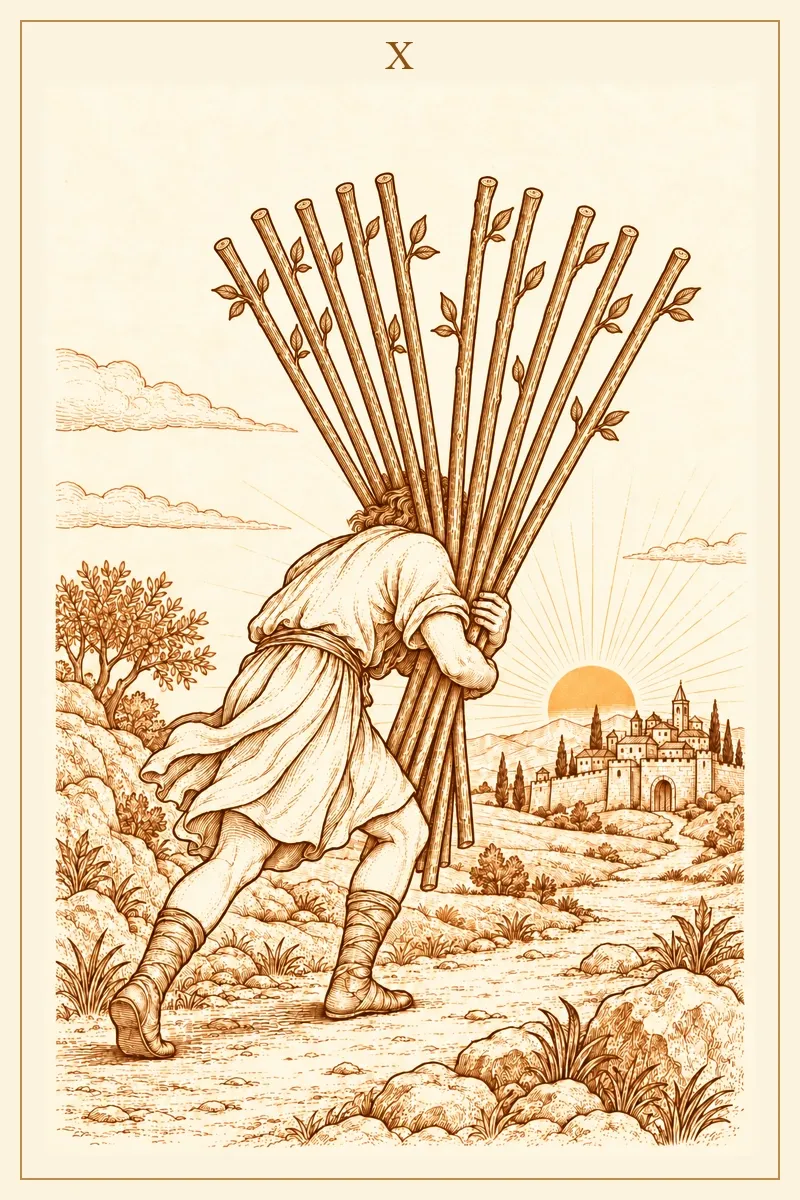
In the Ten of Wands, a figure seen from behind leans forward under a bundle of ten leafy staves pressed against chest and head, trudging along a stony path toward a walled town, with a low sun on the horizon beside it. The bundle blocks the view ahead, which is exactly the point. Upright, the card names overload: too many responsibilities, too few hands. In a self-care reading it asks which of the ten you could set down, hand off or postpone. The Ten of Wands tarot meaning explores burden and responsibility in more depth.
Reversed, the card may show the moment of putting the load down, or the strain of refusing to. If you recognize yourself in the bent figure, try listing everything you are carrying, then mark one item that is not truly yours to hold. Letting go of a single staff changes how the rest of the bundle feels.
Temperance: a pace you can sustain

Temperance shows a winged figure pouring water from one golden cup into another, one bare foot in a stream and the other on the rocky bank, with irises growing at the water's edge and a sun rising over distant hills. Upright, it is the card of mixing and moderating: not all work, not all rest, but a blend you can keep up. In self-care terms it might suggest regular meals, a slower start to the morning, or alternating demanding days with lighter ones. The Temperance tarot meaning looks at its theme of balance and healing more broadly.
Reversed, Temperance points to excess or to swinging between extremes: overwork followed by collapse, a strict routine followed by none at all. The care it suggests is rarely dramatic. Find the middle setting, the version of your habit you could keep up on a tired day.
The Star: slow renewal
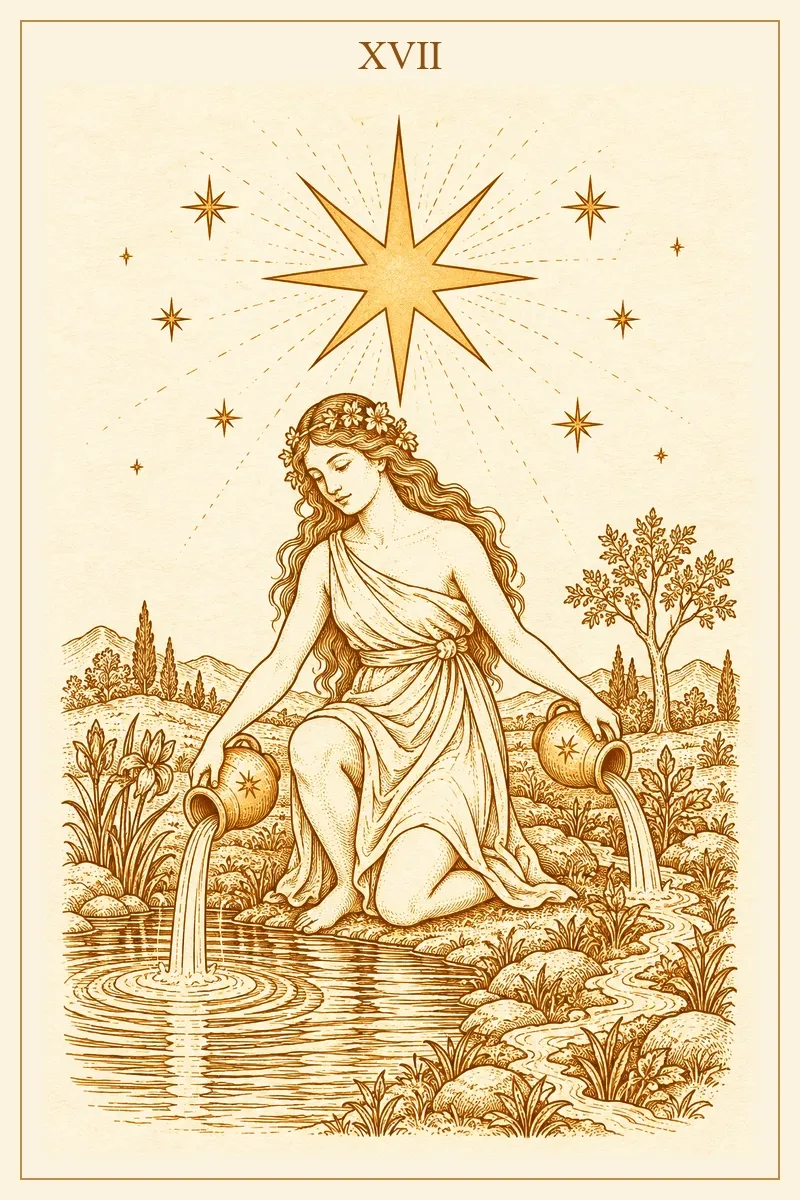
The Star shows a kneeling woman with a crown of flowers pouring water from two jugs, one into a still pool and the other onto the land, where it runs off as a small stream, beneath a large eight-pointed star ringed by smaller ones. Upright, it describes hope returning after a hard stretch, the quiet replenishing that happens when you stop forcing yourself. In a self-care spread it can invite restorative things: time outdoors, music, a long bath, a conversation that makes you feel like yourself again. The Star tarot meaning follows its themes of hope and renewal.
Reversed, it may reflect discouragement, a sense that nothing is refilling you. That is useful information, not a failure. Look for the smallest source of comfort you still respond to and give it more room; hope tends to come back in small doses before it comes back whole.
Queen of Cups: compassion turned inward
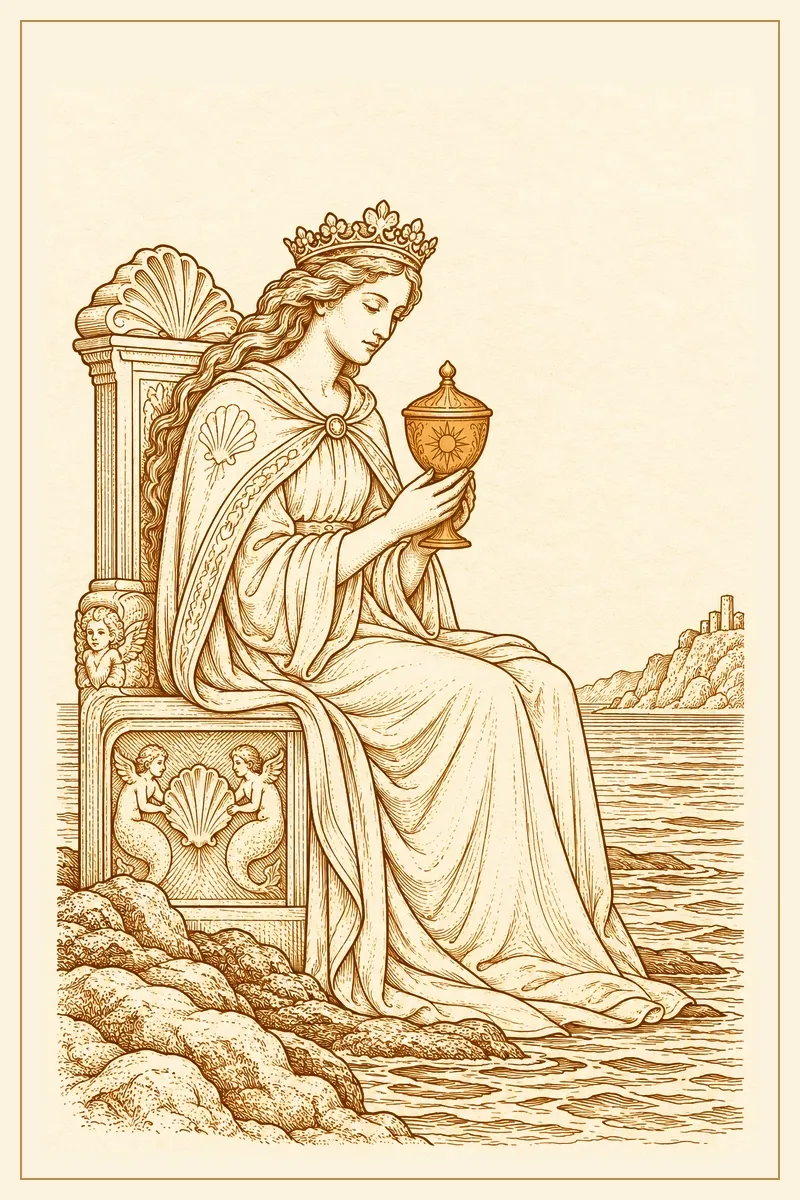
The Queen of Cups sits at the edge of the sea on a throne carved with scallop shells and small winged figures, gazing at the ornate lidded cup she holds in both hands. Upright, she models emotional care: listening to your own feelings with the patience you would offer someone you love. In a self-care reading she might ask you to speak to yourself more kindly, to let a feeling be there without fixing it, or to spend time with someone who makes you feel understood. Her full Queen of Cups meaning covers her role in love and work.
Reversed, she can point to depletion from caring for everyone except yourself, or to feelings pushed aside because there was no room for them. The repair is to give your own heart a turn: an hour that belongs only to you, a page in a notebook, or an honest answer the next time someone asks how you are.
A worked example: one week through the Sunday Reset
Here is how a single reading might unfold, using an imagined example. The person asking has had a demanding week of work deadlines and a family visit, and sits down at the end of it with the five-card Sunday Reset.
Card 1, how am I really feeling: Ten of Wands. No surprise there; the week has been a bundle carried uphill. Saying it plainly ("I am overloaded") already lightens it a little.
Card 2, what drained me: Three of Pentacles. This card of teamwork and shared craft, sitting in the drain position, suggests the meetings and group projects, being needed by several people at once, rather than the work itself.
Card 3, what nourished me: Six of Cups. A card of familiarity and simple kindness, it points to the family visit: an old recipe, a shared memory, an evening of not having to perform.
Card 4, what I need more of: Four of Swords. Quiet, sleep and time with nothing scheduled.
Card 5, my focus for the coming week: Temperance. A sustainable pace rather than one heroic day off.
Put together, the cards tell a coherent story. The overload came mostly from being in demand, the comfort came from something warm and familiar, and the need is plain rest. Temperance as the focus card warns against swinging from exhaustion into a weekend of doing nothing and then a Monday spent catching up. The person writes one sentence: "This week I will leave one evening completely unscheduled and say yes to another family dinner instead of an extra meeting." It is small, specific and kind, which is the whole aim.
Notice what the reading produced: a clearer view of the week behind and one act of care for the week ahead, chosen by the person from what the cards brought into focus. That choice, more than any single card, is what carries the reading into the next seven days.
Setting up a gentle reading
The ritual around a self-care spread is part of the care. Nothing elaborate is needed, but a few choices make the reading feel different from scrolling through your phone.
- Make the space comfortable. A clear table, a blanket, a drink you enjoy: whatever tells your body that this is a pause. Music or soft light can help, but none of it is required.
- Choose the layout by your energy, not your ambition. On a depleted day, the Quick Check-In is enough. Save the Seasonal Soul for when you have time to sit with seven cards.
- Use your kindest voice. Interpret the cards as you would for a dear friend. If a card shows exhaustion, answer it with "of course you are tired, you have carried a lot," not with criticism.
- Record what you drew. A tarot journal turns separate readings into a picture over time. You may notice that certain suits turn up when you are craving connection or grounding, which says more about your patterns than any single draw.
- Follow through with something small. A spread that asks for rest means little if you then push through another long day. A short walk, one declined request or going to bed half an hour earlier all count.
Journaling prompts to go with your spread
After the cards, a few minutes of writing helps the reading settle. Choose one or two of these rather than working through them all:
- What does self-care actually look like for me, apart from the polished version I see online?
- When did I last do something purely because I enjoy it, and how did I feel afterward?
- Which card in today's spread did I want to skip past, and what might it be asking of me?
- If my body could speak right now, what would it ask for?
- What would change if I treated rest as necessary rather than optional?
- Which single act of care from this reading can I manage before tomorrow?
Frequently asked questions
What is the best tarot spread for self-care?
There is no single best one. The Quick Check-In suits a short pause, the Sunday Reset suits a look back over a week, and the Emotional Landscape suits a mood you cannot name. Choose by the time and energy you have; a three-card reading you actually do is worth more than a seven-card one you keep postponing.
What if my spread is full of difficult cards?
In a self-care reading, a hard card names something that needs attention; it is not a judgment of you or a forecast. A run of Swords might point to mental strain, a run of heavy Cups to grief or loneliness. Respond to what the cards name with care, and resist reshuffling until you get a nicer picture.
Can tarot replace therapy or medical care?
No. Tarot is a tool for reflection, and it cannot diagnose a condition, confirm what will happen, or tell you what someone else is thinking. If you keep drawing cards about exhaustion or distress and self-care is not easing it, please talk to a doctor, counselor or another qualified professional. A reading can sit alongside that support, never in place of it.
Do I need to know every card meaning first?
No. Each position asks a plain question, so you can start from the card's image and how it makes you feel, then look up a meaning afterward. The card pages and meaning guides help, but your own response to the picture belongs in the reading too.
Can I do self-care readings with a friend?
Yes. Reading for each other, or each drawing your own Quick Check-In and comparing notes, can make it easier to say what you need out loud, and a need spoken to someone else tends to feel more real. Keep it supportive: the friend's role is to listen, not to diagnose.
Can I make my own self-care spread?
Yes. Start with one question you keep avoiding, then add two or three positions that move from noticing to acting, such as "what I am feeling," "what I need" and "one thing I can do today." Keep the last position practical and the spread will do its job.
Caring for yourself after the cards
You do not have to reach a certain level of exhaustion before rest is justified, and care is not a reward for being productive. A self-care spread is simply a structured way to ask what you need and to take the answer seriously. Shuffle when you have a few quiet minutes, choose one small act from what you see, and let that be enough for today.
If you would like a calm place to begin, try a reading on Veil Soul with one of these positions in mind and notice what it brings up.