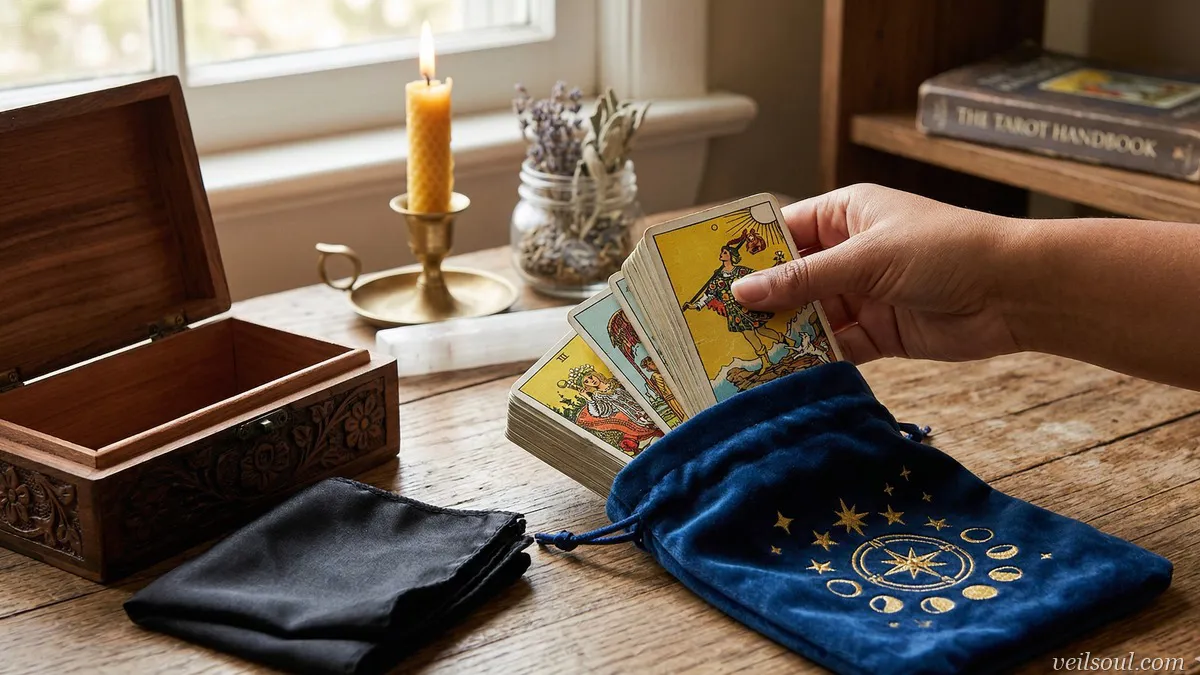
To set up a tarot reading space, you need a clear flat surface, a cloth that marks where the cards will land, light good enough to see the images, and ten to fifteen minutes when nobody needs you. That is the whole requirement. A small altar, a lamp, a scent or a favorite stone can come later, one at a time, and each should stay only if it helps you settle and pay attention.
The point of a dedicated spot is habit, not magic. When you sit in the same place, unfold the same cloth and follow the same short routine, your mind learns that this is the moment to slow down and look closely. No object in the room changes what the cards say, and no setup turns a reading into a forecast: tarot is a way to reflect on your own question, and it cannot confirm what another person thinks, pin down a date or decide an outcome for you.
Below you will find the essentials first, then light, sound and scent, a simple tarot altar, three cards whose pictures happen to show a good reading space, setups for small and shared homes, an opening and closing routine, and a first reading to try once everything is in place.
Here is the whole setup in seven steps:
- Pick a spot and a time: a table, desk or patch of floor you can clear, at an hour when you will not be interrupted.
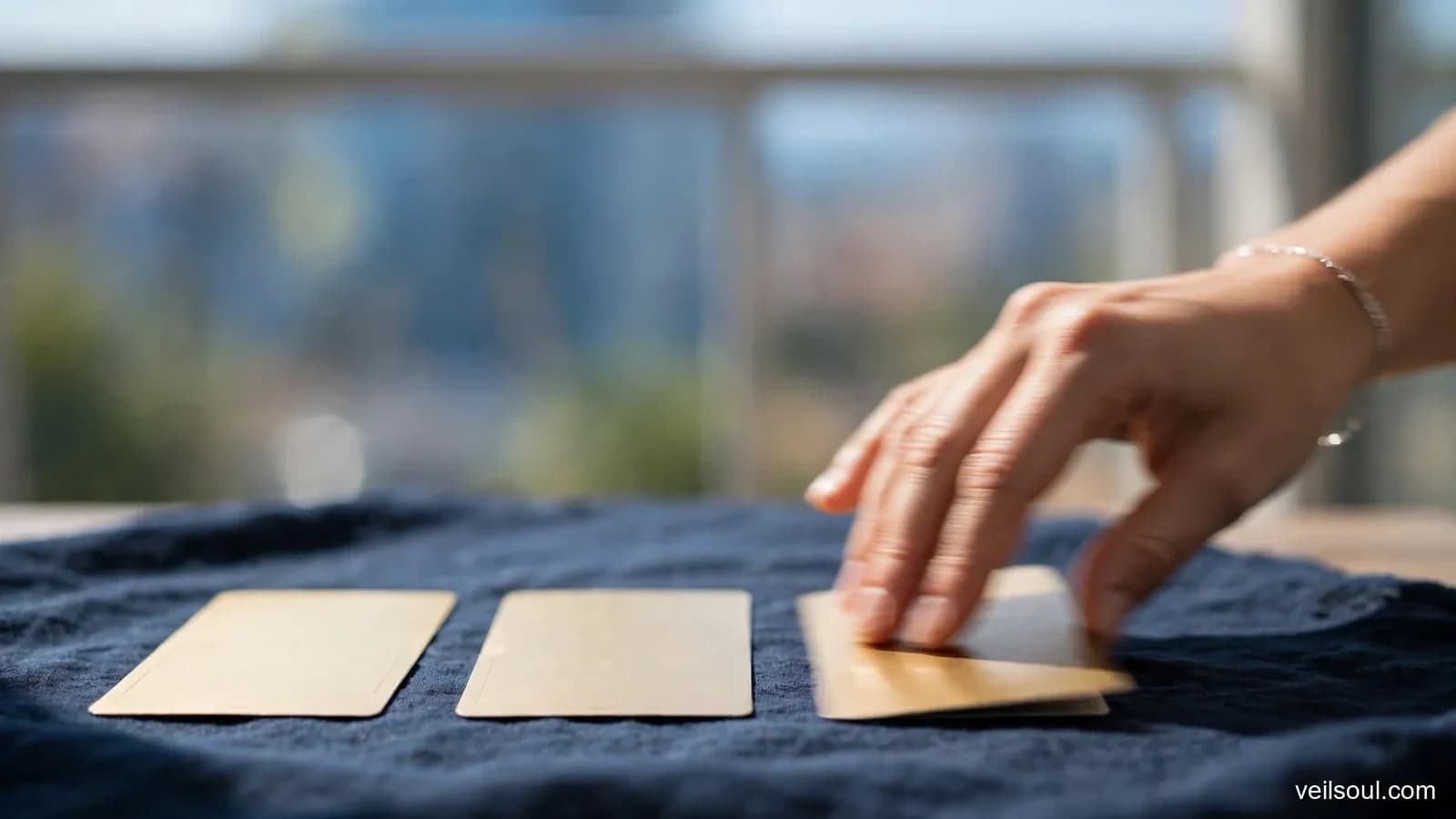
- Lay a cloth: any clean fabric that protects the cards and frames the reading area.
- Fix the light: soft but bright enough to see detail, from a lamp, a window or a safely placed candle.
- Keep tools in reach: your deck, a notebook and a pen, so you never have to get up mid-spread.
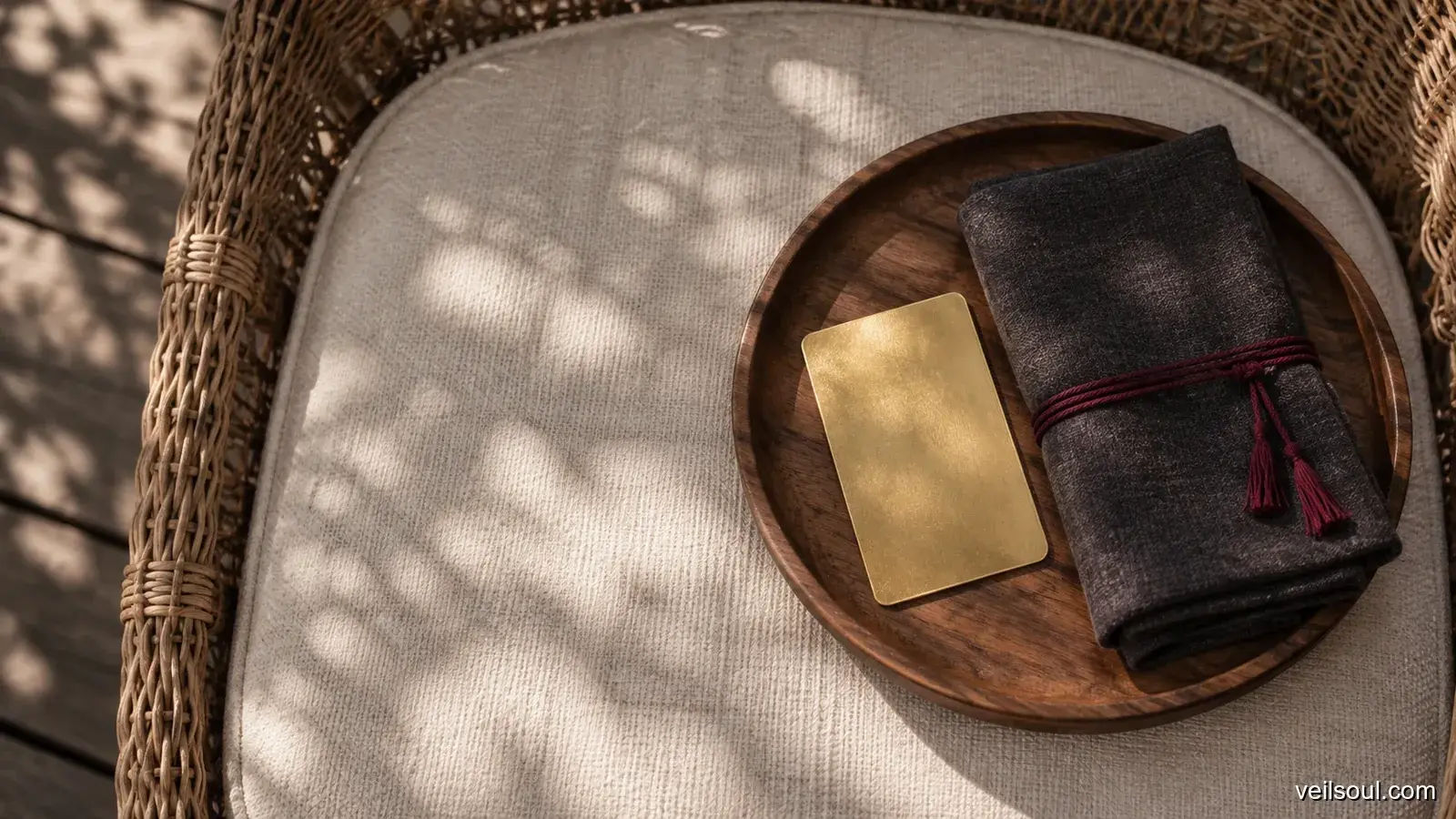
- Add one meaningful object (optional): a stone, a plant, a photo or a small bowl on a tray or shelf.
- Open and close the same way: a two-minute routine that starts and ends each session.
- Reset afterward: put the cards away, clear the surface and note what you drew.
Why a set place helps you read
You can read tarot on a train, at a picnic or on the edge of your bed, and the cards will work just as well as symbols to think with. What changes is you. A familiar setting removes small decisions (where to put the deck, whether the lighting is good enough, where the pen went), and that leaves more attention for the cards themselves. It is the same reason a runner keeps one route or a writer sits at one desk: the place carries part of the effort of getting started.
Repetition also makes your own responses easier to notice. If you always read in the same chair with the same light, the differences you feel from one session to the next are more likely to come from the question and the cards than from the room. That steadiness is a quiet support for building tarot intuition, because you start to recognize the difference between a real hunch and plain restlessness.
A reading space is also a boundary. Unfolding a cloth says "this is reading time" to you and to anyone you live with. Folding it away says the reading is over, which matters more than people expect: a reading that never quite ends tends to follow you around for the rest of the day.
The essentials: surface, cloth and quiet
Use only these three for a couple of weeks before you buy anything; you will learn what you actually miss.
A surface that fits your spreads
Measure the space against the layouts you use most. A single daily card needs room the size of a placemat. A three-card line needs about the width of a laptop. A Celtic Cross or a twelve-card year spread needs a small table or a cleared patch of floor. If you are just beginning, the layouts in five simple spreads for beginners all fit on an ordinary desk. A large hardcover book or a cutting board on your lap works when there is no table at all.
Choose a height that lets you sit comfortably for twenty minutes. Readers who sit cross-legged on the floor often like a low coffee table or a firm cushion for the cards; readers at a desk may want a chair without wheels so the cards do not get bumped.
A cloth that marks the reading area
A reading cloth keeps cards clean, gives them a little grip so they slide less, and frames the area where you are making meaning. Cotton, linen, velvet or an old scarf all work. Plain or quietly patterned fabric is easier to read on than a busy print, which competes with the card images. Many readers pick a color they find calming: deep blue, forest green, charcoal or undyed linen. Wash it or shake it out now and then like any other cloth.
Quiet and an agreed time
You do not need silence, but you do need fewer interruptions. Put your phone face-down or in another room, close the tabs you do not need, and tell anyone at home that you will be busy for fifteen minutes. Reading at the same time of day, whether before work, after dinner or on Sunday mornings, helps the routine settle in faster than any decoration does.
Light, sound and scent, added with care
These are the layers most people picture when they imagine a reading space. Add one at a time, so you can tell which one actually helps.
Light, and how to keep a candle safe
Harsh overhead light keeps the mind in errand mode; very dim light makes card details hard to see. Something in between works best: a desk lamp with a warm bulb, a reading lamp angled toward the cards, or daylight from a window. If you like the ritual of a candle, it can mark the start and end of a session well, but treat it as an open flame every time:
- Use a sturdy holder on a heat-resistant surface, and keep the candle at least a foot away from your cloth, cards, notebook, curtains and anything else that can burn.
- Never leave a lit candle unattended. Blow it out before you leave the room, and before you get sleepy.
- Keep flames out of reach of children and pets, and away from drafts that can push the flame sideways.
- If you read in bed, in a small room or late at night, use a flameless LED candle instead. It gives the same signal without the risk.
Sound that does not pull focus
Some readers want quiet; others focus better with a low background. If sound helps, choose something without lyrics: rain recordings, soft instrumental music, the hum of a fan. A small bell or a singing bowl can mark the beginning and end of a reading, the way a bell starts a class. Keep the volume low enough that you would still notice your own thoughts over it.
Scent, smoke and the question of sage
Smell is closely tied to memory, so a scent you only use when reading can become a useful cue. A drop of lavender oil on a cotton pad, a sprig of rosemary from the kitchen, a strip of orange peel or a mild stick of incense will all do. One scent used consistently helps more than a rotation. If you burn anything, open a window and use a holder that catches ash, and skip smoke entirely if you or anyone at home has asthma or allergies, or if you keep birds or other sensitive pets.
You may see advice to burn bundles of white sage to "cleanse" a reading space. Smudging is a ceremonial practice that belongs to specific Indigenous nations, and many of their members ask people outside those traditions not to copy it; wild white sage has also been heavily overharvested. A reading space does not need it. If you want a clearing gesture, open a window for a few minutes, wipe the surface, ring a bell once or wash your hands before you sit down. These are attention habits: they tell you a new session is starting, and that is all they need to do.
Setting up a small tarot altar
A tarot altar is simply a small, deliberate arrangement next to where you read. It can sit on a shelf, a windowsill, a tray or the corner of the table. It does not need to belong to any religion, and it does not need to look like the photos you see online. Its job is to hold a few objects that remind you why you read.
Choosing what goes on it
Start with three items at most. Good choices are things with a personal story: a stone picked up on a walk, a photo, a small plant, a shell, a letter, a card you drew on an important day. Many readers keep crystals such as amethyst, clear quartz or moonstone. If you like them, enjoy them as reminders: a stone can stand for a quality you want to bring to the table, such as patience or honesty, because you decided it does. That meaning comes from you; the mineral itself does not change the reading or the room.
Leave a clear spot on the altar or tray for the deck itself. Some readers rest the card of the day there until evening, which keeps one image in view and gives the altar a reason to change from day to day.
Keeping it alive
An altar that never changes turns into furniture. Dust it, swap one object when a season turns or a chapter of your life closes, and remove anything that no longer means much. Small changes keep you looking at it, and looking is the whole point.
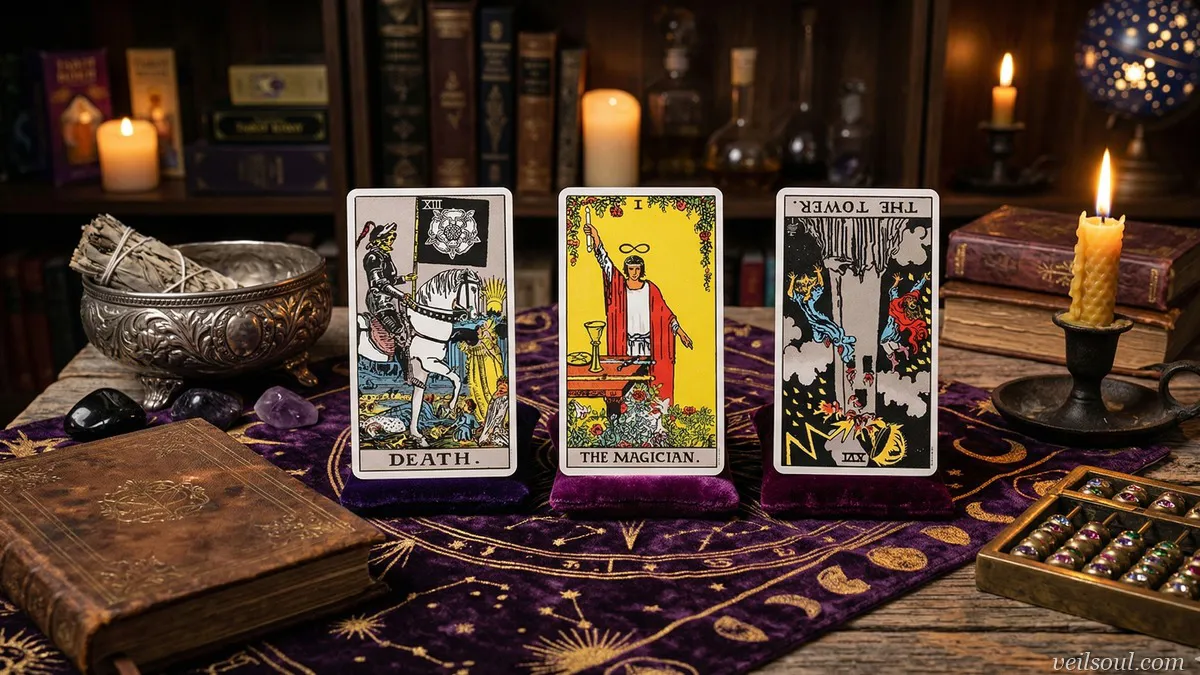
Three cards that picture a good reading space
Some tarot images show exactly the conditions a reading space tries to create. Looking at them while you set up is a good way to check what you are aiming for.
The Magician: tools laid out within reach

The Magician stands behind a stone table set with a cup, a pentacle disc, a sword and a leafy branch, one hand lifting a second branch high and the other pointing down at the table. It is the clearest picture of an altar in the deck: every tool in place, nothing extra, someone ready to begin. Upright, the card speaks of focus, skill and using what you already have. For a reading space, it asks whether your deck, notebook and light are ready before you sit, so you are not hunting for a pen in the middle of a spread. Reversed, it can point to scattered effort or a setup that has become more show than use. The full Magician tarot meaning covers the card in other contexts.
The Hermit: one lamp and some solitude

The Hermit holds up a lantern on a rocky height above a lake and distant mountains, leaning on a staff, with no one else in sight. Upright, the card is about withdrawing for the sake of understanding: stepping away from noise to see one thing clearly. That is the mood many readers want from their space, and the image is a practical reminder that one good light is enough. Reversed, The Hermit can suggest isolation that has gone on too long, or avoiding people by hiding in study. A reading space should be a place you visit, not one you disappear into. You can read more in the Hermit tarot meaning.
Four of Swords: a place where rest is allowed

In the Four of Swords, a figure lies with hands folded on a stone bench beneath a stained-glass window, three swords hung on the wall and a fourth carved into the stone below. Upright, it means rest, recovery and a deliberate pause. It reminds you that your reading space is allowed to be a place where you sit without drawing anything: a few slow breaths at the table are a perfectly good use of it on a tired day. Reversed, the card can show restlessness or pushing on when you should stop, which in practice can look like pulling card after card for the same worry. The Four of Swords tarot meaning explores the card more fully.
Setups for small, shared and travel spaces
Most people do not have a spare room for tarot. These setups work in ordinary homes.
A studio or small apartment
Build a kit instead of a corner. A shallow box or a tray holds the cloth, deck, notebook, a flameless candle and one small object. When you read, set the tray on the table and open it; when you finish, close it and slide it onto a shelf. The table goes back to being a table, and the act of unpacking does the same job a permanent altar would.
A home you share
Talk about it plainly. Most housemates and family members are fine with a short, regular block of quiet if they know when it is and how long it lasts. Early mornings and late evenings are naturally calmer. If someone in your household is uncomfortable with tarot, a closed box on your own shelf and readings in your own room respect both of you; nobody has to share the practice to share the home.
Traveling or reading outdoors
A pouch with a small deck and a folded cloth fits in any bag. A park bench, a hotel desk or a quiet café table can work if you can keep the cards flat and dry. Bring the opening routine with you. It travels better than any object, and it turns an unfamiliar table into your reading space in under a minute.
A two-minute routine to open and close
The routine is what turns a corner of the room into a reading space. Keep it short enough that you will actually do it every time.
- Clear the surface. Move cups, mail and devices out of the way, and wipe the table if it needs it.
- Lay out the cloth and switch on the light. A lamp or a flameless candle both work.
- Sit and breathe. Take three slow breaths with your feet on the floor and your hands resting on the cloth.
- Write the question. One sentence in your notebook, phrased so it can be answered with reflection rather than yes or no.
- Shuffle and draw. Use whatever method suits your hands; ways to shuffle tarot cards compares several if you are unsure.
Closing matters as much as opening. Write down the cards and one sentence about what they suggested, then put the deck back in its box or bag, fold the cloth and turn off the light. Keeping those notes in one place is the start of a tarot journal for tracking your readings, and reading back through it after a month shows patterns no single session can.
Many readers also like a small reset between sessions, especially after a heavy reading or after reading for someone else: knocking on the deck, sorting it back into order, or leaving it overnight by a window. Treat these as ways of marking an ending and starting fresh; the guide on how to cleanse a tarot deck describes several simple ones.
A first reading in your new space
Once the space is ready, a three-card reading about the space itself is a gentle way to begin. Use these positions:
- What I bring to the table: the state of mind you tend to arrive in.
- What this space can give me: the quality the setup could help you find.
- The habit to keep: one practical thing to do each time you read.
Here is an example. Imagine a reader who works long days, sets up a tray on the kitchen table and asks, "How can this space help me read more clearly?" The first card drawn is the Knight of Swords, the second is The Star and the third is the Eight of Pentacles.
In the first position, the Knight of Swords, a card of speed, urgency and sharp thinking, describes how this reader usually arrives: still at work pace, mind racing, wanting an answer fast. That is worth admitting, because it means the routine needs a real pause at the start, not just a lamp switched on.
In the second position, The Star suggests what the space could offer: calm, openness and a sense of renewal after a long day. The reader takes it as permission for the space to feel restful rather than intense, and decides to keep the light soft and the table bare apart from the cloth and one plant.
In the third position, the Eight of Pentacles is the card of steady practice and careful work. The habit to keep becomes simple: three readings a week at the same table, each one written down in two lines. The spread gives a clearer picture of how this person shows up, and one concrete thing to repeat.
If your own cards point somewhere unexpected, write that down too. The first reading in a new space is a starting note, not a verdict.
Keeping the space useful over time
A reading space works because you use it, so keep it easy to use. Clear it before each session; clutter is a decision you would otherwise have to make every time. Replace the cloth when it gets worn, and swap one altar object when the setup starts to feel invisible. If you notice you never read there, ask why: the chair may be uncomfortable, the light poor, the room too busy. Fix that rather than adding decorations.
Resist the pull toward a space that looks good in photos. A beautiful arrangement you rarely sit at helps less than a worn scarf on a cleared desk that you use three times a week. Comfort, consistency and a few objects that mean something to you are enough.
Frequently asked questions
Do I need an altar to read tarot?
No. A clear surface and a cloth are enough. An altar is an optional place to keep meaningful objects, and plenty of experienced readers never use one.
Will a better setup make my readings more accurate?
It can help you focus, which makes your reflection clearer. It cannot make tarot predictive. Whatever room you read in, the cards cannot confirm another person's feelings, a date or an outcome.
Do crystals or incense change the energy of a reading?
There is no evidence that they have a physical effect on cards or rooms. They can still be worth keeping as personal cues: a scent or a stone you associate with reading helps you settle because of what it means to you.
Is it okay to burn sage in my reading space?
White sage smudging is a ceremony of specific Indigenous peoples, and many ask outsiders not to imitate it. You do not need smoke at all: airing the room, wiping the table, ringing a bell or washing your hands works well as a clearing habit.
Can I read tarot in bed or on the floor?
Yes. Choose a firm surface, such as a tray, a large book or a cushion with a cloth on top, so the cards lie flat, and use a flameless light rather than a candle if you might fall asleep.
Should other people touch my reading space or deck?
That is your choice. Some readers keep their space private because it helps them feel settled; others share it freely. If you read for friends, a separate cloth for those sessions is an easy way to keep your personal space feeling like your own.
When your space is ready, sit down with one question and try a reading on Veil Soul to see how the new setup feels.