The past present future tarot spread is three cards laid in a row from left to right: the first shows what from your past is still shaping the question, the middle shows the present as it really stands, and the third shows where things are heading if nothing changes. A past present future tarot reading works best when you treat the row as one story with a beginning, a turn and a likely next chapter, and pay as much attention to the step from one card to the next as to the cards themselves.
That third card is a direction, not a verdict. Tarot cannot tell you what another person is thinking, fix a date, or promise how a situation will end. What a three-card reading can do is lay out the pattern you are carrying, the choice in front of you and the momentum that choice creates, so you can decide whether to keep going or change course.
The spread at a glance:
- Card 1, the past: the event, habit or feeling you still bring into the question.
- Card 2, the present: the situation once you stop seeing it through the past.
- Card 3, the future: where the current momentum points, open to change.
- The first hinge: how card 1 set up the conditions for card 2.
- The second hinge: what in card 2 is the seed of card 3.
- Time range: chosen by you before you shuffle, not read off the cards.
- Result: one sentence that joins all three cards, and one step you will take.
How to lay out a past present future reading
The layout is simple, which is why the preparation matters. A clear question and a fixed time window give each card something definite to answer.
- Write the question down. Open questions read better than yes-or-no ones: "What is shaping my situation at work, and where is it going?" gives the cards more room than "Will I get promoted?" If you want help phrasing it, the guide on asking effective tarot questions walks through rewording a vague question into one a spread can answer.
- Choose the time window. Decide how far back the past card may reach and how far ahead the future card looks, for example "the last year" and "the next three months." Writing it beside the question keeps you from stretching a card to fit any memory.
- Shuffle and draw three cards. Use whatever shuffle you like, then lay the cards face up from left to right: past, present, future.
- Decide about reversals in advance. If you read upside-down cards, settle that before the draw so you are not choosing a meaning after you see the card.
- Look before you look anything up. Note the first thing each picture shows you, a gesture, a color, an object, before reaching for a book or an app.
- Read the row, then the hinges, then write one sentence. The sections below walk through each of these steps.
This is the same three-card frame that sits behind many other layouts. If you want other position names for the same row, such as situation, action and outcome, the three-card spread guide collects nine alternatives. This post stays with the time-based version and goes deeper into it.
What each seat is really asking
Reading the positions as "what happened, what is happening, what will happen" is a fair start, but it flattens the spread into three separate fortunes. Each seat asks a sharper question.
Card one: the past you are still carrying
The first card is less a history lesson than a diagnosis. Its question is: what experience, habit or belief from before is still active in this situation? A card here does not mean the event is finished. It means the event left a posture, a way of standing in the present, and the reading wants you to notice it. A past card that surprises you is worth staying with; it may point to an influence you had stopped counting.
Card two: the present without the old lens
The middle card is the pivot of the row. Its question is: what is true about this situation right now, if you set aside what the past taught you to expect? It connects the other two cards, so read it twice: once as the result of card one, once as the starting point of card three. A middle card that feels uncomfortable is still useful, because it shows the ground you are actually standing on.
Card three: the heading, not the destination
The future card answers: if the current pattern continues unchanged, where does it lead? Think of a navigation app showing an arrival point based on your present heading. The app is not wrong, and you can still turn the wheel. A welcome card here asks you to keep moving toward it; a hard card shows you early where the road bends, while you still have time to choose differently.
Three sample cards in their seats
Here is how one card in each position shifts meaning because of where it lands. The pictures carry part of the message, so each description starts from what the card shows.
Five of Cups in the past seat
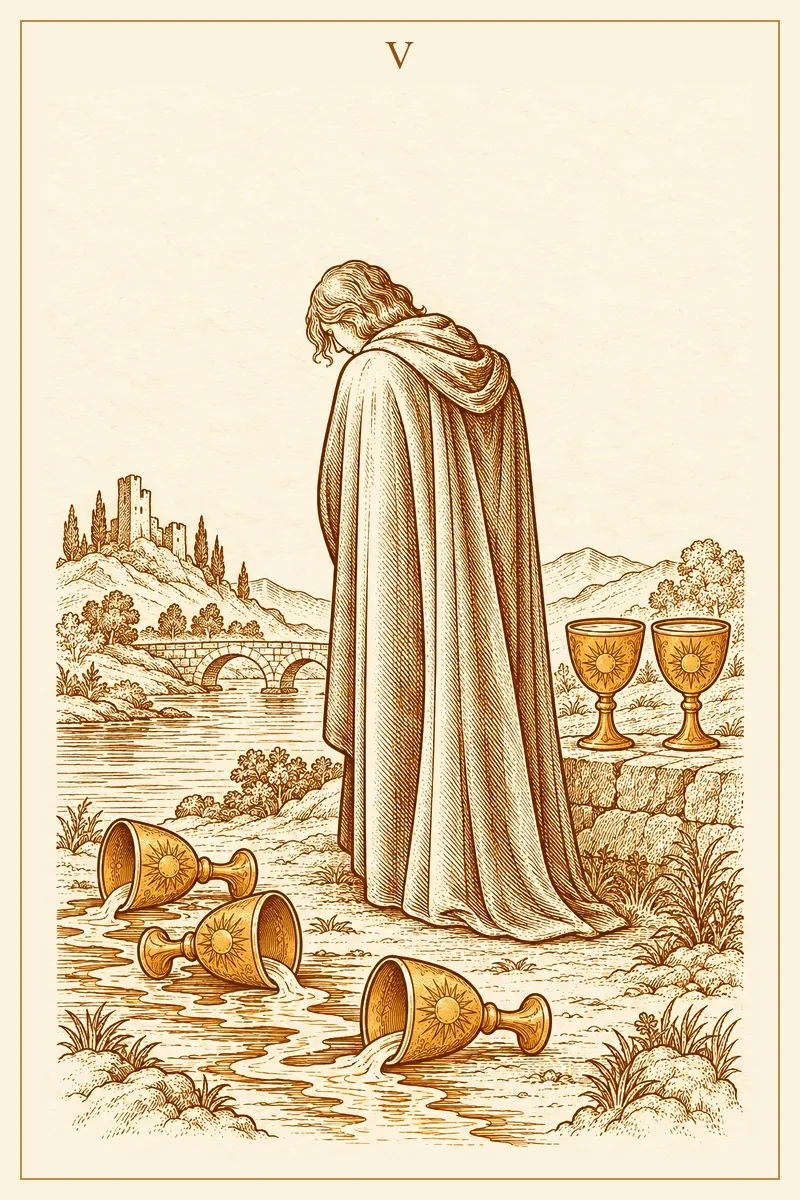
The Five of Cups shows a cloaked figure with head bowed over three cups lying on their sides, their contents running into the ground. Two full cups stand on a stone ledge just behind, and across the river an arched stone bridge leads toward a castle on the hill. In the past position, upright, the card is not simply saying something sad happened. It says you may still be standing in the posture of that loss, facing what spilled with your back to what remains. The question it hands you is practical: what is still standing behind you, and where is the bridge you stopped seeing?
Reversed in this seat, the card suggests the turning has already begun: you have started to look up from the spilled cups, even if the grief has not fully settled. The Five of Cups meaning post covers the card in every context; in this spread, its job is to name the weight you bring into the present.
The Hanged Man in the present seat
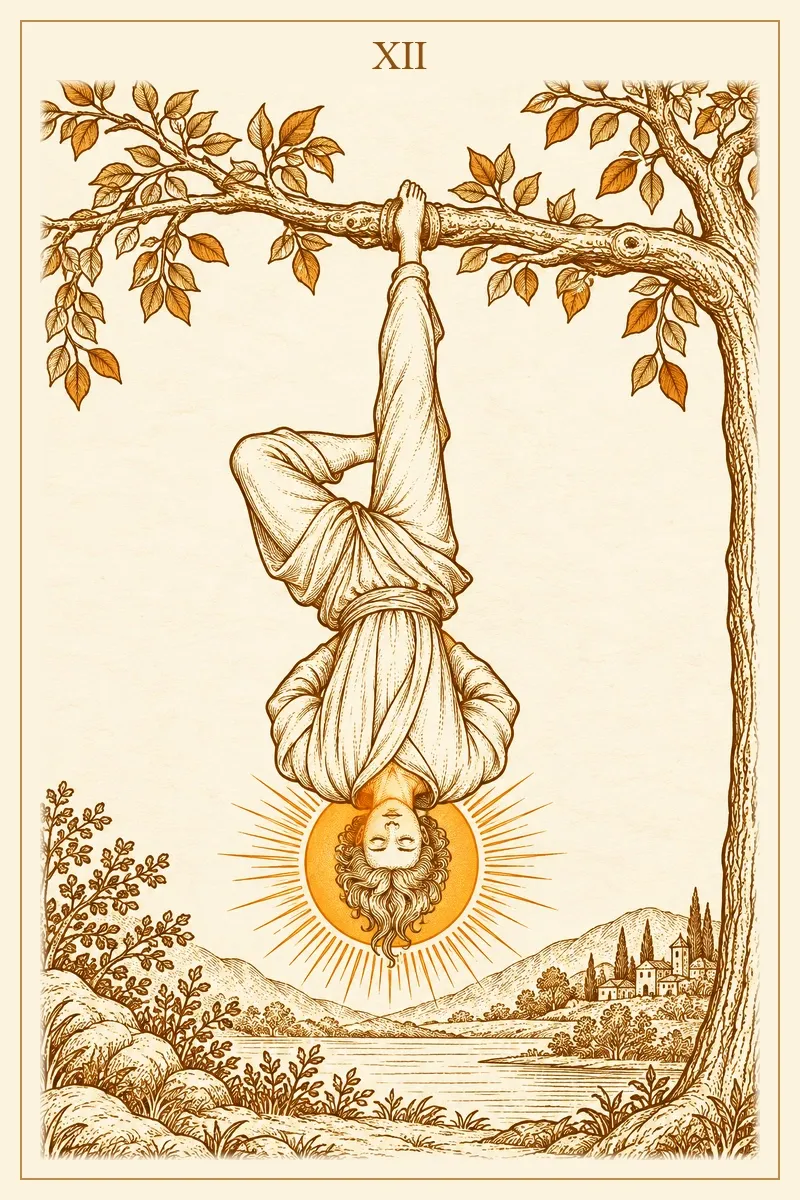
The Hanged Man hangs upside down by one ankle from the branch of a leafy, living tree, arms folded behind his back, eyes closed, a circle of gold light around his head. His face is calm. In the present position, upright, this reads as a pause you are in on purpose: not stuck, but turned around so you can see the situation from an angle you would never choose while rushing. The world looks inverted because you are reversing your view of it, and that may be exactly the work of this moment.
Reversed in the middle seat, the same pause can tip into stalling: waiting because deciding feels risky, or making a sacrifice that no longer serves anyone. The Hanged Man meaning post goes further into the difference between a chosen pause and a stuck one.
The Sun in the future seat
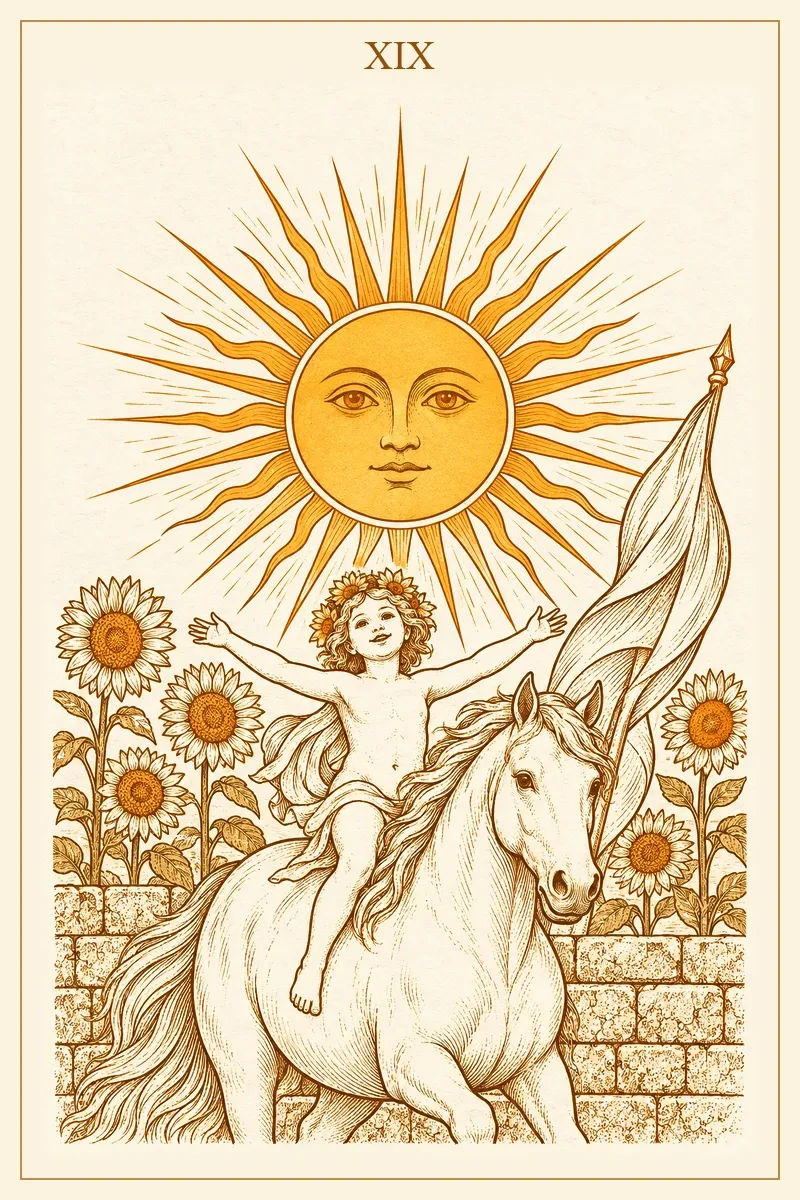
The Sun shows a smiling sun above a child with a flower wreath riding a white horse, arms flung wide, sunflowers rising behind a stone wall and a banner streaming to one side. In the future position, upright, it says the momentum is carrying you somewhere warm and open: clarity, relief, something you can enjoy without hiding it. Because this seat shows a heading, the card also asks you to keep riding. Warmth ahead does not arrive if you stop moving toward it.
Reversed in the future seat, the light is still there but dimmed or delayed: a good result that needs more patience, or a success you will have to let yourself feel. For the full range of the card, see the Sun meaning post.
Reading the hinges between the cards
The richest part of this spread sits between the cards. Two short questions turn three meanings into one account.
Past into present: what card one set up
Ask: how did the first card create the conditions for the second? Suppose the past card is the Ten of Swords, a figure lying face down on a shore with ten blades in the back while the sun sits on the horizon, and the present card is The Fool, a young traveler with a bundle on a stick stepping toward a cliff edge as a small dog leaps at his heels. Read separately, one is an ending and the other a beginning. Read as a hinge, the row says: once there was nothing left to protect, a light, unburdened freedom became possible. The Fool can step forward because the fall has lost its power to frighten.
Present into future: the seed in the middle card
Ask: what in the second card is already growing into the third? Suppose the present card is the Seven of Cups, a figure reaching toward seven cups floating on clouds, each holding a different vision: a castle, jewels, a laurel wreath, a dragon, a snake, a veiled face, a glowing figure. The future card is the Two of Swords, a blindfolded woman on a stone bench with two swords crossed over her chest. The hinge is plain: too many options without a way to choose leads to a standstill. The blindfold is what happens to someone who never commits to one cup. The useful part is that the hinge also shows the fix: pick one cup now, and the future card has less to grow from.
Elements add a second layer if you want one. Cups belong to water, Wands to fire, Swords to air, Pentacles to earth. Fire in the past moving into water in the present can mean passion being cooled or steadied by feeling. The guide on connecting tarot cards into one reading covers elements and other links between neighbors in more detail.
A worked reading: the career that stopped fitting
This example is a hypothetical reading, written to show the method from question to next step.
The question and the window
The querent has spent years in a steady office job and feels flat. Her written question: "What is shaping my restlessness at work, and where is it leading over the next six months?" The window: the past card may reach back to the start of this job; the future card looks six months ahead.
The three cards
Past: The Empress, a woman with a flower crown seated among ripe wheat under a fruit tree, a waterfall running beside her and a golden scepter in her hand. Present: the Eight of Cups, a cloaked traveler with a staff walking away from eight cups standing in two rows on the rocks, toward the mountains under a crescent moon. Future: the Ace of Wands, a hand coming out of a cloud and holding a sprouting branch, with fresh leaves still growing from the wood.
Card by card: The Empress in the past says she once felt fertile and creative; the job grew things, and so did she. The Eight of Cups in the present says she is ready to leave something that is no longer filling her, even though the cups are not empty. The Ace of Wands in the future points to a new spark, a fresh project or direction with its own energy.
Joining the row into one sentence
The first hinge: the abundance of The Empress made the departure of the Eight of Cups possible, because she knows what being creatively fed feels like and can tell it is missing. The second hinge: the traveler's choice to walk on is the seed of the Ace; the new spark appears only because she stops guarding the old cups. One sentence: "I am not walking away from making things; I am walking toward a different kind of making." Her step for the week: list three small projects she could start outside work and try one before the next reading. Nothing in the row tells her to quit tomorrow. It tells her where her energy wants to go, and leaves the timing and the risk to her judgment.
Patterns across the whole row
Once you can read the hinges, step back and look at the three cards together. A few patterns give the row an overall tone.
One suit across all three cards. The question lives mainly in one area: Cups in feelings and relationships, Pentacles in money, work and the body, Swords in thoughts and worry, Wands in drive and ambition. The suit tells you where to put your attention.
Major Arcana on both ends, a Minor in the middle. Large themes frame the question, and the everyday card in the center is the small, human-sized way you are living through them right now.
Numbers climbing or falling. A row like 3, 7, 10 suggests a build-up toward a peak or a breaking point. A row like 10, 6, 2 suggests things simplifying, with less to manage and fewer moving parts.
A rebuild arc. The Tower in the past, with lightning knocking the crowned top off a burning tower and two figures falling, then the Four of Swords in the present, a figure resting on a stone tomb with hands folded beneath a stained-glass window, then The Star in the future, a kneeling woman pouring water from two jugs under a large star. The row reads as shock, rest, renewal. The middle card is not idleness; it is recovery, and the window above it lets light in.
An optional fourth card. After reading the three, you can draw one more and place it under the present card as a "beneath the surface" card: the motive or fear quietly driving the present. Use it as a question to reflect on, not as a fourth verdict.
How far back and how far ahead the cards reach
The cards do not carry a built-in calendar, so the time range comes from the window you chose before shuffling. A few workable conventions:
- A specific question ("Should I take this job offer?"): past as the last few weeks or months, future as the next one to two months.
- An open question ("What do I need to understand about this year?"): past reaching back further, future as roughly a season.
- A life-direction question ("Where is my path heading?"): past as formative experiences, future as six months to a year.
Some cards add their own sense of pace. Aces feel like beginnings, things just starting. Tens feel like completions, energy already close to fully spent. Court cards can stand for a person entering or leaving the story, or for an approach you are being asked to take. The Wheel of Fortune in the future seat suggests a change coming from outside your plans, so keep an eye on directions you were not watching. For a fuller look at timing systems, see the guide to reading timing in tarot cards.
Love, work and money in three cards
The positions stay the same across topics, but what you look for in each seat shifts a little.
Love and relationships
Keep the question about your side of the connection: "What is shaping how I show up in this relationship, and where is it going?" The past card can show an old hurt or a pattern from earlier relationships; the present shows what you are offering and holding back; the future shows the direction of the bond if both of you keep doing what you are doing now. Read the row as a picture of your part in the pattern, the part you can change.
Work and career
Here the past card can show the skills or setbacks that brought you to this point, the present your real position today, and the future the likely result of your current effort. Practical cards such as Pentacles deserve a practical response: an update to your résumé, a conversation, a plan. When the row leaves you choosing between two paths, a decision-making approach to tarot can help you weigh the options next.
Money
Treat the row as a reflection on habits and attitudes, not as financial advice. The past card can show a belief about money you picked up long ago, the present how you are handling it now, and the future where those habits are pointing. Decisions with real stakes still belong with a qualified professional.
Four ways this spread gets misread
- Three answers instead of one story. Reading each card alone and skipping the hinges loses most of what the spread offers.
- Treating the future card as fixed. It shows the current heading. Your choices are part of the reading, not outside it.
- Stretching the past card to fit anything. Without a set window, any card can be matched to some memory. Choose the window first.
- Redrawing until the row looks better. A second draw on the same question muddies the first. If a row confuses you, write down what you can read and come back to it in a day or two.
Frequently asked questions
Can I do a past present future reading every day?
You can, but the future card needs time to unfold before you check it against your life. For a daily pull, a short format such as morning, afternoon, evening fits better. Save the past present future layout for when a question has moved on or something new has happened.
What if the future card scares me?
Remember that the third seat shows a heading, not a sentence. Death there points to an ending that clears room for something new, as the Death meaning post explains, and The Tower points to a shaky structure giving way, which the Tower meaning post explores further. Seen early, a hard card is notice you can use: to prepare, or to make the change on your own terms.
Can this spread tell me exactly what will happen?
No. Tarot works as a mirror for reflection rather than a forecast. It cannot confirm a date, guarantee an outcome, or reveal another person's private thoughts and intentions. It can show the pattern you are part of and where that pattern leans, which is still worth knowing.
Does the past card always refer to my own past?
It refers to whatever earlier influence is still at work, which can include patterns you absorbed from family, culture or earlier relationships. The Six of Cups in the past seat, for example, can point to childhood habits or old loyalties rather than a recent event.
Is the past present future spread good for beginners?
Yes, with one caveat: three cards are easy to lay out but ask a lot of each card, because there are fewer neighbors to give context. That is what makes the spread such good practice. Once you can tell a coherent story with three cards, a larger layout like the Celtic Cross becomes less intimidating.
Should I use reversals in a past present future reading?
Either way works, as long as you decide before drawing. Reversals add nuance, such as a delay, a softer version of the card, or energy turned inward, but the spread reads clearly with upright cards only.
Three cards, a story you can still edit
A past present future reading is narration rather than prediction. The past card is what you still carry, the present card is what you can see once you set that weight down, and the future card is where carrying and seeing together are taking you. Write your sentence, choose your step, and give the story some time before you read it again. When you have a question ready, you can lay out your own three cards with a calm Veil Soul reading.