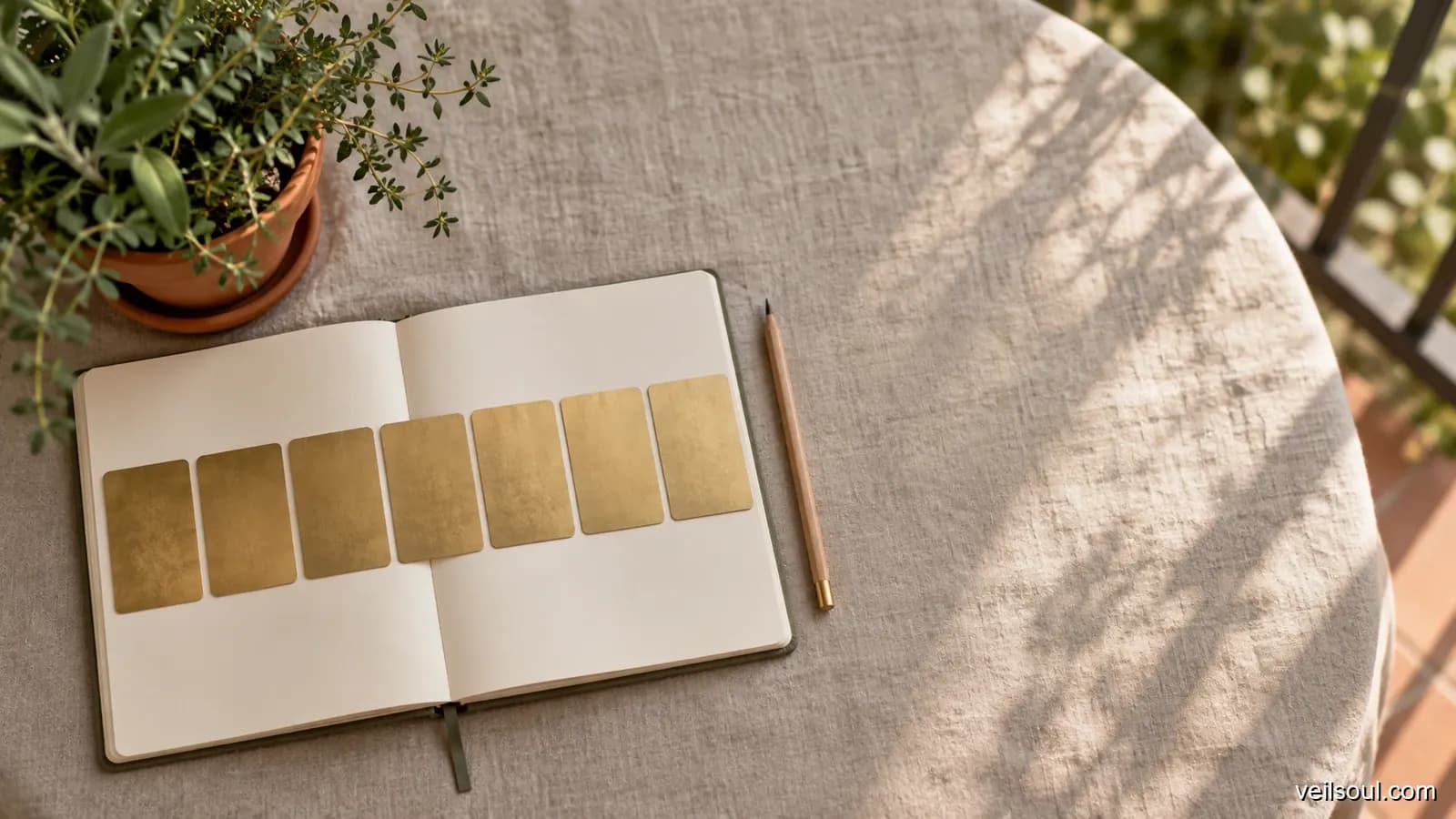
Laid out properly, a relationship tarot spread does one simple job: it gives each card a named position, so a single draw describes a partnership from several angles at once instead of handing you one vague verdict. The five-card check-in on this page reads the energy between you now, the strength you have stopped noticing, the need nobody has said out loud, the place the relationship is being asked to grow, and the one approach worth carrying into the next few weeks.
What it cannot do is worth saying before you shuffle. No layout confirms what your partner privately thinks, proves that someone is faithful, fixes a date, or decides for you whether to stay. It sorts your own impressions into five clear statements you can then take to the person who can actually answer them.
What follows is the layout position by position, what changes when a card falls reversed, the patterns that show up across a whole line, a shorter three-card version, and a full worked example. At a glance, the five positions:
- Position 1, the energy between you now: what this feels like from inside, not how it looks to other people.
- Position 2, the strength you have stopped noticing: what is already holding and deserves to be said out loud.
- Position 3, the need nobody has voiced: the want that has gone unspoken long enough to harden.
- Position 4, the growing edge: where the two of you are being asked to change shape.
- Position 5, the approach that helps: the attitude to carry into the ordinary days ahead.
Choosing the love spread that fits your question
A love spread is only useful when the layout matches what you want to know. A check-in suits a relationship that is already running: you live inside it, nothing is on fire, and you want to see it clearly for once. A brand-new connection rarely needs five cards, and a decision that would cost a great deal to reverse deserves more than five.
- Is this still good for both of us? The five-card check-in described here.
- What is happening in these first few weeks? Three cards, repeated in a month.
- What do I keep avoiding in this relationship? One card, asked plainly, written down afterward.
- Where is this whole situation heading? A long layout such as the ten-card Celtic Cross, with a free evening set aside for it.
If none of those fits, Veil Soul keeps a wider set of love and relationship layouts to choose from. The groundwork of wording a question that two people can both live with is covered in the guide to reading tarot for your relationship, and it is worth doing before you lay a single card.
Walking the five positions, one card at a time
Deal five cards face down in a row, left to right, then turn them one at a time and finish a thought about each before moving on. Reading the whole line at once flattens it. The example cards below show how a position shapes a meaning; they are not a prediction of what you will draw.
Position 1: the energy between you now

The first card answers something partners rarely ask each other directly: what does this actually feel like from the inside? Not the summary you give friends. The temperature of an ordinary weeknight.
The Four of Cups makes a good example because it is so often misread as a bad omen. In this seat it almost never means the relationship has failed. It means someone has stopped receiving: attention is being offered and not taken in. Upright, that withdrawal is usually tiredness or distraction rather than contempt. Reversed, it tilts two ways at once, either someone beginning to look up again or an apathy that has settled deeper than either person has admitted. The Four of Cups card meaning works through both readings.
Whatever lands here, finish the sentence before you move on: right now, from inside, this feels like what? Say it plainly, even if the honest word is dull.
Position 2: the strength you have stopped noticing

Disconnection has a memory problem. When a partnership feels thin, the mind reaches straight for what is missing and skips over everything that is still holding. This position exists to interrupt that habit.
The King of Cups sits on his throne in moving water with the cup held level. As a strength, he describes whoever keeps their footing when feelings run high: the one who does not escalate, who lets a bad evening be a bad evening instead of a verdict on the whole relationship. That steadiness is easy to live on and easy to forget to thank. Reversed, the card asks a sharper question. Has steadiness quietly become silence? Someone who never shows strain is not always calm. Both sides sit in the King of Cups card meaning.
If you share only one card from the whole spread, share this one. Naming a strength is the least risky sentence in the reading and usually the most welcome.
Position 3: the need nobody has said out loud

This is the middle of the spread in more than one sense. Relationships are rarely undone by the arguments people have; they wear thin around the sentences nobody risks saying. The third card gives one of those sentences a shape.
The Ace of Cups here is a plain request for emotional opening. Not a holiday or a grand gesture, just somebody looking up and asking a real question about your day. Upright, the opening is available and someone is waiting to be invited into it. Reversed, the cup is tipped: the feeling exists but has nowhere to go, often because the last few attempts to share it landed badly. Read it beside the Ace of Cups card meaning.
A harder card in this seat is not a disaster, only a plainer message. The Three of Swords usually points at a truth that has been swallowed several times rather than spoken once, and the Moon describes an unease neither of you can evidence yet. Both are still needs, and both can be put into words.
Position 4: where the relationship is being asked to grow

Partnerships are not fixed arrangements. They either widen to hold the two people you are becoming, or they keep a shape that fitted an earlier version of you both. The fourth card points at the widening.
The Hierophant in this seat asks about form: the agreements, rituals and spoken commitments that hold a relationship steady when feeling alone is not enough. Upright, it often means the partnership wants more structure, such as a standing evening nobody cancels, a promise said in actual words, or a decision made rather than drifted into. Reversed, it tends to mean the opposite: you have been following a template handed down by family or friends, and the growing edge is writing your own version of what this is. The Hierophant card meaning covers both directions.
If what surfaces here is the question of commitment itself, give it its own sitting; the cards people read as signs of marriage deserve more room than one position can offer. Expect this card to name something you have both been postponing.
Position 5: the approach that helps

The last card is the one you carry out of the room. It is not a forecast of how things end. It is the attitude most likely to help across the ordinary weeks that follow.
The Two of Cups as guidance is almost embarrassingly simple: turn toward each other. In practice that means putting the phone face down and asking one question you do not already know the answer to. Reversed, the advice changes rather than vanishes. The exchange has gone lopsided, and the useful move is to notice who has been carrying the effort and to redistribute it before resentment does that job for you. The Two of Cups card meaning expands on both versions.
Write this card's instruction down as one action with a day attached. Be more present dissolves by Thursday. No screens after dinner on Thursday tends to survive.
Reading the five cards in pairs
Once each position has an answer of its own, the spread has a second layer.
One and two together set the honest balance. Flat energy beside a substantial strength means neglect rather than damage, and neglect responds quickly to attention. Bright energy beside a thin strength card means you can enjoy the good stretch while staying curious about what is holding it up.
Three and five together are the working heart of the check-in. The unspoken need is the ailment; the guidance card is the dose. When the two sit comfortably with each other, the next step is obvious. When they argue, the guidance usually describes the approach that makes the need speakable rather than the thing that satisfies it.
Four and two together tell you what you are building from. A growing edge is far less frightening once you can see which existing strength will carry its weight.
What a reversed card changes in a check-in
A reversed card in a relationship reading is a change of volume, not a reversal of fortune. The theme stays the same while its direction, timing or availability shifts. An upright card tends to describe something moving in the open; a reversed one describes the same thing turned inward, blocked, delayed, or only just beginning.
In position three that distinction matters most. An upright need is usually one somebody is ready to say if invited. A reversed need has already been swallowed, and swallowed needs come out later as irritation about something else entirely. Read it as a signal about how safe honesty currently feels rather than as a verdict on the relationship.
If you find reversals unsettling, read your whole spread upright for the first few months. Nothing is lost by it.
Patterns across the whole spread
Before you interpret card by card, glance at the shape of the line. Suit and arcana patterns describe the register a relationship is sitting in, and that register is often the most useful thing in the reading.
Mostly Cups. The partnership is running on feeling, which is lovely when both people live comfortably there and airless when one of them needs more room to think. Ask whether emotional intensity has quietly taken the place of emotional clarity.
Mostly Swords. You are both in your heads, rehearsing the conversation rather than having it. A Three of Swords in such a line marks the sentence that keeps getting swallowed, while the Queen of Swords suggests the clarity needed to say it kindly.
Mostly Pentacles. The relationship is being lived out as logistics: money, housework, schedules, who collects whom. None of that is trivial, but it is worth asking whether practical partnership has crowded out the part that is not administration.
Several Major Arcana. Major cards in a check-in usually mean both people are changing, not only the dynamic between them, and that the relationship is being asked to change with them rather than to end. A line that includes The Tower is unsettling to look at, though it more often describes a story about the relationship giving way than the relationship itself.
Two or more court cards. Other people are in the room: a parent, an ex, a close friend whose opinion carries weight, a child.
A three-card love spread for a weeknight
Five positions ask for about twenty quiet minutes. When that is not available, the same questions compress into three cards without losing their shape, and the short version is easy enough to repeat that it becomes a habit rather than an event.
- Where we are: the honest present tense of the relationship.
- What is in the way: the obstacle, which is as often a habit as a conflict.
- What would help: the smallest useful move available this week.
Draw them in a row, read them left to right, and resist the urge to pull a fourth card to soften the second one. The same three-position frame carries past, present and future readings and a dozen other questions, as the guide to three-card spreads shows; what makes this version a love spread is only the question you asked before shuffling.
Lay the five-card check-in at the start of a season and the short version in the weeks between, and you will soon see which themes stay and which were only a bad fortnight.
Worked example: when nothing is wrong and nothing is warm
Here is a complete reading, invented to show the method rather than to describe anyone in particular. The question was deliberately unglamorous: what is actually going on between us this autumn? Four years together, no crisis, a persistent flatness neither person had named.
Position 1, the energy between you now: Four of Cups. Flat, and specifically the flatness of offers not being taken up. Somebody is being reached for and is not noticing it.
Position 2, the strength you have stopped noticing: Ten of Cups. A genuinely shared picture of what a good life looks like. These two want the same things, which is not nothing, and neither of them had mentioned it in months.
Position 3, the need nobody has said: Queen of Swords. Not more romance. Straight speech. Somebody needs to be told the truth plainly and kindly instead of being managed around.
Position 4, the growing edge: The Hierophant, reversed. The inherited shape of the relationship no longer fits. The weekly routine, the division of chores and the assumptions about who handles what were all set early and have never been renegotiated.
Position 5, the approach that helps: Two of Cups. Face each other, and make the exchange even again.
Read as a line, those five say something fairly specific. This relationship is not failing; it is running on an arrangement that stopped fitting a while ago, and the flatness is the symptom rather than the illness. The pair of three and five is the instruction: the need is plain speech and the approach is a genuine two-way exchange, so the next step is a conversation in which both people say one uncomfortable true thing and neither manages the other. The strength in position two is what makes that attempt feel survivable. The reading cannot promise the conversation goes well; it can only tell you which conversation is worth having this month.
When to lay this spread, and when to wait
A check-in is maintenance rather than emergency care, and it works best when there is enough calm in the room for honesty to be survivable. These are good moments to lay it.
- You have been saying that things are fine, and the word has started to feel like a lid.
- A season has turned and the relationship feels different in a way you cannot yet describe.
- A large joint decision is approaching, such as moving or merging money, and you want to know what foundation you are building on.
- A long stretch of busyness has just ended and the two of you need to find each other again.
There are also moments to put the deck away. Do not lay a check-in in the hours after a betrayal surfaces; a reading shaped for heartbreak will serve you better once the first shock has passed. Do not lay it hoping the cards will authorize a decision you have already made, since a spread read that way only ever confirms itself. And do not lay it to win an argument, because a reading used as evidence against a partner has stopped being a reading.
Reading alone, reading together
Both approaches work, and they unlock different kinds of truth. Alone, you get the unedited version: the card that makes your stomach drop in position three is yours to sit with before you decide what to do with it. Nobody is watching your face, so nothing gets softened on the way out.
Together, the spread becomes a shared language for things that are awkward to raise. The guidance card says we need a more even exchange lands very differently from I feel like I do everything. The cards act as a third voice with no stake in who is right, and that neutrality is often what lets a difficult subject stay on the table.
For most couples the useful order is both: read alone first and write down your reactions, then share, not the card meanings but what the cards brought up in you.
Turning five cards into one conversation
The real power of this layout is repetition. Lay it on the same date each month, or at the turn of each season, and keep the entries in one notebook. After half a year that notebook shows you things a single reading never could: the need that keeps reappearing in position three, the strength that holds steady, the growing edge that finally moved.
After each reading, have one specific conversation rather than a general one. Let us talk about us is too large to answer and usually ends in defensiveness. Responding to position three is narrow enough to be possible: here is the need that came up, here is what it brought up in me, what did it bring up in you?
Keep a note of what you actually did afterward, too, not only what the cards said. A check-in that never changes a Thursday evening is a diary. A check-in that moves one small thing is a practice.
Frequently asked questions
What is the best tarot spread for a relationship?
The one that matches your question. For an existing partnership that feels unclear, a five-position check-in is usually enough, because it separates the present mood from the strength, the need and the next step. A new connection needs only three cards, and a decision with real consequences deserves a longer layout.
Can I use this spread if I am single?
Yes, read it as a check-in with yourself. Position one becomes your own emotional weather, position three becomes the need you have not admitted to yourself, and position five stays exactly what it is. A layout built around your own life rather than an absent person is covered in the guide to tarot for singles.
What if every card in the reading looks bad?
No card in the deck is purely negative, and difficult cards in a check-in are the spread doing its work: they point at what needs attention while it is still small. A couple able to look at a hard line of cards together is in better shape than one that only draws when things already feel pleasant.
Should both partners be there when the cards go down?
It depends what you need. For raw personal honesty, read alone; for shared understanding, read together. If you are unsure, read alone first and share afterward, which gives you both without forcing either.
How is a check-in different from a general love spread?
A love spread is a wide category covering attraction, compatibility, new connections and specific romantic questions. A check-in is narrower, since it assumes the relationship already exists and asks how it is doing. Think of a routine appointment rather than a first consultation.
How often can I lay this spread without wearing it out?
Monthly suits most people, and seasonally suits anyone who finds monthly too intense. Drawing the same spread repeatedly within one week rarely produces new information; it produces anxiety wearing the costume of insight. To draw more often, use the three-card version.
Can tarot tell me whether we will stay together?
No, and a spread that claims to is overstating its case. Tarot cannot confirm another person's private feelings, verify loyalty, name a date or guarantee an outcome, because the outcome depends on choices neither of you has made yet. What it can do is show you clearly what you are already sensing, so that those choices get made with your eyes open.
A mirror the two of you hold
The best check-ins rarely end in revelation. They end in recognition: two people finally hearing out loud something they had each been thinking separately for weeks. The cards supplied no new facts. They made a space where the truth could sit on the table instead of in the gap between two pillows, which is the whole purpose of this layout.
When you would like a spread drawn and interpreted for you, you can start a free reading with Veil Soul and bring what it shows into your next honest conversation.