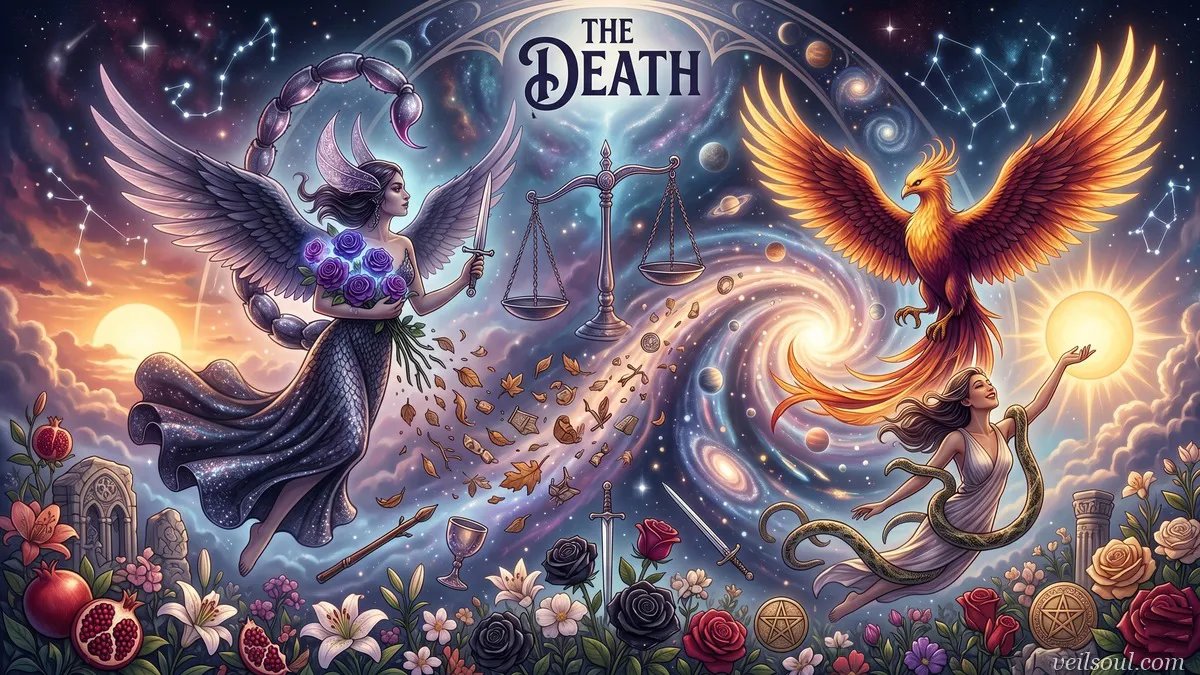
Death, the thirteenth trump of the Major Arcana, is the tarot card for Scorpio, and the image on it is a field being cleared rather than a catastrophe. Mars ruled the sign for centuries before Pluto was found, which puts The Tower one step behind it, and Judgement is the trump modern readers lend to Pluto. The Five, Six and Seven of Cups carry Scorpio's three decans, and two court cards cross its thirty degrees.
These cards describe pressure and the questions that come with it. They will not tell you what another person has privately concluded, when something will happen, or how a situation ends while the people in it are still choosing. What they are good at is naming the thing everyone can feel and nobody will say.
The Scorpio set is short enough to list in full:
- Death (XIII): the sign's own trump, and the ending that has already happened.
- The Tower (XVI): the card of Mars, and a structure failing at its weakest joint.
- Judgement (XX): the trump modern readers pair with Pluto, and a reckoning you cannot un-hear.
- Five of Cups: first decan, Mars in Scorpio, the loss counted properly.
- Six of Cups: second decan, the Sun in Scorpio, tenderness behind the armor.
- Seven of Cups: third decan, Venus in Scorpio, desire with seven faces.
- King of Cups: Scorpio's first twenty degrees, a deep current held on a steady rein.
- Knight of Wands: Scorpio's last ten degrees, where held pressure breaks into motion.
Late autumn, water, and a sign that holds on
Scorpio runs from about October 23 to November 21, when the harvest is in and the light goes early. In the deck, water belongs to the Cups: what people feel, cling to and stay loyal to, often before they can say why. Scorpio is also fixed, set in the settled middle of autumn, and fixed signs keep things where they are.
A fixed sign inside a flowing element produces attachment that will not loosen by itself, which is why these cards are usually about something being kept — a secret, a loyalty, a debt, a grudge, a grief carried past its useful life. That is what holding looks like when the thing held is a feeling.
Each of the three water signs takes three of the numbered Cups, in order: Cancer takes the Two, Three and Four, Scorpio the Five, Six and Seven, Pisces the Eight, Nine and Ten. Scorpio's run is the difficult middle, where feeling stops being pleasant and starts asking something of you.
Death (XIII), and what is actually in the picture
The attribution comes from the Golden Dawn's tables, which almost every twentieth-century deck was built on top of, and there Scorpio takes the thirteenth trump with the Hebrew letter Nun, whose name means fish. The card's old title was the Lord of the Gate of Death, which sounds grim until you notice that a gate is a thing you walk through.
What the thirteenth card is for
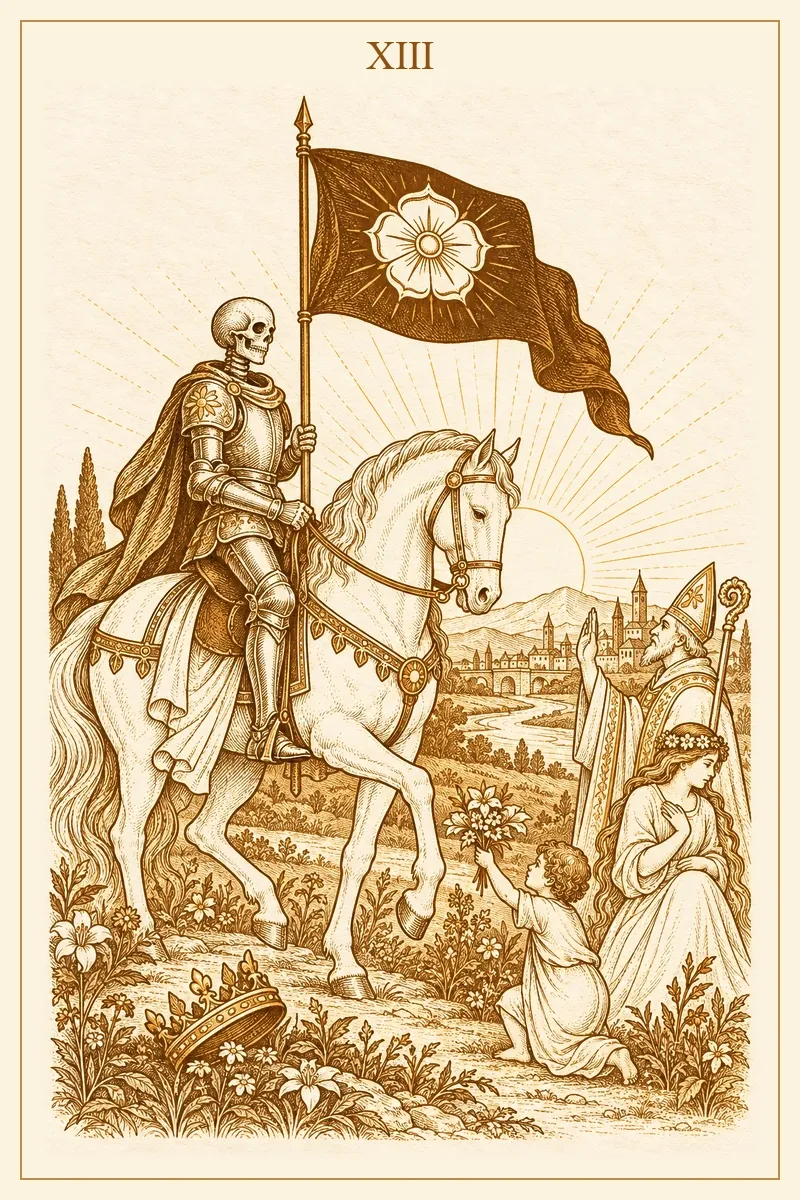
Older decks drew a reaper in a field of stubble with a scythe, which is where the harvest reading comes from. The later version swapped the scythe for a banner: an armored skeleton on a pale horse at walking pace, a fallen crown in the flowers, and a bishop, a young woman and a child waiting in its path, with a low sun behind them. Nobody in the picture is exempt, and that sun is usually read as rising.
Upright, the card says an ending has already taken place, and the only open question is how much longer you will describe the situation as though it had not: the job you have mentally quit, the friendship that is now two people being polite, the version of yourself that stopped fitting a while ago.
Reversed, it points at the gap between the ending and the admission. Something is kept technically alive — the group chat nobody posts in, the arrangement renewed out of habit, the apology drafted and never sent. It can also read gently, as a transition not to be hurried. The full Death tarot meaning works through its symbols one at a time.
Mars and Pluto, the sign's two rulers
The deck treats them very differently. Mars is the traditional ruler and holds a trump of its own. Pluto was discovered in 1930, long after the attributions were written, so it never received a card of its own; readers borrow one instead, and almost all of them borrow the same one.
The Tower (XVI): the card Mars actually holds
The Tower belongs to Mars under the Hebrew letter Peh, with the old title Lord of the Hosts of the Mighty. A tall tower on a rock has had its crown blown off by a single bolt, and two figures are thrown into the air. It is not a punishment card but a structural one: what comes down was already built wrong, and the lightning only found the joint. Upright, a fiction stops being maintainable — a resignation, an admission that changes what everybody can pretend. Reversed, the collapse is slower or postponed: the repair that holds one more season, the conversation delayed again. The Tower tarot meaning covers the card outside an astrological frame; here it works as a diagnosis, asking which joint is bearing weight it was never designed for.
Judgement (XX): the trump readers lend to Pluto
Judgement shows an angel sounding a trumpet above figures rising with their arms open. In the traditional attributions it belongs to the element fire and the letter Shin, not to any planet, so pairing it with Pluto is a modern choice rather than an inherited one. It is a good choice: Pluto describes what surfaces and cannot be put back, which is the trumpet's job. Upright, the card is a call already heard, a decision long in formation that is now audible and usually has other people inside it. Reversed, it is the hand over the ear, or a self-assessment too harsh to answer honestly. The Judgement tarot meaning covers its vocational side. Read it as the opposite of The Tower: not a structure failing, but a summons.
The Cups get difficult in the middle, and the middle is Scorpio
Book T, the Golden Dawn's card manual, cuts the zodiac into thirty-six ten-degree slices and gives each a numbered card, Twos through Tens, in fixed rotation. The sequence begins at zero degrees of Leo with the Five of Wands, so the suits land where they do for arithmetic rather than for poetry. Treat a decan card as the mood of a few weeks rather than a forecast: read it as a card before you read it as a date, and let the sub-ruling planet tell you what pressure it is under. The dates drift by about a day between years, and each window marks when a theme tends to be loud, not when an event will land.
Five of Cups: Mars in Scorpio, about October 23 to November 1
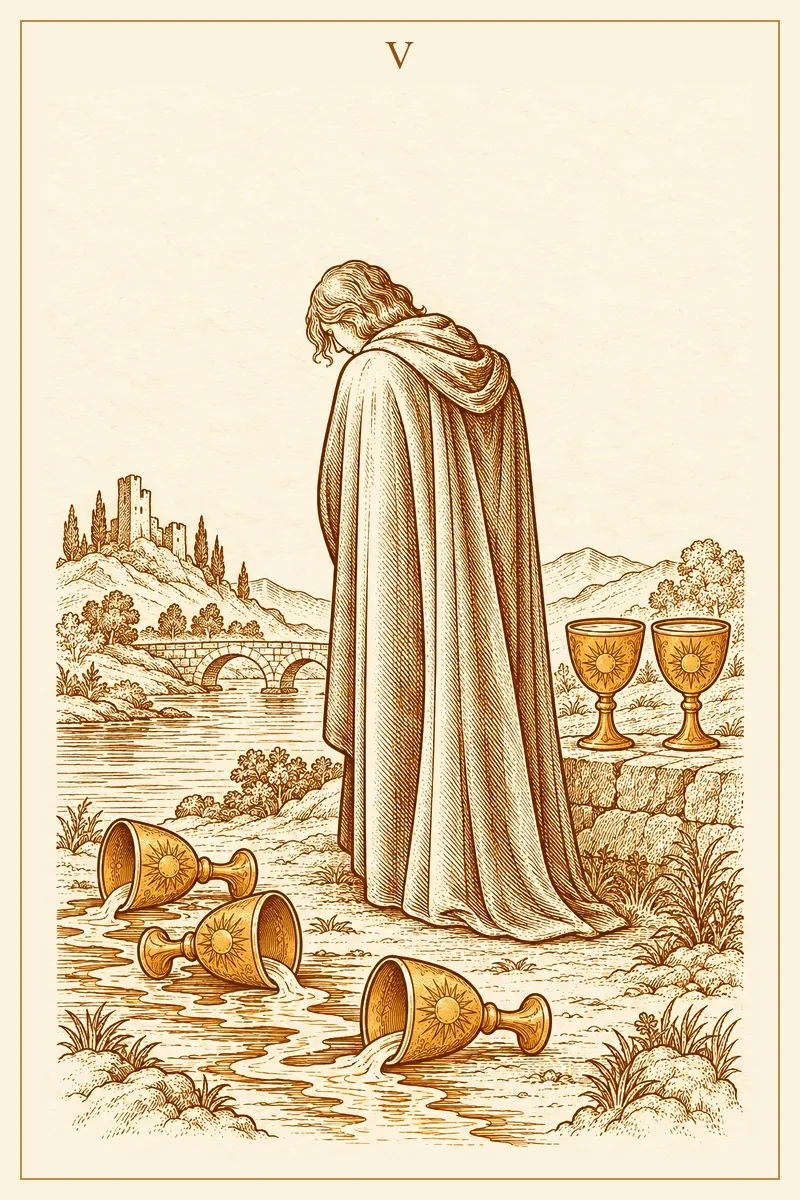
A cloaked figure stands with their head down over three spilled cups. Two more are upright behind them, unnoticed, and a bridge crosses the river toward a building on the far bank. The old title is the Lord of Loss in Pleasure, and Mars sub-rules the decan, which is why this grief has edges: early Scorpio does not drift through disappointment, it goes in and counts what was lost.
Upright, the card is permission. Something is worth mourning, and mourning it is the correct response rather than a failure of perspective. Reversed, either the figure turns around and the two standing cups come into view, or the loss is put down too quickly with cheerfulness used as a lid. Mars adds the Scorpio risk of turning a grief into a grievance and then into a project. For the bridge, the most hopeful detail in the picture, see the Five of Cups meaning.
Six of Cups: the Sun in Scorpio, about November 2 to 11
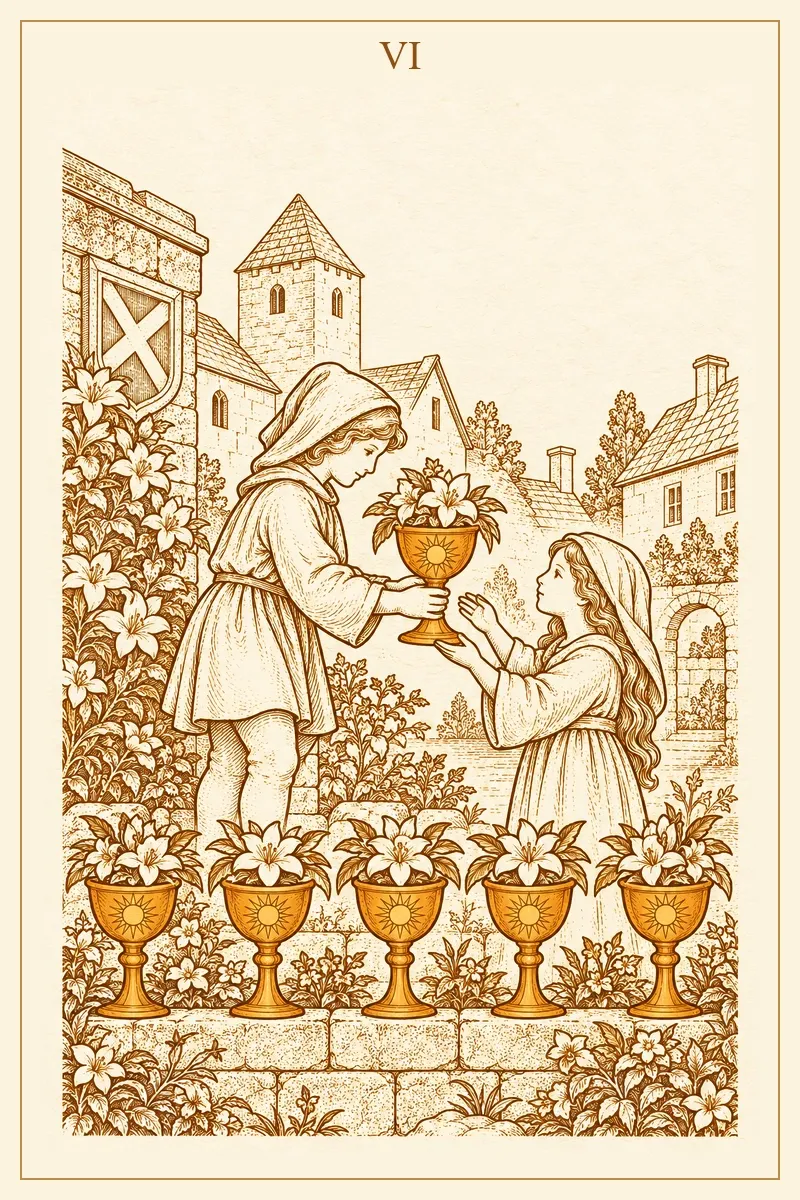
A taller child hands a cup of white flowers to a smaller one in a walled courtyard. The Golden Dawn called it simply the Lord of Pleasure, and the Sun sub-rules it. That surprises readers in the middle of Scorpio, and it is the most useful thing the decans say: behind the guard there is a disproportionate amount of sweetness, and it comes out when the person feels safe.
Upright, it is memory doing something kind — a reunion, an old friendship resumed without explanation, a generosity with nothing attached — and here it often marks the point where someone lets a person back in. Reversed, memory turns into furniture: the past is kept so warm that the present cannot compete, or a relationship is conducted with an edition of someone who no longer exists. The Six of Cups meaning is good on the line between nostalgia and avoidance.
Seven of Cups: Venus in Scorpio, about November 12 to 21
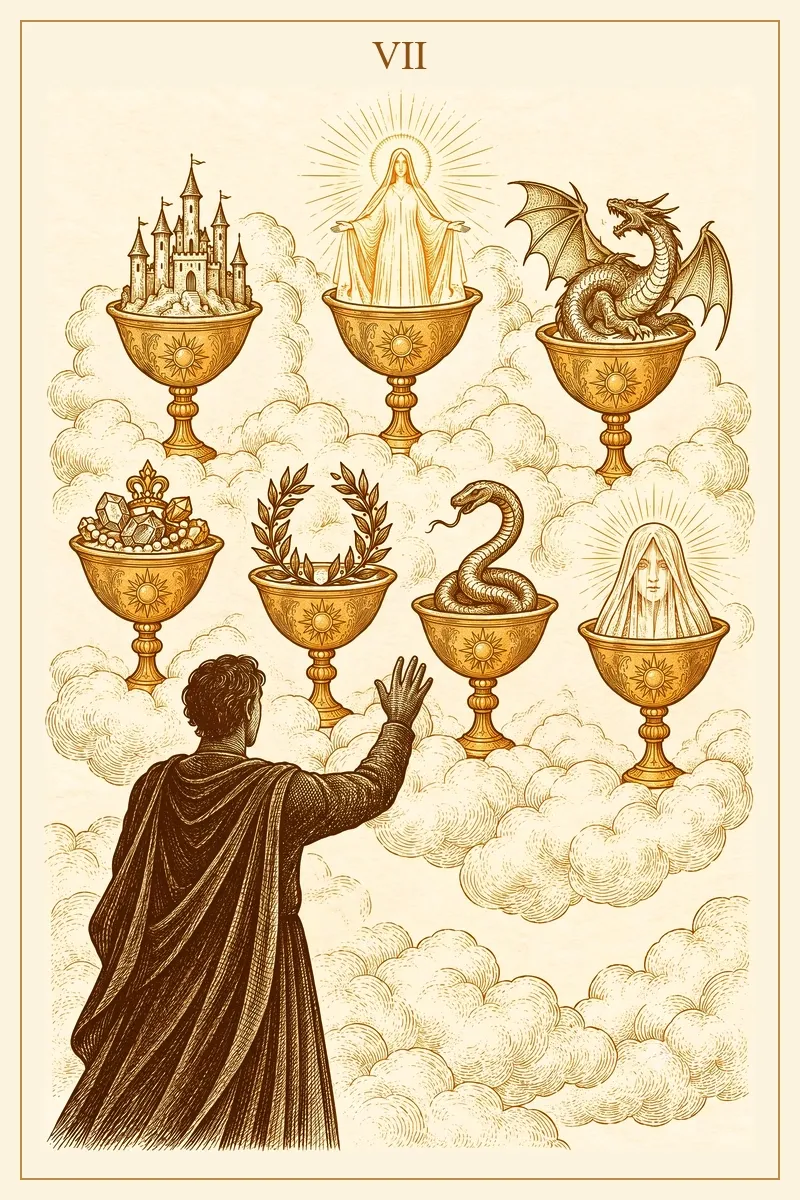
Seven cups rise out of cloud in front of a cloaked figure seen from behind, each holding something different: a glowing robed figure, a veiled face with light behind it, a snake, a castle, jewels, a laurel wreath, a dragon. The old title is the Lord of Illusionary Success, and Venus sub-rules the decan, which gives late Scorpio desire with a large imagination attached.
Upright, the card warns about richness without weight: seven vivid options, none of them costed, a fantasy rehearsed often enough to feel like a plan. Here it usually concerns a person rather than a project, an attachment built mostly out of what you have filled in. Reversed, the cloud clears — you pick one cup and accept that choosing means losing the other six, or you see that the offer was never real. The Seven of Cups meaning goes through what each cup holds.
Which court card do you actually pick up?
This is where the sign gets misread most often, and the confusion is a naming problem rather than an astrological one. The older system gives every suit a King, Queen, Prince and Princess; most decks printed in the last century give it a King, Queen, Knight and Page. The older Prince, a figure in a chariot, is printed as the King in a modern deck, and the older King, a mounted figure, becomes the Knight. Line the ranks up and Scorpio's thirty degrees turn out to be covered by two cards.
King of Cups: 0 to 20 degrees of Scorpio
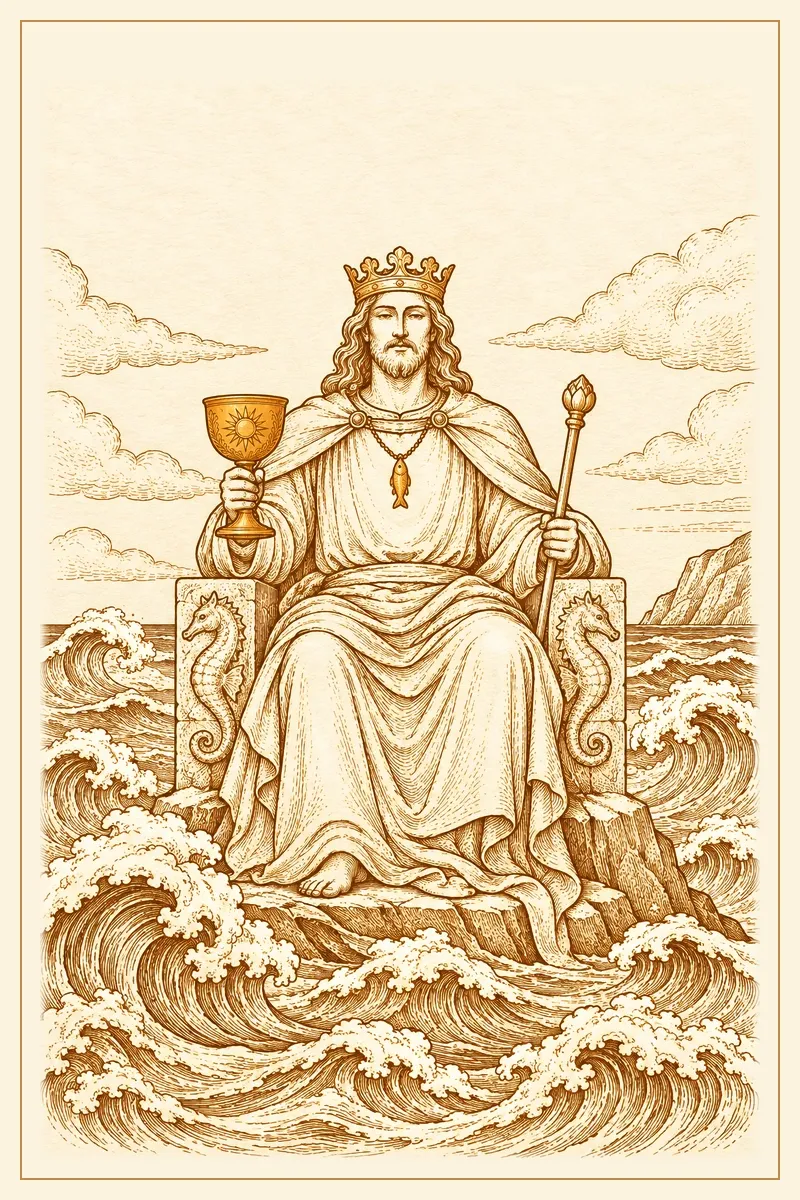
A crowned figure sits on a seahorse-carved stone throne on a rock in rough water, cup in one hand, scepter in the other, a small fish at his chest. Nothing about the sea is calm and nothing about the figure is troubled. This is the card to reach for out of an ordinary deck when you want Scorpio's court, and it is the older Prince; the same card also covers the back half of Libra.
Upright, it is composure that comes from experience instead of distance — the person others tell things to, a counselor or a nurse or a manager trusted with bad news. Reversed, feeling is managed rather than felt, calm becomes a lid, or a deep read of what moves somebody else gets used as leverage instead of care. That last one is the fair part of Scorpio's reputation, and it is a failure mode rather than a nature. The King of Cups meaning covers the leadership side.
Knight of Wands: 20 to 30 degrees of Scorpio
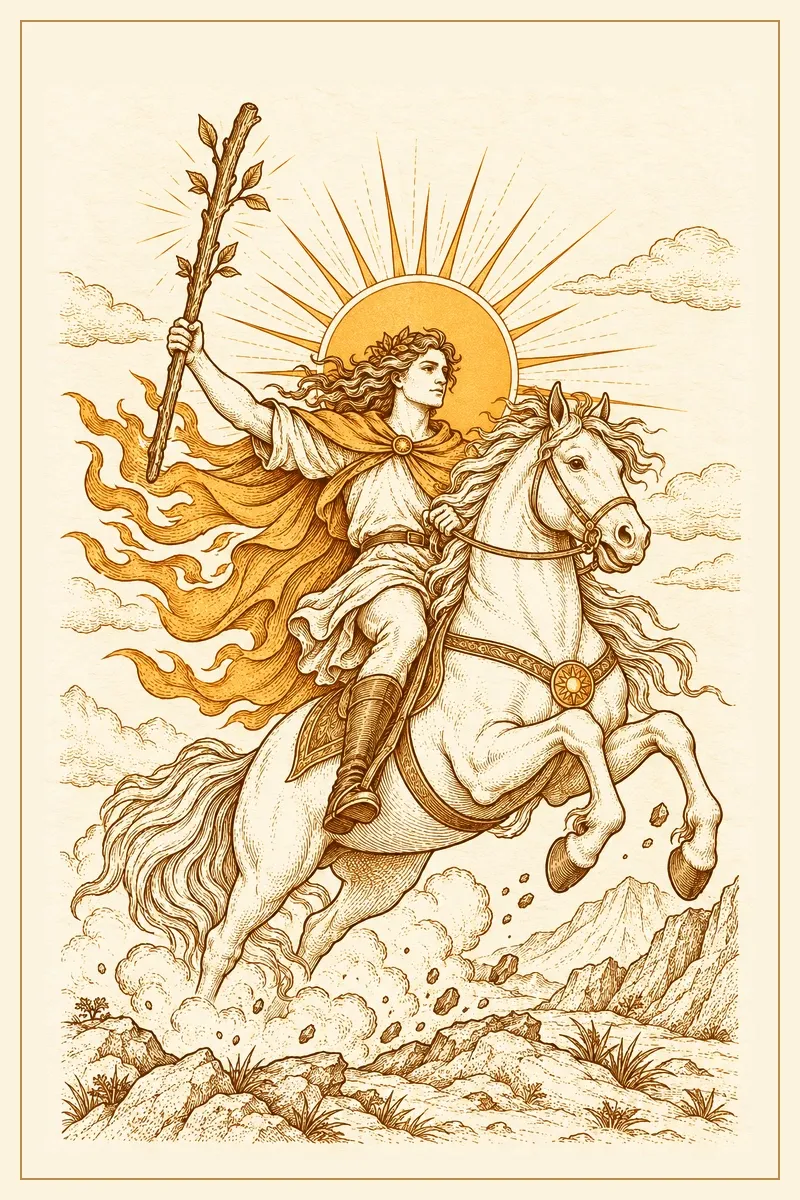
The sign's last ten days belong to the rider in a flame-edged cloak, on a horse already lifting off the ground. Here he reads differently than he does further into Sagittarius, because this is where held intensity converts into movement, and the conversion is abrupt: months of saying nothing, then a decision announced on a Tuesday.
Upright, the thing finally gets done — the message sent, the apartment given up, the application in, the truth said at ordinary volume. Reversed, the charge goes off without a direction, in a fight picked because the pressure needed somewhere to go, or a departure staged as a liberation when it is mostly an exit. Taken with the Knight of Wands meaning, the Scorpio end of his range is the end that has been loading up in silence.
These cards in love, at work, and in what people share
Love and intimacy
Death in a relationship question is the card people most want to argue with, and it is rarely the end of the relationship. It is the end of a form: the long-distance arrangement, the second year's version of each other, a role one person has played since the beginning. Six of Cups nearby suggests a return to something warmer; Seven of Cups nearby suggests part of what is ending only ever existed in one person's head. The King of Cups upright is a partner who can hold a hard conversation without it becoming a crisis; reversed, it is the pleasant surface over an unspoken two years.
Work and reputation
The Tower at work is almost always structural: a role built on one person's goodwill, a process held together by somebody's unpaid overtime, a shift schedule that only works while nobody is sick. Judgement is the other shape, a call rather than a collapse, usually about work that keeps asking for you. Death in a career reading often means the job is already over internally, so the question moves from whether to leave to how to leave well. The Knight of Wands here is the moment a quiet person says the thing out loud in a meeting.
Shared money, debts and what somebody left behind
Modern astrology links Scorpio with the territory of things held in common: joint accounts, inheritances, debts, anything where two people's resources are tangled together. Five of Cups counts a real loss and asks you not to round it down; Six of Cups brings in family history and the favors nobody wrote down; Seven of Cups is the valuation made out of hope rather than arithmetic. None of that is financial advice. What a reading can do is show which part of the question is about money and which part is about who felt owed.
A six-card spread for what will not stay buried
This layout suits the questions that bring people to Scorpio's cards: a situation everyone is careful around, a change nobody has acknowledged, a loss that keeps getting rounded down. Shuffle with the question written in front of you and lay the cards in order.
- What has already ended. The part of this that is finished, whatever you still call it.
- What I am holding shut. The thing kept out of the conversation by you, on purpose or by habit.
- What is underneath that. The older feeling the secrecy is protecting.
- What it is costing somebody else. The part of this that other people are carrying for you.
- What survives the change. What is still here on the far side, usually more than it looks.
- The first honest move. One thing you could do or say this week without rehearsing it.
Write a sentence for each position before you turn the next card, and expect position four to be the one you want to skip. Newer readers can practice first with the beginner spreads guide, which works with fewer cards. A short list of the questions you actually want answered helps more than adding cards.
Three cards on a conversation that stopped
Take an illustrative question: my sister and I have not spoken about our mother's house since the spring, and I no longer know what I am dealing with. Three positions from the spread above, drawn one at a time.
What has already ended: Six of Cups. At first glance this looks like the wrong card for a stalled argument, and in position one it is precise. What ended is the family as it used to operate, where two sisters never had to negotiate anything because their mother handled it. The card names what is mourned underneath a dispute that looks like it is about a building.
What is underneath: Five of Cups reversed. Upright this would be grief counted properly. Reversed, here, it reads as grief put down far too early: eight months of practical arrangements and nobody saying out loud that they are sad. The two standing cups are present, which is to say the relationship is not gone — it has been unavailable for conversation since the funeral.
The first honest move: Knight of Wands. The last court card of Scorpio does one thing well, and it is the thing that has not happened: direct contact, unrehearsed, with no strategy behind it. Not a discussion about the house — a message that says the part nobody has said. He also warns against his own excess, so the move is one message rather than a long letter, and sent rather than drafted.
The reading cannot report what her sister is thinking or how the house will be settled. It names the object standing in for the conversation, and the smallest action that would end eight months of silence.
Depth is a skill right up until it becomes a habit
These instincts belong to anyone using these cards, Scorpio-born or reading in late autumn, and each can go wrong.
What this attention catches
- The unspoken part. You notice what is being carefully not mentioned, in a spread and in a room.
- Motive, not only event. You read for why a situation persists rather than only for what happened, which is where the useful answer lives.
- Stamina for heavy cards. A hard card does not get softened on sight; this instinct keeps looking until it says something.
Where it overreads
- Everything becomes profound. Sometimes the Five of Cups is a canceled weekend and not a wound from childhood. Let a small card stay small.
- Hidden motives in neutral cards. A Page is not always concealing something. Take the card at face value first and go looking only when the spread gives you a reason.
- Attachment to transformation. Acceptance without change is a legitimate answer, and Death does not insist on appearing in every reading.
Habits that make a heavy season bearable
Decide the number of cards before you shuffle and stop there, because re-drawing until the spread agrees with you is the commonest way a deep reading goes wrong. Fix the wording of the question on paper and leave it alone. When you finish, wash a cup or walk around the block so the reading has a clear end.
Frequently asked questions
What tarot card is Scorpio?
Death, the thirteenth trump. That is the Golden Dawn attribution and nearly every modern deck keeps it. Mars, the traditional ruler, brings in The Tower, modern readers pair Pluto with Judgement, and the Five, Six and Seven of Cups hold the three decans.
Why is Scorpio's card Death if Death is not about dying?
Because the sign governs the part of the cycle where a form breaks down so the material can be used again, which is what the card depicts. The attribution is about completion and a change of state, and in practice the card describes endings people are already living through.
I am a Scorpio and I drew Death. What does that mean?
Usually that a change you have been circling for months is further along than you have admitted. A card matching your own sign tends to land as confirmation rather than news, and it is more useful as a mirror than as fate.
Is Scorpio's court card the King of Cups or the Knight of Cups?
Neither name is wrong, but the King of Cups is the card you want out of a modern deck. The older system calls that figure the Prince of Cups and gives it twenty degrees of Libra to twenty degrees of Scorpio. The Knight of Cups in a modern deck is the older King of Cups, whose degrees run across Aquarius and Pisces, so it is not a Scorpio card at all.
What are the Scorpio decan cards?
The Five of Cups, with Mars, covers roughly October 23 to November 1; the Six of Cups, with the Sun, about November 2 to 11; and the Seven of Cups, with Venus, about November 12 to 21.
Which cards get called Scorpio by mistake?
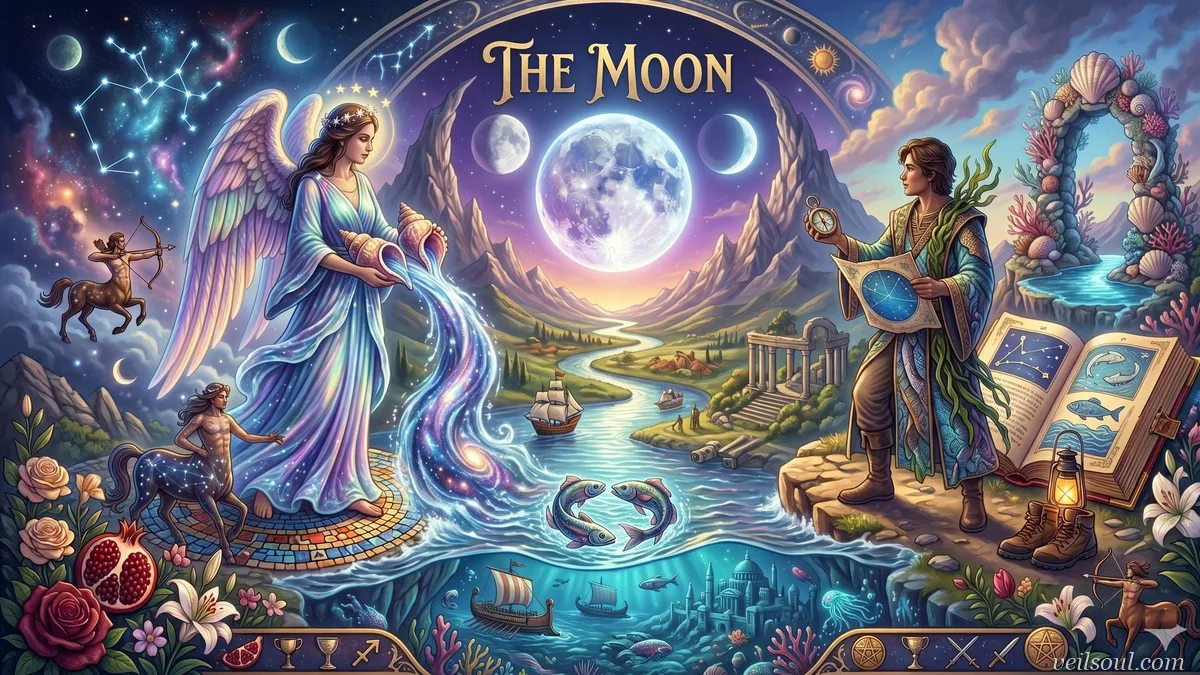
Three in particular. The Devil is Capricorn, however much its chains and appetite sound like the reputation. The Moon is Pisces; the Scorpio version of not being able to see is the Seven of Cups, where the trouble is too many bright pictures rather than darkness. And the Three of Swords, the card people call betrayal, is Saturn in Libra.
Can tarot tell me what will end during Scorpio season?
No. Nothing in a deck fixes a date, reports what somebody else has decided, or locks an outcome in place while the people involved are still deciding. Use a seasonal reading to set two or three intentions, then check them again in December.
What the cleared field is for
The point of this part of the deck is not intensity. It is accuracy about what is finished, and then the willingness to put down something carried out of loyalty rather than need. Nothing here asks you to destroy anything; it asks you to stop maintaining what has already ended.
One card is enough to begin with: draw a single one in a reading and write down the one thing it makes you admit.