Tarot is not dangerous. A deck is 78 printed pictures, and laying a few of them out is a structured way to think about a question; the cards cannot curse you, bring something into your home, or fix your future in place. What deserves care is how you use a reading: it should not stand in for a doctor, a lawyer, a financial advisor or your own judgment, and a reader who frightens you and then sells you the cure is someone to walk away from.
Tarot also has limits worth naming at the start. A reading cannot tell you what another person is thinking, give you a date, or promise how a situation ends. It reflects your question back to you so you can see it more clearly. If you want the safety side in more depth, the full answer to whether tarot cards are dangerous walks through overuse, high-stakes decisions and hard moments one at a time.
Below are twelve tarot myths debunked one by one, grouped by the worry behind them: fear of harm, rules about your deck, doubts about who is allowed to read, and questions of faith and fate. Here is the short version:
- Tarot can curse you or invite something in: a deck is paper and ink, with no power of its own.
- Death means someone will die: it describes an ending and a change of season, not a physical death.
- The Devil card is evil: it names a habit or attachment you can loosen.
- Some cards are always bad: every card has a hard side and a helpful side, and context decides which applies.
- Your first deck must be a gift: buying your own is fine.
- Nobody else may touch your deck: a matter of taste, not a rule.
- You need psychic powers: reading is a learnable skill.
- You cannot read for yourself: you can, with a few honest habits.
- More cards mean a better reading: one well-asked card can say more than ten.
- Real readers must use reversals: reversals are optional.
- Tarot is against religion: traditions differ, and the choice is yours.
- Tarot predicts a fixed future: it shows a direction you can still change.
Why tarot picked up a frightening reputation
Tarot began as a card game. Decks were painted for noble families in northern Italy in the fifteenth century, and the game, later known as tarocchi, spread across Europe long before anyone read the cards for meaning. The link with fortune-telling and the occult came centuries later, when French and English writers of the late 1700s and the 1800s wrapped the trump cards in theories about ancient Egypt and secret wisdom. Historians have not found support for those theories, but the mystique they created stuck.
Film and television added the rest. A Death card turned over by candlelight is a quick way to tell an audience that something bad is coming. Add the warnings passed between friends and relatives, such as "never buy your own deck" or "don't let anyone touch it," and a beginner can arrive at the cards already nervous. None of that history makes tarot harmful, but it explains why the questions below can feel urgent before you have shuffled even once.
Myths about harm and bad luck
Myth 1: Tarot can curse you or let something into your life
The myth: Reading tarot opens a door to spirits, attracts bad energy, or brings bad luck to whoever owns the deck.
The truth: A tarot deck is card stock printed with pictures, a close relative of a pack of playing cards, and it does nothing on its own. Shuffling it does not summon anything, and a deck sitting in a drawer has no effect on your luck. The meaning in a reading comes from the person looking at the images and thinking about a question.
What can go wrong is human, not supernatural. Asking the same question again and again can leave you anxious, and a dishonest reader can use fear to sell "curse removal" or expensive rituals; if anyone says you are hexed and the fix will cost money, you can leave, because there was nothing to remove. If your spiritual beliefs make you uneasy about tarot, that unease deserves respect, and choosing not to read is a complete answer.
Myth 2: The Death card means someone will die
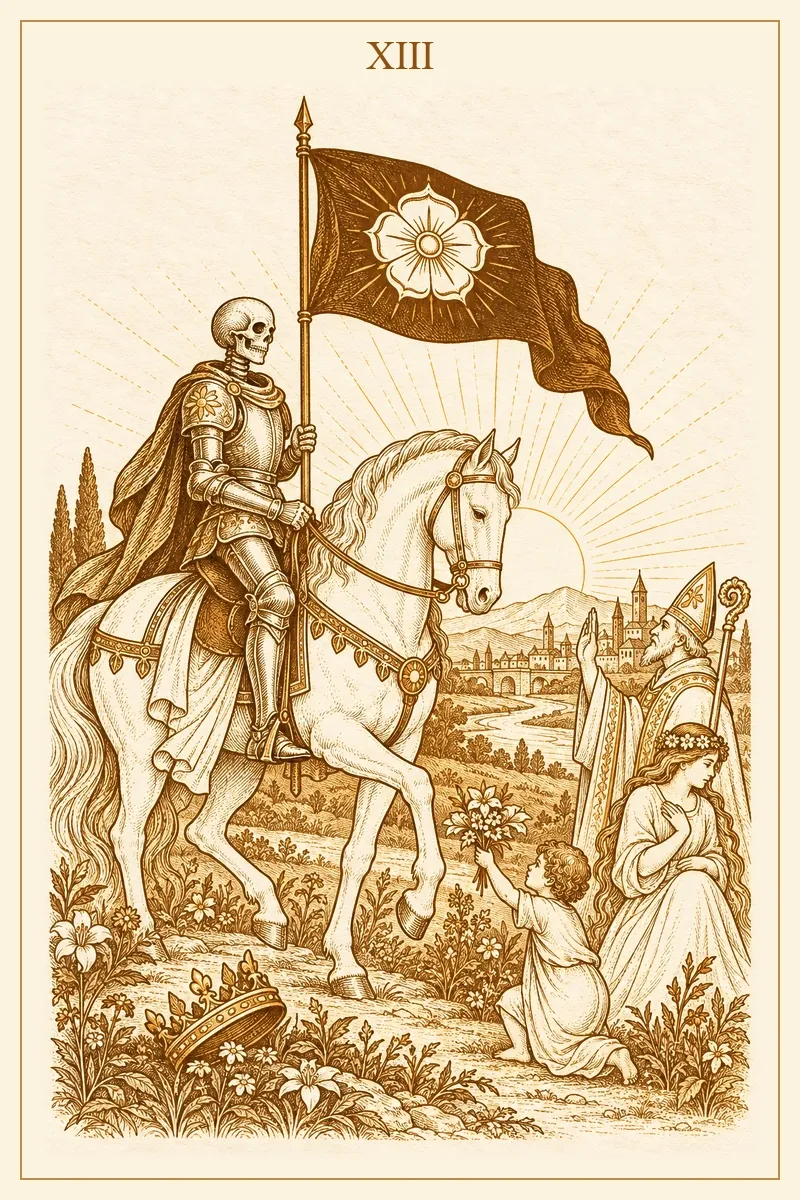
The myth: If Death appears, the reading is predicting your death or the death of someone close to you.
The truth: Death is a card about endings that clear space: a job that has run its course, a relationship changing shape, a habit or belief you are ready to put down. On the card, a skeleton in armor rides a white horse under a dark banner marked with a white flower. A crown lies in the grass, a bishop raises one hand, a kneeling woman and a child holding out flowers meet the rider, and beyond a river and a distant town the sun sits on the horizon. The rider singles no one out, and the sun is still there at the edge of the scene.
Upright, the card says something is finishing, whether you chose it or not. Reversed, it points to holding on to something that is already over, often because the next stage feels unknown. In love it can mean a relationship ending or taking a new form; at work, a role closing so another can open. The full Death tarot card meaning covers each position. If the card frightens you, write down what in your life feels finished, then read the card as a comment on that.
Myth 3: The Devil card is a sign of evil
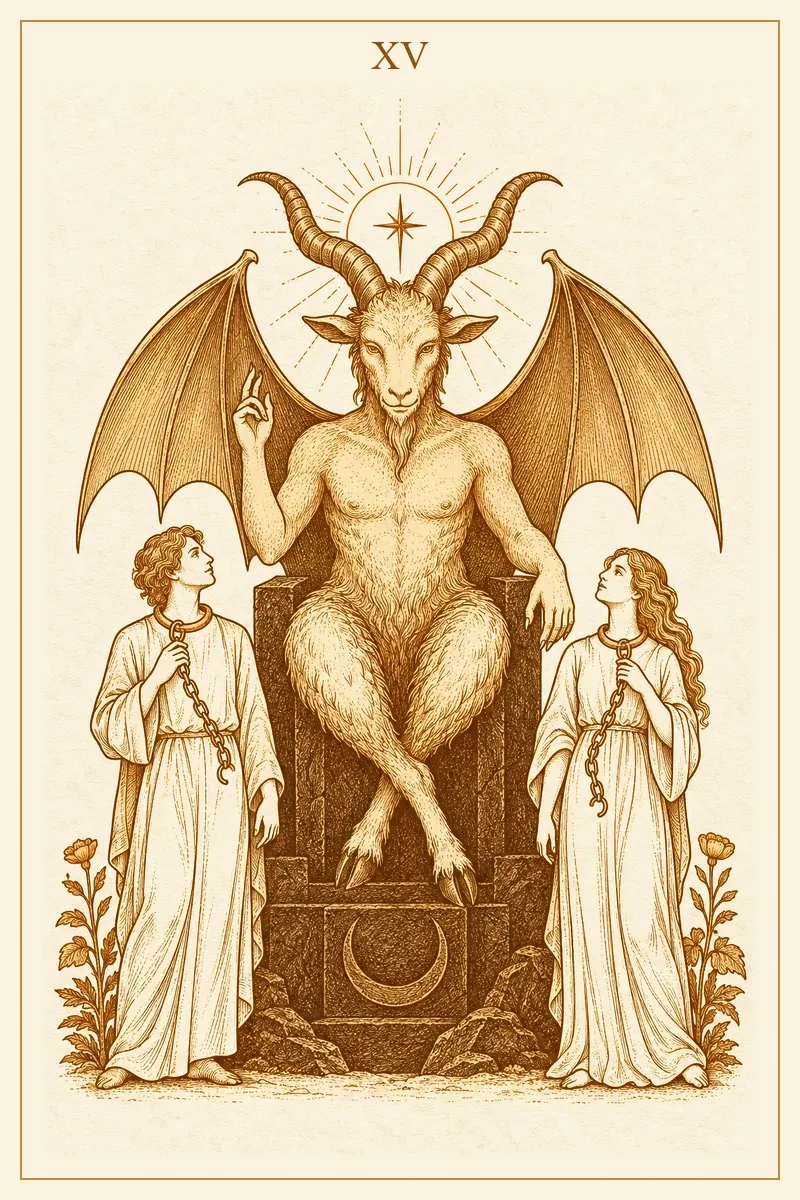
The myth: Drawing The Devil means dark forces are around you, or that tarot itself hides something sinister.
The truth: The Devil is a card about attachment and temptation, the things that hold us more tightly than we would like. On the card, a horned, goat-headed figure with bat wings sits on a dark stone block carved with a crescent moon, one hand raised. Two people in loose robes stand on either side, each with a chain hanging from a collar, and each holds that chain in one hand. Nothing ties their hands; the chain is something they are holding.
Upright, the card can describe a spending pattern, a phone you keep reaching for, a relationship dynamic you return to, or a fear that has quietly started making decisions for you. Reversed, it tends to show the moment you notice the chain and begin to loosen it. In love it can point to strong attraction mixed with jealousy or control; at work, staying in a role only because leaving feels impossible. None of this is evil, and the full Devil tarot meaning explains how its position changes the message.
Myth 4: Some cards are always bad news
The myth: The Tower, the Ten of Swords and the Three of Swords only ever bring bad news, and a reading that contains one has gone wrong.
The truth: No card is good or bad in every reading. Each one carries a range, from difficult to freeing, and the question, the position and the neighboring cards decide which part of that range applies.
- The Tower: a sudden change, typically the collapse of something that was already unstable. It can also be the relief of leaving a situation you were afraid to leave, and the Tower tarot meaning shows both sides.
- Ten of Swords: the lowest point of a painful cycle, which also means the cycle is done and recovery can begin, as the Ten of Swords meaning explains.
- Three of Swords: grief or heartbreak named honestly, which is where healing starts; the Three of Swords meaning covers its upright and reversed readings.
Where a card lands counts as much as which card it is. A hard card in an "advice" or "what to release" slot points straight at the thing that needs attention, so ask what it wants you to look at rather than what it seems to threaten.
Myths about your deck
Myth 5: Your first deck has to be a gift
The myth: You should never buy your own tarot deck; it only works if someone gives it to you, ideally another reader.
The truth: There is no historical rule behind this, and no practical reason either. It probably grew out of a wish to make tarot feel exclusive, a small gate that keeps newcomers waiting for permission. Your connection to a deck comes from using it, not from how it reached your hands.
Buy the deck you want to look at every day. A full 78-card deck in the Waite-Smith tradition, with an illustrated scene on every card, is an easy place to start because books and free guides follow its imagery, but another style that speaks to you is a fine choice too. For what to check before you pay, see how to choose your first tarot deck.
Myth 6: Nobody else should touch your cards
The myth: If another person handles your deck, their energy contaminates it and your readings stop being accurate.
The truth: This one is personal preference dressed up as a rule. Some readers keep their deck private, the way some people never lend out their favorite pen. Others ask the person they are reading for to shuffle, because it helps that person feel part of the reading. Both approaches are fine.
If someone picks up your cards and it bothers you, a slow, thorough shuffle of the deck is plenty to make it feel like yours again. A small ritual, such as knocking on the deck or putting the cards back in order, settles your own attention; it is not a repair, because nothing was damaged.
Myths about who can read tarot
Myth 7: You need psychic powers to read tarot
The myth: Only people born with a special gift, second sight or a family talent can read the cards.
The truth: Tarot is a skill. You look at an image, notice what stands out, connect it to the question and to the cards around it, and put what you see into words. All of that improves with practice, and what experienced readers call a psychic flash is usually intuition trained by many readings until it works quickly.
If you can look at a card and feel something, even confusion, you have enough to begin. Keep a notebook and describe the picture before you look up the meaning; your tarot intuition grows with that kind of practice.
Myth 8: You cannot read tarot for yourself
The myth: Self-readings are unreliable because you are too close to your own life, so you need someone else to read for you.
The truth: Reading for yourself is a respected practice, not a lesser one. Yes, you bring hopes and fears to the table. You also bring context no outside reader has: what was said last week, what you have already tried, what you are avoiding. The aim is not to remove bias but to see it.
Before you shuffle, write one line about the answer you are hoping for and one about the answer you fear, then interpret the spread as you would for a friend sitting across from you. For a full method, the guide to reading tarot for yourself goes step by step.
Myth 9: More cards make a better reading
The myth: Big spreads with ten or more cards are more accurate and more serious than small ones.
The truth: A single card drawn for a clear question can say more than a ten-card spread laid out in a hurry. The quality of a reading depends on the question, your focus and how carefully you interpret, not on how much of the table is covered.
Skilled readers rely on one-card and three-card draws too, because a small spread is easier to hold in your head and harder to talk yourself out of. For layouts to begin with, try these five simple tarot spreads for beginners.
Myth 10: A real reader has to read reversals
The myth: Reading upside-down cards is what separates serious readers from beginners, and skipping them leaves your readings incomplete.
The truth: Reversals are optional. Respected readers work upright-only, while others treat reversals as central to their practice, and neither is more advanced. A reversed card can add nuance, such as a blocked, delayed or inward version of the card's theme, but every upright card already carries both its easy and its difficult side.
What matters is deciding before you shuffle, so you are not choosing after the fact which orientation to believe. If you want to try them, the guide to tarot reversals explains a few ways to read them; if upright-only suits you better, that is a complete practice.
Myths about faith and fate
Myth 11: Tarot is against religion
The myth: Tarot is dark magic, and anyone who reads it is turning against their faith.
The truth: Each tradition and each person answers this differently, and it is not tarot's place to settle it. Some religious traditions ask believers to avoid divination of any kind. Others leave it to personal conscience, and some people of faith use the cards only as prompts for reflection or prayer. People with no religion use tarot as well, purely as a thinking tool.
What can be said plainly is that tarot started as a game and does not ask you to believe in anything supernatural. If your faith or your conscience tells you not to read, that settles it for you, and nobody is owed an argument. If it does not, you can read with a clear mind.
Myth 12: Tarot predicts a fixed future
The myth: Whatever the cards show will happen, and nothing you do can change it.
The truth: A reading describes where things seem to be heading if nothing changes, more like a weather forecast than a sentence handed down. If the forecast says rain, you take an umbrella; the forecast does not make the rain, and you are not helpless in front of it.
A card in a future position is a direction to consider, and your choices, other people's choices and plain chance all shape what actually happens. For a longer look at prediction and free will, read about whether tarot can predict the future.
Plain guardrails for a calm practice
Since the real cautions in tarot sit in how it is used, a handful of simple guardrails cover what matters.
- Ask once. Write the question down, read the cards, and let the answer stand for a while. Redrawing until you like the result turns reflection into a slot machine.
- Keep big decisions with the right people. Health, legal and money questions belong with qualified professionals. A card can help you list what to ask them; it cannot answer in their place.
- Walk away from fear-selling. No honest reader needs you frightened. Curses, urgent deadlines and rising fees are sales tactics.
- Put the deck down in a crisis. If you feel unsafe or overwhelmed, contact someone you trust, a doctor, or a local crisis line before anything else.
- Take breaks. If readings leave you more anxious than before, stop for a week or a month.
A three-card spread for a nervous first reading
If the myths have left you hesitant, this small spread lets you look at the hesitation directly. Shuffle, ask "What do I need to know as I begin with tarot?", and lay three cards in a row from left to right.
- What draws me in: the curiosity or need that brought you to the cards.
- What holds me back: the worry, rule or belief that makes you cautious.
- A boundary that keeps it healthy: a habit or limit that will keep your practice grounded.
Read the second card gently. It describes your caution, not a danger. The third card is the practical one: turn it into a rule you can actually keep, such as one reading per question or no readings late at night.
Worked example: a first reading after hearing the warnings
Suppose Lena has wanted to learn tarot for a year but kept putting it off. A relative once told her that buying your own deck is bad luck and that the Death card is a warning, and she half believes both. She finally buys a deck and, on a quiet evening, uses the spread above with the question "What do I need to know as I begin with tarot?"
- What draws me in: Page of Cups
- What holds me back: Two of Swords
- A boundary that keeps it healthy: Four of Swords
The Page of Cups describes curiosity, openness and a willingness to be surprised. Lena reads it as the honest reason she wants to learn: the images help her name feelings she usually skips past.
The Two of Swords is about a decision held at arm's length, two options balanced so that neither has to be chosen. She has been neither starting tarot nor letting the idea go, with the old warnings on one side and her curiosity on the other. Read this way, the card is not telling her to stop; it is showing her the stalemate.
The Four of Swords stands for rest and stepping back. Lena turns it into two rules: no readings when she is upset or tired, and a week off whenever a reading leaves her uneasy. She writes the cards and the rules in a notebook to look at again in a month.
The reading did not predict whether Lena will be good at tarot or what her future holds. It gave her words for an inner standoff and a practical limit to start with, which is the kind of help a reading can honestly give.
Frequently asked questions
Is tarot dangerous to use?
No. Using a deck carries no physical or spiritual risk in itself. The cautions are practical: do not let readings replace professional advice, do not redraw compulsively, and avoid readers who use fear to sell services. Used for reflection, tarot is a calm and ordinary practice.
Can tarot cards bring bad luck into a home?
No. A deck in a drawer, on a shelf or in a bag has no effect on luck. If having one in the house makes you or someone you live with uncomfortable, you can store it out of sight or give it away; that is a choice about comfort, not safety.
What should I do if I draw Death or The Tower?
Pause, breathe, and look at the position the card landed in. Then ask what in your life is ending or shifting. Neither card predicts harm; both describe change.
Do I need to cleanse my deck to keep it safe?
No cleansing is needed for safety, because a deck holds nothing harmful. Some readers enjoy a cleansing ritual as a way to start fresh after a heavy reading or a long break, and that is a personal habit you can take or leave.
Can tarot tell me exactly what will happen?
No. Tarot cannot reveal what another person is thinking, give you a date, or guarantee an outcome. It shows the shape of a situation as it looks now and helps you think about your next step, which leaves the outcome open to the choices still ahead.
Your experience outranks every rule
After twelve myths, one idea holds up: tarot is a personal practice, and the voice that matters in it is yours. No book, tradition or article, this one included, has more authority over your readings than your own careful experience. Keep what helps and drop what does not.
Tarot itself is simpler than its rumors: 78 cards, a question, and the conversation between them. If you want the foundations first, start with what tarot is and how it works. When you feel ready, you can try a calm reading on Veil Soul with one question of your own.