Beginner tarot mistakes are habits, not proof that you lack a gift. The ones worth catching early are trying to memorize all 78 cards before your first spread, re-asking a question until the answer changes, abandoning your first impression for a book definition, panicking at Death or The Tower, starting with a ten-card layout, and never writing a reading down. Every one of them has a small, practical fix, and none of them means the cards were wrong.
That last point matters when a reading seems to miss. A card is a picture with a range of meanings; it cannot misfire the way a weather forecast can. When something feels off, check the question you asked, the spread you chose and the mood you brought to the table before you blame the deck. Tarot also has limits that no amount of skill removes: it cannot tell you what another person is thinking, give you a date, or promise an outcome. It works best as a structured way to reflect on your own situation, and every fix below is built on that.
The ten mistakes are grouped by where they happen: while you learn the deck, while you frame a question, when a hard card turns up, and while you lay out and record a reading. After them come a short diagnostic for readings that feel wrong, a three-card spread built to keep you honest, a worked example, and a four-week practice plan.
Here are the ten mistakes at a glance, each with its fix:
- Memorizing all 78 cards first: learn in small batches through daily draws.
- Overriding your first impression: write it down before you look anything up.
- Comparing yourself with polished readers: measure against your own notes from last month.
- Re-asking until the answer changes: one question, one draw, then journal the discomfort.
- Relying on yes-or-no questions: ask what you can understand or do.
- Practicing only on pretend questions: read on real decisions that carry little risk.
- Treating hard cards as threats: read Death, The Tower and the Ten of Swords as descriptions of change.
- Starting with a big spread: one card, then three, then more.
- Never recording readings: five lines in a notebook after every draw.
- Giving up in the awkward first month: commit to four weeks before judging.
Learning the deck: three habits that slow you down
The early weeks with a deck feel like studying a language with seventy-eight words, each carrying several shades of meaning. Three habits make that stage slower and more stressful than it needs to be.
Mistake 1: Trying to memorize all 78 cards before reading
The urge makes sense: you want to be ready for whatever lands on the table. But a stack of memorized keywords produces stiff, recited readings, and the pressure to know everything first can keep the deck in its box for weeks. Card meanings settle in through use, the same way a new word sticks once you have said it in a real sentence.
Start with the 22 Major Arcana and the four Aces, since they carry the broad themes the rest of the deck fills in. Then add one suit at a time: a week or two with Cups, then Swords, Wands and Pentacles. Draw one card each morning, describe the picture in your own words, and only then read a short definition. Keep a reference open during readings, too. Checking a meaning is part of learning, not a sign that you are failing at it.
Mistake 2: Dropping your first impression for the book
You turn over a card, something about the figure's posture or the color of the sky strikes you, and then a guidebook says something different, so you discard what you noticed. Deferring to an outside authority feels safer than trusting a reaction you cannot yet explain. The trouble is that the reaction may be the most personal information in the whole reading.
Write your first impression before you look anything up, even if it is only three words. Then read the standard meaning and ask how both could be true at once. If the book says a card means steady effort and you felt boredom, the reading may be about work that has turned into a grind. After a few weeks, compare your notes with what actually happened; that record trains your judgment far better than reassurance from anyone else. The guide to building tarot intuition has exercises that strengthen this look-first habit.
Mistake 3: Measuring yourself against polished readers
Online readers who speak smoothly for twenty minutes make tarot look effortless. What you see is the finished performance, not the years of halting readings behind it, and comparing your third week with someone else's tenth year is a quick way to lose heart.
Use other readers as a source of ideas: notice how they link cards together or phrase a hard message kindly. Then measure your progress against yourself. Reread your notes from a month ago. If you now recognize a few cards without checking, or you connected two cards in a way that surprised you, that is real growth, and it is the only comparison that tells you anything useful.
Asking the question: three ways a reading goes off course
A reading can only be as clear as the question behind it. These three mistakes all start before the first card is turned.
Mistake 4: Asking the same question until the answer changes
You ask about a relationship, dislike what you see, shuffle and ask again, then again. Each new draw muddies the one before, and by the fourth spread you have a pile of contradictory cards and less clarity than when you began. The impulse comes from anxiety: you are looking for comfort rather than information, and you keep drawing until something feels soothing.
Give each question one reading and then let it rest for at least a day. If the answer bothers you, write about why; the discomfort may point straight at the real issue. When the urge to redraw comes back, change the question instead of repeating it. "What am I resisting in this answer?" is a new question, and it deserves its own reading.
Mistake 5: Leaning on yes-or-no questions
"Will I get the promotion?" "Is this person the one?" Questions like these feel efficient, but they squeeze a seventy-eight-card vocabulary into a coin toss, and whatever card turns up, they leave you with nothing to do next.
Rephrase each yes-or-no question into one you can act on. "Will I get the promotion?" becomes "What can I show in the next month that supports my case?" "Is this person the one?" becomes "What do I need to understand about how I feel in this relationship?" The answer now speaks to your own choices, which is where a reading earns its keep. You will find more rewrites like these in the guide on how to ask effective tarot questions.
Mistake 6: Practicing only on questions that do not matter
It is tempting to stick to hypothetical prompts and stock phrases, because your real questions feel too important to risk on an untested skill.
Real questions teach faster, because you care about the answer and look harder at every card. Start with decisions that matter but carry little risk: how to approach a busy week, what to focus on in a hobby, how to open a slightly awkward conversation. If a question feels heavy, draw the cards, photograph or note them, and come back to interpret them the next day, once the first rush of feeling has passed.
Mistake 7: Reading Death, The Tower and the Ten of Swords as threats
Films and television have turned a handful of cards into omens, and a beginner who draws one can lose the thread of the whole reading in a single breath. The fix is to learn what these cards actually describe, upright and reversed, so that the next time one appears you have something to work with besides fear.
Before looking at the three cards below, keep in mind that no card is good or bad in itself. Position and question decide much of the meaning, and every card can describe something hard as well as something welcome.
Death: an ending that clears space
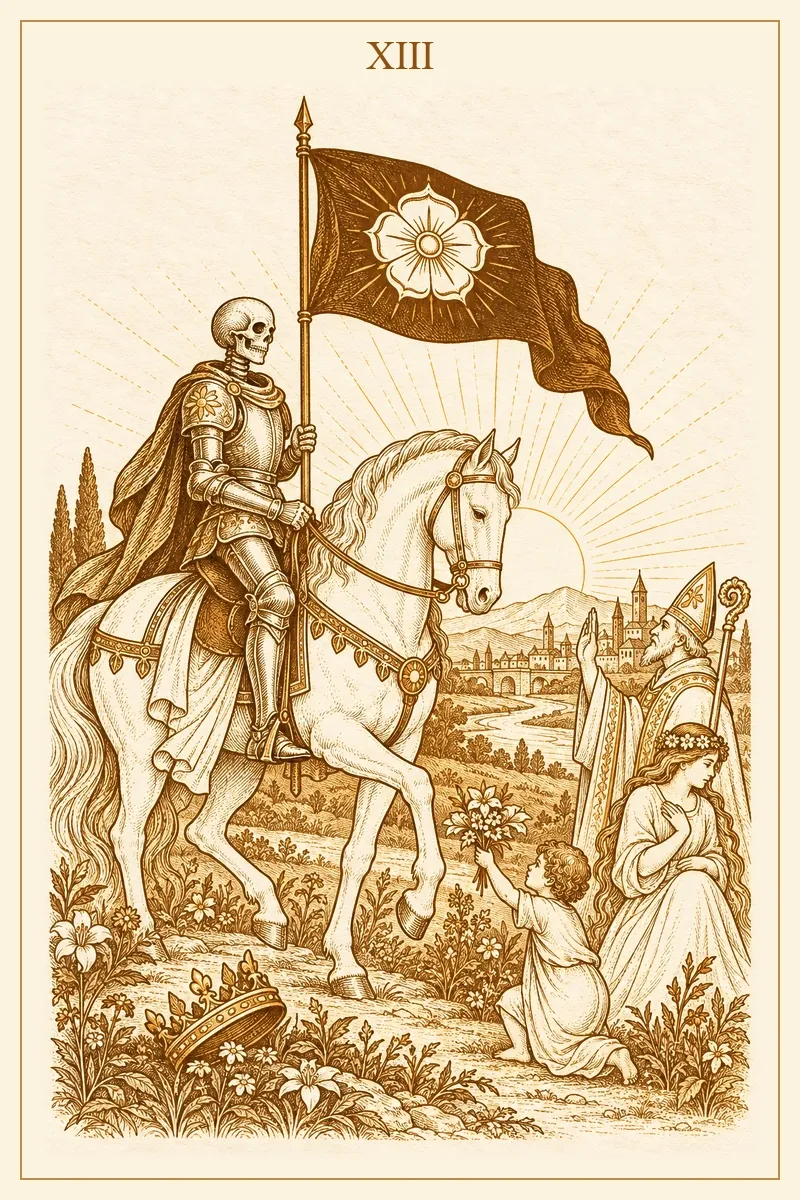
Upright, Death describes a chapter closing: a role, a habit, a relationship or a version of yourself that has run its course. It does not predict physical death. In a reading it asks what is finishing and what that ending makes room for. In a career question it might point to a job you have outgrown; in love, to a pattern between two people that cannot continue in its current form. The full Death tarot meaning covers its symbolism in more depth.
Reversed, Death points to resistance: holding on to something that has already ended, or a transition that drags because you keep postponing it. A useful question when it appears either way is "What am I keeping alive out of habit?"
The Tower: a sudden shake-up that reveals something true
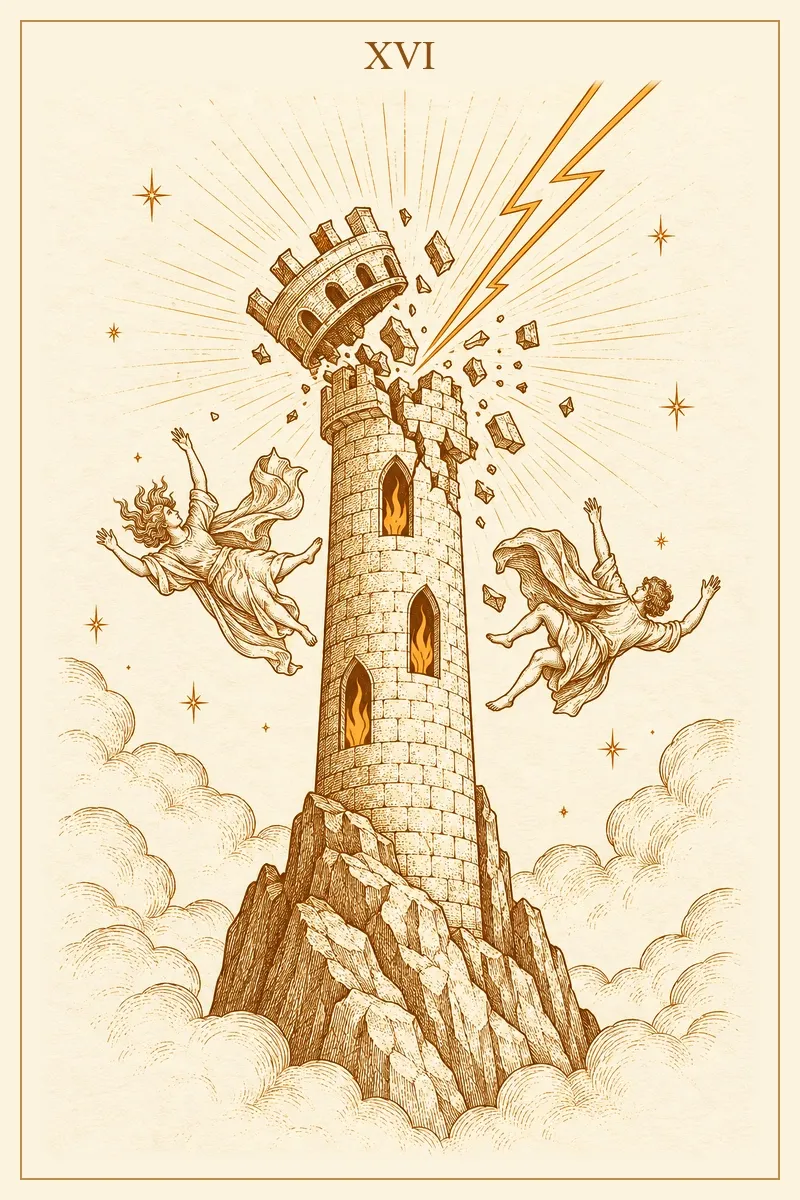
Upright, The Tower shows a structure falling quickly: a plan, a belief or an arrangement that was built on a weak foundation. The experience can be jolting, but the card also describes revelation, the moment a truth you had avoided becomes impossible to ignore. Read it as a question about what was unstable to begin with, not as a promise of disaster. The post on The Tower tarot meaning explores how it reads across love, work and money.
Reversed, The Tower can describe an upheaval happening inwardly rather than in public, a change you are delaying, or a near miss that gives you a chance to rebuild more carefully. In each case the card asks what you would rather change on purpose than have changed for you.
Ten of Swords: the low point that is already over
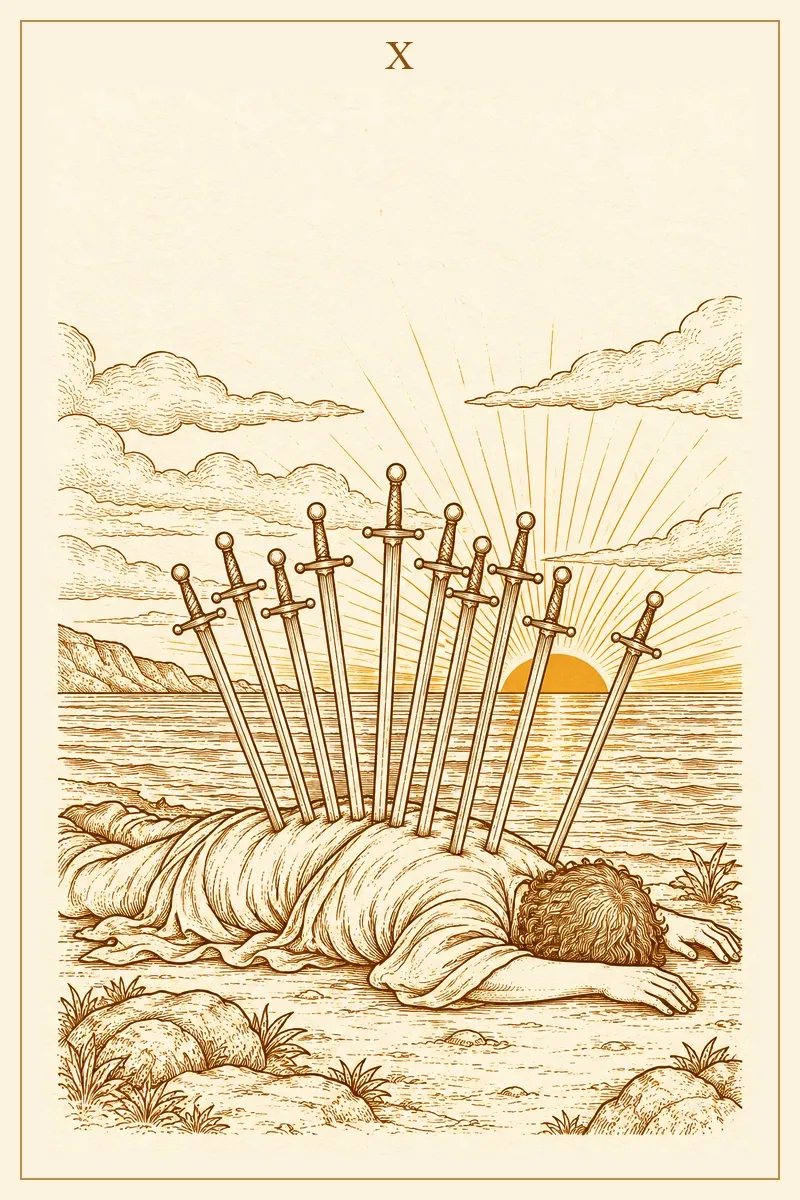
The image is dramatic: a figure lying face down on a shore with ten blades in its back. Upright, the card describes a painful ending, exhaustion or the feeling of having hit bottom. Beyond the figure, though, the sun is rising over calm water. The card marks the end of a hard cycle, and a situation that has fully played out has nothing further to take from you. For more on how it reads in different positions, see the Ten of Swords tarot card meaning.
Reversed, the Ten of Swords can point to recovery beginning and a slow return to your feet or, in a less comfortable reading, to refusing to let an old wound close. Ask which of those fits, and write down what one small step toward rest would look like.
Spread and record: two practical slips
Even a well-framed question can get lost in how the cards are laid out and in what happens to the reading afterward.
Mistake 8: Starting with a ten-card spread
Enthusiasm leads straight to the Celtic Cross: ten positions, ten cards and a web of relationships between them that takes practice to see. For a newcomer the result is overwhelm, so much information that none of it lands.
Begin with one card a day. Move to three-card spreads once a single card feels comfortable, using simple positions such as situation, challenge and advice. Larger layouts become useful once you can read three cards as one story rather than three separate definitions. The collection of simple tarot spreads for beginners offers layouts sized for these early stages.
Mistake 9: Never writing a reading down
A reading feels vivid in the moment, so noting it seems unnecessary. By evening you have forgotten one of the cards, and a week later you cannot say whether the reading was useful. Without a record you lose the best teaching material you have, which is your own readings.
After every draw, write five lines: the date, the question, the cards and their positions, your first impression, and a one-sentence summary. Once a week, read back over the entries. Recurring cards, questions you keep circling and interpretations that held up will start to stand out. The guide to keeping a tarot journal shows several ways to set one up.
Staying with it past the awkward month
Mistake 10: Deciding too early that tarot is not for you
After a handful of confusing readings, it is easy to conclude that you have no talent for this. Every new skill has a stretch where you can tell what a good result looks like but cannot yet produce one. Tarot is no different, and that stretch is a stage, not a verdict.
Set a time frame before you judge: four weeks of short daily practice is enough to notice change. Accept that some readings will be flat or puzzling; they are part of the material too. Count small wins, like naming a card without checking, linking two cards into one idea, or trusting a first impression that later proved useful.
A four-week practice plan
- Week 1: draw one card each morning from the Major Arcana only. Describe the picture, read a short meaning, then note one way it might show up in your day.
- Week 2: add the Aces and one suit. In the evening, revisit the morning card and write whether it connected to anything.
- Week 3: add a second suit and try two three-card readings on real questions that carry little risk.
- Week 4: work with the full deck, read your journal from the start, and mark three entries where your first impression added something the book did not.
At the end of the month, decide what to keep. You may find that the daily card is the habit worth holding on to, or that a weekly three-card reading suits you better. Either rhythm counts as practice.
When a reading seems wrong
A reading that misses does not mean the deck failed. Before you set it aside, run through five checks. Each one traces the miss back to something you can adjust next time.
- Was the question about your part? A question that hinges entirely on someone else's choice leaves the reading little to say about what you can understand or do.
- Did the spread fit the question? Ten positions for a simple question, or one card for a tangled situation, both blur the result.
- What mood did you bring? Strong hope or dread can bend every card toward the answer you wanted or feared.
- Did you read it too literally? A card about travel may describe a change of perspective rather than a trip.
- Has enough time passed? Some readings make sense only weeks later, which is one more reason to keep notes.
If none of these explains the miss, note it honestly in your journal and move on. A run of readings that never seem to land is worth reviewing as a whole, and the piece on whether tarot cards can be wrong goes deeper into the difference between a card and the reading built on it.
A three-card spread that keeps you honest
This spread is built to avoid the mistakes above: it takes an open question, uses only three positions, and ends with something you can do. Shuffle while holding the question in mind, then lay the cards from left to right.
- What I am bringing to this: the feelings, assumptions or hopes you carry into the situation.
- What I cannot control: the part of the situation that is not yours to decide.
- What I can do this week: one concrete action or attitude within your reach.
Write your first impression of each card before you look anything up, then read the three together as a short story: where you start, what you have to accept, and how you can move.
Worked example: waiting to hear about a job
Suppose you interviewed for a job a week ago and have heard nothing. The first question that comes to mind is "Will I get it?" That is a yes-or-no question about a decision someone else will make, so rephrase it: "How can I handle the wait for this job well?"
You draw three cards. In the first position, what I am bringing to this, is the Nine of Wands: a figure who has been through a lot, tired but still standing guard. It matches the sense of having pushed through several application rounds and bracing for another disappointment.
In the second position, what I cannot control, is the Wheel of Fortune. You might be tempted to read it as luck and take it as a yes. In this position it says something more modest: the timing and the outcome turn on factors outside you, such as other candidates, budgets and the hiring team's schedule. The card reminds you which part of the situation is not yours to carry.
In the third position, what I can do this week, is the Eight of Pentacles: steady, focused work on a craft. The practical reading is to put your energy into something that builds skill whatever happens, such as finishing a course module, polishing a portfolio piece or preparing the next application.
Notice the mistakes you avoided. You did not reshuffle when the Wheel came up, did not treat it as a promise, and did not decide from the guarded Nine of Wands that the job was lost. Your journal entry reads: "Nine of Wands, Wheel, Eight of Pentacles. Tired and defensive. The decision is not mine. This week: finish the portfolio piece." A month later, whatever the employer says, that entry shows how you handled the wait, which is what the reading was really about.
Frequently asked questions
Can tarot cards be wrong?
A card cannot be wrong in itself, because it carries a range of meanings rather than a fixed claim. A reading can miss, and when it does, look at the question, the spread and your state of mind. It is also worth being clear about limits: tarot cannot reveal another person's thoughts, fix a date or guarantee an outcome. It is a tool for reflection and works best when you treat it that way.
How long does it take to learn tarot?
There is no fixed timeline. With a few minutes of daily practice, the Major Arcana start to feel familiar within weeks and one- and three-card readings become useful. Fluency with the whole deck builds over months and keeps deepening for years. A journal makes the progress visible, which helps on the days it feels slow.
Is it cheating to look up meanings during a reading?
No. Looking up a card is how its meanings become familiar. The habit to build is about order rather than abstinence: note your own impression first, then check the reference, then decide what fits your question.
Should beginners read reversed cards?
It is fine to start with every card upright and add reversals once the upright meanings feel familiar. Reversals add nuance, such as a delayed, blocked or inward version of a card's theme, but they also double what you need to hold in mind. Pick one approach and use it consistently so your notes stay comparable.
Do I need a special deck or ritual to read well?
No. Any deck whose images you enjoy looking at is enough to begin. A simple routine, such as clearing the table and taking a breath before you shuffle, can help you focus, but no ritual makes a reading more accurate. Attention and honest notes matter more than accessories.
Can I read for friends while I am still learning?
Yes, as long as you tell them you are learning and keep the reading reflective. Leave health, legal and financial decisions to qualified professionals, and never present a card as a prediction about someone else's choices. Reading for others also gives you practice explaining a card out loud, which sharpens your own understanding.
Your next reading
Pick one mistake from the list that feels familiar and change only that one this week. When you want a calm place to try a three-card reading with an open question, you can start a Veil Soul reading whenever you are ready.