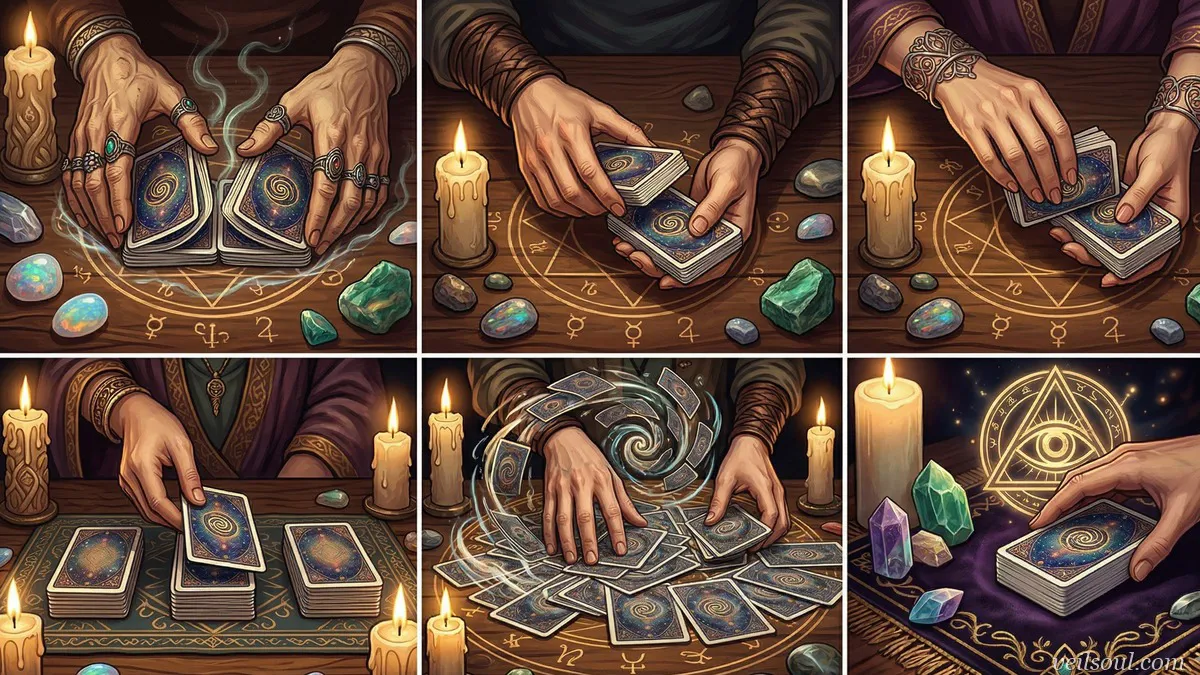
To shuffle a tarot deck, hold it face-down and mix it with whatever motion your hands can repeat calmly: an overhand shuffle, a Hindu shuffle, a pile deal, a run of cuts, or a wash that spreads the cards flat across the table. Each of those mixes a deck well enough to read from, and none is more correct than the others. The method that lets you stay with your question is the one to keep.
If a card slips out while you are shuffling, nothing has gone wrong. Readers call a card that leaves the deck on its own a jumper, and it carries meaning only when you decide in advance that it will. This guide covers the five methods step by step, then gives a full section to cards that fall out.
One limit worth naming at the start: no shuffle can tell you what another person is privately thinking, pin down a date, or settle a medical or money question. What it does is slow your hands long enough for you to notice what you are really asking.
The five methods in brief:
- Overhand: packets lifted out of the middle and dropped back on top. Easiest to learn, gentle, never turns a card around.
- Hindu: packets drawn from a lightly held deck into the other hand. Smooth and kind to card edges.
- Pile deal: the deck dealt into stacks and gathered in a new order. Slow, thorough, no bending at all.
- Cut and restack: the deck lifted into sections and rebuilt. Fastest of all, best used after another method.
- Wash: the cards spread face-down and swirled with both hands. The most complete mix, and the natural way to bring reversals in.
What a shuffle is actually doing
Two separate things happen while you shuffle. The first is ordinary mixing. A deck straight from its box still sits in factory order, suit by suit, and anything drawn from it shows long runs of one suit until that order is broken.
The second is attention. Handling cards gives your hands a small repeating task, and most people find their thinking settles while their hands are busy. By the time you stop, the vague worry you sat down with has often sharpened into a question.
Neither job requires a particular technique. There is no number of shuffles that charges a deck and no direction that counts as correct. What method does change is the wear on your cards and the orientation they end up in: tarot stock is larger and often thicker than playing cards, and techniques built for a thin poker deck will crease it.
Five ways to shuffle a tarot deck
Try all five across a week of readings rather than picking one from the page. Hands differ, and so do decks: a jumbo deck on linen stock behaves nothing like a glossy pocket-sized one.
The overhand shuffle
The loose shuffle most hands already know from a pack of playing cards. It moves small blocks rather than single cards, so it mixes gradually and almost never damages a deck.
- Hold the deck face-down in your non-dominant hand, resting along the palm.
- With your dominant hand, lift a small packet out of the middle of the deck.
- Drop that packet onto the top of the cards in your other hand.
- Keep a steady rhythm until the deck has passed through your hands several times over.
- Best for: beginners, upright-only readings, and anyone who wants to shuffle while thinking rather than while watching their fingers.
- Watch for: under-mixing. Because the packets stay intact, cards that started side by side often stay there. Give it more passes than feel necessary, or finish with a few cuts.
The Hindu shuffle
A close cousin of the overhand with a different grip, and the one readers most often call meditative. The deck hangs lightly between thumb and fingers while the other hand draws packets off the top.
- Hold the deck face-down in your dominant hand, pinched loosely along the short edges.
- With your free hand, slide a small packet off the top of the deck.
- Drop that packet into your free palm, then draw the next packet on top of it.
- Continue until the deck has transferred, square it up, and run it again two or three times.
- Best for: a slow, repeatable rhythm, and a shuffle quiet enough to do beside a sleeping household.
- Watch for: a grip that is too tight. If you are pinching hard, the edges take the pressure and soften over time. Let the cards slide rather than forcing them.
The pile deal
Instead of mixing in the hands, you deal the deck out and rebuild it. It is the slowest method here and one that never bends a card, which makes it the usual choice for gilded edges.
- Choose a number of piles between three and seven, and set the deck face-down in front of you.
- Deal one card at a time into each pile in turn, left to right, until the deck is gone.
- Gather the piles in a different order from the one you dealt them in.
- Repeat once for a fuller mix, varying the number of piles the second time.
- Best for: new or delicate decks, and the first mix after someone else has handled your cards. It doubles as a count, so a missing card shows up at once.
- Watch for: predictability. One pile deal redistributes cards in a fixed pattern, so follow it with cuts if the deck was in a known order.
Cutting and restacking
The plainest technique of all, and the main one for plenty of readers who draw a card a day. You lift sections off the top and rebuild the deck in a new order.
- Rest the deck face-down on a surface, or hold it in one hand.
- Lift roughly the top third and set it down beside the rest.
- Lift part of what remains and place it on the stack you just made.
- Rebuild the deck and repeat, cutting at a different depth each time.
- Best for: quick draws, small tables, trains, and anyone with limited hand mobility. It works one-handed and makes almost no noise.
- Watch for: leaving it as your only step. Cuts rotate the deck without disturbing the order inside each section, so add an overhand or a wash before a larger spread.
The wash
Also called the messy pile, this is the shuffle that looks least like one: you spread the cards face-down on a flat surface and push them around with both hands until the order is gone.
- Spread the whole deck face-down across a clean table or a reading cloth.
- Move both hands through the cards in wide circles, letting them slide over and under each other.
- Keep going until it feels mixed, usually longer than you expect.
- Sweep the cards into a loose pile, square them up, and finish with a cut.
- Best for: the most complete mix available, a deck fresh out of its box, and readings where you want reversals to appear on their own.
- Watch for: the surface. A rough tabletop scuffs card backs, so put down a cloth and avoid carpet, where edges catch.
One technique is missing on purpose. The riffle, where two halves are sprung together, suits playing cards and fits tarot badly, because springing thicker stock bows every card. If you love it, lay both halves flat and push the corners together without lifting them.
Upright only or reversals: decide before you shuffle
Your shuffle quietly decides whether reversed cards can appear at all, so settle it first rather than discovering the answer mid-reading. Overhand, Hindu, pile dealing, and cutting all preserve orientation: if the deck went in upright, it comes out upright. Only the wash turns cards around on its own.
If you want reversals, turn one portion of the deck end for end before you start mixing: take roughly a third, rotate it a half turn, slot it back in, and shuffle normally. Reversals then appear at a natural rate for many readings afterward. If you want the opposite, skip the wash, or turn any reversed card upright before you put the deck away.
Neither choice makes you a better reader. Reversals add nuance and also double what you are holding in mind, which is why many people read upright only at first. The guide to reading tarot reversals sets out both approaches; whichever you choose, keep it consistent within one reading.
How long should you shuffle?
There is no required count, and a deck does not become more honest at the tenth pass than at the sixth. What matters is that the previous reading is genuinely broken up. Overhand and Hindu shuffles move cards in blocks, so they mix far more slowly than they look, which is why most readers add cuts or a wash. Reasonable starting points:
- A single daily card: five or six overhand passes, or three cuts. The one-card daily draw gets its value from repetition rather than from elaborate preparation.
- A three to five card spread: a dozen overhand passes and two cuts, or a short wash and a cut.
- A large spread, or a question you have carried for weeks: a full wash, gathered and shuffled again by hand.
- A deck straight out of the box: a long wash. Factory order is stubborn.
- After a reading that unsettled you: however long it takes to put the cards down calmly.
Many readers simply shuffle until something tells them to stop: the cards feel loose, the rhythm breaks, or one starts to slide out. If you keep going because you hope for a particular card, the urge is about the question, not the mix.
When a card falls out of the deck while you shuffle
A card that falls out means whatever you agreed, before you started, that it would mean. No rule in tarot makes a fallen card urgent. Some readers treat a jumper as the headline, some read it as an extra card at the end, and some pick it up and carry on. All three are legitimate; the only unhelpful option is deciding after the fact, because then the card you keep is simply the one you liked.
Still, a card leaving the deck is worth a pause: it happened while you were holding your question. What you felt in that half second is often more useful than the card itself.
Rule out the ordinary explanations first
Cards fall for mechanical reasons far more often than any other kind, and a reader who treats every slip as a message ends up with a very noisy deck. Check the obvious: a new deck is stiff and springs apart at the edges; a well-loved deck develops a bend that makes certain cards sit proud of the stack; humidity makes stock tacky in summer and slippery in dry winter air; and a shuffle done standing up or in a hurry simply loses cards.
Square the deck, shuffle five more times calmly, and see whether cards keep leaving. If they do, the deck or the grip is the cause, not the question, and a pile deal will usually stop it.
Deciding whether to read it
Set your rule before the first shuffle, out loud or in your journal, and keep it for the whole reading. One that works well: a card landing fully clear of the deck during a calm shuffle gets read; a card sliding off the top as you set the deck down does not. You can choose differently. What you cannot do is choose twice.
Where the jumper goes is also your call. Reading it first works when you want it to frame everything else, as background or as the thing you have been avoiding; reading it last works when you want a closing note after the spread has had its say. Pick one, use it consistently, and a few months of journal entries will show whether jumpers add anything at all. If you want that question treated on its own, there is a whole post on what it means when cards fall out of the deck.
Reading a jumper, upright or reversed
A jumper is read like any other card, with one addition: it has no position, so you have to give it one. The simplest framing is to treat it as the answer to "what is the first thing I should know here?" A card did not become a warning because it hit the floor.
Orientation needs a decision too. A fallen card can land either way regardless of how it sat in the stack, so if you read reversals, set a rule in advance, most simply to read it the way it lies when you turn it over toward you, and keep to it. If you read upright only, read it upright like everything else.
Several cards at once, or the same card again and again
When a handful falls together, the cause is almost always the shuffle rather than the message: gather them, square the deck, and start the mix again. If you want to use them, read them as one cluster with a single shared theme; three cards treated as three urgent messages produce a reading that contradicts itself.
A card that jumps out repeatedly across sessions is worth attention, though usually not for mystical reasons. Check it physically first, because one slightly warped card will leave the deck again and again. If it is flat and still keeps appearing, treat it as a subject you have not finished with and give it a reading of its own.
A worked example: shuffling into a three-card draw
Here is a full sequence, from question to interpretation, with a jumper in the middle of it. The point is less the cards than the order of the decisions.
Setting the question and the rules
The question was: "What am I not seeing about the way I am handling my workload right now?" That is an open question about the reader's own behavior, the kind tarot handles well; the notes on asking effective tarot questions cover the difference between that and a demand for a verdict. Reversals were on, and the jumper rule was set in advance: a card landing clear of the deck gets read, and it gets read last.
The spread was three cards in a row, with positions named before the shuffle: what I am carrying, what I keep missing, and what would help. Naming positions first stops a reading from drifting, and there are other layouts to try the same way in the guide to simple tarot spreads for beginners.
The shuffle
A short wash to break up the previous reading, then about ten overhand passes while holding the question. During the fourth pass a card dropped face-down on the table, well clear of the deck. It stayed there, untouched, and the shuffle finished with two cuts.
What came up, and how it read
The three cards were Two of Pentacles in the carrying position, Four of Swords reversed in what I keep missing, and Queen of Pentacles in what would help. The jumper, turned over last, was Eight of Cups.
Two of Pentacles described the obvious part: several commitments in the air at once, each manageable, none droppable, and a rhythm that works right up until something unexpected arrives. Four of Swords reversed is where the reading earned its keep. That card is rest, and reversed it reads as rest postponed or refused, which named something the reader had been calling a busy stretch for four months. Queen of Pentacles, in the helping position, gave the practical rather than the heroic answer: tend the resources you have, including your own, and hand over tasks that do not need you.
Eight of Cups, as the jumper, said out loud what the reader already suspected. It is the card of walking away from something once worth having, and read last it landed as a question rather than an instruction: which of these commitments have you already left, quietly, without telling anyone? The reading finished there, with two things to say no to that week. Notice what it did not do: it did not predict how the workload would resolve.
Looking after your deck while you shuffle
Shuffling is what wears a deck out, so a few habits will keep yours readable for years.
- Dry, clean hands. Hand cream and food oils turn card edges dark and tacky, and no cleaning method reverses it.
- A soft surface. A reading cloth or a folded scarf protects card backs during a wash and makes the cards easier to pick up afterward.
- No forcing. If a shuffle needs pressure, it is the wrong shuffle for that deck. Thick cards and gilded edges want a pile deal rather than anything springy.
- Break a new deck in gently. New cards stick together and jump out constantly for a few weeks, which settles on its own. The guide to choosing a first tarot deck covers stock and size, which matter more to shuffling than the artwork does.
- Store it squared. A box or a wrapped cloth keeps the deck flat; a deck left loose in a bag warps, and warped cards are the ones that fall out.
- Reset after other hands. If a friend has been handling your cards, a pile deal gives you a clean start and a quick count, and there are gentle rituals too in the guide to cleansing a tarot deck.
Building a shuffle routine that fits you
Most readers end up with a combination rather than one method. A common shape: a wash to clear the last reading, a dozen overhand passes while the question settles, and a cut into three piles before drawing. Another: pile deal, cut, draw, for people who read quickly and often.
Build yours by subtraction. Keep the steps that help you concentrate, and drop anything you do only because you saw someone else do it. Squaring the deck is preparation; needing to tap it three times before every draw, and feeling the reading is void if you forget, is a rule you made and then handed authority to.
Frequently asked questions
Is there a wrong way to shuffle tarot cards?
Not in any way that affects a reading. The only genuinely wrong shuffles are the ones that damage cards: a hard riffle on thick stock, or washing cards on a rough surface. Anything that leaves the deck mixed and intact has done its job.
How many times should I shuffle before a reading?
Enough that the last reading is broken up, which for an overhand shuffle means more passes than feel necessary: a dozen, or a wash plus a cut. Beyond that you are shuffling for your own benefit, which is fine as long as you are not waiting for a particular card.
Does it matter if someone else shuffles my deck?
Only if it bothers you. Nothing passes into the cards when someone else handles them; if it still bothers you, a pile deal gives you a clean start. Some readers have the person they are reading for shuffle and cut, because it gives that person a moment to focus on their own question. If you would rather not, that preference needs no justification.
Can I reshuffle if I do not like the cards I drew?
You can, and most readers have. It usually produces a worse reading, because the second draw gets interpreted against the first and you end up negotiating with the deck instead of thinking. A more useful move is to keep the cards and change the question. If you redraw often, the piece on doing too many tarot readings describes the pattern and how to step out of it.
What does it mean when a tarot card falls out of the deck?
Mechanically it means the deck is new, bent, slippery, or being shuffled in a hurry; those four causes account for most fallen cards. Interpretively it means what your own rule says it means, which is why the rule should exist before the shuffle. If you have decided that jumpers are read, read it as an ordinary card in a position you have defined. If you have decided they are not, put it back and keep going.
Should my mind be blank while I shuffle, or should I hold the question?
Hold the question, loosely. A blank mind is hard to achieve and does not improve a reading, while a question held gently keeps you from drifting into another topic halfway through the mix. If your attention wanders, bring it back to the wording of the question.
Does a better shuffle make a reading more accurate?
No. A thorough mix removes the leftover order from your last reading, and that is its whole contribution. Clarity comes from a clear question and an honest interpretation; the cards cannot confirm another person's feelings, fix a date, or decide for you.
From shuffle to reading
When your hands know what to do, let the cards settle and open a tarot reading at Veil Soul whenever the question is clear enough to say out loud.