A rider crowned with laurel, a cheering crowd on foot, a staff held high: the Six of Wands means victory that other people can see. Upright, it reflects effort paying off in public, through good news, credit for your work and a confidence you have earned. The Six of Wands reversed points to the same win going unrecognized, arriving late, or needing more applause than the work itself can carry.
Read it as a mirror for how you hold success, not as a promise. The card cannot tell you whether you will get the job, win the contest or hear back from someone, and it cannot see how other people will judge you. It is good at showing what a win means to you, who shared it, and whether you can let it land.
The Six of Wands in a few lines:
- Upright: success that is noticed, good news, earned confidence, being trusted to lead.
- Reversed: credit withheld or delayed, doubting a real achievement, or pride that runs ahead of the result.
- Love: a relationship you are proud of and attraction built on confidence; reversed, a couple that looks better from outside than it feels inside.
- As feelings: admiration, pride in you, wanting other people to know about you.
- Work: a promotion, a result with your name on it, a team that wins together.
- Yes or no: upright, a clear yes; reversed, a yes that comes slower or quieter than hoped.
Laurel, ribbons and a white horse: the Six of Wands picture
The rider and the six staffs
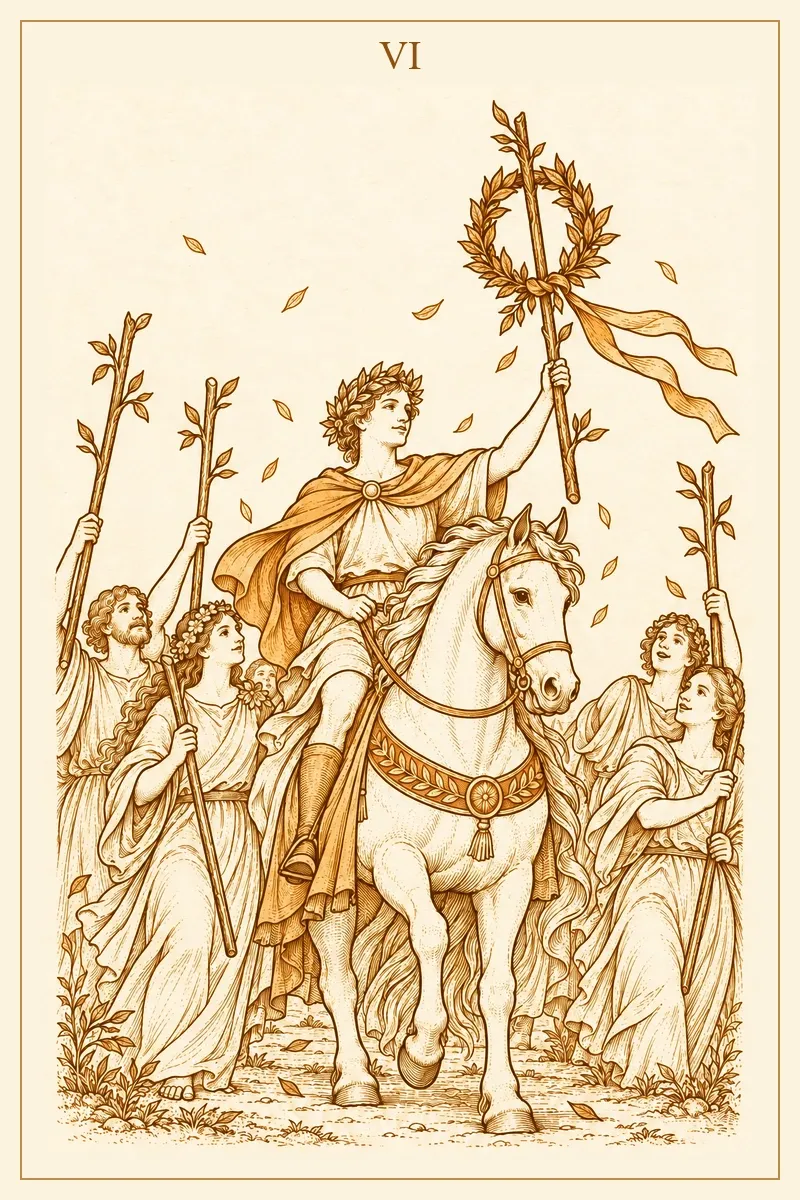
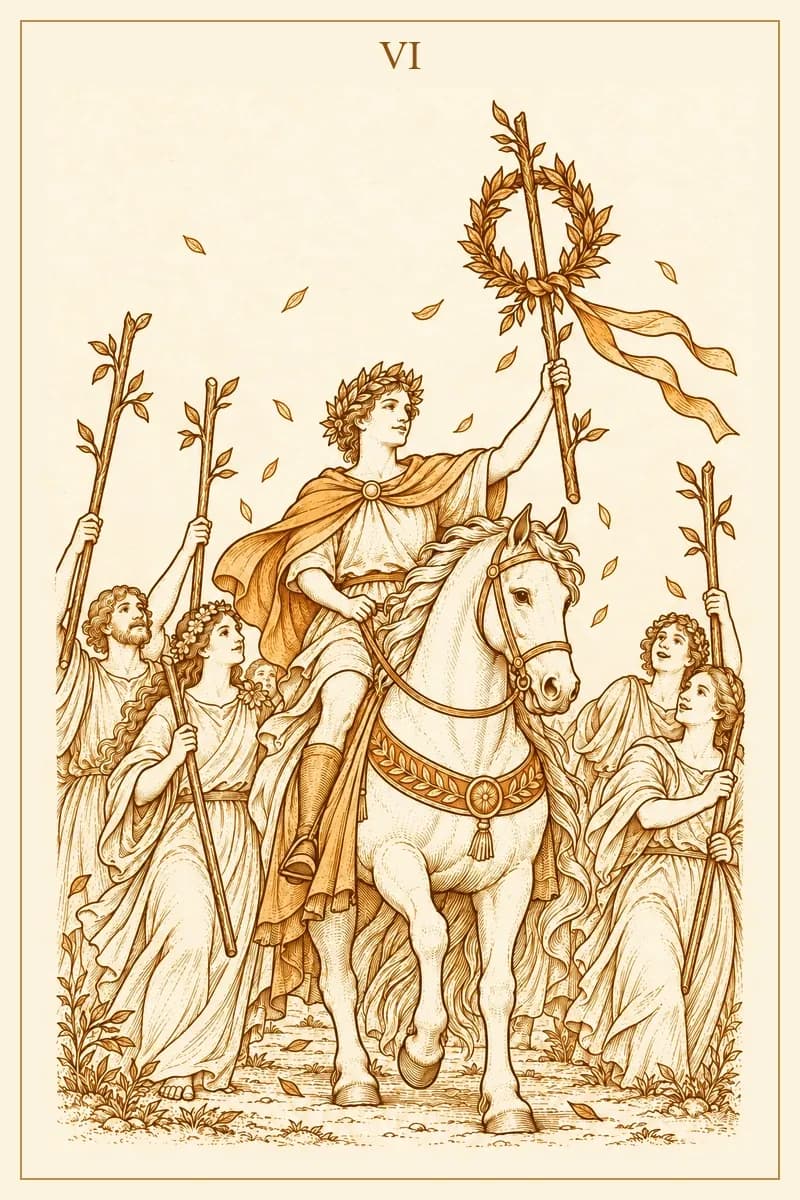
A young man with curly hair rides a white horse straight toward you. A laurel wreath sits on his head, and he smiles as he looks up and to the side. An orange cloak, pinned at the shoulder with a round brooch, swings out behind him over a belted, short-sleeved tunic, and he wears tall boots. One hand holds the reins. The other raises a leafy staff high, and near its top a second laurel wreath is tied on with a knot, two long ribbons streaming out to the right.
The horse steps forward with one front hoof lifted, its long mane rippling, a leaf-patterned band across its chest with a round medallion and a hanging tassel. People in long robes walk around it. On the left, a bearded man raises a staff in each hand, a woman crowned with flowers holds hers low, and a small child's face peeps out behind her. On the right, a curly-haired youth in a laurel wreath of his own reaches a staff upward while a woman grips a long staff with both hands. With the rider's, that makes six staffs. Loose leaves drift through the air above the path.
- Two wreaths: one on his head, one on the staff. The win is felt and also displayed.
- A crowd in wreaths too: the woman's flowers and the youth's laurel suggest a shared victory; the walkers took part in what is being celebrated.
- Every face turned up: they look at the rider, and he looks past them toward his staff. Admiration flows one way, which is lovely in the moment and is also where the reversed meanings begin.
Lord of Victory: Jupiter in Leo
The Golden Dawn, the magical order whose system the Waite-Smith deck drew on, titled this card Lord of Victory and gave it to Jupiter in Leo, the second decan of that sign (its middle ten degrees). Leo is fixed fire, the sign of the heart, pride and being seen; Jupiter is the planet of growth, generosity and good fortune. Together they describe confidence that grows outward and is met with warmth.
The three Leo decans tell a short story inside the suit. The Five of Wands holds the first (Saturn, Lord of Strife), the Six the second, and the Seven of Wands the third (Mars, Lord of Valor): struggle, then victory, then the need to hold your ground. Every six also belongs to Tiphareth, Beauty, the central sphere of the Tree of Life, which the Golden Dawn linked to the Sun, the ruler of Leo. A. E. Waite, who wrote the meanings for the original deck, read it as a victor in triumph and also as great news, the kind a royal courier might carry in state, and as hope crowned by the very thing it hoped for.
Six of Wands upright: when the effort is finally seen
Upright, the Six of Wands says your work has reached the point where others notice it. That can be formal: an offer, a passed exam, a strong review, a prize, a launch that lands well. It can also be quiet: a friend who says "I saw what you did there", a family that finally understands your choice, a team that starts coming to you first. The card describes the meeting point between effort and witness.
Its gift is permission to receive. It is easy to work hard for months and then wave away the moment it pays off. The rider does not: he lifts the staff, takes in the cheering and lets the moment be a moment. Upright, the card asks you to do the same, and to notice who is walking beside you.
Signs that the upright reading fits:
- a result you worked on is about to be announced, or just was;
- people have started asking your opinion or quoting your work;
- a group you belong to has won something together, and you had a real part in it.
Six of Wands reversed: late applause, no applause, too much applause
Reversed, the procession does not go as planned. Waite listed apprehension, disloyalty and indefinite delay for this position, and those words map neatly onto the three forms the card takes in a real reading.
Credit withheld or delayed. The work is done, and done well, but the announcement slips, someone else presents it, or the people you hoped would notice are looking elsewhere. This form asks for patience and for naming your own contribution clearly, in writing where it matters. If credit was taken, the card favors a calm, factual conversation over a resentful silence.
A win you cannot let in. Sometimes the crowd is cheering and you cannot hear it. You suspect it was luck, you wait to be found out, you make yourself small so no one can call you arrogant. The apprehension Waite named has turned inward. A guide on tarot for self-doubt offers spreads for looking at that voice rather than obeying it.
Living for the cheering. The third form is pride running ahead of the result: needing praise to feel worth anything, overselling, keeping score against others, or leaning on an old win long after it ended. The disloyalty in Waite's list can belong here too, either as a crowd that drifts away once the rider stops winning or as your own drift away from the people who helped.
One question helps sort them: if nobody ever found out about this achievement, would it still matter to you? A firm yes usually points to the first form, a hesitant answer to the second, and a no to the third.
Between strife and a hill to defend: the Six in the Wands story
The Six reads most clearly beside its two neighbors, which share the sign of Leo with it.
Five of Wands: the scuffle before the parade
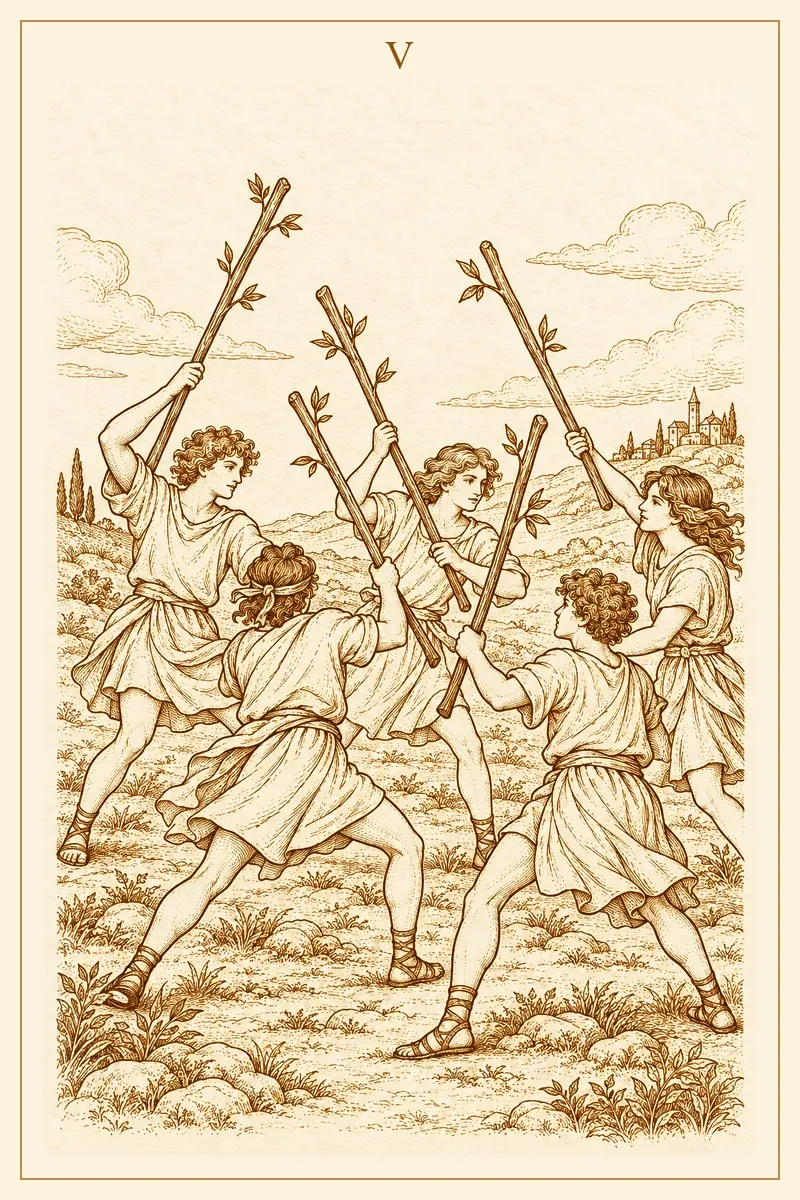
On the Five of Wands, five young people in short tunics swing leafy staffs at one another in a grassy field, with a hilltop village on the horizon and a few cypresses at the left edge. Nobody is clearly winning yet. When the Five appears in the same reading, or just before the Six in a timeline, it shows the competition, debate or messy practice that the win grew out of. The Five of Wands meaning of rivalry and creative friction covers that stage in depth.
Seven of Wands: keeping the ground you won
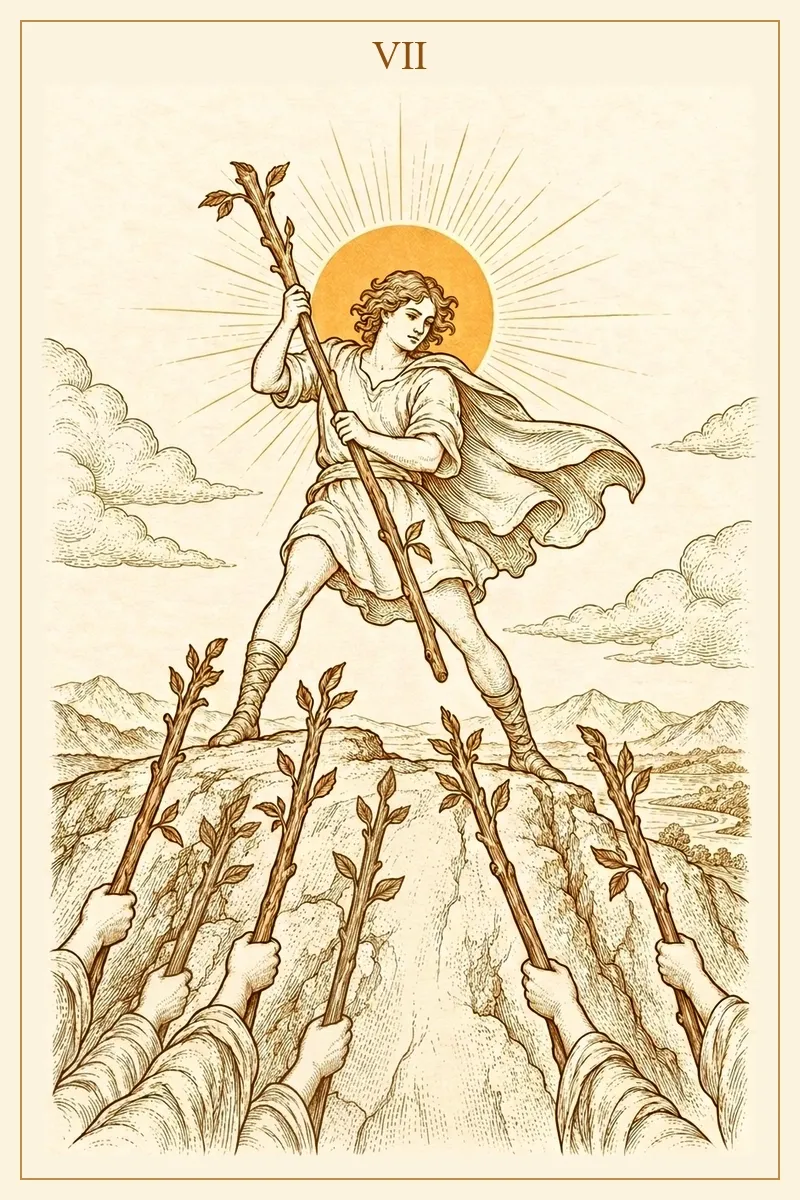
On the Seven, a young man stands with his feet planted wide on a rocky ridge, gripping one leafy staff across his body with both hands, while six more staffs thrust up from below, held by arms reaching in from the bottom edge. A sun blazes behind his head and his cloak whips in the wind. After the procession comes the hill: once you are visible, you also become someone people test. The Seven of Wands meaning of standing your ground picks up the story where the Six leaves it.
Six of Wands in love: a bond you are proud of
In love, the Six speaks of pride in the good sense: being glad to be seen together, and liking who you are inside the relationship.
Together, single or hoping
In a relationship, the upright card reflects a couple that feels like a team, perhaps after getting through something hard together, moving in, meeting each other's families or going public. Friends may admire you, or you may simply feel proud of what the two of you have built. Reversed, look at the gap between outside and inside: a relationship that looks lovely in photos but feels thin at home, or one partner's success drawing all the attention while the other quietly feels left in the crowd.
If you are single or hoping for someone in particular, upright, confidence is your best introduction right now, and a recent win in another area can carry over. Reversed, you may be holding back until you feel impressive enough, or judging possible partners by how they would look to others. Neither brings you closer to someone real.
Six of Wands as feelings: how they see you
As feelings, the upright Six of Wands reflects admiration. The person may be proud of you, impressed by something you did, or happy to be connected with you, the kind of feeling that wants to tell friends about you. It can also show confidence in the connection itself. Reversed, that admiration may be mixed with insecurity: they look up to you but feel they cannot measure up, they like the picture of the relationship more than its everyday reality, or they are waiting for a sign from you before showing anything. Either way, if you need to know where you stand, a direct and kind question will tell you more than any card.
Getting back together: the Six upright and reversed
For reconciliation, the upright Six suggests a meeting where both of you can face each other with your pride intact: time has passed, each of you has grown, and talking again could feel like good news rather than surrender. That is an opening, not a guarantee. Reversed, pride is the obstacle. Neither wants to reach out first, or one of you wants the other to admit having lost. Ask yourself whether you want the relationship or the win. The guide to tarot cards for reconciliation sets the cards that speak to this question side by side.
Promotions, results and money: the Six of Wands at work
At work: your name on the result
Upright, this is the card of results being recognized: a promotion, a good evaluation, a successful pitch, an interview that goes well, a project that launches with your team's name on it. If you are job hunting, the Six encourages you to state your achievements plainly, and the overview of tarot cards for a new job shows where it sits among the other cards of hiring and fresh starts. Reversed, credit may be slow, unfairly shared or claimed by someone else, or you may be underselling yourself in reviews. Treat a delayed result as delayed rather than as a verdict.
Money: enjoying a good result without inflating it
Upright, a financial win may become visible: a raise, a bonus, a strong month of sales, a savings goal reached. Enjoy it, then decide on purpose what the money is for, because the mood of the Six is generous and Jupiter likes to expand. Reversed, the result may be smaller than hoped, or you may feel pressure to spend in order to look successful. The card is not financial advice; for investments, debt or contracts, decide with a qualified adviser.
Yes or no with the Six of Wands: leaning yes, with witnesses
Upright, the Six of Wands gives one of the plainest yes answers in its suit: it reflects a favorable situation and a result that other people can see. Reversed, it still leans toward yes rather than no, but the yes may be slower, quieter, or come with less credit than you wanted.
- "Should I put myself forward?" Upright, yes. Reversed, also yes, after checking whether fear of being judged is the real reason you hesitate.
- "When will I hear back?" The old theme of delay in the reversed card is a reason to plan for some waiting, not a date on the calendar.
If you want to shape your own question so the answer is easy to act on, a step-by-step guide to yes or no tarot walks through it, and the collection of questions to ask the cards about work, love and goals offers ready wording.
The Sun, The Emperor, The Moon and two more cards beside the Six
The Sun: a win that also feels good
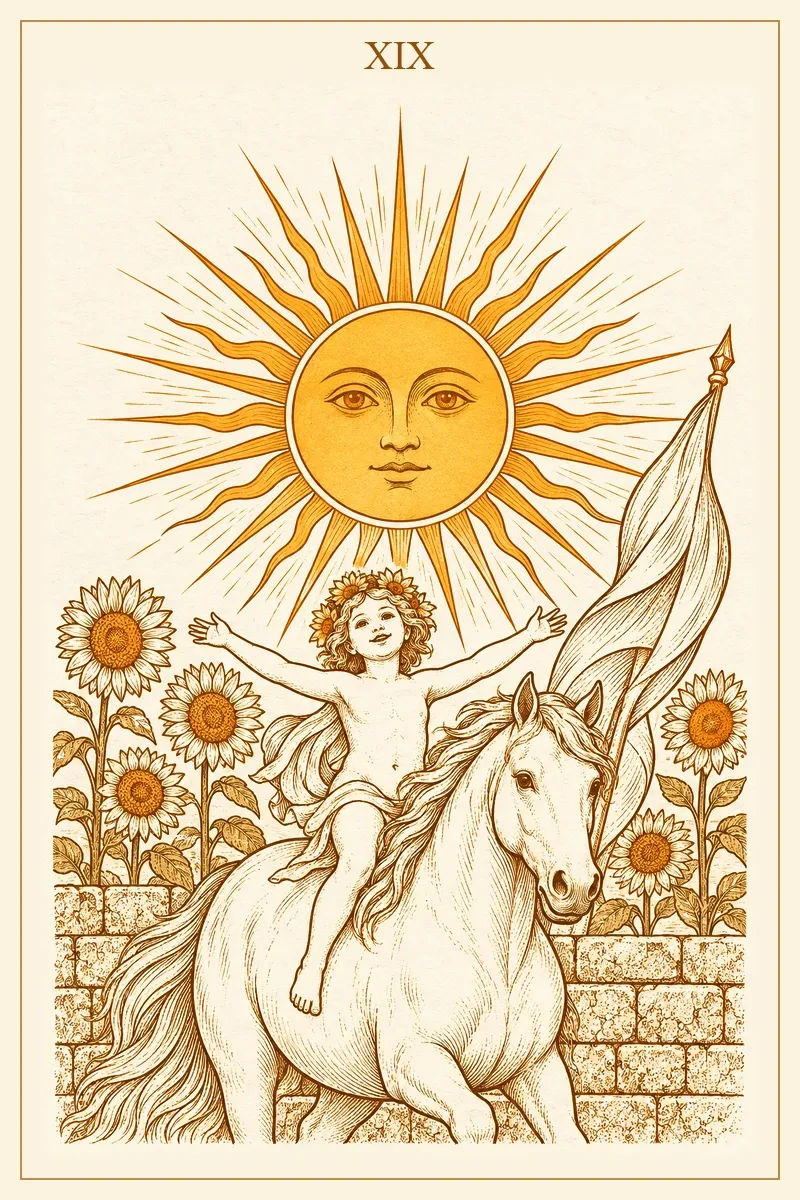
The Sun shows a large sun with a calm face above a child crowned with flowers, riding a white horse without a saddle, arms flung wide, with sunflowers rising behind a stone wall and a pale banner on a staff. Next to the Six, whose rider also sits on a white horse, the card turns public success into plain joy: the result is good, and you get to enjoy it. The Sun's meaning of joy and vitality describes that warmth.
The Emperor: recognition that comes with authority
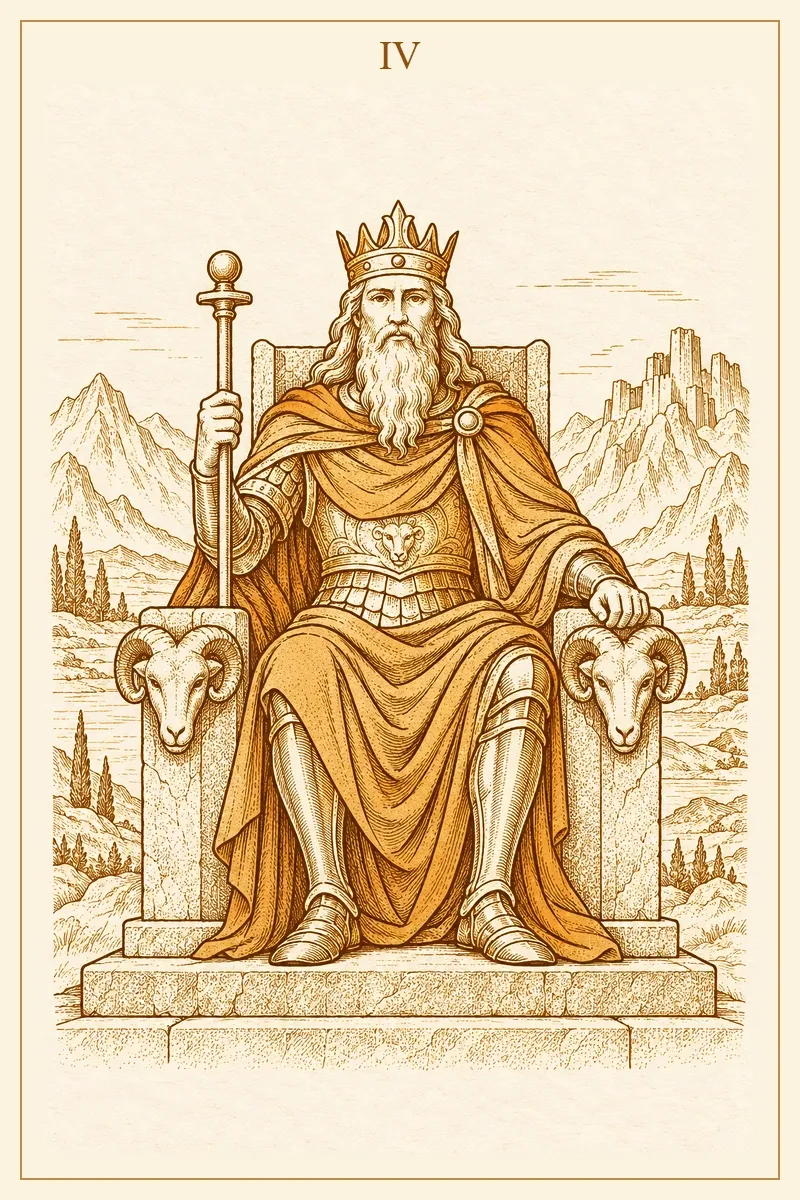
On The Emperor, a crowned, white-bearded ruler sits on a stone throne carved with rams' heads, armor under his orange cloak and a scepter in one hand, with mountains and a castle behind him. With the Six, recognition turns into responsibility: a promotion to lead, a role with structure and rules, a win that now has to be managed. The Emperor's meaning of structure and leadership explores that kind of authority.
The Moon: cheering outside, doubt inside
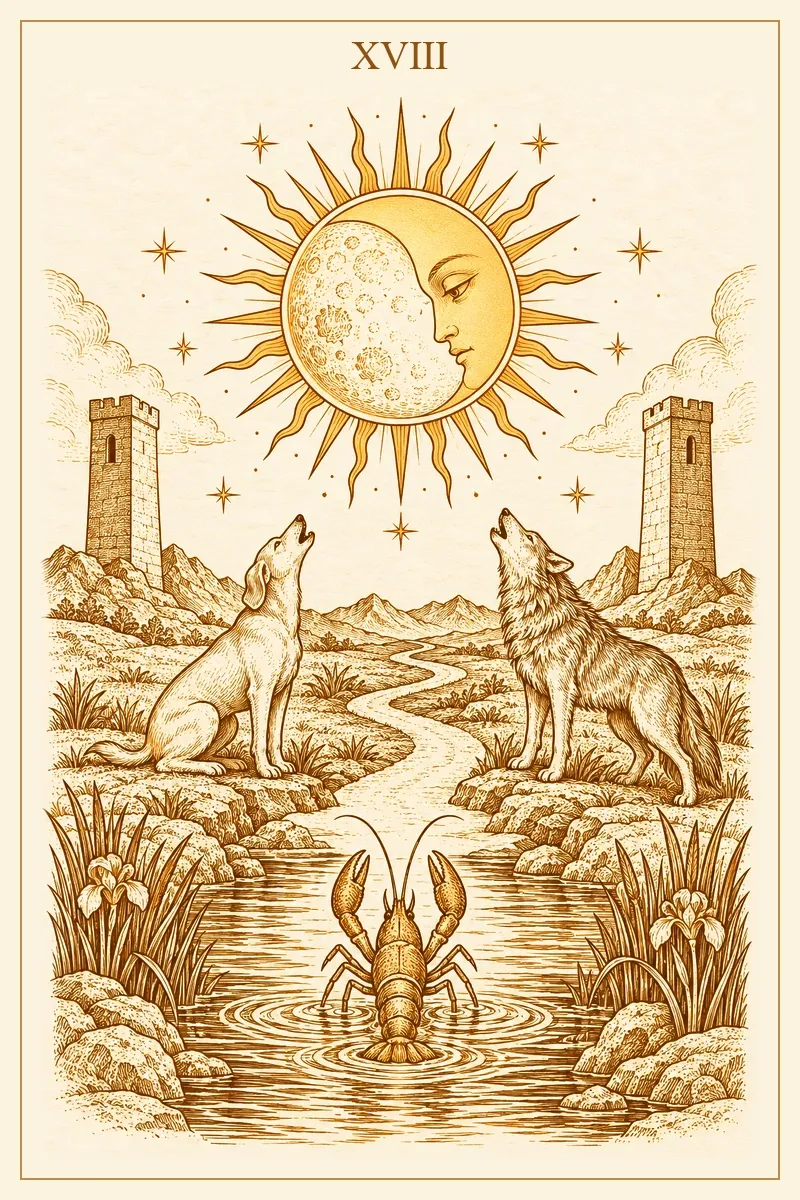
The Moon shows a crescent face inside a rayed disc, a dog and a wolf howling up at it between two stone towers, and a crayfish climbing out of a pool toward a winding path. Paired with the Six, it describes success that looks clear from outside while you feel unsure inside, or praise you do not quite trust. Check the doubt against facts rather than moods. The Moon's meaning of uncertainty and intuition goes further into that fog.
Ten of Wands and Three of Pentacles
Two more pairings round out the picture. On the Ten of Wands, a figure bends under a bundle of ten staffs on the way to a walled town; beside the Six, the victory brings more weight than expected, as new duties arrive with the wreath, and the Ten asks which of them you actually agreed to. On the Three of Pentacles, a young craftsman carves a column from a scaffold while a monk and a cloaked man hold up a building plan; with the Six, recognition comes from people who know the craft, such as peers, mentors or clients who understand exactly what you did well.
A victory-lap spread, with an invented example
This four-card spread looks at a win from several sides, so you can receive it without being carried off by it. Shuffle with a recent success, or a result you are waiting for, in mind.
- The win: what was actually achieved, and through what.
- The crowd: who walked beside you, or who is watching now.
- Under the cheering: what the applause covers, such as a worry, a cost or a feeling you are not saying.
- The road after the procession: the next sensible step.
Aya is invented for this page, to show how the positions work together. She bakes bread on weekends. Her naturally leavened loaf won first prize at a neighborhood market fair, and a café owner who tasted it has asked for loaves every week. Thrilled and uneasy at once, she asks: "How can I build on this without losing what I love about baking?"
The win, the Eight of Pentacles upright: patient practice. The prize rewards two years of weekend baking, not one lucky loaf.
The crowd, the Three of Cups upright: friends celebrating together. The friends who tasted every failed batch are part of this result.
Under the cheering, the Nine of Swords upright: worry that grows at night. Aya lies awake picturing a weekly order going wrong, a fear about a future that has not happened.
The road after, the Page of Pentacles upright: a careful first step, learning by doing.
In this example Aya offers the café a one-month trial of six loaves a week, to be reviewed with the owner at the end, and bakes a celebration loaf for the friends who tasted her early attempts.
After the procession: four ways to use a Six of Wands moment
- Say the win out loud. Write one sentence about what you achieved and how, without "just" or "only".
- Thank the crowd by name. A message to two or three people who helped makes the win shared, as it is on the card.
- Keep the evidence. Save the email, the review, the result. On reversed days a record is easier to trust than a memory.
- Choose the next hill yourself. Decide what to do with the attention you now have before other people decide for you.
One question to keep with you: whose applause are you really waiting for?
Frequently asked questions
Is the Six of Wands a good card?
Yes. It is among the most encouraging cards in the Wands, standing for success, recognition and confidence. If it carries a caution at all, it is to see the win at its real size and to remember who helped.
Who are the people walking beside the rider?
They stand for the people who witness and share your success: colleagues, friends, family, an audience. Several carry staffs of their own, a sign that they helped earn the win.
What is the difference between the Six of Wands and the Four of Wands?
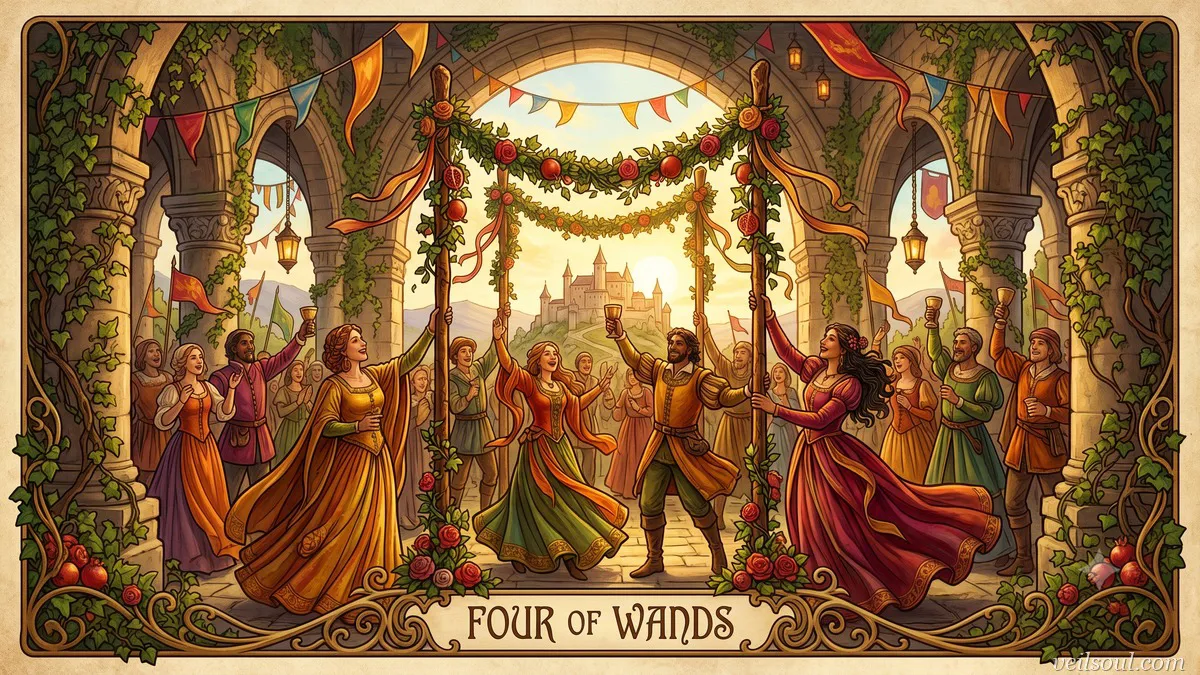
The Four of Wands shows two people raising bouquets beneath garlands strung between four leafy poles, with a castle behind them: a celebration at home or among your own people. The Six is a personal victory being acknowledged in public. The Four says "we have made a place to celebrate"; the Six says "people saw what you did".
What does the Six of Wands mean in a past, present or future position?
In the past, an earlier success that still shapes your confidence, or one you still lean on. In the present, recognition arriving now, to be received. In the future, a direction that looks favorable if you keep your work visible: a possibility, not a fixed result.
Can the Six of Wands tell me if I will get the job or win?
No. Tarot cannot confirm what an employer, a panel or another person will decide, set a date or guarantee an outcome. The Six reflects your confidence and what recognition means to you, and it can help you prepare and present your work well.
Riding on, staff still raised
The Six of Wands asks you to let a good moment be good: lift the staff, take in the cheering, thank the people beside you, and then ride on without needing the crowd to follow you everywhere. You can follow the Wands from first spark to heavy bundle through all 78 tarot cards, and when you want to look at a win, or a wait, of your own, try a reading on the result you are hoping for and see which cards ride alongside the Six.