Two people walking through snow past a lit window: that is the Five of Pentacles in a love reading. Upright, it describes a hard season a relationship is living through, such as money worries, illness, loss or the feeling of being shut out, and it points to help or warmth that is closer than either person has noticed. Reversed, it describes the thaw: help accepted, shelter found, a couple turning toward each other again, or now and then one more cold stretch before things ease.
Treat the card as a way to look at the season you are in, not as a verdict on the relationship. Tarot cannot tell you what a partner privately feels, promise that the two of you will come through, or name the month when things get easier; it can help you see where the cold is, who is carrying what, and which door you have been walking past. The card's general meaning in work, money and health is covered in the Five of Pentacles tarot card meaning, so this page stays with love.
- Couples under strain: money pressure, illness, caregiving or grief wearing down a partnership.
- Left out together: a couple without the support of family, friends or a community.
- Lonely side by side: two people sharing one hardship but no longer talking about it.
- Single: feeling that love and belonging are happening behind someone else's window.
- Reversed: asking for help, coming in from the cold, reconnecting, or a slow and uneven recovery.
- Yes or no: mostly "not in this weather"; a yes when the question is about asking for support.
Two travelers under a glowing window: the picture in a love context
Five of Pentacles: snow, crutches and colored glass
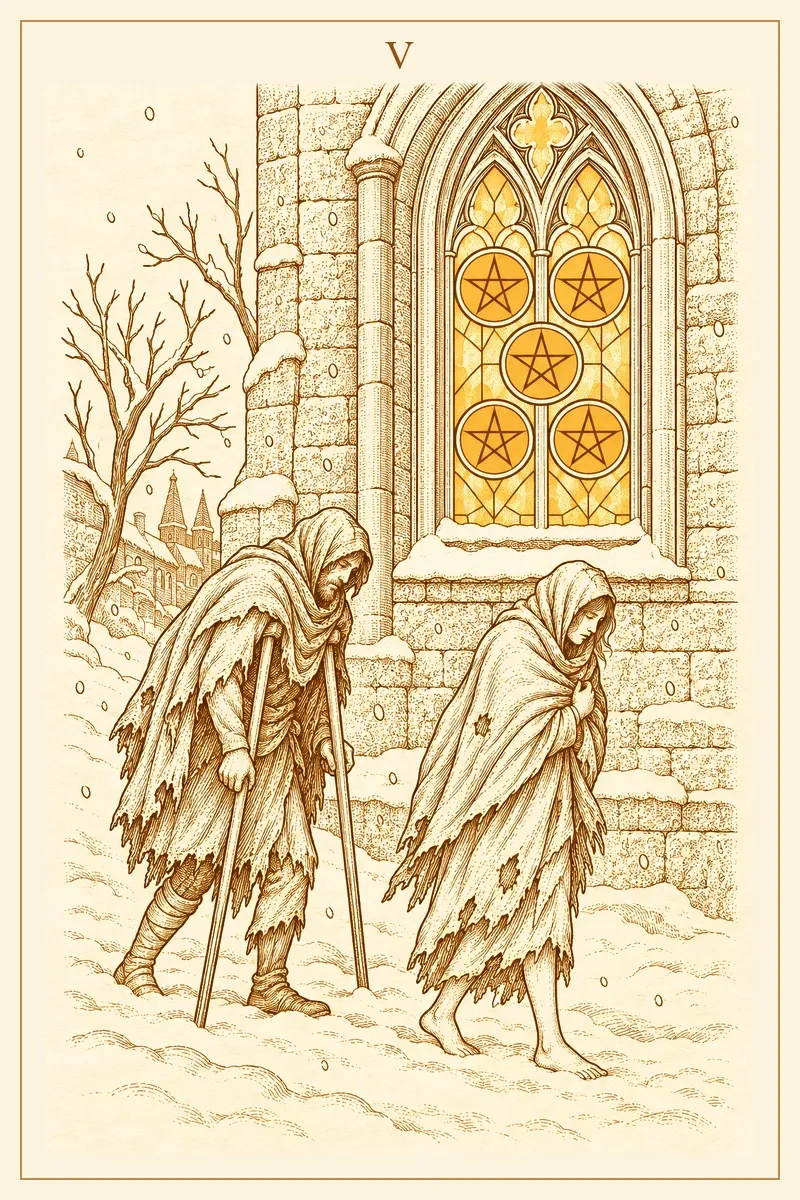
On the card, two people make their way through deep snow along a stone wall while flakes keep falling. The one behind is a bearded man in a hooded, ragged cloak, leaning on two wooden crutches, one leg bound in cloth bandages. Ahead of him walks a woman, barefoot, a long shawl pulled over her head and clutched closed at her chest, its hem torn and dotted with small holes. Both keep their heads bowed. Above them, set into the wall, is a tall arched window of amber stained glass holding five gold pentacles, two at the top, one in the center and two below, with snow lying on the sill. At the left edge, behind the pair, stand a bare tree and the roofs and spires of a distant town.
Read as a love picture, the details start to speak. The two walk the same road, yet neither looks at the other. One hardship is easy to see, the crutches and bandages, while the other is quieter and just as real, bare feet in snow and arms wrapped tight. The window is bright, close and directly above them, but with their heads down they walk right under it. The card does not scold them for missing the light; it asks gently what you would see if you lifted your head for a moment.
The kinds of cold an upright Five of Pentacles can name
The upright card shows that something is hard; your question and the cards around it show what. Look for the situation below that sounds closest to your own.
Money pressure on a couple
A lost job, a cut in hours, debt or rent that keeps rising can stand behind this card. Money trouble leaks into small arguments about groceries, late shifts and the embarrassment of declining invitations. The card names the pressure without blame, and it hints that shame is part of the weather, because shame is what keeps the two figures from looking up. If qualified help with debt or budgeting exists in your area, that is a lit window too.
Illness, injury and caregiving
The figure on crutches makes this a clear card for a relationship shaped by health. One partner may be ill or recovering while the other carries the household, the appointments and the fear. Both get tired, in different ways. The card asks whether the caregiving partner has room to say they are struggling too, and whether the partner who is unwell is allowed to be more than a patient. A doctor, a counselor or a caregiver support group can help in ways a card cannot.
Left outside as a couple
Sometimes the cold comes from other people: a family that disapproves of the relationship, friends who drifted away after a move, or a new country where you know almost no one. The lit window here is a circle of belonging the couple stands outside. The card acknowledges how isolating that is and points toward warmth you can find or build elsewhere.
Lonely in the same room
The two figures are together and still alone. This is the reading for partners coping with the same hardship who have stopped sharing it: each protects the other by staying quiet, and the silence turns into distance. You may lie awake worrying about the very thing your partner is worrying about, and neither of you says so. The guide to tarot for loneliness has gentle ways to name that feeling before you bring it to your partner.
Single and standing outside the window
For a single reader, the card can describe the sense that love is a warm room other people are sitting in. After a breakup, it can also be the first winter alone, with a smaller home and a social circle split in two. The card does not say you are meant to stay outside. It points to the ways you may have stopped expecting warmth: not reaching out, turning down invitations, or deciding in advance that no one will open the door. The ideas in tarot for singles can turn that feeling into small next steps.
Who is on crutches? Matching the two figures to you and your partner
A love reading invites you to cast the two travelers, and it helps to be honest. The partner whose hardship is visible is easy to place on the crutches. Yet the barefoot figure is struggling too, in the way no one asks about: carrying the worry, the extra work, the brave face. Neither figure is the strong one. Both are cold.
- Ask who is carrying what. List what each of you holds in this season, practical and emotional. The second list tends to be longer than either person admits.
- Notice whose head is down. One partner may be ready to ask for help while the other feels asking would be a defeat. Name that difference without turning it into a fight.
- Check the position. In a "you" position the card describes your own posture; in a "partner" position it describes what you observe in them, which is worth checking with them rather than assuming.
Reversed Five of Pentacles in love: the thaw and its uneven steps
Lifting your head toward the window
The most hopeful reversal is a change of posture: one or both partners stop walking past the help. That might mean accepting a parent's offer, calling a counselor, telling a friend how things really are, or simply admitting to each other that this is hard. The asking matters even before anyone answers.
Coming in from the cold together
Reversed, the card can also describe recovery already underway: an illness easing, steady work returning, a debt plan that is working, or grief softening enough that the two of you laugh again. The warming is gradual, so count small signs, such as a calmer evening.
Rejoining the people you pulled away from
Hardship can make a couple retreat. The reversal can show the return: answering messages again, a reconciliation with family, going back to a group that used to feel like yours. For a single reader, it can be the moment of saying yes to company after a long stretch of saying no.
A slower stretch before it eases
Less comfortably, the reversed card can describe the cold lasting longer than hoped, or help that still feels impossible to accept. This is not a prediction of disaster, only an honest note that recovery does not run in a straight line. Gentle neighbors such as The Star lean toward easing; heavier ones ask for patience and practical support.
Five of Pentacles as feelings, a yes or no, and when
When you asked how someone feels
Drawn for "How do they feel about me?", the Five tends to describe someone who is struggling: under pressure, ashamed of their circumstances or feeling they have nothing to offer right now. That is not the same as not caring. Reversed, it points to someone who is starting to steady themselves and may be more willing to reach out or let you in, although pride or embarrassment can still slow them down. Either way, what they do and say counts for more than the card, so offer one gentle, specific invitation, such as a quiet walk, rather than pressing them to explain how they feel.
As a yes or no
For "Will we get through this?" or "Should we move in together now?", the upright card leans toward "not in this weather," meaning conditions are hard rather than that the answer is never. It turns toward a yes for questions about support, such as "Should I ask for help?" Reversed, it leans toward a cautious yes for recovery questions.
Timing
The Five gives no dates. Its timing clue is a condition: things begin to shift when someone looks up and asks. If you drew it for "When will things get better?", try the follow-up "What help am I not using yet?"
How the spread position shapes the card
- Past: a hard season you came through, and what it taught you about relying on each other.
- Present: the cold is here now; look at who is carrying it and whether you are carrying it together.
- Obstacle: walking past help, or the silence between partners, keeps closeness from returning.
- Advice: look up and ask, whether for practical help, emotional support or one honest conversation.
- Outcome: a demanding road rather than a closed door; the cards before it show where help could come in.
Cards that bring the window closer, and cards that deepen the snow
With the Six of Pentacles: help that is actually received
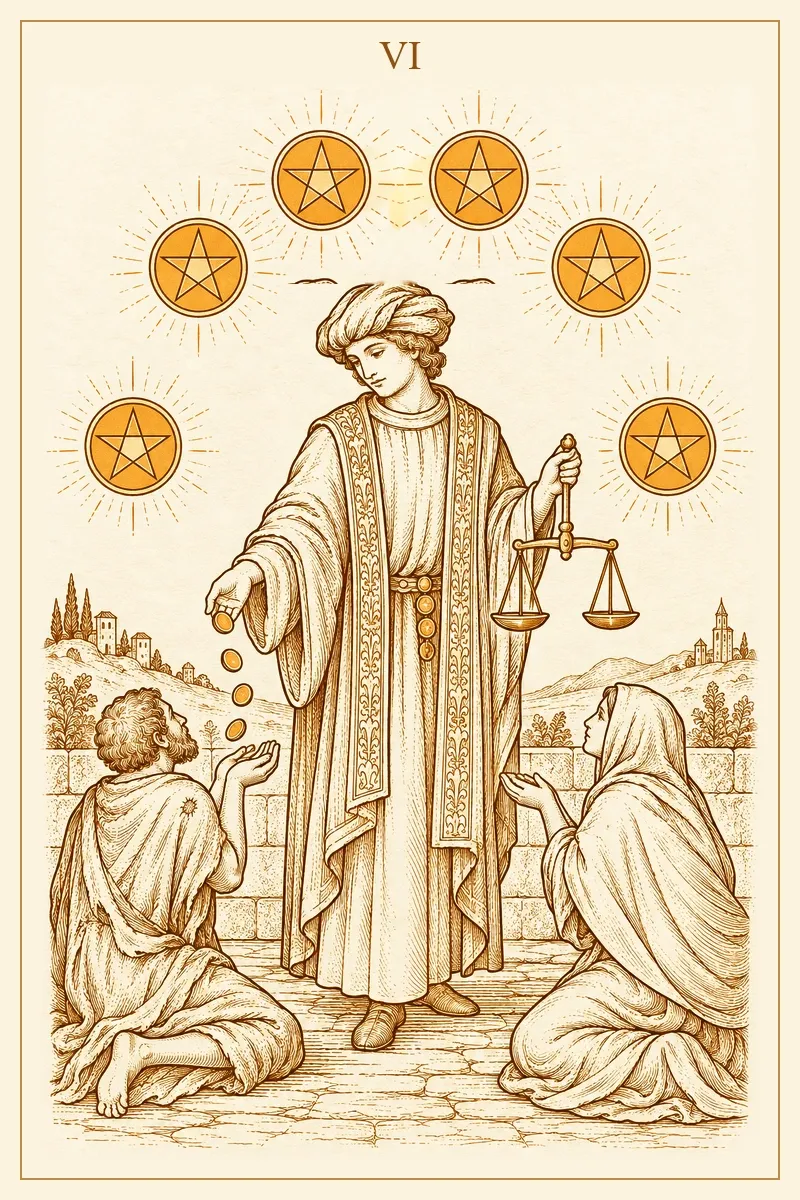
The Six of Pentacles shows a young man in a turban and embroidered robe dropping coins into the cupped palms of a kneeling man while his other hand holds balanced scales; a hooded woman kneels on the other side with open hands, and six gold coins arch overhead. After the Five's snowy street, this is the moment someone steps inside. In love, it can be family, friends or a service supporting a couple, or one partner finally letting the other help, with an eye on balance so receiving does not turn into owing. The Six of Pentacles tarot card meaning looks at both sides of that exchange.
With The Hermit: hardship carried in private
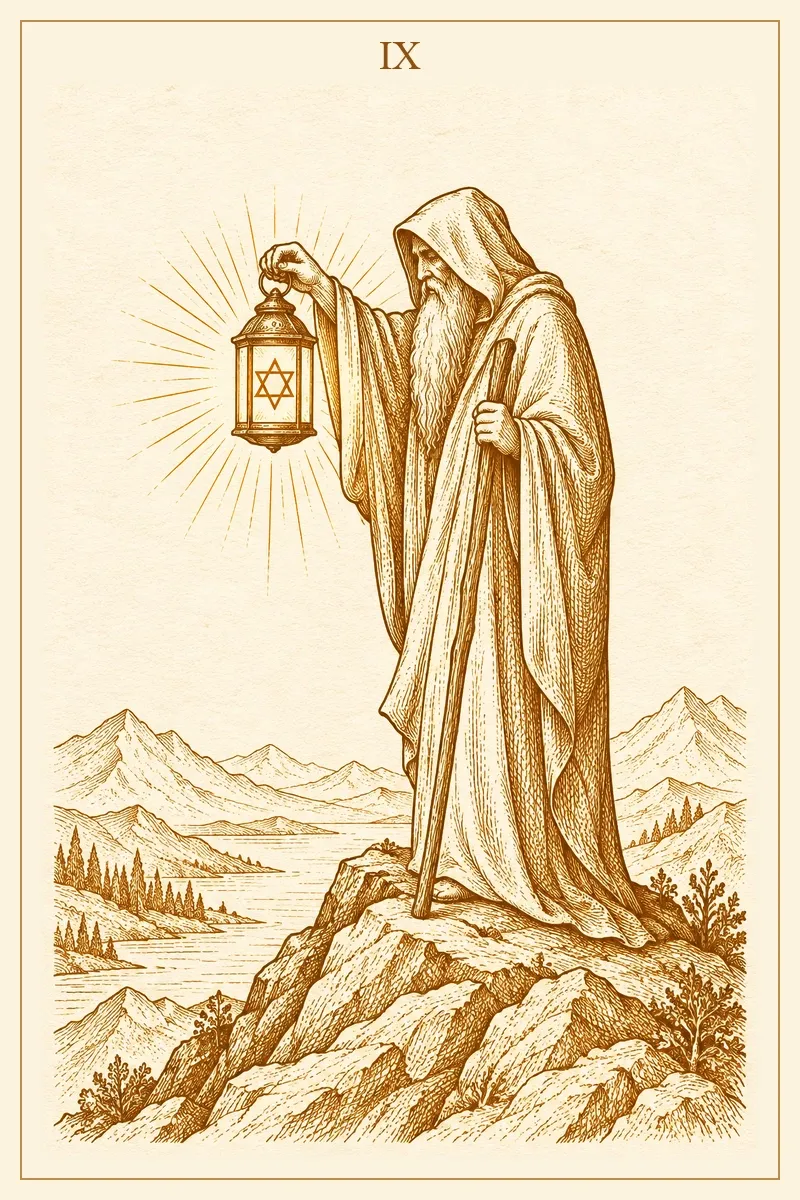
In The Hermit, a robed old man with a long white beard stands alone on a rocky peak, lifting a lantern with a six-pointed star inside and leaning on a tall staff, mountains and a lake far below. Next to the Five, his solitude takes on a sharper edge: one partner withdrawing to cope, working everything out alone and keeping worries away from the other. As the only way of coping, it leaves the other person walking in the snow without knowing where you are. The Hermit tarot meaning explores the healthier kind of retreat, the kind that comes back with a light to share.
With The Tower: when hardships pile up
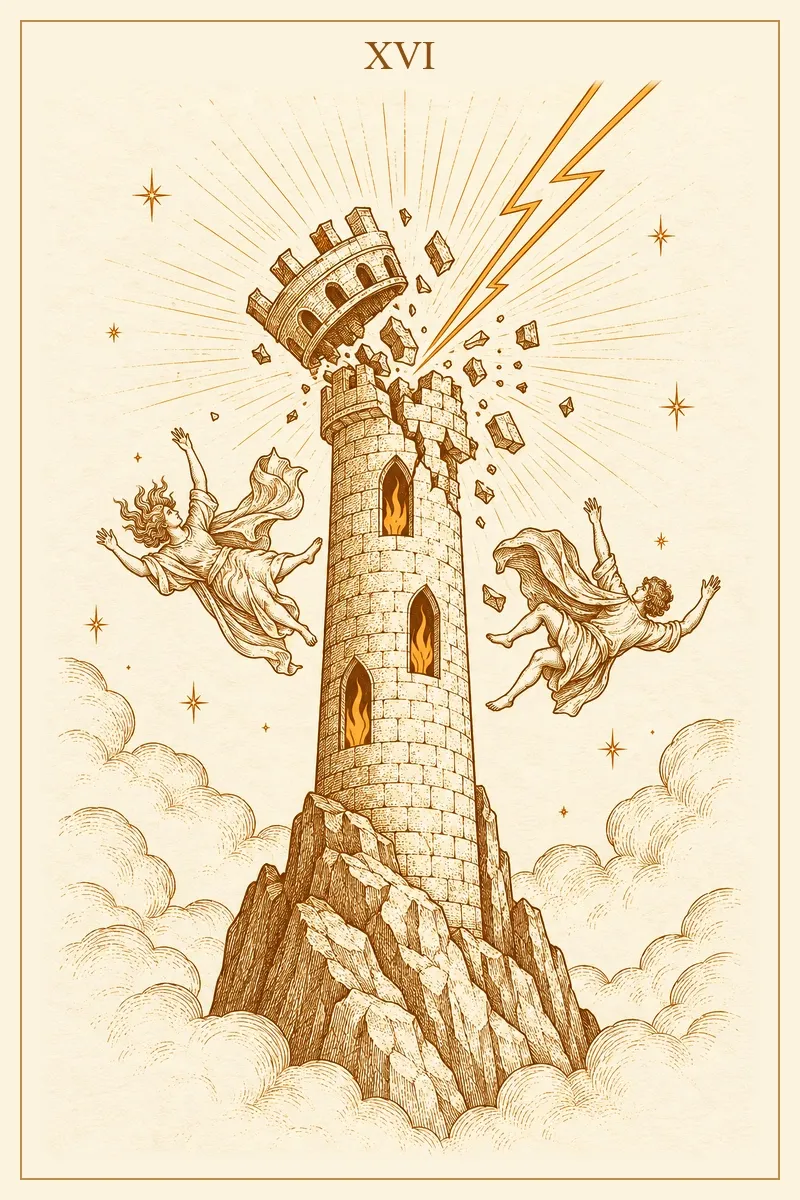
The Tower shows a stone tower on a jagged crag above the clouds; lightning knocks its crowned top clean off, bricks scatter, flames show in three windows and two figures fall from either side. With the Five, the pair describes a sudden event, such as a job loss, an accident or a diagnosis, that leaves a couple in a hard season, or one shock arriving on top of another. It is not meant to frighten; it is a reason to call in support early. The Tower tarot meaning looks at how people rebuild after the ground shifts.
With the Ten of Pentacles: a home built after hard years
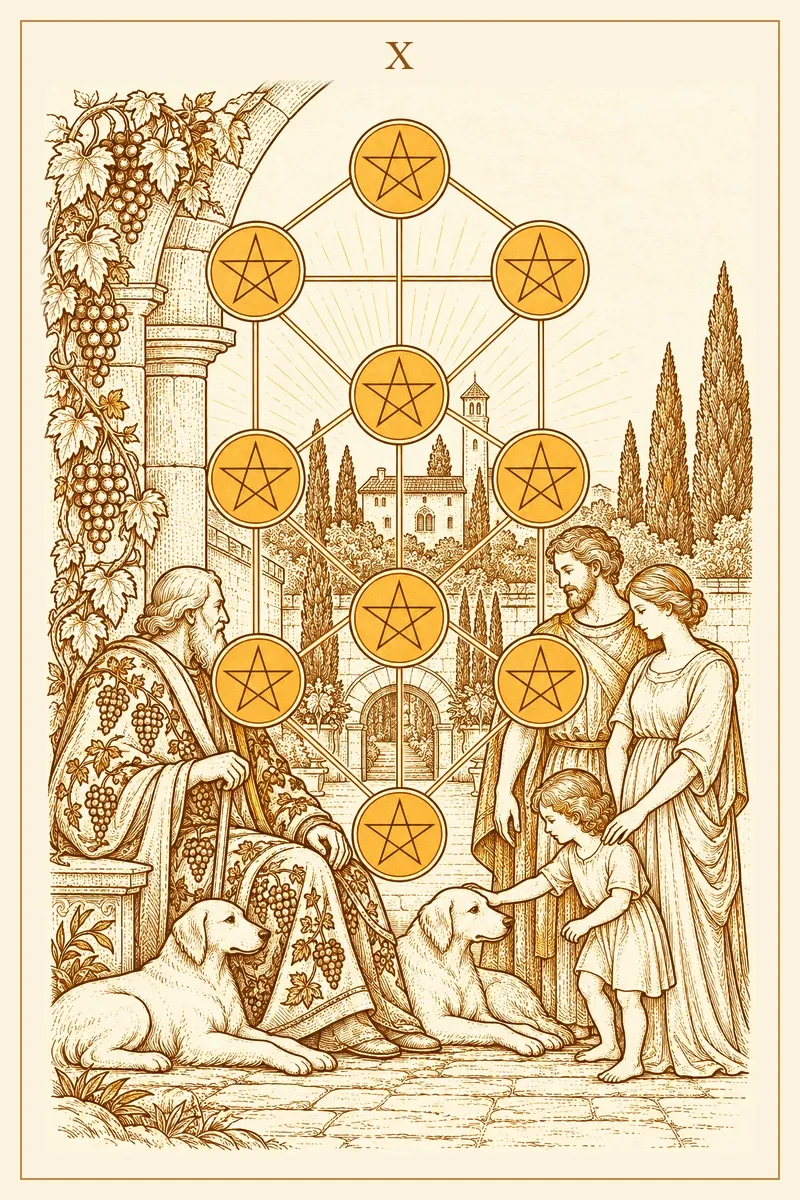
In the Ten of Pentacles, an old man in a robe patterned with grapes sits under a vine-hung stone archway with two white dogs beside him; a younger man and woman stand nearby while a child reaches out to pet a dog, and ten gold coins hang in the shape of a branching tree before a villa and tall cypresses. Paired with the Five, it tells the long version: a couple who went through a lean stretch and slowly built a shared home. It promises no wealth; it suggests the hard season can be one chapter of a longer life together. The Ten of Pentacles tarot card meaning covers its themes of family and legacy.
Three more pairings in brief
With the Three of Cups: friends or chosen family are the window, ready to bring warmth if you let them in. With The Star: a gentle recovery after a long winter, hope returning a little at a time. With the Three of Swords: a specific heartbreak inside the wider hardship, a wound that needs its own care rather than being lost in the general weather.
Pride, shame and asking: what the window asks of a couple
The most practical lesson of this card in love is about asking. Couples in a hard season can sometimes get help from a relative, a friend, a counselor, a community service or each other, and still do not ask, out of pride, fear of being judged, not wanting to be a burden, or the worry that accepting help means admitting failure. The card offers another view. The travelers are not failing; they are cold. Accepting warmth is not a defeat, and refusing it can quietly cost the relationship more than the hardship itself. Asking also works best when it is specific. "We're fine" closes a door; "Could you watch the kids on Thursday so we can talk?" opens one. And if you are usually the one offering, the card may ask you to make help easy to accept, without conditions or lectures attached.
The Lit Window spread: five positions for a couple in a hard season
Use this spread when the Five of Pentacles has shown up in a love reading and you want to understand the season rather than predict its end. Shuffle with a question such as "How can we get through this together?" and lay five cards in a row.
- The cold we are in: the hardship itself, named as plainly as possible.
- What I carry that may not show: your share of the load, including the worries you keep quiet.
- What I notice my partner carrying: the pattern you observe in them, to be checked in conversation rather than assumed.
- The lit window: help, warmth or support within reach.
- One step toward shelter: a small, concrete action for the coming week.
Read cards two and three side by side to see whether you are carrying the same weight in different ways, and read card four slowly, since it may point to something you already know and have been avoiding. A few weeks later, the relationship check-in tarot spread can show how things are changing.
A fictional example: reduced hours and a quiet kitchen table
This is a fictional example to show the spread at work; Nadia and Sam are invented.
Nadia and Sam have lived together for four years. Since Sam's hours at work were cut two months ago, they no longer talk about money, plans or how either of them is doing. After drawing the Five of Pentacles in a morning pull, Nadia lays the Lit Window spread and asks: "How do we get through this season without drifting apart?"
The cold we are in: the Ten of Wands. The hardship is more than less money; it is a pile of bills, extra shifts and plans on hold that each of them is trying to carry alone.
What I carry that may not show: the Nine of Swords. Nadia lies awake with worries she has not mentioned, because she does not want Sam to feel worse.
What I notice my partner carrying: the Four of Cups. Sam seems to be turning things down: a friend's offer of extra work, his sister's dinner invitation, Nadia's attempts to talk. She treats this as something to ask him about, not proof of what he feels.
The lit window: the Three of Cups. Friends and family have already reached out, and the couple has been politely declining.
One step toward shelter: the Two of Pentacles. Sit down together with the numbers and decide what to juggle, instead of each juggling in private.
The spread suggests the cold is real but silence is making it harder. Nadia plans to tell Sam about her sleepless nights, ask what he has been carrying, and suggest they accept his sister's invitation that weekend. The reading does not say when Sam's hours will return or how he will respond; it shows that the window they keep passing is their own kitchen table and the people already offering warmth.
Small steps for a couple in a hard season
- Name the weather together. Say what is hard right now in a sentence or two each, without trying to fix it in the same conversation.
- Make one ask, and accept one offer. Choose one specific request for help, and say yes to a small part of support someone has already offered.
- Keep one warm habit. A walk, a shared meal, a film on the sofa: something that reminds you both the relationship is more than the hardship.
- Look for practical help. For money, health or housing questions, qualified services and professionals can offer what a reading cannot.
Frequently asked questions
Does the Five of Pentacles mean my relationship is going to fail?
No. It describes a difficult season, not an ending, and couples who share the load and accept support can come out of hard stretches closer. The card is also limited: tarot cannot predict how a relationship turns out, confirm another person's feelings or tell you how long a hard time will last. It can help you see the situation clearly enough to choose your next step.
Is the Five of Pentacles always about money in love?
No. Pentacles are the suit of material life, so money is one reading, but the card also covers illness, caregiving, grief, isolation and feeling excluded. Your question and the surrounding cards show which kind of hardship is meant.
What does the Five of Pentacles mean for someone who is single?
It can describe loneliness, the sense that love is something other people have, or a stretch of life with little room for dating. It also asks whether you have stopped reaching out or accepting warmth when it is offered, and invites one small step toward connection.
Does the reversed Five of Pentacles mean an ex will come back?
Not by itself. Reversed, the card describes recovery, accepting help and reconnecting with people, which may include an ex but can just as well mean friends, family or community. If you are hoping to reconcile, look at the surrounding cards and at what has actually changed between you.
How is the Five of Pentacles different from the Three of Swords in love?
The Three of Swords is a sharp emotional wound, such as a betrayal, a breakup or painful words. The Five of Pentacles is a longer hardship that wears on a couple over time. The Three asks you to feel and grieve the hurt; the Five asks you to seek shelter and support. When both appear, a specific hurt may sit inside a wider hardship, and each deserves its own care.
Looking up, together
The Five of Pentacles does not ask you to pretend the snow is not there. It asks you to walk beside your partner rather than just ahead, and to lift your head long enough to notice the warmth already close by. When you want to look at your own question in more depth, a Veil Soul reading can help you find the window you have been walking past.