Generosity that someone is quietly measuring: that is the Six of Pentacles in a love reading. Upright, it describes support moving between two people (money, time, care, patience) and asks whether that flow feels fair to both of you. Reversed, the measuring gets louder: a hand closes, a debt starts shaping the relationship, a gift comes with conditions, or the partner who always gives finally learns to let someone give back.
Read the card as a mirror for the give and take you already have, not as a forecast. Tarot cannot tell you what a partner privately feels, whether they will help you, or how a relationship will turn out; it can show you which part of the exchange deserves an honest conversation. The card's wider meaning in work, money and health is covered in the Six of Pentacles tarot card meaning, so this page keeps to romance and partnership.
- Upright: support given and received in a way both partners can live with.
- Uneven roles: one partner earns, plans or comforts more, and the card asks whether that still suits you both.
- Receiving: the work of accepting care without feeling small.
- Reversed: a closed hand, a silent ledger, generosity with strings, or a giver who starts receiving.
- Yes or no: a qualified yes, depending on whether the exchange is honest.
- Single readers: what you are being offered, and whether you can take it in.
Coins falling, a scale held high: the card as a picture of two hearts
Six of Pentacles: one giver, two open pairs of hands
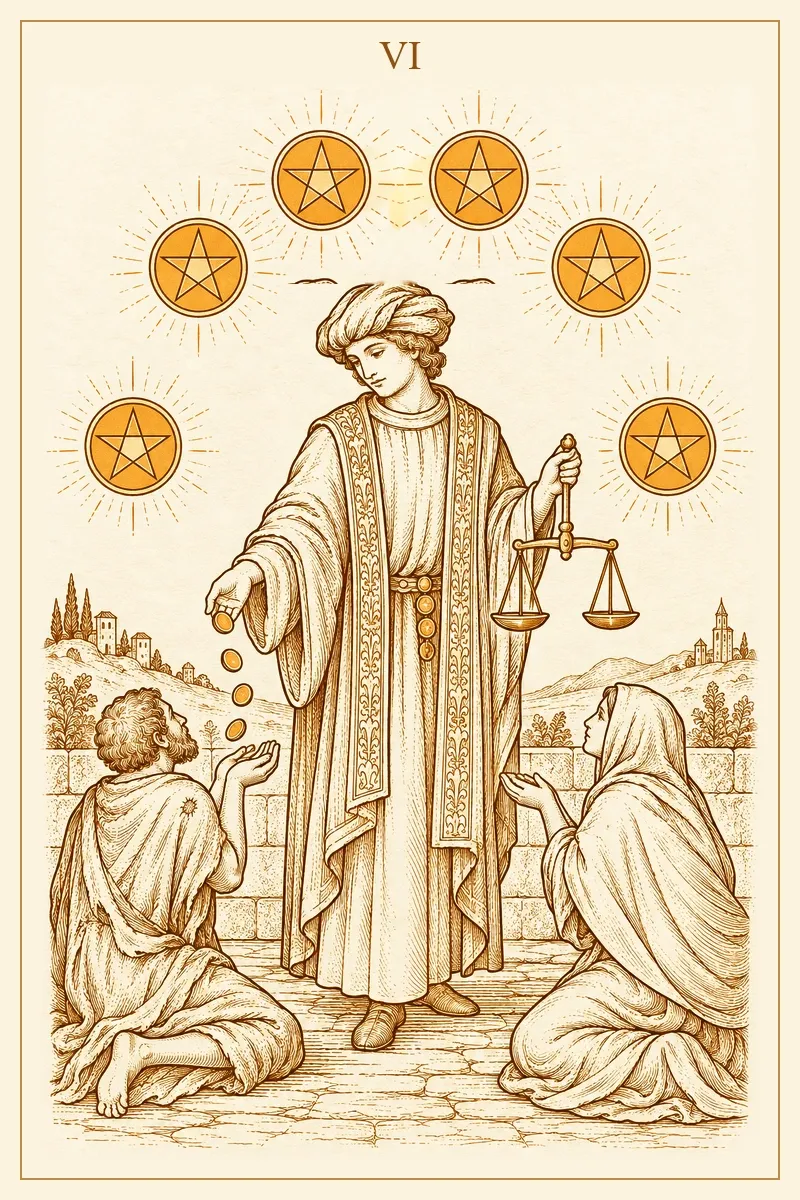
At the center of the card stands a young man in a wrapped turban and a long robe whose front panels are worked with a climbing pattern; a belt hung with small round discs circles his waist. He looks down and to his right. With one hand he lets a few coins drop, one after another, toward a curly-haired man kneeling barefoot on the paving stones, palms cupped upward to catch them. With his other hand he lifts a balance scale, its two pans hanging level and holding nothing. On the opposite side kneels a second figure, hooded and wrapped in a heavy cloak, both hands raised and open. No coins are falling toward this one yet. Six radiant pentacles curve in an arch over the giver's head, and behind the three figures run a low stone wall, rolling hills, cypress trees and small hilltop towns on either side.
As a love picture, three details matter. The coins pass through the air rather than from hand to hand, so the person receiving has to stay in position to catch them; in a relationship that can feel like waiting to be given what you need. The scale is raised while the gift is made, which suggests the giver is weighing as he goes, even if no one says so aloud. And the hooded figure reminds you that one gift leaves someone else still hoping, whether that is a second person, a need that has not been named, or a part of you that has been put aside for later.
In the Golden Dawn system the card is the Moon in Taurus, titled Lord of Material Success: Taurus for comfort and steadiness, the Moon for needs and moods. In love, that means the everyday support that keeps two people fed and housed, and how each of you feels as it changes hands.
Upright in love: six shapes the giving can take
The upright card names an exchange; your question and the neighboring cards show which kind.
When one partner earns more
One of you brings in more money, owns the home or covers the larger bills. The Six does not treat this as a problem. It asks how the arrangement is held: whether both of you agreed to it, whether the partner earning less still has a voice in spending, and whether gratitude runs in both directions. A couple can carry a big difference in income gracefully when the terms are spoken and revisited.
When the gift is care, time or calm
Pentacles are the suit of the tangible, but in a relationship the coins can be hours and attention. Someone who remembers the appointments, keeps the household running, or settles every argument with patience is giving too. The card asks whether this kind of giving is noticed. Unpaid, unseen work is where resentment tends to grow first, precisely because nobody has put a number on it.
Helping a partner through a hard stretch
Sometimes the question is how to support a partner who has lost a job, fallen ill or gone back to study. The Six favors measured help over rescue: give what you can keep giving without draining yourself, agree on what the help covers, and decide when you will look at it again. Help that runs past your own limits tends to turn into the very debt you hoped to avoid.
When receiving is the hard part
Some people are fluent givers and clumsy receivers. They wave away offers, insist on paying, and feel uneasy when a partner takes care of them. Upright, the Six can point straight at this. A relationship needs both hands open; if one partner never lets the other give, the other eventually stops offering. Accepting help well is a gift in its own right, because it lets the person who loves you show it.
Reciprocity that trades places
The healthiest version of this card is an exchange that moves. One year one partner carries the rent while the other finishes training; later the roles turn. One partner leans on the other through a loss, then returns the steadiness when the other is struggling. Here the card describes a partnership where giving and receiving rotate rather than harden into fixed positions.
Single, or just getting to know someone
For a single reader, the Six asks what is being offered to you right now: a friend's growing interest, an invitation, a slower and kinder kind of attention than you are used to. In a fresh connection it can describe the early balance, where one person texts, plans or pays more and both are working out what feels even. The guide to new relationship tarot covers that first stage in more detail. The question the Six adds is simple: can you receive what is being given, and can you give back without keeping count?
Reversed in love: when the scale starts running the relationship
Reversed, the exchange stalls or tilts. Four readings are worth considering, and the cards around it help you choose.
The closed hand
The giver has stopped giving. A partner who has the money, time or affection to share has pulled it back, sometimes out of fear, sometimes to make a point. The person waiting below keeps their hands up. If this rings true, the question is what made the hand close, and whether it can be talked about rather than punished.
The silent ledger
Past giving has turned into a debt that nobody names. One partner feels owed; the other feels weighed down by a balance they never agreed to. Arguments about small things (who paid for dinner, who drove last time) are really arguments about the larger tally. The reversed card asks you to say the number out loud and decide together what would settle it.
Strings attached
Money offered so the other person cannot leave, help that comes with a lecture, attention given to secure obedience: this is the darker side of the reversal. The gift is real, but it is buying control. If a gift is being used to bind you, that pattern deserves outside support and not only a card reading.
The giver who finally receives
Not every reversal is a warning. Sometimes the upside-down card marks a partner who has always been the provider learning to accept care: being cooked for, being driven home, being asked how they are doing and answering honestly. The positions swap, and the relationship breathes easier for it.
Giver, receiver or the one still waiting?
A love reading becomes clearer once you ask which figure in the picture you are.
If you are the giver, look at your raised scale. What are you measuring, and does your partner know? Giving that is generous today can turn into leverage tomorrow if the terms live only in your head. Say what you are glad to give and where your limit is.
If you are the one catching the coins, notice how it feels to kneel. Receiving for a season is not a failure. What matters is whether you still have a say, whether you are thanked as well as thanking, and whether there are ways you give that your partner does not see.
If you are the hooded figure, your hands are open and nothing is reaching them yet. This can describe a partner whose needs keep getting postponed, someone in a relationship where another person (a child, a parent, a friend in crisis) is receiving most of the care, or a single person watching others be chosen. The card does not promise that the next coins are yours. It asks you to name what you are waiting for, so that it can be asked for directly.
Six of Pentacles as feelings, yes-or-no questions and timing with this card
Their feelings. When you ask how someone feels about you and the Six appears, it describes a wish to support you or a sense of being supported by you, not necessarily romance. Care is present; the card cannot confirm what kind. Reversed, their feelings may be tangled up with the balance itself: they might feel they give more than they get, feel uneasy about owing you, or be holding warmth back until something feels evened out. That points to strain in the exchange, not proof that the care has gone. Either way, watch what they actually do and offer, and let their actions answer the rest.
Yes or no. Upright, the answer leans toward yes when your question is about asking for help, accepting an offer or making an exchange fairer. Reversed, it leans toward "not on these terms": the arrangement has to change before a yes would be healthy.
Timing. No card names a date. The Six speaks to sequence instead: the next step comes once the give and take has been talked about openly.
Past, present, advice, outcome: the Six by position
Past. A season of giving or receiving that shaped where you stand now, such as one partner supporting the other through study. Ask what it taught you both about fairness.
Present. The exchange is active now. The question is whether both of you have agreed to your current roles or have simply slid into them.
Obstacle. Generosity has become a hierarchy: a giver who decides everything, or a receiver who has stopped contributing. Naming the pattern is the first step out of it.
Advice. Give with open hands and say what you are giving. Receive without apology. Keep your scale visible instead of hidden.
Outcome. A relationship defined by how it shares: hopeful when the roles keep turning, a caution when they have set in place.
Pairings that warm the exchange
The Empress: abundance without a scale
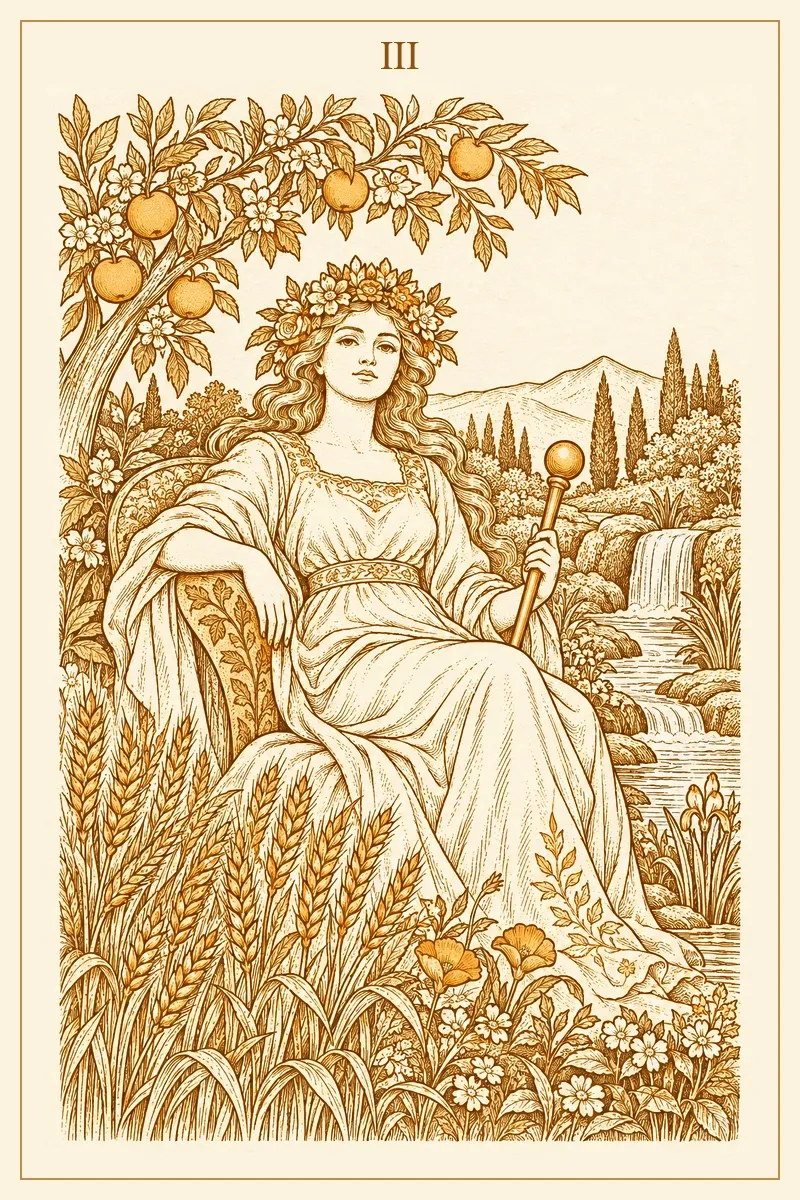
The Empress sits at ease in a patterned chair, crowned with flowers, a golden scepter resting in one hand. A fruit tree in blossom bends above her, ripe wheat and poppies grow at her feet, and a stream spills over a small waterfall beside her. Next to the Six, she adds a sense of plenty: care that comes from fullness rather than calculation. Together they describe a household in a nourishing season, where support flows easily and nobody is counting. Reversed, either card can point to a giver running on empty. The Empress tarot meaning explores her side of the pair.
Ten of Cups: generosity that built a home
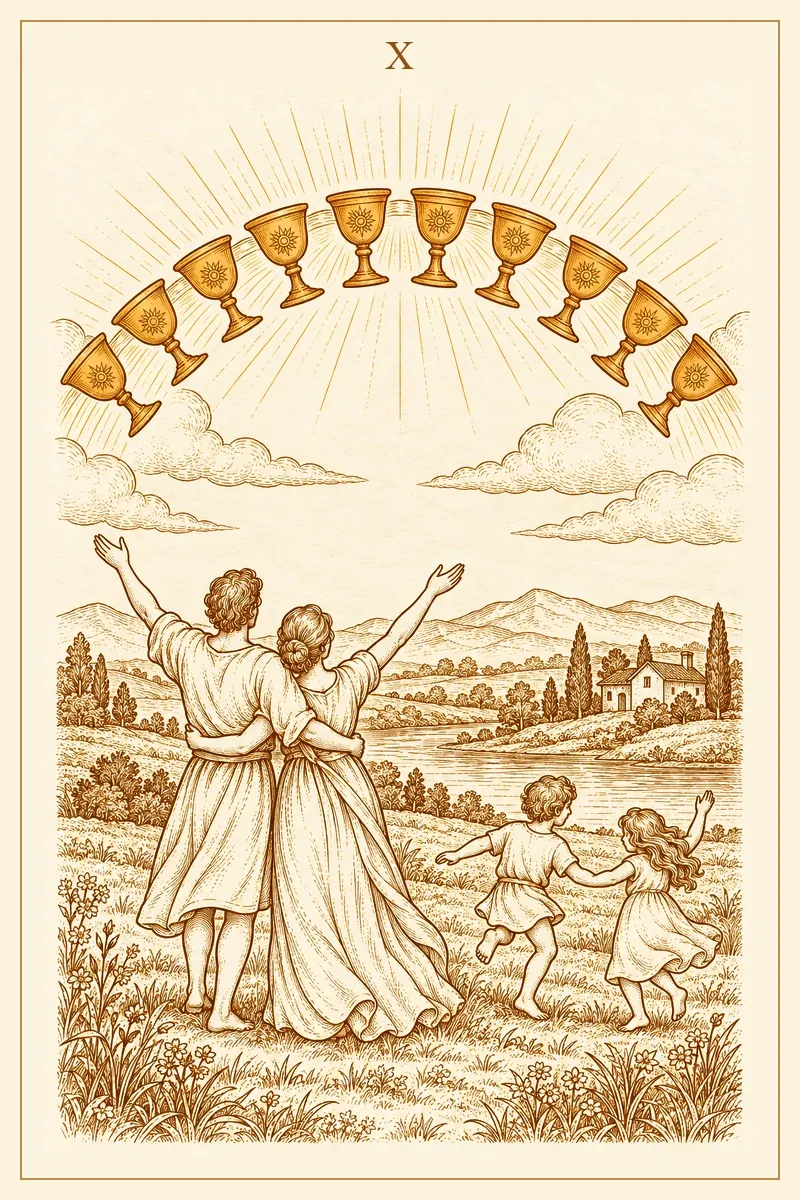
On the Ten of Cups, a couple seen from behind hold each other around the waist and lift their free arms toward an arc of ten golden cups, while two children run hand in hand across the meadow toward a river and a house on the far bank. With the Six, the pair reads as years of give and take that have added up to real belonging. It is one of the warmest combinations for a long relationship. You can read more in the Ten of Cups tarot card meaning.
Two shorter pairings: the Five and the Three of Pentacles
With the Five of Pentacles, hardship meets help: a couple in a cold season finds support arriving, or learns to ask for it. With the Three of Pentacles, generosity runs alongside shared work, as when two people pool skills and savings to build something together.
Pairings that tip the scale
Justice: making the measure fair
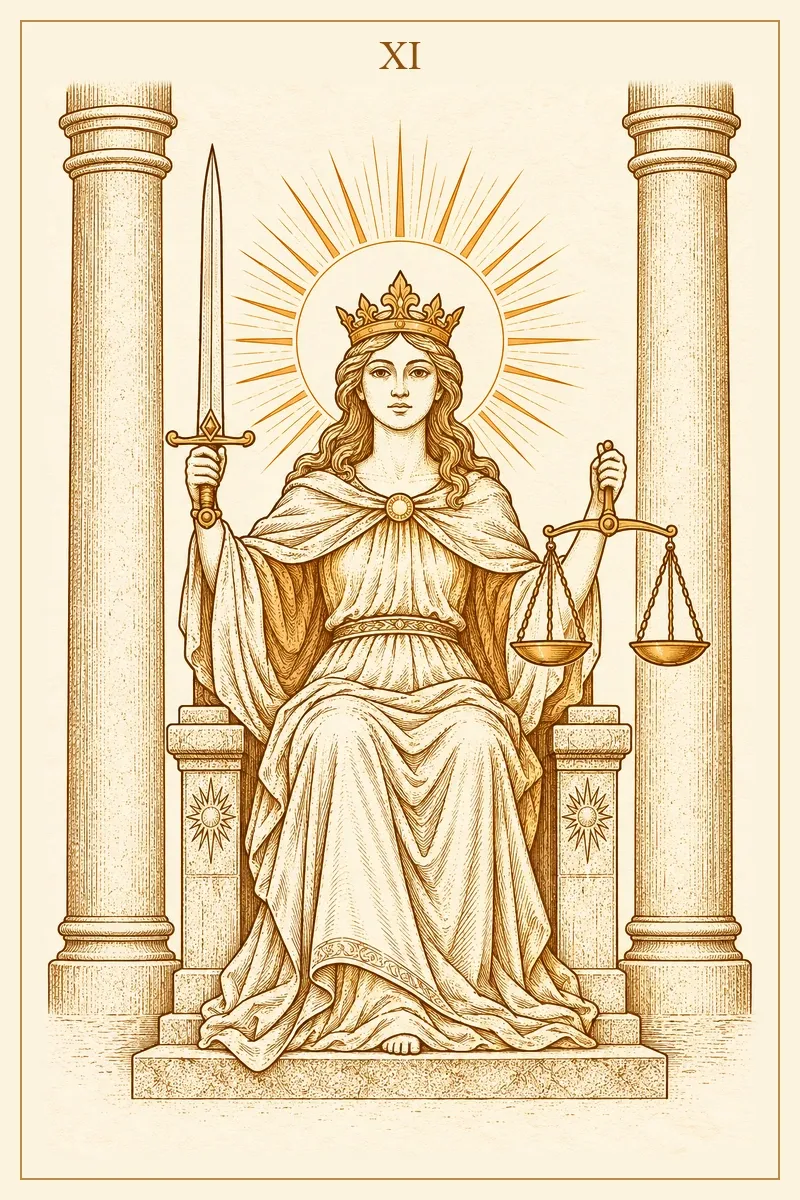
Justice sits crowned on a stone throne between two columns, a ring of light behind her head, a raised sword in one hand and a balance in the other. Two cards holding scales side by side make the measuring conscious. In love, this pair describes a couple ready to look at who carries what, sometimes through an uncomfortable talk about money, chores or a shared debt, and to agree on something both can call fair. The Justice tarot meaning goes further into accountability.
The Devil: the gift that binds
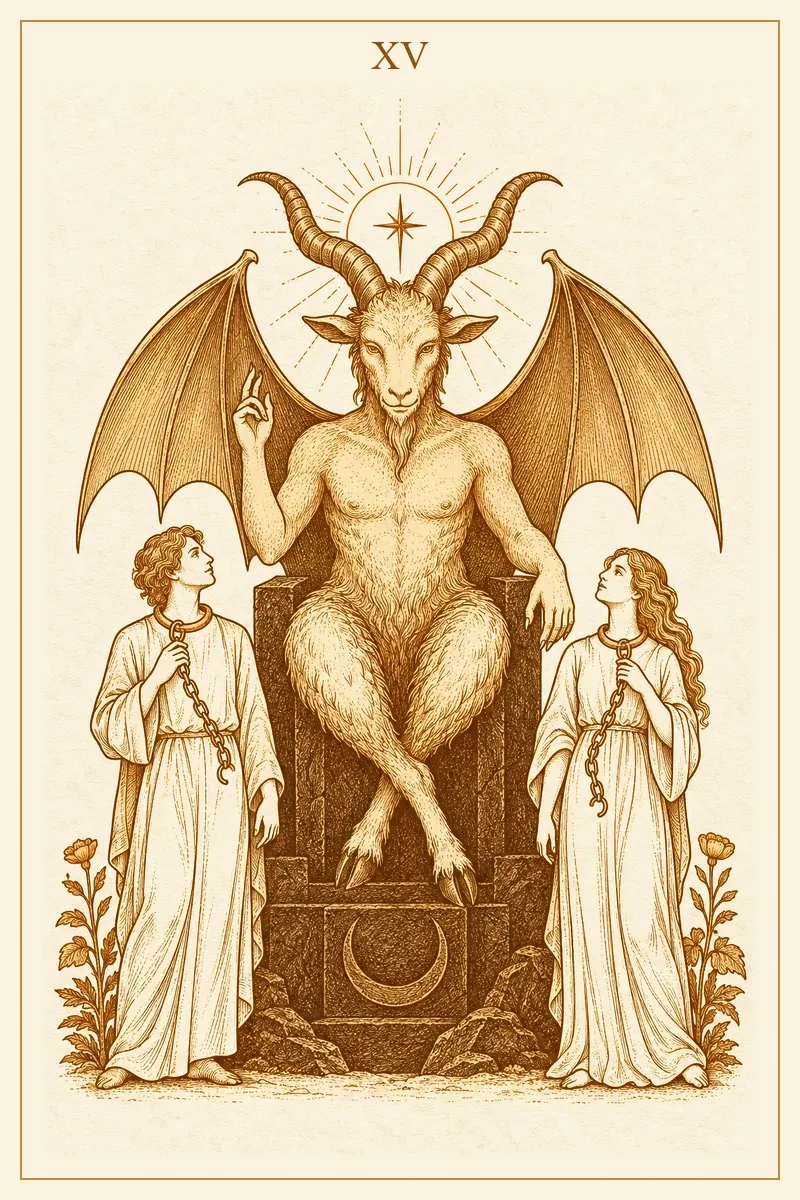
On the Devil, a horned, goat-headed figure with bat wings sits on a dark stone block carved with a crescent, one hand raised. A man and a woman stand on either side in collars, each holding the chain that hangs from their own collar. Next to the Six, the pair warns that support has become a hold: money, housing or care given so that the other person stays dependent. The picture also suggests the way out, because the chains rest in the wearers' own hands. The Devil tarot meaning looks at that release more closely.
Three more neighbors in brief
The Four of Pentacles points to a hand that wants to give but keeps closing. The Hierophant suggests an inherited script about who provides for whom. The Wheel of Fortune says the roles are about to turn.
Giving is not the same as loving: four misreadings
Treating the card as pure charity. The giver holds a scale. Pretending the measure is not there is how resentment hides.
Mistaking support for intimacy. A partner can pay every bill and still be emotionally absent. Is the giving a way of being close, or a substitute for it?
Assuming the kneeling partner is lesser. Receiving for a season is part of any long relationship; it becomes a problem only when it turns permanent.
Forgetting the second open pair of hands. Like a quieter need in a relationship, the hooded figure is easy to overlook. Ask who is still waiting.
The Open Palm spread: five positions for give and take
Use this layout when the Six has appeared and you want a closer look at the exchange between you. Lay five cards in a row.
- What I give: the support you offer, seen honestly.
- What I receive: what reaches you from your partner, including what you may not count.
- What my partner gives, as I see it: your view of their part, which is worth checking with them.
- The scale: what is being measured, and by whom.
- A fairer next step: one change that would make the exchange feel more even.
Position three is a perception, not a fact about your partner, so treat it as a question to bring to them. For more layouts built around couples, see these love tarot spreads.
A hypothetical reading: one partner back at school
To show how the pieces fit, here is an invented example. Imagine Maya, who pays the rent while her partner Theo completes a two-year nursing course. She believes in the plan, yet lately she snaps at him over small things. Her question: "How can we share things more fairly until Theo finishes?"
What I give: Nine of Wands. Maya is tired and guarded. She is still giving, but defensively, braced for the next demand.
What I receive: Page of Cups. Small tender gestures (notes, a cooked meal, a joke at the end of a long day) are reaching her, and she has not been counting them as giving.
What Theo gives, as I see it: Eight of Pentacles. Maya sees Theo working steadily at his studies. That is effort invested in their shared future, even though none of it shows up in the bank account yet.
The scale: Six of Pentacles reversed. A ledger is running in Maya's head that Theo has never seen, and the silent tally is what makes small things sting.
A fairer next step: Two of Cups. A conversation between equals, face to face, about what each is giving now and what will change when the course ends.
Read together, the spread suggests the arrangement itself is not the trouble; the unspoken count is. Maya decides to tell Theo how tired she is, to thank him for the things she had stopped noticing, and to agree on a date to revisit the budget together. The reading cannot tell her how Theo will respond or whether the plan will work out. It shows her where to start talking.
Steps for evening out the give and take
- Make two lists. Separately, each of you writes what you give to the relationship and what you receive. Compare them to learn, not to win.
- Name one invisible gift. Thank your partner for something they do that you have taken for granted.
- Agree on terms out loud. If one of you is supporting the other, say what it covers and when you will look at it again.
- Practice receiving. Accept one offer this week without arguing or paying it back.
- Set a limit kindly. If you are giving past your capacity, the ideas in tarot for setting boundaries can help you find the words.
Frequently asked questions
Does the Six of Pentacles in love always mean money?
No. Pentacles are the suit of material things, so money is one reading, but in a relationship the coins can just as well be time, attention, patience or practical care. Your question and the cards around it show which currency is meant.
Does the Six of Pentacles mean someone loves me or will help me?
It shows care and support in the picture, but it cannot confirm another person's feelings or promise what they will do. Tarot is a tool for reflection: it cannot read someone's mind, set a date or guarantee an outcome. Use the card to think about what you have seen them do and what you want to ask for.
Is it a bad sign to be the kneeling figure?
Not on its own. Long relationships have seasons when one person receives more than they give. It becomes a concern when the position never changes, when you have lost a say in decisions, or when receiving leaves you feeling smaller rather than cared for.
How can I tell whether my generosity has strings?
Notice what happens when your gift is not received the way you hoped. Generosity without strings leaves you disappointed; generosity with strings leaves you resentful, or makes you feel owed. If the second describes you, the gift was carrying a condition you had not said out loud, even to yourself.
What does the reversed Six of Pentacles mean in love?
It points to an exchange that has stalled or tilted: a partner holding back, a debt nobody discusses, help that comes with control, or a long-time giver learning to accept care. The surrounding cards help you tell the warning readings from the hopeful one.
How is the Six of Pentacles different from the Empress in love?
The Empress gives from plenty and does not measure. The Six gives from a limited supply and decides how much, to whom and when. Both can be healthy: the Empress's risk is exhaustion, the Six's is measuring that turns into power.
Both hands open
The Six of Pentacles does not ask you to give more or to need less. It asks you to look at the scale you are holding, set it where both of you can see it, and keep the exchange moving in both directions. When you want to explore your own question, a Veil Soul reading can help you see what is passing between you.