Pausing to see what your love has actually grown: that is the Seven of Pentacles in a love reading. Upright, it says the relationship has produced something real and asks you to stop and look at it honestly before you decide whether to keep tending it, tend it differently, or let it go. Reversed, the pause goes wrong in one of a few ways: impatience with slow growth, walking away just before things ripen, effort poured into something that was never going to return it, or, more hopefully, a change of direction that is long overdue.
Treat the card as a prompt for taking stock, not as a verdict. Tarot cannot tell you how committed a partner is, whether a milestone will arrive, or how a relationship will end up; it can help you see what you have been tending and what you want from it. The card's broader meaning for work, money and health is covered in the Seven of Pentacles tarot card meaning, so this page stays with romance, dating and long partnership.
- Upright: an honest look at what the relationship has grown so far.
- Patience: the season before a harvest, when growth is real but not yet ready to pick.
- A choice ahead: keep tending, change how you tend, or move your effort elsewhere.
- Reversed: impatience, leaving too early, effort that is not returned, or a needed new direction.
- Yes or no: "not yet," or "look before you decide."
- Single readers: a review of your dating effort and what it has taught you.
A gardener resting his chin on his spade
Seven of Pentacles: a laden bush and nobody picking
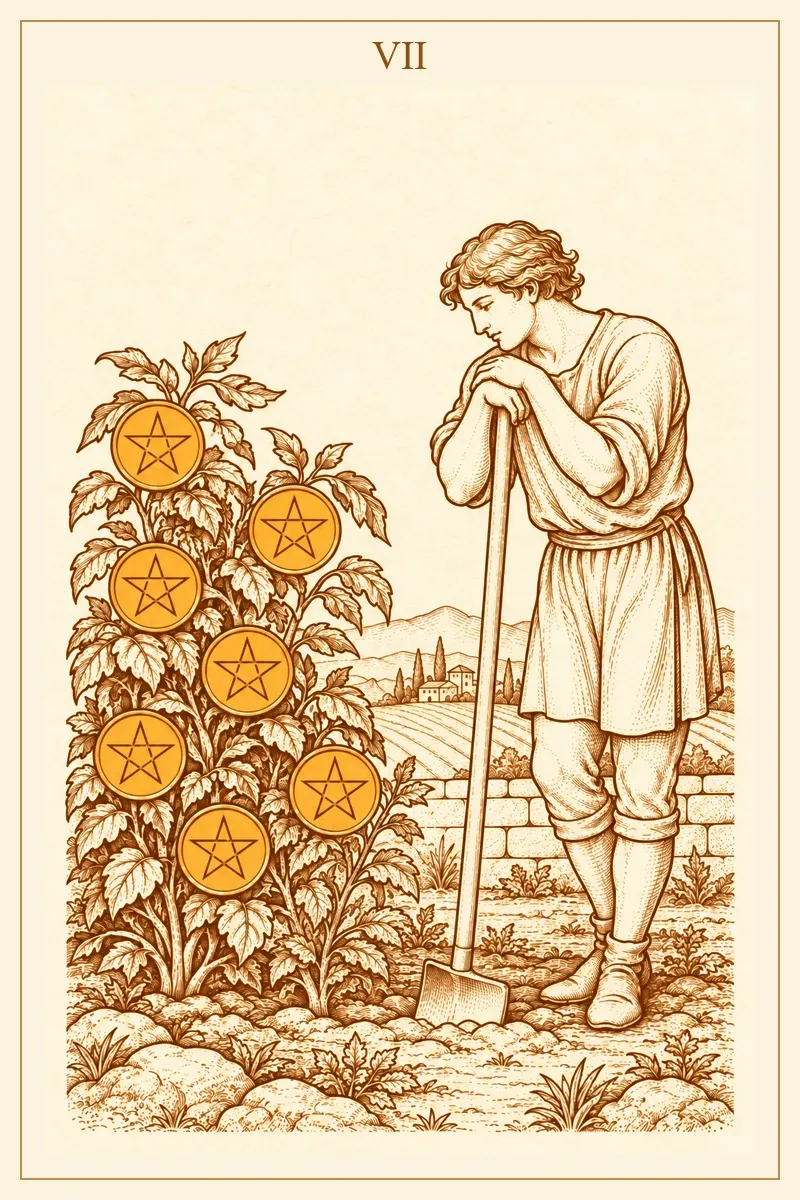
On the left side of the card a leafy bush that reaches nearly to the shoulders of the man beside it carries seven gold pentacles, hung among the leaves like ripe fruit from top to bottom. A young man with short curly hair stands to its right in a loose tunic with the sleeves pushed up, a cloth sash at his waist, leggings and soft boots. He has planted a long-handled spade in the turned soil, folded both hands over the top of the handle and rested his chin on them, so his whole weight leans into the tool. His eyes are lowered toward the coins. Small seedlings poke up from the dirt around his feet. Behind him runs a low stone wall, and past it lie plowed fields, a farmhouse among cypress trees and soft hills on the horizon.
Read as a love picture, a few details carry the meaning. Every coin is still on the bush: nothing has been harvested yet, and nothing has been lost either. The blade stays in the ground, so the work has stopped without being abandoned. His posture is tired but not defeated. And the fields beyond the wall are a reminder that this one bush is not his whole life: a relationship sits inside a larger landscape of work, family, friends and self, and an honest assessment includes that landscape.
In the Golden Dawn system the card is Saturn in Taurus, called the Lord of Success Unfulfilled. Saturn brings time, effort and limits; Taurus brings the slow, steady growth of things that cannot be rushed. In love, that pairing describes a bond that has taken real work and is not finished becoming whatever it will be.
Upright in love: what you might be taking stock of
The upright card says a review is due. Your question and the neighboring cards show what is being reviewed.
Two or three years in, when the early rush has settled
The card fits the stage when the first excitement has given way to routine. The question is no longer "do we like each other?" but "what are we building?" The Seven asks you to count the good honestly: the trust that has formed, the habits that make daily life easier, the way you handle conflict now compared with the first year. It also asks you to name what feels thin.
Deciding whether to keep investing
You may be weighing whether to keep choosing this person and doing the work a relationship needs. The card counsels neither a quick exit nor automatic continuation. It asks what your effort has actually produced, and whether you would plant the same thing again knowing what you know now. If the answer is unclear, look longer before announcing anything.
A hope that has not come up yet
Sometimes the card points to one specific wish that has not grown: moving in, marriage, children, a certain kind of closeness, or simply meeting your partner's family. The bush is full, but not with the fruit you planted for. The Seven asks you to separate "not yet" from "not this relationship," and to say the hope out loud rather than waiting for it to appear by itself.
A love that keeps its own schedule
Some relationships move more slowly than one partner would like: a long-distance arrangement, two people rebuilding after earlier heartbreak, or a partner who needs more time to commit. Patience is the counsel, but not blind patience. Notice whether the bush is growing at all. Slow and steady is a pace; nothing changing for a long stretch is a pattern.
When one plot gets all the water
The card also shows up when effort has been lopsided. Perhaps work has taken most of your energy and the relationship has gone untended, or you have poured so much into the partnership that friendships, hobbies and your own sense of self have dried out. The Seven asks whether your effort is spread in a way you can sustain.
Single, and looking back at months of dating
For a single reader the bush can stand for everything you have put into finding someone: the apps, the first dates, the work on yourself. The card asks what all of it has yielded, and the answer is rarely "nothing." You probably know far more clearly what you want and what you will not accept. The ideas in tarot for singles pair well with this card when you want to think that season through.
Reversed in love: when the waiting goes wrong
Reversed, the calm assessment wobbles. Four readings are possible, and the cards around it help you choose between them.
Digging up the roots to check on them
The first reversed meaning to consider is impatience. You or your partner want proof now: a label, a ring, a timeline the season cannot yet give. Pushing for results can damage the very thing you want to grow, the way digging up a plant to check its roots sets it back. The card asks what you fear will happen if you wait, and whether that fear belongs to this relationship or an older one.
Walking away just before things ripen
Sometimes the reversal warns of leaving too early. The fruit is still forming, but someone has put the spade down and turned toward the gate. This is not a rule that you must stay. Ask whether you are leaving because the relationship has truly stopped growing or because the slow, unglamorous middle stretch has become uncomfortable.
Effort that was never going to come back
The reversed Seven can also describe a hard realization: one person has done most of the tending, and the other has not been planting at all. Here the card counsels grief and honesty rather than more effort. You cannot grow a two-person relationship with one person's work.
Picking up the spade for a different plot
The reversal also has a constructive form. After a long pause the decision finally gets made, and energy that went one way is redirected. That might mean ending a relationship that had run its course, or the same couple dropping an old plan and choosing a new one together.
Seven of Pentacles as feelings, a yes or no, or when
When the question is how they feel
In a feelings position, the Seven suggests someone thinking things over rather than acting on impulse. They may value what you have built and still be unsure where it is heading. That is not coldness; it is someone taking the relationship seriously enough to look at it. Their interest is steady rather than showy: they notice the effort you have both made and want to be sure before they promise more. Reversed, the feelings are more restless. They may feel things are moving too slowly and be tempted to pull back, or feel they have put in more than they are getting and be quietly counting the cost. Sometimes it shows someone whose interest has already drifted elsewhere; the neighboring cards help you tell these apart. Either way, the card describes a mood, not a fixed decision. What to do with it: instead of guessing, ask them one open question about how they see the two of you, then watch what they say and do over the following weeks.
When you need a yes or no
As a yes-or-no answer, the Seven of Pentacles leans toward "not yet" or "look before you decide." If you asked whether to move in, propose or leave, it suggests gathering more information first. If you asked whether the relationship has a future, it asks you to judge from what already exists rather than from a forecast.
When you asked how long
The card belongs to slow, seasonal time: weeks or months rather than days. For how readers estimate timing, and why no card gives a firm date, see this overview of tarot card timing.
Where it lands in the spread changes the story
Past. A season of reckoning the relationship has already been through. Ask what was decided then, and what was left undecided.
Present. The assessment is happening now. Keep it honest, neither catastrophizing nor brushing problems aside.
Near future. A pause is coming, welcome or not. Leave room for it instead of filling every gap with plans.
Advice. Lean on the spade for a while and see what has actually grown before you change anything.
Obstacle. A stuck review. The pause that was meant to be short has become a freeze: no one is working and no one is deciding.
Outcome. Rarely a final ending. More often the threshold before the next phase, where the looking itself becomes the turning point.
Cards that answer the gardener's question
The Seven poses a question, and its neighbors often suggest the answer. Here are the pairings most worth knowing in love.
Eight of Pentacles: back to work with a plan
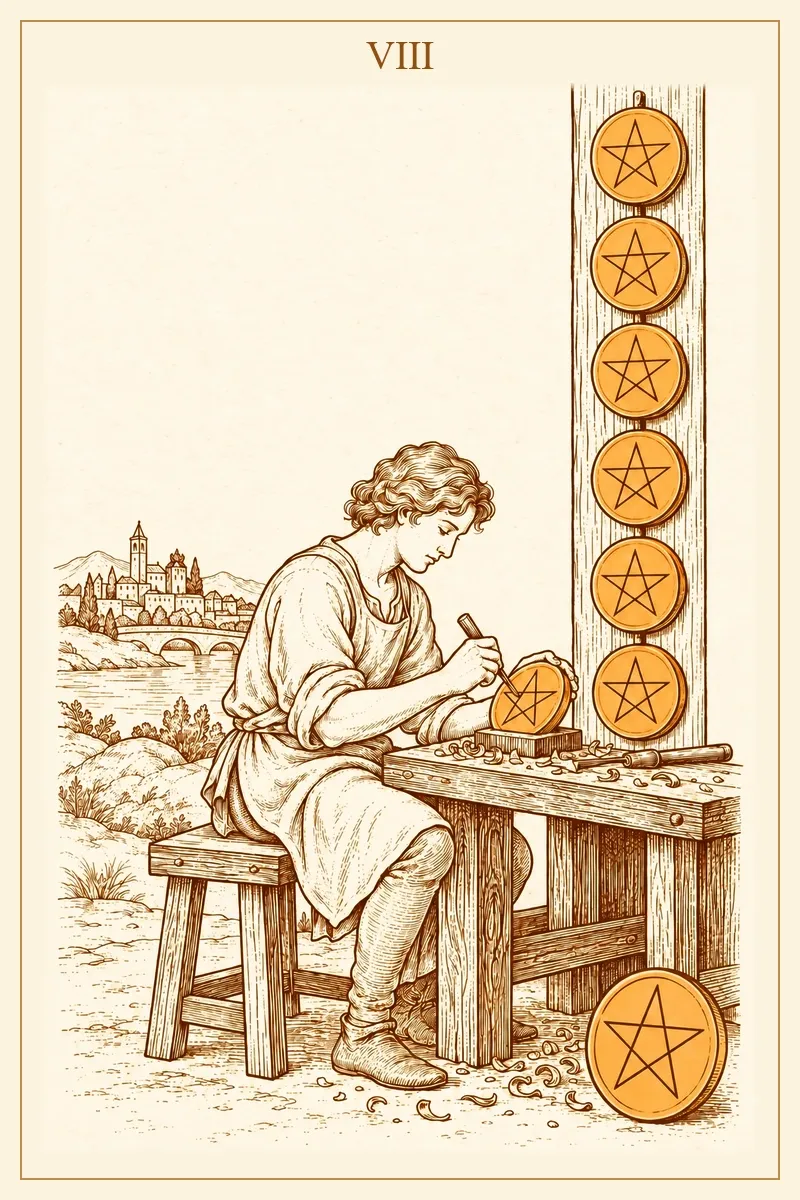
The Eight of Pentacles shows a curly-haired apprentice in a smock, seated on a wooden stool at a sturdy bench, carving a star into a coin with a chisel. Six finished pentacles hang one above another on a tall post beside him, another leans against the leg of the bench, and wood shavings litter the ground. The card's full meaning is explored in the Eight of Pentacles tarot card meaning; next to the Seven it describes a pause that ends in renewed commitment. The couple has looked honestly, chosen each other again, and gone back to the daily practice of the relationship with clearer purpose.
The Hanged Man: a pause inside a pause
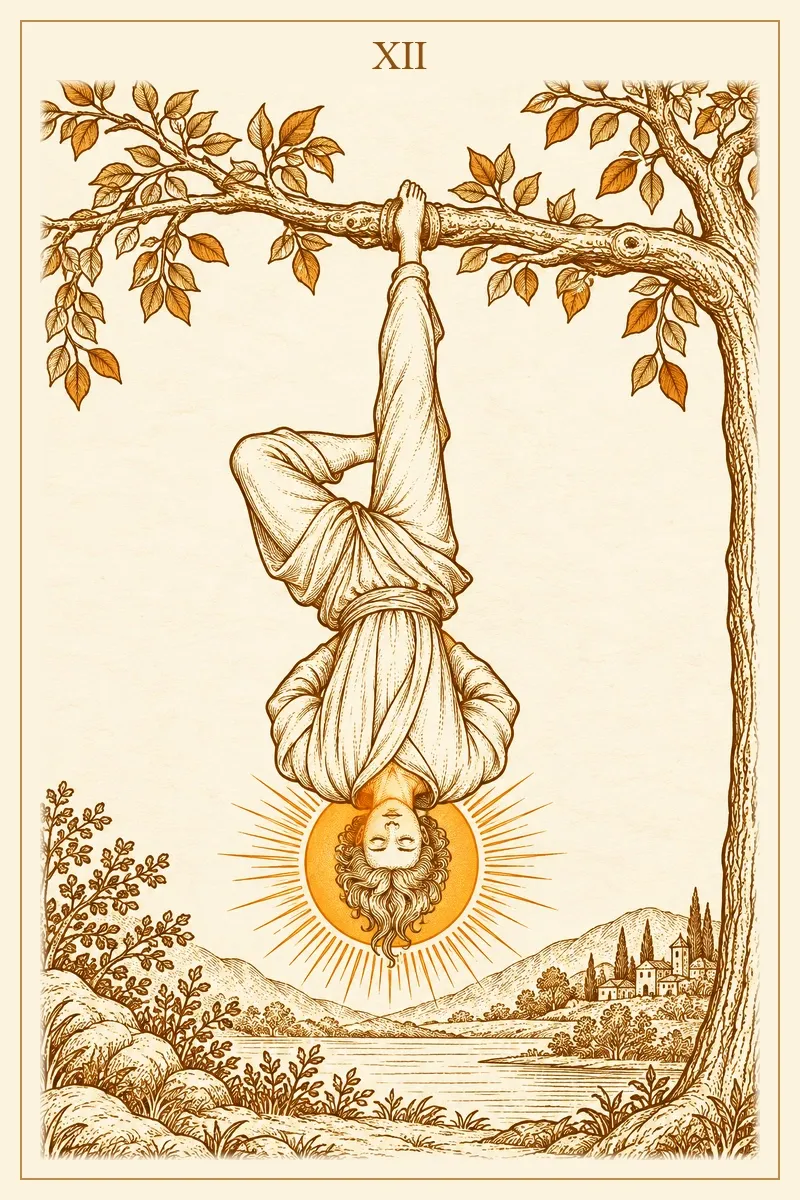
The Hanged Man hangs upside down from a leafy branch by one ankle, the other leg bent behind the first, arms folded behind his back and eyes closed. A golden halo rays out around his calm face, and a lake and a small village lie below. As the Hanged Man tarot meaning explains, this is a card of surrender and new perspective. Together with the Seven it describes a relationship in a long, deliberate pause, usually longer than you hoped, and asks you to stay with not knowing until a clearer view arrives rather than forcing an answer.
The Star: hope after an honest count
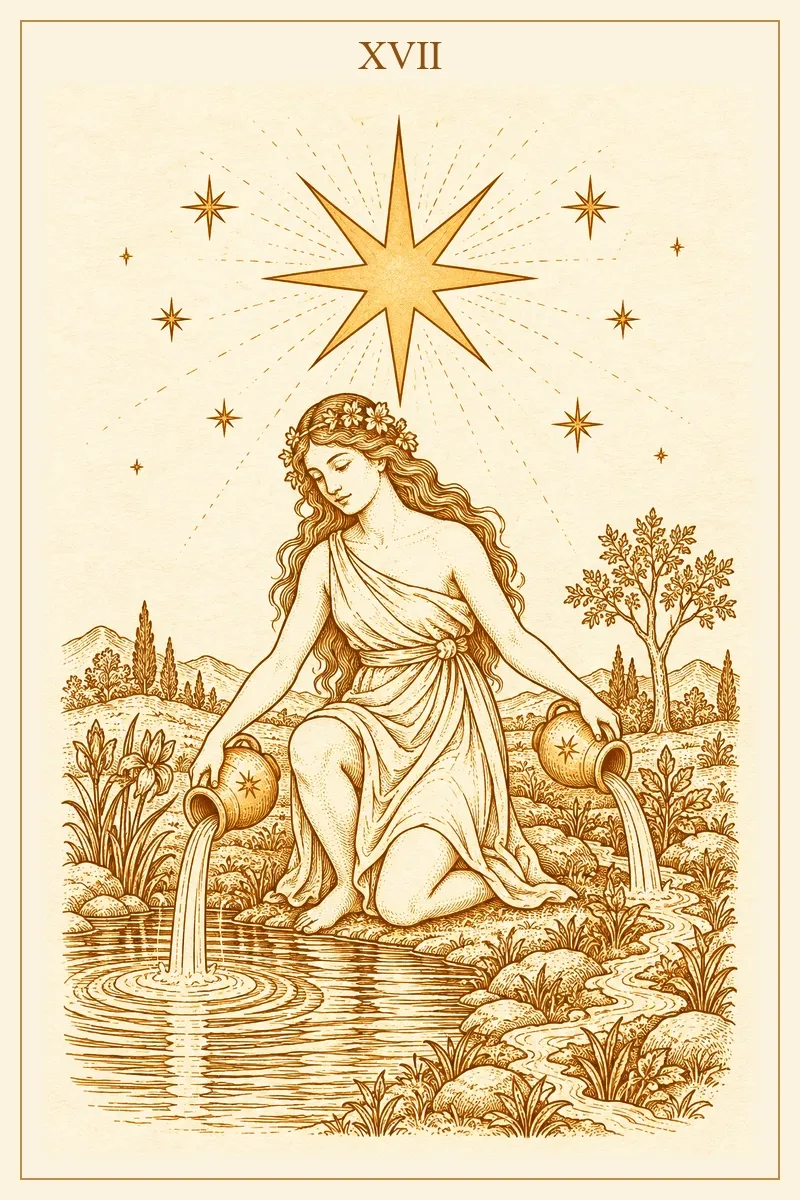
The Star shows a woman with a crown of flowers and long wavy hair, kneeling at the edge of a pool in a light draped dress. She pours water from two jugs, each marked with a small star: one stream falls into the pool, the other runs over the grass into a winding brook. A large eight-pointed star shines above her, surrounded by a scatter of smaller stars. The Star tarot meaning covers its themes of renewal and trust. Beside the Seven, it suggests that a review you dreaded turns up more good than you expected, and hope returns because it is grounded in what you actually found.
Death: when the count says a season is over
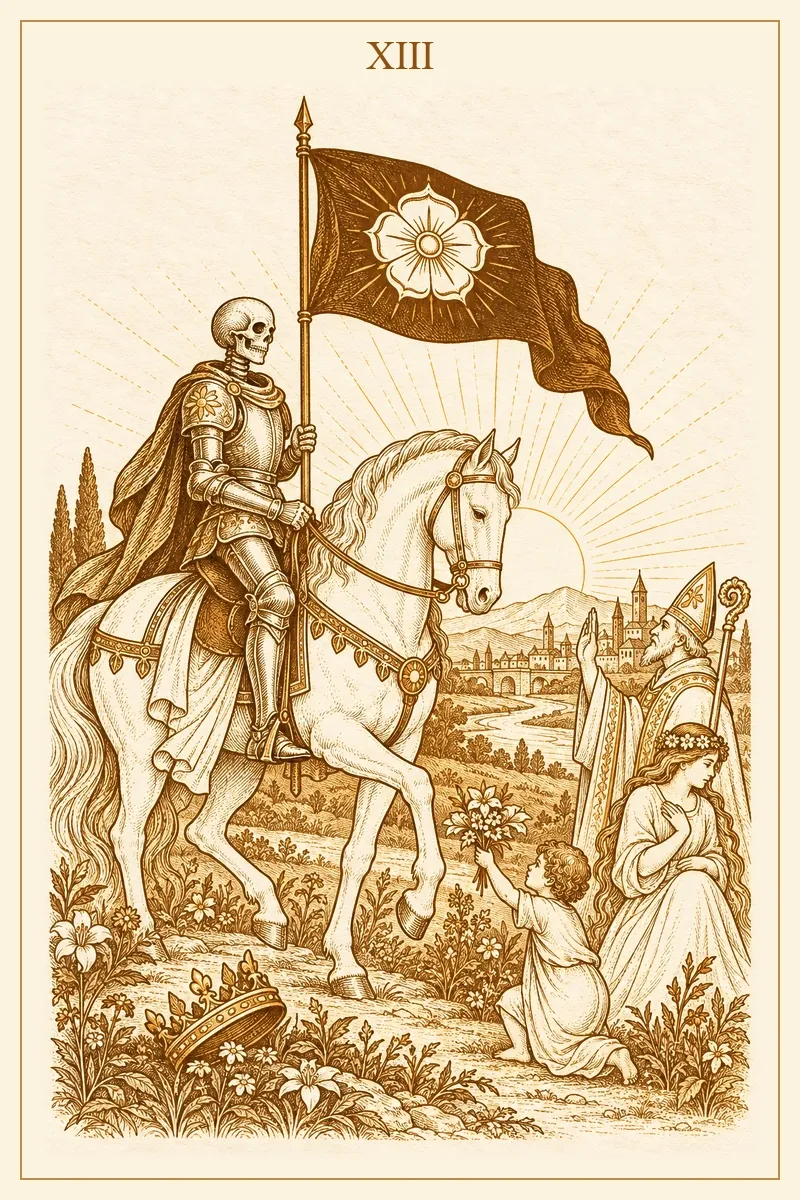
Death appears as a skeleton in armor riding a white horse and holding a dark banner marked with a white five-petaled rose. A crown lies fallen among lilies on the ground. A small child kneels to offer the rider a bunch of flowers, a young woman in a flower crown kneels with one hand on her chest, and a bishop in a tall miter raises his hand, while the sun sits low over a distant river town. The Death tarot meaning describes it as transformation rather than literal death. With the Seven, the honest look may show that one chapter has truly finished. That can mean ending the relationship, or it can mean the end of an old way of being together so a different one can begin.
Four quicker pairings
With the Three of Wands, taking stock opens onto new plans, such as a move or a shared venture built on what you have already grown. With the Five of Pentacles, the count is uncomfortable: what was put in has not come back. With The Empress, the review may touch on children or on what the two of you could create together. With The Hierophant, the yardstick may be borrowed from tradition or family expectation, so check whether the timeline you are measuring against is truly your own.
Not failure, not a verdict: slips to avoid with this card
Reading it as failure. The bush is full. Real growth has happened. The Seven is not the Five of Pentacles or the Three of Swords; it honors what has been built even while it asks whether it is enough.
Turning the review into a list of complaints. A fair assessment includes appreciation and an accurate account of both the growth and the gaps.
Treating the pause as doing nothing. Standing still to look is work, and a review that leads to a clear next step is some of the most useful work a relationship does.
Deciding before the looking is done. The card asks for patience with not knowing, not for a snap judgment made to end the suspense.
The Harvest Check spread: five cards for a relationship you are weighing
This spread turns the card's image into questions. Shuffle while holding the relationship in mind and lay five cards in a row. If you and your partner want to use it together, the format of a relationship check-in tarot spread works well as a model for taking turns.
- What has grown. The real fruit of the relationship so far.
- What I hoped for that has not come up. The wish still waiting, named plainly.
- What grew that I did not plan. The unexpected good, often the easiest to overlook.
- What the tending costs me. Where the effort comes from, and whether that is sustainable.
- The work for next season. One direction for the coming weeks: keep tending, tend differently, or turn toward another plot.
Positions 1, 2 and 3 also work as a journaling exercise without cards. Write three columns side by side and give the third one the most time; it is the column that is easiest to leave blank.
A fictional example: four years together and the question of moving in
This example is invented to show how the spread reads; the people and cards are not from a real reading. Lena has been with Jonah for four years. They live in separate apartments, and every time she raises moving in, the conversation drifts. She draws the Seven of Pentacles in a one-card pull, then lays out the Harvest Check spread with the question: "Am I waiting for something that is coming, or something that isn't?"
1. What has grown: Six of Cups. Tenderness, ease and a shared history. Lena recognizes this at once.
2. What I hoped for that has not come up: Four of Wands reversed. The shared home and the celebration around it, postponed. The card names her wish without saying it will never come.
3. What grew that I did not plan: Page of Pentacles. A practical habit they built together almost by accident: a joint savings account they started for travel. Lena had not counted it as progress until now.
4. What the tending costs me: Nine of Wands. Weariness and guardedness. She has been the one who brings up every future plan, and she is tired of raising it alone.
5. The work for next season: Temperance. Blending and pacing. The card suggests a middle path: neither another year of waiting in silence nor an ultimatum.
Lena's reading: the relationship has grown real warmth and even a shared practical project, so this is not empty soil. But the milestone she cares about has been left to her alone, and that is wearing her down. Instead of raising the topic in passing, she asks Jonah for one unhurried conversation, says plainly what she hopes for, and suggests a step, such as spending a month mostly at one place, with a date to talk again. The spread did not tell her what Jonah would say. It showed her that she had stopped asking clearly.
What to do this week if you drew it
- Write the three columns. What has grown, what has not come up yet, and what grew that you never planned.
- Name one hope out loud. Say it to your partner as a wish, not a complaint or a deadline.
- Check the rest of the landscape. Notice whether friends, rest or your own interests have gone without water.
- Set a review date instead of a verdict. Agree to look at the question again in a few weeks or months, so the pause has a shape.
- Do one small piece of tending. A pause to look is not a reason to stop being kind.
Frequently asked questions
Does the Seven of Pentacles mean my relationship is failing?
No. The picture shows a bush full of coins, which means something real has grown. The card asks for an honest review, and that review can lead to recommitting, changing how you work together, or letting go. None of these is the card's automatic verdict.
Can the Seven of Pentacles tell me whether my partner is committed?
Not on its own. Tarot cannot read another person's mind, confirm their intentions or promise an outcome. What it can do is help you look at what you have seen them do and what you want to ask. If commitment is the question, the most reliable answer comes from a direct, calm conversation.
What does the reversed Seven of Pentacles mean in love?
It can mean impatience or leaving too soon: acting before the looking is finished. It can also point to effort that one partner has carried alone, or to a long-delayed change of direction finally happening. The surrounding cards show which.
How long should I wait after drawing this card?
Long enough to see clearly, which is often weeks or months for a big relationship question. A pause works best when it has a shape: decide what you are watching for and when you will check again, so waiting does not become drifting.
Should I make a big decision while the Seven is in my reading?
The card favors deciding after the review, not during it. If life requires a decision now, make the smallest one that keeps your options open, and gather as much honest information as you can first.
How is the Seven of Pentacles different from the Hanged Man in love?
Both describe a pause, but of different kinds. The Hanged Man is a pause of surrender, where you let go of your usual view and wait for a new one. The Seven is a pause of assessment, where you stay upright and count what is actually there. Long relationships tend to need both.
Count the coins, then choose
The Seven of Pentacles does not ask you to stay or to go. It asks you to stop for a moment, look at what the two of you have grown, and let that honest count shape what you do next. If you would like to explore your own question, a Veil Soul reading can give you a quiet place to start.