Sorrow over love sits at the center of the Five of Cups in a love reading. Upright, it points to grief or disappointment you are still standing in: a breakup, a partner who let you down, a hope that did not come true, or regret over your own part in how things went. Yet two full cups stand just behind the grieving figure, and that is the card's quieter message: something in your love life has not been lost, even if you cannot look at it yet. Reversed, the head begins to lift, and acceptance, forgiveness or a cautious reopening come into view.
Treat what follows as a way to reflect, not a verdict. Tarot cannot tell you what an ex is thinking tonight, promise that a relationship will be repaired, or put a date on when the hurt eases; it can help you see where your attention is resting and what you might do with it. If you want the card's wider meaning across work, money and health, our Five of Cups tarot card meaning guide covers that ground, so this page stays with love.
- Upright, after a breakup: grief that deserves time; the loss is real and still fills your view.
- Upright, in a relationship: a disappointment between you that has not been talked through yet.
- Upright, single: an old hurt that still shapes how open you feel to someone new.
- Reversed: acceptance and turning toward what remains, or, in some readings, grief pushed down before it was felt.
- As someone's feelings: sadness, regret or a sense of having lost something with you.
- Yes or no: not yet; the card asks for mourning before a decision.
Where the cloaked figure is looking, and why it matters for love
Five of Cups: eyes on what spilled
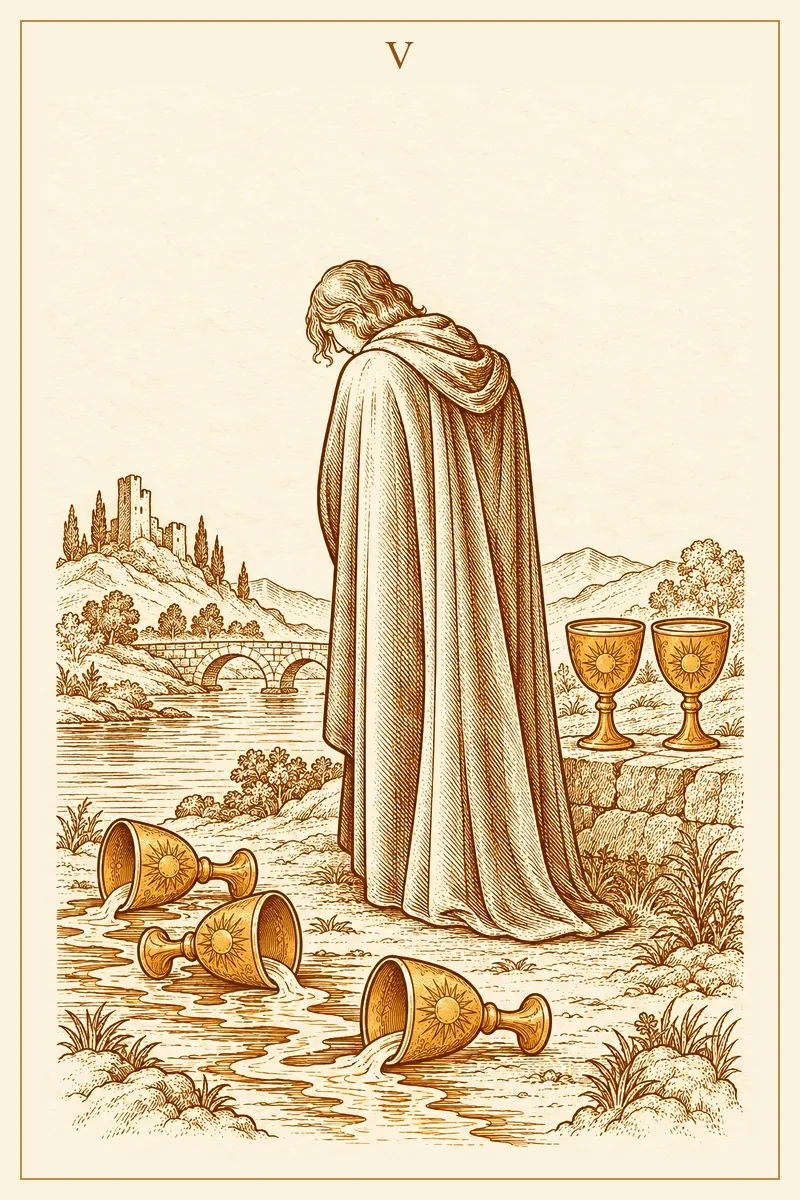
Look at the card before reading any keyword. A figure in a long, pale hooded cloak stands with head bowed, hair falling forward, turned toward three goblets that lie on their sides in the grass. Liquid runs out of each one and threads away across the ground in small streams. To the figure's right, close enough to touch, two goblets stand upright and full on a low stone wall. On the far side of the water to the left, a stone bridge with rounded arches leads toward a hill where a castle tower rises among cypress trees.
In love, the most useful detail is the direction of the gaze. Nothing in the picture says the figure is wrong to grieve; three cups really did fall, and what was in them is soaking into the earth. But the body is angled so that the full cups sit just outside the line of sight. That is the posture of a hurt heart: attention narrows to the loss, and whatever is still intact (a friendship, your own warmth, a part of the relationship that survived) becomes hard to see. The card does not tell you to stop looking down; it only shows that the scene holds more than the spill.
The bridge matters too. It is far off and small, and the figure has not taken a step toward it. In a love reading it stands for a way across that already exists: a conversation, a goodbye, a new beginning, or simply a day when the hurt is lighter. It does not need to be built. It needs to be noticed, and crossed when you are ready.
The love losses an upright Five of Cups can point to
The upright card names a loss without naming its size. Read it against your question and the cards around it, and ask which of these situations sits closest to yours.
After a breakup or divorce
Here the card says the ending still hurts, and that this is fitting. The two standing cups in this setting might be co-parenting that still works, friends who stayed, or the person you became during the relationship and get to keep. For a gentle companion to this stage, tarot for heartbreak walks through the first weeks after love ends.
When trust has been broken
After infidelity or a serious lie, the grief is doubled. You lose the relationship as it stands and also the story of the past you thought you were living. The Five of Cups does not decide whether the relationship should continue; it asks you to feel the size of the breach before anyone hurries to repair it. The remaining cups may be the dignity and support that stay yours whatever you decide.
Disappointment inside a relationship that continues
Not every Five of Cups is an ending. Inside a steady partnership it can point to a letdown neither of you has named: a forgotten anniversary, a plan that fell through, or a partner who was absent when you needed them. The cups on the wall are the parts of the bond still working. The card suggests talking about the spilled one directly rather than letting it quietly color everything else.
Regret over your own part
Sometimes the card is less about what someone did to you than about what you did, or did not do. "If only I had said it." "If only I had left sooner." Regret is grief aimed at a choice. The card is honest that you may have made mistakes; it is equally honest that replaying them does not refill the cups. Ask whether you have taken on blame that belongs to two people, or to circumstances nobody controlled.
Grief for a partner who has died, or for a pregnancy lost
In the heaviest readings, the card speaks to bereavement: the death of a partner, or a couple mourning a pregnancy or a hoped-for child. Here the Five of Cups asks for nothing but patience. The standing cups may be shared memories, love that does not depend on presence, or the partner you are grieving beside. Cards are a small companion in a loss like this, and a grief counselor, a support group or trusted people can offer far more; tarot for grief and loss explores how a deck can sit alongside that care.
Love that never quite began
The card also covers losses that leave no official record: an unreturned crush, a situationship that faded, a few promising dates followed by silence. Because nothing "ended" on paper, this grief is easy to dismiss; the Five of Cups treats it as real. Its advice is to mourn the possibility honestly so that it stops standing in for the people who are actually in front of you.
What the two upright goblets can mean in your love life
The standing cups are sometimes pointed out too soon, as a consolation prize, which tells a grieving heart its loss does not count. They are better read as an inventory, once the spill has been named. In a love reading they can stand for:
- friends and family who have stayed close since the loss;
- your own capacity for warmth, which the hurt has not used up;
- what a relationship taught you about what you need next time;
- a part of a strained relationship that is still good, such as shared humor, a household that runs well, or children you both love;
- an ex who remains a decent co-parent or friend, if that is honestly the case.
When the card appears, write down two of these, even if they feel thin. You are not trying to talk yourself out of the grief. You are making sure the reading reflects the whole scene and not only its saddest corner.
Reversed Five of Cups in love: lifting the head, or looking away
The turn toward what remains
Reversed, the Five of Cups describes the moment the figure begins to turn. The grief has been felt for long enough that other things can come back into view: the friends who called, an evening you enjoyed without guilt, the thought that you might love again. In a relationship, it can show a couple who have talked through a disappointment and found that the bond held. The change is gradual, more a loosening than a single moment of release.
Forgiveness, of them or of yourself
The reversal can also mark forgiveness: not excusing what happened, but putting down the weight of replaying it. Sometimes the person forgiven is an ex. Sometimes it is you, for staying too long, leaving too fast or missing what was there to see.
When the grief goes underground
There is a shadow side to the reversal as well. It can show sorrow that was skipped rather than felt: jumping into a new relationship to avoid empty evenings, insisting you are "totally fine," or refusing to look at the spilled cups at all. If the surrounding cards are restless or escapist, ask yourself honestly whether you have turned around or only turned away.
Exes, getting back together and the bridge in the background
When the question is about an ex, the bridge invites one hope in particular: that it leads back to them. The card itself is cautious. Upright, it describes a loss being felt, not a reunion being planned. It can show that you miss the person, and next to certain cards that they miss you, but missing someone and being ready to rebuild with them are different things. The bridge leads to a new shore, and nothing in the picture says that shore holds the same relationship you lost.
If reconciliation is on the table, the Five of Cups asks for an honest account of the spill before anyone crosses back: what broke, who has changed, and what would be different this time. Cards that support repair carry more weight here than the Five alone: Judgement for an honest reckoning, Temperance for patient rebalancing, the Six of Cups for goodwill rooted in shared history. Our page on signs of reconciliation in tarot shows how to read such cards together.
Five of Cups as feelings, whether to wait, or when
In a feelings position
As the answer to "How do they feel about me?", the Five of Cups describes sadness, regret or disappointment connected to you. It may be regret about how things ended, sorrow over the distance between you, or disappointment that the relationship did not become what they hoped. It does not say whether they will act on any of it. A person can grieve a relationship and still choose not to return.
As a yes or no
The card leans toward "not yet." It is not a flat no, but it suggests the situation needs mourning, honesty or repair before a clear yes is possible. If you asked "Should I text them?", it turns the question back to you: would you be reaching out from the loss, or from a steadier place?
Timing
The Five of Cups gives no dates. In timing questions it says the next step begins once the grief has had its time, and that length is yours to feel, not to schedule. In later readings, the reversed Five, The Star or the Ace of Cups can be read as signs that the turn is under way.
Cards that deepen or ease the Five of Cups in love
With the Three of Swords: the wound before the mourning
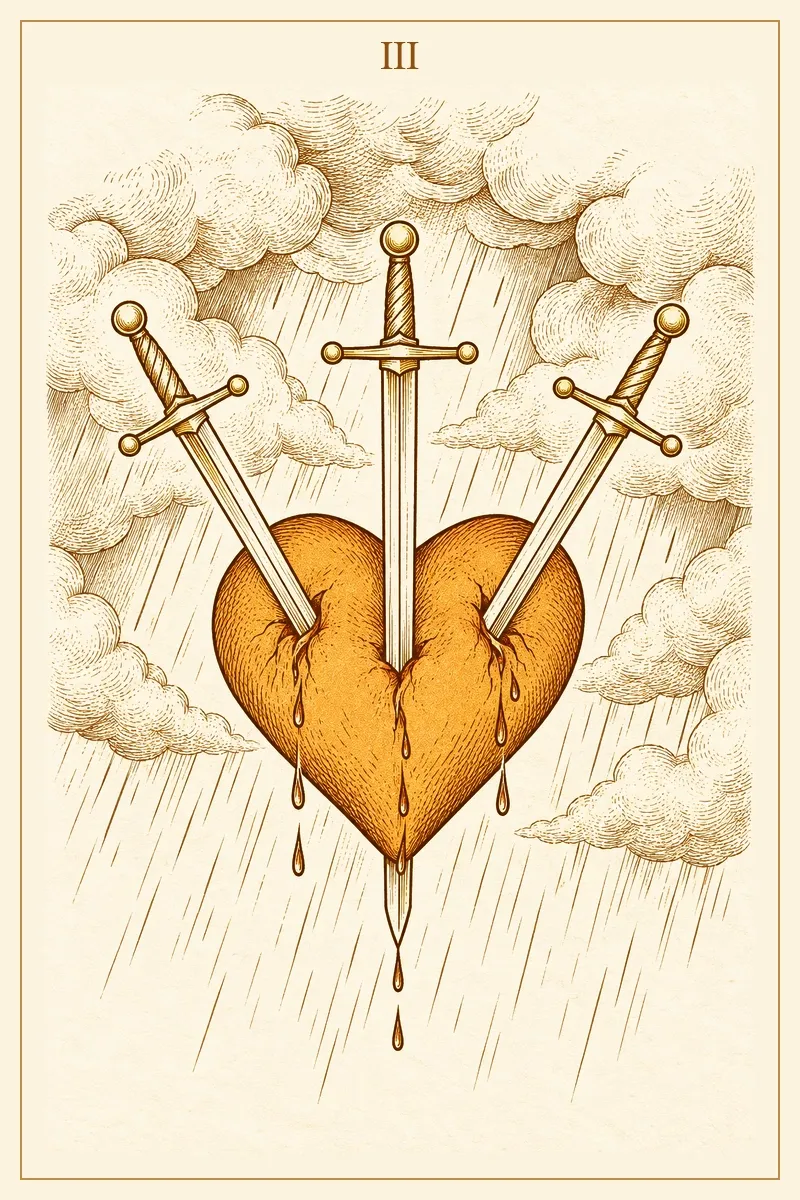
The Three of Swords shows a golden heart pierced by three swords under heavy rain, drops falling from its lower point. Beside the Five of Cups, it marks the order of events: first the cut, a painful truth or a sudden ending, then the long ache that follows. Together they ask you to care for the fresh wound before analyzing what went wrong. The Three of Swords meaning post explains that card's own message about painful truth.
With the Six of Cups: an old love on the doorstep
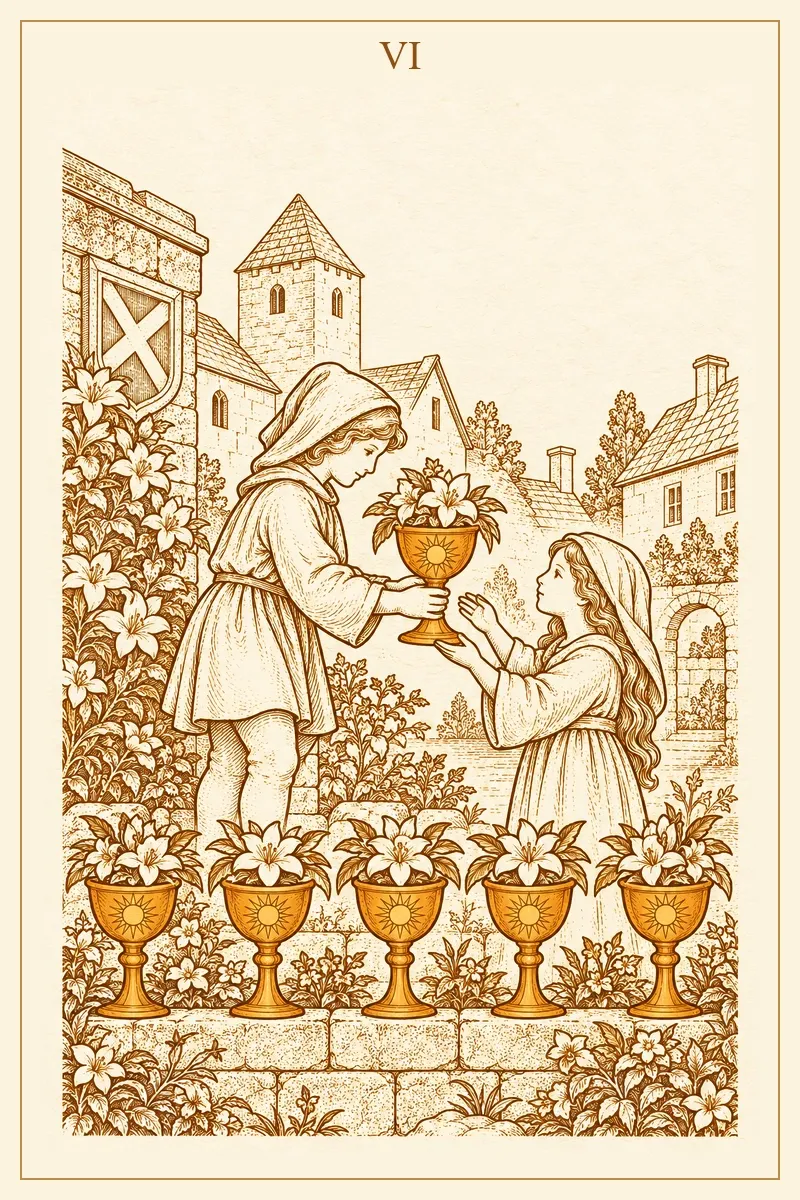
In the Six of Cups a hooded boy hands a little girl a goblet full of lilies, while five more flower-filled goblets line a stone ledge in front of a quiet village. Paired with the Five, it brings the past forward: a former partner getting in touch, memories of an earlier love, or nostalgia that softens the edges of what happened. Ask what has changed since the cups spilled before treating an old love as a fresh start; the Six of Cups tarot card meaning goes deeper into memory and the pull of the past.
With the Eight of Cups: grieving versus leaving
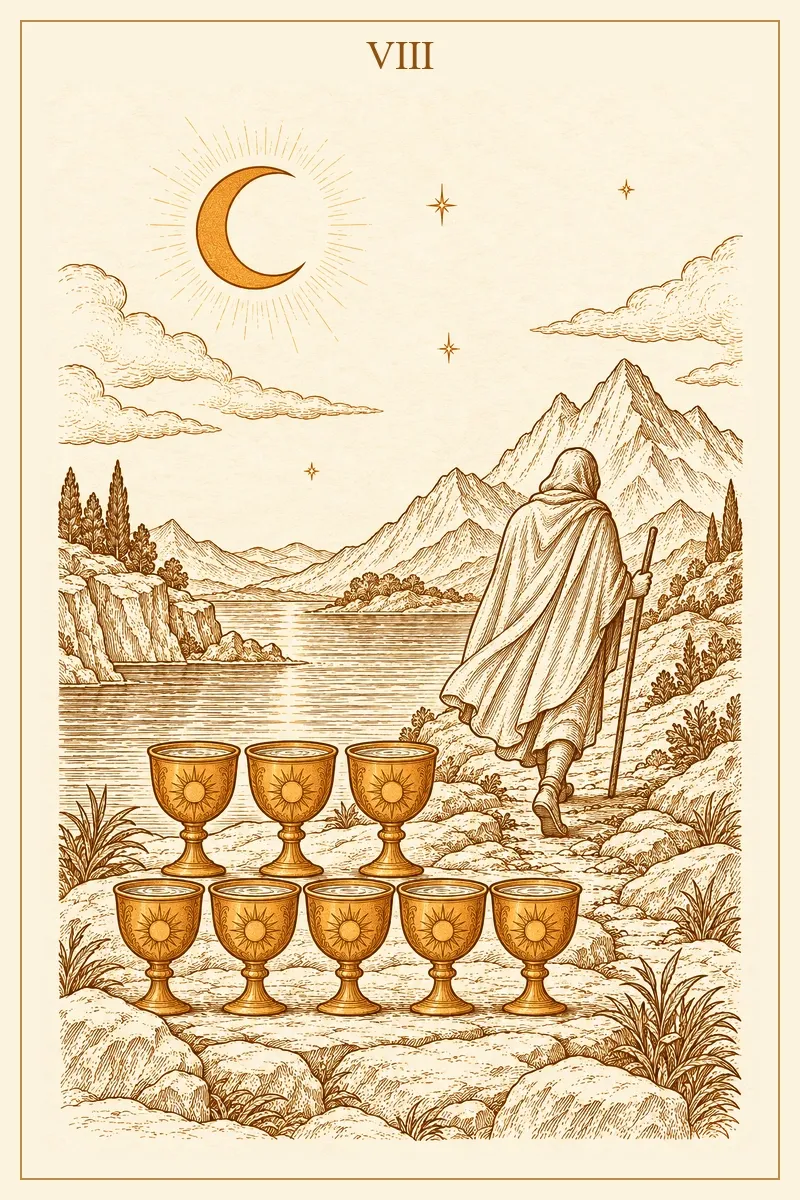
The Eight of Cups shows eight goblets standing in two rows on the rocks while a cloaked walker with a staff heads toward the mountains under a crescent moon. The Five grieves what was lost; the Eight chooses to leave what is still standing because it no longer satisfies. Drawn together in a love reading, they can describe someone who has mourned a relationship long enough to know it is time to go, or a hurt that is ripening into a decision. When walking away is part of your question, the Eight of Cups meaning is worth reading next.
With The Star: hope starting to return
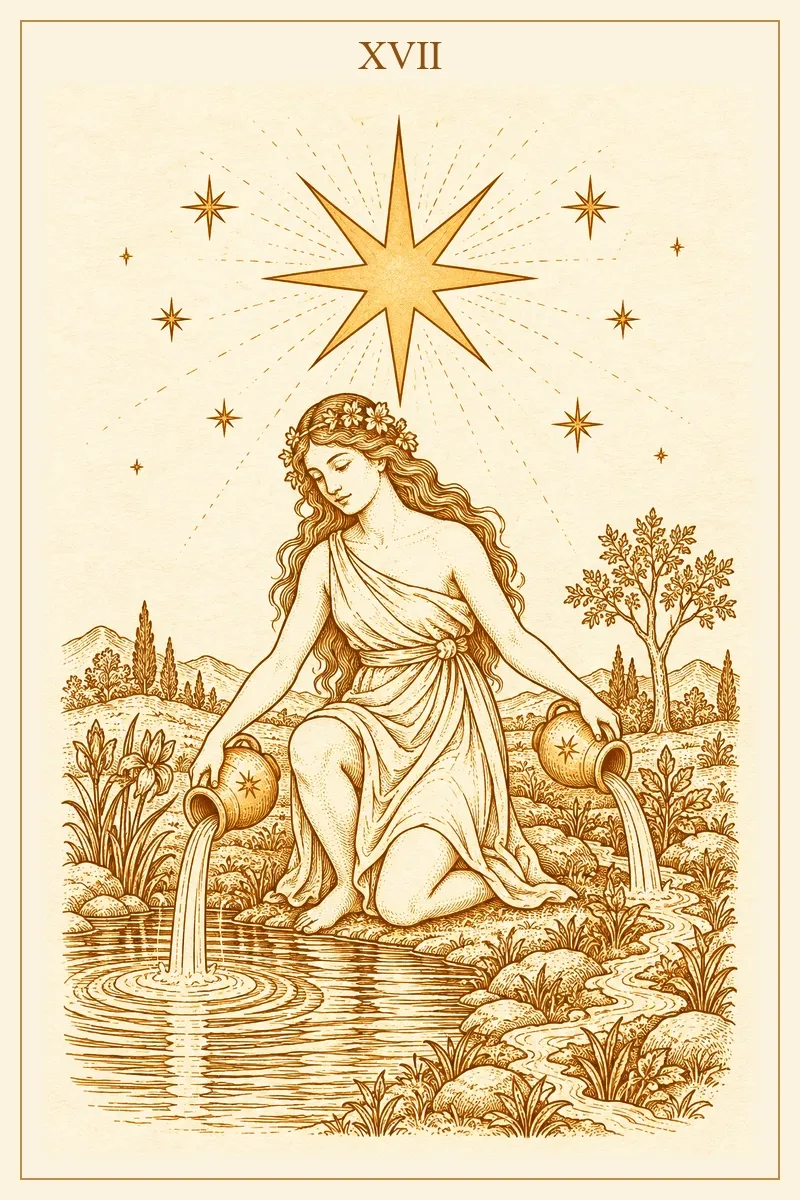
In The Star, a woman with a crown of flowers kneels at the water's edge and pours from two jugs, one into a pool and one onto the land, under a large eight-pointed star scattered round with smaller ones. After the Five's spilled goblets, this pouring feels deliberate: water given on purpose rather than lost. The pair speaks of healing that has begun, hope that is quiet rather than giddy, and a heart willing to be refilled. For the card's broader message, see The Star tarot meaning.
Three quicker pairings
With the Knight of Cups: a new romantic offer arrives while you are still grieving; take it slowly and be honest about where you are. With The Tower: the loss came suddenly, and the Five describes the sorrow inside the rubble. With the Ten of Cups: the grief is for a shared home or family picture, so it may be the future you imagined, more than the person, that you miss most.
The Inventory spread: five positions for a love that spilled
Use this layout when the Five of Cups has appeared and you want to understand your own grief rather than predict anyone else's moves. Shuffle with a question such as "What do I need to understand about this loss in my love life?" and lay five cards in a row.
- What actually ended: the loss named plainly, which may be a person, a plan or a picture of the future.
- The regret I keep replaying: the thought, choice or conversation your mind keeps circling back to.
- What did not spill: support, strength or love that is still within reach.
- What still needs saying: to them, to someone else, or to yourself.
- A first step toward an open heart: a small, practical move, not a promise about the next relationship.
Read cards one and two together; they describe the weight you are carrying. Then read card three before card four, so that what remains is in view when you face the harder conversation. Treat card five as something to try for a week, then notice how it feels, rather than as a prediction.
An invented example: seven months after an engagement ended
The reading below is a made-up illustration of the spread; Dana and her story are fictional.
Dana's engagement ended seven months ago, by mutual agreement but not without pain. After the Five of Cups turns up in a single-card morning pull, she lays the Inventory spread with the question: "Why do I still feel stuck, and what would help me open up again?"
What actually ended: Ten of Cups reversed. The loss is less about her former fiancé himself than about the household she had already pictured: the shared apartment, holidays with his family, the children they had talked about. She has been telling herself she misses him, when much of the ache is for a future that had felt settled.
The regret I keep replaying: Two of Swords. This card of avoided decisions points to what she has left unresolved. She has not decided what to do with the ring, or whether to stay close to his sister, who had become a real friend. Not deciding keeps the loss open.
What did not spill: Three of Cups. Her friends are still inviting her out, and she has been saying no. The card also points to her own talent for shared joy, which she had set aside along with the wedding plans.
What still needs saying: Justice. A fair, clear conversation is due, with his sister about whether their friendship continues on its own terms, and with herself about which part of the ending was hers and which was not.
A first step toward an open heart: Page of Cups. The step is small and a little playful: one yes to one invitation, or picking up the sketchbook she put away. It says nothing about a new partner, and that is the point: opening up starts with letting any feeling in.
Put together, the spread suggests Dana is grieving a picture as much as a person, and that an unmade decision keeps the cups on their sides. Her plan: settle the ring, have one honest coffee with his sister, and accept the next dinner invitation. None of it promises when she will want to date again; it simply turns her a little toward the wall where the other cups stand.
Gentle steps for the weeks after you draw it
- Name the spilled cups. Write three specific things this loss took, such as a person's company, a shared plan or a version of yourself. Vague grief is heavier than named grief.
- Give the sadness a container. A walk or a journal page set aside for it keeps it from leaking into every hour.
- Name two standing cups. Even small ones count: a friend who checks in, a morning routine that still steadies you.
- Hold off on big moves about an ex for a while. Late-night messages, sudden reunions and dramatic goodbyes are easier to choose well once the first wave has passed.
- Reach for people as well as cards. Tell one friend how you are actually doing, and if sadness makes daily life hard for weeks at a time, call a doctor or licensed counselor.
Frequently asked questions
Does the Five of Cups mean my relationship is over?
No. It shows grief or disappointment, and that can sit inside a relationship that continues. If you are together, it points to a hurt that needs attention; if you have already broken up, it describes mourning the ending rather than forecasting whether you will reunite.
Does the Five of Cups mean my ex regrets the breakup?
In a feelings position it can describe regret or sadness on their side. Even so, this is where tarot reaches its limit: the cards cannot confirm what another person thinks, what they will do, or when, and they reflect the situation as you bring it rather than a message from someone else's mind. Regret on their side would also not equal a wish to return.
Why do I keep drawing the Five of Cups after a breakup?
A card that repeats is pointing at something still in progress. It may be asking you to give the grief more room instead of pushing past it, or to name a regret you have not yet looked at. It is not a sign that something is wrong with you or that you will always feel this way.
What do the two standing cups mean in a love reading?
They are what remains: friends, family, your own warmth, lessons you carry forward, or a part of the relationship that is still good. The card never asks you to focus on them before you are ready; it only refuses to let them disappear from the picture.
Is the reversed Five of Cups a sign they will come back?
Not by itself. Reversed, it shows acceptance and a turn toward what remains. For some readers that includes a careful reconnection; for others it means moving on with less weight. Read the cards around it, and your own readiness, before drawing a conclusion.
One small turn toward what remains
The figure on the card has not moved yet, and the scene is calm about that. The fallen cups are allowed to stay fallen for a while, the two on the wall are not going anywhere, and the bridge will still be there when you are ready to walk. If you would like to look at your own love question with the cards, you can begin a reading whenever it feels right.