Love held in a closed fist is the heart of the Four of Pentacles in a love reading. Upright, the card describes someone guarding their heart, their partner or their shared life so carefully that warmth stops moving: steady loyalty on a good day, possessiveness, jealousy or emotional distance on a harder one. Reversed, the grip is changing, either loosening into trust and generosity or tightening under strain.
Read it as a mirror rather than a forecast. A card cannot tell you what a partner or an ex secretly feels, promise that a relationship will last, or name the week someone opens up; it can show where love is being held too tightly and what that hold is protecting. The Four of Pentacles tarot card meaning covers the card in work, money and timing, so this page stays with love.
- Single: a guarded heart; wanting closeness while keeping the gate shut.
- Dating: slow to commit, careful with time and feelings, sometimes testing before trusting.
- Committed: loyalty and a protected home, or control over a partner's time, money and friendships.
- After a breakup: holding on to the person, the memory or the shared things after the relationship has ended.
- Reversed: hands opening, generosity returning, or a grip that clamps down harder when it feels threatened.
- Yes or no: mostly "not while the hold stays this tight."
The seated king and his four coins, read as a relationship
Four of Pentacles: one coin pressed to the heart
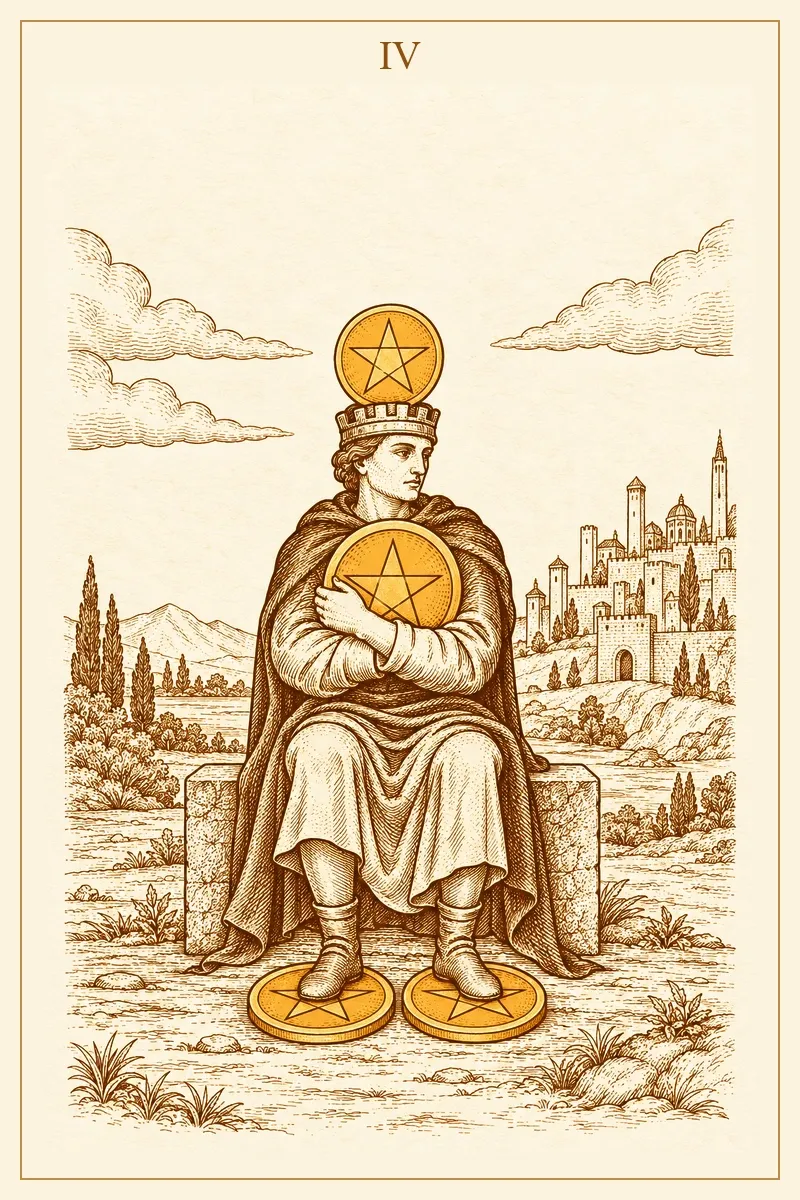
On the card, a young man in a crown with square battlements sits on a block of rough stone in open country. A heavy cloak hangs from his shoulders and spills onto the ground. He crosses both arms over a large gold coin and holds it flat against his chest, one hand spread across its face. A second coin rests on top of his crown, balanced there as if he dare not tip his head. His boots stand squarely on the last two coins. Behind him, on the right, rises a walled town with tall towers, a domed roof and an arched gate; on the left, cypress trees and soft hills. His head is turned toward the town, yet he stays on his stone.
In a love life each coin becomes a question. The coin at his chest is the person or feeling he cannot bear to lose, held so close that nobody else can see it. The coin on his crown is an idea about love he has to keep steady: how a partner should behave, what he must never let himself need. The two coins under his boots are the practical ground of a shared life, such as a home, savings and routines. He can stand on them, but he cannot step anywhere without lifting a foot.
The town matters most. Out there are other people, celebration, risk and new meetings, and he is looking right at it. The posture is not indifference; it is wanting connection while staying where it feels safe, which is why this card fits people who say "I want a relationship" and "I'm fine on my own" in the same breath.
Upright in love: where the grip shows up
The upright card does not say who is holding or what is being held. Match it to your question and the cards beside it, and look for the situation below that sounds most like yours.
If you are single: a gate that stays shut
For someone single, the Four often describes a heart under careful guard. You may date and enjoy the company, yet keep each person at a measured distance: no talk about the past, no plans more than a week ahead, an exit ready if anyone gets close. Sometimes the coin at the chest is an old love that still takes up the room a new one would need; sometimes it is an independence you earned the hard way. In early dating the same caution shows up as testing before trusting, or keeping score of who texted first. The card does not call any of this foolish. It asks whether the wall is still protecting you or simply keeping the gate closed.
In a committed relationship: loyalty or control
Inside a long relationship the card has two faces. On the steady side it shows a partner who stays, protects the home, keeps promises and builds something to last. On the shadow side, the protecting turns into managing: checking a partner's phone, resenting time they spend with friends, needing to know where they are, treating their independence as a threat. The question the card puts to a couple is simple: is the closeness chosen by both people, or held in place by one? If controlling behavior is part of your story and you feel unsafe, our guide to tarot cards that point to a toxic relationship can help you name the pattern, and a trusted person or a support service can help you act on it.
Money between partners
Pentacles are the suit of material life, so the Four often points to money inside the relationship: one partner holding every account and decision, a refusal to share finances after years together, or someone who will not spend anything on the relationship itself, from a dinner out to a trip that matters to the other person. Money is rarely the whole story. It is usually where a deeper fear of dependence, or of being taken advantage of, becomes visible.
Holding on after it ended
The figure can also be clutching a relationship that is already over. You may still wear the ring, keep the shared playlist, check their profile or leave the boxes in the closet unsorted. The coin is no longer a living partnership; it is a memory you cannot set down. The card does not rush you, but a hand closed around the past has no room for anything else, and tarot for letting go offers gentle ways to begin loosening it.
Is it your grip or theirs?
When the Four lands in a love reading, many people assume it describes the partner: the jealous one, the stingy one, the one who will not commit. Sometimes that is right. Just as often, the seated figure is the person asking. Before deciding, try three checks:
- Whose fear is it? If you feel a jolt of panic at the idea of your partner spending a weekend away, the coin may be in your arms.
- What happens when you picture letting go? Relief suggests the grip is costing you; dread suggests it guards something you have not looked at yet.
- Where is the card in the spread? In a "you" position it describes your posture; in a "them" position it describes the pattern you notice in them, not proof of what is in their mind.
Often both people are holding something, one guarding money and the other time or feelings, and each sees only the other's tight hands. Naming your own coin first usually makes the conversation easier.
Reversed in love: hands that open, or a tighter hold
Opening up
The most hopeful reversal shows the grip easing. Someone says what they feel after a long silence, stops checking a partner's movements, agrees to a shared account or simply makes room in their calendar. The change tends to be gradual, a loosening of fingers rather than a dramatic release, and it can feel unsteady at first. Unsteady is not the same as wrong.
Letting go of one specific thing
The reversal can also mark one concrete act of release: returning an ex's belongings, selling a house that had become more burden than home, supporting a partner's move to a job in another city, or accepting that a relationship you held together alone has ended. The act may be sad and still be right.
Holding harder under pressure
Less comfortably, a reversed Four can show a grip clamping down because it feels threatened: a partner who senses distance and responds with more rules, or someone who tries to tie the other person closer with money, guilt or plans. Heavy neighbors such as The Devil or The Tower make this reading more likely.
Losing what was held, and finding what mattered
Sometimes the coins fall whatever anyone does: a relationship ends or a shared plan collapses. Afterward, the reversed Four can show a person discovering what they actually valued once there is nothing left to clutch. It is a hard teacher, though it often brings unexpected relief.
Four of Pentacles as feelings, a yes or no, and when things move
As someone's feelings
Drawn for "How do they feel about me?", the Four usually describes someone who cares and is being careful. They may value you a great deal and still hold back, out of fear of losing what they have, being hurt again or giving up their independence. Reversed, it can show that caution easing as someone starts to let you in, or the opposite: guarding that hardens into distance or jealousy. Either way, how they act over time and a direct conversation tell you far more than a card can.
As a yes or no
For questions such as "Will they commit?", "Should I move in?" or "Will we get back together?", the upright card leans toward "not yet." It can be a yes when the question is about keeping something: "Should I keep this boundary?" or "Is it wise to protect my savings while we date?" Reversed, it leans toward a careful yes for questions about opening up.
Timing
The Four gives no dates. In love its timing clue is a condition rather than a calendar: things tend to stay as they are until someone loosens their grip. If the card answers "When will they open up?", the useful follow-up is "What would make it safe enough to open?"
How each position colors the card
- Past: a season of guarding you have come through, such as a possessive ex or your own closed-off stretch.
- Present: the holding is happening now; look at who is doing it and what they protect.
- Obstacle: the grip itself blocks closeness, because affection cannot circulate while it is clutched.
- Advice: usually loosen up; beside protective cards, a sign that something fragile needs guarding for now.
- Outcome: a relationship that lasts but grows more closed, and the question of whether that is the shape you want.
Pairings that tighten or loosen a guarded heart
With The Devil: when holding becomes a chain
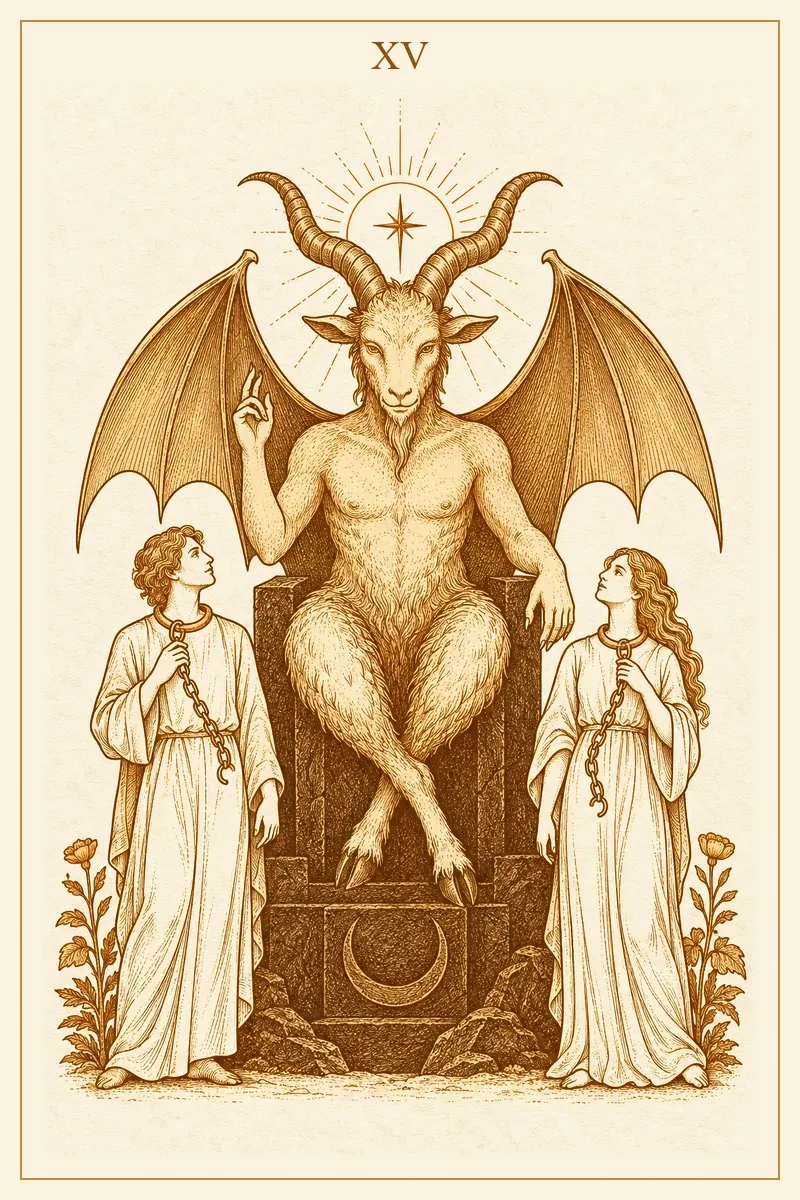
On The Devil, a horned, goat-headed figure with bat wings sits on a dark stone throne with a crescent moon carved into its base. A young man and a young woman in long pale robes stand on either side, chains looped at their necks, the loose ends resting in their own hands, both gazing up at him. Next to the Four this pair is heavy: careful holding has slid into dependence, jealousy or control that both people feel unable to leave. Yet the chains in the picture are held, not locked. The Devil tarot meaning explores how attachments like these loosen once they are seen clearly.
With The Lovers: choosing over clinging
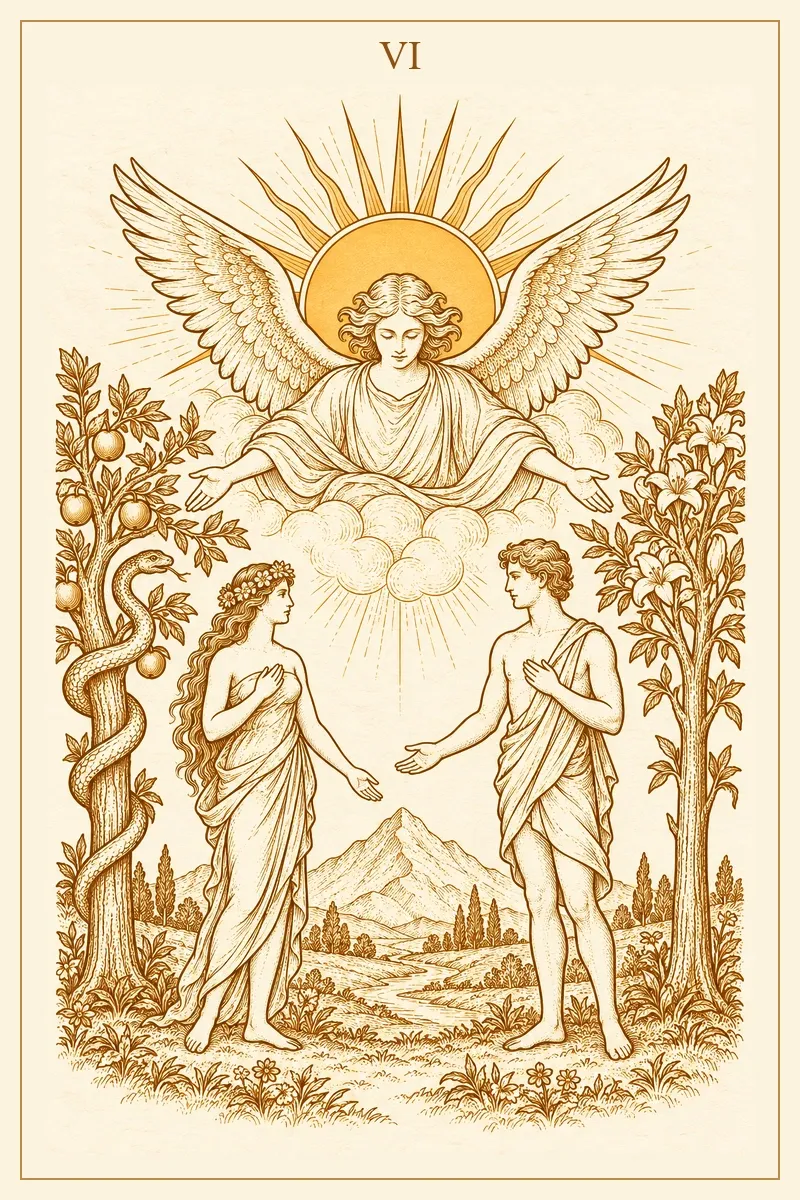
In The Lovers, a winged figure with a blazing sun behind it spreads its arms above a cloud. Below, a woman with a crown of flowers stands by a tree where a serpent winds among the fruit, and a man stands by a flowering tree, each with one hand on the chest and the other reaching out. The Lovers ask for an open, freely given yes; the Four hesitates because choosing means risking what already feels safe. The pair speaks to the moment when moving in or a deeper promise is on the table and one person is holding back. The Lovers tarot meaning covers that card's wider theme of values and choice.
With the Six of Pentacles: what an open hand could look like
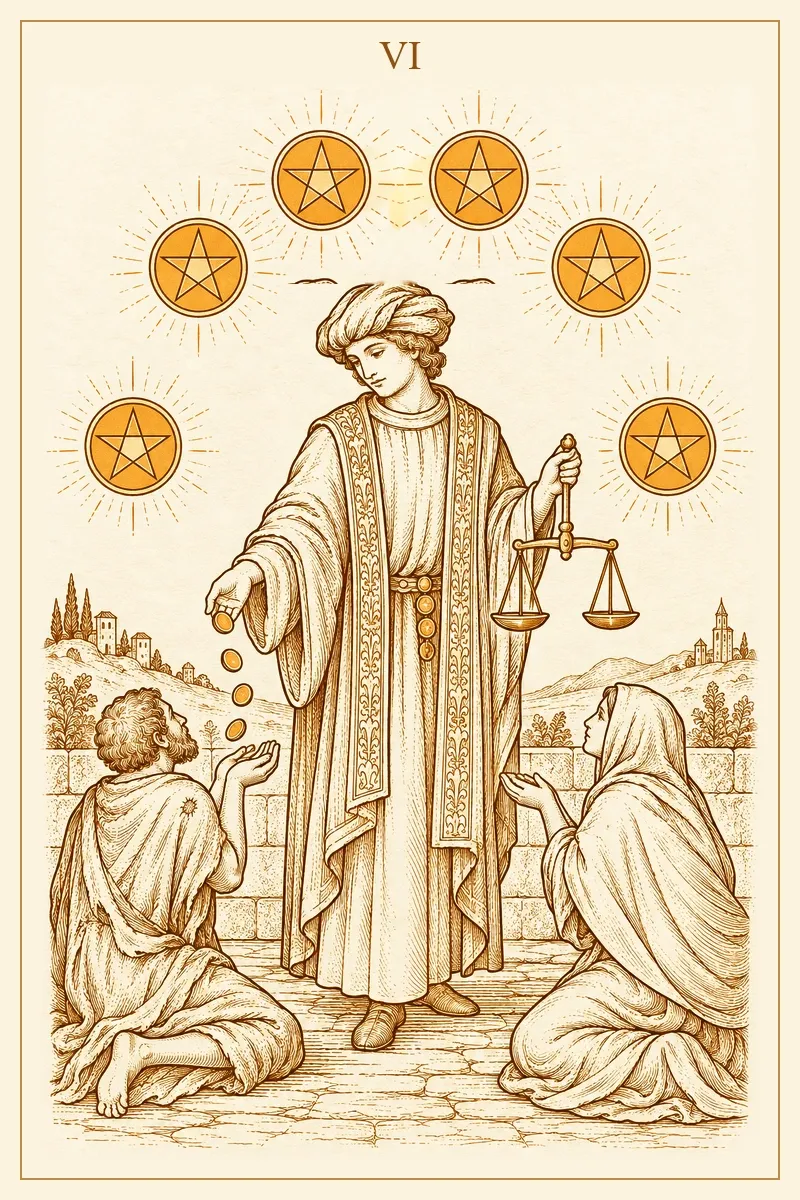
The Six of Pentacles shows a man in a turban and an embroidered robe holding balanced scales in one hand while coins drop from the other into the cupped palms of a kneeling man; a hooded woman kneels on the other side with her hands raised. Paired with the Four, it shows the relationship as it could be if time, attention and money were shared in measure again. It can also warn of generosity that comes with strings, and the Six of Pentacles tarot card meaning looks at both sides of that exchange.
With The Star: trust after a long guard
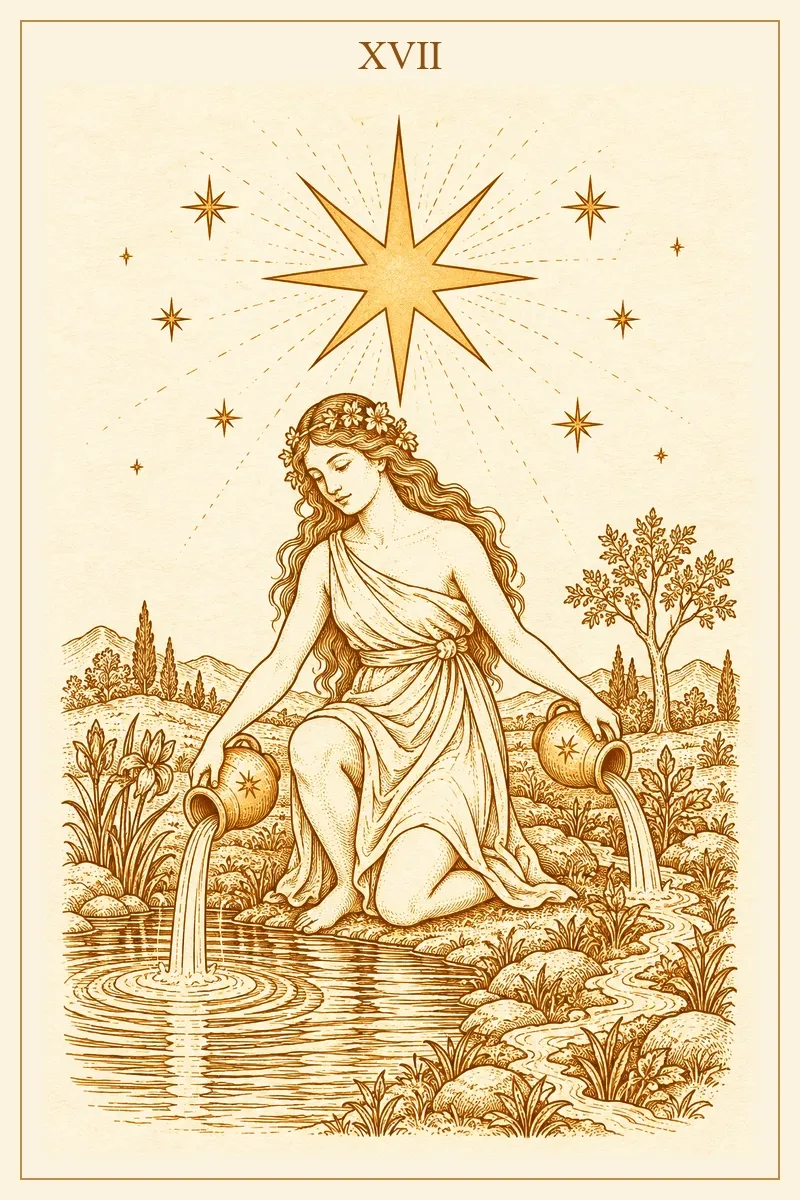
In The Star, a woman crowned with flowers kneels by a pool and pours from two jugs, one into the water and one onto the bank, where it runs away as a small stream, while a great eight-pointed star shines overhead. After the Four's clenched arms, her pouring hands are the picture of release. Together they describe a heart beginning to trust again after a long season of guarding, or a couple who have come through a tight stretch and can breathe. The Star tarot meaning follows that gentle recovery further.
Three quicker pairings
With the Three of Cups: friends are calling you out of isolation, or a partner's social life feels like a threat; notice which. With the Eight of Wands: messages or a fast-moving romance press against a stance that does not want to move. With The Empress: care and abundance are on offer, but arms wrapped around a coin cannot receive them.
Careful or controlling? Reading the Four fairly
The Four of Pentacles is easy to read too harshly. Two distinctions keep the reading honest. First, it is not greed: the figure holds out of fear of loss far more than selfishness, and there is usually tenderness under the grip. Second, it is not automatically control. Keeping your own savings, your own friends or a slow pace is healthy when both people agree to it; the line is crossed when one person's need for safety starts to shrink the other person's life.
Look at the setting, too. Nothing in the picture is attacking the seated king; the town is calm and the land is open. In love, that is often the most useful insight: the threat being guarded against may belong to an earlier relationship, an earlier home or an earlier version of you.
The Town Gate spread: five cards for a guarded relationship
Use this layout when the Four has appeared in a love reading and you want to understand the holding rather than predict anyone's next move. Shuffle with a question such as "What am I guarding in this relationship, and what would opening the gate change?" and lay five cards in a row.
- What I am guarding: the person, feeling, possession or idea held closest.
- What I fear if I loosen my hold: the loss the grip is trying to prevent.
- How the guarding shows up between us: the effect on the relationship as you experience it, not a reading of the other person's mind.
- What is worth keeping: the part of the protection that is healthy and deserves to stay.
- The first exchange: one small thing to give, share or receive in the coming week.
Read the first two cards as a pair; they show whether the grip comes from present facts or an older fear. Read card four before card five, so the healthy boundary is clear before you decide what to open. For a broader look at how the relationship is doing, try the relationship check-in tarot spread a few weeks later.
An invented example: three years together and two front doors
This reading is a hypothetical illustration of the spread; Maya and Jordan are fictional.
Maya and Jordan have been together for three years and still live in separate apartments. Jordan has asked twice about moving in, and both times Maya has said "soon." After the Four of Pentacles appears in a morning one-card pull, she lays the Town Gate spread with the question: "Why do I keep postponing this, and what would help?"
What I am guarding: The Hermit. The coin at her chest is not money or even Jordan; it is her solitude, a room that is entirely hers and the habit of answering to no one.
What I fear if I loosen my hold: the Three of Swords. Under the love of solitude sits an old hurt: her last relationship ended painfully soon after she gave up her own place.
How the guarding shows up between us: the Two of Cups, reversed. The exchange feels uneven to her: Jordan keeps offering, she keeps deferring, and the easy back-and-forth they used to have is straining.
What is worth keeping: Temperance. Her need for a measured pace is healthy. The problem is not that she wants to go slowly but that she has never said how slowly, or why.
The first exchange: the Ace of Cups. The step is emotional rather than practical: telling Jordan about the fear itself.
Read together, the spread suggests Maya's grip guards an old wound more than her present relationship. Her plan: talk to Jordan this weekend about the last move and what it cost her, then propose a few nights a week at his place before anyone signs a lease. The spread does not promise how Jordan will respond or whether living together will work; it shows that the coin she is clutching is older than him.
Loosening your hold this week
- Name your coins. Write down what you hold at the heart, on the crown and under your feet in this relationship. Specific beats vague.
- Pick the easiest one. Choose the least essential coin and one small, reversible act that sets it down: an evening planned by your partner, a question you stop asking, a bill you split differently.
- Keep one boundary on purpose. Opening up does not mean giving up everything. Decide what stays protected so loosening does not feel like losing yourself.
- Say the fear out loud. Tell your partner, or a trusted friend if you are single, what you are afraid would happen if you let go. Fears spoken aloud usually shrink.
Frequently asked questions
Does the Four of Pentacles mean my partner is possessive?
Not necessarily. The card describes a posture of holding on, and that figure can be either partner, often the person asking. It can also describe healthy loyalty. Look at behavior over time: whether both people keep their own friends, money and time, and whether closeness feels chosen rather than enforced.
Can the Four of Pentacles tell me if someone is holding back feelings for me?
It can describe a pattern of caution, and in a feelings position it often points to someone who cares but is guarding themselves. That is as far as a card goes. Tarot cannot confirm what another person feels, decide for them or tell you when they will speak; their actions and an honest conversation are the real answer.
Is the Four of Pentacles a yes or no for getting back together?
Upright, it leans toward "not yet." It may show that one of you is still holding on, but holding on and being ready to rebuild are different things. Reversed, it can support a careful yes if both people have loosened their grip on the old patterns.
Can a relationship move past a Four of Pentacles phase?
Yes. Many relationships go through seasons of guarding, especially after a loss, a move or a financial scare. What helps is noticing the grip, talking about it and practicing small releases together. The card describes a posture, not a sentence.
How is the Four of Pentacles different from The Devil in love?
The Four is a grip the holder can loosen through awareness and practice. The Devil describes a bond that has become compulsive, where dependence, shame or control capture attention so fully that release feels impossible. When both appear together, the reading often points to a pattern still worth interrupting before it hardens further.
Keeping love without clutching it
Caring about what you have is not the problem; holding it so tightly that nothing can move is. The seated king can keep his coins and still stand up, look toward the town and walk through the gate. When you are ready to look at your own love question, a Veil Soul reading can help you see which coin to loosen first.