
A career tarot spread is a layout whose positions are written for working life — what you bring to the job, what is quietly blocking you, where your leverage sits, how the timing looks — so every card answers a work question instead of a general one. The seven layouts below cover a check-in, a stay-or-go crossroads, a promotion, a business launch, a pay conversation, a purpose review and a year in quarters. No spread can confirm that an offer is coming, name a number, or report what a manager privately thinks; what a good layout does is put your own reasoning somewhere you can look at it.
Choose by the shape of your question, not by how many cards you feel like drawing. A decision with two sides needs two option positions; advancement needs a position for how you are seen and one for the gap. If you cannot state the question in one sentence yet, start with the check-in and let its obstacle card tell you which longer layout to lay next.
- Three-card career check-in: three cards for a general unease you cannot yet name.
- Career crossroads: five cards for stay or go, accept or decline.
- Promotion pathway: five cards for advancement where you already work.
- Business launch: six cards to test a venture before you fund it.
- Pay and negotiation: four cards for a raise, an offer or a freelance rate.
- Purpose alignment: five cards for work that goes well and still feels hollow.
- Annual career forecast: seven cards for a year planned in quarters.
What a career layout does that a general draw cannot
Positions carry meaning, and in work questions they carry most of it. The Ace of Pentacles in a position called "what I already have" describes something under your hand: a skill, a contact, a small fund. The same card in a position called "what is arriving" describes an opening you have not yet accepted. The picture did not change. The question the position asked did. Past, present and future are not the moving parts of a career problem; skills, perception, obstacle, money, relationship and timing are.
Write the question down before you shuffle, in one sentence, with a verb in it. "Tell me about my career" is not a question; "what should I focus on this quarter to be considered for the lead role?" is. If framing it is the hard part, the prompts in the Veil Soul question library give you a sentence to adapt. Then name each position out loud before you turn its card, or it becomes easy to read a hopeful card into whichever position flatters the plan you already made.
Spread 1: the three-card career check-in
Three cards, ten minutes, no ceremony. This is the layout for the week where nothing is wrong and nothing is right: the work gets done, nobody is unhappy, and something underneath still hums. Lay the cards left to right.
- Position 1 — your current work energy. Not the energy you describe in a status meeting; the one you carry through the door. The Eight of Pentacles is a craft phase: repetition building competence even while it feels unglamorous. The Four of Cups reads the other way — you have stopped looking up, and something is being offered at the edge of your attention.
- Position 2 — the hidden obstacle. This position usually turns inward: perfectionism, a dislike of being visible, a quiet story about what someone like you may ask for. The Seven of Swords can mean you are telling your manager one version of what you want and yourself another; the Two of Swords means you are declining to look at a choice you could already describe.
- Position 3 — the next best move. One action this week, not a five-year plan. The Ace of Swords asks for the direct version: the honest sentence in the one-to-one, the message you have drafted four times, the request you keep softening.
Read the three together first: a craft card beside an avoidance card usually means the work is fine and the conversation about it is not.
Spread 2: the career crossroads layout
Use this when the question has two sides: stay or leave, accept or decline, this team or that one. Lay the core card in the center, Path A left, Path B right, the blind spot below and your deeper need above. Decide which option is A before you shuffle.
- Position 1 — the core issue. What is driving the decision, rather than the version you give other people. The Tower here says this is not a tidy pivot: something structural has already given way, and the real choice is whether you say so out loud.
- Position 2 — Path A, staying. What continues if nothing changes. The Seven of Pentacles is patience with a hard edge: the crop is planted and not ripe, so leaving now means leaving before the thing you built pays.
- Position 3 — Path B, leaving. What opens if you move. The Fool is a genuinely open road and genuinely without guarantees: permission to begin, not a forecast of how the beginning goes.
- Position 4 — what you are not seeing. Usually the most useful card here: a cost you have rationalized away, a person whose support you have assumed, or a rhythm the move would quietly break.
- Position 5 — your deeper need. The Chariot says you need forward motion, and a comfortable static role will keep eroding you however well it pays. The Hermit says the opposite: depth, quiet, long uninterrupted hours.
If both path cards look appealing, the decision is no longer about the cards but about which cost you would rather carry. Our longer treatment of the stay-or-go question works through that choice card by card, and readers who need room for a third possibility will find the six-position career crossroads spread a closer fit.
Spread 3: the promotion pathway
Five positions for advancement inside the place you already work. Place the cards in a rising line so the sequence reads like the climb it describes.
- Position 1 — how you are seen now. Not your self-assessment but the picture other people hold. The Three of Pentacles is one of the better cards here: work being reviewed by the people who can commission more of it.
- Position 2 — your strongest asset. The quality that makes you a candidate rather than an applicant. The Magician says the raw material is already in your hands and the work ahead is presentation: the same skills, in the language the decision uses.
- Position 3 — the gap. What sits between the current picture and the role. If the Eight of Swords lands here, the gap is rarely skill. It is self-perception: restrictions you treat as fixed when at least two are negotiable.
- Position 4 — the key relationship. The person with the most influence over the outcome. The King of Pentacles suggests a decision-maker who trusts measurable competence, so make the case concrete: what you shipped, what it cost, what it returned.
- Position 5 — timing and shape of the move. The Six of Wands is the clearest encouragement in this layout: recognition that happens in public rather than in a private note. Beside a patience card it follows a season of unglamorous work rather than replacing it.
Reversals matter most in position 3. A reversed King of Wands often describes technical depth without the visible direction the role is hired for; the fix is to lead the next presentation with a point of view. For the card-by-card version of these signals, the guide to cards that indicate a new job or promotion sets them out with their reversals.
Spread 4: the business launch spread
Six positions, deliberately unflattering. The most useful business reading is the one that finds the weak point while it is cheap to fix. Lay three cards in a top row for the venture and three below for you.
- Position 1 — the concept. The life in the idea itself. The Ace of Wands is the pull every founder hopes for: something that grows once planted. Next to The Moon, add a caution — part of your picture of this market is still imagined rather than checked.
- Position 2 — market readiness. Whether anyone is waiting for this. The Three of Wands describes demand forming at a distance; your job is to keep watching rather than to claim it has arrived.
- Position 3 — financial foundation. Runway, not revenue. The Five of Pentacles says the funding is thinner than the plan assumes and that help you have not asked for is closer than it feels. Name how many months you can survive before you name a launch date.
- Position 4 — your own readiness. Bandwidth, skills, health, support at home. The Ten of Wands here says your load is already at its limit, so something comes off the pile before a venture goes on it.
- Position 5 — the largest risk. Write it as a sentence you could show to someone else.
- Position 6 — six months out. Where this stands half a year from now if you proceed. Treat it as the current trajectory, not a verdict.
Check the suit balance across all six before you close. Heavy Wands with almost no Pentacles usually means drive without a model that pays for itself; all Pentacles and no Wands is the opposite problem, a sound plan with nothing in it that makes a stranger choose you. Owners facing recurring decisions will find more layouts in our guide to tarot for business.
Spread 5: the pay and negotiation spread
Four cards in a square, for a raise, an incoming offer, or a freelance rate you have not changed in years. Lay it a day before the conversation, so what it surfaces becomes preparation instead of nerves.
- Position 1 — your value. What you bring, stated without apology. The Nine of Pentacles is strong confirmation: self-made competence quiet enough to look effortless. When it lands, the common mistake is underpricing out of habit rather than evidence.
- Position 2 — their position. What the other side values and where it has room. Read it as information about constraints — a budget cycle, a headcount rule, a precedent they would rather not set — rather than as a judgment of you.
- Position 3 — the approach most likely to work. Justice points at documented, even-handed argument: comparable rates, what the work returned, what changed since the last review. Lead with the record and let the figure follow.
- Position 4 — the likely shape of the outcome. The Sun is the warmest card in the deck and still not a guarantee; read it as a conversation that leaves both sides able to meet again. A softer card is not a refusal but a signal to prepare a second question — timing, scope, title, review date — for the moment the number will not move.
Bring two figures to the room as well: the one you are asking for and the one below which you would decline. The reading cannot set either.
Spread 6: the purpose alignment spread
Five positions for the emptiness that arrives when the job goes well. Good reviews, fair pay, reasonable people, and a Sunday evening that keeps feeling heavier than it should. This layout asks what the work is made of rather than how it is going.
- Position 1 — your natural gifts. The things you do well enough that you forget they are skills. Watch for a card describing something this role never asks for.
- Position 2 — how well the role uses them. The Four of Pentacles here is uncomfortably honest: you are holding the role tightly because letting go feels unsafe, and the grip has become the reason nothing new can reach you.
- Position 3 — what the work gives back. The parts that genuinely restore you.
- Position 4 — what the work takes. The specific drain — the meeting, the commute, the mode of attention — rather than a general tiredness.
- Position 5 — the direction underneath. Judgement describes a calling rather than a vacancy: something dormant waiting for you to answer it. Beside The World it reads as completion — a chapter finished rather than abandoned.
Alignment readings rarely end in a resignation letter. More often they end in a redesign: one project traded for another, a day moved, a side practice given a real evening each week. If the direction card does point at a change of field, our guide to timing a career change covers the slower questions that follow.
Spread 7: the annual career forecast
Seven cards for a working year, pulled in January, on a work anniversary, or on a morning when the next twelve months feel shapeless. Lay the theme card first and the six period cards around it in a clock.
- Position 1 — the theme of the year. The Wheel of Fortune describes a year with turning points in it: what is stuck begins to move and what is comfortable gets disturbed, often in the same quarter.
- Position 2 — the first quarter, foundation. What to build early so the rest of the year has something to stand on.
- Position 3 — the second quarter, the opening. Where the clearest opportunity appears, and what it asks you to be ready for.
- Position 4 — mid-year, the pivot. The obstacle or decision near the middle. An expected difficulty costs far less than a surprise.
- Position 5 — the third quarter, growth. What skill the year is quietly asking you to build.
- Position 6 — the fourth quarter, harvest. What the year returns. The Ten of Pentacles describes the durable kind: security that extends past you.
- Position 7 — where you stand at year end. The Star is a gentle close: not triumph, but clarity and restored confidence after a year that asked something of you.
Photograph the layout, write one sentence per position, and read it again each quarter. An annual spread is nearly useless as a prediction and genuinely useful as questions you revisit on a schedule.
Worked example: an offer that pays more and excites less
Say the question is this: "Should I accept the senior analyst offer at the larger firm, or stay in my current team?" The pay is higher, the commute is longer, the current team is pleasant. Path A is staying; Path B is accepting.
Core issue — Four of Cups. The engine underneath is not ambition, it is boredom. The offer is attractive partly because it is the first new thing to appear in two years.
Path A, staying — Seven of Pentacles. Something planted here is still growing. A project begun last spring has not produced its result yet, and leaving hands that result to whoever inherits it.
Path B, leaving — Three of Wands. The new role genuinely widens the view: a larger firm, work at a scale the current team does not see. A horizon rather than an arrival.
Blind spot — Ten of Wands. The week is already full, and the longer commute plus a new team's expectations land on exactly the same hours.
Deeper need — The Hermit. What is missing is concentration: long, quiet work on something difficult. A larger firm with more meetings may give less of that, not more.
Read together, the layout does not say refuse. It says the offer answers the wrong hunger. The useful next step is a conversation in the current team about scope and focused time, with the offer as leverage and a decision date already set.
Reading the cards you hoped not to see
Four cards cause more alarm in career layouts than they deserve, and all four get misread because the honest version is uncomfortable. None is a punishment.
The Tower: a structure that was already leaning
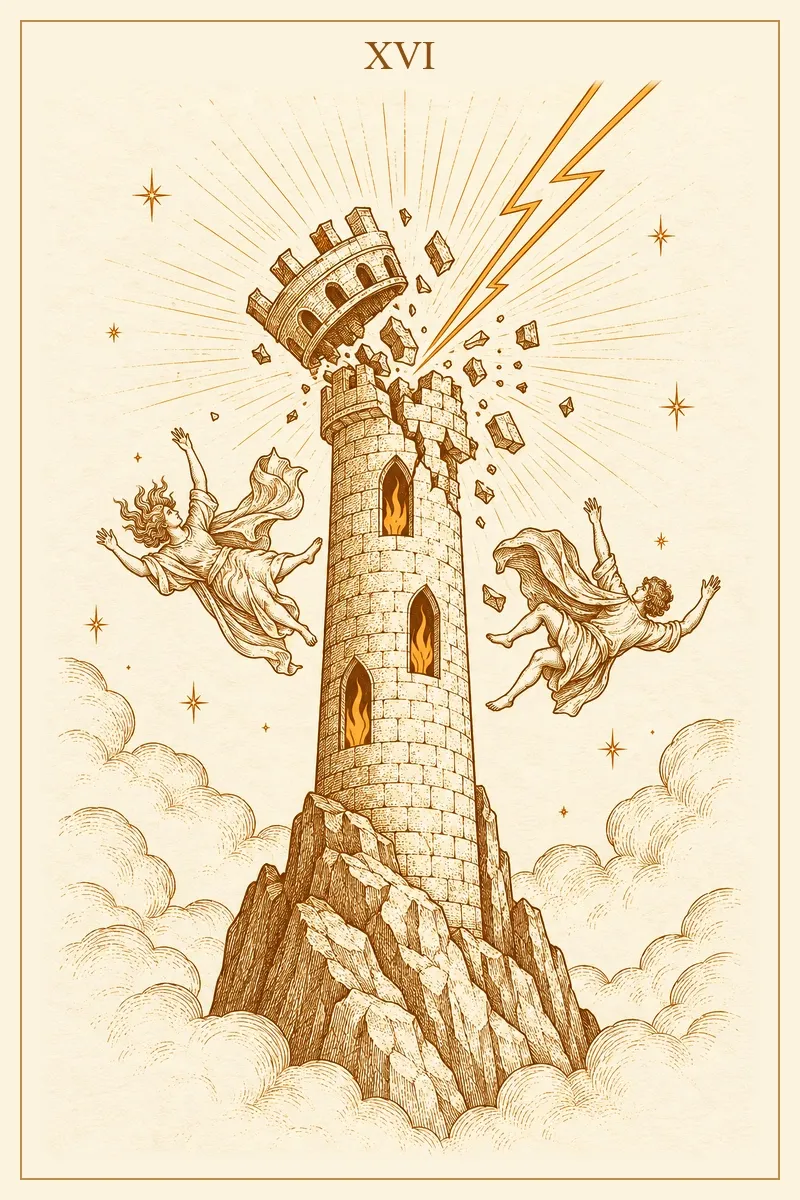
In a work reading The Tower rarely means a sudden firing. More often it names a structure you have maintained past its usefulness: a story about where the path leads, a loyalty to a role that stopped returning anything, a business model that still looks sound on a slide. What falls was already compromised, and the question is whether you rebuild before the collapse or afterward. Its fuller range, including the reversals, is covered in the Tower tarot meaning.
Ten of Wands: the load you are already carrying
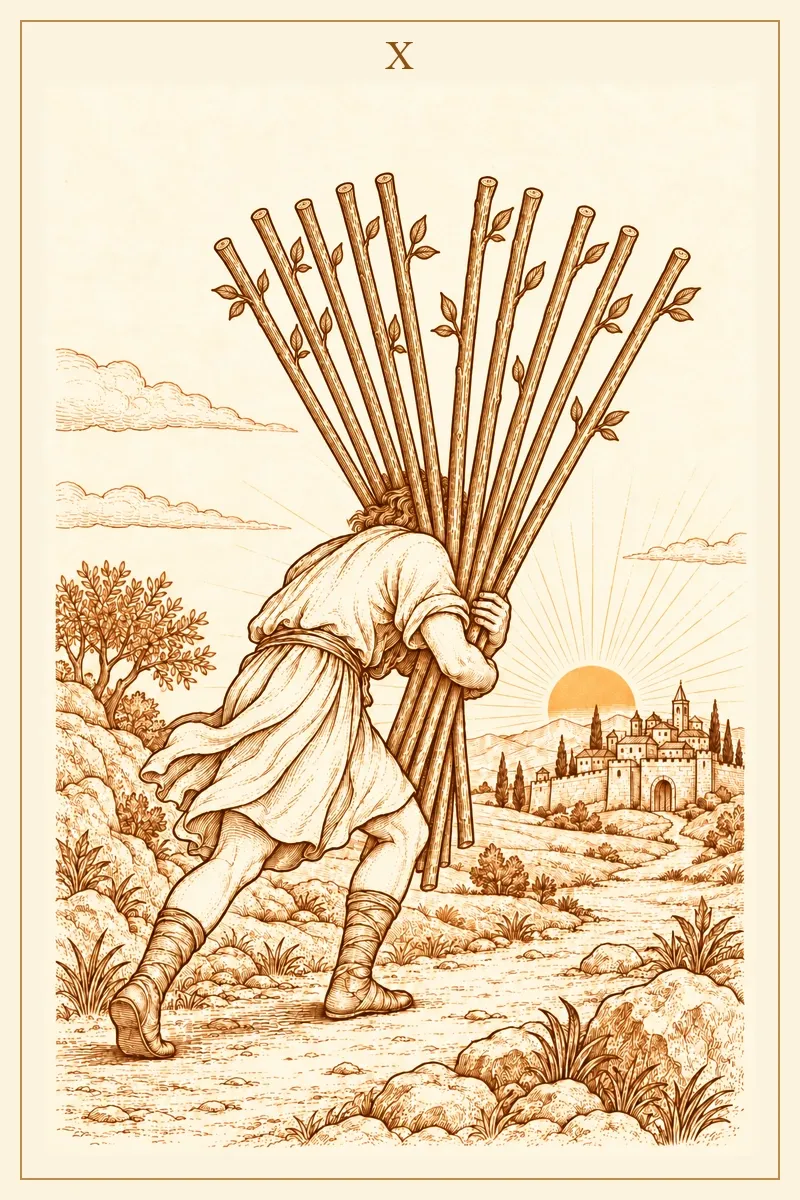
This card never means work harder. It means the load is at capacity, and adding to it reads less like dedication than like a collapse with a date on it. In a readiness or obstacle position, the useful response is subtraction: one commitment ended, one responsibility handed over, one standing meeting declined. The Ten of Wands meaning goes further into what it asks elsewhere.
Two of Swords: a decision you have already made
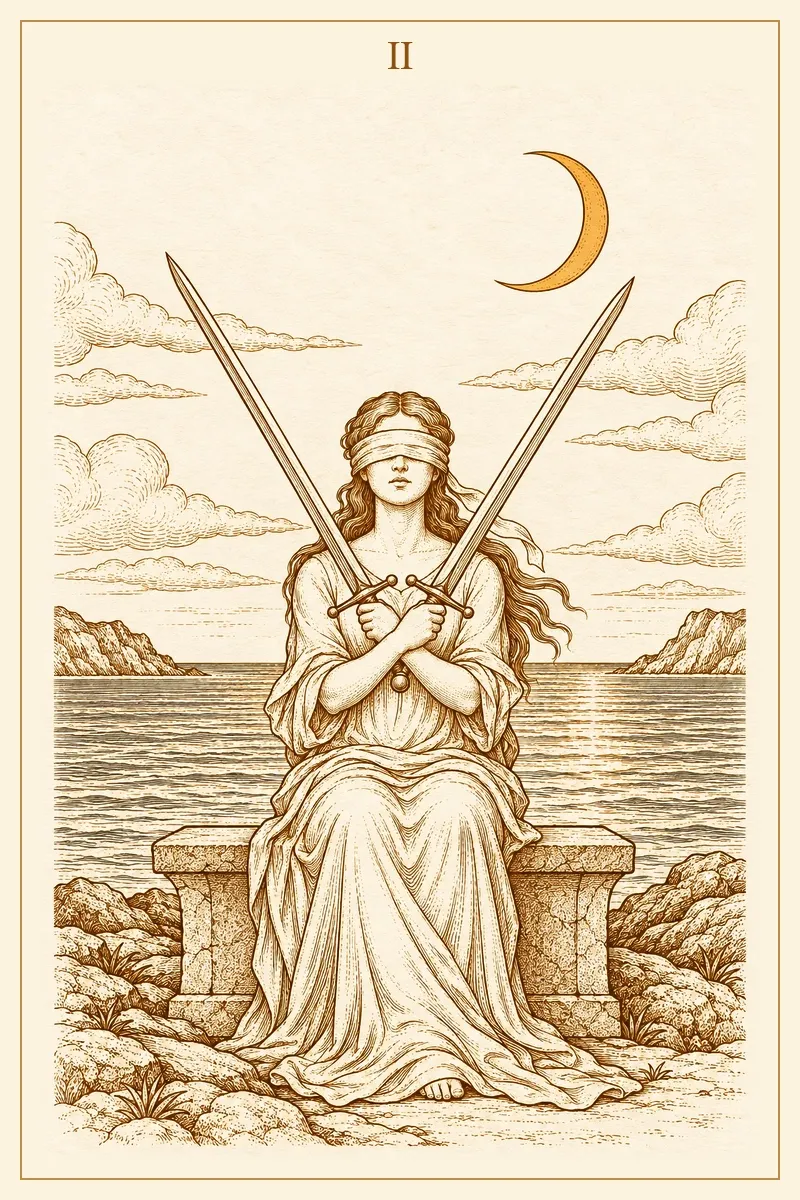
This one gets misread as a request for more information, and usually it is not. It describes someone who has enough to decide and is afraid of what deciding would require: a conversation, a loss, a change in how others see them. The practical move is to name what you already suspect, out loud, to one person who will not argue. For its range across other questions, see the Two of Swords meaning.
Four of Pentacles: security that stopped paying
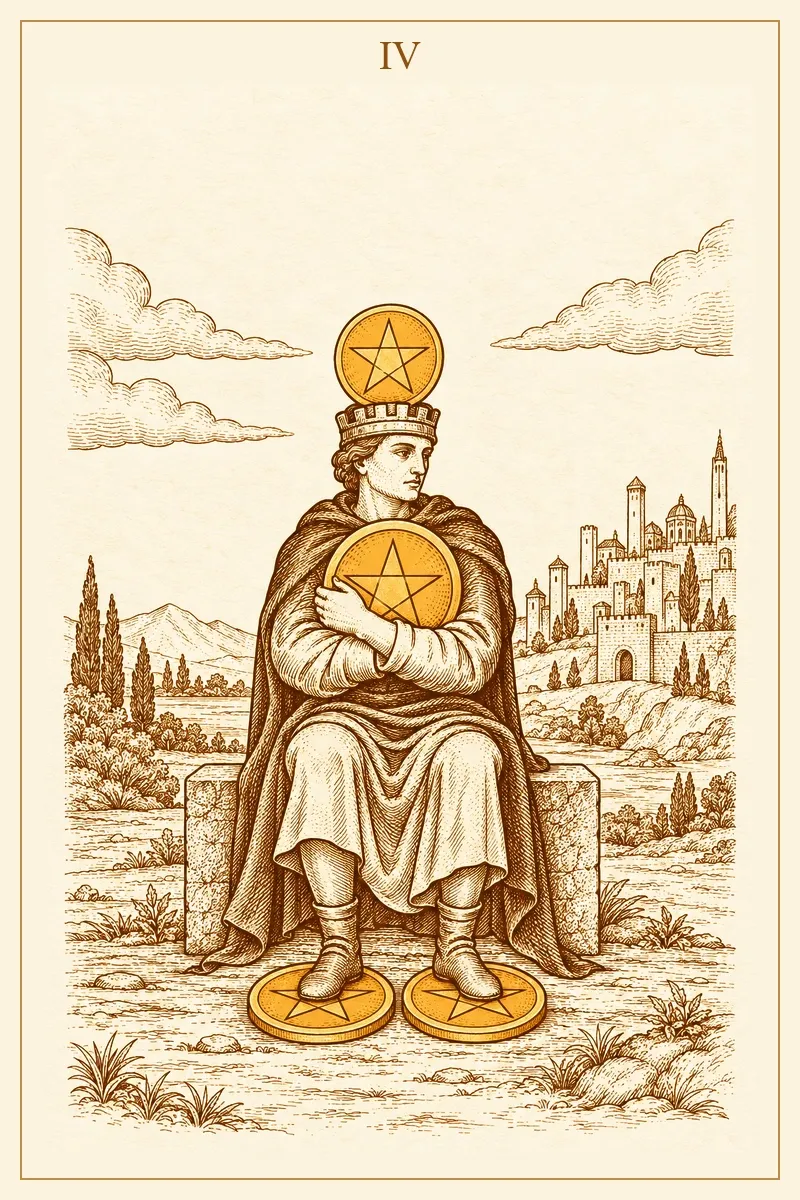
In career readings this card often arrives dressed as financial sense, and sometimes it genuinely is. But in an alignment or obstacle position it usually describes a grip tight enough that nothing new can reach you: the safe role, the predictable paycheck, the title that stopped meaning anything. Ask what the grip protects against and whether that threat is still current. The Four of Pentacles meaning covers the generous version of the card as well as the fearful one.
From positions to a short list of actions
A career reading that ends in a feeling has not finished. Before you clear the cards, turn the layout into something you can put in a calendar.
- Write one sentence per position. Plain language, no card names. If a position resists a sentence, that is the part of the question you have not framed yet.
- Pick exactly one action for the next seven days. One message, one request, one figure checked.
- Name the evidence that would change your mind. Decide in advance what a yes looks like and what a no looks like, so the next conversation gives you information instead of a mood.
- Set a date to look again. A month for a check-in, a quarter for a forecast.
Frequently asked questions
Can a career tarot spread tell me whether to take the job?
No, and a layout that claims to is overselling itself. Tarot cannot confirm what a hiring manager thinks, produce a start date, or guarantee how a role turns out. What a career spread does well is structure: it separates what you want from what you know, makes an unexamined assumption visible, and gives you language for a conversation you have been avoiding. Use it alongside a budget and a talk with someone already in the role.
How often should I lay a career spread?
Monthly for the three-card check-in, once per decision for the longer layouts, once a year for the forecast. Give a decision reading at least a week before you repeat it. Asking daily does not sharpen the answer; it produces contradictory cards and a growing sense that nothing is reliable.
Which layout should a freelancer or contractor use?
The pay and negotiation layout transfers directly to pricing a project, and the business launch layout suits a new service line or a retainer decision. For whether a freelance practice is working overall, the alignment layout fits better than the promotion pathway, which assumes an organization with ladders.
What if the same card appears in two different career spreads?
Read it as emphasis rather than as an omen. A returning card is often attached to a part of the question you have acknowledged and not yet acted on; once you act, notice whether it still turns up. Note which position it occupied each time.
Can I lay a career spread for someone else?
Yes, and these layouts read well for another person when they have told you their question in their own words. Reading about someone's work without their knowledge is a different matter and worth declining. Keep the language descriptive, and hand the decision back to the person whose career it is.
Do I have to read reversals in a career spread?
Only if you already read them comfortably. They add nuance in the gap and obstacle positions, where they often mark a quality that is present but not yet expressed. If they mostly make you anxious, read every card upright and let the position supply the shading.
A map you redraw as you go
What these seven layouts offer is slower and more useful than a verdict: they take the thing you have been circling at two in the morning and give it edges and a name, so the next step becomes a specific action rather than a general dread. The ambition you have been calling impractical, the fear you have been calling patience — a spread puts each one in its own square on the table.
Start with the layout that matches the question you can state today, and let the next reading begin from there. When you are ready to lay one of these spreads with the cards in front of you, you can start a free reading on Veil Soul at your own pace.