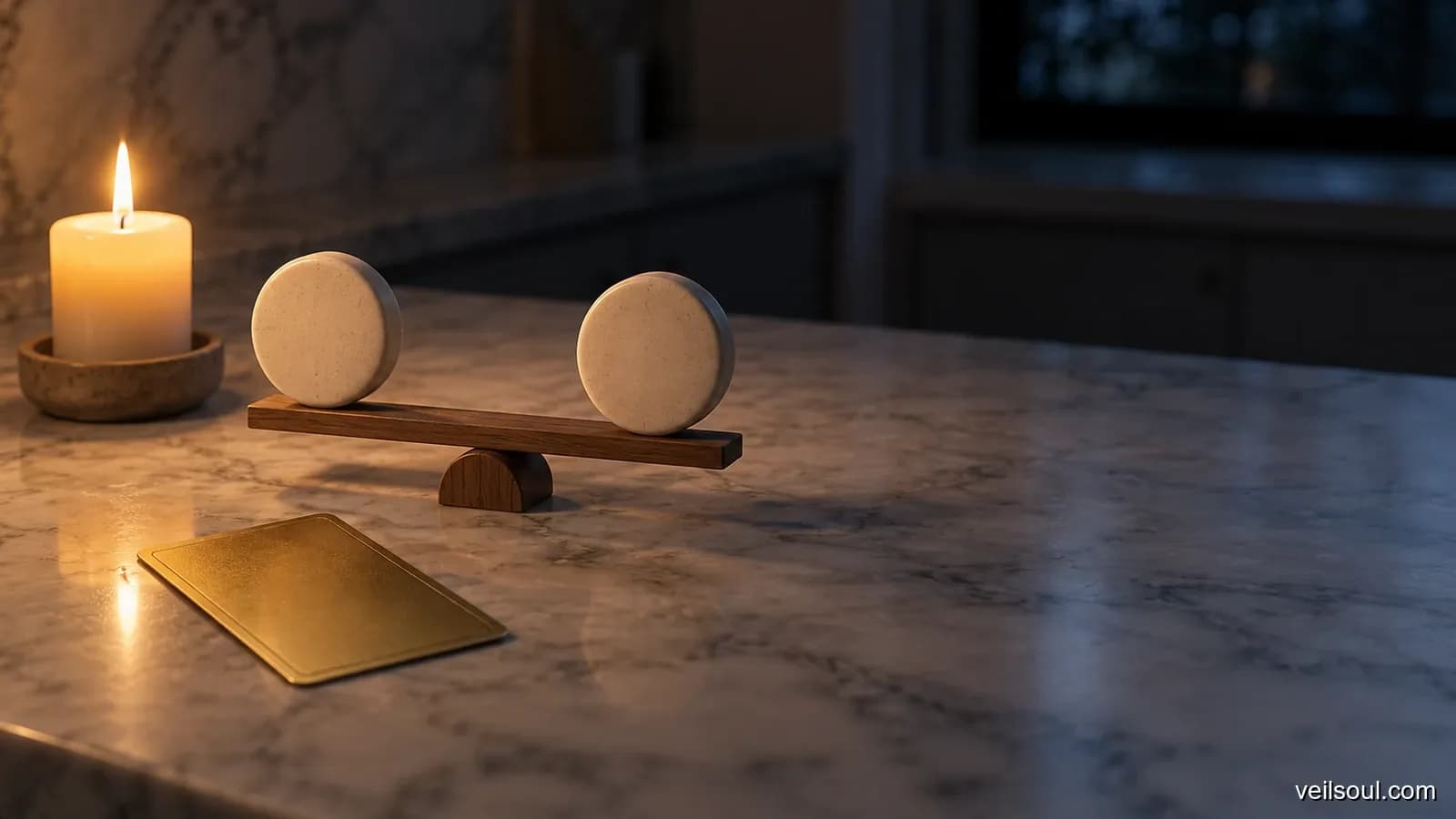
Two coins kept in motion by one looping ribbon: the Two of Pentacles means balancing two real demands at once, such as two jobs, work and family, or income and bills, and adjusting as they shift. Upright, the juggle is working because you stay flexible. Reversed, the Two of Pentacles points to overcommitment: too much in the air, a budget or schedule that has stopped holding, and a choice about what to set down. In love, it describes a relationship that has to share time and attention with the rest of a full life.
Read it as a mirror of how you are carrying things right now, not as a forecast. The card cannot tell you what another person is thinking, promise that a payment will clear, or name the date a busy season ends. What it can do is show where your rhythm is holding and where one coin is about to slip.
- Upright keywords: balance in motion, adaptability, juggling priorities, resourcefulness, lightness under pressure.
- Reversed keywords: overcommitment, dropped tasks, disorganized money, a lost rhythm, putting off a choice.
- Love: making room for each other in a crowded schedule; reversed, a relationship pushed to the bottom of the list.
- Yes or no: a conditional yes upright, if something else can bend to make room; reversed, leaning no until the load is lighter.
- Astrology and title: Jupiter in Capricorn, the first decan of Capricorn; in the Golden Dawn system, the Lord of Harmonious Change.
A dancer on a rock between two ships
Two coins and a figure-eight ribbon
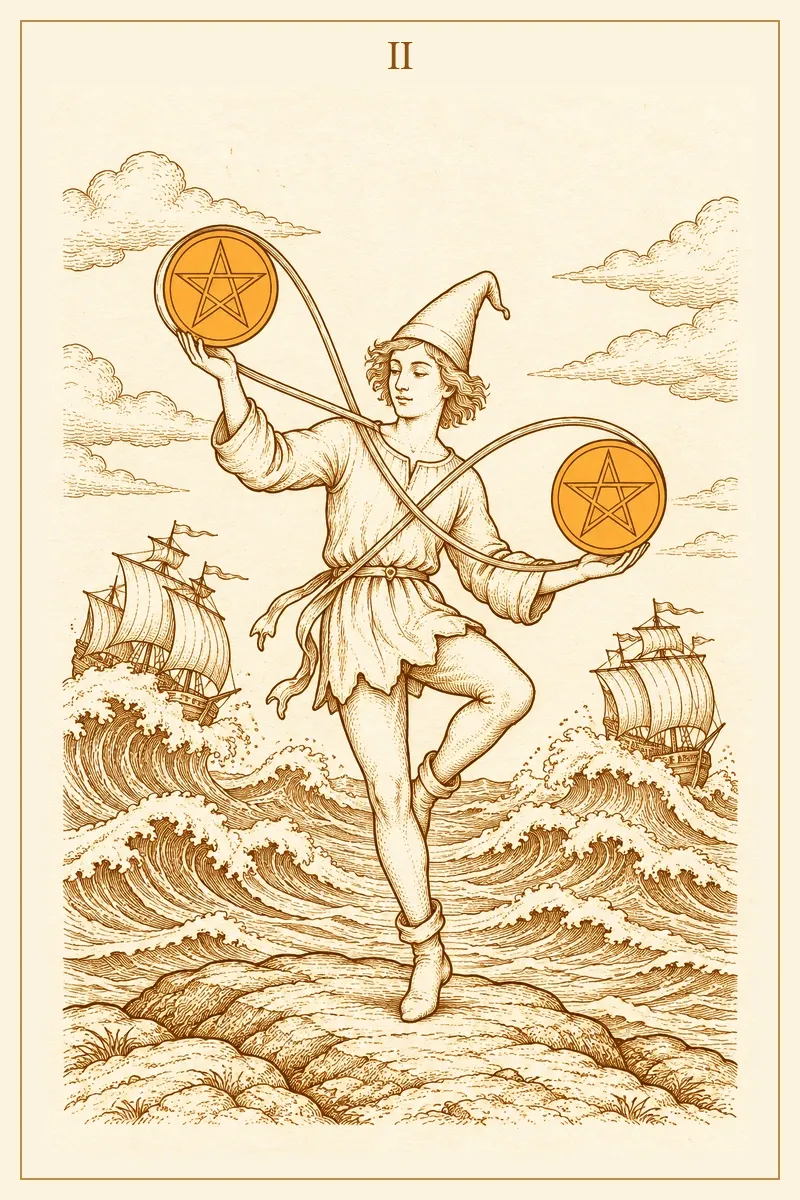
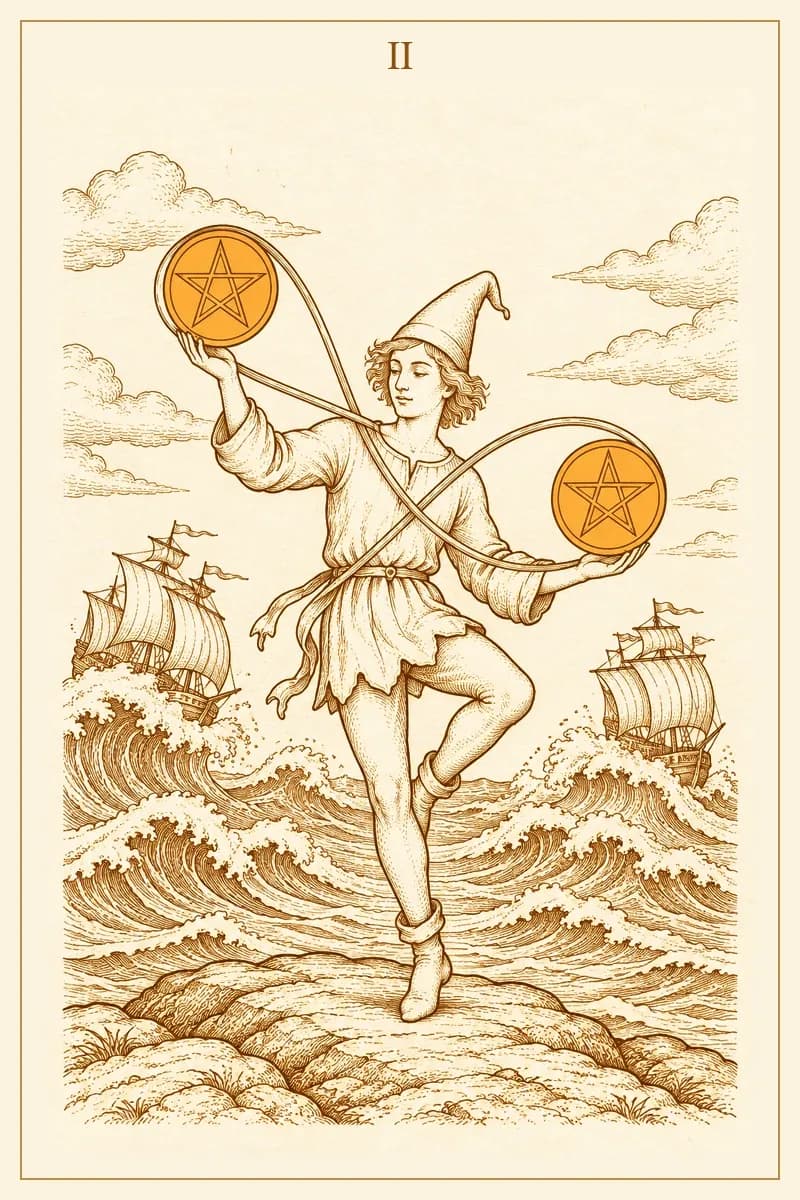
A young man in a tall, soft pointed cap stands on one foot, the other leg lifted and bent as if he were mid-step in a dance. His right arm is raised high with a gold coin balanced in the hand; his left hand holds a second coin lower, out at his side. A long pale ribbon runs from one coin to the other and crosses over his body, so the two coins sit at either end of a figure eight. A sash is knotted at his waist and its loose ends flutter as he moves. His face is calm, eyes lowered toward the coins, more absorbed than anxious.
The figure eight is the heart of the card. It is the shape of infinity, and here it ties the two coins into one moving system: lift one, and the other has to shift. Your rent and your savings, your job and your course, your partner and your parents are not separate problems. They are joined, and the skill the card asks for is keeping the loop moving rather than freezing it. Notice too that the coins sit at different heights. Balance here is not two things held perfectly level; it is a constant trade of attention, where one demand rises for a while and the other waits its turn.
Rough water behind, solid rock below
Behind the dancer the sea is high. Waves curl and break into heavy foam, and two sailing ships ride them, one on each side of him, their hulls tilted on the swell. Yet the young man does not stand in the water. His planted foot rests on a low outcrop of rock at the shore.
That contrast tells you how to read the card. The ships show the outside world doing what it does: prices rising and falling, schedules changing, news arriving that you did not ask for. The rock is what keeps the dancer steady while everything else pitches and rolls: a routine, a home base, a few habits that do not change when the week does. A juggler without solid footing drops things; a juggler with it can afford to be playful.
Jupiter in Capricorn: the Lord of Harmonious Change
In the Golden Dawn system, each numbered card from two to ten rules one ten-degree slice of the zodiac, called a decan, under one planet. The Two of Pentacles holds the first decan of Capricorn, from 0 to 10 degrees, ruled by Jupiter; the sun passes through it in the last days of December, just after the winter solstice. The order's title for the card is the Lord of Harmonious Change.
The pairing explains the picture. Jupiter is the planet of growth and of more: more opportunities, more plans, more commitments. Capricorn is the cardinal earth sign, the one that asks what something will cost and how it will be maintained. Together they describe expansion that has to fit inside real limits: twice the work in the same number of hours, a new expense inside an existing budget. Harmonious change is the art of letting things grow without letting them topple.
The older Golden Dawn description of this card shows a serpent coiled around two disks in a figure eight, holding its own tail in its mouth: change that keeps renewing itself. If you want to follow the sign further, read how Capricorn works in tarot; its major arcana card is The Devil, and its other two decans belong to the Three of Pentacles and the Four of Pentacles.
Between the Ace and the Three: the Two in the Pentacles story
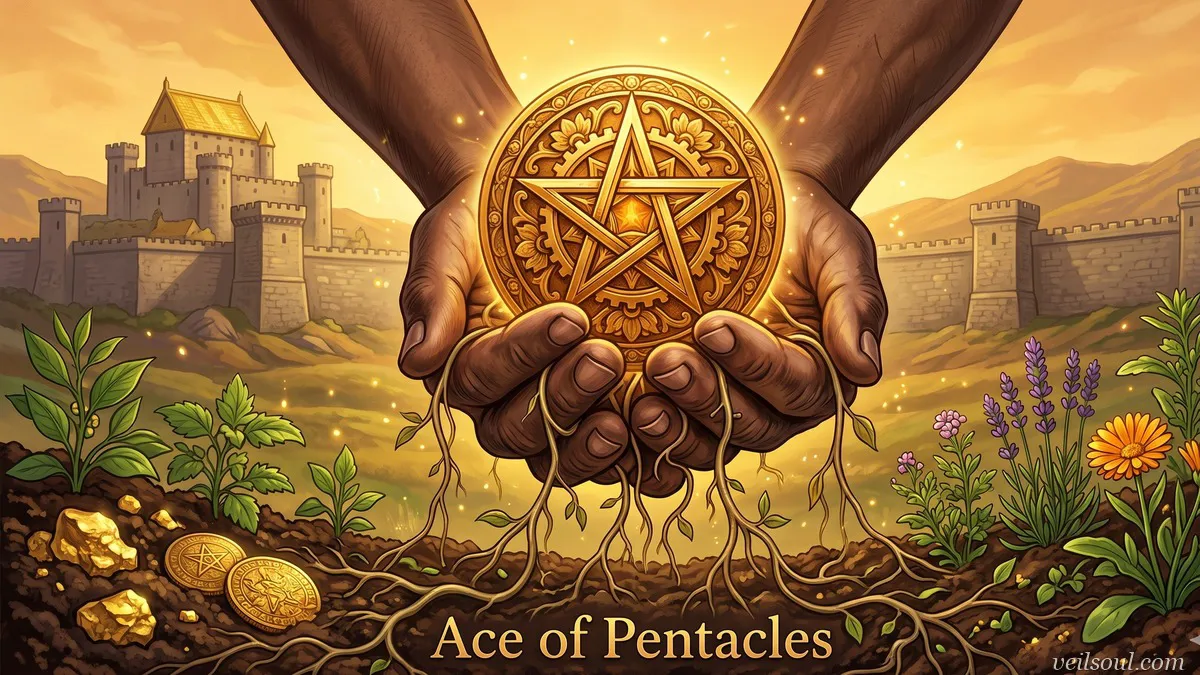
Each minor arcana suit tells a short story from one to ten, and the Pentacles story is about the material world: money, work, body and home. The Ace of Pentacles offers a single coin from a cloud, and the Ace of Pentacles meaning treats that coin as an opportunity, not yet a result. The Two is what happens the moment you accept it: now there are two things to tend, the new opportunity and everything you were already carrying.
The cards on either side show where this can lead. The Three of Pentacles brings in other people and turns the solo act into a shared project; the Three of Pentacles meaning describes that move from juggling alone to building with help. The Four of Pentacles shows the opposite reflex: after a stretch of juggling, someone grips every coin tightly and stops moving at all. Between the gift and the structure, the Two teaches that flexibility comes before stability, not instead of it.
The Two of Pentacles upright: two demands, one rhythm
Upright, the card says you are carrying more than one important thing and, for now, you are managing it. That might be a second job, a move, a new baby alongside work, or a month in which every bill seems to land at once. The card does not call this easy. It calls it workable, as long as you keep adjusting.
Adaptability as the skill
The upright Two rewards people who can change the plan midweek without treating it as failure. A meeting moves, so the grocery run moves. Flexibility is your strongest asset right now, more useful than a perfect schedule you cannot keep.
Priorities that trade places
The upright card does not expect everything to get equal attention every day. It suggests letting one demand lead for a while, then the other, and being honest about which one is up today. The balance is measured across the week, not within each hour.
Lightness under pressure
The dancer's face is calm and his cap is a little playful. Upright, the Two can mean finding some enjoyment in a lively season: the satisfaction of making it work, a sense of humor about the chaos. It may be inviting you to notice that you are, in fact, keeping it together.
Two of Pentacles reversed: when a coin slips out of the loop
Reversed, the Two of Pentacles shows the rhythm breaking. The flexibility that worked in a short burst has turned into a permanent scramble. Tasks get dropped, money gets muddled, and the person doing the juggling is tired in a way that one good weekend will not fix.
Overcommitment
The plainest reading of the reversal is overcommitment: saying yes to more than the hours allow, whether from kindness, ambition or fear of disappointing someone. The card asks you to name what you are carrying and admit that not all of it fits. If you do not choose what to set down, something will fall on its own, and probably not the thing you would have picked.
Money out of order
Reversed, the card can describe finances that have stopped being tracked: payments shuffled between accounts until nobody knows the real balance, a late fee here, a forgotten subscription there. The repair is rarely dramatic. Sit down with the actual numbers, list what is due, and decide in what order things get paid. If debt or legal deadlines are involved, a qualified financial counselor is the right next call, not another card.
Stalling between two options
Another side of the reversal is refusing to choose. Two job offers, two apartments, two directions for a business, and you keep both coins in the air because putting either down feels like a loss. Sometimes the opposite happens and the plan grows so rigid that any change feels like a threat. Either way, the reversed Two asks for movement.
Love: making room for each other in a crowded week
If you are single
Upright, the Two of Pentacles suggests dating is one more thing being fitted around work, family and everything else. That is not a bad sign. The person who suits you right now may be someone who understands a full life. It can also describe weighing two people you are interested in. Be honest with both, and with yourself, about how much time you actually have.
If you are in a relationship
For couples, the card shows love sharing the stage with other demands: shift work, children, caring for a parent, long commutes. The relationship may be fine; it just needs deliberate time. Small, regular gestures matter more than a grand plan: a fixed evening that does not get canceled, a check-in message during a long day. The ribbon is a good image for a couple: two separate coins, one shared loop.
Reversed in love
Reversed, the relationship is the coin that keeps getting dropped. One partner may feel like an item on a to-do list, or both are too tired to give much. It can also point to someone splitting attention between two connections. Whatever the cause, the current arrangement is not giving love enough room, and a clear conversation about what each of you can realistically offer is a better next step than guessing.
Work and study: two jobs, a side project or a shifting role
Upright at work
In career readings, the upright Two describes a busy, changeable period: two roles at once, a day job plus a side business, a team reorganization, or a mix of work and study. You can handle it; the caution is not to mistake activity for progress. Keep a short list of what actually moves your goals forward, and protect time for those items first.
Reversed at work
Reversed, the workload has outgrown the person carrying it. Deadlines slip, quality drops, and you may be answering messages late at night to keep up. The card points toward practical repairs: renegotiate a deadline, ask what can be delegated, decline the next extra project, or ask a manager which of your tasks matters most.
Money, energy and the pace you can keep
Financially, the upright Two of Pentacles describes careful juggling: income on one side, expenses on the other, and you shifting funds to keep both in balance. It is not a card of windfalls, and not a card of disaster either; it is the budget of someone paying attention. Reversed, spending creeps past income, or keeping track has become so stressful that you have stopped looking. The card is not financial advice, but a plain list of what comes in, what goes out and what is due is the first step back to the dancer's rhythm.
The same logic applies to your energy. Upright, you are fitting rest and movement into a packed schedule in small, flexible ways, and that is enough for now. Reversed, the strain may be showing up as tiredness, poor sleep or tension you carry from one day into the next. Treat that as information, not a diagnosis, and see a doctor if something persists. The rock under the dancer's foot matters as much as the coins in his hands.
Yes or no: yes, if something else can bend
As a yes-or-no card, the upright Two of Pentacles gives a conditional yes. If you are asking whether to take on a new commitment, the answer depends on whether something else in your life can make room for it. If you can name what will shift, the answer leans yes. If you would have to keep everything exactly as it is and add more, it leans toward "not yet."
Reversed, the card leans no for now. You are already carrying more than fits, and the wiser move is to set something down before picking anything new up. For a choice between two options, neither the upright nor the reversed card picks a winner; it asks which option you can actually sustain.
Pairings that steady the juggle
Two of Pentacles with Temperance
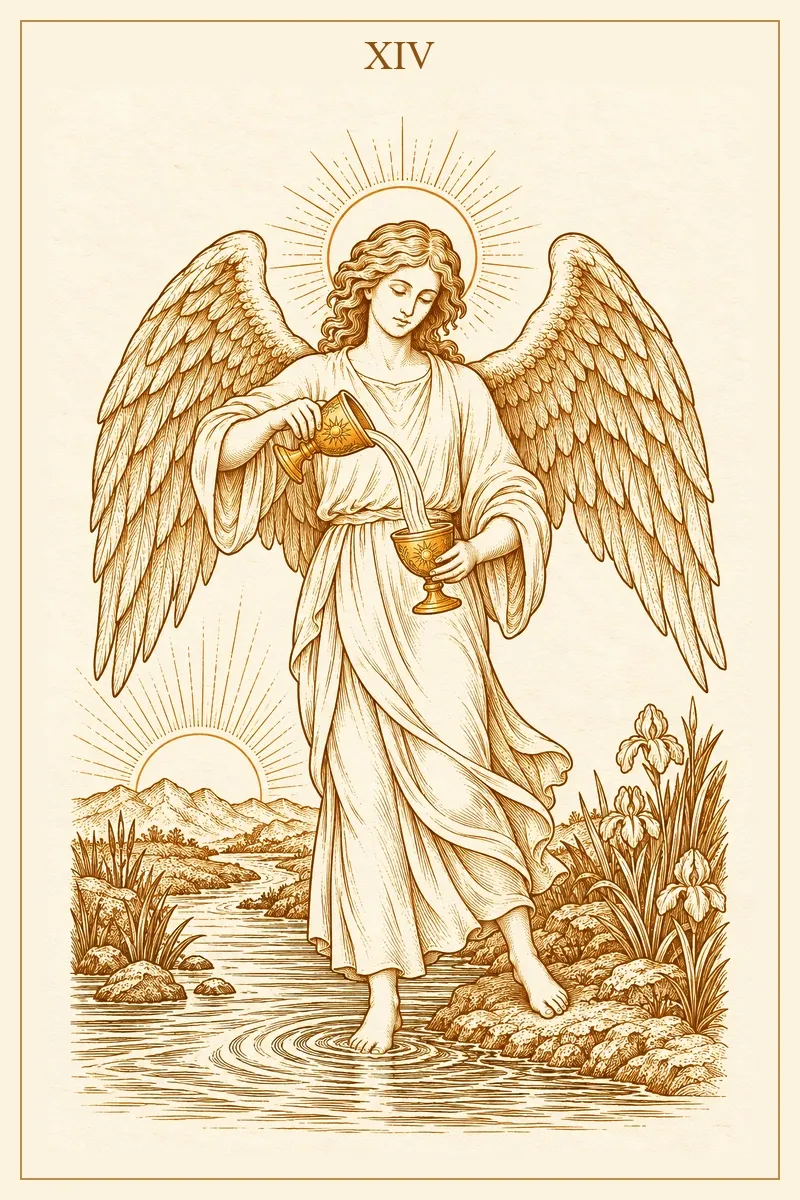
On Temperance, an angel stands with one foot in a stream and pours water from one gold cup into another. Next to the Two, it turns hurried juggling into measured pacing: the same two demands, handled with more patience. The Temperance meaning covers its theme of moderation in depth; together, the cards say balance is possible if you slow the tempo.
Two of Pentacles with the Eight of Pentacles
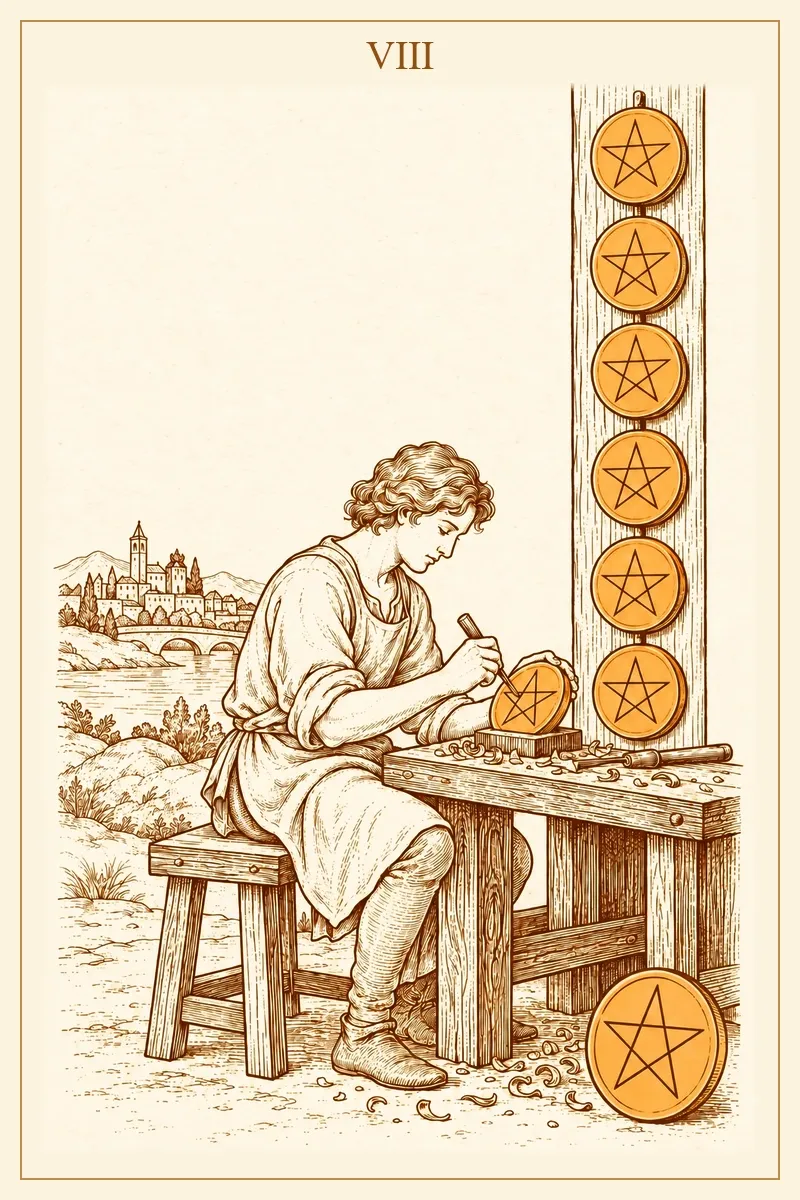
The Eight of Pentacles shows a craftsman at a wooden bench, carving a coin, with finished coins fixed one above another on a post beside him. Paired with the Two, it suggests narrowing focus: fewer things, done properly. It asks which task deserves your full attention, and the Eight of Pentacles meaning explores that kind of patient, skill-building work.
Two of Pentacles with The World
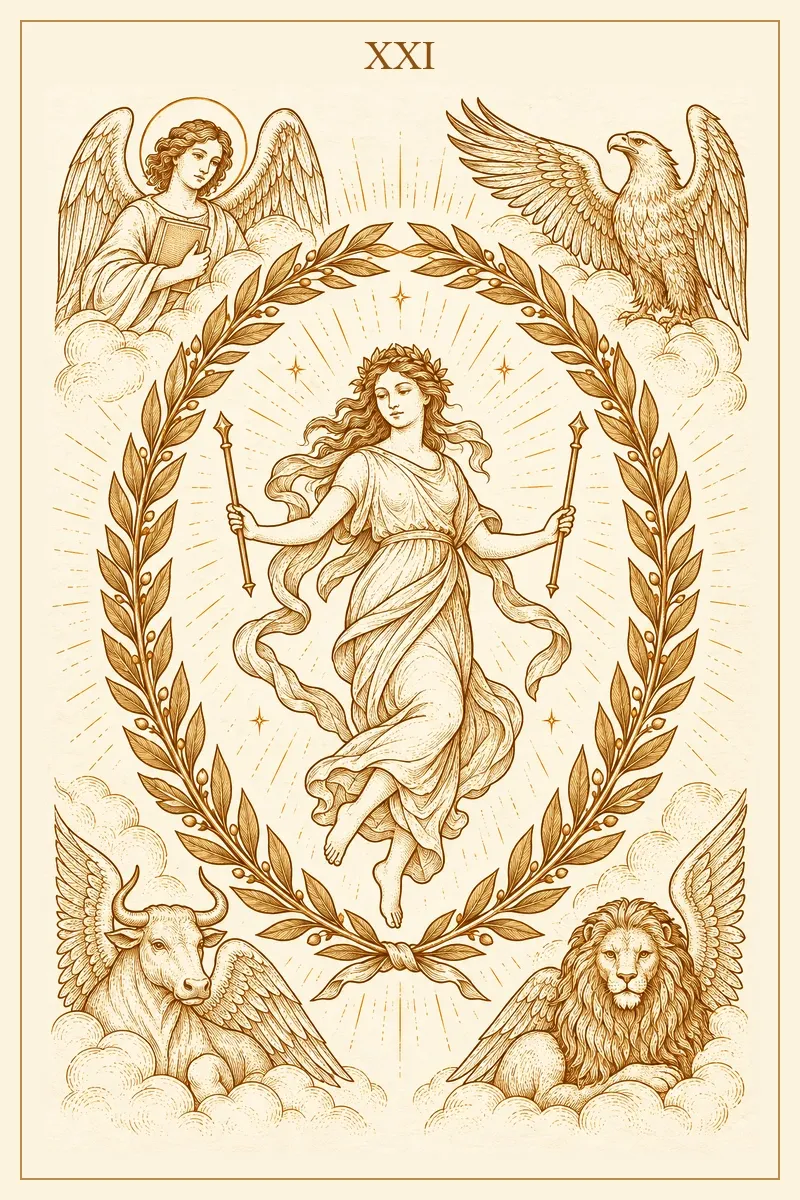
The World shows a dancer floating inside a laurel wreath, a slim wand in each hand, with an angel, an eagle, a bull and a lion in the four corners. She is the juggler grown up: still dancing, still holding two things, but now inside a closed circle. Together they describe the separate parts of a life fitting into a whole, the theme at the center of The World's meaning.
Pairings that shake the loop or call for a pause
Two of Pentacles with The Tower
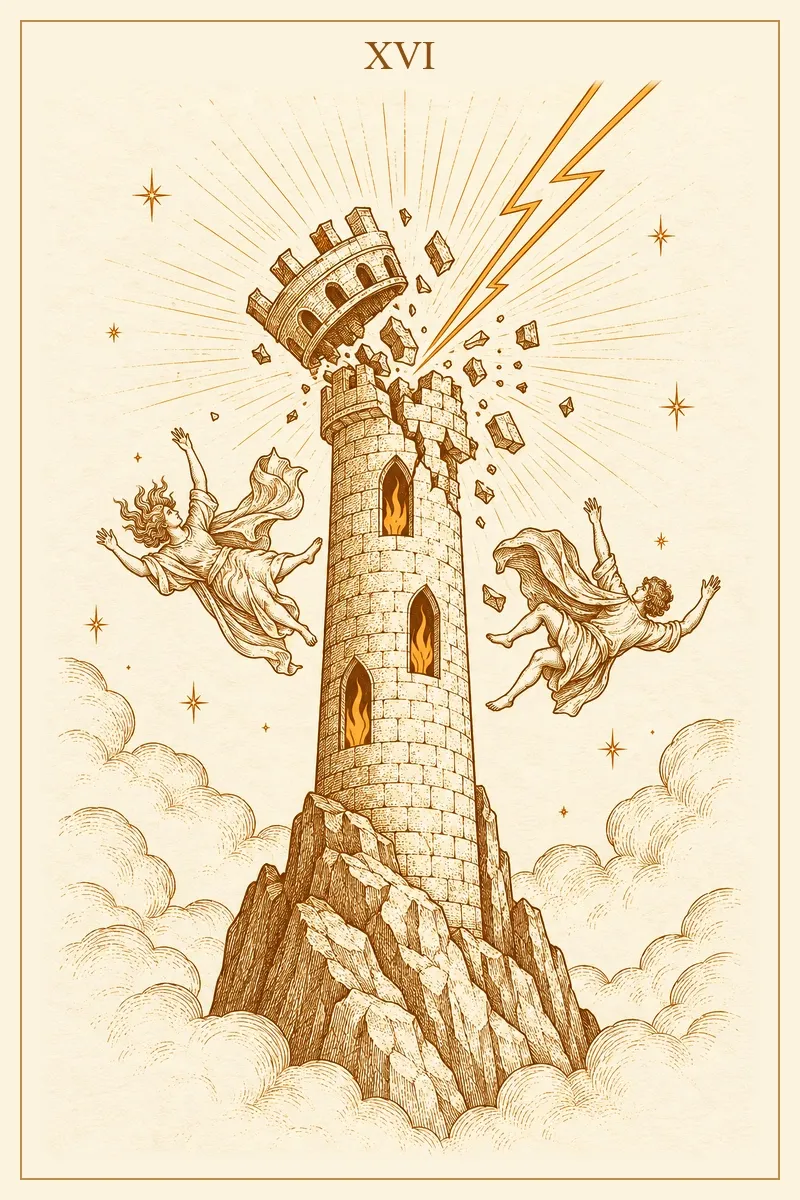
On The Tower, lightning strikes a stone tower on a rocky peak, knocks off its crowned top and sends two figures falling, while flames show in its windows. Beside the Two of Pentacles, this is the moment the juggling stops by force: a sudden change, such as a lost contract or an unplanned move, that makes the old balance impossible. It clears the table so you can decide what really belongs on it, and the Tower meaning looks at how to work with that kind of upheaval.
Two of Pentacles with The Hermit
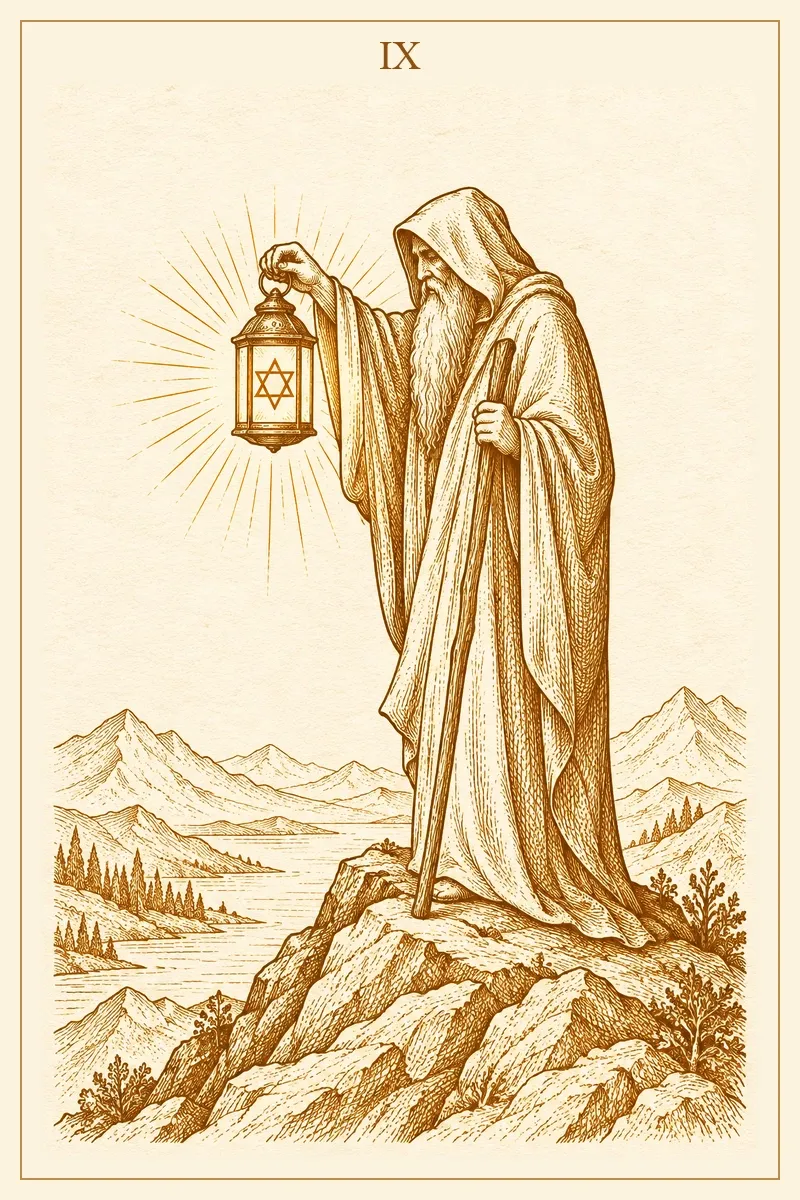
The Hermit stands alone on a mountain peak in a heavy hooded cloak, leaning on a staff and holding up a lantern with a six-pointed star inside. Next to the busy Two, he sets the opposite pace: step away from the juggling, even briefly, and ask which of these things you would choose again. As the Hermit meaning describes, his solitude is for clarity, not escape.
Two other neighbors are worth knowing. With the Two of Swords, the juggling hides a decision you have been avoiding. With the Wheel of Fortune, the change comes from outside, in cycles you can ride but not control.
The two-coin spread: five positions for a stretched season
This spread borrows its positions from the card itself. Shuffle with a question such as "How can I carry what is on my plate right now?" and lay five cards in a row.
- The raised coin: the demand taking most of your attention right now.
- The lower coin: the demand waiting its turn, or getting less than it needs.
- The ribbon: what links the two, or the rhythm that lets both keep moving.
- The ships: the outside change you cannot control and have to ride.
- The rock: what keeps you steady, the support or habit to protect.
Read positions 1 and 2 together first. If they look very unequal, the spread is already showing you where the imbalance sits. Then read 3 for the fix, 4 for the conditions and 5 for what to protect.
A sample reading: a full-time job and an evening course
Here is an invented example to show how the spread works. Imagine someone who works full time and has just started a course that meets two evenings a week. They ask, "How do I keep both going without burning out?" and draw five cards.
- The raised coin, Knight of Pentacles: the job is steady and routine, asking for reliability more than brilliance.
- The lower coin, Page of Pentacles: the course is a beginner's project, new and exciting, and getting the leftover hours.
- The ribbon, Four of Swords: what links the two is rest. Without planned recovery, neither gets done well.
- The ships, Eight of Wands: things are moving fast, with deadlines and assignments arriving close together over the coming weeks.
- The rock, Ten of Pentacles: home and family form the base, and their support is what makes the plan possible.
Read together, the cards do not say "quit one." The Knight shows a job that can run on routine, which frees energy for the Page's learning. The Four of Swords is the key: rest needs to be scheduled as firmly as class nights, or the fast pace of the Eight of Wands will knock both coins loose. The Ten of Pentacles suggests asking the household for practical help during the busiest weeks. A sensible next step: block one evening a week as protected rest.
Small adjustments to try this week
- List what you are carrying. Write every commitment down, including the small ones.
- Name the raised coin. Choose which demand leads this week and let the other wait without guilt.
- Protect the rock. Pick one habit that keeps you steady, such as sleep, a walk or a weekly meal with someone, and treat it as fixed.
- Set one thing down. If the card came up reversed, decide what you will cancel, delegate or postpone, and tell whoever needs to know.
Frequently asked questions
Is the Two of Pentacles a positive card?
Mostly, yes. Upright, it shows someone handling a demanding season with skill. It is not a card of ease, and it warns against taking on more without making room, but its tone is capable and lively rather than heavy.
Does the Two of Pentacles mean choosing between two people?
It can describe attention divided between two people or two connections, but it does not tell you which to choose. Its focus is on whether the situation is sustainable. Reversed, it may suggest that keeping both in the air is causing strain, for you or for them.
What does the Two of Pentacles say about how someone feels about me?
It suggests a person whose life is full and whose attention is divided: interested, perhaps, but busy. Still, tarot cannot read another person's mind or confirm their feelings, and no card can promise how a relationship will turn out. Use the card to reflect on what you see in their actions and on what you need, then talk with them directly.
Does the Two of Pentacles show timing?
Some readers link it to its decan, the first ten degrees of Capricorn, which falls in late December. More practically, it describes an ongoing, busy stretch rather than a single event, so read a "when" question as "while things are still in motion" rather than as a date on the calendar.
Is the Two of Pentacles only about money?
No. Pentacles cover the practical world, and the Two applies wherever limited time, money or energy has to stretch across more than one demand, a calendar as much as a bank account.
Set one coin down, then look again
The Two of Pentacles does not ask you to stop juggling; it asks you to juggle with your feet on solid rock and your eyes on what matters. If a current situation feels like too many coins at once, you can lay out the two-coin spread yourself or start a reading with Veil Soul and see which coin wants your attention first.