For most people, a comfortable rhythm is one full tarot reading a month, a short check-in once a week if you like structure, and, if it helps, a single card drawn each morning as a moment of reflection. For any one question, read once, then wait until something real has moved, such as new information, a decision or a date you chose in advance, before asking again; for most everyday questions that gap falls somewhere between two weeks and a month. Sessions with a professional reader are usually spaced further apart still, every few months or at a genuine turning point.
Frequency does not make tarot more accurate. The cards cannot confirm what someone else is thinking, give you a date or settle how a situation will end, however often you shuffle. What a steady rhythm does give you is room: time to act on a reading, notice what happened and come back with a better question. So the right answer depends less on a magic number than on what you use the cards for.
Healthy rhythms at a glance:
- Daily: one card in the morning, a minute or two, used as a prompt rather than a forecast.
- Weekly: a three-card check-in on a fixed evening, about ten minutes.
- Monthly: one fuller spread for whatever matters most right now.
- Per question: one reading, then a pause until something actually changes.
- Seasonally: a look back through your notes every three months or so.
- With a professional reader: a few times a year, or at a real crossroads.
This guide is about building a rhythm that fits your life. If you suspect the opposite problem, that you reach for the deck far more often than it helps, the guide to signs of too many tarot readings covers over-reading and how to step back from it.
Let the purpose set the pace
Tarot does several different jobs, and each one runs on its own clock.
Reflection is the lightest job: a card as a mirror for your mood, your habits or the day in front of you. It can happen often because nothing is being decided. Planning looks a little ahead, across a week or a month, and works best on a regular schedule so that one reading can be compared with the next. Decisions are different. A question like "Should I take this job?" deserves one careful reading, some time to act and a follow-up only when the situation has moved. Learning is the exception to every limit: practicing card combinations on made-up questions builds skill, and it can be as frequent as your curiosity.
So before you ask how often, ask which of these you are doing. Someone with a daily card, a Sunday check-in and one monthly session may touch the deck thirty times a month and still have a calm practice. Someone who lays three spreads on the same relationship worry in one evening has read only three times, yet far too fast for that question. The count matters less than whether each reading has time to be lived.
Four layers of a steady practice
A steady practice is usually built from a few layers. You do not need all four; pick the ones that suit your week and leave the rest.
A daily card as a quiet prompt
The lightest layer is a single card drawn in the morning. You are not asking for a prediction; you are choosing one image to carry through the day and noticing where it shows up. It takes a minute or two, and over months it teaches you the deck faster than any book. The guide to the one-card daily draw covers how to frame it and what to write down, and the ideas in daily tarot rituals can help it settle into a routine you actually keep.
Keep the daily card small. If a hard card makes you want to draw two more to soften it, let the first one stand and look at it again in the evening, and save your heaviest question for a reading with room to breathe.
A weekly check-in
Once a week, on the same evening or morning, lay three cards: what you are carrying in from last week, what needs your attention this week, and where you can ease off. Ten minutes is enough. The value comes from repetition: after a month or two, you can set four weeks of notes side by side and see which themes kept returning. For a fuller picture of the days ahead, the weekly tarot spread gives each day its own position.
A monthly reading for what matters most
The monthly layer is where your bigger questions belong: work direction, a relationship you are thinking about, a habit you want to change. Choose a fixed day, such as the first Sunday of the month or the day after payday, and give yourself half an hour with a larger spread and a notebook. Because a month is long enough for real things to happen, this is also the layer where earlier readings can be checked against your life. A four-position spread built for this slot appears further down.
A seasonal look back
Every three months or so, skip the new spread and read your notes instead. Which cards kept appearing? Which worries resolved on their own? Which advice did you follow, and how did it go? A run of the same card across a season can be meaningful, and the guide on what it means when a card keeps appearing helps you tell a real theme from chance. A birthday or the turn of the year is a natural moment for a larger review, and a tarot journal for tracking readings makes the look back far easier.
How long to wait before asking again
Questions about frequency are often really about one question in particular: "I asked last week, can I ask again?" The answer depends on how fast the situation itself is moving, not on how restless you feel.
- A fixed event ahead, such as an interview, a test result or a reply you are expecting: wait until the event has happened. One reading the day after tells you more than three readings before.
- Relationship questions: two to four weeks, or after a real conversation, whichever comes first. Feelings shift daily; patterns take weeks to show.
- Career and money questions: about a month, or at the next milestone, such as an offer, a review or the end of a project.
- Big life direction, such as a move, a change of field or what you want from the next few years: once a season, or when a concrete option appears.
A simple habit holds this together: when you finish a reading, write a re-read date beside it. It can be a calendar date ("the first of next month") or an event ("after we talk on Saturday"). If the urge to ask again arrives before that point, check whether anything has truly changed. New information, a step you have taken or a choice someone else has made all count. A different mood about the same facts does not.
If one card in a reading genuinely confuses you, you can draw a single clarifier and set it beside that card. That is different from reshuffling the whole spread because you disliked the answer. And in a crisis, such as a breakup, a job loss or frightening news, one reading for the event is usually enough; after that, people, rest and practical help do more than another spread can.
How often to see a professional reader
If you book readings with someone else, in person or online, the same principle applies with a longer gap. For most people, a few sessions a year is plenty: before a significant decision, after a big change, or when you want a fresh pair of eyes on a pattern you cannot see from inside. Between sessions, your own notes carry the thread.
A session tends to be most useful when you arrive with one clear question and leave with something to try. If you notice you are booking again before you have acted on the last session, or visiting several readers about the same issue until one says what you hoped, lengthen the gap. A thoughtful reader helps you lean on your own judgment more over time, does not push packages or frequent repeat bookings, and never claims something terrible will happen unless you pay for more. It is fair to ask any reader why they suggest a particular schedule.
If you read professionally, the risk runs the other way: reading for others all day leaves little energy for your own cards. A fixed weekly or monthly slot for personal readings, protected like any appointment, keeps your own practice alive.
Cards that speak to timing and pace
Sometimes the reading itself suggests how soon to come back to it. None of these four cards sets a date; each describes the tempo a situation seems to have, which helps when you decide how long to leave a question alone.
The Hanged Man: leave the question alone for a while
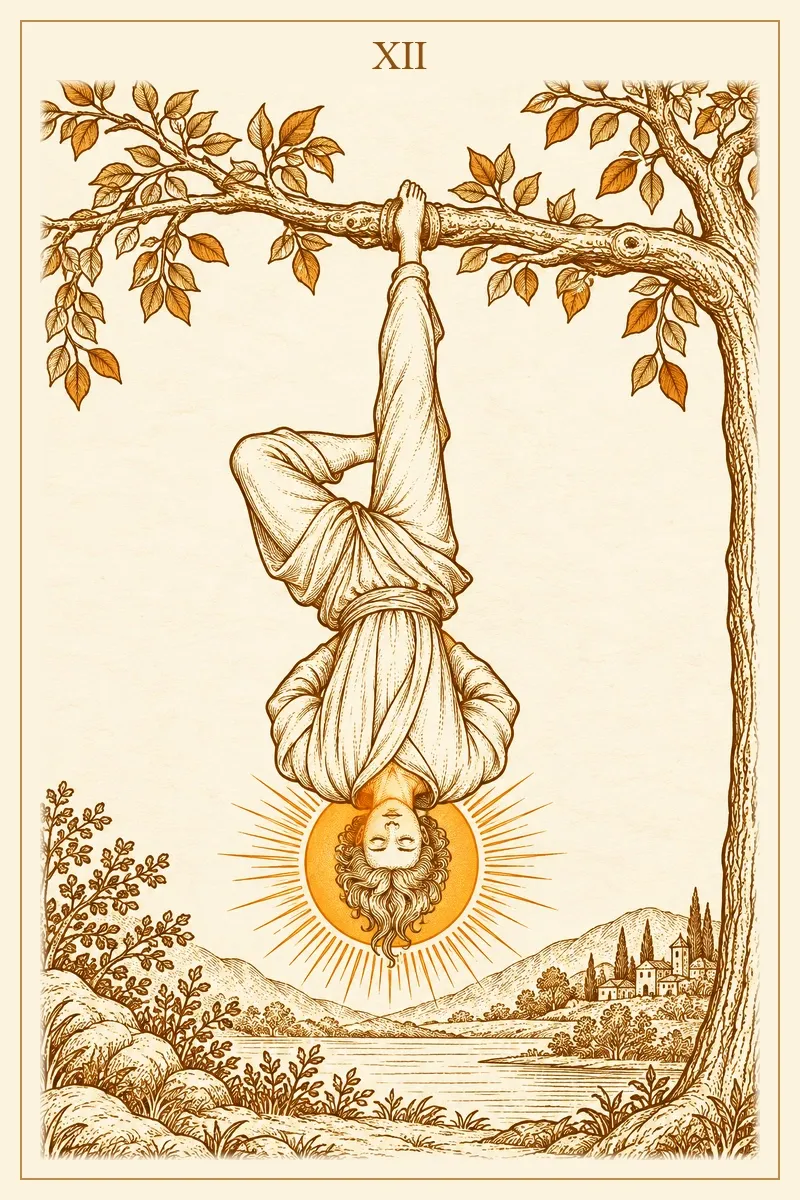
The Hanged Man shows a figure hanging upside down by one foot from the branch of a living tree, the other leg bent behind, face calm and eyes closed inside a golden halo, with a still lake and a distant village below. Upright, it speaks of a deliberate pause: seeing the situation from a new angle and letting go of the need to push. As a timing signal, it is one of the clearest invitations to give a question time.
Reversed, it can describe a pause that has turned into being stuck, or impatience with a wait that still has a purpose. In love it might suggest holding off on a decision until you see the relationship differently; at work, letting a process run its course. The full Hanged Man tarot meaning explores the card in more depth. A practical step: set your re-read date further out than you first planned.
Seven of Pentacles: check progress at intervals
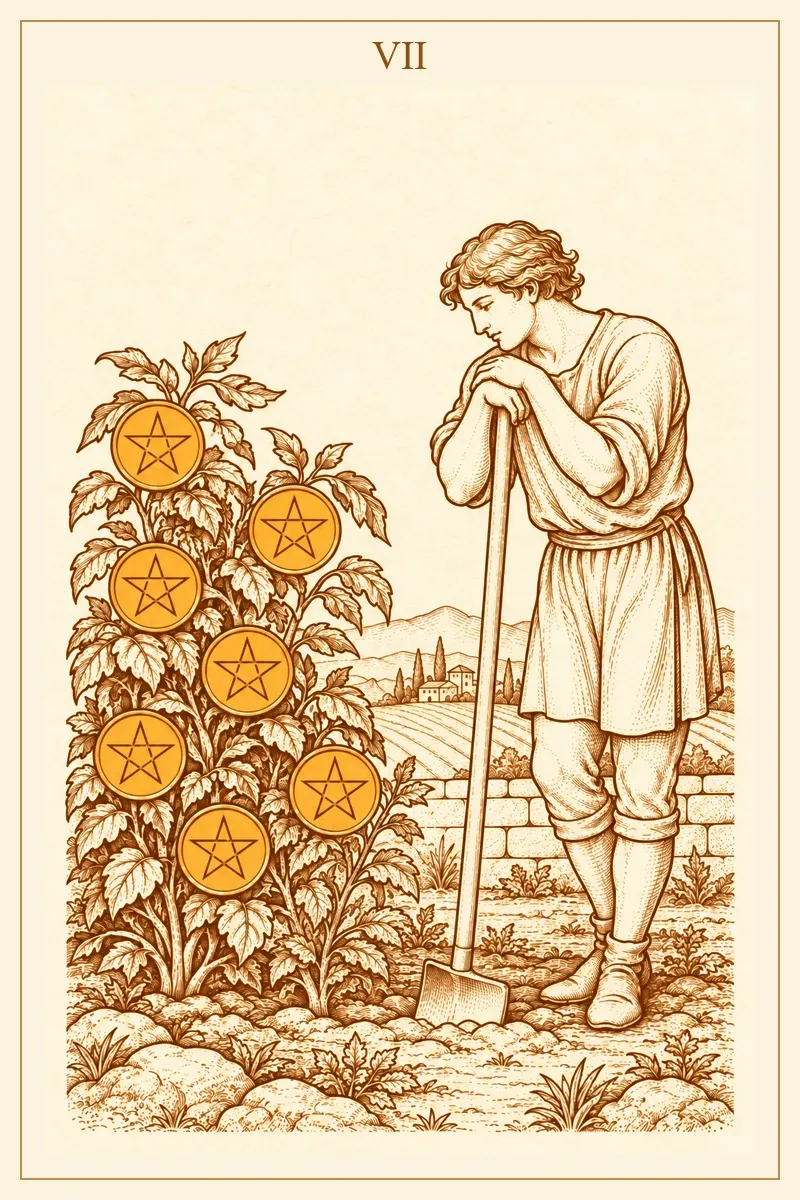
The Seven of Pentacles shows a young gardener leaning on the handle of his spade, chin resting on his hands, looking at a leafy bush that bears seven gold pentacles. Upright, it is the card of patient assessment: you have put in the work, the results are growing, and the useful move now is to step back and judge progress, not to dig up the roots to check on them. Its steady, periodic pace is the rhythm of a monthly reading.
Reversed, it can point to impatience, effort spread too thin or frustration that results are slow to show. For money and career questions, it suggests reviewing at set intervals rather than every day; in a relationship, giving a new effort time before judging it. You can read more in the Seven of Pentacles tarot meaning. A practical step: put your next check on the calendar and leave the question there until then.
Eight of Wands: a situation moving quickly
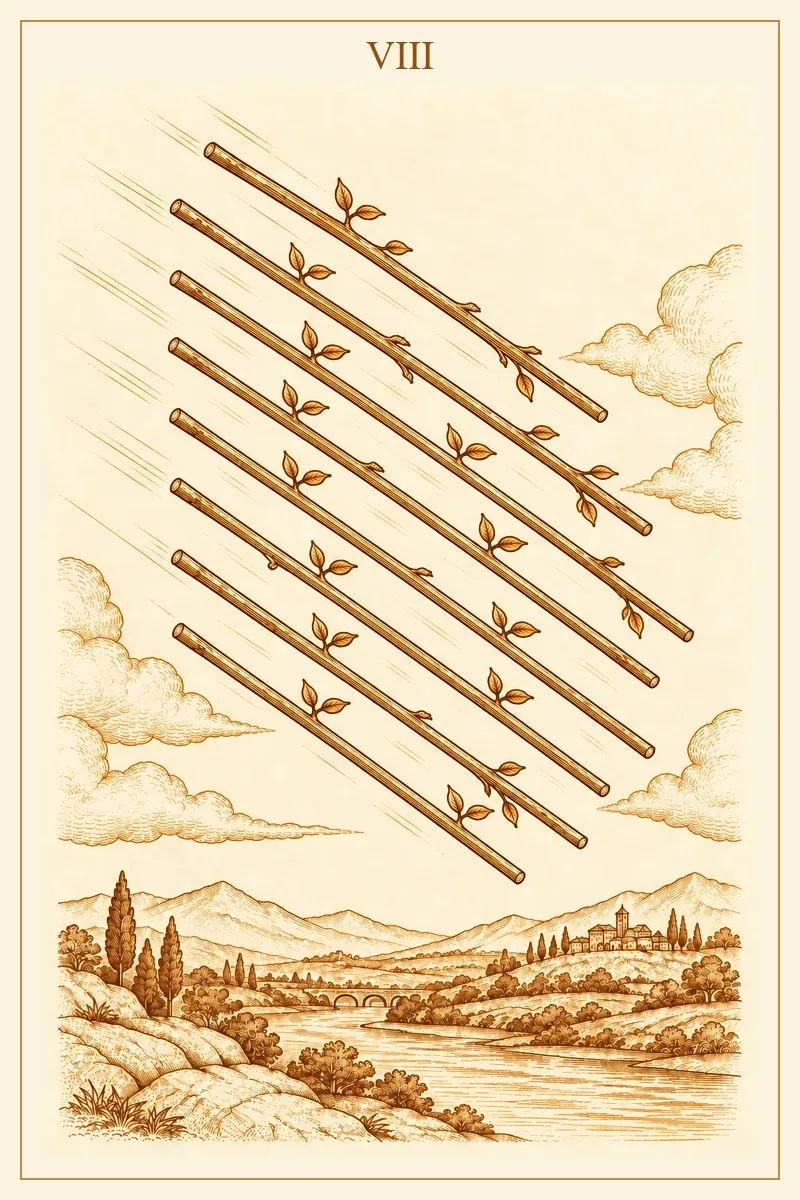
The Eight of Wands shows eight budding staffs flying in a long diagonal across an open sky, high above a river valley and a hilltop village. Upright, it describes momentum: messages arriving, plans moving fast, events stacking up in a short stretch of time. When this card appears, a slightly shorter rhythm can make sense, because the situation may genuinely change within days. The rule of waiting for a real change still applies; the change simply tends to arrive sooner.
Reversed, it can describe delays, crossed wires or energy scattered in too many directions. In love it may point to mixed signals or a pace one person finds too fast; at work, a project waiting on someone else. The Eight of Wands tarot meaning covers its other angles. A practical step: decide which event would count as the next development, and read again only after that.
Wheel of Fortune: a natural turning point

The Wheel of Fortune shows a great golden wheel among the clouds, a crowned sphinx resting on top, a snake gliding down one side and a jackal-headed figure climbing the other, with four winged creatures reading books in the corners. Upright, it speaks of cycles turning: a chapter shifting, circumstances changing in ways you did not fully choose. In terms of rhythm, it marks the kind of moment when a fresh reading earns its place, because the ground under the old one has moved.
Reversed, it can describe resisting a change already under way, or a stretch where the same pattern keeps coming around. In career questions it might mark the end of one phase at work; in love, a relationship entering a new season. The Wheel of Fortune tarot meaning explores its full range. A practical step: when the wheel turns in your actual life, not only in the cards, take that as your cue for a new reading.
A four-card spread for setting your monthly rhythm
This spread suits a fixed day each month. It looks back once, looks ahead once and, unusually, gives one position to something you will deliberately leave alone. Lay the cards in a row.
- What last month taught me: the lesson or theme to carry forward.
- What this month asks for: where to put your main effort.
- The question to park: something that can wait until next month without harm.
- The pace that suits me now: how quickly or slowly to move, and how often to check in.
The third position is the one that protects your rhythm. Whatever lands there, write the question it points to on a separate line with a re-read date. That gives the worry somewhere to go, so it does not leak into your daily cards for the next four weeks. If you are new to reading your own spreads, the step-by-step guide on how to read tarot for yourself covers framing the question and laying out the cards.
Worked example: one month, read at its own speed
Picture a reader who draws a card most weekday mornings and keeps a monthly reading on the first Sunday. Last month they sent applications for a role in a new field. This month an old friend has also been in touch, and both things pull at their attention. On the first Sunday they ask, "What does this month need from me, and what can wait?" and lay the four-card spread.
- What last month taught me: Three of Wands
- What this month asks for: Ace of Pentacles
- The question to park: Six of Cups
- The pace that suits me now: Knight of Pentacles
The Three of Wands, a cloaked figure on a cliff edge watching ships sail toward a low sun, sums up last month well: the applications are out, and waiting is part of the process, not a sign that nothing is happening. The Ace of Pentacles, a hand from a cloud offering a single gold coin above a flowering garden archway, points to one practical new start. They have been comparing evening courses for weeks; the card suggests choosing one and enrolling.
The Six of Cups, a child handing a cup of flowers to a younger one in an old courtyard, lands in the parked position. The friendship matters, but it does not need a verdict this month. They write "What do I want from this friendship now?" on its own line, with a re-read date of "after we meet for coffee." The Knight of Pentacles, an armored rider holding a coin on a dark horse that stands quite still beside plowed fields, sets the pace: slow, steady, one thing at a time. They decide the daily card will not be used to ask about the applications, and the weekly check-in stays at three cards.
Midway through the month, an interview invitation arrives. That is a real change, so they lay one short reading on how to prepare and leave it there. After the coffee two weeks later, they draw for the parked question. On the next first Sunday they review their notes and lay the spread again. Nothing in the cards decided the job or the friendship. What the rhythm did was keep each question in its own slot, so none of them took over the month.
Seasons for reading more, and seasons for less
You may benefit from reading more often when the cards only come out in a crisis, when a question has sat with you for weeks because you are nervous to look at it, when your last real reading was months ago despite big changes, or when you keep meeting the same pattern in new places, such as the same conflict at each new job. A regular monthly slot, kept even in calm weeks, often shows slow shifts before they turn into problems.
You may benefit from reading less during grief, illness or exhaustion, when even a short spread feels like one more thing to manage. In a busy season, dropping to the daily card alone, or pausing completely, is a perfectly good rhythm. The cards will be there when you have room for them. If checking them has started to feel like something you cannot stop, the over-reading guide mentioned near the top of this page is the better next read.
Building your own rhythm in four steps
- Choose your layers. Daily, weekly, monthly, seasonal: start with one or two. A monthly reading plus an occasional daily card is a sound beginning.
- Anchor them to your calendar. Tie each layer to something you already do, such as your morning coffee, Sunday evening, the first day of the month or the new moon, so the rhythm does not depend on mood.
- Record every reading with a re-read date. Date, question, cards and the point at which you will look again. This is what turns separate readings into a practice.
- Review after three months. Did the rhythm help or crowd you? Adjust it. Often the monthly reading stays and the weekly one comes and goes with busy periods.
Frequently asked questions
Is it okay to do a tarot reading every day?
A single daily card used for reflection is fine and builds familiarity with the deck. A full spread every day on the same issue is a different matter: the situation rarely changes that fast, so the readings blur into each other. If you want daily contact with the cards, keep it to one card and save real questions for your weekly or monthly slot.
Does reading more often make tarot more accurate?
No. Tarot is a tool for reflection; it cannot confirm another person's thoughts, a date or how something will turn out, and a higher count does not change that. Spacing readings out actually helps you judge them, because you can see what happened in between.
How often should a beginner read?
As often as you like for practice, and with more care for real questions. Daily cards and practice spreads on sample questions teach the deck quickly. For questions that carry emotional weight, the same monthly and per-question rhythm applies to beginners as to anyone else.
Can I read about different topics on the same day?
Yes. A career reading and a separate reading about a friendship do not interfere with each other. What muddies things is reading the same topic several times, or crowding so many questions into one evening that none of them gets real attention. Two or three distinct questions in a sitting is usually plenty.
What if I have not read in months?
Nothing is lost, and there is no need to start over. Begin with a gentle look back: what has changed since your last reading? Then pick one layer, such as a monthly slot, and see whether it fits your life now. A long gap often just means you were busy living, which is what the readings are meant to serve.
Leaving room between readings
The healthiest rhythm leaves space between readings for life to happen, then brings you back with a clearer question. When your next one is ready, you can begin a reading on Veil Soul at your own pace.