It is possible to do too many tarot readings. The clearest sign is asking the same question again because you want a different answer, not because anything in your situation has changed. A simple rule of thumb: one reading per question, then wait until something real changes, such as new information, a decision you have made or a date you set in advance, before you ask again. A short daily one-card pull is a separate habit and is usually fine.
Over-reading rarely starts from carelessness. It usually starts from caring a lot about an outcome and wanting a certainty that no deck can give. Tarot can help you reflect on a situation, notice what you feel and choose a next step. It cannot confirm what another person thinks, give you a date or guarantee how something will turn out, and reading more often does not change that.
If your question is mainly about rhythm, our guide on how often to get a tarot reading covers frequency in depth, from daily pulls to sessions with a professional reader. This post stays with the other side of the question: why over-reading happens, the signs that you have slipped into it, the cards that tend to stand out when you do, and a calm way to reset.
At a glance:
- The main sign: reshuffling the same question to change the answer.
- The rule of thumb: one reading per question, then live with it until something changes.
- Usually fine: a one-card daily pull for reflection, and practice readings while you learn.
- A warning sign: readings leave you more anxious, not clearer.
- The reset: a short pause, one journal prompt a day, then a simple reading rhythm.
Why over-reading happens
Most over-reading follows a loop. Something uncertain matters to you: a reply that has not come, a job decision, a relationship that feels unsettled. Uncertainty is uncomfortable, so you look for relief. Drawing cards gives a moment of relief because it feels like doing something. But nothing outside has changed, so the relief fades, the worry returns and the deck looks like the fastest way to feel better again.
Each new reading also hands your mind new material. A card you did not expect raises another question, which seems to need another spread. Instead of settling the first worry, the readings multiply it. The same loop shows up in other habits, such as refreshing a message thread or rereading an old conversation for clues. The tool changes; the pattern stays.
Tarot is especially easy to overuse because it answers every time. A friend would eventually say, "We talked about this yesterday." A deck never does. It produces a new arrangement every time you shuffle, and if you are looking for permission or reassurance, there will always seem to be one more card that might give it.
There is also a quieter reason: reading can feel safer than acting. As long as you are still checking, you have not yet sent the message, made the call or accepted the risk of being wrong. Seen this way, over-reading is less about tarot and more about how hard it is to sit with not knowing. That is a very human difficulty, and it is one you can work with.
Seven signs you're over-reading
No single sign proves anything, and everyone slips into a few of these now and then. Look for a pattern that repeats over weeks rather than one restless evening.
1. You reshuffle the same question. The first reading unsettled you, so you drew again, and then again, hoping for a softer card. This is the clearest sign. At that point the extra draws are no longer asking for perspective; they are asking for agreement.
2. Small decisions wait for the cards. What to eat, whether to reply now or later, whether to go out tonight. When ordinary choices start to need a draw, your own judgment gets less practice, and it begins to feel weaker than it really is.
3. Readings leave you more anxious. A helpful reading usually leaves you calmer, or at least clearer about what to do next. If most sessions end with your heart racing, especially when a card like The Tower appears and you spend the evening imagining disasters, the practice is feeding the worry instead of easing it.
4. The answers contradict each other. Ask the same question five times in an hour and you will get five different pictures. That is not the deck failing; it is what happens when you ask before anything has changed. The contradiction is a sign to stop, not a puzzle to solve with a sixth reading.
5. You keep the frequency to yourself. Plenty of people read privately, and privacy is not a problem. The sign is different: feeling embarrassed about how often you read, hiding it from people close to you, or laying out spreads at 3 a.m. when you would rather be asleep.
6. There is no gap between readings. A reading needs time to be lived: you try something, notice what happens and learn from it. If you read again before any of that can happen, you are reading faster than your life is moving.
7. Tarot makes life feel heavier, not lighter. This is the broadest sign. If your days have felt more confusing or more fearful since you started reading this way, the practice needs a pause and a new shape. It does not mean tarot is wrong for you; it means this way of using it is not helping.
Cards that often stand out when you over-read
When people read in a loop, a few cards tend to catch their attention and feel loaded with meaning. These cards do not appear because you read too much; the deck is not keeping score. Their images simply mirror the state of mind that over-reading creates, so they are worth knowing. If one of them keeps catching your eye, treat it as an invitation to look at the habit, not as a verdict.
Nine of Swords: worry that grows at night
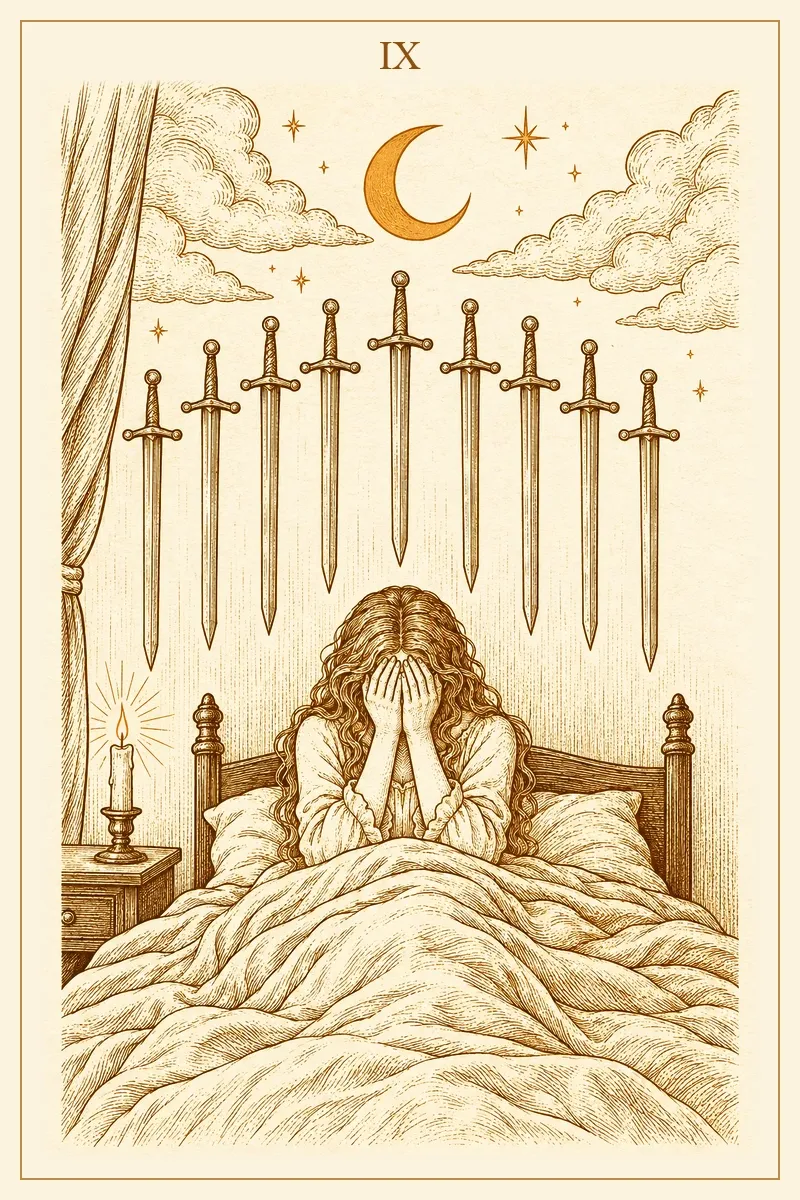
The Nine of Swords is traditionally drawn as someone sitting up in bed with their face in their hands. Upright, it speaks of anxiety, rumination and the fears that feel largest in the dark. In an over-reading pattern it can describe the experience itself: drawing card after card late at night, with each answer giving the mind something new to turn over.
Reversed, it often points to worry beginning to ease, or to a fear that has been kept private and is ready to be spoken. Either way, the useful response is rarely another spread. Write the worry down in one sentence, close the deck and come back to it in daylight. The full Nine of Swords tarot meaning covers its love and career readings as well.
Two of Swords: the decision you are avoiding
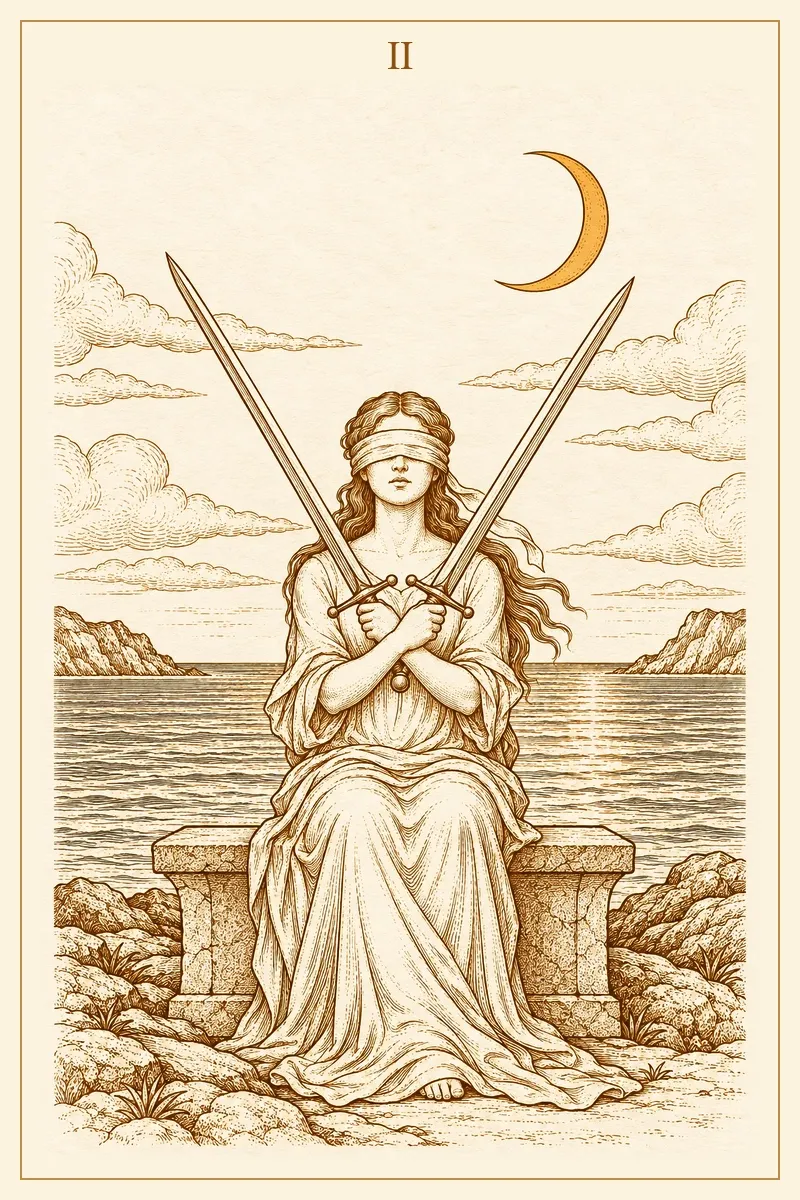
The Two of Swords traditionally shows a blindfolded figure holding two crossed swords, balanced and still. Upright, it describes a stalemate: a choice you are holding at arm's length because both options carry a cost. When you are over-reading, this card can mirror the way the readings themselves have become the blindfold, keeping the decision suspended.
Reversed, it can mean the stalemate is breaking, sometimes through information overload, sometimes because waiting has become harder than choosing. Ask yourself which two options you are really weighing, and what you would choose if you could not consult the cards for a week. The Two of Swords tarot meaning explores the card in other contexts.
Ten of Swords: the worst-case story
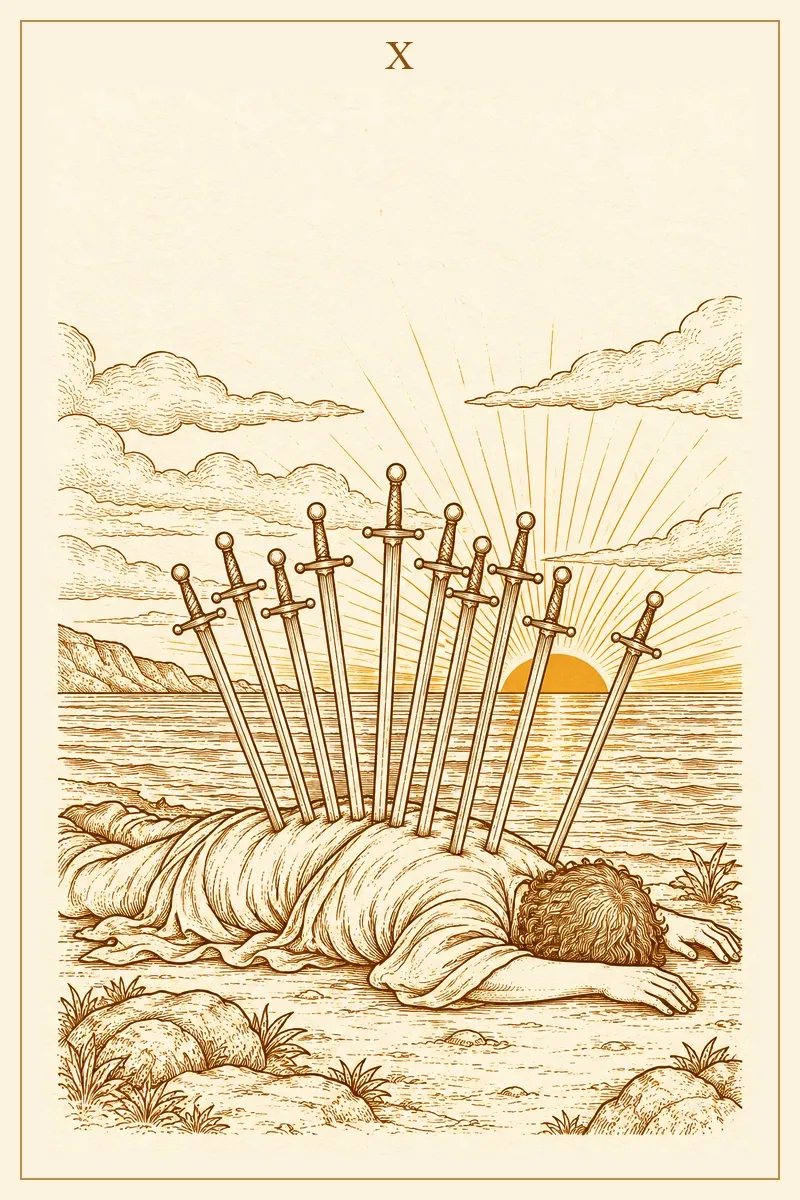
The Ten of Swords is one of the most dramatic images in the deck. It is traditionally drawn as a figure lying face down with ten swords in their back, under a dark sky that is starting to lighten at the horizon. Upright, it speaks of a painful ending, exhaustion or reaching the bottom of something. For an anxious reader it can easily look like proof that everything will go wrong.
That reading misses the dawn in the picture. The card also says that the worst point is passing and that a chapter can close. Reversed, it often describes recovery, or a reluctance to let something end. If this card sends you reaching for the deck again, pause and ask: what am I treating as already lost, and what is still in my hands? You can read more in the Ten of Swords tarot meaning.
The Devil: a habit that feels like a chain
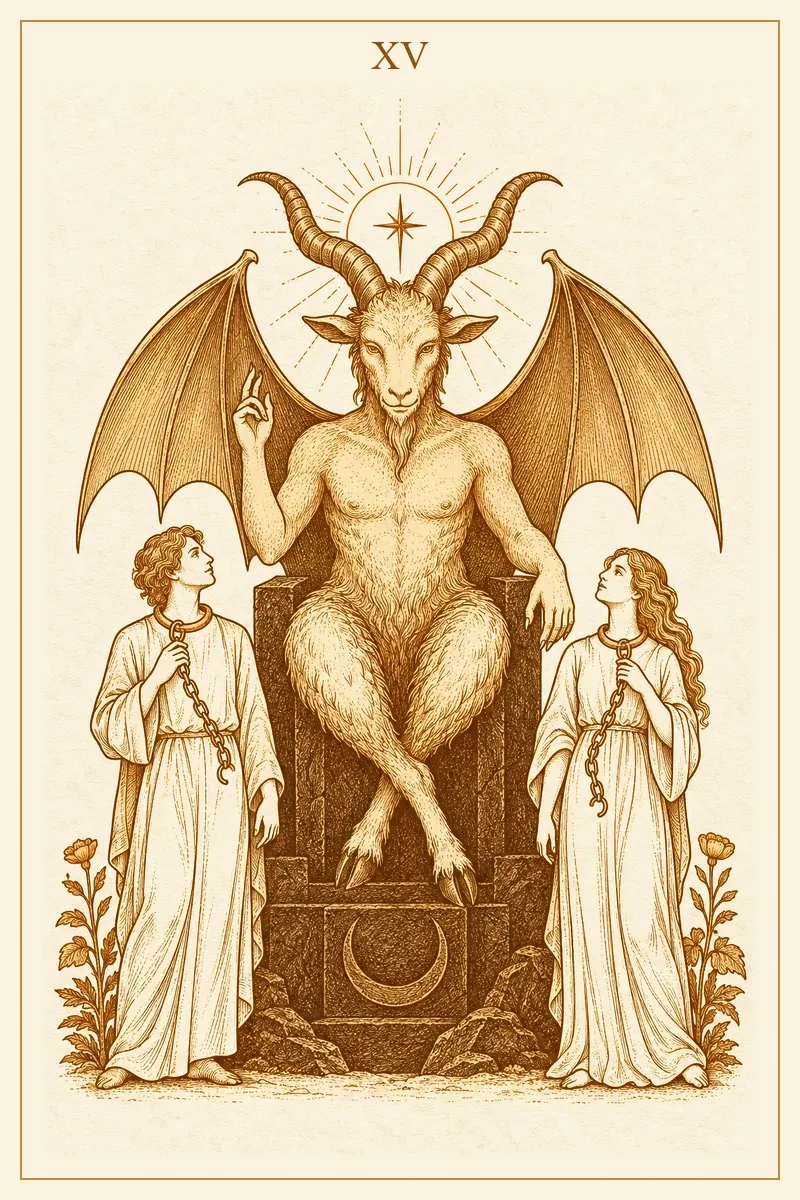
The Devil is traditionally drawn as two figures chained to a pedestal, yet the chains around their necks are loose enough to lift off. Upright, it speaks of attachment, compulsion and patterns that feel impossible to leave even when part of you wants to. In a reading about your tarot habit, it can name the checking itself: the sense that you cannot make a move without one more draw.
Reversed, The Devil often describes loosening a grip, seeing a pattern clearly or taking the first step away from it. The point of this card is not shame. It reminds you that the loop has an exit, and that you are the one who can take it. The Devil tarot meaning covers its relationship and money angles in more depth.
What over-reading does to your practice
Beyond how it feels, over-reading also changes how well tarot works for you as a tool for reflection.
Your reading skill stops growing. You learn tarot through a simple cycle: read, act, notice what happened and compare. When you read again before you act, you never get the feedback that shows which interpretations were helpful, so your skill stays where it is.
The cards start to feel flat. Over-readers often say the images stop speaking to them and every card seems generic. The deck has not lost anything; your attention is simply tired from too much input. A pause usually brings the images back to life.
Trust drains away. After a run of contradictory readings, it is natural to conclude that tarot is random or that you cannot read. Neither is the real lesson. The contradictions came from asking before anything had changed, not from a lack of ability.
Decisions get postponed. Each extra reading delays the moment of choosing. Over time, that delay can cost more than the decision you were afraid of making.
Other people become the question. Many loops are about someone else: whether they still care, whether they will reply, what they are thinking right now. Reading on another person's mind again and again keeps you focused on what you cannot know and away from what you could say or do yourself.
How to reset with healthy reading boundaries
Resetting is simple, though not always easy, because it asks you to stay with uncertainty for a while without reaching for the deck. These boundaries help.
- Pause for a set time. One week is a good start. Wrap the deck in a cloth and put it somewhere out of sight. The urge to read is usually strongest in the first days and softens after that.
- One reading per question. When you return, ask once, write the cards down and let the answer stand. If you dislike it, that discomfort is part of the reflection, not a reason to shuffle again.
- Ask again only when something changes. New information, an action you have taken or a date you set in advance are good reasons to read on the same topic again. Feeling restless is not.
- Keep learning and consulting separate. Practice readings on sample questions help you learn and can be as frequent as you like. Readings on real, emotionally charged questions are the ones to limit. If you often read for yourself, the step-by-step guide on how to read tarot for yourself shows how to frame a single, clear question.
- Write before you draw. When the urge comes, write for five minutes first. Often what you hoped the cards would say is already on the page.
- Name the feeling under the urge. "I want to pull cards right now" is useful information. Is it fear, loneliness, boredom or a need for control? Naming it often takes away some of its pull.
A gentle note: if checking the cards has started to feel compulsive, if you cannot stop even when you want to, or if it is tied to anxiety that is affecting your sleep, work or relationships, you do not have to sort it out alone. Talking to someone you trust, or to a professional such as a counselor, can help. That is not a failure of your practice; it is care for the person doing the practice.
A 7-day reset plan
If you like structure, use one week as a gentle reset. Keep the deck wrapped, take about ten minutes a day with a notebook and answer one prompt. There is no right answer, and missing a day is fine.
- Day 1, set it aside: wrap the deck and put it away. Prompt: "What was I hoping the cards would tell me this week?"
- Day 2, name the feeling: "When I want to draw a card, what am I feeling, and where do I notice it in my body?"
- Day 3, what you already know: "Without any cards, what do I already know about this situation?"
- Day 4, the postponed decision: "What decision have I been waiting on, and what is the smallest version of it I could make?"
- Day 5, one real step: take that small step, then write: "What happened when I acted without checking first?"
- Day 6, someone to talk to: "Who could I talk to about this, and what would I want to say?"
- Day 7, your new rules: write your own reading rhythm in two or three lines, then answer: "What kind of reading would actually help me now?"
On day eight you can return to the cards with one question and one reading. Many people notice that the question has changed during the week, and often it has become smaller and more honest.
A worked example: one question, asked once
Here is how a single, well-framed reading can end a loop. Imagine someone who has drawn cards a dozen times in a week on "Does he still like me?" after a person they have been dating went quiet. Each reading said something different, and each one made the waiting feel worse.
After a short pause, they rewrite the question as something they can act on: "What do I need to see about how I'm handling this wait?" Then they draw three cards, once, into named positions.
- What I already know: Seven of Cups
- What the repeated readings protect me from: Eight of Swords
- One step for this week: Four of Swords
The Seven of Cups, a row of cups filled with imagined possibilities, describes what they already know: they have been living inside scenarios, picturing every version of what the silence might mean. The Eight of Swords, a bound figure surrounded by swords with an open path behind, shows what the readings have been protecting them from: the discomfort of asking directly and hearing an answer they cannot control. The restriction feels real, but much of it is made of thoughts. The Four of Swords, a figure resting in stillness, offers the step: rest from checking, step back and stop looking for more information for a few days.
The reading does not reveal what the other person feels, and it does not need to. It shows a choice: send one honest, simple message and then put the phone down, or decide to wait until the weekend without checking anything. They choose the message, note the three cards and their decision in a journal, and wrap the deck until Sunday. Whatever the reply turns out to be, the loop has ended, because the next move is back in their hands rather than in the deck.
A rhythm you can keep after the reset
Once the pause has done its work, choose a rhythm you can keep. A common, steady shape is a one-card pull in the morning as a short reflection, one fuller spread a week for whatever matters most, and a deeper reading at a natural turning point such as a new month or a big decision. Write it down so that it is a choice rather than a mood.
Two small habits keep it steady. First, record every reading with the date and the question, so you can see later how the cards related to what actually happened. Second, before any unplanned reading, ask yourself whether something has changed since you last asked. If the honest answer is no, write instead.
When the cards start to feel inviting again, notice that too. Many readers are glad to see The Star after a break: a figure calmly pouring water under an open sky, an image of renewal and quiet hope. It reflects the kind of practice people often find after a reset, one that refreshes them instead of draining them. The Star tarot meaning explores that hope in more depth.
Frequently asked questions
Is a daily one-card pull too many readings?
Usually not. A single card drawn in the morning and used as a reflection point for the day is a different habit from a spread on an emotional question, and it builds familiarity with the cards. It becomes a problem only when the one card turns into five because the first one felt wrong.
Is it bad to ask tarot the same question twice?
It is not harmful, but it rarely helps unless something has changed. If you have new information, have taken an action or a set amount of time has passed, asking again can show you how things have moved. Asking again within minutes simply produces a different arrangement and more confusion.
I'm learning tarot. Isn't more reading better?
For learning, yes. Practice readings on sample questions, card studies and trying new spreads all build skill, and you can do them as often as you like. Keep them separate from readings on real questions that carry emotional weight, which are the ones worth limiting.
Can over-reading bring bad luck or negative energy?
No. The effects of over-reading are human ones: more worry, delayed decisions and less trust in yourself. Tarot is a tool for reflection; it cannot confirm another person's thoughts, a date or an outcome, and reading more often does not make it more certain. If you are curious about safety in general, the article are tarot cards dangerous looks at the common worries calmly.
My reader suggests weekly sessions. Is that too often?
Weekly sessions on the same situation are usually more frequent than circumstances change. Sessions on different areas of life during a period of active change can make sense. A good reader helps you rely more on your own judgment over time, so it is reasonable to ask why a particular frequency is being suggested.
How do I know I'm ready to read again after a break?
A good sign is that you can hold a question without urgency. If drawing today or next week would feel equally fine, you are probably ready. If you feel you must know right now, write first and give it another day or two.
Tarot works best with space around it: time to read, time to live and time to notice what happened. When you are ready for one clear question, asked once, you can try a calm reading with Veil Soul.