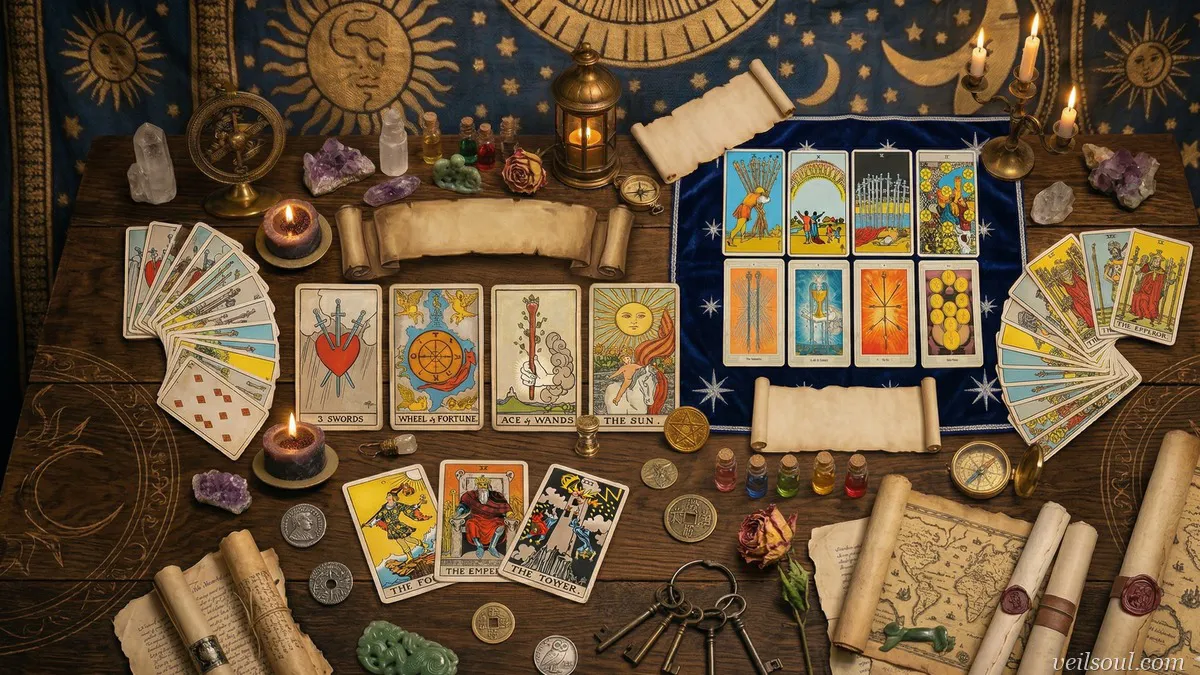
All four Tens in tarot sit at the end of their suit's story, and each one ends it differently. The Ten of Wands is a load carried to the last stretch of the road, the Ten of Cups is belonging that has settled into ordinary life, the Ten of Swords is a defeat that has already landed, and the Ten of Pentacles is security with roots deep enough to outlast the person who built it. A Ten says that a cycle has reached its full size; it does not say what you will build next.
Because the situation a Ten describes is finished rather than pending, these are working cards rather than dramatic ones. They point at what you are still carrying out of habit, what you have already achieved and barely noticed, and what is genuinely over. What tarot cannot do is name a date, report another person's private intentions, or guarantee how an ending resolves; those stay with the people involved and with the choices still in front of you.
Below, each Ten gets its upright and reversed meanings with love, work and money angles, followed by what two Tens together suggest, how the Tens mirror the Aces, a four-card spread for a closing cycle, a worked example and the questions readers ask most.
At a glance, here is what each Ten brings to a reading:
- Ten of Wands: too much carried for too long; the finish line is close, and only you can set the load down.
- Ten of Cups: emotional fulfillment, family and friendship that have become a life rather than a hope.
- Ten of Swords: the worst of it has happened; the ending is behind you, not ahead of you.
- Ten of Pentacles: legacy, deep roots and the kind of security that can be handed on.
What the number ten carries in every suit
Each minor suit runs a small story from Ace to Ten. The Ace is the first spark, the middle numbers test and shape it, the Nine shows the nearly complete version along with its private cost, and the Ten shows the whole thing built, for better and for worse. If you want the pattern behind every rank, our guide to number symbolism in the minor arcana walks through what each number does across all four suits.
Four themes repeat across the Tens, whichever suit you are reading:
- Culmination: the suit's energy has reached its fullest expression, and there is no further step available in this direction.
- Excess: a Ten shows what too much of something looks like — too much duty, too much comfort, too much pain, too much structure.
- Threshold: the card sits on the border between this cycle and the next, which is why Tens so often arrive around a move, a resignation, a wedding or a funeral.
- Earned experience: a Ten carries everything its suit learned on the way. It describes something lived, not something theorized.
Position matters as much as the card itself. In a "what is happening now" position, a Ten usually describes a situation that already exists. In an advice position it reads more like an instruction: finish it, accept it, protect it. In an outcome position, treat it as the full-size version of the path you are currently on, and ask whether that size is what you actually want.
The four Tens, card by card
Read each Ten through the suit it belongs to. Wands are effort and drive, Cups are feeling and attachment, Swords are thought and speech, Pentacles are body, work and money. The same word — completion — produces a very different picture in each one.
Ten of Wands: the last stretch of a load you chose
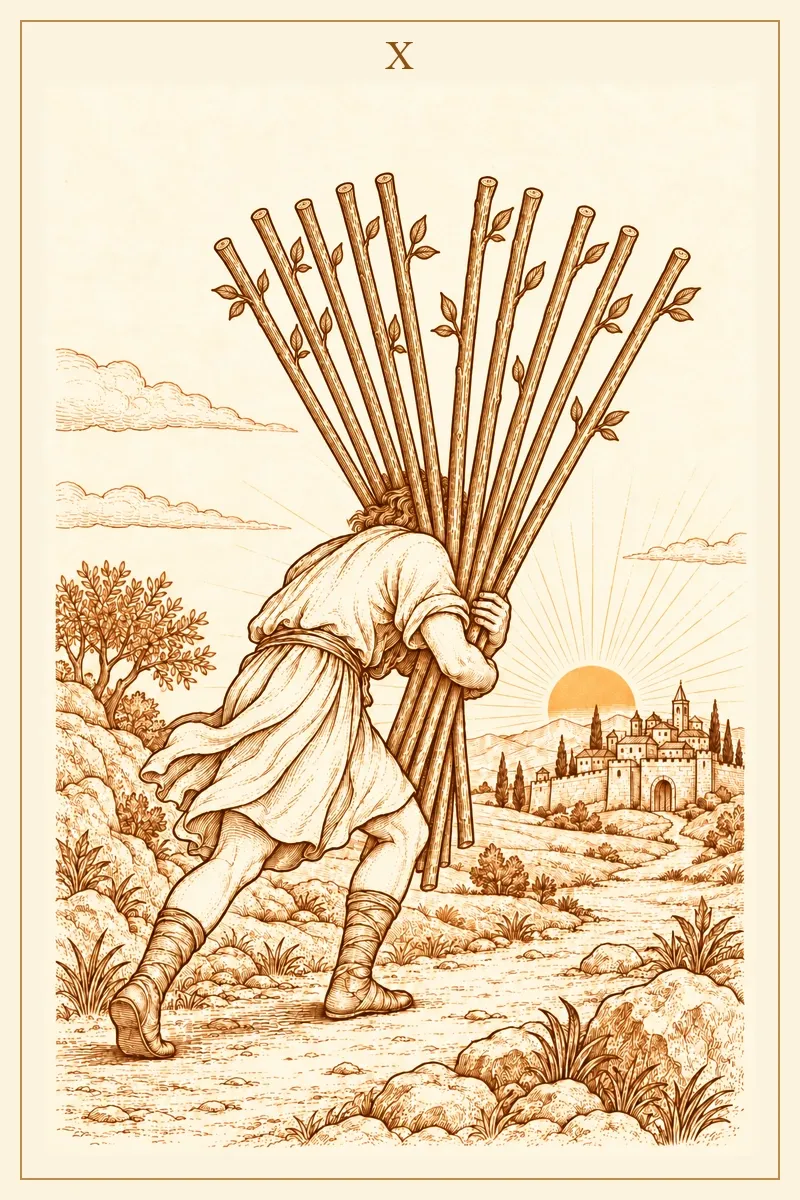
Upright, the Ten of Wands shows someone close to the end of a job and bent under more than they can comfortably hold. What makes the card uncomfortable is that almost every one of those commitments was agreed to: the weight is real and it is also self-assembled. It points to overcommitment, responsibility that has quietly multiplied, the stage of a project where only grinding is left, and the unglamorous side of achievement. The question it asks is not whether you can finish, but how much of this is yours to carry at all. The full Ten of Wands tarot meaning goes further into its imagery and its behavior in different positions.
Reversed, the card usually moves in one of two directions. The healthier one is release: delegating, stepping down from a role, finishing a long commitment, feeling your shoulders drop after a hard season. The harder one is a refusal to put anything down, where someone keeps collecting duties so they never have to ask whether the work still matters, until exhaustion makes the decision for them. The surrounding cards usually tell you which version you are in — a supportive card beside it tends to describe the unloading, a pressured one the stubbornness.
In love, this card often describes one partner doing most of the invisible work — the scheduling, the worrying, the emotional repair — and a relationship that has quietly become another item on a list. At work it is overtime near a deadline, a promotion whose real cost is only visible from the inside, or a small business owner who has never hired help. With money it reads as obligation rather than poverty: debts, dependents, subscriptions and promises that each made sense alone and became heavy together.
The useful next step is specific. List everything you are currently carrying, mark the items someone else could hold, and set one of them down this week. A Ten of Wands rarely asks for a dramatic exit. It asks for one fewer wand.
Ten of Cups: belonging that became ordinary life
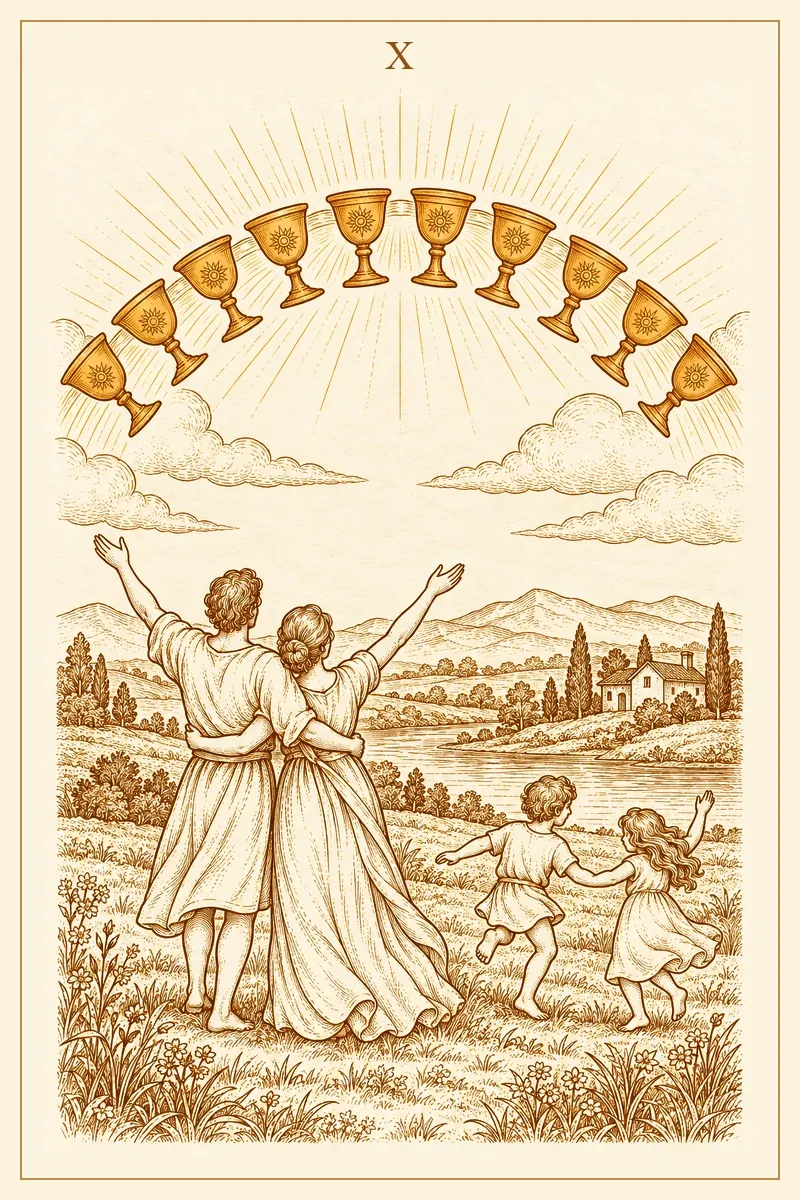
Upright, the Ten of Cups is the suit of feeling at its fullest: people who are glad to be in the same room, a home that feels safe, affection that no longer has to be proven. It describes a settled state more than a peak moment — the contentment of being known and still welcome. In a reading it can confirm that a relationship, a family or a chosen circle has become genuinely sustaining, or it can suggest that what you want is not another milestone but a quieter version of what you already have. Its own page, the Ten of Cups tarot meaning, covers how it shifts across love, family and friendship questions.
Reversed, the card points at the gap between the picture and the daily reality. That might be a household where everyone is performing happiness, a family you love and cannot relax in, an ideal of home borrowed from someone else's life, or simply a good relationship under strain. It is not a verdict that the warmth is fake. It is an invitation to say out loud which part of the picture is yours and which part you inherited without ever examining it.
In love it is commitment that has stopped being a question; reversed, a quiet drift both people have noticed and neither has named. At work it shows a team or a vocation you belong to, where colleagues and values matter more than the title, while reversed it can show a cheerful surface over something unresolved. With money it rarely means wealth. It means enough, shared well, with the question of who pays for what already settled and calm.
If this card arrives while you are hoping for something, be concrete about what happiness would look like on an ordinary Tuesday evening rather than in a photograph. Then check whether the people in your picture have agreed to be in it.
Ten of Swords: the ending has already happened
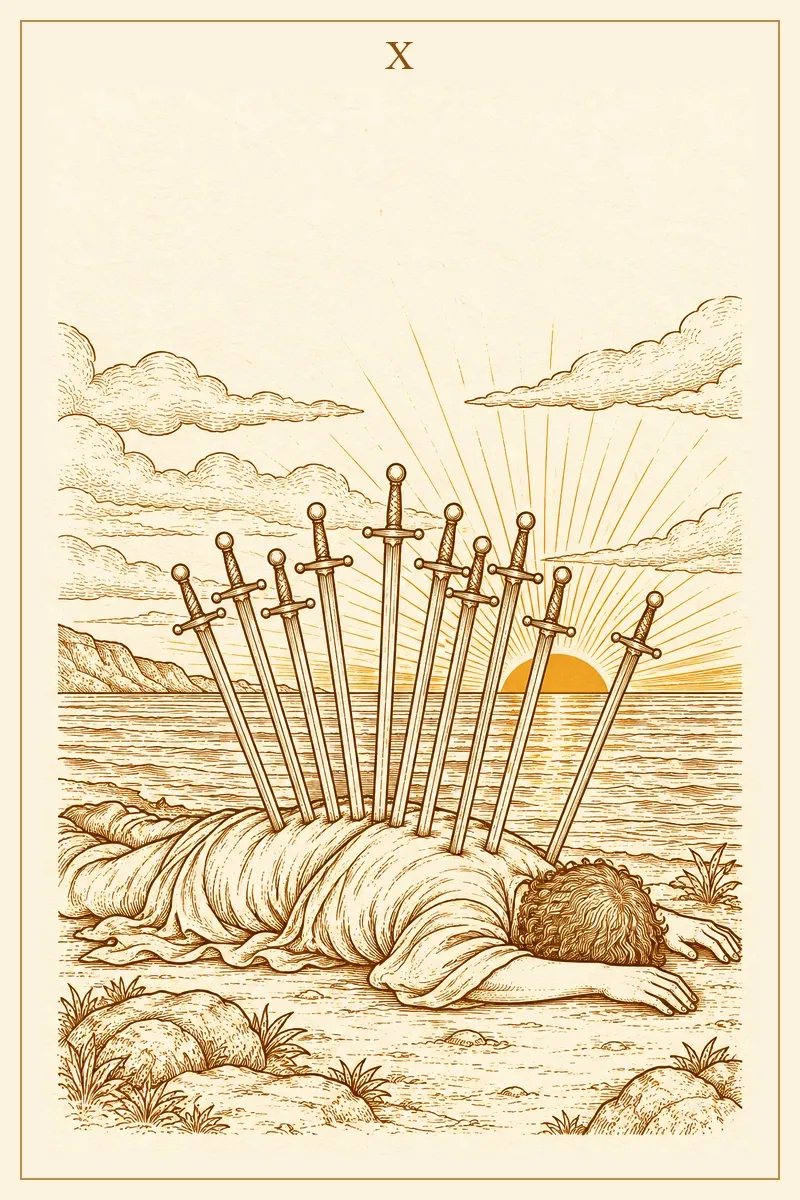
Upright, the Ten of Swords carries the most theatrical image in the deck and is the most frequently misread card of the four. In most decks the picture is ten blades, a figure face down, a black sky — and along the horizon, daylight. It describes a conclusion that has already taken place: the betrayal happened, the message was sent, the position was cut, the story you were telling yourself collapsed. Its strange comfort is finality. Nothing more can be added to this particular injury, which means the next move is recovery rather than defense. The Ten of Swords tarot meaning looks at the card and its reversals in more detail.
Reversed, it usually marks one of two stages of the same process. Often it is the aftermath: swords drawn out one at a time, strength returning slowly, someone getting up. Sometimes it is resistance — replaying the ending, rehearsing the argument, keeping the wound open because closing it would make the loss real. Ask whether you are healing slowly or holding the scene in place. The two feel similar from inside and look very different from a week's distance.
In love it is the end both people can finally name, or the exhausted last round of a conflict that has run out of material. At work it covers redundancy, a project canceled late, or the day a workplace problem becomes undeniable. With money it describes a loss already taken rather than one approaching, and the practical work of repayment or restructuring belongs with a qualified adviser rather than with a card.
Give the ending its weight before you go looking for a lesson in it. Sleep, eat, tell one person. If a reading leaves you frightened or unable to function, a counselor or a trusted human being is a better next step than another spread.
Ten of Pentacles: what lasts longer than you do
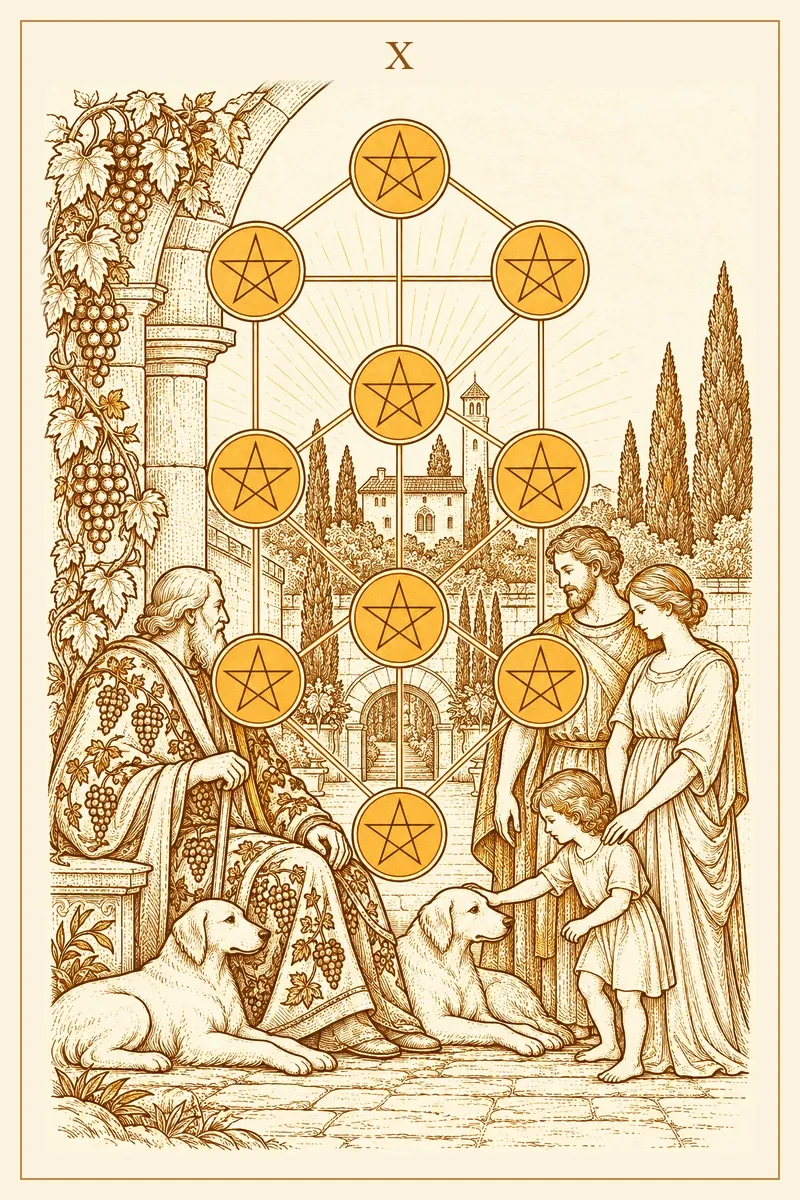
Upright, the Ten of Pentacles is wealth with a long time horizon: a house with family in it, a business in its second generation, savings that cover more than one person, traditions that still do their job. The emphasis falls less on accumulation than on continuity — something built well enough to be handed on. It often appears around property, inheritance, joining a family, or a decision whose consequences run for decades. For a fuller treatment, read the Ten of Pentacles tarot meaning.
Reversed, the structure itself is in question. That might be an argument over an estate, money that arrives with conditions attached, a legacy that costs more freedom than it is worth, or foundations that look solid and are not. It can also mark a healthy refusal: deciding that the family business, the hometown or the expected path is not where your life goes. Stability that nobody is allowed to question is not quite the same thing as security.
In love it is the long view — shared property, children, in-laws, a relationship measured in decades; reversed, a disagreement about family expectations that predates the relationship itself. At work it is the established institution, the pension, the firm with a name on the door, while reversed it can show the cost of staying somewhere safe. With money it favors slow, dull, compounding decisions over a clever one.
Ask what you are building that would still stand if you stopped tending it, and who else depends on that thing. Then ask whether anyone has actually told you they want to inherit it.
Two Tens, or a Ten beside an Ace
Tens combine unusually clearly with one another, because they are all reporting the same news from different parts of a life.
- Two Tens: two cycles closing at once. This is common around a move, a job change alongside a relationship change, or a graduation. It is rarely doubled trouble; more often it is one large transition touching two areas.
- Three or four Tens: a rare spread, and worth slowing down for. Read it as a chapter rather than an event, and expect the practical consequences to arrive over months instead of days.
- A Ten with an Ace: the clearest cycle signal in a reading, with something finished and something starting, often in the same few weeks. Check the suits: a Ten of Swords beside the Ace of Cups tells a very different story from a Ten of Cups beside the Ace of Swords.
- Ten of Wands with Ten of Pentacles: the load you carry is holding up something other people rely on. That is worth choosing deliberately rather than resenting quietly.
- Ten of Swords with Ten of Cups: one area ends while another holds. Readers often treat this as a contradiction, but the second card is usually the reason the first one is survivable.
A Ten beside the Nine of the same suit deserves a second look too. The Nine is the nearly complete stage with its private cost and the Ten is the finished one, so together they can show you how long a situation has been ending.
How the Tens mirror the Aces
Every Ten has a matching Ace, and the pair makes more sense together than either does alone. Our guide to the Aces in tarot covers the other end of the same cycle: pure potential, nothing built yet, everything still possible.
- Energy: an Ace is potential with no history behind it; a Ten is all history, with little potential left in this particular direction.
- Feeling: an Ace brings excitement and a touch of vertigo; a Ten brings fullness, and frequently tiredness.
- Risk: an Ace can fail to begin. A Ten can refuse to end.
- Question: an Ace asks what this could become. A Ten asks whether what it became is what you wanted.
The numbered cards describe the stages of a situation, while the court cards describe people and the way they handle one. When a Ten and a court card turn up together, the Ten is usually the situation and the court card the attitude you are bringing to it.
A four-card spread for a cycle that is ending
Use this when something feels finished and you cannot tell whether it truly is. Write the question down before you shuffle — "what has run its course here, and what is mine to carry forward?" — and keep the positions fixed even if the cards unsettle you.
- What has reached its full size. The situation as it stands now, not as it was when it started.
- What I am still carrying. Duties, stories or habits from this cycle that may not belong in the next one.
- What is genuinely finished. The part that no amount of further effort will change.
- The first honest step. One action inside your own control, small enough to take this month.
Read the second and third positions against each other, because the mismatch between them is usually where the insight lives. If the fourth card frightens you, make the step smaller until it does not: a conversation, an email, a single free afternoon.
Worked example: six years in the same job
A reader asks, "I have been in this role for six years and something feels over — what am I not seeing?" Four cards come out: Ten of Wands, Ten of Pentacles reversed, Ten of Swords reversed, and the Ace of Wands.
In the first position, the Ten of Wands says the role has grown into a load. Not a crisis and not an injustice — accumulation. Six years of "could you also handle this" have produced a job that nobody ever designed.
In the second, the Ten of Pentacles reversed shows that what is still being carried is a story about security. Staying has been justified by stability, and the reversal asks whether that stability is real or simply familiar. It is a prompt to look at actual numbers rather than at a feeling.
In the third, the Ten of Swords reversed suggests the ending is already underway and largely survived. This reader has probably been quietly leaving for about a year. Nothing dramatic is required of them now; the collapse people dread has mostly happened in private.
In the fourth, the Ace of Wands makes the first honest step small and energetic rather than final. Not a resignation letter, but a conversation about scope, one application sent, or a side project given one real evening a week.
Taken together, the spread does not predict a resignation. It says the job is complete in its current shape, the security argument needs checking, and there is still appetite for something new. What the reader does with that remains entirely theirs.
What to do when a Ten lands in your reading
- Name the cycle. Write one sentence covering what began, roughly when, and what it turned into. Tens get much easier to read once the story has edges.
- Separate what is over from what you are still doing. These two lists are rarely identical, and the difference is the work.
- Pick the smallest true action. Hand back one responsibility, send one message, book one appointment.
- Leave the next Ace alone for a while. A beginning does not have to be designed on the day an ending is acknowledged; a gap between them is normal and often necessary.
If you would rather sharpen the question than enlarge the spread, the question library is a good place to find wording that keeps a reading usable.
Frequently asked questions
What do the Tens mean in tarot?
They mark completion. Each Ten shows its suit at full size and at the end of its arc: Wands completes as burden, Cups as belonging, Swords as an ending already suffered, and Pentacles as security that can be passed on. Read a Ten as a report on something that has finished growing, and as a question about what you keep from it.
Are the Tens good cards or bad cards?
Neither, although two of them feel pleasant and two of them do not. All four describe something at its limit, which is uncomfortable even when the content is happy — the Ten of Cups can show up exactly when a family becomes something you are afraid to disturb. Comfort and usefulness are separate measures in a reading.
Is the Ten of Swords the worst card in the deck?
It is the most alarming image and rarely the worst news. Because it describes an ending that has already happened, it often arrives once the hardest part is behind the reader. A card describing a slow, unresolved difficulty can be far harder to live with than one clean conclusion.
What does it mean if several Tens show up in one reading?
Usually one large transition touching several areas rather than several separate endings. Look at which suits appear: Wands and Pentacles together point at work and resources, Cups and Swords at relationships and the thinking around them. Treat it as a chapter closing and give yourself a longer horizon than usual.
Can a Ten tell me when something will end?
No. Tarot does not supply dates, cannot confirm another person's decision, and cannot guarantee an outcome; the cards describe the shape of a situation rather than its calendar. If timing matters, set your own check-in point — after a conversation, in a month, before a specific deadline — and decide now what you will look at then.
How are the Tens different from the Nines?
A Nine is the nearly complete stage, usually experienced alone and still in motion: nearly satisfied, nearly defended, nearly sleepless. A Ten is the finished state, with other people in the frame. If you are still inside the effort you are in Nine territory; once the effort has produced its result, you have reached the Ten.
After the Ten
The Tens are generous cards once you stop reading them as verdicts. They tell you that something has finished growing and hand the next decision straight back to you: what to set down, what to protect, what to grieve, and what to pass on. There is no rule saying the next beginning has to follow immediately.
If you want a quiet space to sit with an ending, draw a reading and give the result a few days before you act on it. The card describes the cycle; the choices afterward are yours.