A yes or no tarot reading answers one clearly worded question with one to three cards. Shuffle while you hold the question, turn the cards and read their lean: open, encouraging pictures point toward yes, heavy or blocked ones point toward no, and a few cards say "not yet." You can do it free in a few minutes with your own deck or an online draw, and the whole skill lies in how you word the question and how honestly you read what comes up.
The cards cannot confirm what another person thinks, fix a date or promise an outcome. What a short draw does well is show how a situation leans right now and what a yes or a no would ask of you, so treat the answer as a reflection to think with, not a verdict to obey.
Here is the whole process at a glance:
- The question: one decision, about your own action, inside a time frame you can name.
- One-card pull: the quickest lean, for small and reversible choices.
- Three-card pull: two of three cards decide, and the odd one names the condition.
- Upright or reversed: a starter rule for your first week with a deck, no card knowledge needed.
- Three possible answers: yes, no and not yet, each one worth acting on.
- One draw per question: ask again only when the facts change, not when the answer disappoints.
Wording a question the cards can answer
A short draw is only as clear as the sentence behind it. A yes or no reading can split a question in two only when the question has two sides: one specific choice, one person making it, one stretch of time. Before you touch the deck, write the question down, so it cannot quietly change while you shuffle.
Questions that split cleanly
- "Should I accept the offer from the design studio this week?" names the choice and the deadline.
- "Is this a good month to raise the moving plan with my partner?" asks about your own timing.
- "Should I sign up for the spring pottery course?" is small, concrete and yours to decide.
Questions that blur
- "Will I ever find love?" has no time frame and nothing you can do with the answer.
- "Is he my soulmate?" asks the deck to label another person instead of looking at a choice you can make.
- "Should I be happy?" describes a state of mind, not a decision.
Turning a foggy question into a clear one
Add three things to any question that feels foggy: a specific choice, a time frame and an action you would take. "Will I find love?" becomes "Is this a good season for me to start dating again?" "Will I be successful?" becomes "Should I pitch this project to my manager before the end of the quarter?" "Is he the one?" becomes "Does this relationship support the life I am building right now?" For more practice, the guide to asking effective tarot questions works through other question shapes, including the open ones that suit longer spreads.
The one-card pull, step by step
One card gives the fastest lean and suits choices you could undo: whether to send a message tonight, go to an event or try a new approach at work.
- Write the question and read it aloud once.
- Shuffle until your hands feel ready to stop; any count will do.
- Cut the deck or fan it out, and take one card from wherever your hand goes.
- Before you look anything up, notice your first reaction to the picture: relief, a sinking feeling, curiosity.
- Decide the card's lean: yes, no or not yet. While the meanings are new, the lists of tarot cards that mean yes and tarot cards that mean no make this step easier.
- Write the card, its lean and your reaction next to the question, with the date.
A small check helps before you turn the card. Say "the answer is yes" out loud, then "the answer is no," and notice which sentence lets your shoulders drop. Now you know which outcome you are hoping for. If the card disagrees with that feeling, ask why your hope and the picture point in different directions before you act on either one.
Three cards and a majority vote
Three cards keep the directness of a yes or no while adding a reason. Shuffle with the question in mind, deal three cards in a row and give each one a lean. The majority decides the answer, and the card that disagrees shows the condition attached to it.
- Three cards leaning yes: a clear yes with nothing pulling against it.
- Two yes and one no: yes, with a concern that the odd card names. Deal with that concern instead of ignoring it.
- Two no and one yes: no as things stand, while the yes card shows what could change the answer if you change your approach.
- Three cards leaning no: a clear no. Resist the urge to deal again and let the answer settle overnight.
- A not-yet card in the mix: treat it as a pause rather than a vote, and read the other two as the direction things lean once the pause ends.
Read the three as a short sentence rather than a score, with optional positions: where the question is now, what is helping or hindering, and where things lean if nothing changes.
The upright and reversed shortcut
The simplest rule of all: shuffle so that some cards turn upside down, pull one, and read upright as yes and reversed as no. It needs no knowledge of the cards, which makes it a fair place to start during your first days with a deck.
The trouble is that it turns seventy-eight pictures into a coin toss decided by the way a card happened to land. Some cards stay hopeful when reversed: The Star, a kneeling figure pouring water from two jugs into a pool and onto the land beneath a large eight-pointed star, still carries hope reversed, only quieter and harder to feel. Others are a no even upright, and the Ten of Swords is the plainest example. Use the shortcut while you learn, then let the picture outrank the orientation as soon as you recognize the cards. The guide to reading tarot reversals explains other ways to handle a card that lands upside down.
Choosing between the three methods
- One card: about a minute. For small choices, daily questions and learning the deck.
- Three cards: five to ten minutes. For decisions that matter, when you want a reason as well as an answer.
- Upright or reversed: a few seconds. For your first week with a deck only.
- A full spread: for anything larger, as the section on bigger questions explains.
Reading the card you pull: yes, no or not yet
Any card in the deck can be placed on a scale from open yes to firm no, and a few sit outside the scale altogether. The six below are the clearest examples of each answer, which makes them good teachers for how a lean feels. In a real reading, the question you asked still decides what the card is talking about.
The Sun: a yes with nothing hidden
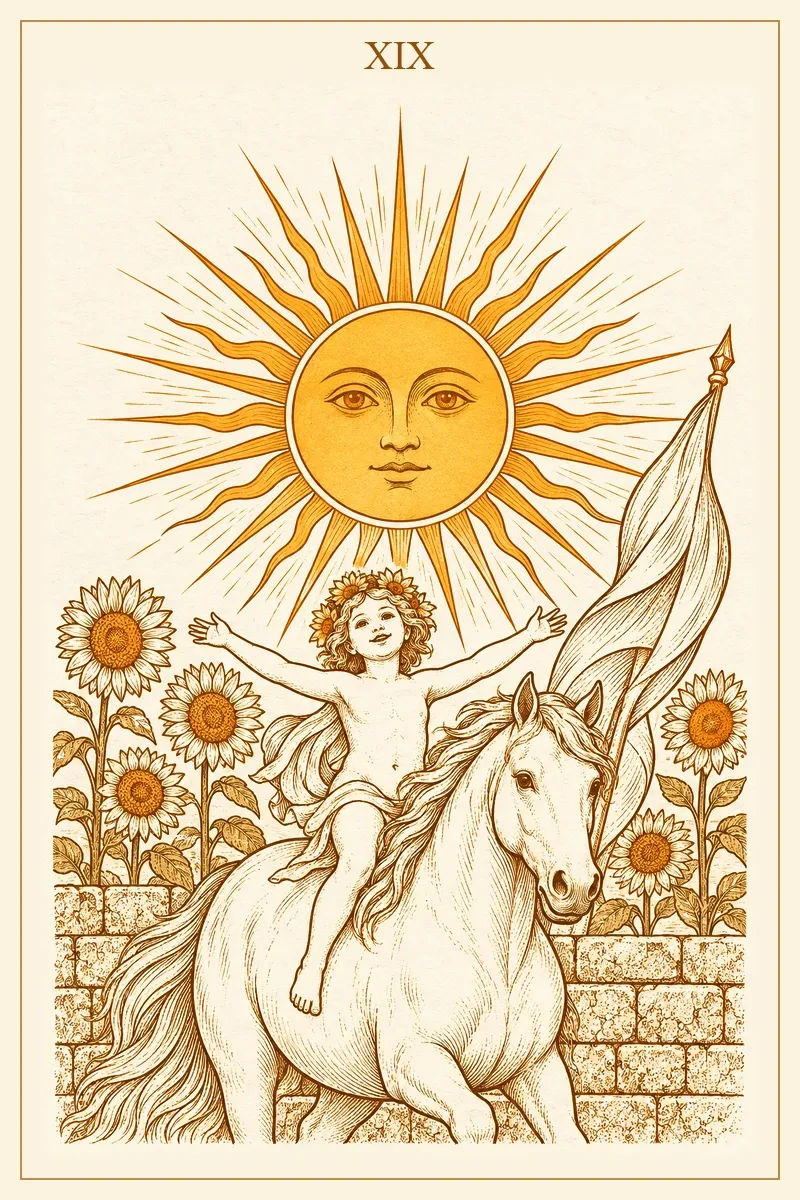
The Sun shows a child with arms spread wide and a crown of flowers riding a white horse beneath a large, smiling sun, while sunflowers rise behind a stone wall and a banner lifts in the wind. Nothing in the picture is concealed, and that is the answer it gives: yes, openly, with no catch waiting further down the road.
In love questions it speaks of warmth that other people can see; in work questions it points to effort that shows results; for money it suggests relief rather than a windfall. Reversed, it still leans yes with the brightness turned down: the thing happens, but tiredness or doubt keeps you from enjoying it. The full guide to The Sun's tarot meaning covers the card in longer spreads. Its close neighbor is The World, a dancer turning inside a laurel wreath, which answers yes to things already under way and ready to be completed.
Ace of Wands: yes to starting
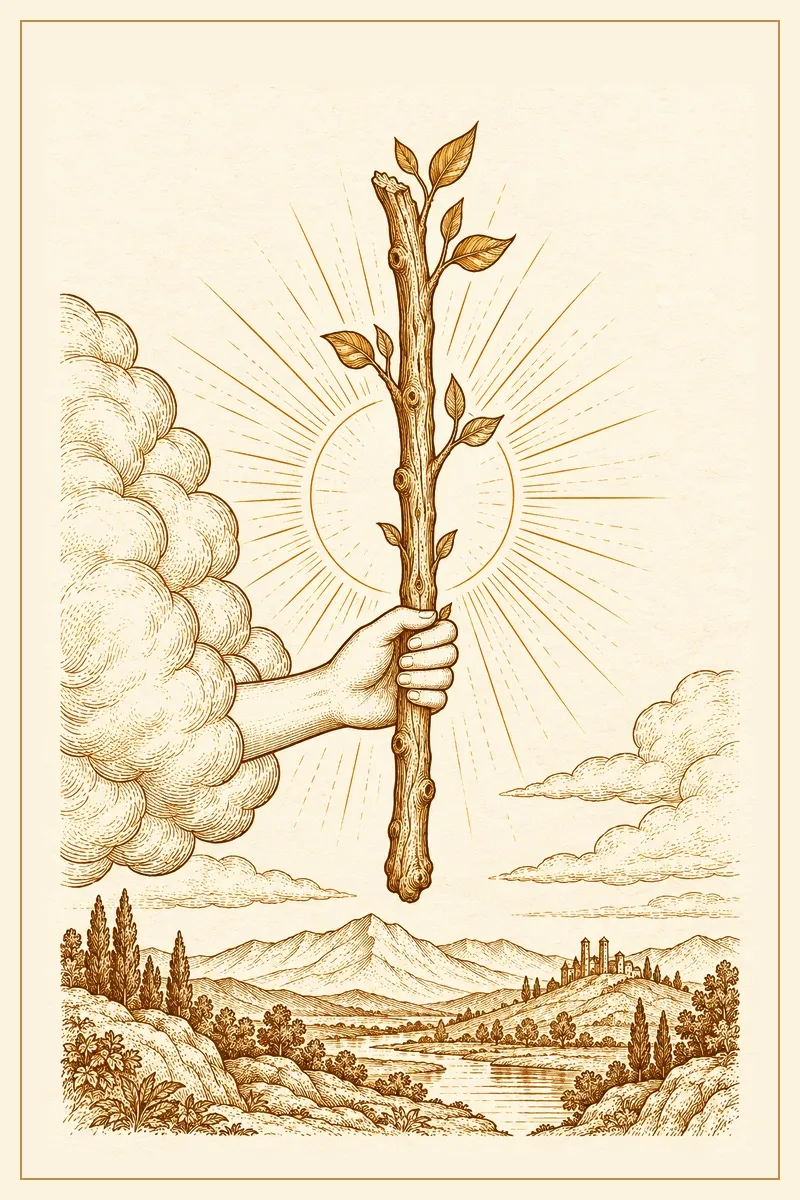
In the Ace of Wands, a hand reaches out of a cloud holding a living branch with leaves still sprouting along it, set against a ring of light above a river valley and a hilltop town. The card says yes to beginning: the idea has life in it, and now is a good time to start. What it does not promise is that the thing will grow by itself. A seed still needs planting.
For a new project, a class, a first message or a creative idea, it is one of the most encouraging cards you can pull. In love it suggests energy and attraction more than a settled bond; in work it favors launching over polishing. Reversed, the spark is still there but delayed, held back by hesitation, a crowded calendar or the fear of a bad start, so the answer becomes "yes, once you act." The guide to the Ace of Wands meaning follows the same impulse through love, career and timing questions.
The Tower: no to the plan as it stands
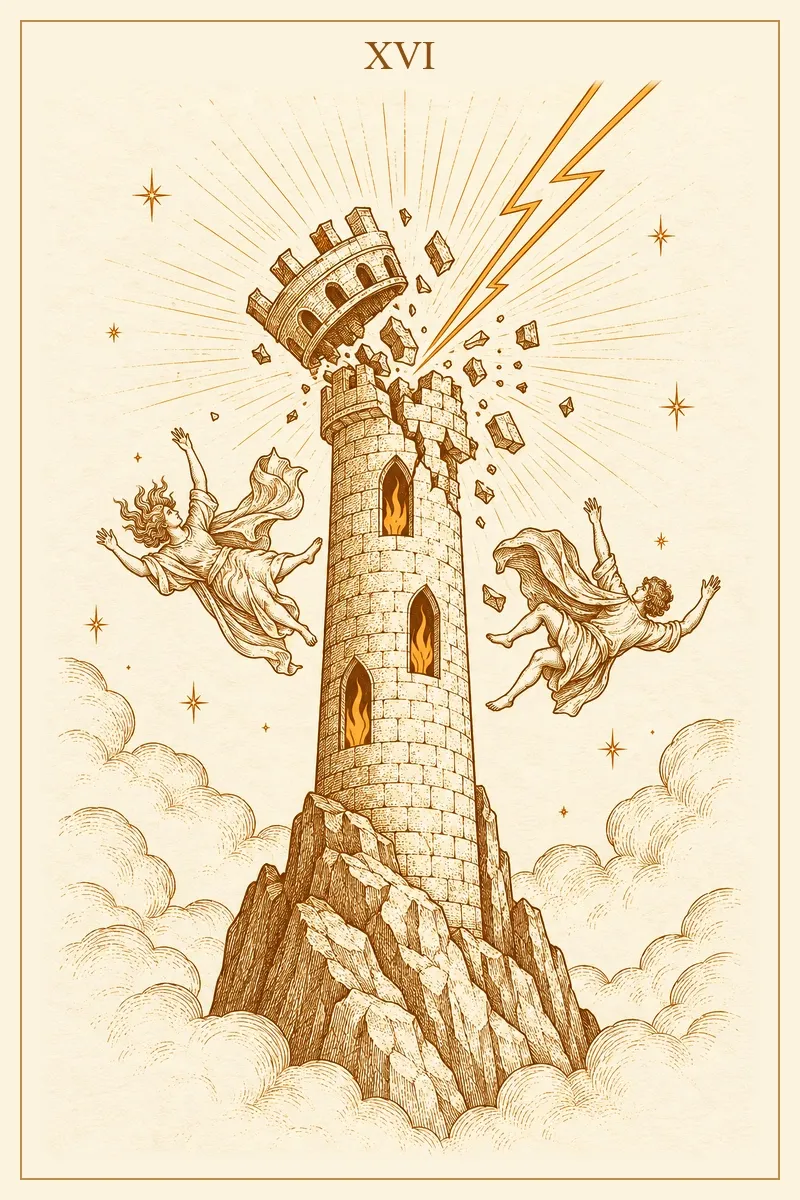
In The Tower, lightning knocks the crown off a stone tower on a rocky peak above the clouds; flames show in its windows and two figures fall through the air. In a yes or no reading, it gives a firm no to the plan as it stands. Something in the structure is unsound, and pushing ahead would mean building on that weakness.
That is not doom: the card pictures a false assumption breaking, which can feel like relief later. Reversed, it describes a shake-up you are trying to avoid or one unfolding slowly: still a no, with a nudge to look at what you already know is cracked. The Tower tarot meaning guide goes into how the card reads in love and work. Another firm no is the Five of Pentacles, two ragged figures walking through snow past a lit stained-glass window; it says no to the current approach because help is close by and has not yet been asked for.
Ten of Swords: no, this chapter has closed
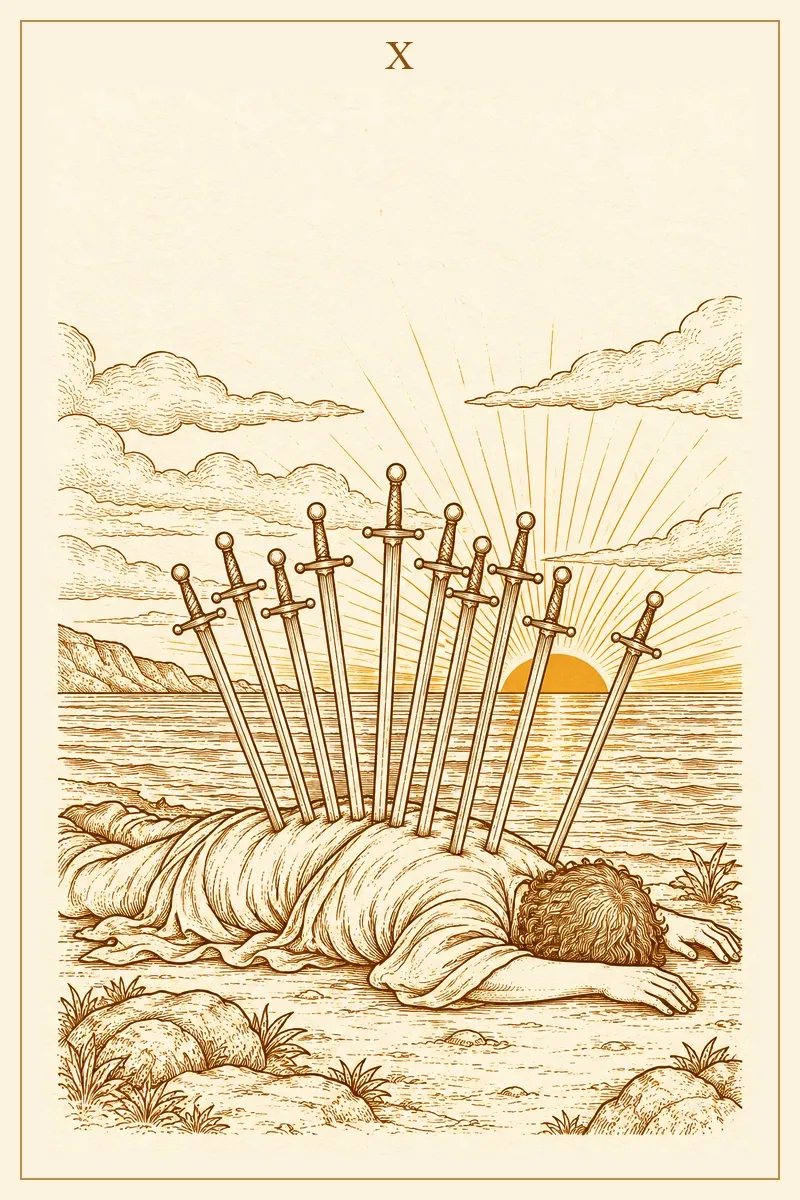
A figure lies face down on a shore with ten swords standing in its back, while the sun sits low on the horizon over a calm sea. It is the deck's plainest picture of an ending, and in a yes or no reading it says no: this version of the plan, the relationship or the effort has run its course.
Look at the horizon, though. The light at the edge of the water says the worst part has already happened and nothing more can be taken. Asked "Should I try one more time?", the card answers no and points your energy toward what comes next. Reversed, it describes a slow recovery, a no that begins to loosen as you get up and start again. The full Ten of Swords meaning shows how it reads beside gentler cards.
The Hanged Man: not yet, look again
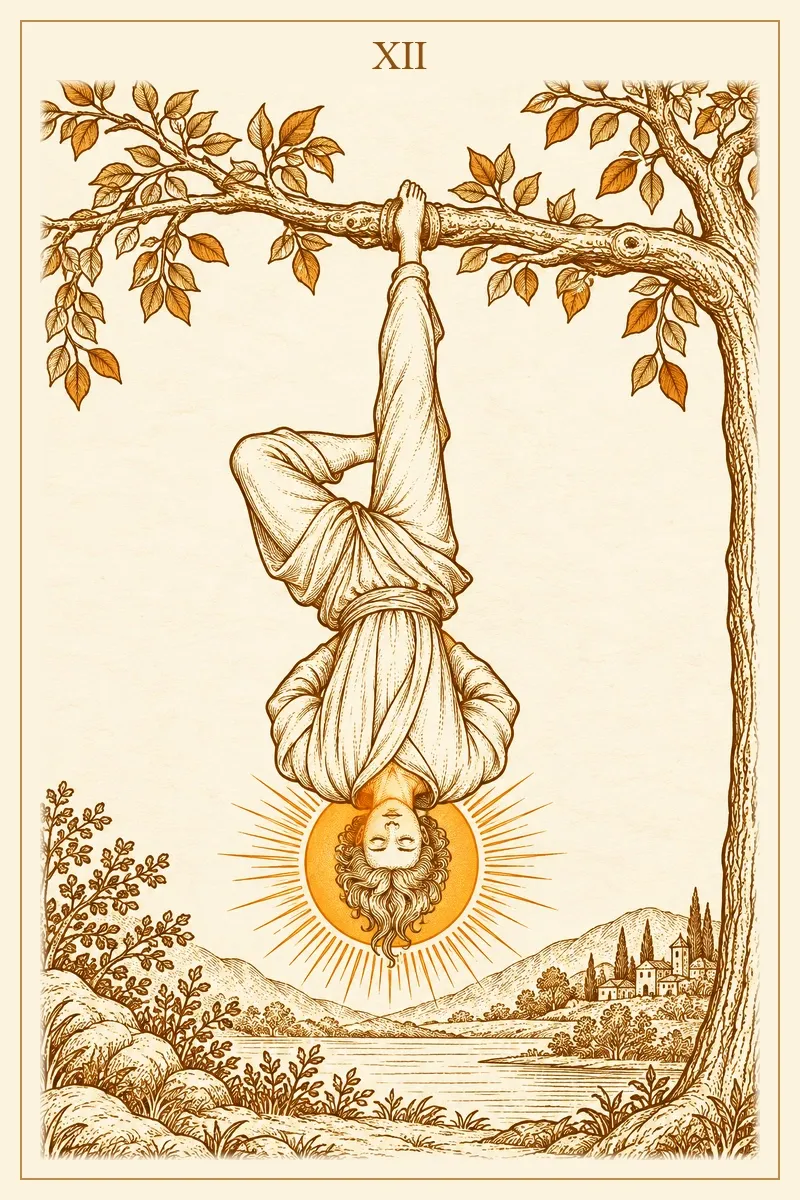
In The Hanged Man, a figure hangs upside down from a leafy branch by one bound foot, the other leg bent, arms behind the back and eyes closed, with a calm face haloed in light and a quiet lake and village below. The card answers neither yes nor no: it says the question cannot be settled from where you stand, and that a pause will show it from another angle.
When it appears, ask what you would see if you turned the question upside down. A job you want may matter less than the reason you want it; a message you plan to send may need a week of waiting first. Reversed, the pause has gone on too long and turned into stalling, and the card asks you to stop waiting for a certainty that will not come. The guide to The Hanged Man's meaning describes the card as a chosen pause rather than a stuck one.
Two of Swords: not yet, a choice you are avoiding
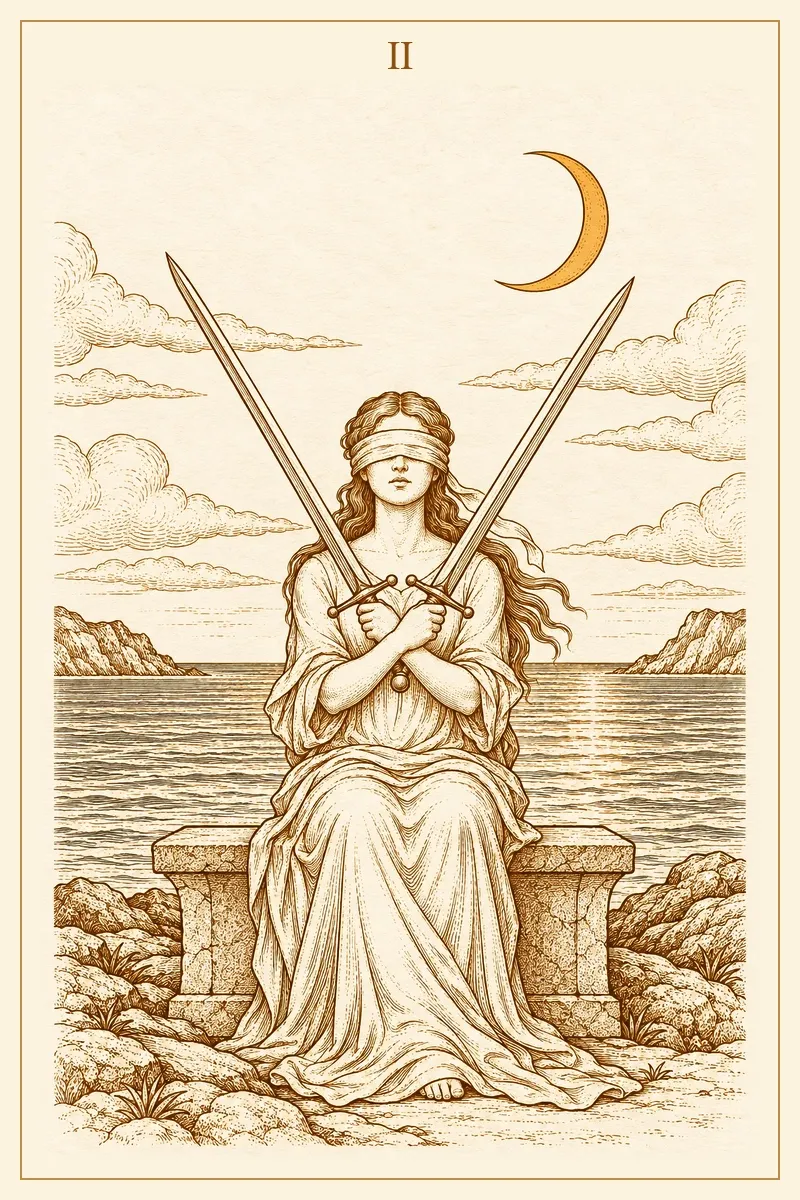
In the Two of Swords, a blindfolded woman sits on a stone bench by the sea under a crescent moon, arms crossed over her chest, holding two long swords that point upward. The answer is not yet, but for a different reason than The Hanged Man gives: it is being held back because you have not let yourself look at one side of the choice.
Ask what the blindfold is covering. It may be a fact you do not want to check, a feeling you keep at arm's length or a conversation you keep postponing. Reversed, the arms are tiring: the decision is close, and avoiding it now costs more than making it. The Two of Swords meaning guide covers the card in love and work stalemates. The Seven of Pentacles, a gardener leaning on a spade and studying a plant hung with coins, belongs to the same not-yet family: the work is growing, and harvest time has not arrived.
A worked example: three cards for a job application
The question. Imagine someone who has found a posting for a project coordinator role at a company she admires, with an application deadline on Friday. Her first wording, "Will I get this job?", asks about other people's decision, so she rewrites it: "Should I apply for the coordinator role before Friday's deadline?"
The cards. She shuffles, deals three in a row and turns over the Ace of Pentacles, the Three of Pentacles and the Five of Swords.
The lean of each card. The Ace of Pentacles, a hand offering a single large coin above a garden gate framed by a flowering arch, leans yes: a concrete opportunity is being held out. The Three of Pentacles, a young stone carver working on a scaffold while two figures study a building plan beside him, also leans yes: her skills fit a team that works from shared plans. The Five of Swords, a figure gathering up swords while two others walk away along a shore, leans no: it hints at friction, a win that leaves someone else unhappy.
The reading. Two cards to one: yes, apply. The Five of Swords is the condition. It suggests finding out how the team gets along before she commits, perhaps by asking in an interview how disagreements are settled, or by talking with someone who has worked there. The answer is not "you will get the job" and not "the job will be bad." It is "applying makes sense; go in with your eyes open."
The next step. She sends the application on Wednesday, writes down two questions about team culture for a possible interview, and records the three cards in her journal so she can compare them with what actually happens.
Habits that cloud the answer
- Asking in the middle of a storm. When you are crying, furious or panicking, the reading mirrors the feeling rather than the situation. Wait until your breathing has slowed, then shuffle.
- Drawing again because you disliked the card. The first draw answered the question you asked; a second one answers "tell me something nicer." If you catch yourself reaching for the deck, notice which answer you were hoping for, since that is useful information on its own. The guide to doing too many tarot readings looks more closely at the urge to keep drawing.
- Asking about someone else's heart. "Does she love me?" asks the deck to read another mind. Bring the question back to yourself: "Is this relationship giving me what I need?" The cards can work with that, and so can you.
- Treating "not yet" as a failed reading. When The Hanged Man or the Two of Swords appears, the deck is being more honest than a forced yes or no would be. A pause is an answer, so plan around it.
When the question is bigger than one card
Some questions resist a yes or no, not because the deck is being difficult but because the question holds more than two answers can carry. "Should I leave my partner?" or "Should I move to another country?" asks one card to squeeze years of history, feeling and consequence into a single word.
A simple test helps. If the decision is easy to undo, such as going to an event, reaching out to someone or trying a different approach at work, a yes or no draw fits well. If the consequences are large and lasting, such as ending a relationship, leaving a job or relocating, use a spread with named positions that lays out both paths. The decision making tarot spread compares two options side by side, and the guide to asking tarot whether to quit your job walks through one of the hardest work decisions card by card.
Frequently asked questions
How accurate is a yes or no tarot reading?
A yes or no reading reflects how a situation leans at the moment you ask; it cannot confirm another person's thoughts, fix a date or guarantee an outcome. How useful it is depends on the question: a specific, present-tense question about your own choice gives a clearer reflection than a vague one about the distant future. Treat the answer as one input alongside the facts, your own judgment and advice from people you trust.
Is a free online yes or no reading as good as using my own deck?
The method is the same either way: a clear question, a randomly drawn card and an honest reading of its lean. A physical deck gives you the ritual of shuffling, which can be calming; an online draw is quicker and easy to save. What matters is the wording of the question and your willingness to accept the answer, not where the card comes from.
Can I do a yes or no reading for someone else?
Yes, when they have shared the question with you and want the reading. Let them word the question, keep their situation in mind while you shuffle, and let them say what the card stirs in them before you offer your own view. Reading about someone's life without their knowledge is best left alone.
What does a "maybe" card such as The Hanged Man mean?
The Hanged Man, the Two of Swords and the Seven of Pentacles each say "not yet" in their own way: look from a new angle, face what you are avoiding, or give the work more time. Treat them as "the answer is not available yet" instead of forcing them into a yes or a no, and ask again once something real has changed.
How many times can I ask the same question?
Once, and once more only if the circumstances genuinely change, for example after a conversation or new information. Asking again on the same day because the first answer disappointed you turns the reading into a search for permission. The urge to ask again is worth writing down, because it shows which answer you wanted.
Should I use reversed cards in a yes or no reading?
You can read with or without reversals. Without them, each card's picture carries the whole answer. With them, a reversed card softens or delays its upright lean rather than flipping it automatically, so a reversed Sun is a quieter yes, not a no. Pick one approach and stay with it so your notes remain comparable.
Before the card turns over
The most useful moment in a yes or no reading arrives just before the card is turned, when you notice which answer you are hoping for. Keep the question small, read the card honestly and let a "not yet" count as a real answer.
When you have a question ready, you can draw your cards in a free Veil Soul reading and see which way it leans today.