Steady, deliberate practice is what the Eight of Pentacles means: skill earned one careful repetition at a time. Upright, this tarot card points to study, training, an apprenticeship or a craft you are getting genuinely good at, and it says the quality of your effort matters more than its speed. The Eight of Pentacles reversed shows the same workbench gone wrong: perfectionism that never lets a piece go, boredom that leads to cut corners, or hard work poured into the wrong project.
In love, career and money, the card keeps asking one thing: what are you willing to practice until it becomes second nature? Read it as a mirror for your own effort rather than a verdict. A reading cannot promise that a skill will pay off, tell you what an employer or partner privately thinks, or set a date for mastery; what it can do is show you where your hours are going and whether that is where you want them to go.
The card at a glance:
- Upright: skill development, focused work, apprenticeship, craftsmanship, pride in quality.
- Reversed: perfectionism, monotony, cutting corners, misdirected effort, avoiding practice.
- Love: care shown through consistent effort; reversed, a relationship running on autopilot.
- Career and money: training, certification, earning through skill; reversed, a grind that teaches you nothing new.
- Astrology: the Sun in Virgo, first decan of Virgo; the Golden Dawn title is Lord of Prudence.
- Yes or no: yes, through steady work; reversed, yes only if the method changes.
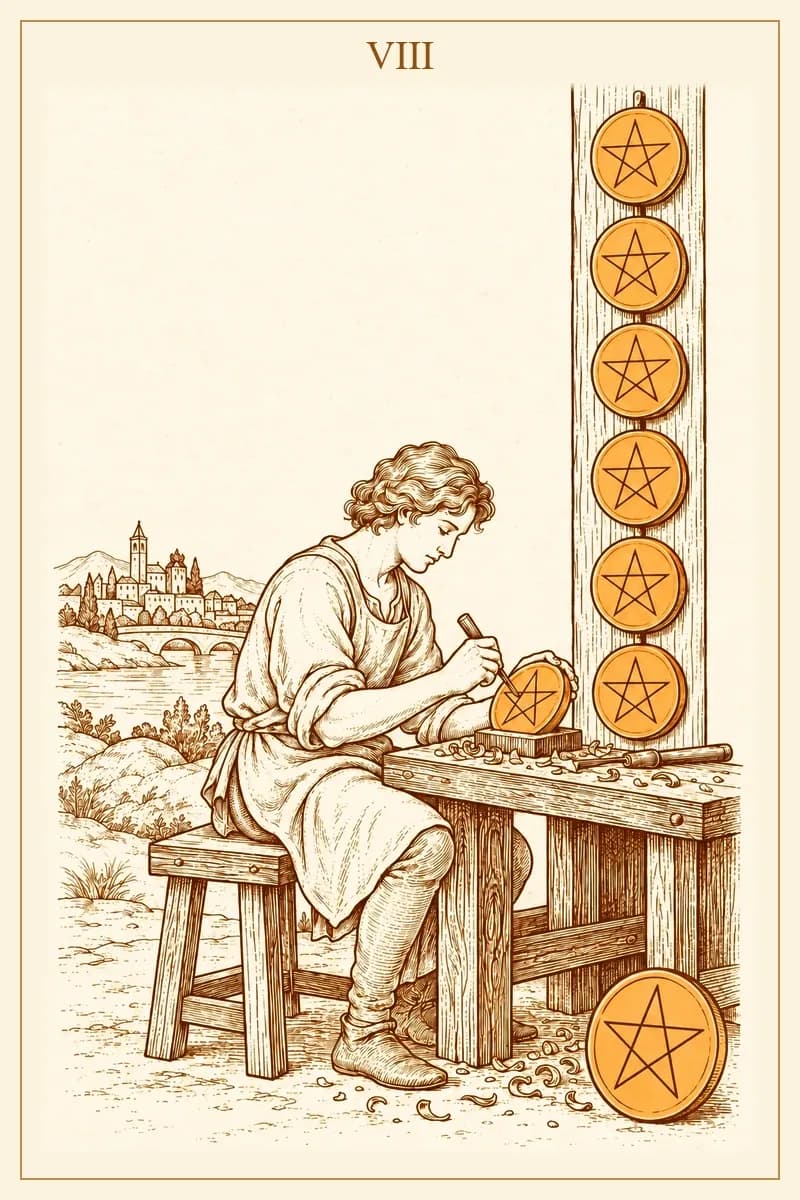
Chisel, coin and a post of finished work: the picture on card VIII
A young carver bent over one coin
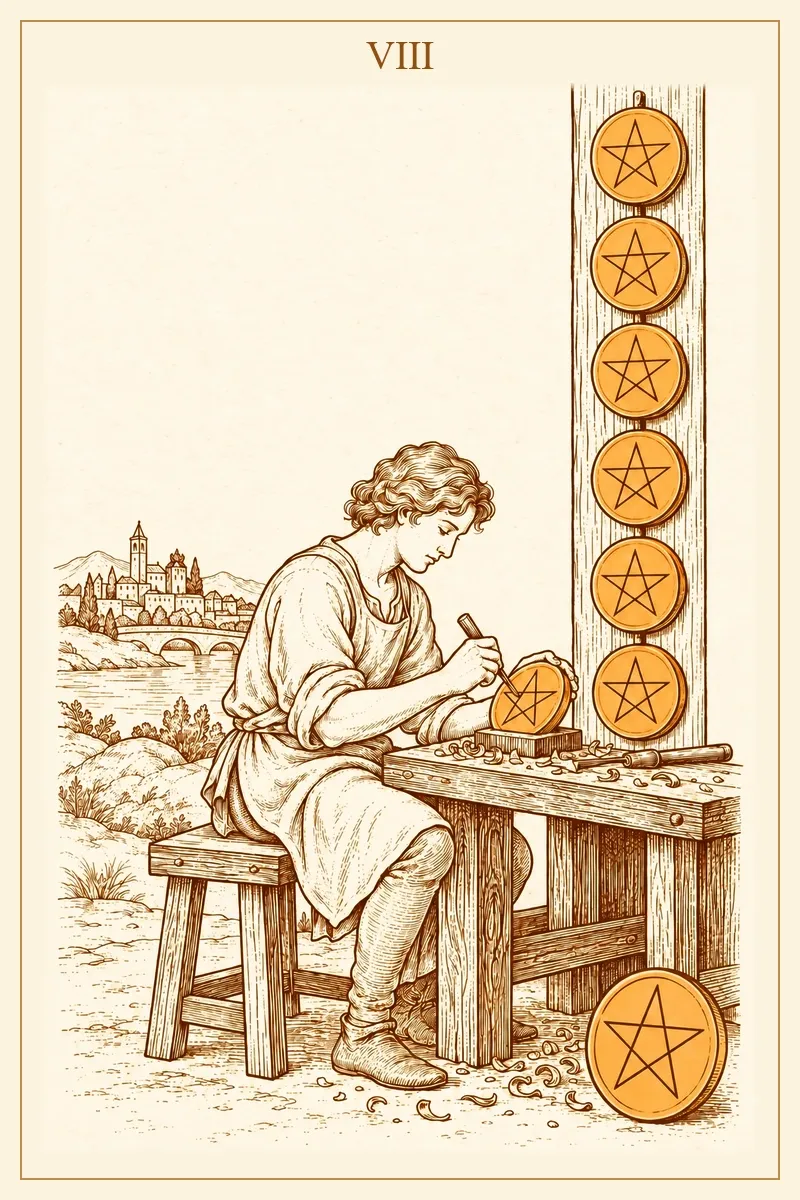
A young man with a mop of curly hair sits on a plain wooden stool, leaning toward a heavy workbench. He wears a loose smock with the sleeves rolled to the forearm, leggings and soft shoes. In one hand he holds a slim chisel; with the other he steadies a gold pentacle propped on a small wooden block, and he is cutting the star into its face line by line. There is no audience on the card and no one inspecting his work; the focus comes from him.
Six coins on the post, one resting by the bench leg
To his right rises a tall wooden post, and six finished pentacles hang down it in a neat column, each the same size, each star cut with the same care. The coin on the block makes seven, and an eighth leans against the leg of the bench on the ground, waiting its turn. This is the middle of a run of work, not its first attempt or its last. What earns each coin its place on the post is consistency, the same standard kept on the fifth piece as on the first.
Shavings underfoot, a town across the river
Curls of wood are scattered across the bench top and the ground beneath the stool, with a second tool lying beside the block. Far to the left, beyond a river, a small town sits among low hills with a bell tower, rooftops and an arched stone bridge. He works outside the town, close enough to walk back and sell what he makes but far enough to avoid interruption: focus sometimes needs a little distance, and the work is still meant to return to the world once it is good.
Lord of Prudence: the Sun in the first decan of Virgo
In the Golden Dawn system, which shaped most modern tarot, the Eight of Pentacles is called the Lord of Prudence and belongs to the first decan of Virgo, ruled by the Sun, roughly late August into the first days of September. Virgo is the mutable earth sign of craft, service, analysis and improving things through small corrections. The Sun brings vitality and visibility. Placed together, they describe someone who pours their best energy into the details and is quietly proud of a job done properly.
Prudence here does not mean timidity. It means using your resources well: choosing what to practice, pacing yourself so the work lasts, and not wasting good material on a rushed cut. If Virgo themes keep surfacing in your readings, the Virgo and tarot guide gathers the other cards tied to the sign.
Between the Seven's pause and the Nine's garden
The Eight makes most sense when you look at its neighbors. In the Seven of Pentacles, a curly-haired young man leans on a long spade with his hands folded on the handle, gazing at seven coins growing on a leafy bush near a low stone wall. He is deciding whether his crop deserves another season, and the Eight follows a yes: you go back to work with a narrower focus and a better method. That moment of review is covered in depth in the Seven of Pentacles meaning.
Ahead lies the Nine of Pentacles, where a woman in a long gown patterned with flowers stands in a vineyard heavy with grapes and coins, a falcon resting on her gloved hand and a villa on the hill behind her. Her ease is the payoff of the hours the Eight describes, and the Nine of Pentacles meaning picks up the story from there. As a sequence, the Seven asks whether to continue, the Eight does the work, and the Nine enjoys what it built.
Eight of Pentacles upright: the hours nobody applauds
Learning a skill from the ground up
Upright, the card can appear when you are a student in some sense: starting a trade, a degree, a language, an instrument, or a second career that makes you a beginner again. The slow stage, where you repeat basics and make visible mistakes, is not a detour from the goal but the road to it. If you feel embarrassed by how much you still have to learn, the Eight treats that as the normal condition of anyone building real skill.
Quality as a daily habit
The carver does not save his best effort for the coin that might be noticed. Upright, the Eight asks you to work to the same standard whether the task is visible or not: the email nobody will praise, the scale you play before the song, the spreadsheet column you check twice. Over time those habits become your reputation, and the card values modest, repeatable care over bursts of heroic effort followed by long breaks.
Work that begins to speak for itself
Because the coins on the post are on display, the upright card can also signal that your competence is becoming visible: a supervisor trusting you with harder tasks, a client asking for you by name, friends coming to you for help with what you have been practicing. The card does not promise a promotion; it suggests the conditions for one are being built in the work itself.
Eight of Pentacles reversed: the chisel slips, stalls or cuts the wrong coin
Perfectionism that never lets a piece leave the bench
One reversed reading turns care into a trap. You recut the same star again and again because it is never quite right, so nothing reaches the post. A portfolio that is never sent, a draft that is never submitted, a course you retake instead of using what you learned: this reversal asks whether your standard is serving the work or protecting you from being judged. Finished and good often helps more than perfect and hidden.
Boredom, burnout and cut corners
Repetition is the heart of this card, and reversed it can harden into monotony: the work feels mechanical, attention drifts, and quality drops because you have stopped caring, not because you lack skill. If the cause is exhaustion, rest will do more than discipline; if the task has stopped stretching you, you need a harder problem. Either way, the reversed Eight treats cut corners as a symptom to understand, not a character flaw.
Skilled effort aimed at the wrong target
Another reading is misdirection. You may be working hard and well at something that no longer fits your goals: perfecting a skill your field is moving away from, polishing a role you want to leave, or carving coins nobody plans to buy. Look up from the bench toward the town on the horizon: who is the work for, and does it still lead where you want to go?
Avoiding practice altogether
Finally, the reversal can describe the bench left empty: you read about the craft, buy the tools and plan a schedule, yet never quite begin. No amount of preparation replaces a short, regular session with the actual work.
The Eight of Pentacles in love: care practiced like a craft
In a relationship
For couples, the upright Eight describes love expressed through effort and attention to detail: learning how your partner likes to be supported, keeping small promises, working on a recurring argument instead of hoping it disappears. It is not the most romantic card in the deck, but it is one of the most dependable, a relationship that improves because both people keep showing up for its unglamorous parts.
Single or dating
If you are single, the card points to a season of building yourself up, through counseling, a new routine or a career push, which shapes the life you bring to a future partner. It can also describe meeting someone through work, a class or a shared hobby. The Eight favors getting to know someone gradually over fast, intense beginnings.
Reversed in love
Reversed, the effort may have turned into routine: dinners happen and messages get answered, yet nobody is really paying attention. It can also show overwork crowding out the relationship, or, for singles, a checklist so strict that no real person could pass it. The card suggests looking at where attention goes rather than adding effort to the same habits.
When you ask how someone feels about you
In a feelings question, the Eight can describe someone who sees you as serious, capable and worth investing in, or someone whose energy is mostly on their work right now. Take it as a prompt to watch their actions: do they make consistent time for you?
Apprenticeships, promotions and paid skill: work and money
Career upright
In career readings the upright Eight is one of the clearest signs of growth through competence. It supports training, certifications, apprenticeships and any role where you learn by doing, as well as a job where you are already skilled and refining your craft. If you are deciding whether to sign up for a course or take on a demanding new project, the card leans toward the option that will make you better at your work, even if it is harder at first.
Career reversed
Reversed, work can feel like a treadmill: you produce, but you are no longer learning, or the workplace rewards speed over the quality you care about. Ask what part of this job still teaches you something, and whether a conversation about your role is overdue.
Money, upright and reversed
Financially, the Eight ties income to skill. Upright, it favors earning through work you do well and investing in your own abilities, such as a qualification or better tools. Reversed, it can point to returns that lag behind effort, often because the skill is underpriced or not yet aimed at people who would pay for it. For decisions involving debt, loans or large purchases, talk to a qualified financial professional.
Training the body and keeping a practice: health and spirit
In health questions, the Eight favors small, sustainable routines over dramatic overhauls, such as a regular walk or sleep habits built a little at a time; reversed, it can point to a routine so rigid it has become joyless, or to skipping the basics for a shortcut. Symptoms and treatment belong with a doctor. Spiritually, this is a card of practice rather than revelation: meditation, journaling or learning tarot itself deepen through regular, slightly dull repetition, and a five-minute habit you keep is worth more than an hour-long ritual you abandon.
Yes, no, and how long the practice takes
As a yes-or-no answer, the upright Eight of Pentacles is a working yes. The goal is achievable, but through effort, skill and time rather than luck. Reversed, it reads more like "yes, if you change the method": the current approach is wasting energy, and adjusting it matters more than trying harder.
For timing, many readers link the Eight to weeks or months of steady practice rather than a single event, and some use its Virgo decan as a seasonal marker. Treat any timing hint as a check-in date for your own progress, not a deadline the cards have set.
Four Major Arcana companions for the craftsman
The Magician: talent meets technique
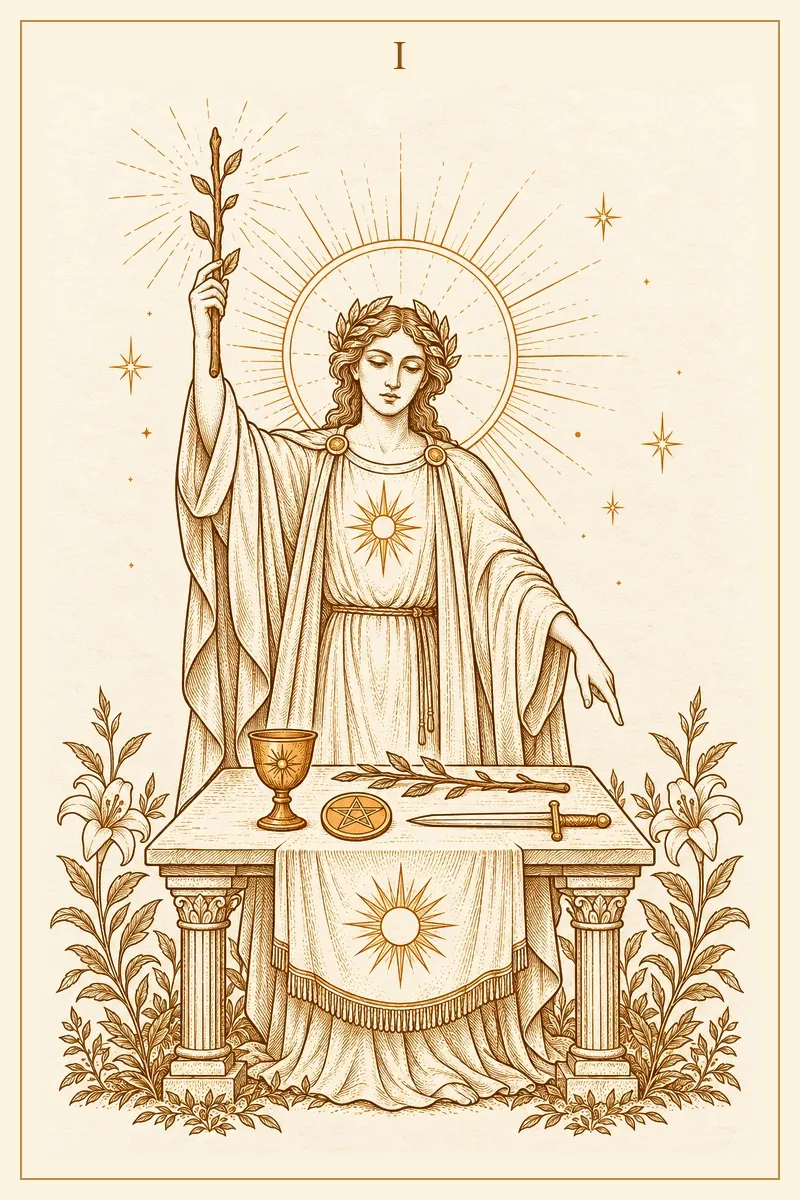
The Magician stands behind a stone table with a laurel wreath on his head and a halo of rays behind him, raising a leafy branch in one hand and pointing down with the other. On the table lie a cup, a pentacle, a sword and another branch. Next to the Eight, he says the raw ability is already there and practice is turning it into real command of your tools. His side of the pairing is explored in the Magician tarot meaning.
The Hermit: practice in solitude
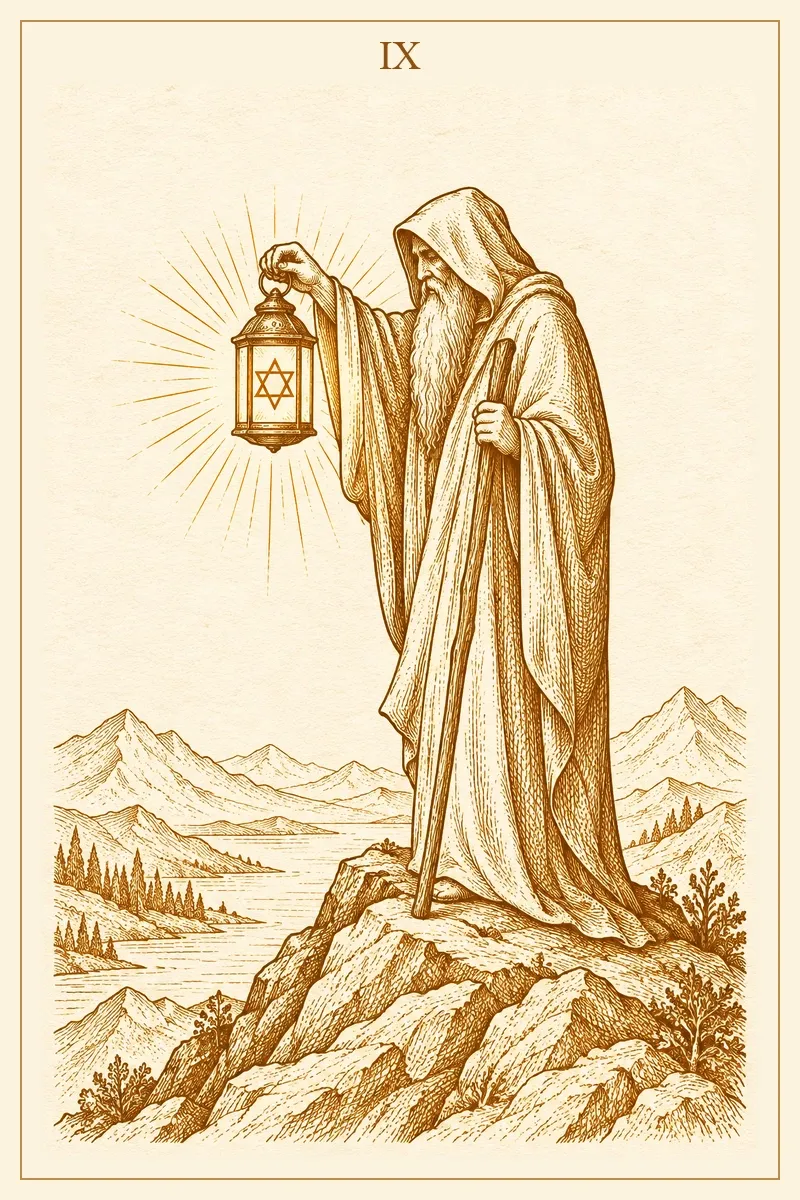
The Hermit, hooded and white-bearded, stands on a rocky summit above a lake and pine-covered slopes, holding out a lantern with a six-pointed star inside and leaning on a long staff. With the Eight, he suggests withdrawing from distraction to go deep into your craft, such as a focused study period or a stretch of turning down most invitations. Out of balance, the pair can warn of working so alone that nobody gives you feedback. You can read more about his solitary path in the Hermit tarot meaning.
The Star: work that feels like a calling
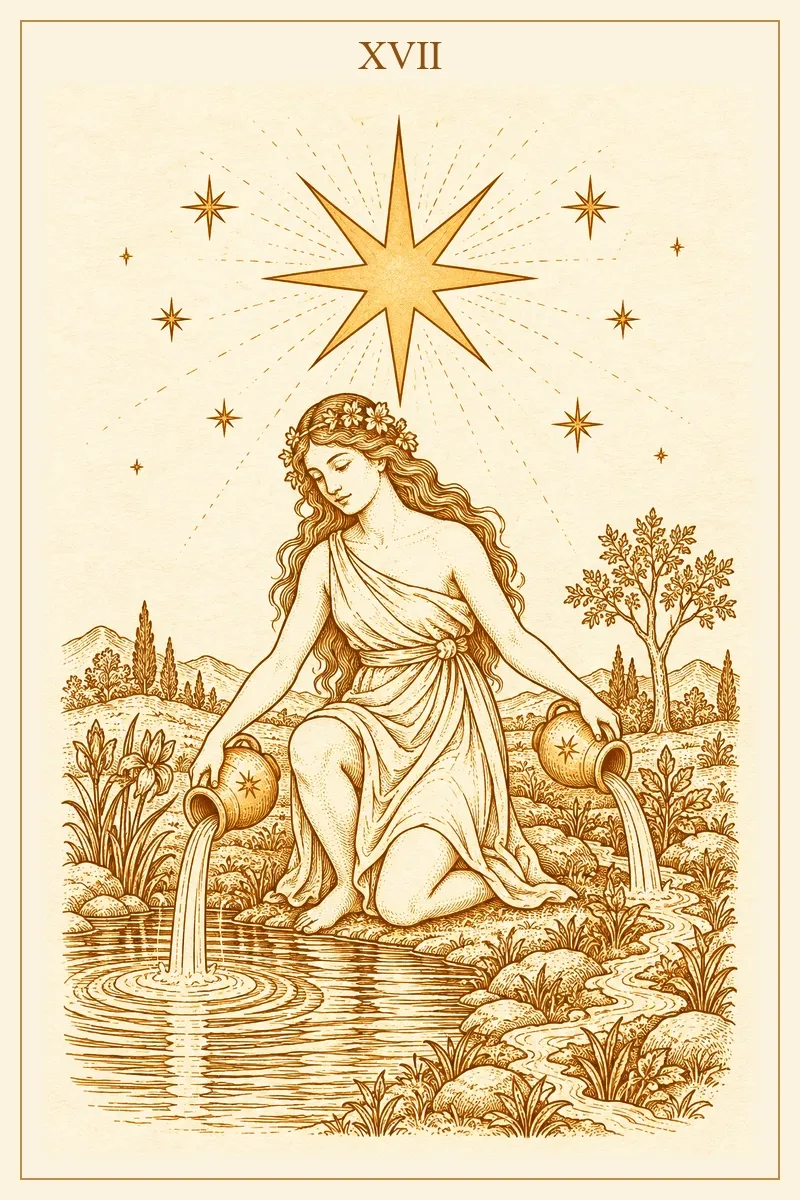
On the Star, a woman with a crown of flowers kneels at the water's edge beneath a large eight-pointed star, pouring one jug into a pool and the other onto the land. Beside the Eight of Pentacles, she suggests that the work you are refining is tied to hope and purpose, perhaps a craft that feels like what you are meant to do. The Star tarot meaning looks more closely at that sense of renewal.
The World: the apprenticeship completed
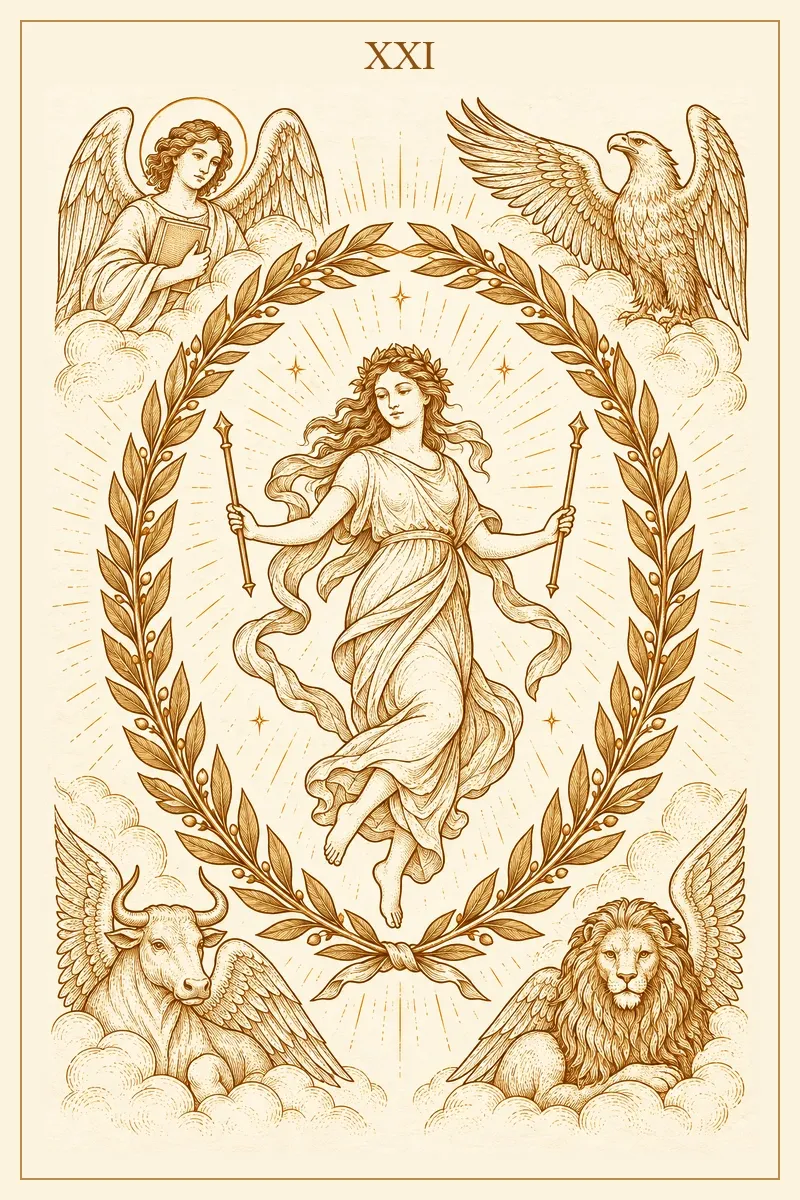
The World shows a dancer floating inside a laurel wreath tied with ribbon, a wand in each hand, while an angel, an eagle, a bull and a lion watch from the four corners. Paired with the Eight, it marks the end of a long learning phase: a qualification earned, a body of work finished, a skill mature enough to teach, a theme of completion that the World tarot meaning follows further.
Smaller pairings that shift the work
- With the Three of Pentacles: individual skill meets collaboration; others start asking for your craft, or you learn faster by working alongside them.
- With the Page of Pentacles: a doubled student signature; a course, an apprenticeship or the first steps in a new field.
- With the Four of Cups: boredom at the bench; a strong hint that the reversed meanings about monotony and lost interest apply, even if the Eight is upright.
The Workbench spread: five positions for a skill you are building
These positions come from the card's picture. Shuffle with one skill or project in mind and lay five cards in a row.
- The chisel in your hand: the ability or resource you already have.
- The coin on the block: what you are working on now, and how that work is going.
- The coins on the post: progress you have already made, which you may be overlooking.
- The shavings on the floor: a habit, task or expectation you can sweep away.
- The coin by the bench leg: the next piece of work worth starting.
Positions three and four work as a pair: many people who feel stuck have more coins on the post than they admit and more shavings on the floor than they need.
A worked reading: a guitarist preparing for paid gigs
Imagine a guitarist who has played open-mic nights for two years and has just been offered a few paid bookings at a local restaurant. Her question is "How do I get ready for paid gigs without burning out?" She draws five cards in the Workbench spread.
- The chisel in your hand: Ace of Wands. Her real asset is enthusiasm; she still loves playing, and that spark is worth protecting.
- The coin on the block: Eight of Pentacles reversed. Her practice has gone rote: the same favorite songs every evening, while she avoids the two pieces that trip her up.
- The coins on the post: Six of Wands. Recognition has already arrived: the bookings themselves, and regulars who request her songs.
- The shavings on the floor: Seven of Cups. Too many plans at once: jazz chords, an album and a website, all in the same month.
- The coin by the bench leg: Three of Pentacles. Collaboration: rehearsing with another musician or asking an experienced player to hear her setlist.
Taken together, the cards say her problem is the shape of her practice, not a lack of skill. The reversed Eight asks her to trade comfortable repetition for twenty minutes a night on the hardest passages. The Seven of Cups suggests postponing the album and website until the bookings feel routine, and the Three of Pentacles points to one step: a rehearsal with a friend who plays bass. The spread does not say the gigs will go well; it gives her a clearer plan for the next month.
Questions to ask at your own workbench
- Which skill would change your life most if you practiced it for twenty minutes a day for a year?
- Where are you holding back finished work because it does not yet feel perfect?
- Which part of your current routine has turned mechanical, and what would make it interesting again?
- If you looked up from the bench, would the town on the horizon still be where you want to go?
Frequently asked questions
Is the Eight of Pentacles a good card?
Generally, yes. Upright, it is one of the most encouraging cards for study, work and long-term goals, because it describes skill that grows with effort. Its challenge is patience: it rarely promises quick results.
Does the Eight of Pentacles mean a new job?
Not necessarily. It describes how you work more than where: it can appear around training for a new role, and it can just as well point to growth inside your current job.
Is the Eight of Pentacles reversed a bad sign?
It is a sign to adjust, not a warning of failure. The reversal usually points to perfectionism, burnout, boredom or effort aimed at the wrong goal, and each of those can be addressed once you see it.
Can tarot tell me whether I will master this skill, or when?
No. Tarot cannot predict outcomes, confirm another person's decisions or give a reliable date. It is a tool for reflection that helps you see your habits and choices more clearly. If you are new to how readings work, this introduction to tarot explains the basics.
What is the difference between the Eight and the Three of Pentacles?
Both cards are about craft. The Three shows a carver on scaffolding inside a cathedral while a monk and a man holding a plan look on: skill shaped by teamwork and feedback. The Eight shows the craftsman alone at his bench, building skill through solitary repetition.
Can the Eight of Pentacles represent a person?
Sometimes. It can describe a student, an apprentice, a hard-working colleague or someone with a strong Virgo streak: detail-minded, modest and reliable. It can also simply describe you, quietly building something.
One more coin on the post
When the Eight of Pentacles turns up, the most useful response is usually small and concrete. Choose one skill or project. Set a short, regular practice time you can keep for the next few weeks. Name one weak spot to work on first, and one person who could look at your work and tell you honestly what they notice. Then let the finished pieces accumulate. Whenever you want to look at your own question through the cards, you can begin a reading with Veil Soul.