The King of Cups is the card of emotional maturity: someone who feels deeply and still keeps a steady hand. Upright, the King of Cups meaning centers on compassion, diplomacy and calm authority, whether that describes a caring partner, a trusted counselor, or the composed part of you that can hold a hard conversation without going under. Reversed, the same depth turns inward or sideways, into bottled-up feeling, sudden mood swings, or kindness used as leverage.
A court card can describe a person, a role you are being asked to play, or an attitude the situation needs, and your question decides which. What the card cannot do is read another person's private thoughts, promise an outcome, or put a date on anything. Treat it as a mirror for how you are handling feeling right now.
Here is the card in brief:
- Upright keywords: emotional maturity, compassion, calm under pressure, diplomacy, wise counsel, caring authority.
- Reversed keywords: bottled-up feeling, moodiness, emotional manipulation, coldness passed off as control, escaping into habits.
- Element: water, the suit of Cups. In the Golden Dawn scheme the modern King is the Prince of Cups, Air of Water.
- Astrology: mostly Scorpio, with the last decan of Libra (20° Libra to 20° Scorpio).
- Yes or no: upright, a calm yes; reversed, a yes that waits until you have checked your motive.
- In love: an emotionally safe partner, or the steadiness you are learning to offer.
- At work: a mentor, counselor or leader who listens before deciding.
Surf at his feet, a sunburst cup in his hand
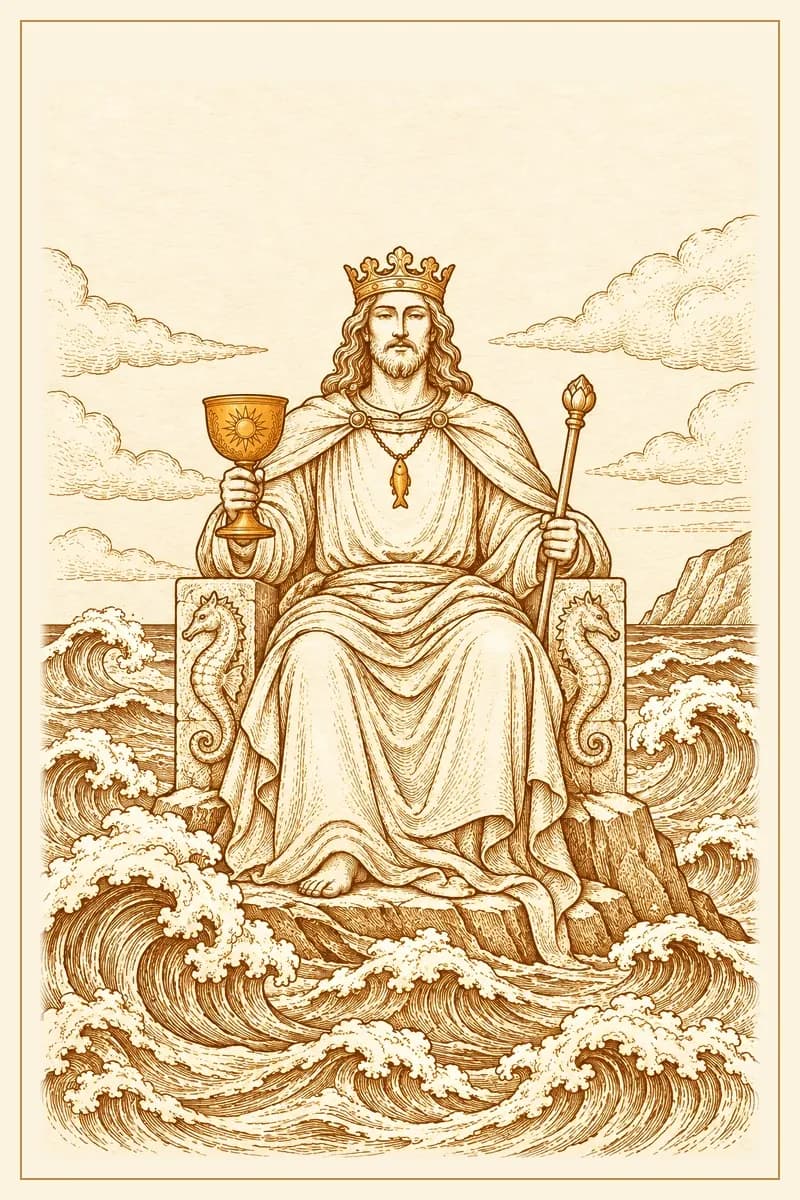
The picture is built on one contrast. A crowned, bearded king sits on a stone throne set on a rocky outcrop while the sea around him surges, curling waves breaking on both sides and foam climbing almost to his knees. The sky above is mild, with soft clouds and a dark headland on the right, but nothing suggests the water will settle. The sea stays wild; the man stays calm. Emotional mastery, in this card, does not mean waiting for calm water. It means finding your seat while the water moves.
The cup and the budded scepter
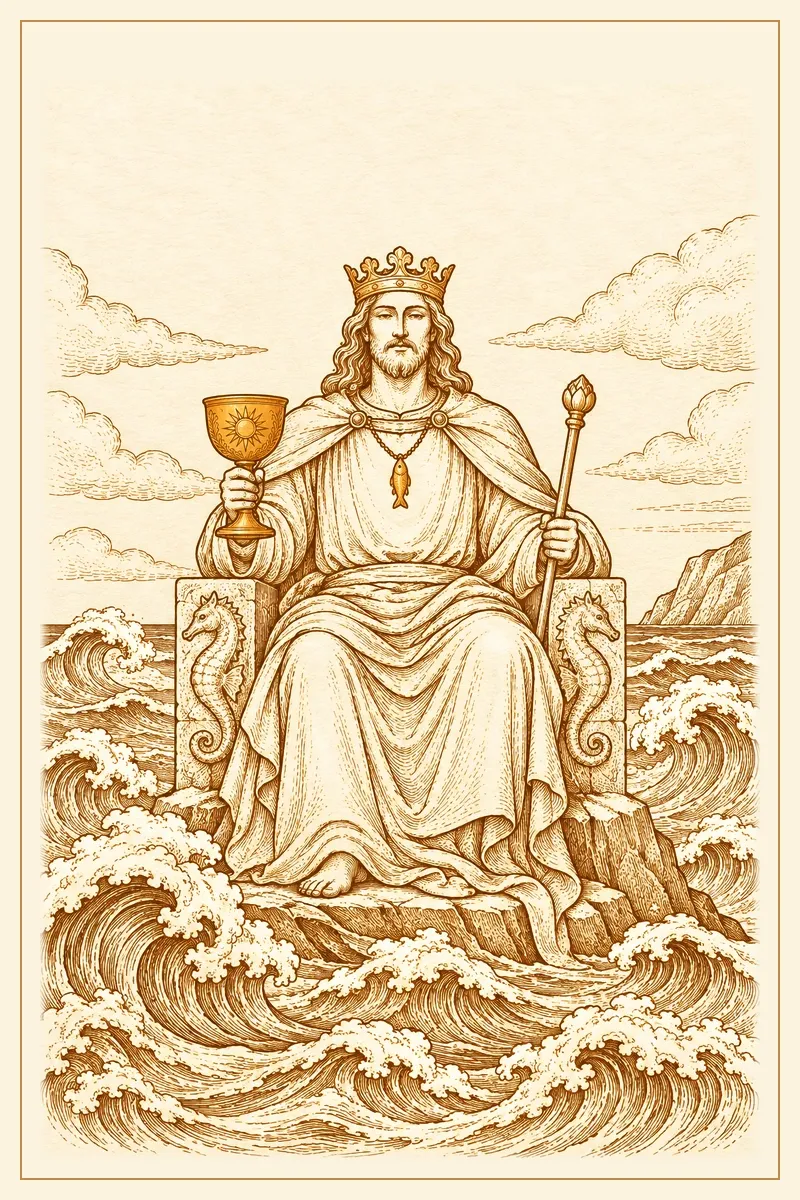
In his right hand he raises a gold cup engraved with a radiant sun. In his left he holds a slim gold scepter topped with a closed, bud-shaped finial. The cup is upright and steady, neither tipped nor spilling: feeling contained rather than suppressed, and the sun on its side says it has been looked at in daylight. The scepter says he also decides, so his compassion comes with the authority to act. Its bud is still closed, as if that power is kept for when it is needed.
Look down and you will see bare feet on the stone. He wears no armor against the sea; he keeps contact with the element he rules and trusts himself to stay put.
Seahorses, a fish pendant and a fish grown quiet
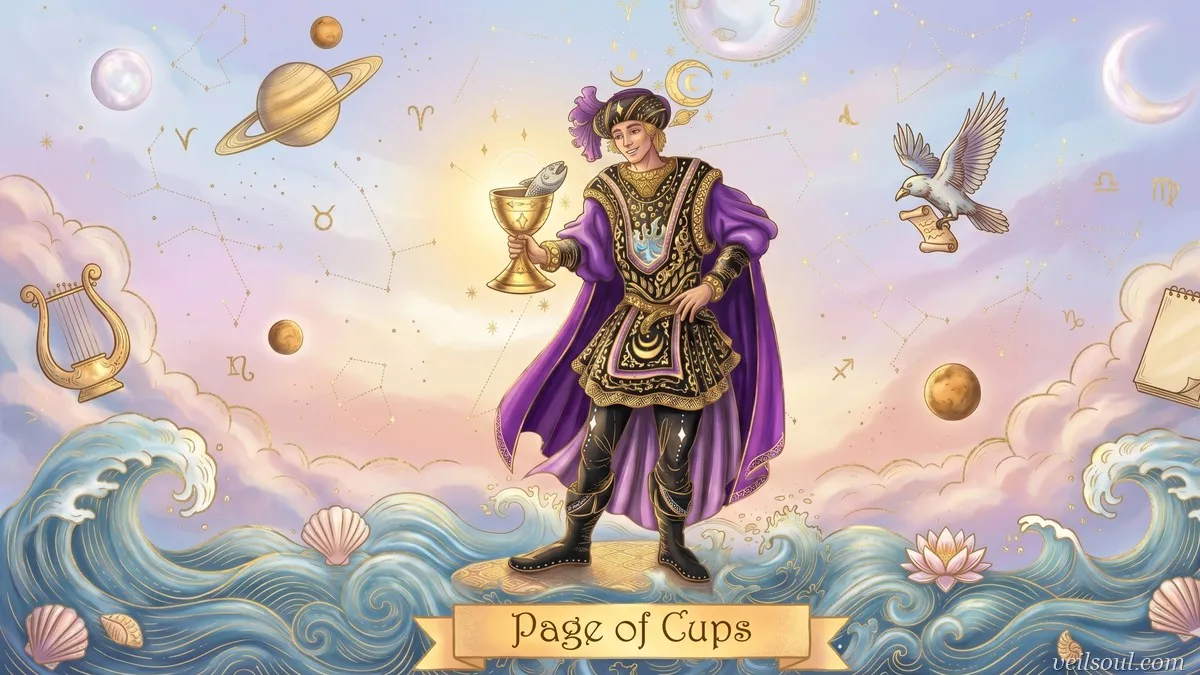
Both arms of the throne are carved with seahorses, creatures that anchor themselves by the tail so the current cannot carry them off. In stone, that instinct becomes permanent: feeling given a shape that holds. At his chest hangs a small fish on a chain. On the Page of Cups, a fish leaps out of the cup and startles the young figure holding it. Here a fish rests, quiet, over the King's heart. The intuitive message that surprised the Page has become something the King wears every day, close to the skin.
Water ruled by air: the Golden Dawn Prince and his Scorpio season
Cups are the water suit: feeling, relationships, intuition and imagination. Kings usually stand for the mature, outward-acting authority of their suit, so this is the figure who takes what the Cups know about the heart and uses it on behalf of others.
The Golden Dawn, whose correspondences many readers still use, named its court cards differently. Its King was a mounted figure, Fire of Water, and corresponds to today's Knight of Cups. Its Prince, the Prince of the Chariot of the Waters, corresponds to the seated King of modern decks, which gives the modern King the element Air of Water and the span 20° Libra to 20° Scorpio. Many modern guides instead assign every king to fire, as the suit's active force, which makes this card Fire of Water. Both mappings are in use; pick one and stay consistent.
Air of Water suits him. Air is thought and language, so this is feeling that can be named, explained and negotiated with, which is the root of his diplomacy. The Scorpio span adds depth, privacy and staying power; anyone who knows Scorpio in tarot and astrology will recognize his composure as intensity held under the surface, not intensity that is missing. The Libra decan brings his sense of fairness. Some readers also hear the protective, caretaking note of Cancer in tarot in him, although in the Golden Dawn tables most of that sign belongs to the Queen of Cups.
Upright King of Cups: feeling everything, steering anyway
The King closes the Cups court. Feeling is not his problem; it is his material. He has grieved, loved and been disappointed, and came through with a working knowledge of the heart. Upright, he usually points to one of three things.
When the King is another person
Often he is someone in your life who listens without rushing to fix you: a counselor, a nurse, a teacher, an older relative, the friend everyone calls when something goes wrong. Such people tend to be calm, a little reserved, generous with time and slow to judge, and they keep confidences.
When the King is you
Just as often the card is an invitation. Something in your situation needs you to respond rather than react. That does not mean pretending you feel nothing. The King notices the wave, names it, and then chooses what to do. In practice this can look like waiting a day before replying to a painful message, telling someone you are upset without attacking them, or holding a boundary kindly but without apology.
When the King is the situation
Sometimes the card describes what a situation calls for: mediation, a negotiation where empathy matters more than leverage, a family meeting that needs one person to keep the temperature down.
King of Cups reversed: when the sea comes over the rock
Turned upside down, the King has not lost his depth. What changes is where it goes. Either the feeling is held so tightly that it leaks out sideways, or the skill of reading people is turned toward getting something from them.
Calm on the surface, flooding underneath
The first reversed reading to consider is suppression. Everything is "fine" until it is suddenly not: an outburst over something small, cold silence for days, sarcasm in place of a direct sentence. Someone who is usually composed may be running out of room. If this is you, the card is not a scolding; the pressure is real and needs an outlet you choose before it picks one for you.
Sympathy used as a lever
The reversed King can also be the person who understands feelings very well and uses that understanding to steer you: guilt, flattery, the right sad story at the right moment, help that always comes with an invoice. Watch what happens when you say no. Real care survives a no; leverage gets louder.
Escape routes and a loose chain
When feeling becomes too much to hold, the reversed King may reach for something that numbs it: drink, endless scrolling, overwork, spending. Beside The Devil, whose two figures each hold their own loose chain, this theme gets louder, and so does the reminder in that picture that the chain can be lifted off. The full Devil tarot meaning explores that kind of attachment in depth. If a habit is hurting you, a doctor, counselor or support group is a better next step than another draw.
A steady heart or a closed door: the King of Cups in love
In love readings the upright King describes emotional safety: the partner who stays calm when you are not, remembers what you said last month, and can sit through an argument without contempt. For a couple, the card often marks a phase of deeper trust, where you can bring up something difficult and expect to be heard. For someone single, it may point to a person who is more settled than the people you usually notice, or to your own growing steadiness.
He is not always quick to declare himself. If he describes the person you are asking about, expect warmth shown through consistency more than grand words.
Reversed, the love picture turns murky. Warmth comes and goes. A charming partner reads you well and uses it to steer the relationship, or a partner who seems calm has quietly withdrawn and stopped sharing what they feel. In questions about an ex or a reconciliation, the reversed King can describe someone who reaches out with the right words but has not changed the pattern underneath. Ask what would be different this time, and look for the answer in actions.
Work and money: the boss people bring their bad days to
Career
At work the upright King is the leader who manages through trust: the manager who notices when someone is struggling, makes decisions with the human cost in view, and stays even-tempered in a crisis. He fits caring professions such as counseling, health care, teaching and social work. If you are weighing a job, the card favors the place where people are treated well over the one that only looks impressive. It can also mark your own move into leadership, where emotional skill turns out to be part of the job description.
Reversed, the workplace King is moody or political: a boss who plays favorites, leaves people guessing, or uses guilt to get overtime. Or the reversal is personal, and your own exhaustion or resentment is starting to undercut the authority you have earned.
Money
Financially, the upright King makes calm, values-led choices: generous without being reckless, careful without being fearful. He is the person who sleeps on a big purchase. Reversed, money gets tangled with mood, whether that means spending to soothe a bad week or making a cold decision that ignores the people it affects. The card offers a mirror for your habits, not financial advice; for a serious decision, a qualified advisor is the right second opinion.
Stress, rest and the wounded healer
For well-being, the upright King points to emotional steadiness as part of self-care: noticing stress early and letting feelings move instead of storing them. Reversed, it can describe someone who holds so much in that the strain starts to show as tiredness or tension. Tarot cannot diagnose anything, so read this as a prompt to take care of yourself and to see a professional for any physical concern.
On the spiritual side, the King is the elder whose authority comes from experience rather than doctrine. He is the wounded healer, able to help because he remembers how grief and fear felt. Reversed, that authority can be misused, or a spiritual practice can become a way to avoid feeling.
Is the King of Cups a yes? Calmly, with a motive check
Upright, the answer leans yes. It is not an excited yes but a settled one: the situation calls for emotional wisdom, and you have access to it. Questions about reaching out, offering support, forgiving someone or taking on responsibility for others get a quiet green light.
Reversed, the honest answer is "yes, once you have checked your motive." Ask whether you are choosing from steadiness or from a reaction, from care or from a wish to control how the other person feels. If the answer is reaction, wait.
Readers who use astrological timing link the card with its Golden Dawn span, roughly mid-October to mid-November. Treat that as a season to watch, not a date to count on.
Page, Knight, Queen, King: the Cups court as one story
When two or more Cups court cards share a spread, read them as stages of one emotional education.
Page of Cups: the message before the mastery
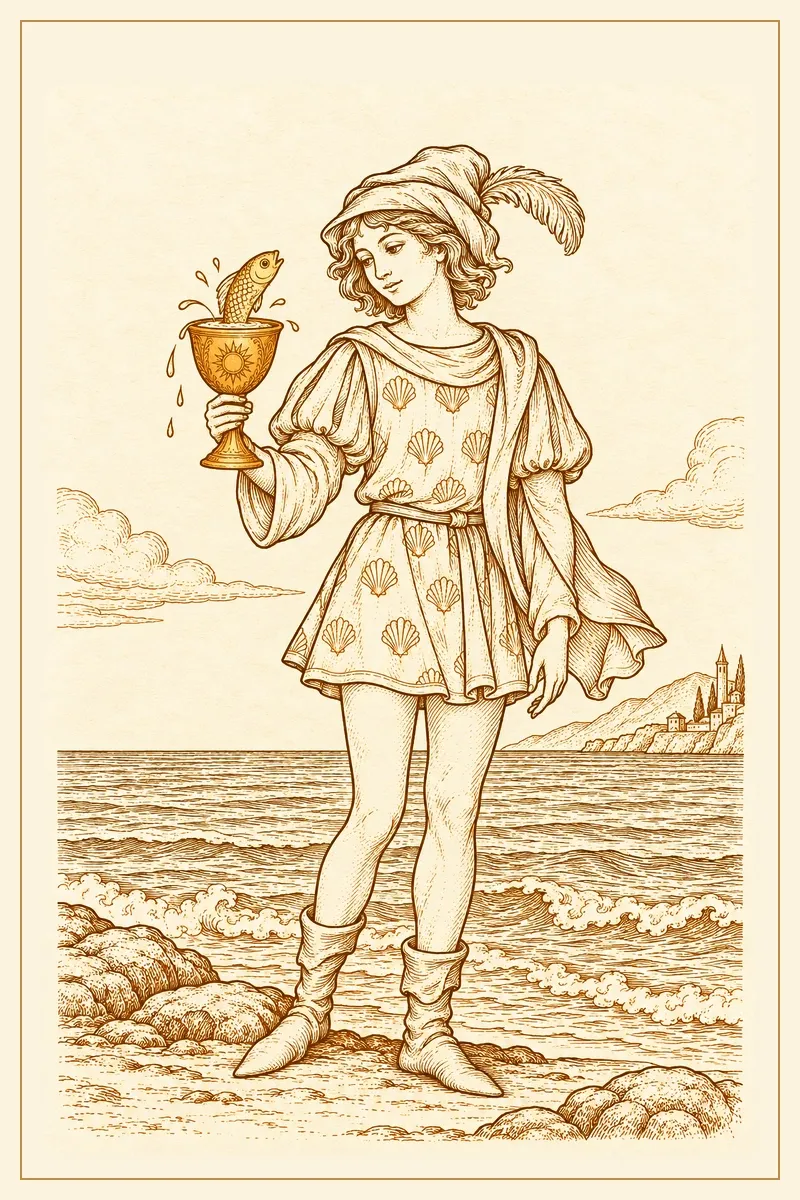
The Page stands on the shore in a shell-patterned tunic and a feathered cap, holding out a cup from which a fish has just leapt, scattering drops. Beside the King, the Page can be a younger person you are mentoring, or the beginner in you who still feels things before understanding them. The full Page of Cups tarot card meaning covers that first, tender stage of the suit.
Knight of Cups: the offer in motion
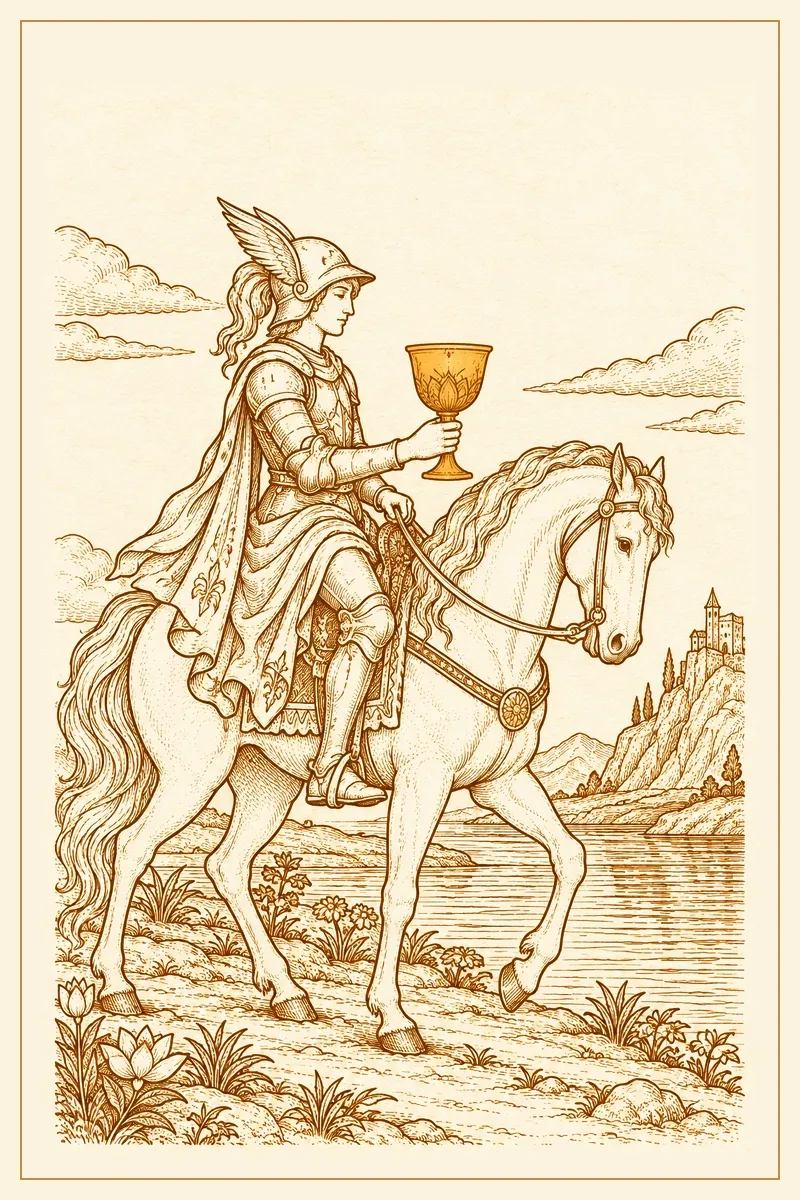
The Knight wears a winged helmet and rides a white horse at a walk along the water, a cup held forward like an invitation. He is romance, idealism and an offer on its way to you. This is the card the Golden Dawn called its King. With the King, the Knight often describes an offer meeting the maturity to judge it, or a romance growing up. The Knight of Cups meaning explains when that charm is sincere.
Queen of Cups: the partner on the next throne
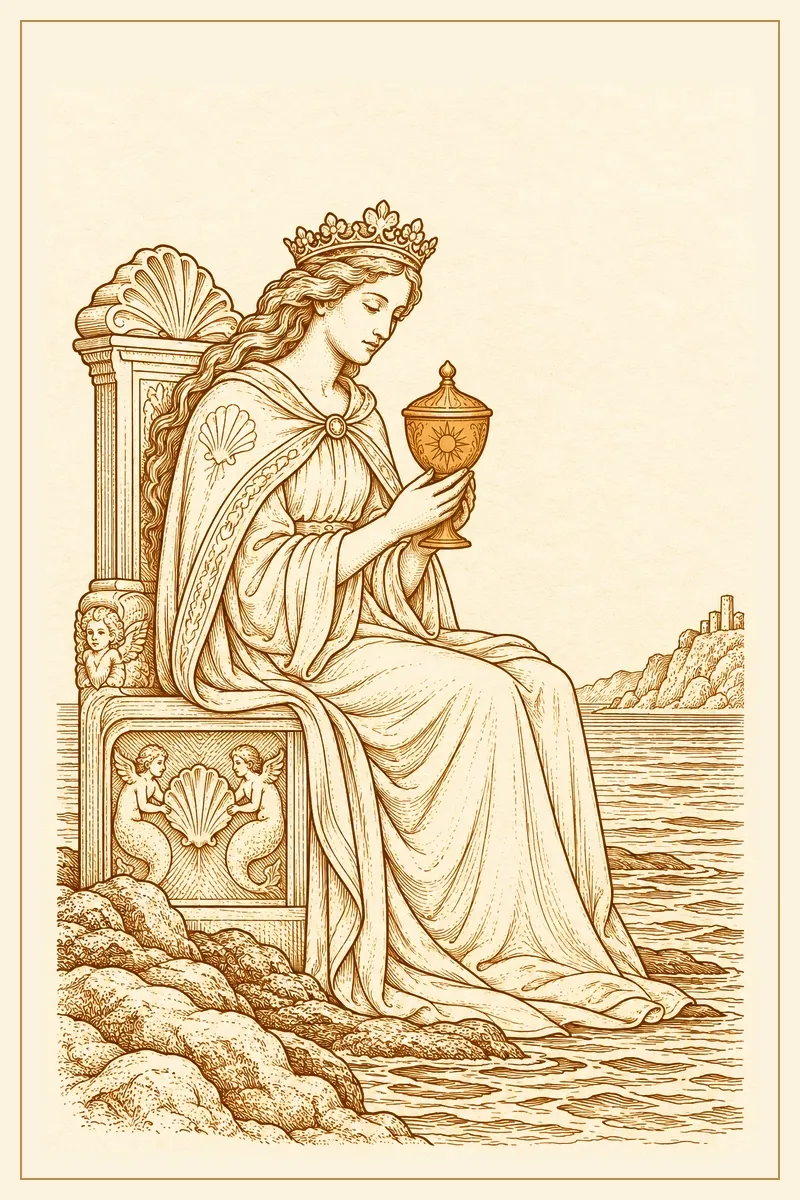
The Queen sits at the water's edge on a throne carved with shells and small sea figures, gazing into an ornate lidded cup she holds close. Her feeling turns inward, toward intuition and receptivity; the King's turns outward, toward counsel and action. Together they are the suit's deepest emotional partnership, two mature people who understand each other without needing everything explained, or, in one person, the balance of listening and responding. Read the Queen of Cups tarot meaning for the receptive side of that pair.
Next to the Emperor, Justice or the Tower
With The Emperor, two thrones meet. The Emperor sits armored on a throne carved with rams' heads; the King of Cups sits barefoot in the surf. Together they describe leadership that is both firm and kind, or two parenting styles that complement each other. The Emperor tarot meaning fills in the structural half of that pair.
With Justice, the pairing points to fair and compassionate judgment: a decision that weighs rules and mercy, logic and empathy. For legal matters, the cards can help you clarify what matters to you, not replace a lawyer. The Justice tarot meaning covers the balance side in more detail.
With The Tower, the King's calm is tested by sudden upheaval, and he is the one who stays steady while things break. Reversed beside the Tower, it can mean that feelings held down for too long are now breaking out all at once. The full Tower tarot meaning explains why that collapse can also clear the ground.
Among the minor cards, the Five of Cups beside the King suggests grief held with dignity, or someone who can sit with you in a loss.
The Rock and Tide spread: five positions for a heavy week
This spread borrows its positions from the King's own picture. Use it when feelings are running high, yours or someone else's, and you want to find your footing before you act. Shuffle, draw five cards and lay them in a row.
- The surf: what is stirring you up right now.
- The rock: what already keeps you steady, even if you have forgotten it.
- The cup: the feeling you are holding, and whether it is yours or someone else's.
- The scepter: the decision that is genuinely yours to make.
- The pendant: what your intuition is quietly saying, and what to carry forward.
Positions three and four belong together. Many heavy weeks come from carrying a feeling that belongs to someone else while avoiding a choice that belongs to you.
Sample reading: the one everyone calls in a crisis
Imagine someone whose sister is going through a divorce. For weeks they have spent most evenings on the phone with her, and they ask: "How do I keep supporting my sister without going under myself?" They draw the Rock and Tide spread.
- The surf: Ten of Wands.
- The rock: Temperance.
- The cup: King of Cups, reversed.
- The scepter: Four of Swords.
- The pendant: Three of Cups.
The Ten of Wands names the surf plainly: too much carried for too long. Temperance in the rock position is a reminder that this person already knows how to pace things. The reversed King in the cup position is the heart of the reading. They have been playing the calm one on every call and absorbing their sister's distress without letting any of their own feeling out. On the outside it looks like strength; underneath, the water is rising.
The Four of Swords in the scepter position makes the decision concrete: rest is a choice they are allowed to make. The Three of Cups in the last position suggests the support does not have to come from one person. Other friends and relatives can share the evenings. A practical response might be to set two fixed call times a week, encourage the sister to lean on a wider circle, and keep one evening entirely for themselves. None of this makes them love their sister less; it lets them stay the upright King for longer.
Keeping your seat when the water rises
If the King of Cups has shown up for you, a few small actions turn the card into practice:
- Name the feeling before you act on it, even just to yourself: "I am hurt," "I am scared," "I am angry."
- Put an hour, or better a night, between a charged message and your reply.
- Notice whose feelings you are carrying this week, and hand one of them back with kindness.
Then journal on three questions. Where is the water rough right now, and what helps you keep your seat? Are you using your understanding of people for connection or for control? Where are you being asked to lead with compassion?
Frequently asked questions
Is the King of Cups a person or a feeling?
Either, and sometimes both. About other people it often describes someone calm and emotionally mature; about yourself, the steadiness the situation asks you to bring. Let the position and your question decide.
Does the King of Cups mean someone has feelings for me?
It can describe warmth and care in a connection, but no card can confirm what another person privately feels, promise an outcome, or give a date. Read it as a picture of the dynamic, then look at how the person actually behaves.
What does the King of Cups reversed mean in love?
Usually emotional unavailability, mixed signals or manipulation: a partner who withdraws, or one who reads you well and uses it to steer things. It can also point to your own habit of hiding hurt until it comes out sideways.
What zodiac sign is the King of Cups?
In the Golden Dawn system, where the modern King is the Prince of Cups, the card covers 20° Libra to 20° Scorpio, so it is mostly Scorpio. Some readers also link it with Cancer or Pisces for its caretaking and intuitive qualities.
Does the King of Cups have to be a man?
No. Court cards describe ways of handling a suit's energy, and anyone of any age or gender can be the calm, caring authority the King shows.
What is the King of Cups' advice?
Feel what you feel, then choose what to do with it. Stay kind without dropping your boundaries, and let calm come from knowing your own depths rather than from pretending the water is still.
Your own seat on the rock
The King of Cups ends the suit's court with its hardest skill: staying open to feeling without being carried off by it. If you want to follow the suit from its first spark, the Ace of Cups is where the water begins, and the Ace of Cups card meaning traces that opening in detail. If you are new to all of this, the beginner's introduction to tarot is a gentle place to start. And when you have a question of your own, you can draw your cards in a quiet reading and see where your seat is today.