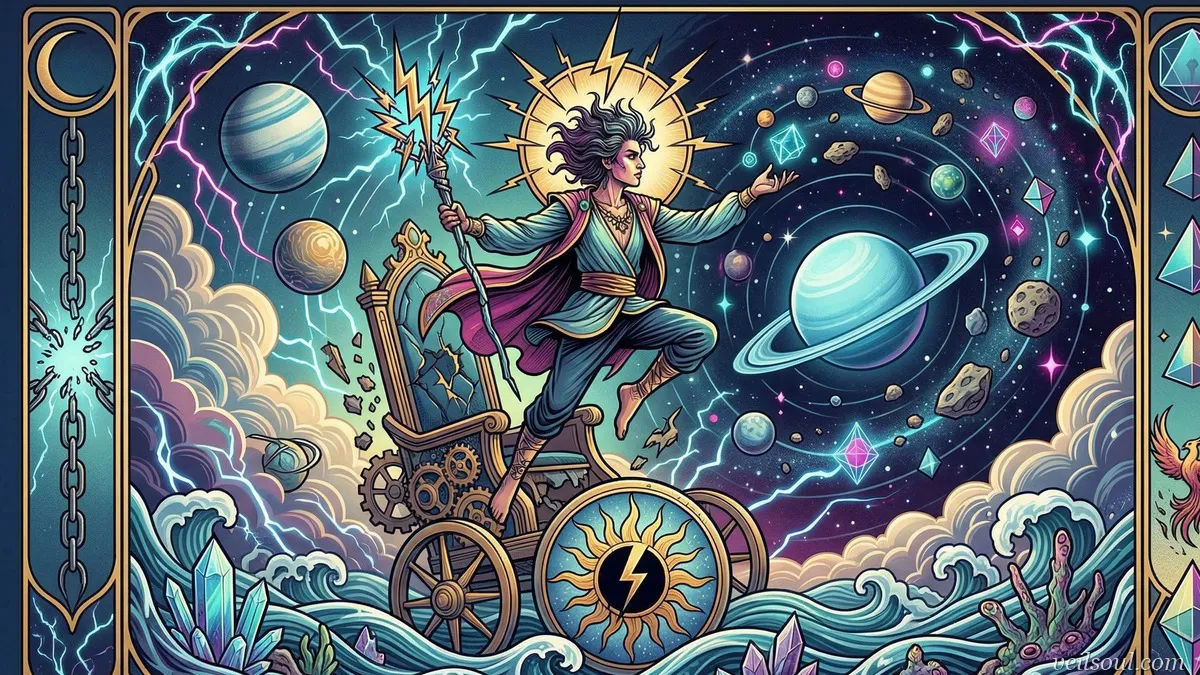
If you are looking for Pluto's tarot card, most modern readers will point you to Judgement (XX), the card of the trumpet call and the figures rising from their tombs. Many also connect Pluto with Death (XIII), because Death is the card of Scorpio and Pluto is Scorpio's modern ruler. Both pairings are modern conventions: Pluto was found in 1930, after the classic map linking tarot and astrology had been drawn, so it has no traditional card of its own.
Because these links are recent, you are free to test them and keep what helps. Whichever card you link to Pluto, a reading cannot tell you when a hard chapter will end, what another person intends or how a change will turn out. It can help you see what is ending, what you are still gripping and what might be ready to grow in its place.
These are the cards readers most often tie to Pluto, and the reason for each:
- Judgement (XX): the most common modern Pluto card; awakening, reckoning and a call to rise.
- Death (XIII): the card of Scorpio, Pluto's modern sign; a real ending that clears space.
- The Tower (XVI): the card of Mars, Scorpio's traditional ruler; the sudden fall of what was unsound.
- Five of Cups: Scorpio's first decan, ruled by Mars; grief and loss that need room.
- Six of Cups: Scorpio's second decan, ruled by the Sun; memory, roots and the past.
- Seven of Cups: Scorpio's third decan, ruled by Venus; desire, fantasy and choosing what is real.
A planet discovered after the deck was mapped
The planetary correspondences most English-language tarot decks follow come from the Hermetic Order of the Golden Dawn, an occult society founded in London in 1888. Its system was built on the seven planets visible to the naked eye, from the Moon out to Saturn, on the twelve zodiac signs, and on three classical elements tied to the Hebrew "mother letters." Each of the twenty-two Major Arcana cards took one of those places, and the numbered minor cards were spread across the 36 decans, ten-degree slices of the zodiac that were each given to one of the seven planets.
Uranus and Neptune had already been discovered by then, but the scheme left them out. Pluto came later still: Clyde Tombaugh found it at Lowell Observatory in Arizona in 1930. With every card and every decan already assigned, there was no seat waiting for it. So Pluto has no classical card and no decans, and every link you will read between Pluto and a tarot card was made by twentieth-century readers.
In 2006 the International Astronomical Union reclassified Pluto as a dwarf planet, but most Western astrologers still read it in a birth chart. Its stretched orbit takes about 248 years, so Pluto stays in one sign for anywhere from about twelve to more than thirty years. That placement is read as a generational backdrop, while its slow passage over the key points of one person's chart is read as a long season of change.
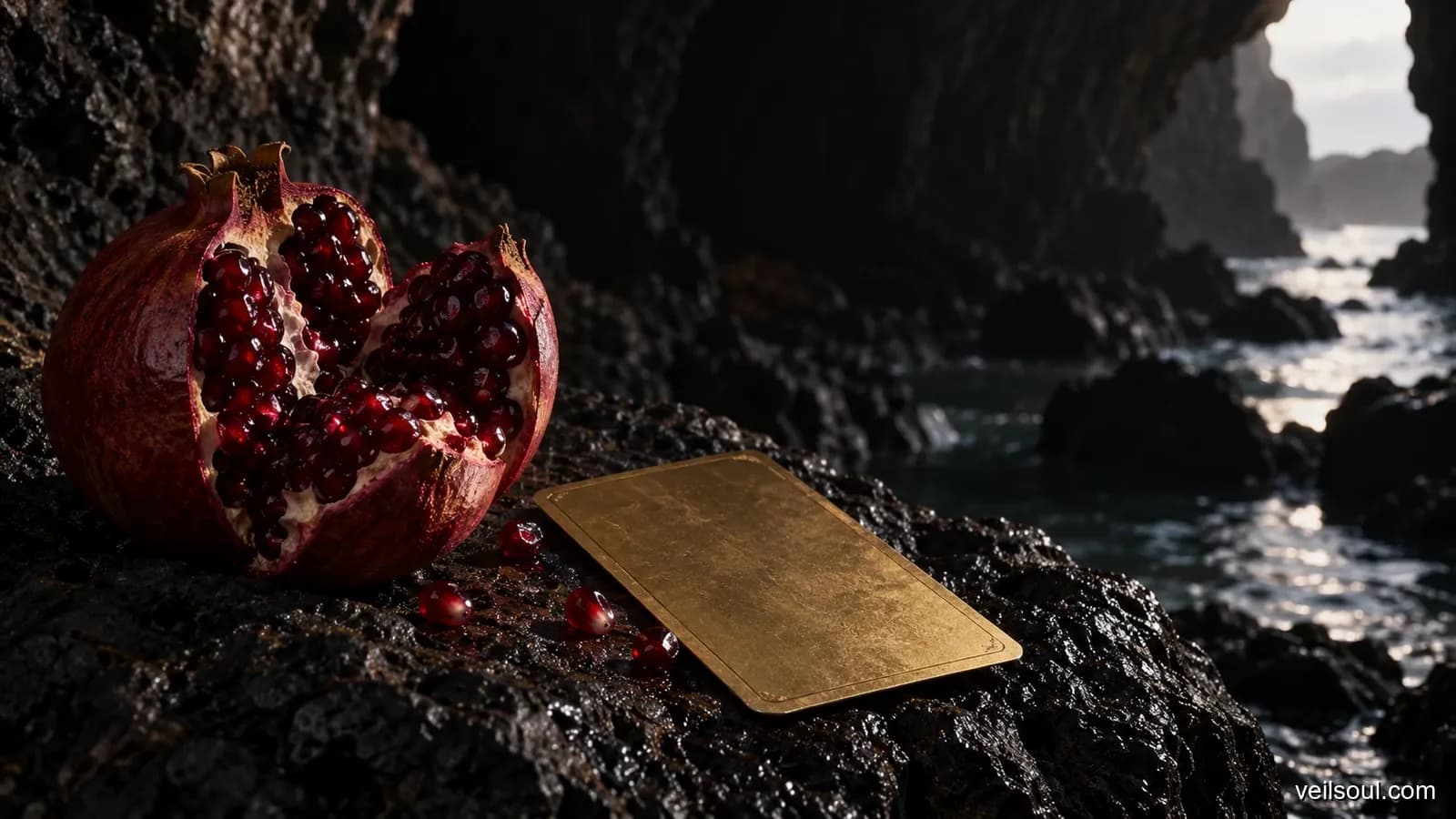
The name is the Roman one for the ruler of the underworld, and astrology gives the planet his themes: endings, what lies hidden or buried, power and control, debts and resources held in common, and renewal after loss. In the myth, Persephone eats pomegranate seeds in his realm and so must return there for part of every year, which is why the pomegranate often stands for a descent that is also a cycle. These are the themes readers look for when they match Pluto to a card.
Why Judgement became Pluto's card
In the Golden Dawn system, Judgement was not a planet card at all. It belonged to the Hebrew letter Shin and to the element Fire, while The Fool held Air and The Hanged Man held Water. When twentieth-century astrologers and tarot writers looked for places to put the three outer planets, these elemental cards were the obvious openings, because they were the only trumps without a sign or a classical planet. The pairing that became most widely used gives Uranus to The Fool, Neptune to The Hanged Man and Pluto to Judgement.
The fit is more than convenient. Judgement shows an ending that is not final: something buried hears a call and comes back up, changed, which is close to how modern astrology describes Pluto. Some readers still prefer Death, so both cards appear here.
Judgement (XX): the call to rise
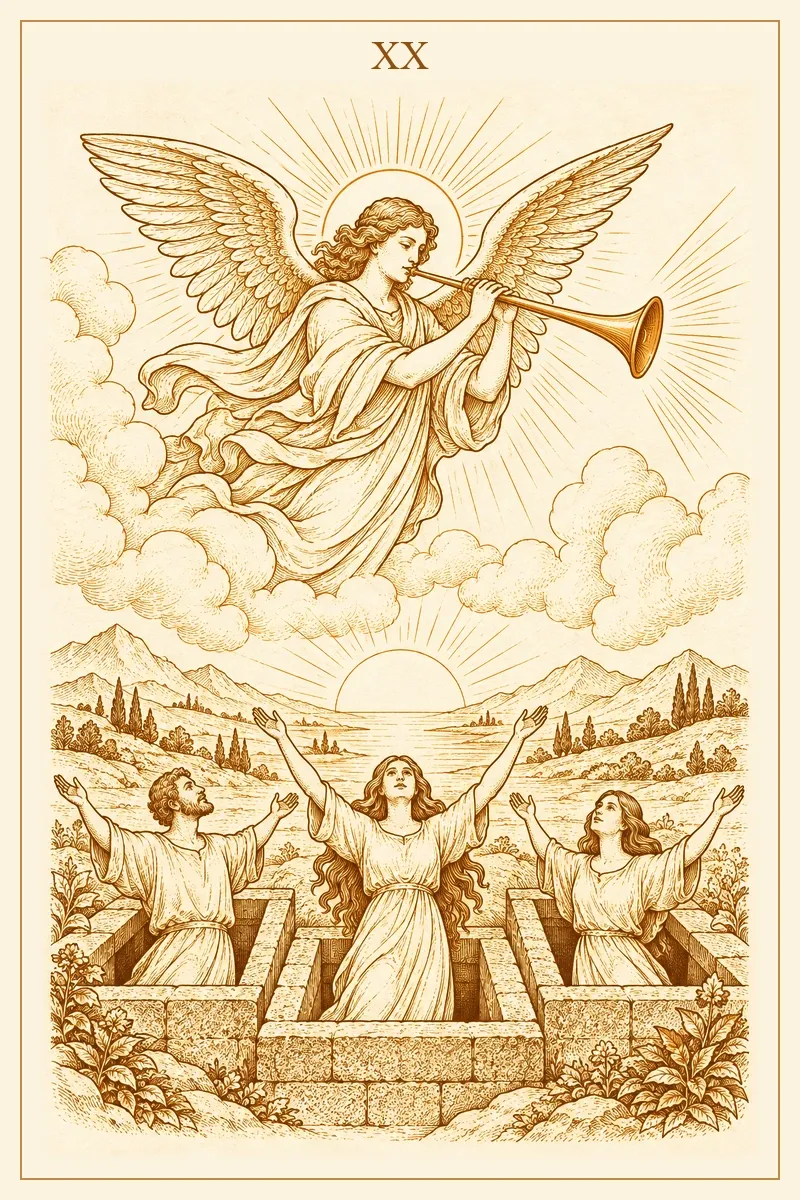
An angel leans out of the clouds and sounds a long trumpet. Below, three figures, a man and two women, stand up in open stone tombs with their arms raised toward the sound. Behind them the sun sits low between distant hills. Nothing in the scene is forced: the call goes out, and those who hear it rise.
As a Pluto card, Judgement describes the moment after a long descent when you can finally see your situation whole. Upright, it points to a reckoning that clarifies rather than punishes: you look honestly at what happened, forgive what can be forgiven, including in yourself, and answer a call you have been putting off. It often appears when someone is ready to return to a vocation, a creative path or a relationship on new terms.
Reversed, the call is heard but not answered yet. You may be judging yourself so harshly that you cannot move, or replaying an old verdict instead of making a fresh decision. Sometimes the reversed card simply says the process is not finished; you are still in the tomb, and that is allowed. Our full Judgement card meaning covers the card outside the planetary lens.
In love, Judgement asks what you learned from the last relationship before you repeat it. At work it can mark the point where you admit a role no longer fits. It does not say what the other person will decide; it shows where your own answer is waiting.
The Scorpio route: Death and The Tower
The second way Pluto reaches the deck is through the sign it rules. Modern astrology gives Scorpio to Pluto, traditional astrology gave it to Mars, and many astrologers now name both, calling Mars the traditional ruler and Pluto the modern one. In tarot, Scorpio's own card is Death, and Mars's card is The Tower. Readers who think of Pluto through Scorpio often treat both as Plutonian, and our Scorpio and tarot guide follows the sign through the rest of the deck.
Death (XIII): the ending that clears ground
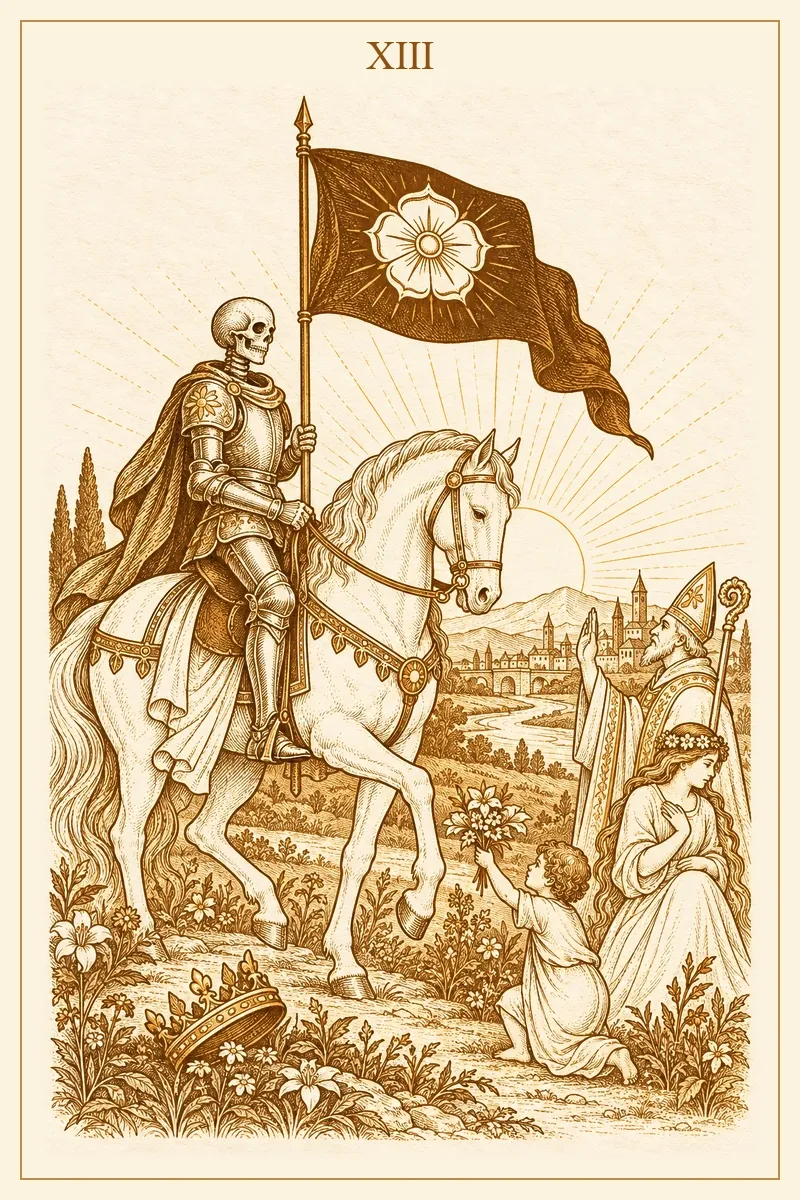
A skeleton in armor rides a white horse and carries a black banner marked with a white five-petaled rose. Under the hooves, a dropped crown rests in the grass. A child kneels and holds up a bunch of flowers, a young woman kneels with her eyes lowered, and a bishop in a tall miter raises his hand as the rider passes. Beyond them, the sun comes up over a walled town. Rank, age and power make no difference to the rider, and the sunrise says the day goes on.
Death is rarely about physical death in a reading. Upright, it names a real ending: a job, a relationship, a habit or an identity that has run its course. In Pluto's terms it is the first half of the cycle, the clearing, and it tends to be gentler than people fear because it describes something that is already finished. Reversed, it often shows resistance: holding on to what has ended, or living in a long in-between because closing the door feels too final. For the card's full range, see the Death card meaning.
In love, Death can describe the end of one way of being together rather than the end of the relationship itself. In money and work, it can mark a closed chapter, such as a role, a business model or a debt you finish paying off, that frees energy for whatever comes next.
The Tower (XVI): the older ruler's sudden break
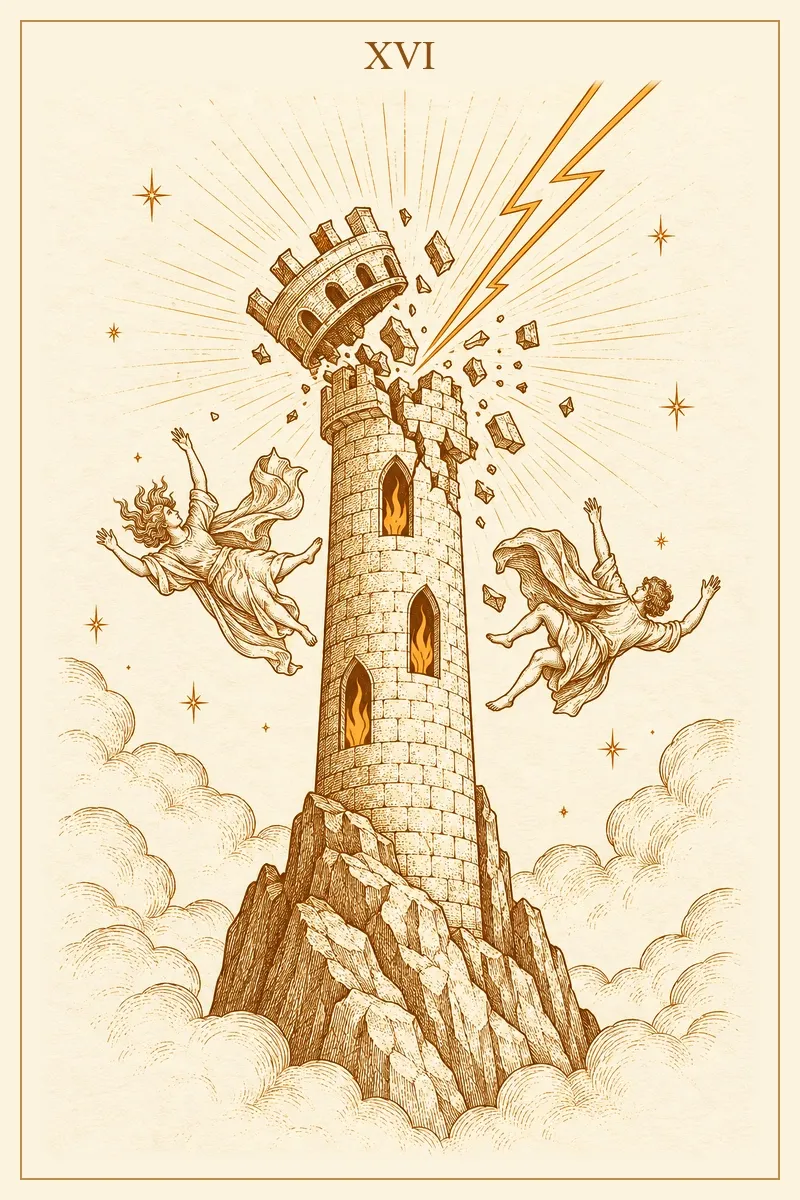
Lightning strikes a stone tower on a rocky peak above the clouds and knocks off its crown-shaped top. Flames show in the windows, and two people fall through the air among small stars. The tower looked secure; the lightning shows that it was not.
Mars ruled Scorpio long before Pluto was found, and our look at Mars in tarot explains why the planet of force and courage owns this card. Some readers see The Tower as the sharp, sudden face of a Pluto story, where Death is the slow one. Upright, it marks a shock or a truth that cannot be unseen, and the collapse of something built on a false premise. Reversed, it can mean bracing harder to avoid a crisis, or a quieter inner collapse, such as a belief giving way. The Tower card meaning goes further into both sides.
Three cups from Scorpio's decans
Scorpio's thirty degrees are split into three decans, and each one belongs to a numbered Cups card. None of them is ruled by Pluto: the Golden Dawn gave them to Mars, the Sun and Venus. They still carry Scorpio's water, the feelings that run deep and do not leave when ignored, so many readers notice them in a Pluto reading. Each also shows a different way people meet loss: grieving it, looking back at it, or escaping into what might have been.
Five of Cups, the Mars decan: grief that needs room
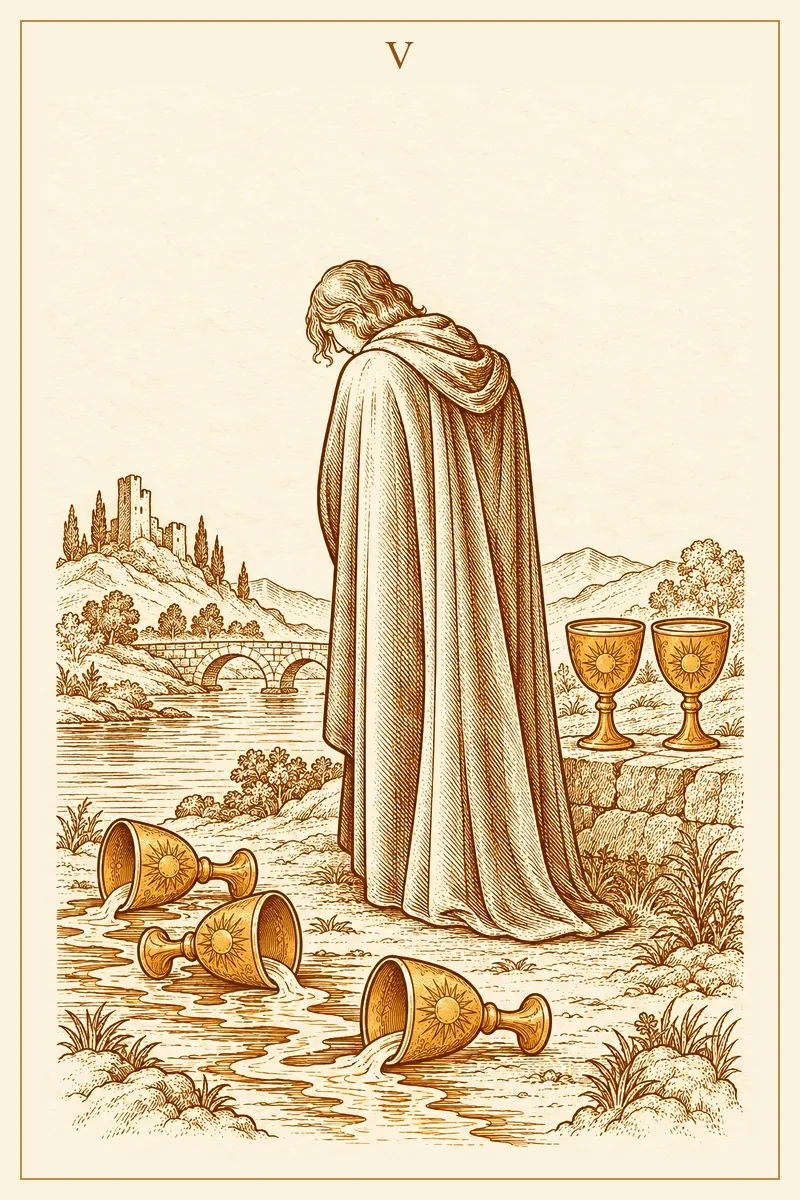
A figure in a long cloak stands with head bowed over three spilled cups, their contents running into the ground. Behind the figure, on a low stone wall, two cups still stand. Across the river an arched bridge leads toward a castle on a hill.
Upright, this card is grief and disappointment that have not been fully felt. In a reading colored by Pluto it reminds you that renewal does not skip the mourning; the two standing cups matter, but you turn to them after you have looked at what was lost. Reversed, it often shows the start of recovery, when you notice what remains and the bridge comes back into view, or, less often, grief pushed down so you can keep going. The Five of Cups meaning covers love and career readings in more detail.
Six of Cups, the Sun decan: what the past still holds
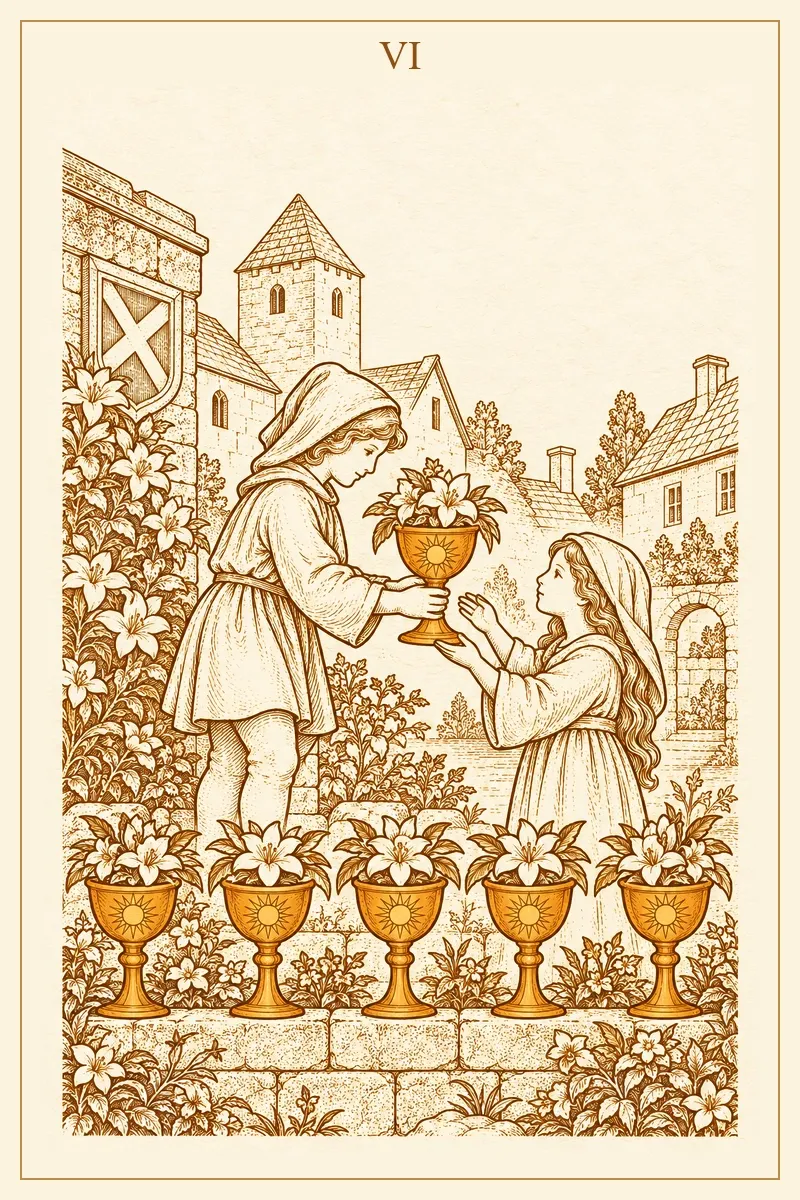
In a village garden, an older boy in a hood hands a cup of white lilies to a younger girl. Five more cups of lilies stand along a stone ledge in front of them, and a shield with a diagonal cross hangs on the wall behind.
Upright, the Six of Cups is memory, kindness and the people who shaped you early. Through a Pluto lens, it asks what from your past still steers your choices today, for better or worse: an old loyalty, a family pattern, a sweetness you want back. Reversed, it can mean being stuck in nostalgia, or finally outgrowing a story about where you come from. The full Six of Cups meaning shows its lighter, everyday side.
Seven of Cups, the Venus decan: desire and illusion
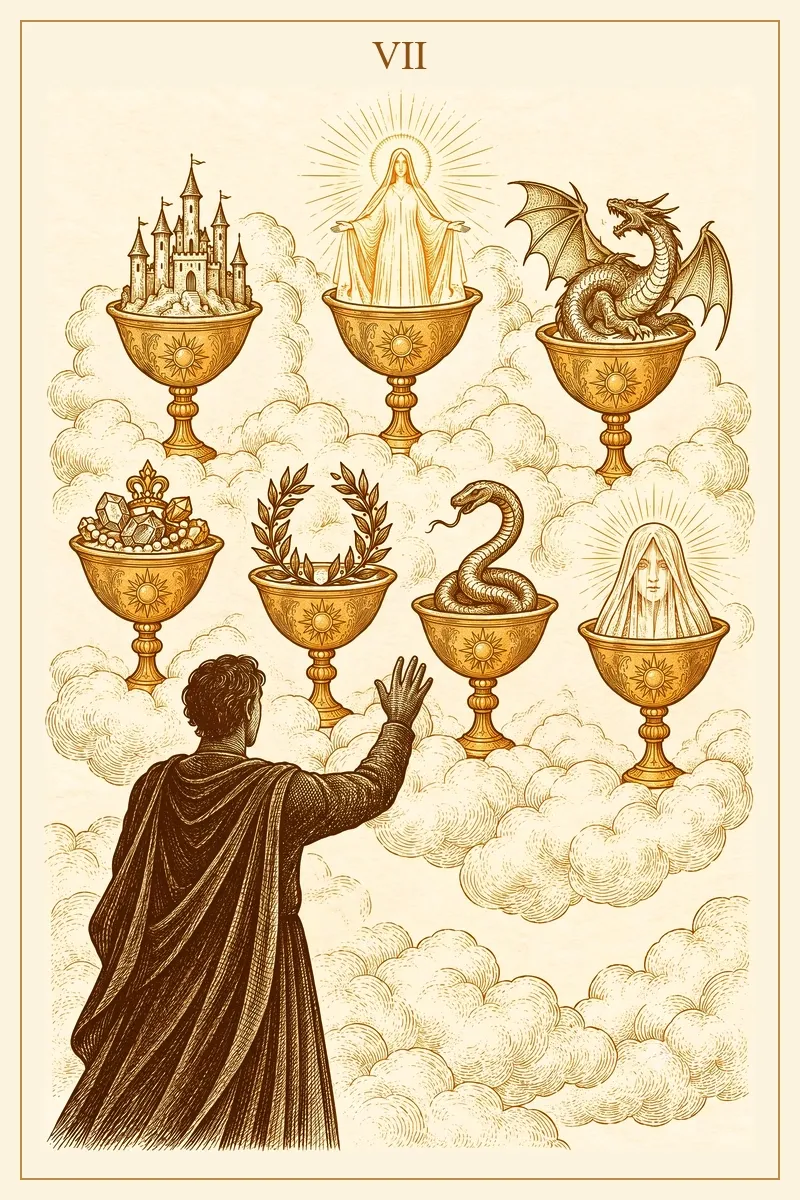
A figure in a dark cloak, seen from behind, raises a hand toward seven cups floating on clouds. Each holds a different vision: a castle, a glowing robed figure, a dragon, a heap of jewels, a laurel wreath, a snake and a veiled head.
Upright, this card is choice clouded by fantasy: many options, few of them solid. Pluto adds a darker note, since some of those cups hold wishes strong enough to turn into fixations. Reversed, it often marks the fog lifting, when you see which option is real and let the others go. Because this decan belongs to Venus, our guide to Venus in tarot makes a good companion, and the Seven of Cups meaning covers the card on its own terms.
Where Pluto themes surface in a reading
You do not need to know astrology to notice Pluto's themes. When Judgement, Death or The Tower lands beside one or more of the Scorpio cups, or when the question itself is about an ending, a power struggle or something kept hidden, it can help to ask what Pluto would ask: what is finished, who holds the power here, and what is underneath?
Love and closeness
Pluto themes in love are about depth, trust and control. The cards may point to jealousy, secrets or a bond so intense it leaves little room to breathe, or to a relationship that must change shape to survive. Ask what you fear would happen if you let the other person see you clearly, and whether either of you uses closeness to keep control.
Work and authority
At work, Pluto shows up as restructuring, a change of leadership, or your own relationship with authority. The Tower might describe a reorganization you did not choose; Judgement might describe the moment you stop chasing a role someone else wanted for you. The useful question is where your real influence lies, not how to win every struggle.
Money, debts and shared resources
Astrologers link Scorpio and Pluto with money held in common: joint accounts, inheritances, loans, taxes and what partners owe each other. Cards in this area invite a clear look at who controls the money and which agreements have never been said out loud. Treat them as a prompt for an honest conversation or a plan, and for decisions with real stakes, talk with a qualified advisor.
Shadow and what you keep hidden
Pluto is often called the planet of the shadow: the parts of yourself you push out of sight, such as anger, envy, shame or a hunger for control. A reading full of Pluto cards can be an invitation to look at one of those parts with curiosity instead of judgment. If that is new to you, our guide to shadow work with tarot offers gentle prompts to begin with. If what surfaces feels heavy, a counselor or someone you trust is better support than a deck of cards.
Does a Pluto card mean something bad is coming?
No card is a sentence handed down. Death, The Tower and the Five of Cups have heavy pictures, and it is natural to tense up when they appear, but in practice they usually describe something already in motion: a feeling you have not named, a structure already cracking, an ending you can sense. Seeing it in a card gives you a chance to meet it on your own terms.
Pluto's slowness matters too. A Pluto transit over a sensitive point in a chart can last a year or more as the planet passes back and forth, so Pluto cards are best read as a season rather than an event. Instead of asking for an end date, ask which stage you are in: the ending, the in-between or the return.
Reversals do not make these cards worse. A reversed Death may simply say you are not ready to let go yet; a reversed Tower may show a quiet internal shift instead of a public crash. Read the orientation as a question about pace and resistance, not as a warning.
A descent-and-return spread
This five-card spread follows the shape of a Pluto story: down, through and back up. Lay the first three cards in a line that steps downward, then the last two climbing back up beside them, so the layout forms a V.
- What is ending: the chapter, role or habit that has run its course.
- What I am still gripping: what I hold on to that keeps me from moving through.
- What lies underneath: the feeling or fear below the surface of this situation.
- What I can reclaim: a strength or part of myself I gave away and can take back.
- What is ready to rise: what can grow once the ending is complete.
Use it when something is clearly changing, during Scorpio season from late October to late November, or whenever an ending keeps asking for attention. Write one sentence of your own for each card before you look up any meanings, and revisit the spread a few weeks later.
Reading the V: a role that no longer fits
Here is how the spread might read for an invented but common question. Someone has spent eight years in a job they worked hard to reach. They are good at it, yet they feel flat and quietly resentful, and they ask: "Why do I feel stuck in the work I chose?"
- What is ending: Death, upright.
- What I am still gripping: Four of Pentacles, upright.
- What lies underneath: Five of Cups, reversed.
- What I can reclaim: Strength, upright.
- What is ready to rise: Ace of Wands, upright.
Death in the first position does not say "quit." It says a chapter has already closed inside the person, perhaps the version of them who needed this title to feel worthy. The Four of Pentacles shows what keeps them in place: security, status and the fear of losing what they built. That is understandable, and it is also the grip that keeps the flatness going.
The reversed Five of Cups underneath is the tender part: disappointment that reaching the goal did not feel the way they hoped, which they are only now starting to admit. Strength points to patient self-command rather than a dramatic exit, such as limits on overtime or saying clearly what they want next. The Ace of Wands promises nothing, but it shows a spark of interest worth following, perhaps a course or a side project.
A practical next step would be one small, concrete move within a month, then a second look at the spread afterward. The cards did not decide whether to leave; they separated the ending that has already happened from the decision still to be made.
Frequently asked questions
What tarot card is Pluto?
The most common modern answer is Judgement (XX). In the Golden Dawn system that card belonged to the element Fire, and twentieth-century readers gave it to Pluto, along with The Fool for Uranus and The Hanged Man for Neptune. Many readers also link Pluto to Death through Scorpio.
Is Death Pluto's card or Scorpio's card?
Strictly speaking, Death is Scorpio's card. Pluto reaches it because modern astrology makes Pluto the ruler of Scorpio. If you use only the traditional rulers, Scorpio belongs to Mars, and the card that goes with Mars is The Tower.
Pluto is a dwarf planet now. Does it still count in tarot?
It counts if it is useful to you. The 2006 decision changed Pluto's category in astronomy, not the symbolism astrologers have built around it since 1930. Most modern astrologers still read it, and anyone who prefers the seven classical planets can simply leave it out.
Why does Pluto have no decan cards?
The 36 decans were divided among the seven classical planets long before Pluto was found, and the Golden Dawn kept that order. The three Scorpio cups connect to Pluto only through the sign, not through decan rulership.
Can tarot tell me when a hard period will end?
No. Tarot cannot give a date, confirm what another person will do or guarantee an outcome. It can show where you are in a process and what might help you move through it, which is often more useful than a date would be.
Walking back up into the light
Pluto's place in tarot is young and still debated, which leaves room for your own experience. Whether you read it through Judgement, Death or the Scorpio cups, the pattern stays the same: something ends, something hidden comes to light, and something truer has space to grow.
When you have a change of your own to look at, draw a reading with the descent-and-return positions and let the cards show you where you stand.