Temperance, card XIV of the Major Arcana, is the Sagittarius tarot card, and it is not the only card the sign holds. The three Sagittarius decans run across the Eight, Nine and Ten of Wands, Jupiter's rulership brings the Wheel of Fortune in behind the sign, and two court cards split the archer's thirty degrees between them. None of them reports what Sagittarius season will hold, what a Sagittarius is privately thinking, or the day an arrow lands.
What this set of cards does well is show the distance between the aim you announce and the aim you are actually taking. That gap is the whole Sagittarius story: a sign that loves a horizon and has to learn what it costs to keep walking toward one.
Here is the full set at a glance, covering about November 22 to December 21, mutable fire, ruled by Jupiter.
- Temperance (XIV): the card of the sign itself, patient mixing and the long aim.
- Wheel of Fortune (X): Jupiter's card, standing behind the sign as its ruler.
- Eight of Wands: first decan, Mercury in Sagittarius, departure and speed.
- Nine of Wands: second decan, Moon in Sagittarius, tired persistence.
- Ten of Wands: third decan, Saturn in Sagittarius, the weight of every yes.
- Knight of Wands: the mounted court card on the Scorpio and Sagittarius border.
- Queen of Pentacles: the court card on the handover from Sagittarius to Capricorn.
The angel standing in the river, not the archer on the hunt
Readers who expect a loud card for Sagittarius are usually surprised by Temperance. The sign is drawn as a centaur with a bow at full draw; the card is a winged figure standing with one foot on the bank and one in the water, pouring from a jug into a cup without spilling a drop. Sagittarius received Temperance in the Golden Dawn tables that still sit behind most modern decks, and with it the Hebrew letter Samekh, a name that means support: the prop that holds something steady while it is being made.
The pairing makes sense as soon as you look at what a shot actually requires. It is not enthusiasm. It is a held position, a steady arm, controlled breath, and a long calm moment before release. Behind her the stream runs back through low hills toward a sun just clearing the ridge, which describes the Sagittarius quest as well as the bow does: the light is a long way off, and the only route to it is one step after another.
Temperance (XIV): the slow mix, upright and reversed
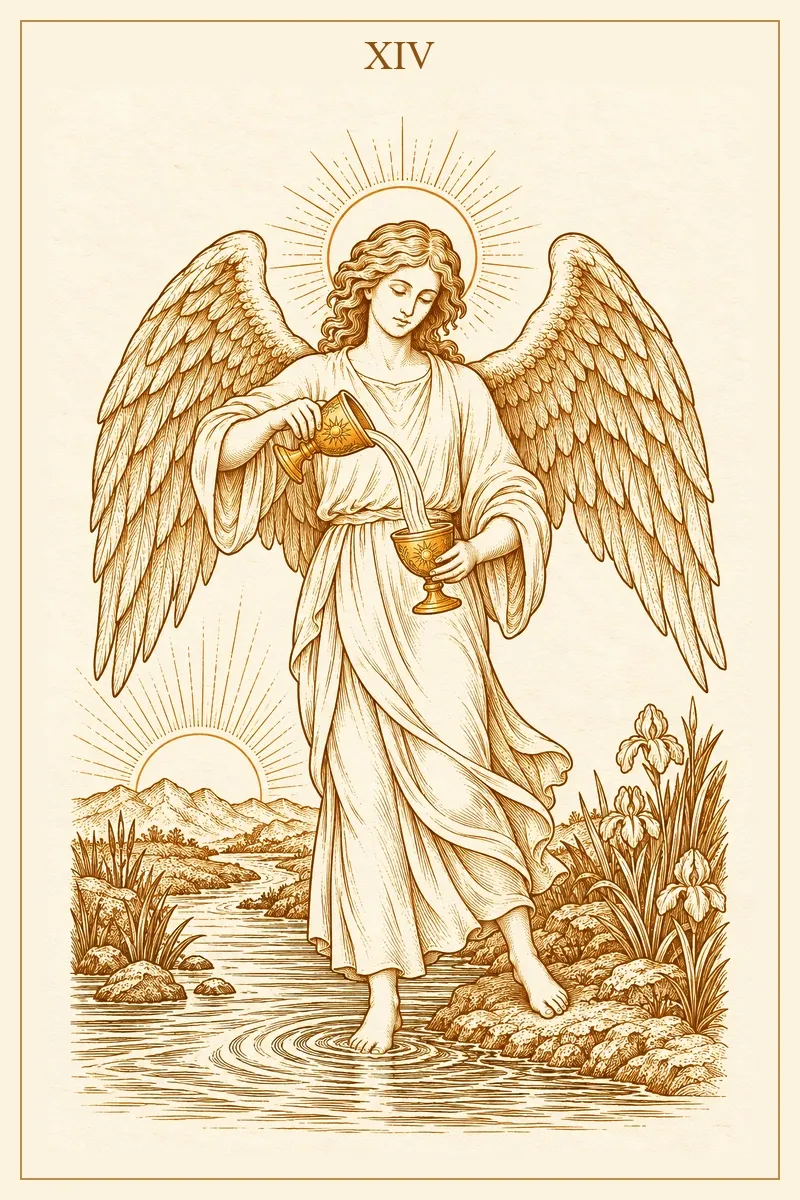
Upright, Temperance asks for a combination rather than a choice. Two things that do not obviously belong together are being blended at a rate that cannot be hurried: study and a job, two countries, the belief you were raised in and the one you found later, an old friendship and a new life. The card is calm about this because the mixing is working. It often turns up when someone wants to be told which half to drop and the honest answer is neither, not yet.
Reversed, the mix has gone wrong in one of two directions. Either the proportions are off, which looks like overdoing one side until the other is starved, or the blending has been abandoned and the two halves are kept in separate rooms. Reversed Temperance is also the card of the rushed cure: the course finished in a weekend, the reconciliation attempted before anyone has cooled down. It is not a punishment, only a note that the recipe needs a slower hand. The Temperance tarot meaning works through both positions in love, work and health questions.
Jupiter behind the bow
A sign's ruling planet comes with a trump of its own. Sagittarius is ruled by Jupiter, so the Wheel of Fortune stands behind Temperance the way a second figure stands behind a portrait. Jupiter is the planet astrologers call the great benefic: growth, scope, generosity, faith, appetite. The Wheel is what that looks like in motion, a turn nobody scheduled, a door opened from the outside, a run of good luck that is a phase rather than a possession. For the planet and its card in full, there is a separate guide to the Jupiter tarot card meaning.
Inside a Sagittarius reading, Jupiter is mostly a question of scale. It enlarges whatever it touches, including the errors: the trip gets longer, the course costs more, the opinion gets louder, the promise covers more ground than you can staff. When the Wheel appears beside these cards, read it as movement with its own timing rather than as a reward, and ask what you would do if the turn went the other way.
This is also why the Sagittarius cards rarely counsel stopping. Jupiter's answer to a problem is more: more reading, more travel, more people, more meaning. Temperance is the counterweight the sign was handed on purpose.
Wands Eight, Nine and Ten: the three Sagittarius decans
Cut the archer's thirty degrees into ten-degree thirds and each third gets a numbered Minor Arcana card and a sub-ruling planet. Sagittarius takes the last three cards of the Wands suit, so the fire that opened as a spark in Aries and warmed into display through Leo finishes here as a load somebody has to carry. The dates below are rounded, because the Sun crosses into Sagittarius on a slightly different day each year, and the wider method is laid out in the guide to tarot timing with astrology.
Eight of Wands: Mercury in Sagittarius, about November 22 to December 1
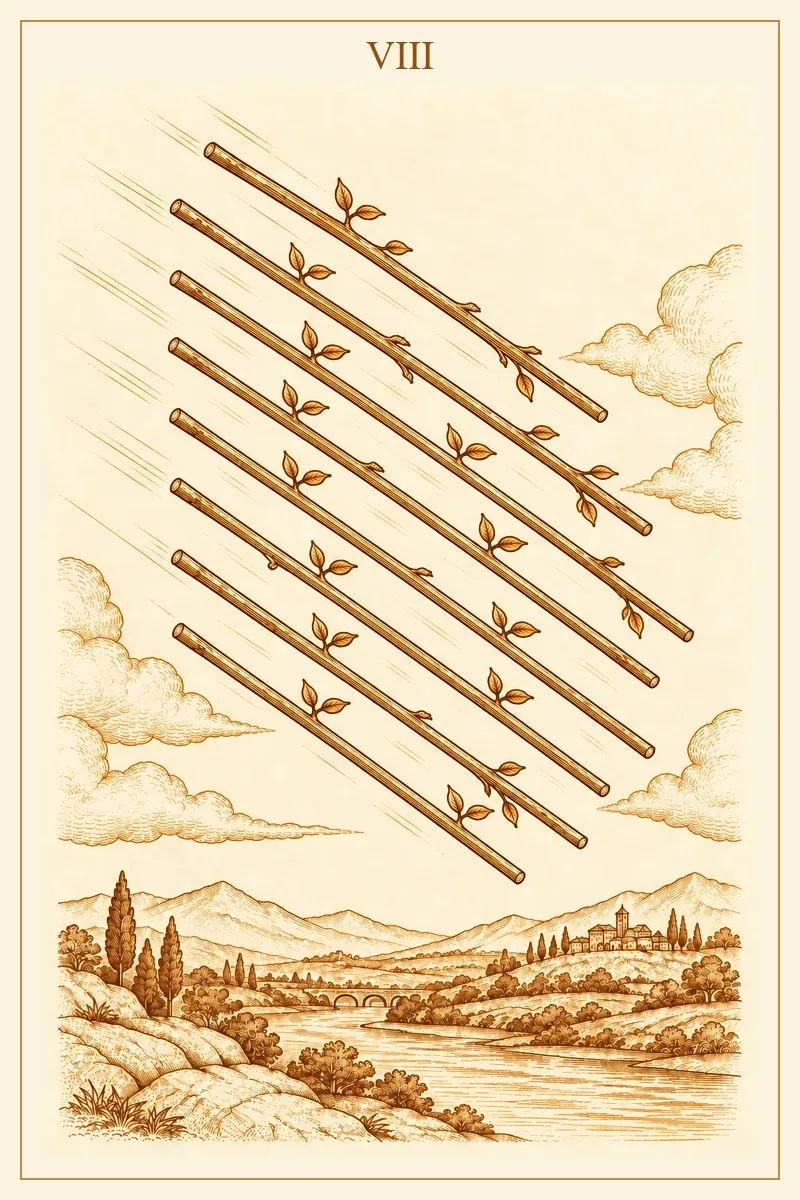
Mercury speeds Jupiter up. The Eight of Wands shows eight staves in flight over open country, already loosed and nowhere near the ground; the Golden Dawn titled it the Lord of Swiftness. This is the decan of departure, when tickets are booked, messages go out, and an idea gets explained to three people before lunch.
Upright: several things move at once. News arrives, a reply finally lands, a plan that sat still for months suddenly has dates attached to it. Literal travel is common with this card, and so is the figurative kind, as when a conversation that had been circling for weeks goes somewhere in one evening.
Reversed: the arrows are in the air and nobody aimed. Messages cross, three versions of the same plan live in three different places, or everything stalls and you cannot tell whether to chase it or wait. Reversed, this card is nearly always asking what the target was. The Eight of Wands card meaning follows both positions into other kinds of question.
Nine of Wands: Moon in Sagittarius, about December 2 to 11
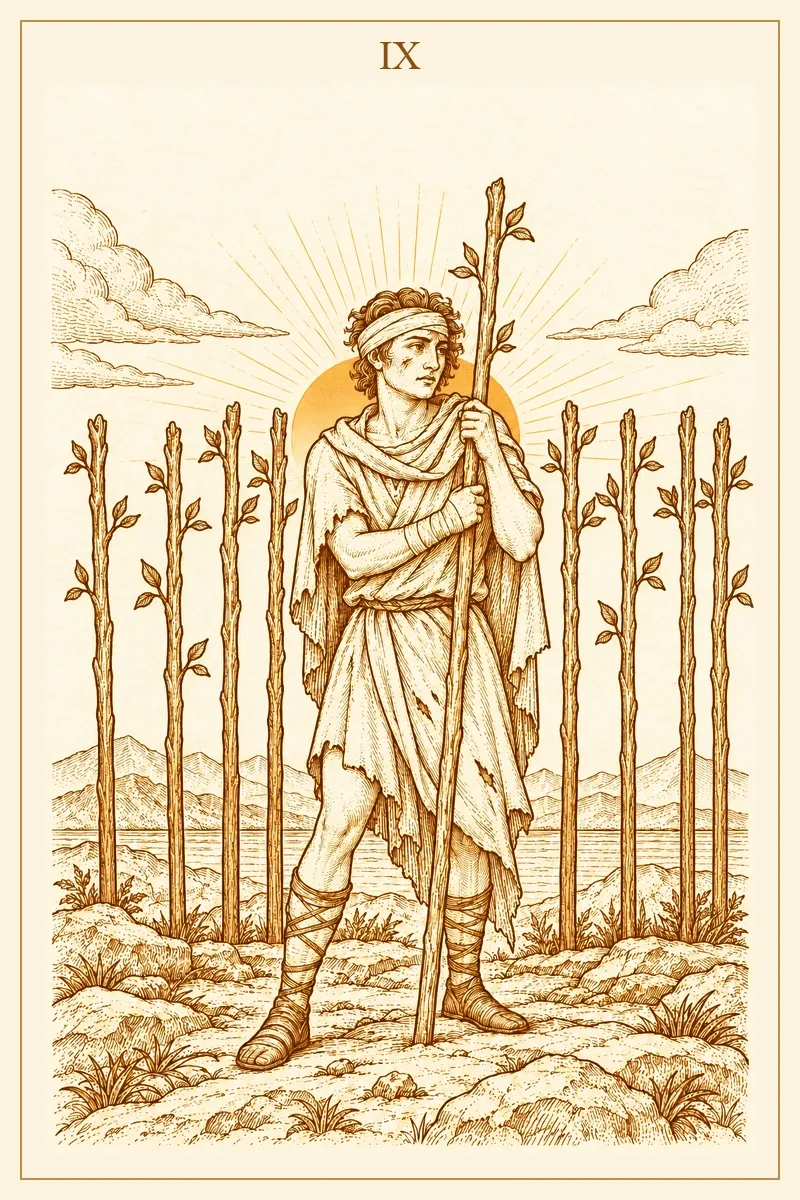
The Moon in a fire sign adds memory, and memory is what the Nine of Wands runs on. A bandaged figure stands gripping one stave with eight more planted behind like a fence, watching ground that was lost once already. Book T names it the Lord of Great Strength, though the strength in question is not fresh; it is earned.
Upright: you are tired and still standing, and the card respects that. It usually means the thing being guarded is worth guarding, and it often arrives at the exact point where one more effort would finish the job. Rest is allowed here; surrender is not being asked for.
Reversed: the fence is still up long after the threat left. That can look like defending against something that ended years ago, refusing help because asking feels like losing, or an exhaustion that has stopped producing anything. The fuller picture, including how it reads in relationships, is in the Nine of Wands card meaning.
Ten of Wands: Saturn in Sagittarius, about December 12 to 21
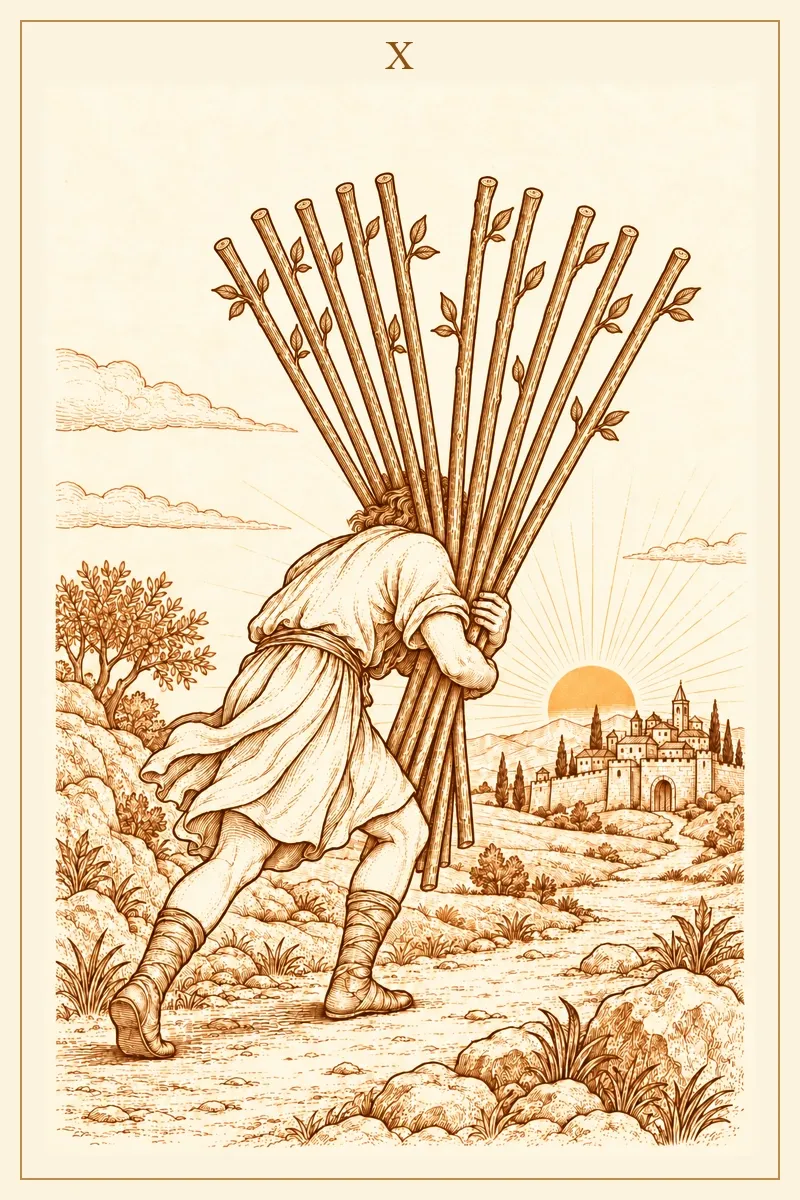
Saturn is the invoice for Jupiter's generosity. The Ten of Wands shows a figure bent under ten staves, close enough to the town to see it and unable to see over the bundle. The old title, the Lord of Oppression, is blunt, and the oppression is self-assembled: every stave in that armful was something agreed to.
Upright: too much, nearly done. The work is real and the finish line is real, but the cost is being paid out of your evenings. The useful question is which of the ten belongs to somebody else, and which were picked up because saying no felt ungenerous.
Reversed: most often the bundle coming down, through a handover, a resignation, a course dropped, or a commitment finally named out loud as too much. Occasionally it is the reverse, carrying on well past sense and calling it duty, and the position plus the cards around it will tell you which. The Ten of Wands card meaning sets out the variations.
The court cards, and why two systems name them differently
A court card does not sit inside one sign. It straddles a boundary, taking the final ten degrees of one sign and the first twenty of the one after, so two of them overlap Sagittarius. Most of the confusion comes from the rank names: the Golden Dawn papers speak of Kings, Queens, Princes and Princesses, while the decks on a shop shelf carry Kings, Queens, Knights and Pages.
Rank for rank, the Golden Dawn King is the one on horseback, which is the place most modern decks give the Knight, so the card covering the Scorpio and Sagittarius border is the King of Wands in the old sources and the Knight of Wands in most readings today. The Golden Dawn's Prince, the rank in a chariot, is the one that maps to the modern King. Both mappings are in use and neither is an error; if your book talks about Princes and Princesses, translate the ranks before you argue about them. The overview of court cards goes through the four ranks in detail.
Knight of Wands: the mounted card on the Scorpio border
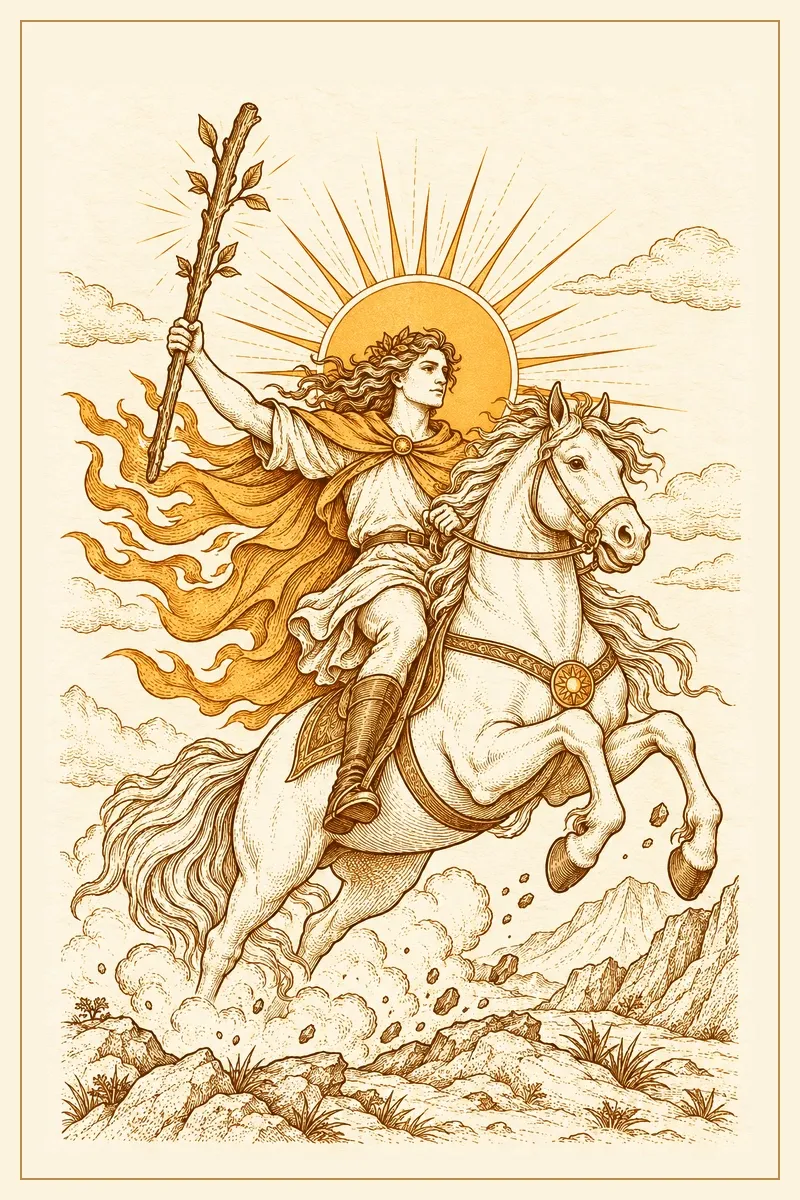
The Knight of Wands covers twenty degrees of Scorpio to twenty degrees of Sagittarius, which is the stretch where intensity turns into motion. Horse half-reared, cloak streaming out behind him like flame, already going before the question has finished being asked: this is the Sagittarius portrait most readers recognize.
Upright: a yes with momentum behind it. A move, a trip, an application sent, a person who makes a plan sound possible, a burst of enthusiasm that genuinely carries other people along with it. Drawn for a person, he tends to describe a teacher, a traveler, a coach or a salesperson.
Reversed: the start without the finish. Three projects at seventy percent, a warm promise made over dinner and never mentioned again, a restlessness that feels like freedom from the inside and like unreliability from the outside. It is rarely malice; it is a charge that ran out. The Knight of Wands card meaning covers how he behaves in love and work questions.
Queen of Pentacles: where the archer hands over to the goat
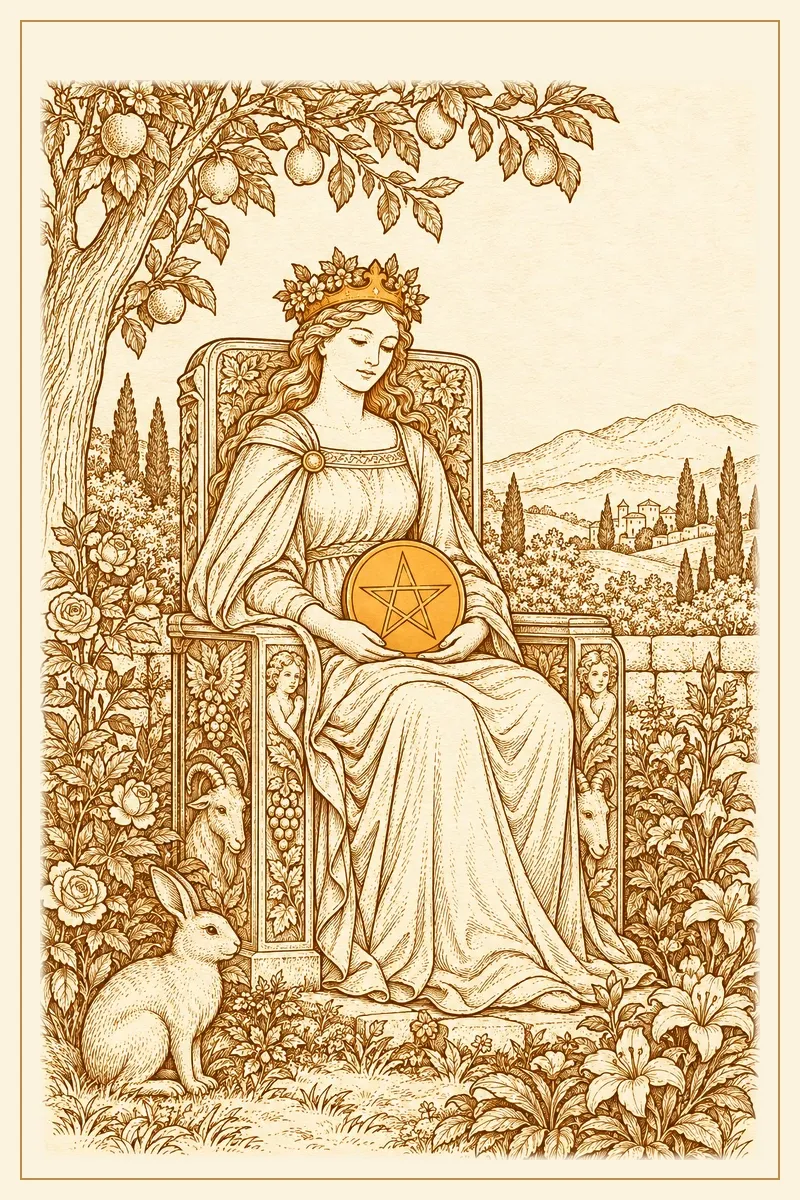
From twenty degrees of Sagittarius to twenty degrees of Capricorn the Queen of Pentacles takes the ground, the card the Golden Dawn called the Queen of Disks. It is an odd and useful pairing: the sign of the open road shares a court card with the most settled figure in the deck. She is the one who notices there is no food in the house for the journey. Where the ground she holds leads next is set out in the Capricorn tarot guide.
Upright: practical care. Money handled, people fed, a plan that includes the dull parts. In a Sagittarius reading she is usually the voice asking what the adventure costs per month and who waters the plants.
Reversed: more going out than is coming in. Care that has quietly become unpaid work, resources stretched until generosity turns anxious, or someone so far into providing that nobody has asked lately what they want. The Queen of Pentacles card meaning has the detail.
Taking the archer's cards into a real question
Questions about direction and capacity suit this set; questions about other people's intentions do not. Sagittarius sits opposite Gemini, and the pair divides neatly: Gemini collects, Sagittarius decides what it all adds up to.
Love: freedom and the promise
Temperance in a relationship question is rarely about passion; it is about pace and proportion. Two lives are being mixed, and the card asks whether the measure is right rather than whether the feeling is real. The Knight of Wands brings heat and movement but says nothing reliable about staying. If the real question is whether someone wants to commit, these cards turn it back toward you: what they show best is whether you have actually asked.
Work, study and the move abroad
Sagittarius governs the long view, so these cards do well on questions about training, teaching, publishing and relocation. The Eight of Wands says go now and sort the details in transit; the Ten of Wands says you already said yes to four things. Read them together before booking anything.
Money: what a yes costs
Jupiter is generous and inattentive about price. The Queen of Pentacles is the card to look for in a money question here, and her absence is as informative as her presence. If the spread is all Wands, the plan has energy and no budget.
When: the windows these cards point at
Used for timing, the decan cards mark roughly ten-day stretches of late November and December, and Temperance points to the Sagittarius month as a whole. The Eight of Wands is the fastest card in the suit and often means days rather than months. These are windows to prepare for, not appointments.
The long aim: a five-card spread for Sagittarius season
This spread keeps the archer's shape without asking the cards to predict the target. Deal positions one and two one above the other so you can compare them directly, then lay three, four and five in a line out to the right.
- The shot you say you are taking. The goal as you would describe it to somebody else.
- What is really pulling the string. The motive underneath, which is often older and plainer than the goal.
- The ground between here and there. The conditions you have to cross, in practical terms.
- What you are carrying that this does not need. The part of the load that can be set down or handed over.
- What the walking is teaching. What you are learning on the way, whether or not you arrive.
Compare one and two first and resist smoothing over the difference between them. If position four comes up as a card you like, that is worth sitting with: the hardest thing to put down is usually something good.
A worked reading: a fourth yes in a full week
This one is an illustrative example rather than a real person's reading. The question was specific. Someone already teaching three evenings a week had been asked to run a Saturday course as well, and wanted to know whether to take it. Three cards, in the positions what I am carrying, what the yes would actually look like, and what would make a decision possible.
What I am carrying: Ten of Wands. No ambiguity there. The three evenings are not the whole bundle; there is also the marking, the travel, and the family dinner that keeps getting moved. The card does not say the work is wrong, only that the armful is already full and the town is still some distance off.
What the yes would look like: Knight of Wands reversed. Upright, this would be the lift of a new room and a new group. Reversed, it describes the likely pattern honestly: an enthusiastic agreement given in the moment, then a term of arriving under-prepared and apologizing. That is not a verdict on anyone's character. It is what happens to a charge spread across four commitments.
What makes a decision possible: Temperance. The answer here is a proportion, not a refusal. She took it as permission to counter-offer: the Saturday course, but six weeks rather than a full term, and only if one evening class moved to a colleague. That was a question she could actually put to the organizer, and she had an answer within the week.
What the half hour did was sort a real load into parts she could act on, which is the work these cards do best.
Small, finishable steps for a season that wants everything
Sagittarius energy at the table has genuine strengths. It reads a spread as one story rather than eight separate omens, it finds the growth in a hard card without pretending the card is kind, and it will follow a question past the likely outcome into what that outcome would mean. The blind spots are the matching pair: a reframe offered when someone needed to be believed instead, and grand themes read over the plain practical detail. The Ten of Wands is about an actual calendar before it is about anything philosophical.
If the cards have given you a direction this season, make it small enough to finish.
- Write the aim in one sentence, then write what you would have to stop doing to reach it.
- Pick one item from the bundle and hand it to someone this week, in writing.
- Before any new yes, name the end date out loud. A commitment without one is a stave you keep.
- Date your reading and come back to it in January, when the Capricorn cards will have a view.
If finding the sentence is the hard part, the question library has wordings for direction, study and commitment that you can borrow and adjust.
Frequently asked questions
What is the Sagittarius tarot card?
Temperance, Major Arcana XIV. The Golden Dawn assigned it to Sagittarius with the letter Samekh, and most English-language decks and books still follow that scheme. Jupiter's card, the Wheel of Fortune, is associated with the sign too, but as the ruler rather than as the sign itself.
Is the Sagittarius court card the Knight of Wands or the King of Wands?
Both answers come from the same place. The Golden Dawn's King of Wands is a mounted figure covering twenty degrees of Scorpio to twenty degrees of Sagittarius, and that mounted figure is the Knight of Wands in modern decks. Readers who match by rank name hand the range to the King of Wands instead. On the mounted-King mapping, the modern King of Wands is the Golden Dawn Prince of Wands, who covers twenty degrees of Cancer to twenty degrees of Leo, which is why so many books tie him to Leo. Say which system you are using and the disagreement disappears.
What are the Sagittarius decan cards and their dates?
Eight of Wands for the first decan under Mercury, roughly November 22 to December 1; Nine of Wands for the second under the Moon, roughly December 2 to 11; Ten of Wands for the third under Saturn, roughly December 12 to 21. The boundaries drift by about a day each year.
Why is the Wheel of Fortune linked to Sagittarius if Temperance is the sign's card?
Because signs and planets are assigned separately. Temperance carries the sign; the Wheel carries Jupiter, which rules the sign. When both appear in one spread, Temperance is usually describing how you are working and the Wheel is describing the conditions around you.
If I draw Temperance, does that point to a Sagittarius in my life?
Not by itself. Correspondences are a layer of meaning, not an identification system. If a card seems to point at a particular person, check it against what you actually know about them rather than against their birthday.
Will the cards show how Sagittarius season turns out, or whether someone will commit?
No. A reading has no access to another person's heart, no calendar to pin an event to and no way to guarantee how things end, and a season is not a forecast. What a reading can do is clarify what you want, show you the load you are carrying and suggest which question to ask next, which is a different and more useful kind of help.
Is a reversed Knight of Wands a bad sign before a trip?
It is a practical one rather than a bad one. Reversed, he tends to point at preparation that has not happened yet: the booking not confirmed, the bag not packed, the person you meant to tell. Treat it as a checklist rather than a cancellation.
An arrow still has to land somewhere
The archer is a generous image, but half of it is a horse and the other half is aiming. Temperance keeps the two together: the appetite for a bigger life, and the patience to mix it at a rate a life can take. If Sagittarius season has you full of plans, the kindest thing you can do is choose one and let the others wait for a turn of the Wheel. Whenever you want to lay the cards out for yourself, a tarot reading is a calm place to start.