Drawn about love, the Ace of Cups says a feeling has opened and is ready to be given or received: a fresh attraction, warmth coming back into a long relationship, or a heart that can love again after a hard ending. Upright, the opening is real, and the card asks you to let it be seen rather than keep it to yourself. Reversed in love, the feeling still exists, but it is being held back, poured toward someone who cannot take it in, or kept waiting behind an old hurt.
What this ace cannot do is name the person, tell you what someone else privately feels, give you a date, or confirm a pregnancy. It describes the emotional climate of your love life and your own part in it. For the card's wider meaning, with its symbols, its suit and how it reads at work, see the full Ace of Cups tarot card meaning; this page stays with love, from single life to reconciliation, along with the reversed card, the cards that change it and a spread you can lay out tonight.
The love message in brief, situation by situation:
- Single: you are becoming reachable again; the opening is in you before it is in a person.
- New connection: the interest is genuine on your side and worth showing at a steady pace.
- Committed relationship: tenderness is trying to come back; small gestures carry it.
- After heartbreak: feeling is returning, which is not the same as being ready to date.
- An ex or reconnecting: warmth is present, but it may be memory as much as a new start.
- Friend to partner: the feeling is real; what you do with it is still your choice.
- Reversed: love that is blocked, unspoken, one-sided or not yet ready to flow.
Reading the offered chalice as a love card
Much of what the card says about love sits in three details of its picture, so it is worth a slow look before turning to situations.
Ace of Cups: one cup, one hand, water that will not stay put
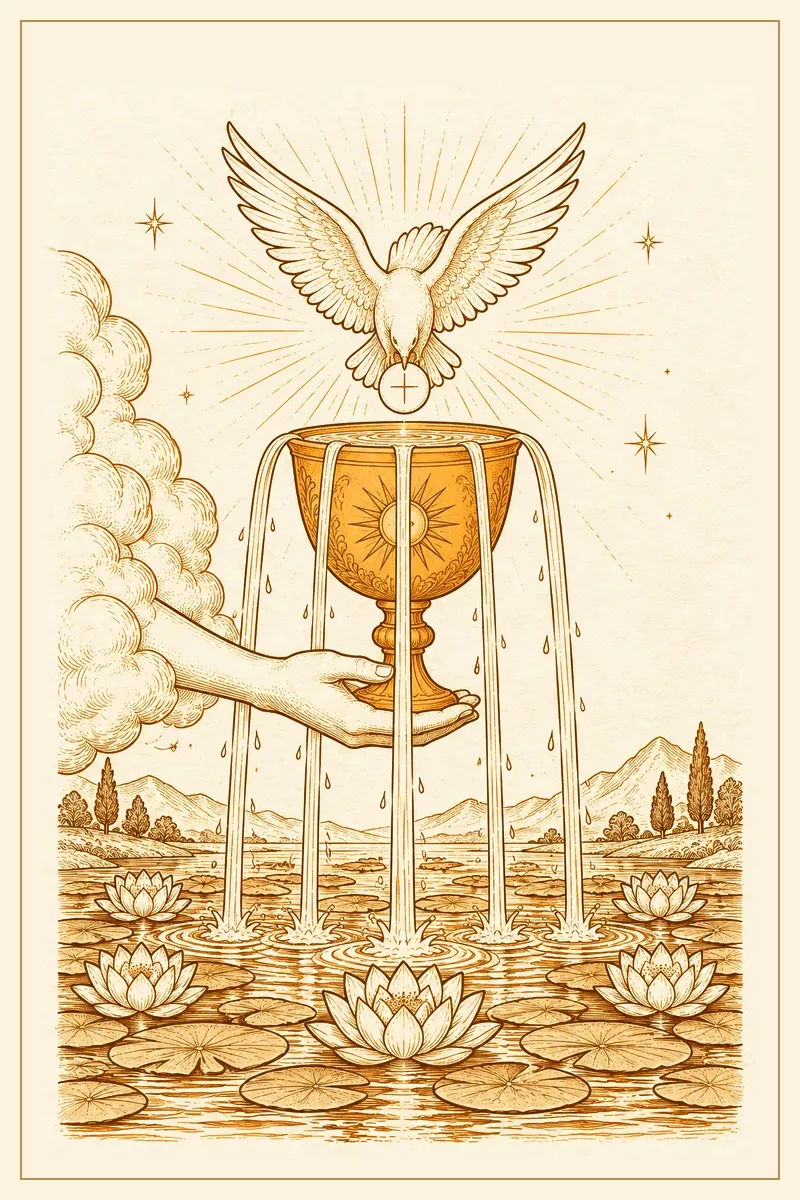
On the card, a hand reaches out of a bank of cloud and supports a golden chalice from underneath, its bowl marked with a sun. Only one hand and one cup are shown. In love that matters: this is a single person's feeling, not yet a pair. Compare it with the Two of Cups, where two people each hold a cup, and you can see why the ace describes an offer rather than an agreement.
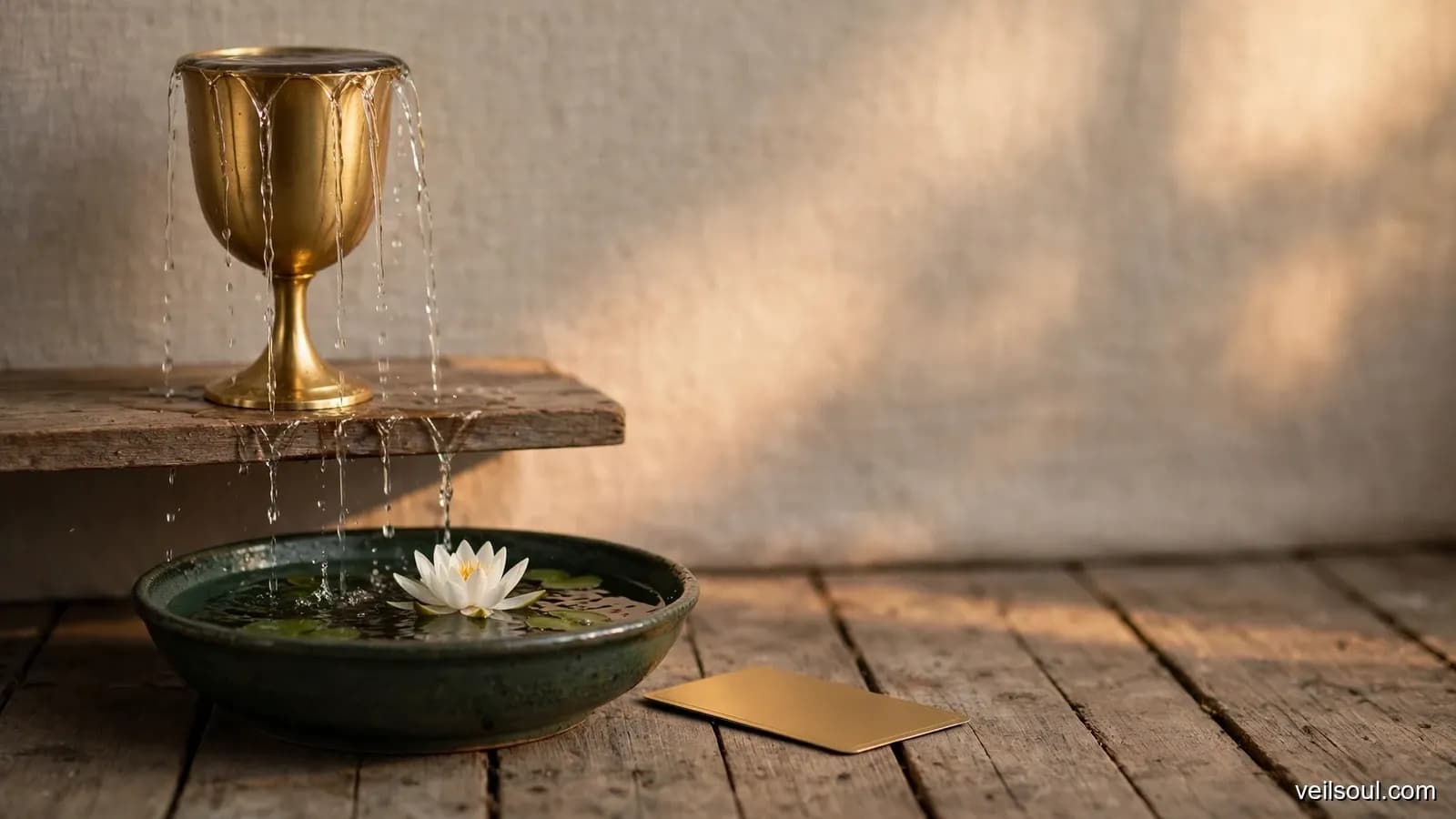
Five streams run over the rim into a lake where lotus flowers open among the lily pads. The cup is too full to carry without spilling, which is a fair picture of new feeling: hard to hide, and reaching the people around you before you have decided to say anything. Above the rim a dove comes down with a round wafer, and that upper half gives the card its sense of love arriving as a gift rather than a reward. You can make room for this kind of opening. You cannot earn it by trying harder.
The Ace of Cups across seven love situations
The same card reads differently depending on where your love life stands. Find the situation closest to yours, then read the cards around the ace before you settle on a meaning.
Single, and not seeing anyone
When no one is in the picture, the ace usually describes you rather than an arrival. Something has softened: you notice couples without the old sting, or you catch yourself imagining a shared Sunday. That is the condition new relationships tend to grow from, and the card asks you to act on it in ordinary ways. Accept the invitation you would normally decline, stay for the second drink, answer a friendly message with more than one word. If the opening feels mostly like a kinder way of treating yourself, the exercises in tarot for self-discovery pair well with this card. The ace does not promise that someone specific is on the way. It says you would notice them if they were.
A new connection, a few dates in
Early on, the ace confirms that your interest is genuine. The flutter when a message arrives, the way the week rearranges itself around the next meeting: the card names that and asks you not to talk yourself out of it. It says nothing about how the other person feels or whether the connection will deepen. A useful reading here is "show the feeling at the pace it is actually growing." Say you enjoyed the evening, suggest the next plan, and leave the declarations for later. For a whole spread about a young relationship, tarot for a new relationship places this ace beside the other early-love cards.
In a committed relationship
Long relationships drift into logistics: who collects whom, which bill is due, whose turn it is to cook. When the Ace of Cups appears for a couple, it often marks a moment where tenderness slips past that layer: a shared laugh in the car, an old song, a kind word on a bad day. The card asks whether you will let that moment count. In practice, that might be a note left in a coat pocket, a phone put away at dinner, or saying "I missed you" after a long day. In a partnership the ace is less about grand romance than about whether affection has somewhere to go each day.
Long distance
Across distance, the ace tends to point to moments when the connection feels present rather than scheduled: the call where the screen stops mattering, the message you sit with for a while afterward. It is encouraging about the feeling and silent about logistics. Use it to ask what keeps the warmth flowing between visits, and settle who travels and how often with the person rather than with the deck.
After heartbreak
For someone who has felt numb since a painful ending, this is one of the gentlest cards to receive. It says feeling is returning: tears at a film, a sudden wish to be held, interest in someone that surprises you. None of it means you must start dating. The card gives permission to feel, and the timetable for anything more is yours. If grief is still the main event, tarot for heartbreak offers spreads made for that stage, and you can come back to the ace when the ground feels steadier.
Reconnecting with an ex
This is where the ace needs the most care. It can describe a real renewal: two people who have changed, meeting each other with fresh warmth. It can also describe your heart remembering what it once felt and mistaking that memory for a present possibility. The cards around it usually tell the two apart. If they show growth or honest conversation, the feeling may have somewhere new to go; if they repeat the old pattern, the ace may be reporting nostalgia. Either way, it speaks for your side only. Whether the other person wants to return is something you learn from them.
When a friend starts to feel like more
The ace in friendship territory is delicate. It says the feeling is real; it does not say the feeling is mutual, or that acting on it is wise. Some people let the affection deepen the friendship and leave it there. Others begin a slow, careful conversation. Both are honest responses to this card. What it does rule out is pretending the feeling is not there, because a cup this full tends to show in how you look at someone. Whoever you love, the card asks only that you treat the feeling, and your friend, with respect.
Reversed Ace of Cups in love
Turned upside down, the cup tips and the water spills before it reaches the lake. In love that rarely means the feeling has gone. It means the feeling is not arriving where it should.
When the block is on your side
Often the reversal describes self-protection. You like someone and keep it light, because the last time you showed your hand it cost you. Or you are so tired from caring for others that nothing is left for romance. These are reasonable responses to real experiences, and the card names them without blame. Ask what showing the feeling would risk, and whether that risk belongs to a past relationship or to this one.
When the feeling has nowhere to land
Sometimes the reversed ace describes a feeling poured toward someone who cannot receive it: a crush on a person who is unavailable, affection given steadily to a partner who returns little, or love for an ex who has moved on. The cup is full; it is simply tipped toward the wrong container. Notice where your care is going and whether any of it comes back. A one-way flow over months is information, not a test of loyalty.
When it is a matter of time
A third version is about readiness rather than refusal. The feeling is beginning, but circumstances cannot hold it yet: a move, a family crisis, a divorce still being finalized. Here the reversal asks for patience with yourself, and some of the water turned back toward your own rest. It is not a no; it is "not in this state."
Pairings that change the Ace of Cups love message
An ace only says that an opening exists. The cards beside it tell you what kind of love is involved and how it is likely to move.
With the Two of Cups: the feeling meets someone
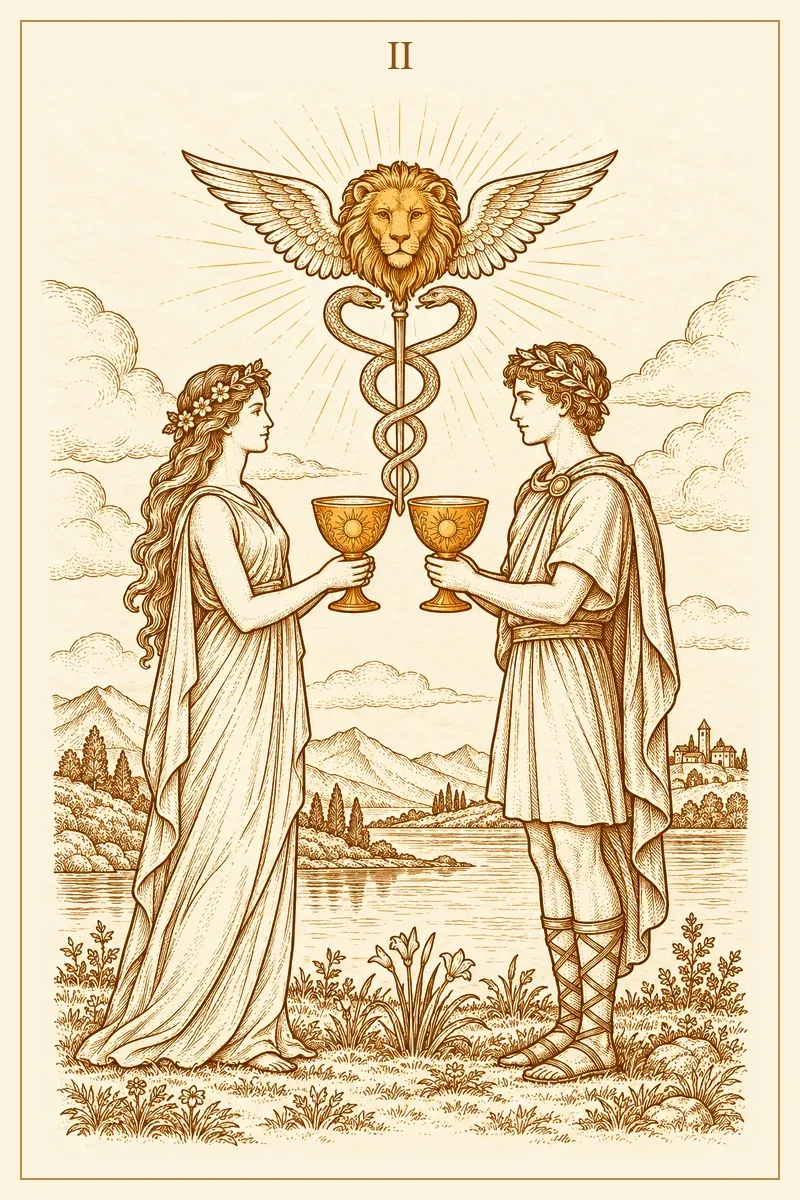
On the Two of Cups, a woman crowned with flowers and a man in a laurel wreath raise golden cups toward each other beneath a winged lion's head. Where the ace is one cup held out, this card shows two people meeting at the same height. Together they describe a private feeling finding an answer in another person: mutual interest, a first honest conversation, or a reconciliation where both sides move. The Two of Cups meaning follows that story further. If the Two arrives reversed, the ace is still real, but the exchange is uneven for now.
With The Lovers: a feeling you also choose
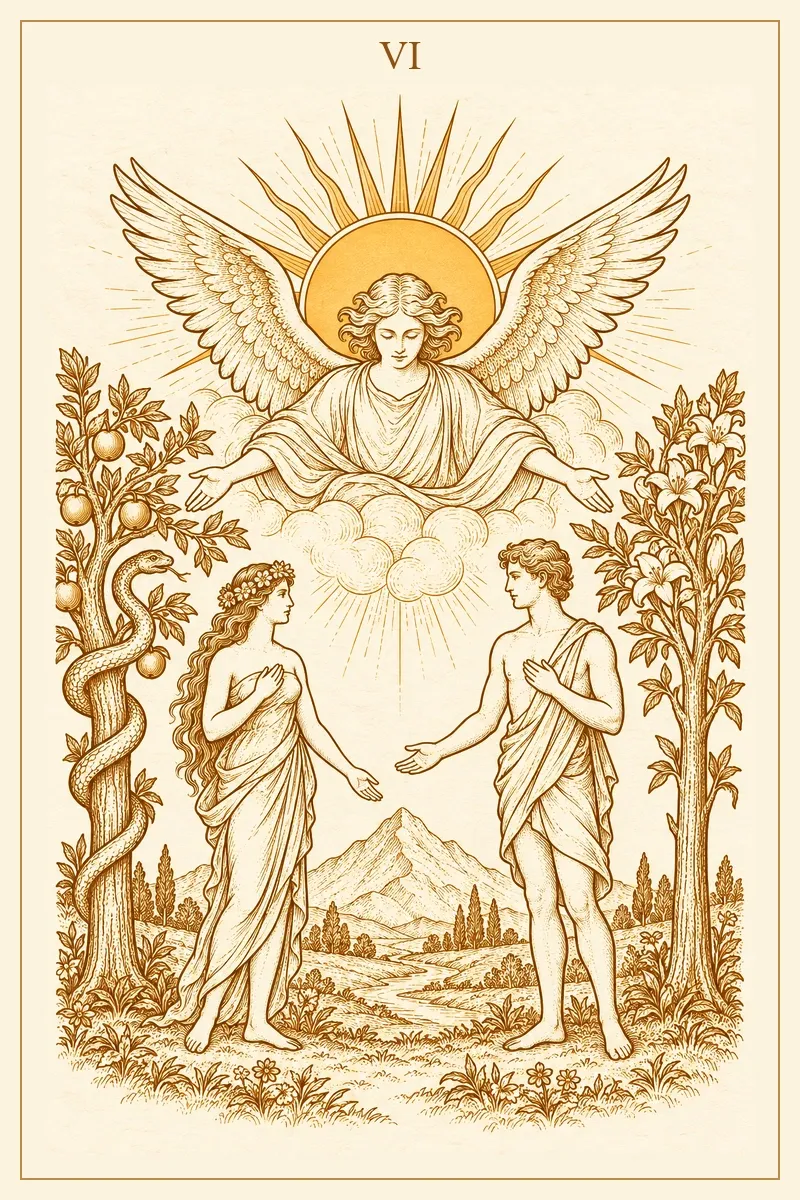
The Lovers shows two figures beneath a winged figure set against a sun; each rests one hand on the chest and reaches toward the other with the other hand. The ace supplies the feeling and this card adds the choice. Side by side, they describe a relationship that is both felt and decided on, such as becoming exclusive or committing after a period of doubt. As the Lovers tarot meaning explains, this is also a card of values, so the pair asks whether what you feel fits the life you want. Reversed Lovers beside an upright ace often means the feeling is strong while the timing or the values are not aligned yet.
With The Empress: love that wants to grow into a life
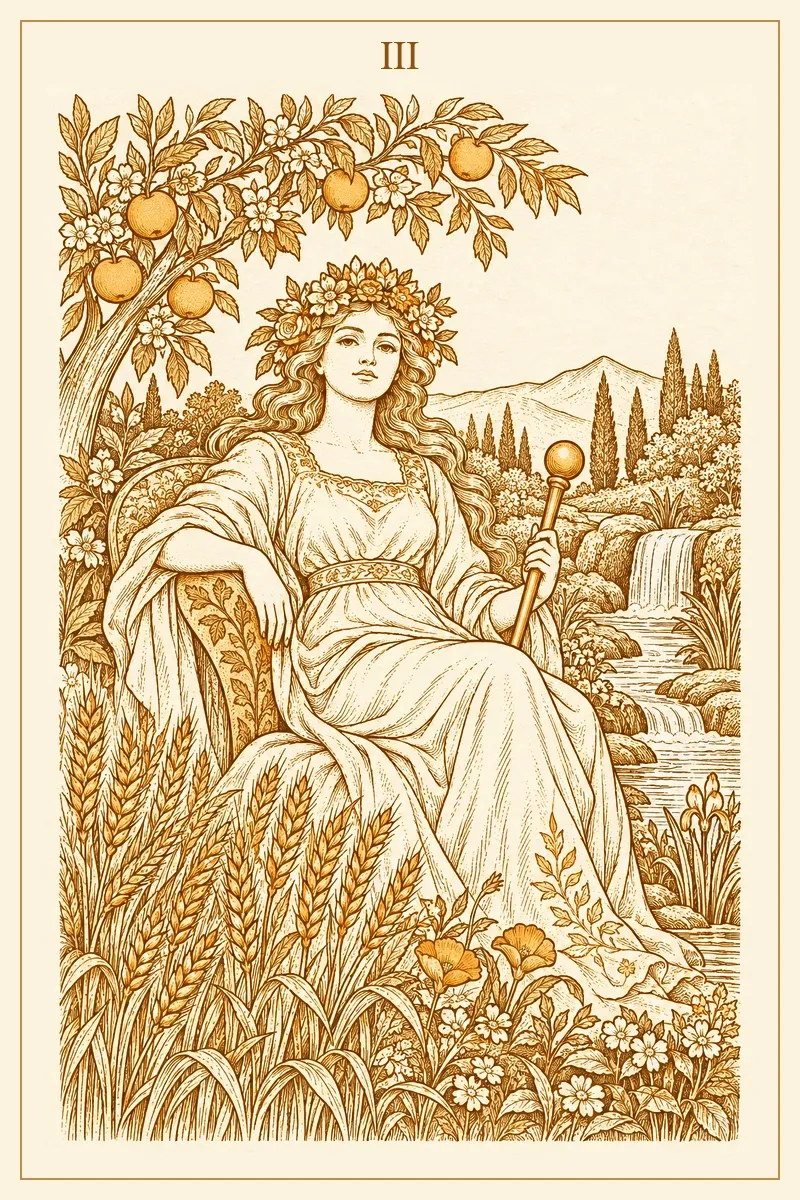
The Empress sits in a field of wheat under a fruit tree, crowned with flowers and holding a golden scepter, a waterfall behind her. She gives the ace's overflow a body and a place to grow. In love, the pair usually describes nurturing: moving in, building a home, physical comfort returning, or a relationship that makes both people more generous with others. Some readers connect the pair with conception; the FAQ below explains why tarot cannot answer that. The Empress tarot meaning explains why she governs things that grow at their own pace, a good reminder for any new love.
With the Three of Swords: feeling after a wound
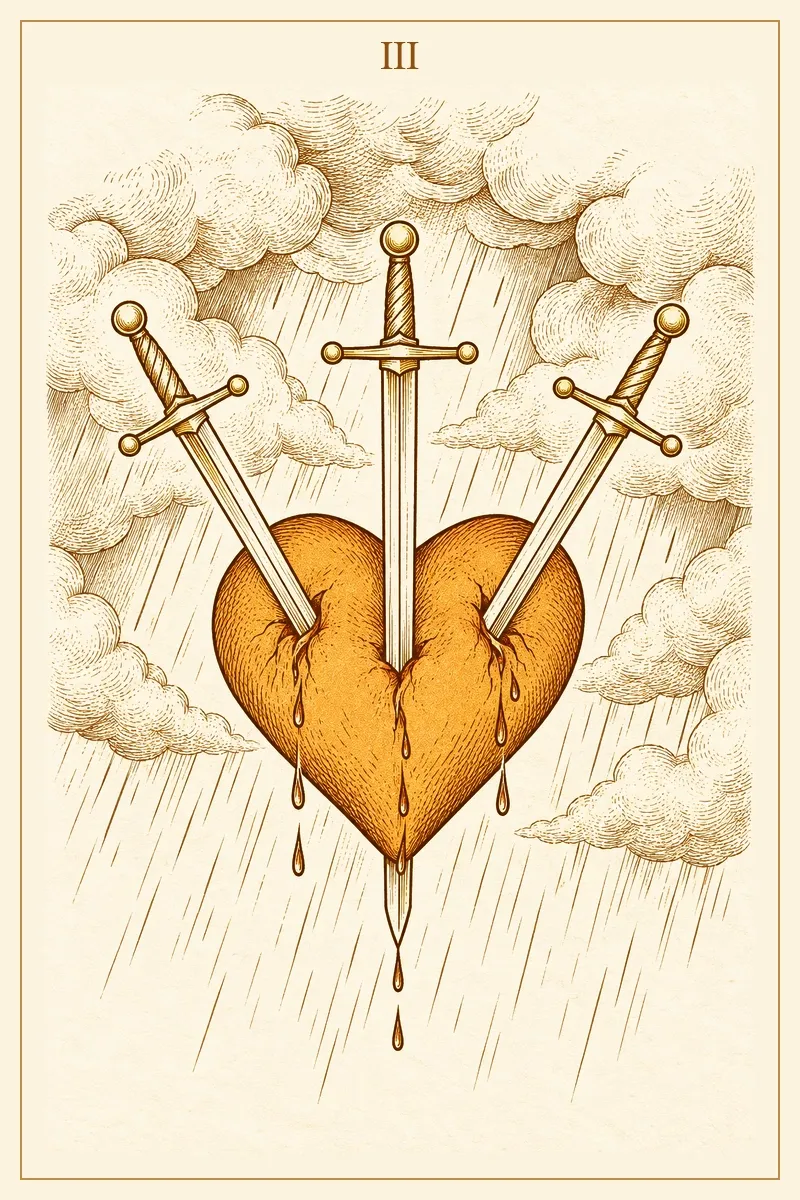
The Three of Swords shows a golden heart pierced by three swords under rain clouds, drops falling from its point. Next to the ace it looks like a contradiction, yet the two often tell one story: a heart that was hurt is beginning to feel again. The pair speaks to someone dating after a divorce, a loss or a betrayal, and it suggests the new feeling and the old grief will arrive together. You do not have to finish healing before you are allowed to feel something good. The Three of Swords meaning covers the grief side in depth.
Other cards to watch beside it
- Knight of Cups: the feeling is about to be expressed; an invitation or a declaration is near, and things may move faster.
- Page of Cups: a shy first step, a playful message, a crush still finding its voice.
- Six of Cups: warmth tied to shared history; it fits readings about an ex or an old friend.
- Five of Cups: attention still fixed on the spilled cups of a past loss while two full ones stand behind.
- Ten of Cups: the opening and a picture of where it could lead, a family or home built around the feeling.
- Four of Pentacles: love held tightly and not given, sometimes for a long time.
- The Hanged Man: a pause; the feeling is real, but nothing will be forced.
Ace of Cups as feelings and timing, handled honestly
These are the questions that press hardest in a love reading, and the ones where an honest reading says the least.
How does this person feel about me?
Read as the other person's feelings, the upright ace describes fresh, sincere affection: interest that is new, a little unguarded and hard for them to hide. It tends to show as attention, quick replies, small kindnesses and wanting to see you again. Reversed, it describes feeling that exists but is held back: someone guarded after an old hurt, unsure how to say it, or fond of you while their life has no room for it yet. Either way, the card pictures the warmth you have seen from them, so check it against what they actually do. Ask what this person has offered and what you are offering back; that keeps the reading on behavior you can observe, and it often points to the obvious next step, which is to ask them.
When will love arrive?
The ace speaks about the present: the opening exists at the moment you drew it. What the surrounding cards can show is movement. The Knight of Cups or fast Wands cards beside it suggest things will move quickly once someone acts; the Four of Pentacles or The Hanged Man suggest a slower unfolding, or a feeling being held back. Read for momentum rather than for a month, and let the next real conversation tell you more than the next spread.
Is the Ace of Cups a yes in love?
Upright, it is a warm yes for questions about feeling: is there something real here, should I open up, is this worth exploring. It is a weaker answer for practical questions such as whether you will move in together by spring, because the card speaks about emotion rather than plans. Reversed, the closest answer is "not as things stand."
The Five Streams: a love spread built on the ace
This spread borrows the five streams that pour over the cup. Shuffle with one love question, lay five cards in a gentle arc and name each position aloud before you turn it.
- The feeling I am holding: what is in your cup right now, named as plainly as possible.
- What already shows: how this feeling is spilling into your words and actions, whether you meant it to or not.
- What has come back to me: what you have actually received from the other person or the situation, based on events rather than hopes.
- What slows the flow: the fear, habit or circumstance that keeps the feeling from moving freely.
- One way to pour this week: a single action small enough to take within seven days.
No position asks what someone else is thinking. Position three points the card at things you have seen, and position five ends the reading on something you can do.
A worked example (hypothetical): from friendship to something more
This reading is invented to show the method. Imagine someone who has been close friends with a climbing partner for three years and lately waits for the weekly session with more than friendly anticipation. Their question: "What do I need to understand about this feeling, and what is a respectful next step?"
- The feeling I am holding: Ace of Cups, upright
- What already shows: Page of Cups, reversed
- What has come back to me: Six of Cups, upright
- What slows the flow: Four of Pentacles, upright
- One way to pour this week: Two of Cups, upright
Ace of Cups in the first position confirms the feeling is new and genuine, not loneliness looking for a target. Page of Cups reversed suggests the feeling leaks out awkwardly: jokes that land oddly, a nervousness the friend may have noticed without understanding. Six of Cups describes real warmth from the friend, rooted in shared history and comfort. It is kind and familiar, but it does not by itself show romantic interest, and the reader is careful not to stretch it.
Four of Pentacles as the block is honest: the person is holding tightly to what they already have, afraid that speaking will cost them the friendship. Two of Cups as the step points to an equal, direct conversation on a quiet evening, something like "I have started to feel more than friendship, and I value us either way." They decide to speak only once they are sure they could accept a no. Whatever the friend answers, the reading has moved the feeling from hidden to spoken, at a pace both people can manage.
Letting the cup be seen: steps for the next few days
- Write the feeling down in one sentence. "I want more closeness with my partner," or "I am interested in this person." If you cannot finish it, keep watching; the card may be ahead of your words.
- Choose one small way to show it. A message, a question, a plan suggested. Small and sincere beats large and rehearsed.
- Notice what returns. Over the next week, write down what actually comes back. That record will answer more than another draw.
- If the card was reversed, set one thing down. An old comparison, a resentment, a habit of over-giving. Make a little room in the cup.
- Read again only after something has happened. A second reading the same night tends to repeat your worry back to you.
Frequently asked questions
Does the Ace of Cups in a love reading always mean a new relationship?
No. It means a new emotional opening. That can be a relationship, but just as often it is warmth returning to a partnership, a reconciliation, or a kinder relationship with yourself. The surrounding cards and the question you asked show which one fits.
Can the Ace of Cups mean pregnancy?
Some traditions link this card with conception, especially beside The Empress. A card cannot confirm or rule out a pregnancy, though, and should never stand in for a test or a conversation with a health professional. In a love reading, it more usefully describes something new that needs care and time, such as a shared home, a deeper commitment or a wish for a family that is worth talking about together.
Can the Ace of Cups tell me if someone loves me or will come back?
No card can reveal another person's private feelings, promise an outcome or set a date. The ace describes the emotional climate around you and your own readiness. If an ex or a crush is on your mind, the cards can help you decide what to say; their answer comes from them, not from the spread.
I keep drawing the Ace of Cups, but I am single. What does it mean?
A repeated ace usually points at your own readiness. Something in you is open, and the card keeps returning because that opening has not been used yet. Treat it as an invitation to be more reachable in daily life rather than as a countdown to a meeting.
How is the Ace of Cups different from the Two of Cups in love?
The ace is one-sided: a single cup, one heart opening, an offer being made. The Two of Cups is mutual: two people meeting with what they each hold. The ace can exist without anyone receiving it. The Two needs both people.
A cup held in one hand
The Ace of Cups in love keeps asking a simple question: there is a feeling here, so will you let it show? You do not need to know where it leads to answer honestly. When you are ready to look at your own situation, you can begin a love reading with Veil Soul and see what sits around the cup.