Love with witnesses is what the Three of Cups brings to a love reading. Upright, it places your romance inside a circle of friends and family: meeting someone through people you already trust, an engagement toast, a partner who slips easily into your world, or a season when friendship is the warmest love you have. Reversed, the circle around the relationship has gone wrong, through gossip, exclusion, a couple cut off from everyone else, or a third person standing too close.
A spread cannot tell you what anyone else privately feels, whether a partner is faithful, or when a wedding will happen. It can show how love and belonging are working together in your life right now. The card's general symbolism and its work and money meanings are gathered in the Three of Cups tarot card meaning; this page stays with romance and the people around it.
The short version for love:
- Single: love is likely to come through your circle, and your friendships already count as love.
- Dating: a good moment to meet each other's friends.
- Committed or married: something to celebrate together, or a reminder that the relationship needs people around it.
- Weddings: a festive sign for the gathering, though never a date on the calendar.
- Reversed: gossip, feeling left out, a couple turned into an island, or a third person who blurs the lines.
- Yes or no: upright, a sociable yes; reversed, yes once the people involved are sorted out.
Raised cups and linked arms: what the dancers say about love
No couple appears on this card, and that is the first thing to notice in a love question. Romance is shown here through the people who gather around it.
Three of Cups: joy that is shared out loud
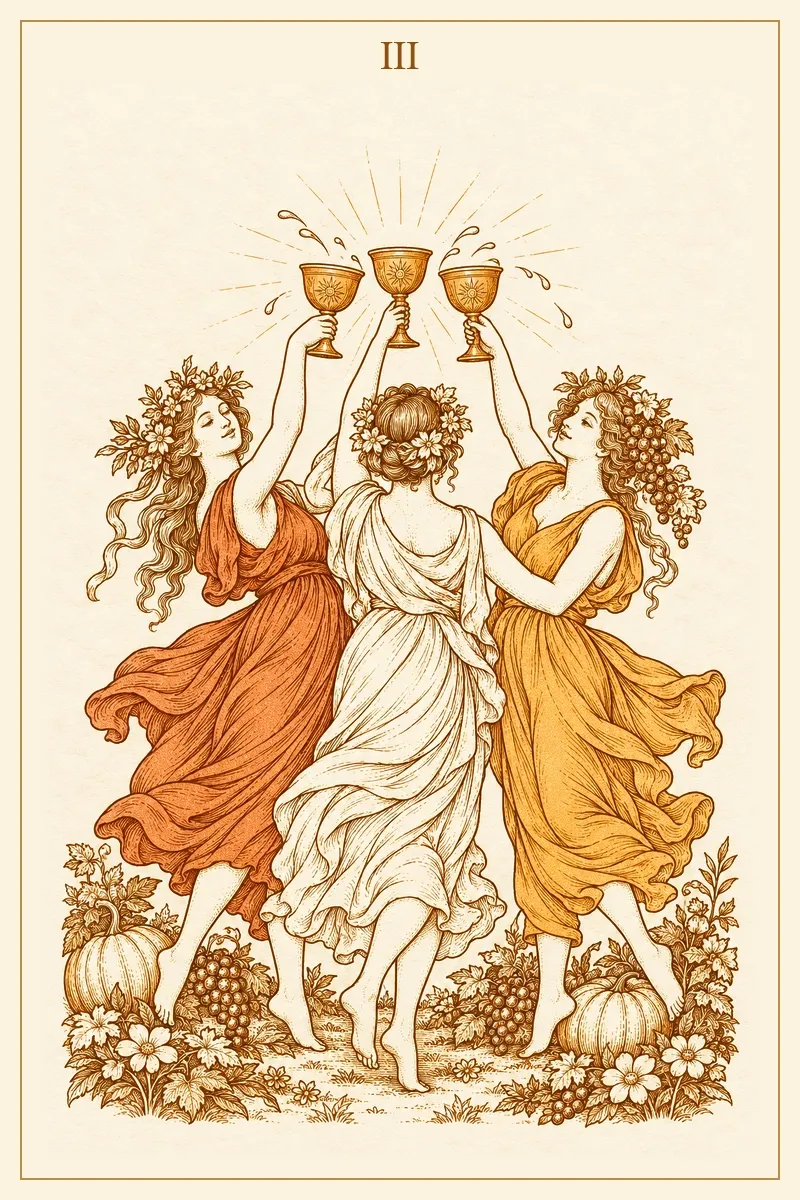
Three young women dance barefoot, close enough that their arms cross and rest on one another's shoulders. One wears a rust-red gown, one cream, one saffron yellow, and each has flowers or grapes twisted into her hair. High above their heads their golden goblets clink together, wine spilling from the rims while fine rays spread out behind them. Pumpkins, grapes and small flowers crowd the ground at their bare feet.
Read for love, three details matter. The cups touch, so this is a real toast, offered to one another rather than simply held up. Nobody stands higher than anyone else, so the joy is not a contest for attention. And the harvest underfoot says the celebration rests on something already grown: months of getting to know someone, or a hard year survived together. The card marks the point when love that has been growing quietly becomes visible to the people who care about you.
The figures are drawn as three women, yet in a love reading the meaning does not depend on gender. The three may be friends, relatives, a couple with their people, or something harder to name.
Upright in love, from first dates to long marriages
The card keeps one message, that love grows better in company, but what it asks of you depends on where you stand.
If you are single
For a single reader, the upright card often points to romance that arrives through friends rather than strangers: a birthday dinner where someone new sits across from you, a friend's wedding, a hiking group, a choir. It favors saying yes to invitations and telling the people you trust that you would like to meet someone. It also carries a quieter message: if your friendships are warm and steady, you are not waiting outside of love but already living one of its forms. For layouts made for this season, tarot for singles pairs well with this card.
Early dating
A few weeks or months in, the card tends to gather around first introductions: meeting each other's friends, a group dinner, bringing a date to a party. Notice whether this person is kind to the people you love, whether they make room for your friends, and whether you feel more like yourself or less when everyone is together. Shared laughter is a real foundation, though it has not yet shown you how the two of you handle a hard week.
In a committed relationship or marriage
For couples, the upright card usually marks something to celebrate: an anniversary, moving in, a recovery, or simply a stretch of easy happiness. It also asks about the life around the relationship. Do you still see friends separately as well as together? A relationship with its own friends, rituals and visitors tends to carry stress more easily than one that has to supply every need alone.
After a breakup
When the card follows an ending, it seldom points straight to a new romance. More often it describes the friends who come back into focus: the ones who bring food, drag you out for a walk, and remind you who you were before the relationship. Let them. A partner you meet from that steadier place usually fits better than one you reach for out of loneliness.
When a friend might become more
About a close friend, the upright card confirms warmth and ease, but it does not say whether the feeling is romantic. Often it describes a friendship that is precious exactly as it is. If you feel more, watch for signals outside the cards, such as whether the other person seeks you out alone or only in the group. When you do speak up, protect the friendship and leave the other person room to answer honestly.
Engagements, weddings and other love milestones
If this card appears while a proposal or wedding is on your mind, the upright card describes the gathering, the toasts and the people who show up for you, more than the practical side of a commitment: the guest list and the dance floor rather than the paperwork.
If you ask whether a proposal is coming, the card can say the relationship is in a celebratory, outward-facing season. Whether a ring is on its way is a conversation, not a card, so let the reading prompt an honest talk about what you both want. If a wedding is already planned, the card blesses the gathering and reminds you that the day is for your people, not for perfection. Reversed, it often points to friction among guests, strong family opinions, or plans that have outgrown the couple; a shorter guest list can bring the joy back. It may also mark family news worth celebrating, but it is not a pregnancy card.
Who is the third figure? Friends, rivals and the circle around a couple
Three figures can send an anxious mind straight to a love triangle. Upright, that is rarely the best reading. The third figure is far more often the community a couple belongs to, or needs: friends, siblings, a shared faith, co-parents, a mentor. For a pair under strain, the card can suggest that help from outside the relationship is part of the answer, whether that means more time with friends or a couples counselor.
The card leans toward a romantic third party mainly when it is reversed and sits beside cards of secrecy or compulsion, such as the Seven of Swords or The Devil. Even then, the spread shows a pattern worth looking at, not proof. Before you act, list what you have actually observed; a calm, direct conversation will tell you more than another shuffle. If you ever feel afraid of a partner, reach out to someone you trust or a support service near you, because no card outweighs your safety.
A gentler version concerns a partner's best friend you feel jealous of, or an ex still in the friend group. Here the card asks for clear agreements more than suspicion: decide together where the lines sit.
Three of Cups reversed: when the circle turns against the couple
Upside down, the raised cups tip and the dance comes apart. The reversed card does not usually predict a breakup. It describes a problem in how the relationship sits among other people, and most versions ease once they are named.
Talk behind closed doors
Gossip is the classic reversal: friends discussing your relationship, a partner sharing private conflicts with the group, rumors that reach you secondhand. Decide together what stays between the two of you.
One of you is left outside
Sometimes a partner never quite gets welcomed by the other's friends or family, or you are the one who feels like a guest in your partner's social life. The reversed card asks the partner on the inside to build the bridge: smaller gatherings, introductions with some context, and a clear signal that the relationship is not up for a vote.
A couple turned into an island
The opposite problem belongs to this card just as much: two people who stopped seeing anyone else. Friends were dropped, invitations declined, and now every need has to be met inside the relationship. The remedy is simple and a little awkward: each of you reaches out to one friend this week, and the two of you host something small together.
Celebration standing in for closeness
The reversed cup can also spill over. A couple might only get along at parties, use drinking or a crowded calendar to avoid hard conversations, or feel like strangers once the guests leave. Ask what happens between you on a quiet evening at home, and protect a few of those evenings.
Reversed for a single reader
Without a partner in the question, the reversal often describes the ache of watching friends pair off, a wedding season when you feel behind, or friendships slipping because one person carries all the effort. Keep your circle close without measuring yourself against it, and gently let go of a friendship that only ever runs one way.
Three of Cups as feelings, a yes or no, and the question of when
In a feelings position
In a position about how someone feels, the card describes enjoyment, ease and fondness: they like being around you, perhaps most of all in good company. That is the mood of the connection in a crowd, which is not the same as the depth of a commitment. Reversed here, it can suggest that they care, but that other people's opinions or a busy social life shape how much they show. Either way, watch how they treat you one-on-one, away from the group, before you decide how deep the feeling runs.
As a yes or no
Upright, the answer leans toward yes, usually with other people involved: yes, go to the party; yes, introduce them; yes, share the news. Reversed, it becomes a conditional yes that depends on who is involved and how much outside influence the relationship can take.
Timing
The card points to an occasion more than a date: a gathering, a holiday, a wedding season, the end of a long stretch of effort. In the astrological system many readers use, it corresponds to Mercury in Cancer, so some link it to early July. Treat that as a light hint and follow what actually happens.
Cards that widen the circle
Some neighbors show where the celebration is heading. These three bring good news for love.
With the Two of Cups: a private bond goes public
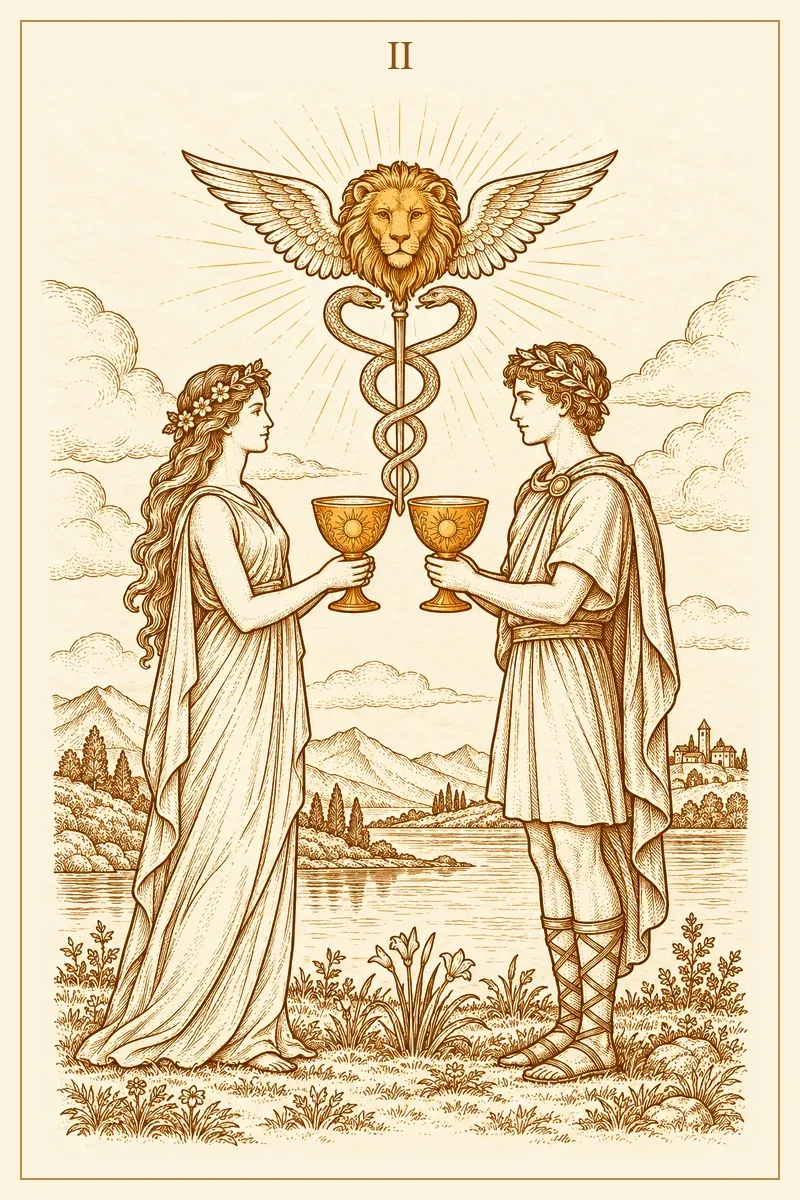
On the Two of Cups, a woman crowned with flowers and a man wearing a laurel wreath face each other, each holding a golden goblet at chest height, beneath a winged lion set over a serpent-twined staff. It is the suit's private pair. Beside the Three, the story moves from two people recognizing each other to two people being recognized by others: telling friends, a first appearance together, an announcement. The full Two of Cups meaning covers that pair in depth. If the Two is reversed here, check whether the bond is ready to be shared, or whether it is being shown off before the two of you have talked it through.
With the Four of Wands: the wedding pairing
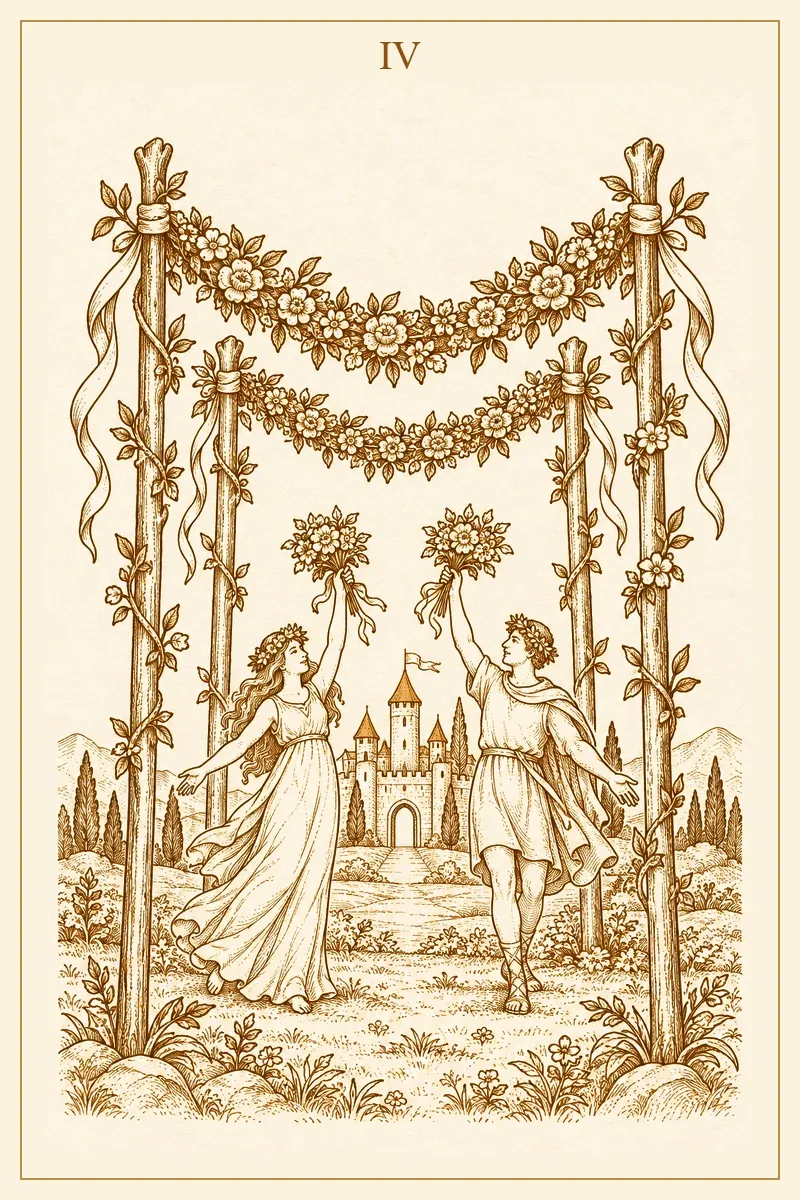
The Four of Wands shows four tall poles hung with garlands and ribbons, forming an open bower, while a woman and a man step toward each other with bouquets lifted high and a castle rises at the end of the path. Where the Three of Cups is about the people celebrating, the Four is about what is being celebrated: a home, a commitment, a shared base. Together they make one of the most festive pairings for an engagement, a wedding or a housewarming, and the Four of Wands meaning explains why it is about foundations as much as parties. Reversed, either card suggests a celebration that is tense or delayed rather than called off.
With the Six of Cups: an old friend, a new feeling
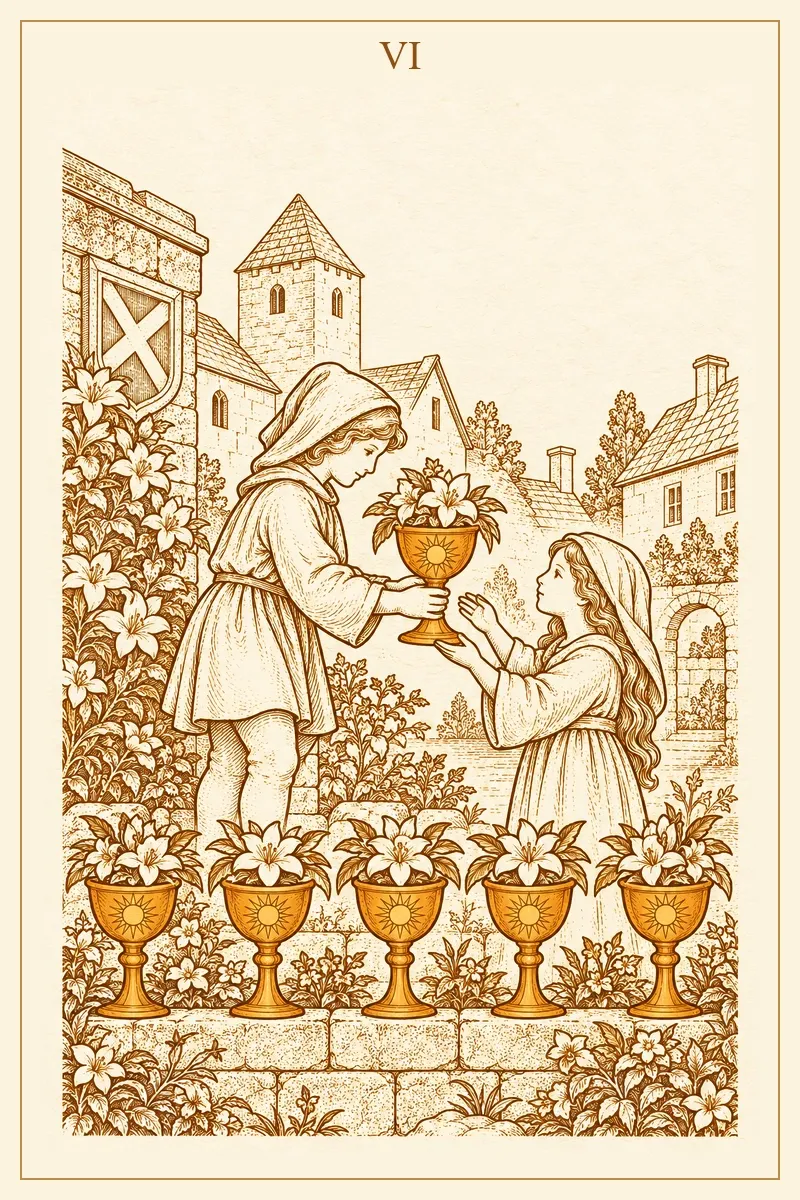
On the Six of Cups, a hooded boy hands a goblet of white lilies to a girl in a village garden, and five more lily-filled cups stand in a row at the front. Next to the Three, it often points to romance with someone from your past: a childhood friend, a classmate met again at a reunion, a friendship that has slowly changed shape. The Six of Cups meaning helps you check whether the pull is toward the person in front of you now, or toward a shared memory. Both can be sweet; only one is a relationship.
Cards that unsettle the toast
Other neighbors bring a warning, though not a verdict.
With the Seven of Swords: something hidden at the party
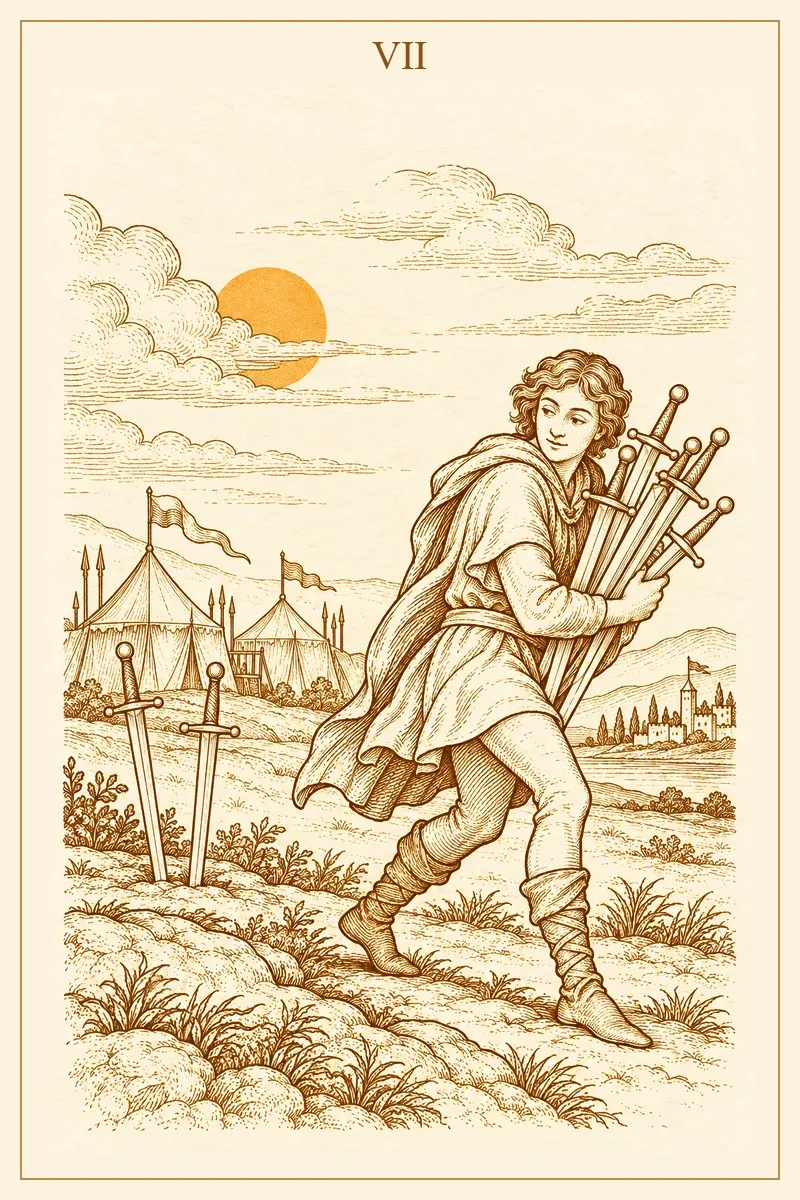
On the Seven of Swords, a young man in a cloak tiptoes away from a camp of tents, a bundle of swords clutched to his chest, while two more stay planted in the ground behind him. Many readers take this pairing, especially with the Three reversed, as secrecy inside a social circle: a flirtation kept quiet, a friend who carries tales, plans made behind someone's back. The Seven of Swords meaning covers its range, from deception to plain strategy, so look for facts before conclusions.
With the Four of Cups: the quiet after the celebration
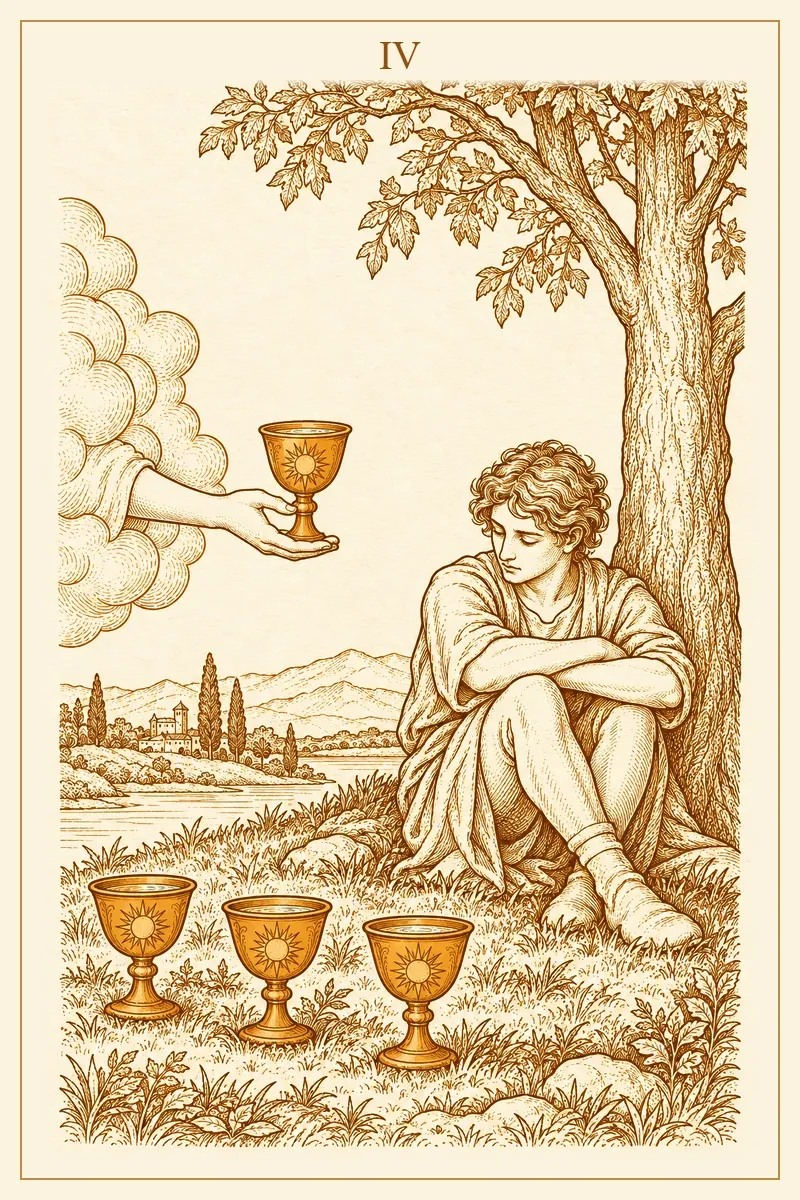
The Four of Cups shows a young man sitting under a tree with his arms folded, three cups lined up on the grass before him, while a hand reaches out of a cloud to offer a fourth he does not take. In the order of the suit it follows the Three, and the pairing teaches that peaks pass. For an established couple, it can mark the flat stretch after a wedding, a move or a holiday, when routine returns and attention drifts. The Four of Cups meaning shows how to notice the offer you might be missing; for couples, it is often a small, ordinary invitation to reconnect.
A few more pairings in brief
- The Lovers: a partnership chosen out of a friendship or a shared community.
- The Empress: embodied joy, from feasts and music to cooking together or raising a family.
- The Hierophant: a ceremony, or being welcomed into each other's family traditions.
- The High Priestess: a couple who needs both company and solitude; honor the quiet partner too.
- Ten of Pentacles: love woven into family lineage, with holidays across generations.
- Knight of Cups: a romantic invitation that arrives through friends or at a gathering.
The Circle of Cups spread: five positions for love and belonging
This layout follows the card's picture: the people in the dance, the toast they share and the harvest underneath. Hold one relationship in mind, or your love life as a whole if you are single, then lay out five cards.
- Where I stand in this love: what you are bringing right now, including hopes and worries.
- The bond itself: the current state of the connection between the two of you.
- The circle around us: how friends, family and community are shaping the relationship.
- What crowds or drains the circle: the pressure, habit or person pulling joy out of it.
- What is worth celebrating: the strength to name and honor, and one way to do it.
Single readers can rename position 2 "The love I am ready for" and position 3 "The people who could lead me to it." For more layouts built around couples and dating, the collection of tarot spreads for love offers several good starting points.
Example reading: a new partner and a wary friend group
The reading below is made up to show the spread in action. Imagine Theo, eight months into a relationship with Sam. Theo's longtime friends are polite but cool with Sam, and group dinners end early and awkwardly. Theo asks: "How can my relationship and my friendships make room for each other?"
Where I stand: Six of Wands, upright. Theo wants the relationship to be cheered on, and that hunger for approval is part of the strain: every dinner feels like an exam Sam has to pass.
The bond itself: Two of Cups, upright. Between Theo and Sam, the connection is mutual and steady. The relationship is not the problem.
The circle around us: Three of Cups, reversed. The friend group feels closed, full of old in-jokes and shared history that leave Sam outside. Nobody is being cruel; the circle simply has not opened yet.
What crowds the circle: Five of Wands, upright. Big dinners turn into competing conversations and teasing with a slight edge. The format, more than the people, is making things harder.
What is worth celebrating: Temperance, upright. Blend slowly. Smaller, mixed gatherings at a gentler pace would let Sam get to know Theo's friends one or two at a time.
Read together, the cards do not decide whether Sam belongs; they suggest the bond is sound and the setting is wrong. A practical next step would be a relaxed brunch with one close friend, and an honest question to Sam about how the dinners have felt.
Ways to honor your circle this week
- Thank one person who has celebrated your love life or held you through its hard parts.
- If you have a partner, plan one small gathering that mixes your worlds, such as a picnic or a game night.
- Protect one quiet evening for just the two of you, without phones or guests.
- If you are single, accept one invitation you would usually decline, and go for the company rather than the search.
- Notice where you carry a friendship alone, and give the other person a chance to carry their share.
Frequently asked questions
Does the Three of Cups mean a wedding is coming?
Not by itself. It describes celebration and the people who gather for it, so it suits weddings and engagements well, especially beside the Four of Wands or The Hierophant. Treat it as a sign of a celebratory season, and talk openly about what you both want.
Can the Three of Cups point to cheating?
Upright, it rarely does; the third figure is usually friends or family. Reversed, next to cards like the Seven of Swords, it can raise the question of secrecy. Tarot cannot prove what another person has done, read their private thoughts, or tell you how a relationship will end, so use the reading to decide what to look at and what to ask, not as evidence.
What does the Three of Cups mean for a single person?
Usually that love is more likely to come through your social world than through chance, and that your friendships are a real source of love right now. Accepting invitations and letting friends know you are open to meeting someone both fit the card.
Is the Three of Cups a polyamory card?
It can describe chosen family and polyamorous or other consensual non-monogamous relationships, since it shows love shared among more than two people; in that case, read it for the specific connection you asked about. It does not mean that everyone who draws it should be in one, and most of the time it is about friendship and community.
How is the Three of Cups different from the Four of Wands in love?
The Three of Cups is the people celebrating; the Four of Wands is the home or commitment being celebrated. They support each other, which is why readers treat them as a natural pair for questions about weddings and moving in.
A toast to the love you already have
This card reminds you that romance is one thread in a wider weave of love: friends, family, chosen kin and the people who will dance at your milestones. Notice who is in your circle, who is missing, and what is ready to be celebrated. When you want to look at a love question of your own, you can begin with a Veil Soul tarot reading.