Feeling that travels both ways is what the Two of Cups describes in a love reading: two people who notice each other, offer something of similar weight and are willing to meet in the middle. Upright, it is one of the warmest answers a love reading can give, whether you are single, a few dates in or years into a partnership. Reversed, the same exchange has tipped, so one person gives more, hears less or has started to pull back.
What the card cannot do is read someone else's mind, promise that a relationship will last or put a date on anything. It shows the shape of the exchange as you are living it, and that is useful enough. For the card's symbolism, its work and money meanings and its place in the suit, the full Two of Cups tarot card meaning is the place to start. This page stays with love.
The love message at a glance:
- Single: you are ready for real give-and-take, and may already know someone who meets you halfway.
- Dating: the interest runs in both directions; the next step is letting it be spoken.
- Committed: renewed closeness, a shared decision or a promise talked through together.
- Reconciliation: repair is possible when both people move, not only one.
- Reversed: uneven effort, crossed wires or a cooling that needs naming.
- Yes or no: upright, a warm yes for questions about a bond; reversed, "not in the current form."
- Timing: a stage rather than a date, usually the point where interest becomes mutual and acknowledged.
Two goblets at one height: the engraving as a love scene
Most of this card's love message lives in the posture of the two people, so look at the picture before matching it to your situation.
Two of Cups: a meeting, not a merger
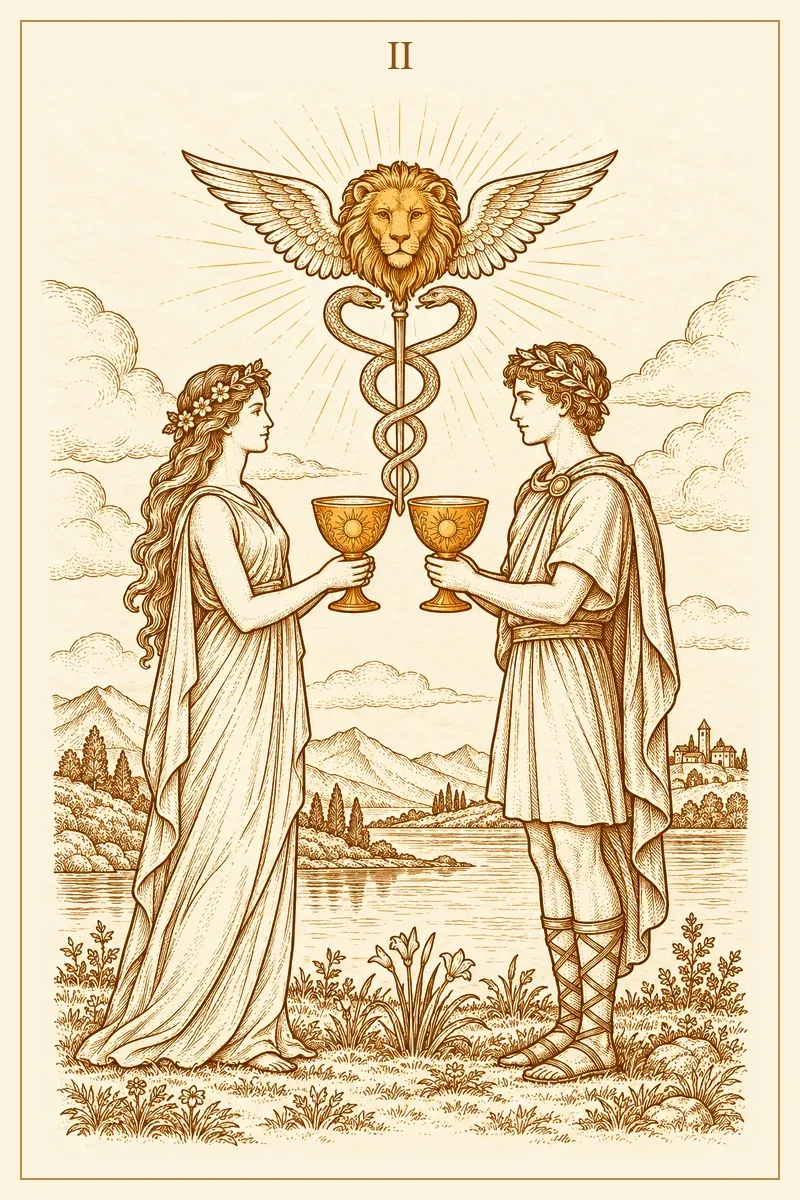
A woman in a long, softly draped gown stands on the left, her wavy hair loose and crowned with small flowers. Facing her is a young man in a short tunic, a cloak over one shoulder and a laurel wreath in his curls. Each holds a golden goblet at chest height, and the two rims nearly meet in the narrow space between them. Neither person leans across to claim the other's vessel, and neither stands taller. Read for love, that is the whole point: affection offered at the same level, by two people who each keep hold of their own cup. The small gap between the rims says the same thing about healthy intimacy: you can be deeply involved with someone and still keep your own feelings, friends and opinions.
Above them a winged lion's head glows against a burst of rays, crowning a staff where two serpents twist together. In a romantic reading the lion brings desire and courage, and the serpents suggest two temperaments winding around one center without strangling each other. Behind the couple lies a calm lake with a small town on the far shore. Nothing near them hints at a shared home: no house of their own, no table and no ring. The card captures the moment two people recognize each other and leaves the building of a shared life to later cards in the suit.
Upright Two of Cups for single, dating and partnered readers
The core meaning holds wherever you are, but what the card asks of you changes with your situation.
Single
When nobody is in the picture yet, the upright card usually says more about your readiness than about a stranger on the way. Sometimes it does point to someone nearby: the colleague whose jokes land, the friend of a friend who keeps finding a reason to talk. Notice who already meets you halfway, and meet them in return. For a whole reading built around this stage, the layouts in tarot for singles work well alongside this card.
Dating or in the first few months
Early on, the card confirms that the pull is real on both sides as far as a reading can show it: replies come at a similar pace, both people suggest plans, and neither of you is performing. It is a green light for honesty, not a guarantee of a future: say what you feel at the size it actually is, and "I like where this is going" is often enough. Then watch how the other person responds in words and actions, because that is where reciprocity becomes visible.
In a committed relationship or marriage
For a couple, the Two of Cups often marks a period when you see each other again rather than only running a household together. It can accompany a shared decision such as moving in or getting engaged, and it often follows a difficult stretch once both partners have done some repair. Protect that returning warmth with small, regular gestures instead of saving everything for an anniversary.
Friends who might become more
About a close friend, the card confirms genuine mutual care but does not decide whether that care is romantic. Many of the deepest Two of Cups bonds stay friendships, and that is not a lesser outcome. If you feel more, look at real signals, such as whether the other person seeks out time alone with you, and choose a gentle, unhurried conversation over a sudden declaration.
Relationships of every shape
The figures happen to be drawn as a woman and a man, but the meaning is about balance and recognition, not gender. It reads the same way for same-sex couples, unmarried partners and open or non-monogamous arrangements, where it usually points to the specific connection being asked about.
Getting back together: the Two of Cups and an ex
Because the card shows two people meeting in the middle, it carries special weight when someone hopes for a reunion. Upright, it suggests repair is possible, with one clear condition: both people have to move. One apology accepted is not yet a Two of Cups; both people naming what went wrong and changing something is.
Ask what is different now, and look for evidence outside the cards: has the other person reached out on their own, owned their part, or shown changed behavior over time? A broader guide to signs of reconciliation in tarot covers the other cards that gather around this question, including the ones that counsel closure.
Two cautions belong here. If the Six of Cups sits next to the Two, part of what you feel may be longing for how things used to be; that pairing gets its own section below. And if the relationship involved fear, control or harm, no card overrides your safety. A warm card never asks you to return to someone who hurt you.
When the cups tilt: the reversed Two of Cups in love
Turned upside down, the goblets point away from each other. The feeling has not necessarily vanished, but the exchange is out of balance. On its own the reversed card rarely announces a breakup; more often it describes one of four patterns that can be addressed once they are named.
Uneven effort
One person plans the dates, starts the conversations and remembers the important days, while the other mostly receives. Stop guessing and describe what you notice, without blame: "I've been the one making plans lately, and I'd like it to feel more shared."
Crossed wires
Here the care is mutual but the messages are not landing. One person shows love through time, the other through practical help; one wants to talk a problem through at once, the other needs space first. The remedy is translation rather than more feeling: ask each other what makes you feel cared for, and try it the other person's way for a week.
A cooling or a pause
Sometimes the reversal describes distance that grew slowly through stress, illness, a new job or a new baby. This version asks for deliberate time together and an honest check on whether both of you still want the closeness back. If only one of you does, that is painful but important information.
Reversed for a single reader
Without a partner in the question, the reversal turns inward. It can describe chasing someone who keeps you at arm's length, giving far more than you receive in early dating, or keeping your guard so high that nobody can reach you. Aim your care at people who return it, and treat yourself with the evenness you hope to find in a partner.
Two of Cups as feelings, a yes or no, and timing
How they feel about you
In a "feelings" position, the upright card describes warmth, interest and a sense of equal footing. That is the dynamic between you as the cards present it, so let it send you back to what they actually say and do. Reversed here, it suggests affection that is real but held back.
A yes or no answer
For a yes-or-no question about a relationship, the upright card leans clearly toward yes, as long as both people keep showing up. Reversed, it leans toward "not in the current form," and the answer can change once the imbalance is addressed.
Timing
This card describes a stage rather than a calendar. In the order of the suit, the Two comes right after the Ace's first spark and before the Three's celebration among friends, so it usually marks the point when interest becomes mutual and openly acknowledged. Readers who use its astrological correspondence, Venus in Cancer, sometimes link it to late June and early July. Use that lightly and let real events lead.
Pairings that deepen the exchange
The cards beside the Two of Cups show what the mutual feeling is turning into. These three often signal a connection that is growing.
With The Lovers: the feeling becomes a decision
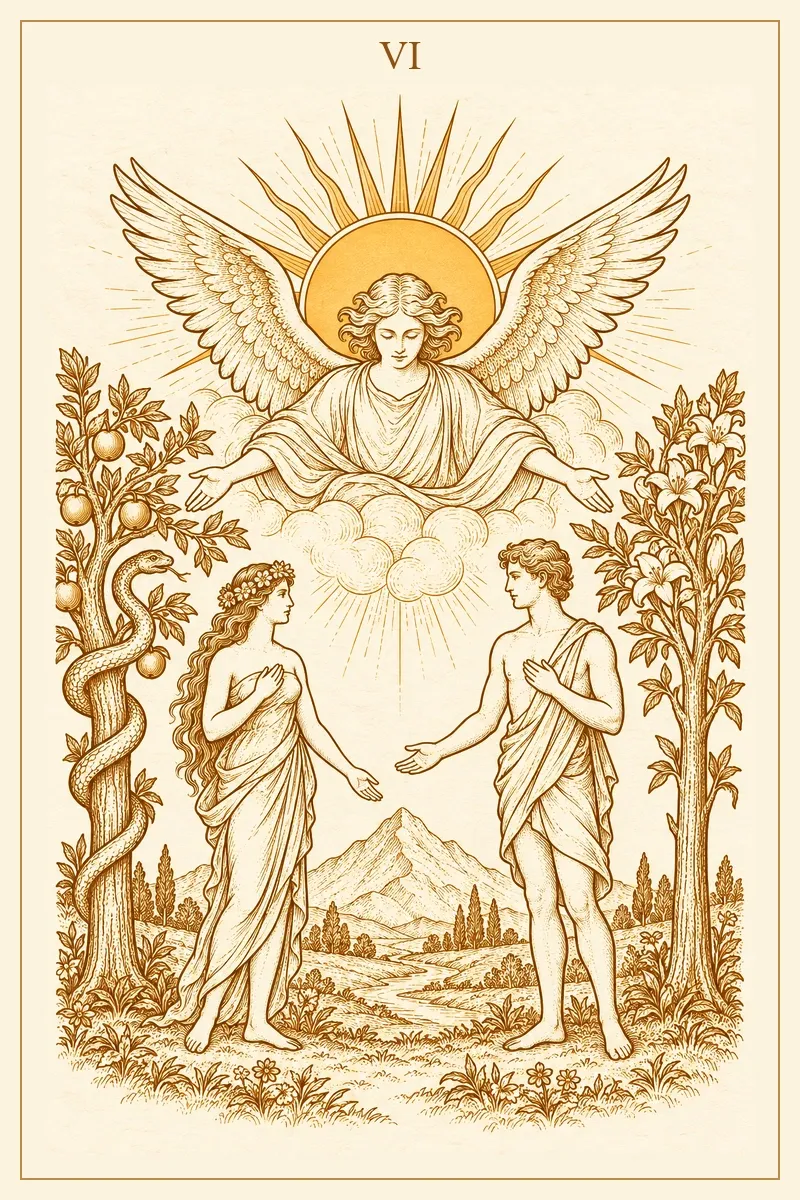
On The Lovers, a woman and a man stand on open ground beneath a winged figure set against a blazing sun. Each presses a palm to the heart and reaches the free hand toward the partner, though their fingers do not touch. Where the Two of Cups shows recognition, this major card adds a conscious choice grounded in values. The pair often describes attraction that is ready to become a commitment, such as agreeing to be exclusive or choosing each other after a period of doubt. The Lovers tarot meaning explains why that choice is about alignment as much as attraction. With The Lovers reversed, the feeling is mutual but you may want different things for now.
With the Ten of Cups: a bond growing toward home
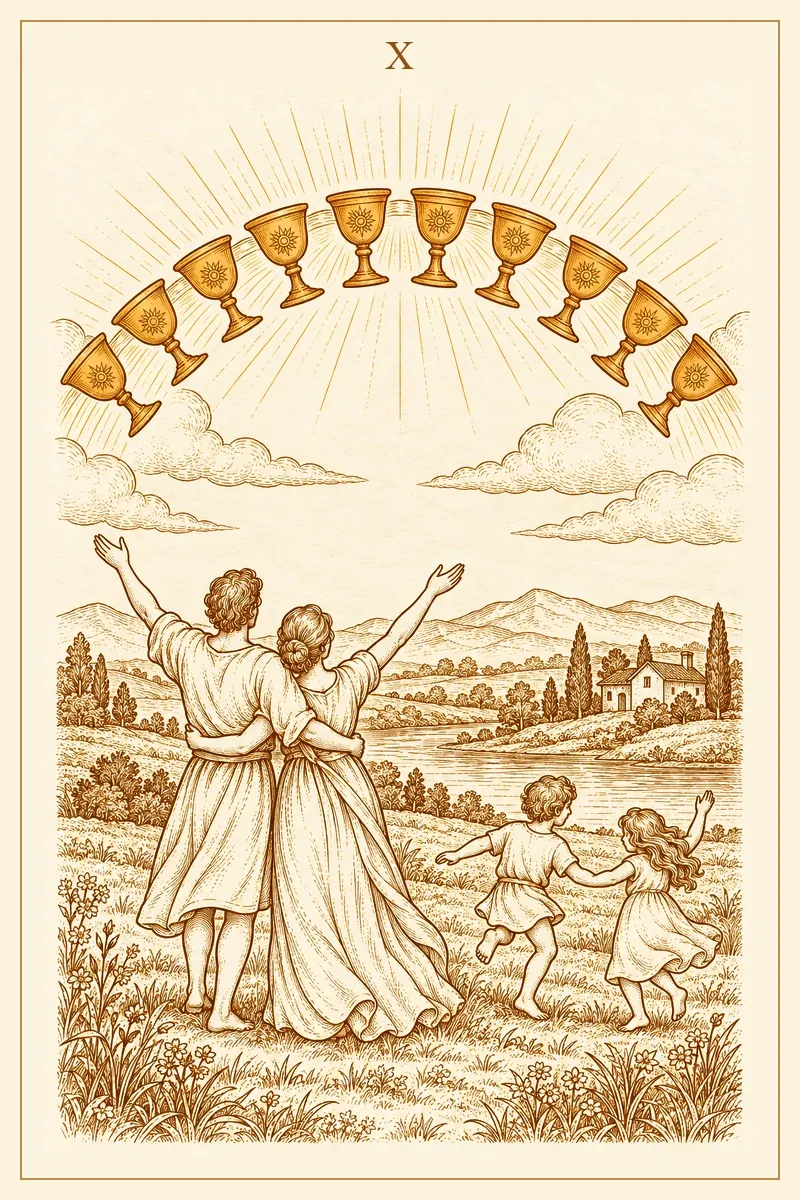
The Ten of Cups shows a couple from behind, arms around each other's waists and free arms raised toward an arc of ten golden cups across the sky, while two children dance beside them and a house sits among trees across the water. Next to the Two, it shows where a first exchange can lead: a shared home, family in whatever form you choose, and belonging that outlasts the early glow. The Ten of Cups meaning explores that long-term picture. The pair describes a direction, not a deadline.
With the Knight of Cups: an invitation on its way
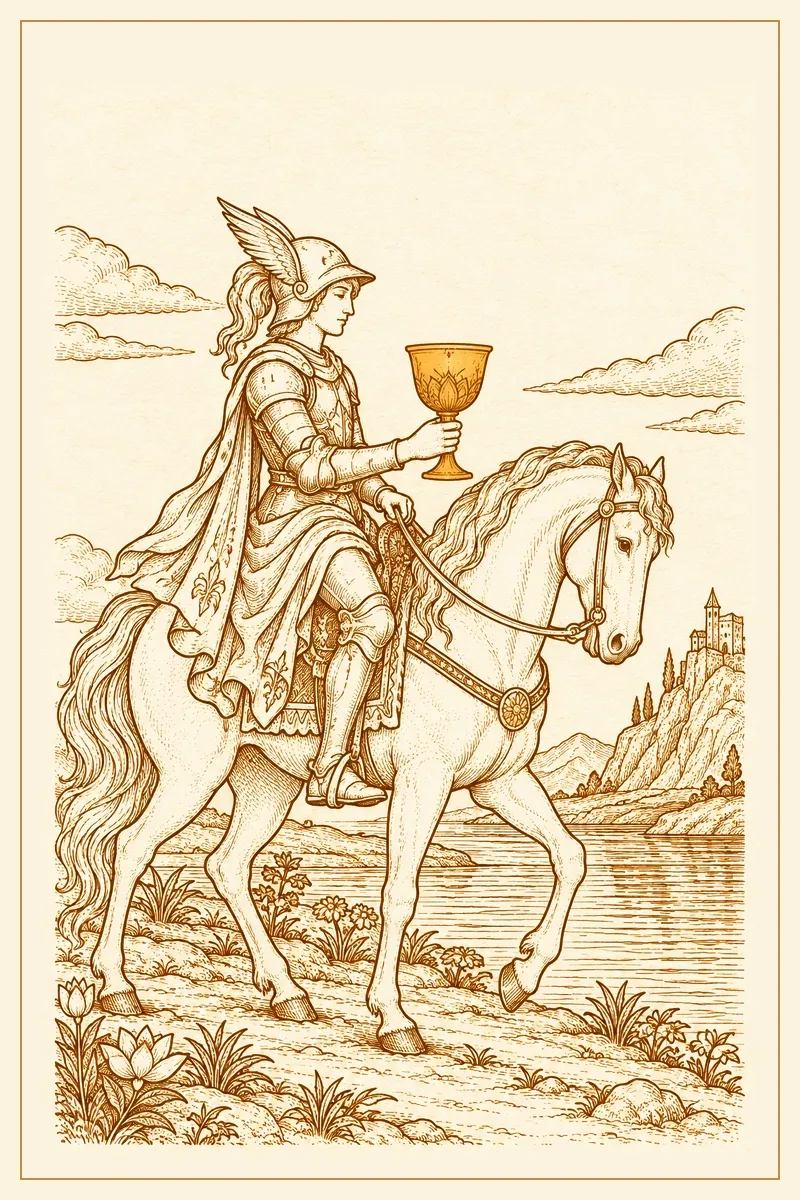
The Knight of Cups rides a pale horse at a walking pace along a riverbank, a winged helmet on his head and a goblet held out before him. He is the suit's romantic messenger. Beside the Two of Cups, he often suggests that someone is about to make their feelings known: a date proposed, a heartfelt message, a declaration. The Knight of Cups meaning also covers his shadow side, where charm runs ahead of follow-through, which is how he reads when reversed beside the Two.
Pairings that test or complicate the bond
Not every neighbor is gentle. These cards add history, pain or friction to the meeting of the cups.
With the Six of Cups: an old flame, or old memories?
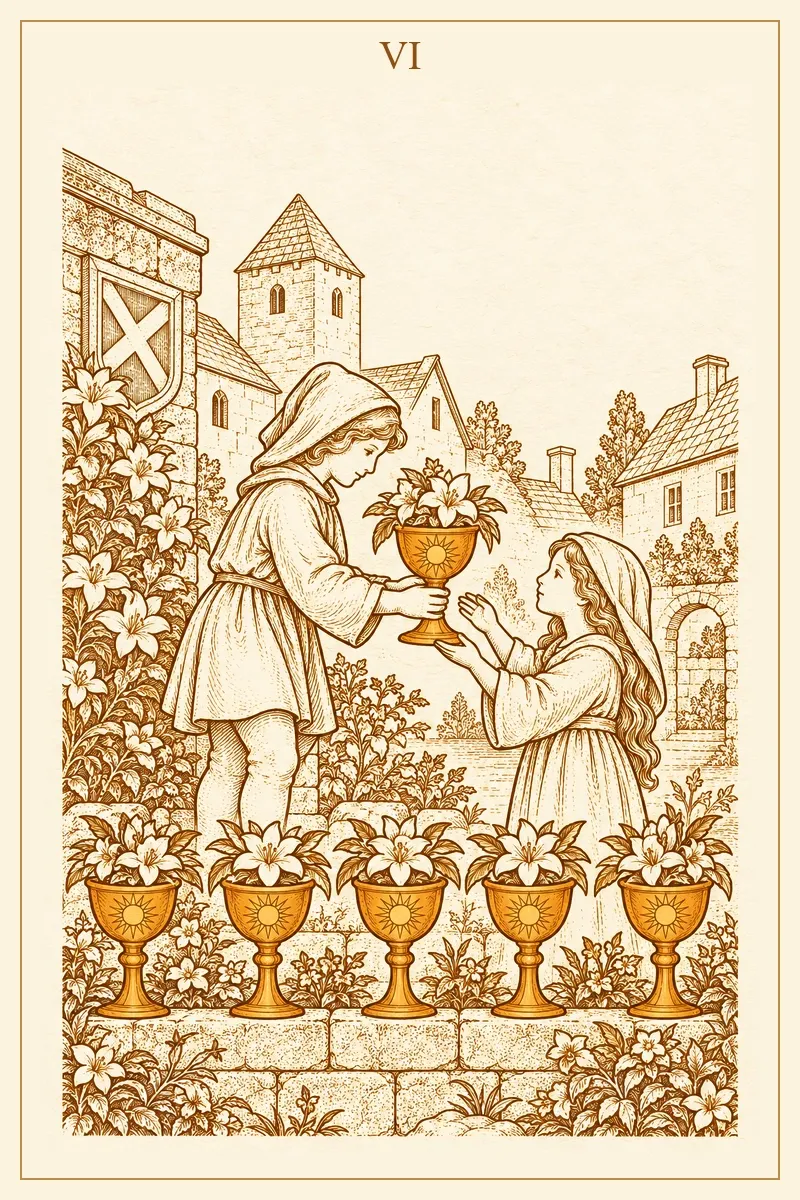
On the Six of Cups, a hooded boy hands a goblet full of white lilies to a small girl in a village garden, while five more cups of lilies stand along the low wall in front. With the Two of Cups, it often points to someone from your past: a first love, a former partner, a person you knew years ago. Ask whether you are drawn to the person as they are now, or to who you were with them. The Six of Cups meaning helps tell those two apart.
With the Three of Swords: hurt inside a real bond
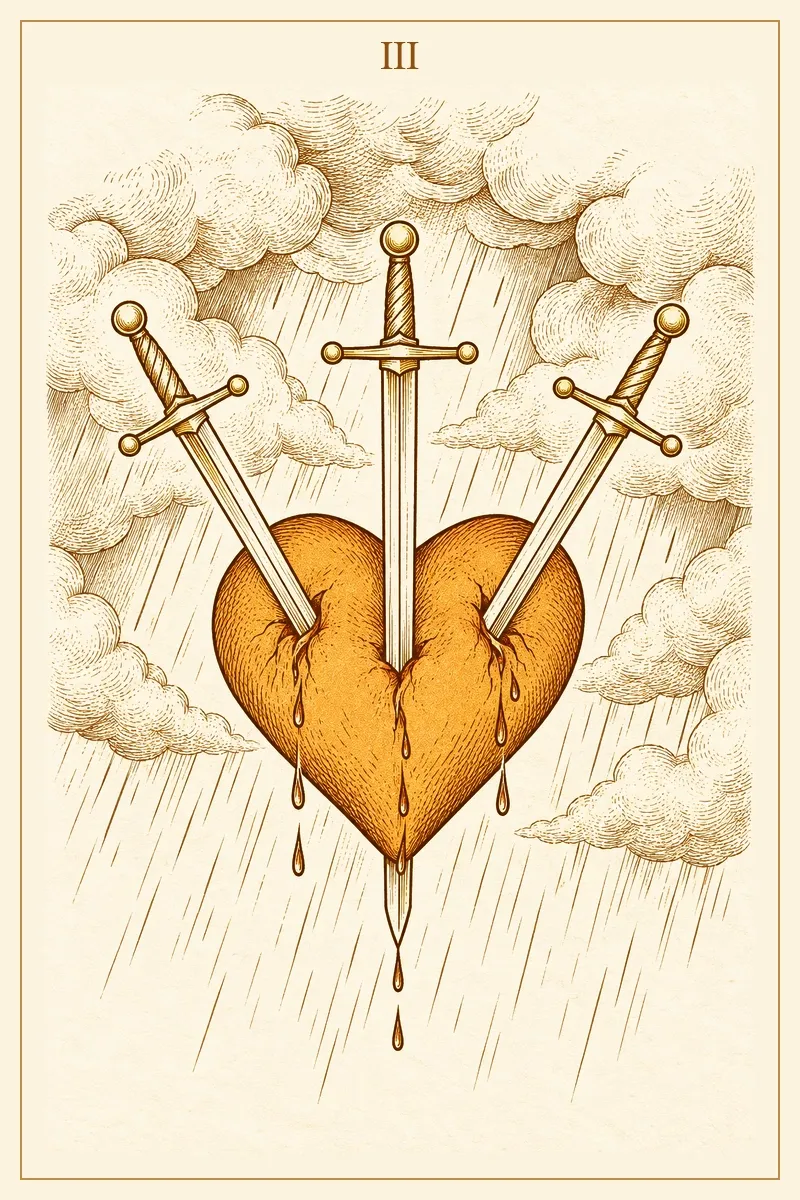
The Three of Swords shows a golden heart pierced by three swords under heavy clouds and slanting rain. Paired with the Two of Cups, it rarely cancels the connection. It says the bond is real and something has hurt it: a betrayal, a careless word, or grief one partner carries alone. Healing starts when the hurt is named rather than smoothed over, and the Three of Swords meaning looks at how to move through that pain. If the hurt is ongoing or deliberate, the Two's warmth does not outweigh it.
Other neighbors worth knowing
- The Hierophant: commitment that other people witness, such as a ceremony or being welcomed into each other's families.
- The Tower: a sudden truth that shakes the relationship's assumptions; what is mutual survives it, what was pretense does not.
- Page of Cups: a tender message, or a shy first sign of interest.
- Five of Cups: something lost or regretted fills the space where closeness used to be; grieve it together first.
- The Emperor: a check on equality, since one person may see a partnership of equals while the other expects to lead.
Three ways the card gets over-read in love
Treating recognition as destiny
It is tempting to hear "this is the one." People recognize each other far more often than they build lasting lives together, though. The card reports that recognition is happening now; whether it becomes a long relationship depends on what both of you do next.
Reading the start as the finish
After a run of disappointing dates, the card can feel like the end of the search. Yet the two figures stand on open ground with no home of their own behind them: a beginning that still needs time and trust.
Confusing it with The Lovers
Both cards show a pair, but they answer different questions. The Two of Cups is about mutual feeling and fair exchange; The Lovers is about a values-based choice, often with something given up. When both appear, read them as two stages, the feeling and then the decision.
The Meeting Point spread: five positions for a love question
This layout follows the picture: two cups, the space between them and the ground they stand on. Shuffle while thinking about one specific connection, then lay five cards in a row.
- My cup: what you are bringing to this connection right now, including hopes and habits.
- Their cup: what the other person offers, as far as their actions show it; behavior you can observe, not hidden thoughts.
- The space between: the current dynamic and how evenly the exchange is flowing.
- What tilts the balance: the habit, fear or circumstance pulling things out of level.
- The next even step: one action that would make the exchange fairer or more honest.
If you are single, rename position 2 "What I am looking for" and position 3 "How ready I am to receive it." When the Two of Cups itself lands in the spread, give that position extra weight, because it marks where mutuality is strongest.
A hypothetical reading: three months in, and only one of them says "we"
This example is invented to show how the spread works. Imagine Dana, three months into seeing someone. The dates are lovely, but Dana is the one who talks about "we" and "next month," while the other person keeps plans loose. Her question: "What does this connection need so it can grow evenly?"
My cup: Nine of Wands, upright. Dana arrives guarded and a little worn from an earlier relationship. Her constant planning is partly a way of staying in control.
Their cup: Page of Pentacles, upright. The other person shows care slowly and practically: arriving on time, remembering small details. The interest looks genuine, but it shows in deeds more than declarations.
The space between: Two of Cups, upright. At the center the connection is mutual. Both people are invested; they speak different emotional languages and move at different speeds.
What tilts the balance: Two of Swords, upright. A conversation is being avoided. Dana has never said directly what she wants, and the other person has never been asked.
The next even step: Three of Cups, upright. Bring the relationship into a wider life, perhaps by meeting each other's friends, and let the other person do some of the inviting.
Read together, the spread does not say whether this will last. It says the feeling is mutual, the imbalance is about pace and expression rather than interest, and the missing piece is one honest conversation. A sensible next step is for Dana to say, "I really like where this is going. How do you feel about it?" and then let the other person suggest the next plan; how they respond will tell her more than another spread could.
Small, even exchanges to try this week
- For one week, notice who starts conversations and who makes plans, without judging either of you.
- Say one true thing about how you feel, at its real size.
- Ask one question you usually avoid, and hear the whole answer before responding.
- Let the other person lead once: wait for them to suggest the next meeting.
- If you are single, spend time where conversation goes both ways, such as a class, a club or volunteering.
Frequently asked questions
Is the Two of Cups a soulmate card?
Many readers count it among soulmate cards because it shows deep mutual recognition. Treat "soulmate" as a description of how a connection feels, not a promise about its future.
Does the Two of Cups mean they love me?
It suggests mutual warmth in the connection as the reading shows it. Tarot cannot confirm another person's private feelings, predict a date or guarantee an outcome, so use the card to look at what is actually happening between you, and ask directly when the time feels right.
Can the Two of Cups appear when love is one-sided?
Upright, it seldom fits a one-sided situation. If it comes up during a crush that is not returned, check how the question was framed: the card may be describing a friendship, a different relationship, or the kind of bond you are now ready for.
I keep drawing the Two of Cups while single. What does that mean?
Often it reflects your readiness for a give-and-take relationship rather than an imminent arrival. It can also point to a friendship that already shows you what mutual care feels like.
Does the reversed Two of Cups mean a breakup?
Not on its own. It names an imbalance, a misunderstanding or a cooling, and many of these can be repaired when both people talk honestly. If other cards also point to an ending, treat that as a prompt for a serious conversation.
Is the Two of Cups good news for a long-distance relationship?
Upright, it says the emotional exchange is mutual even across the miles. The card supports the feeling; who travels and when you might share a city are for the two of you to settle.
Meeting halfway, again and again
At its healthiest, the love this card describes is an exchange both people keep choosing, one ordinary gesture at a time. Look at where your care is returned, where it is not, and what one honest step could change. When you want to ask about a connection of your own, a calm place to begin is a Veil Soul tarot reading.